


Exodus 4:24
- וַיְהִיvay·Hiand it wasH1961Conj-w ¦ V-Qal-ConsecImperf-3msVerb Qal Consecutive Imperfect 3rd Singular Masculineוַandיְהִיit was
- בַדֶּרֶךְva·De·rekhon the journeyH1870Prep-b ¦ N-csNoun Singular common gender Absoluteבַon theדֶּרֶךְjourney
- בַּמָּלוֹןba·ma·Lonat the lodging placeH4411Prep-b ¦ N-msNoun Singular Masculine Absoluteבַּat theמָּלוֹןlodging place
- וַיִּפְגְּשֵׁהוּvai·yif·ge·She·huand he met himH6298Conj-w ¦ V-Qal-ConsecImperf-3ms ¦ 3msVerb Qal Consecutive Imperfect 3rd Singular Masculineוַandיִּפְגְּשֵׁhe metהוּhim
- יְהוָהYah·wehYahwehH3068N-properNoun Proper Title
- וַיְבַקֵּשׁvay·va·Keshand he soughtH1245Conj-w ¦ V-Piel-ConsecImperf-3msVerb Piel Consecutive Imperfect 3rd Singular Masculineוַandיְבַקֵּשׁhe sought
- הֲמִיתוֹha·mi·Toto kill himH4191V-Hiphil-Inf ¦ 3msVerb Hiphil Infinitive Constructהֲמִיתto killוֹhim
English is a literal word-by-word gloss of the Hebrew, not the KJV's wording. Why?
This is the original text the KJV's translators worked from — each Hebrew word with its own literal English meaning in this verse, prepared by scholars at Tyndale House, Cambridge. The KJV translates whole sentences, not word by word, so its wording differs: one Hebrew word can become several English words, and the KJV may choose “the LORD” where the gloss reads “Yahweh”. Both are faithful — they answer different questions. For the KJV's own rendering, switch to the KJV text.
Details
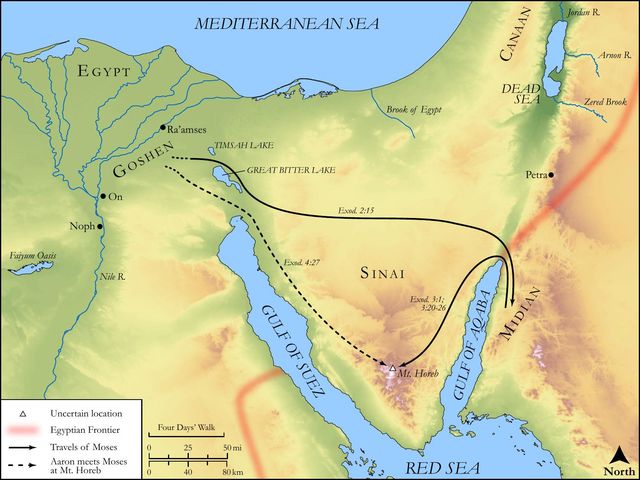
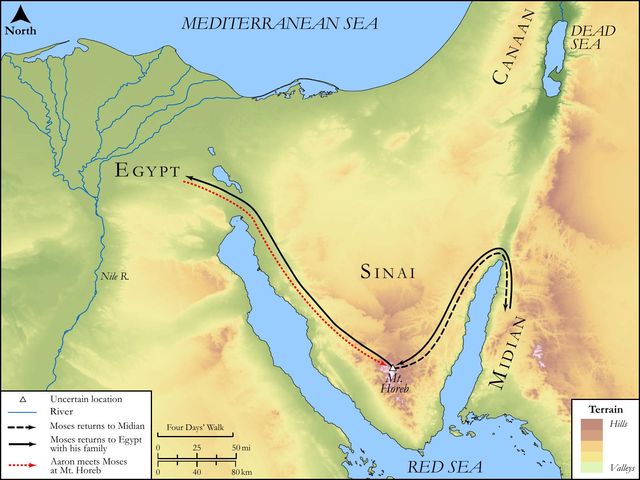
See on the biblical-era map

Study this verse
Public-domain commentary
Matthew Henry
From his Commentary on the Whole Bible. Henry comments on passages, not single verses — this entry covers Exodus 4:24–31. His three-level outline is real structure in the source text, so it is rendered as structure.
Moses is here going to Egypt, and we are told,
I.How God met him in anger, Exo 4:24-26.
This is a very difficult passage of story; much has been written, and excellently written, to make it intelligible; we will try to make it improving. Here is,
1.The sin of Moses, which was neglecting to circumcise his son. This was probably the effect of his being unequally yoked with a Midianite, who was too indulgent of her child, while Moses was too indulgent of her. Note,
(1.)We have need to watch carefully over our own hearts, lest fondness for any relation prevail above our love to God, and take us off from our duty to him. It is charged upon Eli that he honoured his sons more than God (Sa1 2:29); and see Mat 10:37.
(2.)Even good men are apt to cool in their zeal for God and duty when they have long been deprived of the society of the faithful: solitude has its advantages, but they seldom counterbalance the loss of Christian communion.
2.God's displeasure against him. He met him, and, probably by a sword in an angel's hand, sought to kill him. This was a great change; very lately God was conversing with him, and lodging a trust in him, as a friend; and now he is coming forth against him as an enemy. Note,
(1.)Omissions are sins, and must come into judgment, and particularly the contempt and neglect of the seals of the covenant; for it is a sign that we undervalue the promises of the covenant, and are displeased with the conditions of it. He that has made a bargain, and is not willing to seal and ratify it, one may justly suspect, neither likes it nor designs to stand to it.
(2.)God takes notice of, and is much displeased with, the sins of his own people. If they neglect their duty, let them expect to hear of it by their consciences, and perhaps to feel from it by cross providences: for this cause many are sick and weak, as some think Moses was here.
3.The speedy performance of the duty for the neglect of which God had now a controversy with him. His son must be circumcised; Moses is unable to circumcise him; therefore, in this case of necessity, Zipporah does it, whether with passionate words (expressing her dislike of the ordinance itself, or at least the administration of it to so young a child, and in a journey), as to me it seems, or with proper words - solemnly expressing the espousal of the child to God by the covenant of circumcision (as some read it) or her thankfulness to God for sparing her husband, giving him a new life, and thereby giving her, as it were, a new marriage to him, upon her circumcising her son (as others read it) - I cannot determine: but we learn,
(1.)That when God discovers to us what is amiss in our lives we must give all diligence to amend it speedily, and particularly return to the duties we have neglected.
(2.)The putting away of our sins is indispensably necessary to the removal of God's judgements. This is the voice of every rod, it calls to us to return to him that smites us.
4.The release of Moses thereupon: So he let him go; the distemper went off, the destroying angel withdrew, and all was well: only Zipporah cannot forget the fright she was in, but will unreasonably call Moses a bloody husband, because he obliged her to circumcise the child; and, upon this occasion (it is probable), he sent them back to his father-in-law, that they might not create him any further uneasiness. Note,
(1.)When we return to God in a way of duty he will return to us in a way of mercy; take away the cause, and the effect will cease.
(2.)We must resolve to bear it patiently, if our zeal for God and his institutions be misinterpreted and discouraged by some that should understand themselves, and us, and their duty, better, as David's zeal was misinterpreted by Michal; but if this be to be vile, if this be to be bloody, we must be yet more so.
(3.)When we have any special service to do for God we should remove as far from us as we can that which is likely to be our hindrance. Let the dead bury their dead, but follow thou me.
II.How Aaron met him in love, Exo 4:27, Exo 4:28.
1.God sent Aaron to meet him, and directed him where to find him, in the wilderness that lay towards Midian. Note, The providence of God is to be acknowledged in the comfortable meeting of relations and friends.
2.Aaron made so much haste, in obedience to his God, and in love to his brother, that he met him in the mount of God, the place where God had met with him.
3.They embraced one another with mutual endearments. The more they saw of God's immediate direction in bringing them together the more pleasant their interview was: they kissed, not only in token of brotherly affection, and in remembrance of ancient acquaintance, but as a pledge of their hearty concurrence in the work to which they were jointly called.
4.Moses informed his brother of the commission he had received, with all the instructions and credentials affixed to it, Exo 4:28. Note, What we know of God we should communicate for the benefit of others; and those that are fellow-servants to God in the same work should use a mutual freedom, and endeavour rightly and fully to understand one another.
III.How the elders of Israel met him in faith and obedience.
When Moses and Aaron first opened their commission in Egypt, said what they were ordered to say, and, to confirm it, did what they were ordered to do, they met with a better reception than they promised themselves, Exo 4:29-31. 1. The Israelites gave credit to them: The people believed, as God had foretold (Exo 3:18), knowing that no man could do those works that they did, unless God were with him. They gave glory to God: They bowed their heads and worshipped, therein expressing not only their humble thankfulness to God, who had raised them up and sent them a deliverer, but also their cheerful readiness to observe orders, and pursue the methods of their deliverance.
Historical interpretation
Fifteen Centuries of Reception
3 surviving comments on this verse. Each one is dated, so this reads as a timeline rather than a list.
Select a marker to jump to its quote. Markers stagger vertically where authors wrote within a few decades of each other.
We must also inquire who that being was of whom it is said in Exodus that he wished to kill Moses because he was setting out for Egypt. And afterwards, who is it that is called the “destroying angel,” and who also is he who in Leviticus is described as Apopompeus, that is, the Averter, of whom the Scripture speaks thus: “One lot for the Lord, and one lot for Apopompeus”?
We ask first, whom did the angel wish to kill? Was it Moses, because Scripture says, “The angel approached him and sought to kill him”? For whom will he be thought to have approached except him who was in charge of his entire people and by whom the others were led? Or did the angel seek to kill the boy, whom his mother aided by circumcising him? Then one would understand that the reason why God wished to kill the child was that he was not circumcised and thus sanctioned the precept of circumcision by the severity of the punishment. If this is the case, it is unclear of whom it was said previously, “he sought to kill him,” because we do not know who it was until we discover it from what follows. It is a remarkable and unusual expression to say “he approached him and sought to kill him” about someone who had not been mentioned before. But there is such a usage in a psalm: “Its foundations are on the holy mountains; the Lord loves the gates of Zion.” For the psalm begins at that point and had not said anything about the Lord or about that city whose foundations were meant to be understood when the psalm said, “Its foundations are on the holy mountains.” But because of what follows, “the Lord loves the gates of Zion,” the foundations, either those of the Lord or of Zion—“of Zion” yields the better sense—are understood as the foundation of a city. But the gender of this pronoun, “its,” is ambiguous, for it can be masculine, feminine or neuter. In Greek, however, the feminine is autēs, whereas the masculine and neuter are autou, and the Greek text has autou, so we must understand that the foundations are those not of Zion but of the Lord. That is, [they are] the foundations that the Lord constitutes, of which Scripture has said, “the Lord building Jerusalem.” But when the psalm said, “Its foundations are on the holy mountains,” it had not previously mentioned either Zion or the Lord. Here too it is said, “He met him and sought to kill him,” although the child had not yet been named, so that we do not know of whom he was speaking in the words that follow. But still, if someone wants to hold that Moses is meant, he should not be strongly opposed. We should rather understand what follows, if we can, what it means when the text says that the angel refrained from killing any of them because the woman said, “The blood of the infant’s circumcision has stopped flowing.” She does not say that “he drew back from him” because she circumcised the infant but that “the blood of circumcision stopped.” Not that it flowed but that it stopped—in a great mystery, if I am not wrong.
The Lord met him, and would have killed him: This was an angel representing the Lord, who treated Moses in this manner, for having neglected the circumcision of his younger son; which his wife understanding, circumcised her child upon the spot, upon which the angel let Moses go.
Continue studying Exodus 4:24 across the web’s major study libraries — every link below opens this exact verse, chapter, or book on the destination site.
Read & Compare
 BibleGatewayThis verse in more than 200 translations and 70 languages.
 Bible.comThe YouVersion reader — hundreds of translations, reading plans, and highlights.
 ESV.orgCrossway's official English Standard Version reader.
 NET BibleThe NET translation with 60,000+ translators' notes on every rendering decision.
 STEP BibleTyndale House's free study tool — original text, vocabulary, and scholarly resources.
 BibliaLogos Bible Software's free web reader.
 USCCBThe New American Bible (Revised Edition) with the U.S. bishops' study notes.
Commentaries
 BibleHub CommentariesDozens of classic commentaries on this verse, gathered on one page.
 StudyLightMore than 100 commentary sets — the largest collection on the web.
 BibleRefPlain-English commentary on what this verse means, verse by verse.
 Enduring WordDavid Guzik's free commentary on this chapter, widely used by Bible teachers.
 Bible Study ToolsVerse commentary alongside Greek and Hebrew study aids.
Original Language & Research
- BibleHub InterlinearThe verse word by word — original language, transliteration, and English.
- BibleHub LexiconEvery word's original-language definition and Strong's entry.
 Blue Letter BibleDeep-study tools — Strong's numbers, concordance, and word studies.
 SefariaThe Hebrew text with Rashi and centuries of Jewish commentary.
Sermons, Hymns & Audio


TrulyRandomVerse is not affiliated with these sites and doesn’t control their content. They’re linked because they’re genuinely useful.
Summary
Exodus 4:24 records a startling and terrifying encounter where the LORD confronts Moses during his journey back to Egypt, intending to take his life. This sudden divine intervention, occurring at a temporary lodging, serves as a stark revelation of God's absolute holiness and His unwavering demand for covenant obedience. It highlights that even God's chosen instruments are not exempt from His foundational commands, particularly concerning the circumcision of Moses' son, the neglect of which brought about this severe divine judgment.
Context
ShowHideLiterary Context
This dramatic incident immediately follows God's detailed commission to Moses at the burning bush in Exodus 3 and Exodus 4. Moses has overcome his initial reluctance, received miraculous signs, and is now returning to Egypt with his family, carrying the "rod of God" (Exodus 4:20). Just prior to this verse, God has delivered a chilling message for Pharaoh, warning that if he refuses to release Israel—God's "firstborn son"—then God will slay Pharaoh's own firstborn son (Exodus 4:22-23). This pronouncement of impending judgment on Egypt's firstborn sets a somber and serious tone, underscoring God's sovereign power and His readiness to execute judgment, which then unexpectedly turns upon Moses himself.
Historical & Cultural Context
The setting, "in the inn" (Hebrew: malon), refers to a temporary lodging place, often a caravanserai or a designated campsite along a travel route, rather than a modern hotel. Such places were common for travelers in the ancient Near East. The critical cultural element here is circumcision, the physical sign of the Abrahamic covenant. Instituted by God in Genesis 17, circumcision was a non-negotiable command for all male descendants of Abraham, to be performed on the eighth day. Its neglect was a profound act of disobedience, signifying a rejection of the covenant and rendering the uncircumcised individual "cut off from his people" (Genesis 17:14). This cultural and religious mandate forms the crucial backdrop for understanding God's severe reaction to Moses' oversight.
Key Themes
ShowHideThis passage powerfully contributes to several overarching themes in Exodus and the Pentateuch. It emphasizes God's holiness and sovereignty, demonstrating that He is not only the deliverer of His people but also the righteous judge who demands obedience from all, including His chosen leaders. The theme of covenant fidelity is paramount, as Moses' failure to circumcise his son represents a serious breach of the foundational covenant with Abraham. This incident also introduces the theme of divine judgment and mercy, showing God's readiness to execute judgment for disobedience, yet also providing a means of averting it through immediate obedience. Furthermore, it highlights the accountability of leadership, underscoring that those called to represent God must first ensure their own lives and households are in alignment with His commands.
Exposition and Analysis
ShowHideKey Word Analysis
ShowHideThis is the Tetragrammaton, the personal, covenantal name of God, revealing Him as the self-Existent, Eternal One. The use of this name here emphasizes that it is the covenant-keeping God, the one who called Moses and is about to deliver Israel, who confronts Moses, highlighting the seriousness of the covenant breach.
This primitive root means "to come in contact with, whether by accident or violence." In this context, it denotes a direct, intentional, and confrontational encounter. It's not a casual meeting but a divine intervention with a specific, forceful purpose.
This verb signifies a strong, active intention or desire. It means "to search out (by any method), to strive after, to require, to seek." When paired with "to kill," it indicates God's resolute and immediate intent to take Moses' life, not merely a fleeting thought or a passive observation.
Verse Breakdown
ShowHide"And it came to pass by the way in the inn"
This phrase sets the scene, indicating that the event occurred during Moses' journey back to Egypt, at a temporary lodging place. The mundane setting underscores the sudden and unexpected nature of God's intervention, demonstrating that divine judgment can manifest in ordinary circumstances when covenant obligations are neglected.
"that the LORD met him"
This clause reveals the direct and personal nature of the confrontation. It is not an indirect warning or a prophetic word, but the personal presence of the LORD Himself, engaging Moses in a terrifying encounter. The verb "met" implies a deliberate act of interception.
"and sought to kill him"
This is the shocking climax of the verse. The Creator of life, the God who has just commissioned Moses to deliver His people, actively intended to take Moses' life. This intent reveals the extreme gravity of the unstated offense, which the subsequent verse clarifies as the failure to circumcise his son. It underscores God's absolute holiness and His demand for strict obedience to His covenant commands, even from His chosen servant.
Literary Devices
ShowHideExodus 4:24 employs several powerful literary devices. The sudden and unexpected divine confrontation creates Suspense and Dramatic Irony, as the reader is left to wonder why God, who just called Moses to deliver His people, would now seek to kill him. This heightens the tension and emphasizes the severity of the undisclosed transgression. The phrase "sought to kill him" is a stark example of Anthropomorphism, attributing human-like intention and action to God, making His divine wrath tangible and immediate. Furthermore, the entire episode functions as Foreshadowing, subtly preparing the reader for the themes of divine judgment and the necessity of atonement that will pervade the Exodus narrative, particularly in the plagues against Egypt and the institution of the Passover, where the shedding of blood is crucial for deliverance.
Theological and Thematic Connections
ShowHideThis terrifying encounter profoundly underscores the non-negotiable nature of God's covenant requirements and the severe consequences of disobedience, even for those in high standing with God. It reveals God's absolute holiness and impartiality, demonstrating that no one is above His law. For Moses, called to lead Israel as God's covenant people, his personal failure to uphold the covenant in his own household was a profound contradiction that God could not overlook. This incident serves as a powerful reminder that true spiritual authority and effectiveness in God's service flow from personal integrity and obedience to His commands.
Reflection and Application
ShowHideExodus 4:24 serves as a profound and sobering reminder that no one, regardless of their calling, gifting, or intimate relationship with God, is above His commands. It underscores the vital importance of obedience, particularly concerning the foundational tenets of faith and covenant. For believers today, this passage emphasizes that our walk with God must be consistent with His will, not just in public service but also in our private lives and families. It highlights God's expectation that those who lead His people must first be obedient themselves, ensuring their own households are in order. This narrative also subtly points to the concept of God's discipline for those He loves, aiming to bring them back into alignment with His perfect will and prepare them for faithful, unhindered service. It challenges us to examine areas of our lives where we might be neglecting clear biblical commands, reminding us that God's holiness demands our full and consistent obedience.
Questions for Reflection
ShowHideFAQ
ShowHideWhy would God try to kill Moses, His chosen leader?
ShowHideGod's intent to kill Moses was a direct consequence of Moses' failure to circumcise his son, a foundational command of the Abrahamic covenant. This act of disobedience was a serious breach of covenant fidelity, especially for someone called to lead God's people in upholding that very covenant. God's action underscores His absolute holiness and the non-negotiable nature of His commands, demonstrating that even His most favored servants are not exempt from accountability. It was a severe form of divine discipline, designed to bring Moses into immediate compliance with a command essential for his role as covenant mediator.
What was the significance of circumcision in this event?
ShowHideCircumcision was the physical sign of the covenant God made with Abraham and his descendants (Genesis 17:10-14). It symbolized inclusion in God's chosen people and commitment to His covenant. Moses' failure to circumcise his son was a direct act of disobedience to this foundational command, effectively placing his son, and by extension, his household, outside the visible sign of the covenant. This was a critical failure for the man chosen to lead God's covenant people. Zipporah's swift action to perform the circumcision averted God's judgment, highlighting the critical importance of this covenant sign and the principle that obedience, even through the shedding of blood, was necessary to satisfy God's righteous demands.
Christ-Centered Fulfillment
ShowHideWhile Exodus 4:24 reveals God's severe judgment against covenant disobedience and the necessity of blood for atonement, it ultimately points forward to the perfect and ultimate fulfillment found in Jesus Christ. The blood of circumcision, a temporary and symbolic act of covenant initiation and purification, foreshadows the superior and once-for-all atonement provided by the blood of Jesus. Unlike the Old Covenant demands that even Moses, the great lawgiver, struggled to perfectly uphold, Christ perfectly fulfilled all righteousness (Matthew 3:15) and bore the full weight of God's judgment for sin on the cross (2 Corinthians 5:21). Through His sacrifice, believers are spiritually circumcised of heart by the Spirit, not by a physical cutting, but by the putting off of the body of the flesh (Colossians 2:11). We enter a New Covenant relationship with God, not through adherence to outward signs, but by faith in Christ's completed work, where God's justice is fully satisfied and His mercy eternally extended to all who believe (Romans 3:25-26). Moses' near-death experience underscores the deadly seriousness of sin and the absolute necessity of a blood atonement, ultimately finding its complete and final resolution in the Lamb of God who takes away the sin of the world (John 1:29).