


Exodus 4:25
Bible text: King James Version (1769 Blayney text) · Public domain
Bible text: Berean Standard Bible · Public domain
Bible text: American Standard Version (1901) · Public domain
Bible text: World English Bible, Messianic edition · Public domain
Bible text: Geneva Bible (1599) · Public domain
Bible text: Young's Literal Translation · Public domain
- וַתִּקַּחva·ti·Kachand she tookH3947Conj-w ¦ V-Qal-ConsecImperf-3fsVerb Qal Consecutive Imperfect 3rd Singular Feminineוַandתִּקַּחshe took
- צִפֹּרָהtzi·po·RahZipporahH6855N-proper-fNoun Proper Feminine
- צֹרTzora flintH6864N-msNoun Singular Masculine Absolute
- וַתִּכְרֹתva·tikh·Rotand she cut offH3772Conj-w ¦ V-Qal-ConsecImperf-3fsVerb Qal Consecutive Imperfect 3rd Singular Feminineוַandתִּכְרֹתshe cut off
- אֶת'et<obj.>H853DirObjMParticle Object Indicator
- עָרְלַת'a·re·Lat[the] foreskin ofH6190N-fscNoun Singular Feminine Construct
- בְּנָהּbe·Nahher sonH1121N-msc ¦ 3fsNoun Singular Masculine Constructבְּנָsonהּher
- וַתַּגַּעva·ta·Ga'and she made [it] touchH5060Conj-w ¦ V-Hiphil-ConsecImperf-3fsVerb Hiphil Consecutive Imperfect 3rd Singular Feminineוַandתַּגַּעshe made [it] touch
- לְרַגְלָיוle·rag·Lav<to> his feetH7272Prep-l ¦ N-fdc ¦ 3msNoun Dual Feminine Constructלְ<to>רַגְלָיfeetוhis
- וַתֹּאמֶרva·To·merand she saidH559Conj-w ¦ V-Qal-ConsecImperf-3fsVerb Qal Consecutive Imperfect 3rd Singular Feminineוַandתֹּאמֶרshe said
- כִּיkithatH3588PrtParticle Conditional
- חֲתַןcha·tan[are] a bridegroom ofH2860N-mscNoun Singular Masculine Construct
- דָּמִיםda·Mimblood<s>H1818N-mpNoun Plural Masculine Absolute
- אַתָּה'a·TahyouH859Pro-2msPronoun Personal 2nd Singular Masculine
- לִיLito <the> mePrep-l ¦ 1csSuffix Personal 1st Singular common genderלִto <the>יme
English is a literal word-by-word gloss of the Hebrew, not the KJV's wording. Why?
This is the original text the KJV's translators worked from — each Hebrew word with its own literal English meaning in this verse, prepared by scholars at Tyndale House, Cambridge. The KJV translates whole sentences, not word by word, so its wording differs: one Hebrew word can become several English words, and the KJV may choose “the LORD” where the gloss reads “Yahweh”. Both are faithful — they answer different questions. For the KJV's own rendering, switch to the KJV text.
Details
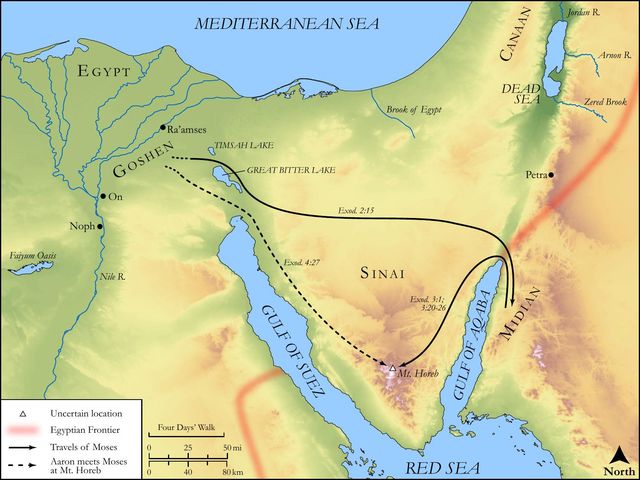
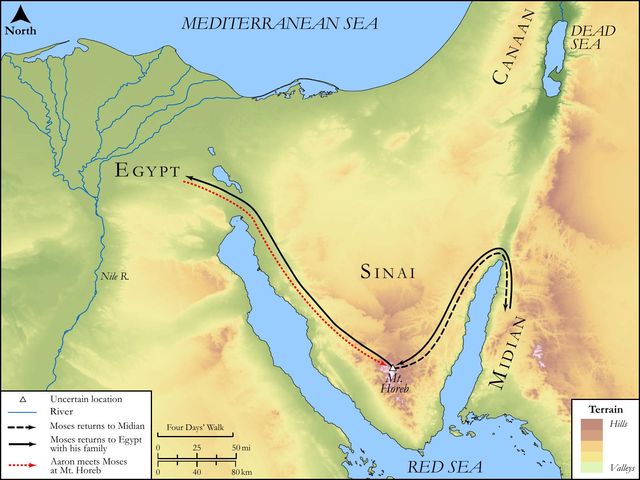
See on the biblical-era maps

Study this verse
Public-domain commentary
Matthew Henry
From his Commentary on the Whole Bible. Henry comments on passages, not single verses — this entry covers Exodus 4:24–31. His three-level outline is real structure in the source text, so it is rendered as structure.
Moses is here going to Egypt, and we are told,
I.How God met him in anger, Exo 4:24-26.
This is a very difficult passage of story; much has been written, and excellently written, to make it intelligible; we will try to make it improving. Here is,
1.The sin of Moses, which was neglecting to circumcise his son. This was probably the effect of his being unequally yoked with a Midianite, who was too indulgent of her child, while Moses was too indulgent of her. Note,
(1.)We have need to watch carefully over our own hearts, lest fondness for any relation prevail above our love to God, and take us off from our duty to him. It is charged upon Eli that he honoured his sons more than God (Sa1 2:29); and see Mat 10:37.
(2.)Even good men are apt to cool in their zeal for God and duty when they have long been deprived of the society of the faithful: solitude has its advantages, but they seldom counterbalance the loss of Christian communion.
2.God's displeasure against him. He met him, and, probably by a sword in an angel's hand, sought to kill him. This was a great change; very lately God was conversing with him, and lodging a trust in him, as a friend; and now he is coming forth against him as an enemy. Note,
(1.)Omissions are sins, and must come into judgment, and particularly the contempt and neglect of the seals of the covenant; for it is a sign that we undervalue the promises of the covenant, and are displeased with the conditions of it. He that has made a bargain, and is not willing to seal and ratify it, one may justly suspect, neither likes it nor designs to stand to it.
(2.)God takes notice of, and is much displeased with, the sins of his own people. If they neglect their duty, let them expect to hear of it by their consciences, and perhaps to feel from it by cross providences: for this cause many are sick and weak, as some think Moses was here.
3.The speedy performance of the duty for the neglect of which God had now a controversy with him. His son must be circumcised; Moses is unable to circumcise him; therefore, in this case of necessity, Zipporah does it, whether with passionate words (expressing her dislike of the ordinance itself, or at least the administration of it to so young a child, and in a journey), as to me it seems, or with proper words - solemnly expressing the espousal of the child to God by the covenant of circumcision (as some read it) or her thankfulness to God for sparing her husband, giving him a new life, and thereby giving her, as it were, a new marriage to him, upon her circumcising her son (as others read it) - I cannot determine: but we learn,
(1.)That when God discovers to us what is amiss in our lives we must give all diligence to amend it speedily, and particularly return to the duties we have neglected.
(2.)The putting away of our sins is indispensably necessary to the removal of God's judgements. This is the voice of every rod, it calls to us to return to him that smites us.
4.The release of Moses thereupon: So he let him go; the distemper went off, the destroying angel withdrew, and all was well: only Zipporah cannot forget the fright she was in, but will unreasonably call Moses a bloody husband, because he obliged her to circumcise the child; and, upon this occasion (it is probable), he sent them back to his father-in-law, that they might not create him any further uneasiness. Note,
(1.)When we return to God in a way of duty he will return to us in a way of mercy; take away the cause, and the effect will cease.
(2.)We must resolve to bear it patiently, if our zeal for God and his institutions be misinterpreted and discouraged by some that should understand themselves, and us, and their duty, better, as David's zeal was misinterpreted by Michal; but if this be to be vile, if this be to be bloody, we must be yet more so.
(3.)When we have any special service to do for God we should remove as far from us as we can that which is likely to be our hindrance. Let the dead bury their dead, but follow thou me.
II.How Aaron met him in love, Exo 4:27, Exo 4:28.
1.God sent Aaron to meet him, and directed him where to find him, in the wilderness that lay towards Midian. Note, The providence of God is to be acknowledged in the comfortable meeting of relations and friends.
2.Aaron made so much haste, in obedience to his God, and in love to his brother, that he met him in the mount of God, the place where God had met with him.
3.They embraced one another with mutual endearments. The more they saw of God's immediate direction in bringing them together the more pleasant their interview was: they kissed, not only in token of brotherly affection, and in remembrance of ancient acquaintance, but as a pledge of their hearty concurrence in the work to which they were jointly called.
4.Moses informed his brother of the commission he had received, with all the instructions and credentials affixed to it, Exo 4:28. Note, What we know of God we should communicate for the benefit of others; and those that are fellow-servants to God in the same work should use a mutual freedom, and endeavour rightly and fully to understand one another.
III.How the elders of Israel met him in faith and obedience.
When Moses and Aaron first opened their commission in Egypt, said what they were ordered to say, and, to confirm it, did what they were ordered to do, they met with a better reception than they promised themselves, Exo 4:29-31. 1. The Israelites gave credit to them: The people believed, as God had foretold (Exo 3:18), knowing that no man could do those works that they did, unless God were with him. They gave glory to God: They bowed their heads and worshipped, therein expressing not only their humble thankfulness to God, who had raised them up and sent them a deliverer, but also their cheerful readiness to observe orders, and pursue the methods of their deliverance.
Historical interpretation
Historical reception
5 surviving comments on this verse. Each one is dated, so this reads as a timeline rather than a list.
Select a marker to jump to its quote. Markers stagger vertically where authors wrote within a few decades of each other.
At the place where they were spending the night, the Lord came upon Moses and wanted to kill him, because he had discontinued circumcision in Midian for one of his sons who had not been circumcised. From the day [the Lord] spoke with him on Horeb, he had not been united to his wife, who was distressed; and she was under judgment because she had not put full faith in his word. [Moses] blamed her for keeping his son from being circumcised. They spent the night [preoccupied] with these thoughts. Suddenly an angel appeared for both of these reasons, while seeming to appear only because of circumcision.[The angel] appeared to Moses in anger so that his departure [from Midian] would not be ridiculed because he had discontinued circumcision without necessity, while the Hebrews had not interrupted it in spite of the death of their children. Now whom should he have feared, God, who prescribed circumcision, or his wife, who had stood in the way of circumcision?
When Moses’ wife saw that he was about to die because she had stood in the way of circumcision, about which and on account of which he had argued with her that evening, “she took a piece of flint” and, still trembling from the vision of the angel, “circumcised her son,” letting him be spattered with his [own] blood. Then she held the angel’s feet and said, “I have a husband of blood. Do not cause suffering on the day of the celebration of circumcision.” Because there was great joy on the day Abraham circumcised Isaac, she said, “I too have a husband of blood. If you do not [refrain from harm] on account of me, who circumcised my son with my own hands, or on account of Moses, refrain on account of the commandment of circumcision itself which has been observed.”
As regards Moses, it is clear that he would have been in peril at the inn, if Zipporah, which is by interpretation “a bird,” had not circumcised her son and cut off the foreskin of marriage with the knife which prefigured the gospel.
And this was made manifest by the message of an angel in the case of Moses’ son, for when he was carried by his mother, being yet uncircumcised, it was required, by manifest present peril, that he should be circumcised. And when this was done, the danger of death was removed. As therefore in Abraham the justification of faith came first and circumcision was added afterwards as the seal of faith, so in Cornelius the spiritual sanctification came first in the gift of the Holy Spirit. And the sacrament of regeneration was added afterward in the laver of baptism.
If I had been a Jew in the times of the ancient people, when there was nothing better to be, I would surely have accepted circumcision. That “seal of the justice of the faith” had so much power at that time, before it was rendered void by the coming of the Lord, that the angel would have strangled the infant son of Moses if his mother had not taken up a stone and circumcised the child and thus by this sacrament warded off his imminent destruction. This sacrament even tamed the river Jordan and reduced it to a brook. The Lord himself received this sacrament after birth, although on the cross he made it void.
Christ was the rock whence was formed the stony blade for the circumcision, and the flesh of the foreskin was the body of sin.
Continue studying Exodus 4:25 across the web’s major study libraries — every link below opens this exact verse, chapter, or book on the destination site.
Read & Compare
 BibleGatewayThis verse in more than 200 translations and 70 languages.
 Bible.comThe YouVersion reader — hundreds of translations, reading plans, and highlights.
 ESV.orgCrossway's official English Standard Version reader.
 NET BibleThe NET translation with 60,000+ translators' notes on every rendering decision.
 STEP BibleTyndale House's free study tool — original text, vocabulary, and scholarly resources.
 BibliaLogos Bible Software's free web reader.
 USCCBThe New American Bible (Revised Edition) with the U.S. bishops' study notes.
Commentaries
 BibleHub CommentariesDozens of classic commentaries on this verse, gathered on one page.
 StudyLightMore than 100 commentary sets — the largest collection on the web.
 BibleRefPlain-English commentary on what this verse means, verse by verse.
 Enduring WordDavid Guzik's free commentary on this chapter, widely used by Bible teachers.
 Bible Study ToolsVerse commentary alongside Greek and Hebrew study aids.
Original Language & Research
- BibleHub InterlinearThe verse word by word — original language, transliteration, and English.
- BibleHub LexiconEvery word's original-language definition and Strong's entry.
 Blue Letter BibleDeep-study tools — Strong's numbers, concordance, and word studies.
 SefariaThe Hebrew text with Rashi and centuries of Jewish commentary.
Sermons, Hymns & Audio


TrulyRandomVerse is not affiliated with these sites and doesn’t control their content. They’re linked because they’re genuinely useful.
Summary
Exodus 4:25 vividly portrays Zipporah's swift and decisive intervention to circumcise her son, averting a divine threat against Moses' life. This pivotal, dramatic moment profoundly underscores the absolute sanctity of covenant obedience, God's unwavering holiness, and the severe consequences of neglecting His commands, even for His chosen leaders. It highlights the profound seriousness with which the Abrahamic covenant's foundational sign was regarded and the immediate efficacy of obedience in appeasing divine wrath.
Context
ShowHideLiterary Context
This intense episode immediately follows God's dramatic commission of Moses at the burning bush and Moses' journey back to Egypt with his family. Specifically, it is a direct consequence of the preceding verse, Exodus 4:24, where "the Lord met him and sought to put him to death." The abruptness and severity of God's action in Exodus 4:24-26 interrupt the narrative flow of Moses' return to Egypt, emphasizing the critical nature of the neglected covenant obligation. Zipporah's quick, decisive action serves as the immediate resolution to this divine confrontation, allowing Moses to proceed with his divine mission.
Historical & Cultural Context
Circumcision was a widespread practice among the nations round about, Egypt among them, often signifying tribal identity, purification, or rites of passage. However, for Israel, it carried unique theological weight as the foundational sign of the covenant God established with Abraham. It marked the male descendants of Abraham as God's chosen people, symbolizing their inclusion in the covenant community and their commitment to God's commands. Neglecting this rite was a profound act of disobedience and a rejection of the covenant relationship. The use of a "sharp stone" (flint knife) for the circumcision was a common and ancient practice, predating metal tools for such rituals, and is mentioned elsewhere in scripture (e.g., Joshua 5:2).
Key Themes
ShowHideThis passage powerfully contributes to several overarching themes in Exodus and the broader Pentateuch. It highlights the theme of Divine Holiness and Judgment, demonstrating God's absolute intolerance for disobedience, especially concerning His covenant. Even Moses, the chosen deliverer, is not exempt from God's righteous standards. It underscores the theme of Covenant Obedience, emphasizing that faithfulness to God's commands is paramount for maintaining a right relationship with Him. Furthermore, the shedding of blood to avert wrath introduces the theme of Atonement and Redemption, foreshadowing the necessity of blood sacrifice for appeasement and reconciliation, a concept that will be extensively developed throughout the Mosaic Law and ultimately fulfilled in Christ.
Exposition and Analysis
ShowHideKey Word Analysis
ShowHideThis primitive root means "to cut (off, down or asunder); by implication, to destroy or consume; specifically, to covenant (i.e. make an alliance or bargain, originally by cutting flesh and passing between the pieces)." In this context, Zipporah's action is a literal cutting, but it carries the profound implication of establishing or restoring a covenant relationship. The act of cutting off the foreskin is a physical manifestation of entering into or re-affirming the covenant with God, contrasting with the destructive implication of the root when God "cuts off" a disobedient person from the community.
This term specifically refers to the prepuce, the part of the male anatomy removed in circumcision. In a broader sense, it can metaphorically refer to anything that is "uncircumcised" or impure, such as "uncircumcised lips" (Exodus 6:12) or an "uncircumcised heart" (Leviticus 26:41). Here, its removal signifies purification, dedication, and inclusion into the covenant people, making its absence a grave spiritual deficiency for Moses' son.
The phrase "bloody husband" (or "bridegroom of blood") is a highly debated and enigmatic declaration. dâm refers to "blood (as that which when shed causes death)," often associated with life, atonement, or guilt. châthân denotes "a relative by marriage (especially through the bride); figuratively, a circumcised child (as a species of religious espousal); bridegroom, husband, son in law." Zipporah's statement likely signifies that Moses, or perhaps her son, has now entered into a covenant relationship through the shedding of blood, making him a "husband" or "bridegroom" by virtue of this bloody rite. The blood shed in circumcision has, in this unique context, served as a means of appeasement and covenant ratification, securing Moses' life and his family's place within God's covenant.
Verse Breakdown
ShowHide"Then Zipporah took a sharp stone, and cut off the foreskin of her son,"
Faced with an immediate, life-threatening divine encounter, Zipporah, a Midianite woman, demonstrates remarkable spiritual discernment and decisive action. She quickly identifies the cause of God's wrath—Moses' neglect of his son's circumcision—and takes the initiative. The "sharp stone" (likely flint) underscores the ancient nature of the ritual and the urgency of her response, as she performs a painful and bloody act that was traditionally the father's responsibility.
"and cast [it] at his feet,"
This action of casting the foreskin at Moses' feet is symbolic and impactful. It could signify a dramatic gesture of accusation, showing Moses the consequence of his neglect, or an act of dedication, presenting the blood-stained evidence of the covenant's fulfillment. Some scholars interpret it as a ritualistic act to symbolically "touch" or "appease" the divine presence that was threatening Moses, using the very sign of the covenant as a means of reconciliation.
"and said, Surely a bloody husband [art] thou to me."
This enigmatic declaration is the climax of the verse. While its precise meaning is debated, it powerfully conveys the re-establishment of a covenant relationship through bloodshed. It likely means that Moses (or perhaps the son, through whom Moses is connected to the covenant) has been "married" or bound to God's covenant through this bloody rite. The shedding of blood in this context is not merely a physical act but a spiritual one, averting divine judgment and restoring the covenant bond, making Moses (and his family) acceptable in God's sight.
Literary Devices
ShowHideExodus 4:25 is rich in Symbolism. The "sharp stone" symbolizes both the primitive nature of the ritual and the painful, cutting truth of covenant demands. The "foreskin" itself is a potent symbol of the flesh, unholiness, and exclusion, while its removal symbolizes purification, dedication, and inclusion into God's covenant people. The "blood" shed is the most powerful symbol, representing life, atonement, and the means by which a covenant is ratified or re-established. There is also a strong element of Dramatic Irony or Situational Irony in this passage: Moses, chosen by God to lead Israel out of bondage and into covenant relationship, himself stands in violation of that very covenant and requires a dramatic intervention to save his own life. The passage also serves as a subtle Foreshadowing of the broader biblical theme that the shedding of blood is necessary for atonement and the establishment of a covenant, pointing ultimately to the sacrificial system and Christ's ultimate sacrifice.
Theological and Thematic Connections
ShowHideThis passage profoundly illustrates God's unyielding commitment to His covenant and His absolute holiness, demanding obedience even from His chosen instruments. The immediate threat to Moses' life underscores that no one, regardless of their calling or proximity to God, is exempt from the requirements of His law and covenant. God's character is revealed as one who upholds His standards with unwavering integrity, demonstrating that a breach of covenant, especially one as foundational as circumcision, carries severe consequences. This dramatic intervention also highlights the concept of substitutionary atonement, where the shedding of blood (in this case, the son's) averts wrath from another (Moses), foreshadowing the ultimate divine provision for sin.
Reflection and Application
ShowHideExodus 4:25 serves as a potent and challenging reminder for believers today. It strips away any notion that our calling, spiritual gifts, or even a close relationship with God exempts us from the fundamental requirement of obedience to His revealed will. Moses, the very deliverer of Israel, faced divine judgment for neglecting a foundational covenant command, emphasizing that God's holiness demands faithfulness from all. This passage calls us to examine our own lives: Are there areas of disobedience, subtle or overt, that we have neglected? Are we truly committed to walking in accordance with God's commands, or do we rationalize our shortcomings? Furthermore, Zipporah's courageous and immediate action in the face of spiritual crisis provides a powerful example of decisive faith. Her timely obedience averted disaster, demonstrating that humble and swift alignment with God's will can restore relationship and avert spiritual peril. We are called to be vigilant, discerning, and obedient, trusting that God's commands are for our good and that His holiness requires our full devotion.
Questions for Reflection
ShowHideFAQ
ShowHideWhat is the significance of Zipporah's statement, 'Surely a bloody husband art thou to me'?
ShowHideThe Hebrew phrase chatan damim (חתן דמים) is one of the most debated and enigmatic statements in the Old Testament, literally translating to "a bridegroom of blood" or "a husband of blood." Interpretations vary widely but generally center on the idea of a covenant established or re-established through the shedding of blood. Some scholars suggest Zipporah is declaring that Moses is now truly her "husband by means of blood," having been saved from death by this bloody covenant act. Others propose it refers to the son, who, through the shedding of his blood, became a "bridegroom" to the covenant, thereby connecting his father to it and securing his life. Still others see it as an exclamation from Zipporah expressing a mix of disgust, relief, or even a ritualistic declaration of the severity and necessity of the act. Regardless of the precise nuance, the phrase powerfully signifies the re-establishment of the covenant relationship and the appeasement of divine wrath through the shedding of blood.
Why was circumcision so crucial that its neglect threatened Moses' life?
ShowHideCircumcision was far more than a mere ritual; it was the foundational and non-negotiable sign of God's covenant with Abraham, symbolizing inclusion in God's chosen people and a commitment to His commands. God explicitly stated that any male who was not circumcised would be "cut off from his people; he hath broken my covenant" (Genesis 17:14). For Moses, as God's chosen deliverer and the one commissioned to lead Israel in covenant faithfulness, neglecting this foundational sign was a profound act of unfaithfulness and a direct breach of the very covenant he was meant to uphold. God's absolute holiness demands obedience, and a breach of such a significant covenant sign was met with severe divine displeasure, emphasizing that even leaders must adhere to God's established requirements.
Christ-Centered Fulfillment
ShowHideExodus 4:25, with its dramatic portrayal of blood-shedding to avert divine wrath and restore a covenant relationship, powerfully foreshadows the ultimate atonement found in Jesus Christ. While Zipporah's act involved the physical blood of a son to appease immediate judgment and fulfill a sign of the Old Covenant, Christ's perfect sacrifice on the cross shed His own divine blood, establishing a new and eternal covenant that provides complete and final redemption for all who believe. The physical circumcision, a sign of the Old Covenant that marked a people set apart, finds its spiritual fulfillment in Christ, who performs a "circumcision made without hands" (Colossians 2:11-12), circumcising the heart and bringing true inclusion into God's people through faith, not ritual. Where Moses, the great law-giver and deliverer, faltered in covenant obedience and required a bloody intervention to save his life, Christ perfectly fulfilled all righteousness, becoming the "bloody husband" who secures our salvation and eternal life not through a ritualistic cutting, but through His own lifeblood poured out on the cross, reconciling us fully to God.