


Genesis 17:14
Bible text: King James Version (1769 Blayney text) · Public domain
Bible text: King James Version with Strong's numbers · Public domain
Bible text: Berean Standard Bible · Public domain
Bible text: American Standard Version (1901) · Public domain
Bible text: World English Bible, Messianic edition · Public domain
Bible text: Geneva Bible (1599) · Public domain
Bible text: Young's Literal Translation · Public domain
- וְעָרֵלve·'a·Reland an uncircumcisedH6189Conj-w ¦ Adj-msAdjective Singular Masculine Absoluteוְandעָרֵלan uncircumcised
- זָכָרza·KharmaleH2145Adj-msAdjective Singular Masculine Absolute
- אֲשֶׁר'a·SherwhoH834RelParticle Relative
- לֹאlo'notH3808NegParticle Negative
- יִמּוֹלyi·mOlhe will be circumcisedH4135V-Niphal-Imperf-3msVerb Niphal Imperfect 3rd Singular Masculine
- אֶת'et<obj.>H853DirObjMParticle Object Indicator
- בְּשַׂרbe·Sar[the] flesh ofH1320N-mscNoun Singular Masculine Construct
- עָרְלָתוֹa·re·la·Tohis foreskinH6190N-fsc ¦ 3msNoun Singular Feminine Constructעָרְלָתforeskinוֹhis
- וְנִכְרְתָהve·nikh·re·Tahand it will be cut offH3772Conj-w ¦ V-Niphal-ConsecPerf-3fsVerb Niphal Consecutive Perfect 3rd Singular Feminineוְandנִכְרְתָהit will be cut off
- הַנֶּפֶשׁha·Ne·feshthe personH5315Art ¦ N-fsNoun Singular Feminine Absoluteהַtheנֶּפֶשׁperson
- הַהִואha·Hiv'<the> thatH1931Art ¦ Pro-3fsPronoun Personal 3rd Singular Feminineהַ<the>הִואthat
- מֵעַמֶּיהָme·'a·Mei·hafrom its kinspeople<s>H5971Prep-m ¦ N-mpc ¦ 3fsNoun Plural Masculine Constructמֵfromעַמֶּיkinspeople<s>הָits
- אֶת'et<obj.>H853DirObjMParticle Object Indicator
- בְּרִיתִיbe·ri·Timy covenantH1285N-fsc ¦ 1csNoun Singular Feminine Constructבְּרִיתִcovenantיmy
- הֵפַרhe·Farhe has brokenH6565V-Hiphil-Perf-3msVerb Hiphil Perfect 3rd Singular Masculine
English is a literal word-by-word gloss of the Hebrew, not the KJV's wording. Why?
This is the original text the KJV's translators worked from — each Hebrew word with its own literal English meaning in this verse, prepared by scholars at Tyndale House, Cambridge. The KJV translates whole sentences, not word by word, so its wording differs: one Hebrew word can become several English words, and the KJV may choose “the LORD” where the gloss reads “Yahweh”. Both are faithful — they answer different questions. For the KJV's own rendering, switch to the KJV text.
Details
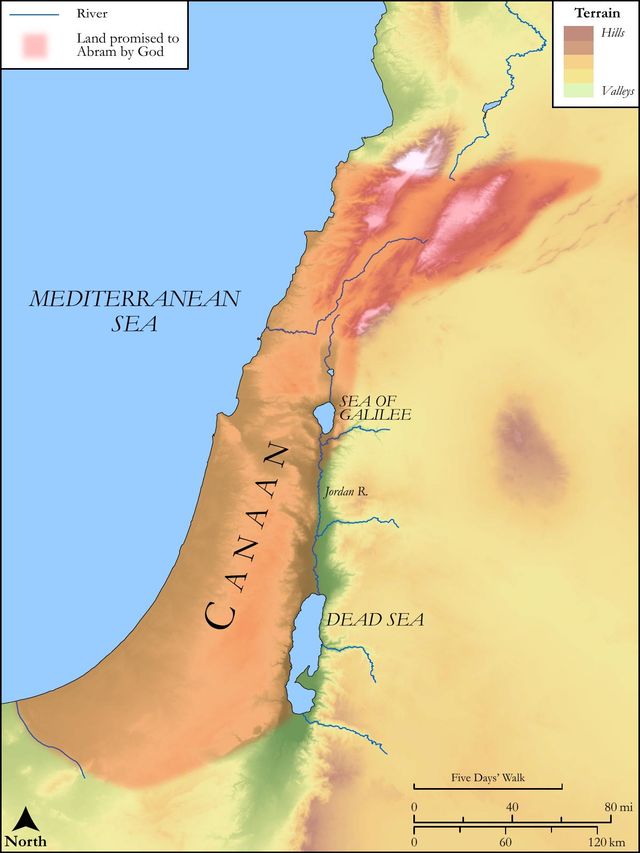
See on the biblical-era maps


Study this verse
Public-domain commentary
Matthew Henry
From his Commentary on the Whole Bible. Henry comments on passages, not single verses — this entry covers Genesis 17:7–14. His three-level outline is real structure in the source text, so it is rendered as structure.
Here is, I. The continuance of the covenant, intimated in three things: - 1. It is established; not to be altered nor revoked. It is fixed, it is ratified, it is made as firm as the divine power and truth can make it. 2. It is entailed; it is a covenant, not with Abraham only (then it would die with him), but with his seed after him, not only his seed after the flesh, but his spiritual seed. 3. It is everlasting in the evangelical sense and meaning of it. The covenant of grace is everlasting. It is from everlasting in the counsels of it, and to everlasting in the consequences of it; and the external administration of it is transmitted with the seal of it to the seed of believers, and the internal administration of it by the Spirit of Christ's seed in every age.
II.The contents of the covenant:
it is a covenant of promises, exceedingly great and precious promises. Here are two which indeed are all-sufficient: - 1. That God would be their God, Gen 17:7, Gen 17:8. All the privileges of the covenant, all its joys and all its hopes, are summed up in this. A man needs desire no more than this to make him happy. What God is himself, that he will be to his people: his wisdom theirs, to guide and counsel them; his power theirs, to protect and support them; his goodness theirs, to supply and comfort them. What faithful worshippers can expect from the God they serve believers shall find in God as theirs. This is enough, yet not all. 2. That Canaan should be their everlasting possession, Gen 17:8. God had before promised this land to Abraham and his seed, Gen 15:18. But here, where it is promised for an everlasting possession, surely it must be looked upon as a type of heaven's happiness, that everlasting rest which remains for the people of God, Heb 4:9. This is that better country to which Abraham had an eye, and the grant of which was that which answered to the vast extent and compass of that promise, that God would be to them a God; so that, if God had not prepared and designed this, he would have been ashamed to be called their God, Heb 11:16. As the land of Canaan was secured to the seed of Abraham according to the flesh, so heaven is secured to all his spiritual seed, by a covenant, and for a possession, truly everlasting. The offer of this eternal life is made in the word, and confirmed by the sacraments, to all that are under the external administration of the covenant; and the earnest of it is given to all believers, Eph 1:14. Canaan is here said to be the land wherein Abraham was a stranger; and the heavenly Canaan is a land to which we are strangers, for it does not yet appear what we shall be.
III.The token of the covenant, and that is circumcision, for the sake of which the covenant is itself called the covenant of circumcision, Act 7:8. It is here said to be the covenant which Abraham and his seed must keep, as a copy or counterpart, Gen 17:9, Gen 17:10. It is called a sign and seal (Rom 4:11), for it was,
1.A confirmation to Abraham and his seed of those promises which were God's part of the covenant, assuring them that they should be fulfilled, that in due time Canaan would be theirs: and the continuance of this ordinance, after Canaan was theirs, intimates that these promises looked further to another Canaan, which they must still be in expectation of. See Heb 4:8.
2.An obligation upon Abraham and his seed to that duty which was their port of the covenant; not only to the duty of accepting the covenant and consenting to it, and putting away the corruption of the flesh (which were more immediately and primarily signified by circumcision), but, in general, to the observance of all God's commands, as they should at any time hereafter be intimated and made known to them; for circumcision made men debtors to do the whole law, Gal 5:3. Those who will have God to be to them a God must consent and resolve to be to him a people. Now,
(1.)Circumcision was a bloody ordinance; for all things by the law were purged with blood, Heb 9:22. See Exo 24:8. But, the blood of Christ being shed, all bloody ordinances are now abolished; circumcision therefore gives way to baptism.
(2.)It was peculiar to the males, though the women were also included in the covenant, for the man is the head of the woman. In our kingdom, the oath of allegiance is required only from men. Some think that the blood of the males only was shed in circumcision because respect was had in it to Jesus Christ and his blood.
(3.)It was the flesh of the foreskin that was to be cut off, because it is by ordinary generation that sin is propagated, and with an eye to the promised seed, who was to come from the loins of Abraham. Christ having not yet offered himself to us, God would have man to enter into covenant by the offering of some part of his own body, and no part could be better spared. It is a secret part of the body; for the true circumcision is that of the heat: this honour God put upon an uncomely part, Co1 12:23, Co1 12:24.
(4.)The ordinance was to be administered to children when they were eight days old, and not sooner, that they might gather some strength, to be able to undergo the pain of it, and that at least one sabbath might pass over them.
(5.)The children of the strangers, of whom the master of the family was the true domestic owner, were to be circumcised (Gen 17:12, Gen 17:13), which looked favourable upon the Gentiles, who should in due time be brought into the family of Abraham, by faith. See Gal 3:14.
(6.)The religious observance of this institution was required under a very severe penalty, Gen 17:14. The contempt of circumcision was a contempt of the covenant; if the parents did not circumcise their children, it was at their peril, as in the case of Moses, Exo 4:24, Exo 4:25. With respect to those that were not circumcised in their infancy, if, when they grew up, they did not themselves come under this ordinance, God would surely reckon with them. If they cut not off the flesh of their foreskin, God would cut them off from their people. It is a dangerous thing to make light of divine institutions, and to live in the neglect of them.
Historical interpretation
Seven Centuries of Reception
6 surviving comments on this verse. Each one is dated, so this reads as a timeline rather than a list.
Select a marker to jump to its quote. Markers stagger vertically where authors wrote within a few decades of each other.
Nothing done unwittingly is declared punishable by the law, since the law makes allowance even for one who claims to have committed unintentional homicide. Why then is the eight-day-old infant who is uncircumcised menaced as though subject to the penalty of death? Some say that this is to be applied, by way of interpretation, to the parents. They, it is thought, should be punished as having made light of the precept of the law. But others think that by the use of hyperbole, the text expresses anger with respect to the infant child, as much as it appears to do, in order that the inevitable punishment might be brought upon those who have reached the use of reason and who have broken the law.
Not without reason or by excessive reaction do many find this passage disturbing, in that the Lord should say, “Any uncircumcised male who is not circumcised in the flesh of his foreskin shall be cut off from his people; he has broken my covenant.” Indeed, it is not taken lightly that the negligence of the parents could bring punishment upon an eight-day-old infant, so much so that his soul would perish, while even in the case of homicide—committed, however, by one who had unintentionally killed a man—the law stipulated to what cities the perpetrator might flee to obtain impunity for the shedding of blood. How is it possible, then, that for the case of homicide the involuntary character of the killing is taken into consideration, while here no account is taken of infancy, in which there could have been no fault whatever, whether of negligence or of purpose—unless perhaps some might think that the parents receive an even graver punishment in the death of their son? But it is regarded as unjust when the crime of a wrongdoer is inflicted on an innocent party or when a person is included in the punishment of another when he is not responsible to the same degree. For this reason some think that the passage is saying that the parent is to be exterminated, that it is his soul that should perish, not that of the baby. But the case is not at all clear, even if this opinion seems to be supported by the comment “because he has violated my covenant.” This then seems to refer to one who is capable of understanding, not to the infant child. Others maintain that the Lord God is threatening the parents, even if silently, with still graver punishments, so that as adults they will have even greater fear when [they see that] not even children are spared.
See the Lord’s wisdom in knowing how inobservant future generations are likely to be, and so, as though putting a bit in their mouths, he gave them this sign of circumcision, curbing their unrestrained urges in case they should mingle with other peoples. You see, he was aware of their lustful tendencies in not practicing restraint, even though it had been drummed into them countless times to refrain from their irrational impulses. Consequently he gave them a perpetual reminder with this sign of circumcision, as though fastening them with a chain. He set limits and rules to prevent them overstepping the mark instead of staying within their own people and having no association with those other peoples but rather keeping the patriarch’s line uncontaminated. In this way even the fulfillment of the promises could be achieved for their benefit. It is like a man of self-control and good sense having a disobedient child; he puts limits and rules on him not to show his face outside the front door or to be seen by passersby. In fact, he oftentimes ties him up by the feet so as to succeed in this way in getting the better of his extreme indiscipline. Well, in just the same way the loving Lord also placed this sign of circumcision in their flesh, like shackles on their feet, so that with this reminder at home they might have no further need of instruction from others.
Verse 7. "And the overseer of the eunuchs imposed names upon them, calling Daniel Belteshazzar (Balthasar), and Hananiah Shadrach, and Mishael Meshach, and Azariah Abednego." It was not only the overseer or master of the eunuchs (as others have rendered it, the "chief-eunuch") who changed the names of saints, but also Pharaoh called Joseph in Egypt Somtonphanec (Genesis 41:45), for neither of them wished them to have Jewish names in the land of captivity. Wherefore the prophet says in the Psalm: "How shall we sing the Lord's song in a strange land?" (Psalm 137:4). Furthermore the Lord Himself changes names benignly, and on the basis of events imposes names of special significance, so as to call Abram Abraham (Genesis 17:5), and Sarai Sarah (Genesis 17:15). Also in the Gospel, the former Simon received the name of Peter (Mark 3:16), and the sons of Zebedee are called "sons of thunder" (Mark 3:17) - which is not boanerges, as most people suppose, but is more correctly read benereem.
(Chapter 17—Verse 3 and following) And the Lord spoke to him, saying: Behold, my covenant is with you, and you shall be the father of a multitude of nations, and your name shall no longer be called Abram, but your name shall be Abraham, for I have made you the father of many nations. It should be noted that wherever we read Testament in Greek, in the Hebrew language it is the word covenant or pact, that is, Berith (). The Hebrews say that God, from his name, which is the Tetragrammaton among them, added the letter He to Abraham and Sarah: for he was first called Abram (), which means lofty father, and later he was called Abraham (), which means father of many: for what follows nations is not part of the name, but is understood. It is not surprising, therefore, that when it seems that the letter Α has been added among the Greeks and us: we have called it the Hebrew letter He added; for the language of that tongue is to write with He (ה), but to read with A (א): just as, on the contrary, the letter A is often pronounced as He.
A male whose foreskin's flesh has not been circumcised, that soul will be cut off from his people: because he has broken my covenant. By this sentence, the greater mystery of the same circumcision is revealed, which is not only a sign of renewal to come in Christ but also an abolition of the transgression committed in Adam; for what baptism now accomplishes through faith in Christ, circumcision accomplished from that time on the eighth day, which was a designation of Christ's resurrection; except that the entrance to the kingdom of heaven was not yet open to those circumcised, before the Lord, rising from death, unlocked the door of that same kingdom to all the elect by ascending to the heavens. For this reason, they were circumcised on the eighth day specifically; to signify that they would not truly be cleansed from all stain of vice except through the effect of the Lord's resurrection. However, it may raise a question how it is said, that soul will be cut off from his people, because he has broken my covenant, when there is no fault of the infant, whose soul, he said, will perish, nor has he himself broken the covenant of God, but those older who did not care to circumcise him; unless because even infants, not according to their own life's property, but according to the common origin of the human race, all broke the covenant of God in that one in whom all sinned. Therefore, since circumcision was a sign of regeneration, and not without reason the infant, on account of original sin, by which the first covenant of God was shattered, would be destroyed by generation unless liberation freed him; thus these divine words must be understood as if it were said: Whoever has not been regenerated, that soul will be cut off from his people, because he has broken the covenant of God; since in Adam, even he sinned with all.
Continue studying Genesis 17:14 across the web’s major study libraries — every link below opens this exact verse, chapter, or book on the destination site.
Read & Compare
 BibleGatewayThis verse in more than 200 translations and 70 languages.
 Bible.comThe YouVersion reader — hundreds of translations, reading plans, and highlights.
 ESV.orgCrossway's official English Standard Version reader.
 NET BibleThe NET translation with 60,000+ translators' notes on every rendering decision.
 STEP BibleTyndale House's free study tool — original text, vocabulary, and scholarly resources.
 BibliaLogos Bible Software's free web reader.
 USCCBThe New American Bible (Revised Edition) with the U.S. bishops' study notes.
Commentaries
 BibleHub CommentariesDozens of classic commentaries on this verse, gathered on one page.
 StudyLightMore than 100 commentary sets — the largest collection on the web.
 BibleRefPlain-English commentary on what this verse means, verse by verse.
 Enduring WordDavid Guzik's free commentary on this chapter, widely used by Bible teachers.
 Bible Study ToolsVerse commentary alongside Greek and Hebrew study aids.
Original Language & Research
- BibleHub InterlinearThe verse word by word — original language, transliteration, and English.
- BibleHub LexiconEvery word's original-language definition and Strong's entry.
 Blue Letter BibleDeep-study tools — Strong's numbers, concordance, and word studies.
 SefariaThe Hebrew text with Rashi and centuries of Jewish commentary.
Sermons, Hymns & Audio


TrulyRandomVerse is not affiliated with these sites and doesn’t control their content. They’re linked because they’re genuinely useful.
Summary
Genesis 17:14 delivers a profound and unyielding divine decree, establishing the absolute necessity of physical circumcision as the perpetual sign of God's everlasting covenant with Abraham and his male descendants. It unequivocally states that any uncircumcised male shall be "cut off from his people," a severe pronouncement signifying not merely social exclusion but a profound spiritual and existential excommunication, a forfeiture of identity, blessings, and participation within the covenant community due to a direct breach of the divine agreement.
Context
ShowHideLiterary Context
Genesis chapter 17 is a pivotal moment in the Abrahamic narrative, following God's previous covenant promises to Abram in Genesis 12 and Genesis 15. Here, God appears to Abram when he is ninety-nine years old, reaffirming and expanding the covenant. The chapter begins with God introducing Himself as "El Shaddai," God Almighty, and commanding Abram to "walk before me, and be thou perfect" (Genesis 17:1). This encounter includes the significant renaming of Abram to Abraham and Sarai to Sarah, emphasizing their new roles in God's redemptive plan. The institution of circumcision as the "token of the covenant" (Genesis 17:11) is central, with specific instructions for it to be performed on all male descendants on the eighth day of life, as well as on all male servants born in the household or bought with money. Verse 14, therefore, serves as the solemn pronouncement of the consequence for failing to uphold this foundational covenant sign, underscoring its non-negotiable nature within the immediate narrative.
Historical & Cultural Context
In Scripture, covenants often involved rituals, oaths, and visible signs to bind parties. While other cultures practiced forms of circumcision (e.g., Egyptians, Edomites), the Abrahamic circumcision was distinct in its theological meaning and its specific timing (eighth day). It was not merely a hygienic practice or a rite of passage, but a divinely commanded sign that marked a people as uniquely belonging to Yahweh. The act of "cutting" in covenant-making was significant, often involving the cutting of animals and the parties passing between the pieces, symbolizing the fate of the one who breaks the covenant (as seen in Genesis 15:9-17). Thus, the language of being "cut off" in Genesis 17:14 resonates with the gravity of covenant violation in Scripture, where breaking an oath had severe social, legal, and often spiritual repercussions. This physical mark distinguished Abraham's descendants from surrounding nations and served as a constant, embodied reminder of their unique identity and relationship with the Almighty God.
Key Themes
ShowHideGenesis 17:14 contributes significantly to several overarching themes within Genesis and the broader biblical narrative. Firstly, it reinforces the theme of Covenant, highlighting God's faithfulness in establishing and maintaining His promises, but also emphasizing the human responsibility of obedience to the covenant's terms. Secondly, it underscores the theme of Obedience and Disobedience, demonstrating that God's commands are not optional, but carry profound consequences for those who disregard them. The failure to be circumcised is explicitly labeled as "breaking my covenant," a direct act of rebellion. Thirdly, the verse speaks to Identity and Belonging, defining who is truly part of God's chosen people and who is excluded. The physical sign of circumcision was the visible marker of inclusion in the covenant community, a precursor to the spiritual identity found in Christ. Finally, it touches upon the theme of Divine Judgment and Holiness, revealing God's absolute commitment to the sanctity of His covenant and His righteous judgment against those who willfully violate its sacred terms. This severity highlights the profound holiness of God and the seriousness with which He regards His relationship with humanity.
Exposition and Analysis
ShowHideThe KJV text of Genesis 17:14 presents a clear and unyielding divine decree concerning the covenant of circumcision, outlining the severe consequences for non-compliance.
Key Word Analysis
ShowHideThis word (H6189) refers to someone "properly, exposed, i.e., projecting loose (as to the prepuce); used only technically,; uncircumcised (i.e. still having the prepuce uncurtailed)." In this context, it specifically denotes a male who has not undergone the covenantal ritual of circumcision. The term highlights the physical state that directly violates God's command, making the individual distinct from the circumcised covenant community.
The verb (H3772) literally means "to cut (off, down or asunder)." However, in a covenantal or legal context, it carries profound implications beyond a simple physical severance. It signifies "to destroy or consume," and specifically "to covenant (i.e., make an alliance or bargain, originally by cutting flesh and passing between the pieces)." When used in the passive or reflexive, as here, it denotes expulsion, excommunication, or destruction. It implies a complete separation from the community and its benefits, often carrying a connotation of divine judgment, whether through premature death, childlessness, or social ostracism.
This noun (H1285) is derived "from בָּרָה (in the sense of cutting (like בָּרָא)); a compact (because made by passing between pieces of flesh); confederacy, (con-) feder(-ate), covenant, league." It refers to a solemn, binding agreement, often initiated by God, establishing a relationship with specific terms, promises, and obligations. The term itself evokes the ancient practice of "cutting" a covenant, underscoring the gravity and permanence of the agreement. To "break" this covenant is to violate the most sacred of bonds.
Verse Breakdown
ShowHide"And the uncircumcised man child whose flesh of his foreskin is not circumcised"
This opening clause precisely identifies the subject of the divine decree: any male descendant of Abraham who, by the eighth day or at any point, remains uncircumcised. It emphasizes the physical state of non-compliance with the specific ritual commanded by God. The repetition of "uncircumcised" and "not circumcised" underscores the deliberate and unacceptable nature of this omission. It is not an accidental state but a failure to fulfill a foundational requirement.
"that soul shall be cut off from his people"
This is the severe consequence. The term "soul" (Hebrew, nephesh) here refers to the entire person, the living being. To be "cut off" from "his people" signifies a profound and multi-faceted excommunication. It implies a loss of identity, status, and all the privileges associated with being part of God's covenant community. This could involve social ostracism, exclusion from religious rituals, and potentially divine judgment leading to premature death or barrenness. It is a spiritual and existential severing from the blessings and promises tied to the Abrahamic lineage.
"he hath broken my covenant"
This concluding phrase provides the explicit rationale for the severe penalty. The failure to be circumcised is not merely a minor infraction but a direct, willful violation of God's sacred covenant. It highlights the seriousness with which God regards His agreements and the expectation of strict adherence to the terms He establishes. This emphasizes that the covenant was a two-sided agreement, requiring human obedience in response to divine initiative and promise.
Literary Devices
ShowHideGenesis 17:14 employs several literary devices to convey its powerful message. The most prominent is Legal Language, evident in the precise definition of the offender ("the uncircumcised man child"), the clear articulation of the consequence ("shall be cut off from his people"), and the explicit statement of the offense ("he hath broken my covenant"). This legalistic phrasing underscores the binding nature of the covenant and the seriousness of its violation, akin to a divine statute. There is also an element of Repetition in the phrase "uncircumcised man child whose flesh of his foreskin is not circumcised," which emphasizes the specific nature of the transgression and leaves no room for ambiguity regarding the target of the decree. Furthermore, the phrase "cut off" functions as powerful Symbolism. While it could imply physical death, its deeper meaning in a covenantal context symbolizes a complete spiritual and communal severance, a loss of identity and belonging, highlighting the profound spiritual implications of disobedience. The verse's Decretive Tone reinforces the absolute authority of God's command and the certainty of the stated consequence.
Theological and Thematic Connections
ShowHideGenesis 17:14 profoundly illustrates the nature of God's covenant relationship with humanity, revealing that while God initiates and sustains the covenant through His faithfulness, human participation requires a tangible response of obedience. Circumcision was not merely a ritual; it was the visible, physical embodiment of a spiritual commitment and a sign of belonging to God's chosen people. The severe consequence of being "cut off" underscores the gravity of rejecting God's terms and the sanctity of the covenant. It teaches that inclusion in God's redemptive plan is conditional upon adherence to His revealed will, demonstrating that God's grace is not license for disobedience but calls for a life of responsive faith. This verse sets a precedent for the importance of covenant signs and the dire consequences of their willful disregard throughout biblical history.
Reflection and Application
ShowHideWhile the physical requirement of circumcision is superseded by the New Covenant in Christ, the principle embedded in Genesis 17:14 remains profoundly relevant for believers today. This verse serves as a stark reminder of the seriousness with which God regards our covenant relationship with Him and the non-negotiable nature of His commands. Just as physical circumcision was the outward sign of belonging to Abraham's lineage and participating in the Old Covenant, so too is a transformed heart and life of obedience the outward manifestation of our inclusion in the New Covenant through Christ. To willfully reject God's revealed will, to refuse to embrace the terms of His grace and walk in obedience, is to effectively "cut oneself off" from the blessings and intimacy of relationship with Him. This calls us to a deep self-examination: are we truly living in responsive faith, allowing the Spirit to circumcise our hearts from sin, or are we, through our actions or inactions, breaking the covenant of grace established through Jesus? Our spiritual identity and participation in God's family are contingent upon our acceptance of His terms, demonstrated by a life continually yielded to His Spirit and His Word.
Questions for Reflection
ShowHideFAQ
ShowHideWhy was circumcision so important in the Abrahamic covenant?
ShowHideCircumcision was paramount because it was the physical, visible, and permanent "token" or sign of the Abrahamic covenant. It served as a constant, embodied reminder to Abraham and his male descendants of their unique, exclusive relationship with God. It marked them as distinct from all other nations, signifying their identity as His chosen people and their commitment to the promises and obligations of the covenant. This physical mark was essential for inclusion in the lineage through which the Messiah would ultimately come, symbolizing their separation unto God and their participation in His redemptive plan.
What does "cut off from his people" truly mean in this context?
ShowHideThe phrase "cut off from his people" (Hebrew, kârath) signifies a profound and severe penalty far beyond mere physical death. It implies a complete spiritual, social, and existential excommunication. This meant losing one's identity as an integral part of God's covenant community, forfeiting all associated blessings, protections, and promises, such as the inheritance of the land, the blessing of offspring, or participation in communal worship. It was a profound separation from the communal and spiritual life of Israel, a direct consequence of willfully breaking God's covenant and denying the visible sign of belonging. This could manifest as social ostracism, exclusion from religious rites, or even divine judgment leading to premature death or barrenness.
Does this verse apply to Christians today, given that physical circumcision is not required in the New Covenant?
ShowHideWhile the literal command for physical circumcision does not apply to Christians under the New Covenant, the underlying theological principles of obedience, covenant fidelity, and the seriousness of our relationship with God certainly do. The New Testament emphasizes a "circumcision of the heart" through faith in Christ, signifying an inner transformation, a cleansing from sin, and a dedication to God that transcends outward ritual. The consequence of being "cut off" for believers today is spiritual separation from God, which occurs through willful rejection of Christ and His covenant of grace. It underscores that true belonging in God's family is marked by a transformed heart and a life lived in obedience to the Spirit.
Christ-Centered Fulfillment
ShowHideGenesis 17:14, with its severe consequence for breaking the covenant of circumcision, finds its profound fulfillment and reinterpretation in Jesus Christ. The Old Covenant's physical sign pointed forward to a deeper, spiritual reality that Christ inaugurates. Paul explains that true circumcision is not outward in the flesh, but "that of the heart, in the spirit, and not in the letter." This spiritual circumcision is accomplished through union with Christ, where believers are "circumcised with a circumcision made without hands, by putting off the body of the sins of the flesh, by the circumcision of Christ" (Colossians 2:11). No longer is physical cutting the mark of belonging, but rather a spiritual transformation, a death to the old sinful self, and a resurrection to new life in Christ. The threat of being "cut off from his people" is thus transformed: those who are "in Christ" are eternally grafted into God's family, no longer subject to the curse of the law but brought near by the blood of Jesus (Ephesians 2:13). Conversely, those who reject Christ, the mediator of the New Covenant, remain spiritually "cut off" from God, not by a failure to perform a physical rite, but by their unbelief and refusal to embrace the ultimate covenant of grace offered through His atoning sacrifice (John 3:18). Thus, Christ fulfills the covenant by providing the means for true spiritual inclusion and belonging, a reality far surpassing the physical sign.