


Genesis 43:21
Bible text: King James Version (1769 Blayney text) · Public domain
Bible text: King James Version with Strong's numbers · Public domain
Bible text: Berean Standard Bible · Public domain
Bible text: American Standard Version (1901) · Public domain
Bible text: World English Bible, Messianic edition · Public domain
Bible text: Geneva Bible (1599) · Public domain
Bible text: Young's Literal Translation · Public domain
- וַיְהִיvay·Hiand it wasH1961Conj-w ¦ V-Qal-ConsecImperf-3msVerb Qal Consecutive Imperfect 3rd Singular Masculineוַandיְהִיit was
- כִּיkithatH3588PrtParticle Conditional
- בָאנוּVa·nuwe cameH935V-Qal-Perf-1cpVerb Qal Perfect 1st Plural common gender
- אֶל'eltoH413PrepPreposition
- הַמָּלוֹןha·ma·Lonthe lodging placeH4411Art ¦ N-msNoun Singular Masculine Absoluteהַtheמָּלוֹןlodging place
- וַנִּפְתְּחָהva·nif·te·Chahand we opened !H6605Conj-w ¦ V-Qal-ConsecImperf-1cp ¦ SfxVerb Qal Consecutive Imperfect 1st Plural common genderוַandנִּפְתְּחָwe openedה!
- אֶת'et<obj.>H853DirObjMParticle Object Indicator
- אַמְתְּחֹתֵינוּ'am·te·cho·Tei·nuour sacksH572N-fpc ¦ 1cpNoun Plural Feminine Constructאַמְתְּחֹתֵיsacksנוּour
- וְהִנֵּהve·hi·Nehand there!H2009Conj-w ¦ PrtParticle Interjectionוְandהִנֵּהthere!
- כֶסֶףkhe·sef[the] silver ofH3701N-mscNoun Singular Masculine Construct
- אִישׁ'isheach manH376N-msNoun Singular Masculine Absolute
- בְּפִיbe·Fi[was] in [the] mouth ofH6310Prep-b ¦ N-mscNoun Singular Masculine Constructבְּ[was] inפִי[the] mouth of
- אַמְתַּחְתּוֹ'am·tach·Tohis sackH572N-fsc ¦ 3msNoun Singular Feminine Constructאַמְתַּחְתּsackוֹhis
- כַּסְפֵּנוּkas·Pe·nuour silverH3701N-msc ¦ 1cpNoun Singular Masculine Constructכַּסְפֵּsilverנוּour
- בְּמִשְׁקָלוֹbe·mish·ka·Loin its weightH4948Prep-b ¦ N-msc ¦ 3msNoun Singular Masculine Constructבְּinמִשְׁקָלweightוֹits
- וַנָּשֶׁבva·Na·shevand we have brought backH7725Conj-w ¦ V-Hiphil-ConsecImperf-1cpVerb Hiphil Consecutive Imperfect 1st Plural common genderוַandנָּשֶׁבwe have brought back
- אֹתוֹ'o·To<obj.> itH853DirObjM ¦ 3msParticle Object Indicatorאֹת<obj.>וֹit
- בְּיָדֵנוּbe·ya·De·nuin our handH3027Prep-b ¦ N-csc ¦ 1cpNoun Singular common gender Constructבְּinיָדֵhandנוּour
English is a literal word-by-word gloss of the Hebrew, not the KJV's wording. Why?
This is the original text the KJV's translators worked from — each Hebrew word with its own literal English meaning in this verse, prepared by scholars at Tyndale House, Cambridge. The KJV translates whole sentences, not word by word, so its wording differs: one Hebrew word can become several English words, and the KJV may choose “the LORD” where the gloss reads “Yahweh”. Both are faithful — they answer different questions. For the KJV's own rendering, switch to the KJV text.
Details
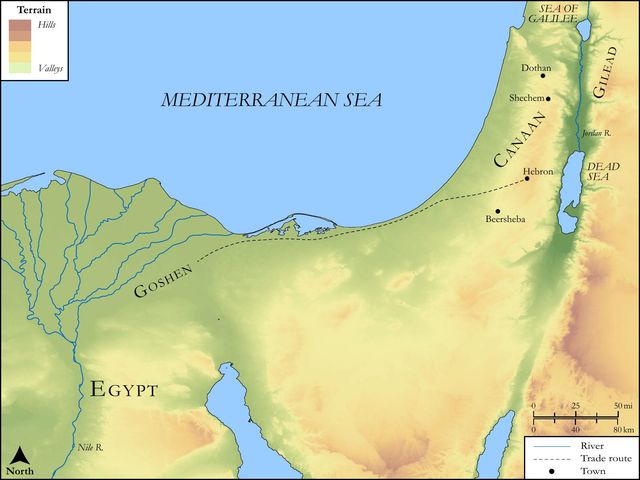
See on the biblical-era maps


Study this verse
Public-domain commentary
Matthew Henry
From his Commentary on the Whole Bible. Henry comments on passages, not single verses — this entry covers Genesis 43:15–25.
Jacob's sons, having got leave to take Benjamin with them, were observant of the orders their father had given them, and went down the second time into Egypt to buy corn. If we should ever know what a famine of the word means, let us not think it much to travel as far for spiritual food as they did for corporal food. Now here we have an account of what passed between them and Joseph's steward, who, some conjecture, was in the secret, and knew them to be Joseph's brethren, and helped to humour the thing; I rather think not, because no man was permitted to be present when Joseph afterwards made himself known to them, Gen 45:1. Observe, 1. Joseph's steward has orders from his master (who was busy selling corn, and receiving money) to take them to his house, and make ready for their entertainment. Though Joseph saw Benjamin there, he would not leave his work at working-time, nor trust another with it. Note, Business must take place of civility in its season. Our needful employments must not be neglected, no, not to pay respect to our friends. 2. Even this frightened them: They were afraid, because they were brought into Joseph's house, Gen 43:18. The just challenges of their own consciences, and Joseph's violent suspicions of them, forbade them to expect any favour, and suggested to them that this was done with a bad design upon them. Note, Those that are guilty and timorous are apt to make the worst of every thing. Now they thought they should be reckoned with about the money in the sacks' mouths, and should be charged as cheats, and men not fit to be dealt with, who had taken advantage of the hurry of the market to carry off their corn unpaid for. They therefore laid the case before the steward, that he, being apprized of it, might stand between them and danger; and, as a substantial proof of their honesty, before they were charged with taking back their money they produced it. Note, Integrity and uprightness will preserve us, and will clear themselves as the light of the morning. 3. The steward encouraged them (Gen 43:23): Peace be to you, fear not; though he knew not what his master drove at, yet he was aware these were men whom he meant no harm to, while he thus amused them; and therefore he directs them to look at the divine Providence in the return of their money: Your God, and the God of your father, has given you treasure in your sacks. Observe, (1.) Hereby he shows that he had no suspicion at all of dishonesty in them: for of what we get by deceit we cannot say, "God gives it to us." (2.) Hereby he silences their further enquiry about it. "Ask not how it came thither; Providence brought it to you, and let that satisfy you." (3.) It appears by what he said that, by his good master's instructions, he was brought to the knowledge of the true God, the God of the Hebrews. It may justly be expected that those who are servants in religious families should take all fit occasions to speak of God and his providence with reverence and seriousness. (4.) He directs them to look up to God, and acknowledge his providence in the good bargain they had. We must own ourselves indebted to God, as our God and the God of our fathers (a God in covenant with us and them) for all our successes and advantages, and the kindnesses of our friends; for every creature is that to us, and no more, which God makes it to be. The steward encouraged them, not only in words but in deeds; for he made very much of them till his master came, Gen 43:24.
Continue studying Genesis 43:21 across the web’s major study libraries — every link below opens this exact verse, chapter, or book on the destination site.
Read & Compare
 BibleGatewayThis verse in more than 200 translations and 70 languages.
 Bible.comThe YouVersion reader — hundreds of translations, reading plans, and highlights.
 ESV.orgCrossway's official English Standard Version reader.
 NET BibleThe NET translation with 60,000+ translators' notes on every rendering decision.
 STEP BibleTyndale House's free study tool — original text, vocabulary, and scholarly resources.
 BibliaLogos Bible Software's free web reader.
 USCCBThe New American Bible (Revised Edition) with the U.S. bishops' study notes.
Commentaries
 BibleHub CommentariesDozens of classic commentaries on this verse, gathered on one page.
 StudyLightMore than 100 commentary sets — the largest collection on the web.
 BibleRefPlain-English commentary on what this verse means, verse by verse.
 Enduring WordDavid Guzik's free commentary on this chapter, widely used by Bible teachers.
 Bible Study ToolsVerse commentary alongside Greek and Hebrew study aids.
Original Language & Research
- BibleHub InterlinearThe verse word by word — original language, transliteration, and English.
- BibleHub LexiconEvery word's original-language definition and Strong's entry.
 Blue Letter BibleDeep-study tools — Strong's numbers, concordance, and word studies.
 SefariaThe Hebrew text with Rashi and centuries of Jewish commentary.
Sermons, Hymns & Audio


TrulyRandomVerse is not affiliated with these sites and doesn’t control their content. They’re linked because they’re genuinely useful.
Summary
Genesis 43:21 captures the bewildered account of Joseph's brothers to their father, Jacob, detailing the shocking discovery of their payment for grain mysteriously returned in their sacks during their first journey back from Egypt. This inexplicable event, which filled them with profound fear and confusion, was an integral part of Joseph's intricate and providential plan to test his brothers' character and compel their return to Egypt with Benjamin, ultimately serving God's overarching purpose for the preservation and reconciliation of their family amidst a severe famine.
Context
ShowHideLiterary Context
Genesis 43:21 is a pivotal moment within the larger narrative of Joseph and his brothers, specifically following their first harrowing journey to Egypt and preceding their second, even more critical, journey. In Genesis 42, Joseph, now the powerful governor of Egypt, had recognized his brothers but remained unrecognized by them. He accused them of being spies, imprisoned Simeon, and demanded they bring their youngest brother, Benjamin, to prove their honesty (Genesis 42:15-20). Secretly, Joseph commanded his steward to return each brother's money to his sack (Genesis 42:25). The discovery of the money terrified them, as recorded in Genesis 42:28. This verse is the brothers' desperate, fear-laden explanation to Jacob, attempting to persuade him to release Benjamin for the perilous return trip, emphasizing their honesty and the perplexing nature of the situation to alleviate Jacob's deep reluctance and fear for his youngest son.
Historical & Cultural Context
Travel in the days of the patriarchs was often arduous and fraught with peril. Journeys between Canaan and Egypt, though common for trade and in times of famine, involved significant distances and reliance on temporary lodging. The "inn" (Hebrew: malon) mentioned here was not a modern hotel but typically a caravanserai or a designated open camping ground where travelers would rest, unburden their animals, and prepare meals. Money, usually in the form of silver by weight, was crucial for transactions. The unexpected return of payment, especially in a foreign land and from a powerful official, would be highly suspicious and terrifying. Such an occurrence could be interpreted as a trap, an accusation of theft, or a magical curse, potentially leading to severe punishment or enslavement. The brothers' immediate thought was that they would be held accountable for the "found" money, fearing it was a pretext for further trouble, highlighting the precariousness of their situation and the absolute necessity of maintaining an appearance of integrity in a world with harsh legal consequences.
Key Themes
ShowHideThis verse significantly contributes to several overarching themes in the Joseph narrative and the book of Genesis. It powerfully illustrates Divine Providence, as God's unseen hand is orchestrating even the seemingly random or perplexing events (like the returned money) to bring about His ultimate purposes for the family of Jacob and the nascent nation of Israel. It highlights Human Perplexity and Fear in the face of the unknown, as the brothers are genuinely bewildered and terrified, unable to grasp the benevolent intentions behind Joseph's actions or the sovereign hand of God at work. The brothers' decision to bring the money back to Jacob underscores the theme of Integrity and Honesty, even amidst extreme duress and temptation, demonstrating a crucial shift in their character compared to their earlier deception regarding Joseph. Furthermore, it is a critical step in the Unfolding of Joseph's Plan for testing his brothers and ultimately achieving family reconciliation and the preservation of God's chosen lineage during the severe famine.
Exposition and Analysis
ShowHideKey Word Analysis
ShowHideThis term (H4411) refers to a temporary lodging place, a caravanserai, or an encampment. It was a common stopping point for travelers, often an open area where people and animals could rest, rather than a structured building with services. The discovery of the money at such a place emphasizes the mundane, routine context in which the extraordinary event occurred, heightening the surprise.
Derived from a root meaning "to be pale," this word (H3701) primarily denotes "silver" and, by implication, "money." In ancient times, silver was the primary medium of exchange, weighed out for transactions. The mention of "money" here emphasizes the specific commodity that was unexpectedly returned, which was of significant value and the very means by which they had purchased their sustenance.
This word (H4948) refers to the exact, numerically estimated weight. The phrase "our money in full weight" underscores that the precise amount they had paid was returned, not a partial sum or a different currency. This precision deepened their confusion and fear, as it ruled out simple error and suggested a deliberate, yet incomprehensible, act that they feared was a trap or a prelude to accusation.
Verse Breakdown
ShowHide"And it came to pass, when we came to the inn"
This clause sets the scene for the discovery, indicating that the brothers had begun their journey home from Egypt and made a stop at a common lodging place. The "inn" was a temporary resting point, likely chosen for its convenience along the travel route, making the subsequent discovery all the more unexpected in a routine setting.
"that we opened our sacks"
This action was likely for practical purposes—to retrieve food for themselves or their animals, or perhaps to reorganize their provisions. It was a moment of mundane necessity that suddenly turned into one of profound shock and confusion, as the contents of their sacks revealed something entirely unforeseen.
"and, behold, [every] man's money [was] in the mouth of his sack, our money in full weight"
This is the core of their astonishing discovery. The phrase "behold" conveys the sudden, startling nature of the revelation. The money was found "in the mouth of his sack," meaning at the opening, easily visible, not hidden deep within. The crucial detail "our money in full weight" emphasizes that the exact amount they had paid was returned, confirming it was not a mistake of short-changing but a deliberate, mysterious act. This precision intensified their fear, as it implied intentionality without a discernible, benign motive.
"and we have brought it again in our hand"
This final clause highlights the brothers' response to the bewildering situation. Despite the opportunity to keep the money, they chose to bring it back to Jacob. This action demonstrates their integrity and their desperate desire to prove their honesty, both to their father and, implicitly, to the Egyptian authorities, whom they feared would accuse them of theft. It was tangible evidence of their predicament and their attempt to rectify what they perceived as an error or a setup.
Literary Devices
ShowHideThe passage employs several potent literary devices. Dramatic Irony is central, as the reader is fully aware of Joseph's identity and his benevolent, though disguised, intentions, while the brothers remain completely ignorant, interpreting his actions as hostile and ominous. This creates a profound tension between the characters' perceptions and the narrative reality. The mysterious return of the money also generates significant Narrative Tension and suspense, driving the plot forward by compelling the brothers to return to Egypt with Benjamin, a condition Jacob vehemently resisted. The recurring motif of the money in the sack functions as a Symbol of Joseph's hidden power and the brothers' vulnerability and confusion, as well as a catalyst for their spiritual and relational transformation. Furthermore, the brothers' detailed recounting of the event, emphasizing the "full weight" and their act of bringing it back, serves as a form of Pleading or argumentation, designed to convince Jacob of their blamelessness and the necessity of their return to Egypt.
Theological and Thematic Connections
ShowHideGenesis 43:21 powerfully illustrates the concept of divine providence, where God, through seemingly random or even distressing human events, orchestrates His overarching plan. The brothers' fear and confusion, though genuine, stand in stark contrast to the reader's knowledge of Joseph's benevolent intentions, which are ultimately God's intentions for the preservation of His covenant people. This episode serves as a testament to God's ability to work through human agency and even human sin (the brothers' initial betrayal of Joseph) to bring about His righteous and redemptive purposes. The brothers' integrity in returning the money, despite their fear, also subtly points to the transformative work that God is beginning to effect in their hearts, preparing them for the profound reconciliation that is yet to come.
Reflection and Application
ShowHideThe perplexing discovery of the money in their sacks left Joseph's brothers bewildered and terrified, unable to comprehend the true, benevolent intentions behind the seemingly adverse circumstances. This narrative offers a profound lesson for believers today: life often presents situations that are confusing, frightening, or inexplicable, much like the money found by the brothers. In such moments, we are called to trust in God's overarching providence and sovereign plan, knowing that His ways are higher than our ways (Isaiah 55:8-9) and that He works all things for the good of those who love Him (Romans 8:28). The brothers' decision to return the money, despite their fear and the opportunity to keep it, serves as a powerful reminder of the enduring importance of integrity and honesty, even when faced with perplexing or challenging situations. Our character, forged in such trials, reflects our trust in God's ultimate justice and goodness. Ultimately, this narrative encourages us to look beyond immediate appearances and trust that God can use even the most bewildering events to bring about His good purposes, leading to reconciliation, restoration, and the fulfillment of His promises in our lives and in the world.
Questions for Reflection
ShowHideFAQ
ShowHideWhy were the brothers so afraid of the money found in their sacks?
ShowHideThe brothers were profoundly terrified because the unexpected return of their money, especially in full weight, seemed inexplicable and highly ominous. In that day, such an event could easily be interpreted as a trap, an accusation of theft, or a pretext for enslavement, particularly given Joseph's earlier harsh accusations of them being spies (Genesis 42:9). They could not comprehend the benevolent, though disguised, intentions behind Joseph's actions, viewing it instead as a grave misfortune or a divine judgment that threatened their lives and freedom. Their fear was rooted in the very real danger of being accused of a crime they did not commit, with severe consequences.
What was an 'inn' (malon) in ancient Israel?
ShowHideThe Hebrew word malon (מָלוֹן, H4411), translated as "inn" in the King James Version, did not typically refer to a formal building like a modern hotel or even a roadside tavern. Instead, it denoted a temporary lodging place, a designated camping spot, or a caravanserai along a travel route. These were often open areas or simple enclosures where travelers would unburden their animals, rest, prepare food, and spend the night. They provided a secure, though basic, place to stop on a journey, rather than enclosed structures with commercial services. The discovery of the money at such a routine stopping point heightened the brothers' surprise and confusion.
Christ-Centered Fulfillment
ShowHideThe narrative of Joseph, initially rejected and seemingly harsh, yet sovereignly orchestrating events to bring his brothers to repentance, provide for them, and reconcile his family, serves as a profound type of Christ. Like Joseph, who was unrecognized by his own brothers (John 1:10-11), Christ, though divine, came to His own people and was largely misunderstood and rejected. Yet, in His divine wisdom and love, He sovereignly orchestrates all circumstances—even those causing perplexity, fear, or suffering—to draw His people to Himself, provide ultimate salvation, and bring about reconciliation and restoration. Just as Joseph's hidden plan led to the preservation of Jacob's family from famine, Christ's sacrificial work on the cross, though a stumbling block to some, is God's ultimate plan to provide spiritual sustenance and eternal life, reconciling humanity to God (2 Corinthians 5:18-19). Through Christ, God works all things according to the counsel of His will (Ephesians 1:11), transforming human sin and confusion into a glorious display of His redemptive purposes.