


Genesis 42:35
Bible text: King James Version (1769 Blayney text) · Public domain
Bible text: King James Version with Strong's numbers · Public domain
Bible text: Berean Standard Bible · Public domain
Bible text: American Standard Version (1901) · Public domain
Bible text: World English Bible, Messianic edition · Public domain
Bible text: Geneva Bible (1599) · Public domain
Bible text: Young's Literal Translation · Public domain
- וַיְהִיvay·Hiand it wasH1961Conj-w ¦ V-Qal-ConsecImperf-3msVerb Qal Consecutive Imperfect 3rd Singular Masculineוַandיְהִיit was
- הֵםhemtheyH1992Pro-3mpPronoun Personal 3rd Plural Masculine
- מְרִיקִיםme·ri·Kim[were] emptyingH7324V-Hiphil-Prtcpl-mpVerb Hiphil Participle Plural Masculine Absolute
- שַׂקֵּיהֶםsa·kei·Hemtheir sacksH8242N-mpc ¦ 3mpNoun Plural Masculine Constructשַׂקֵּיsacksהֶםtheir
- וְהִנֵּהve·hi·nehand there!H2009Conj-w ¦ PrtParticle Interjectionוְandהִנֵּהthere!
- אִישׁ'isheach manH376N-msNoun Singular Masculine Absolute
- צְרוֹרtze·ror[the] bag ofH6872N-mscNoun Singular Masculine Construct
- כַּסְפּוֹkas·Pohis silverH3701N-msc ¦ 3msNoun Singular Masculine Constructכַּסְפּsilverוֹhis
- בְּשַׂקּוֹbe·sa·Ko[was] in his sackH8242Prep-b ¦ N-msc ¦ 3msNoun Singular Masculine Constructבְּ[was] inשַׂקּsackוֹhis
- וַיִּרְאוּvai·yir·'Uand they sawH7200Conj-w ¦ V-Qal-ConsecImperf-3mpVerb Qal Consecutive Imperfect 3rd Plural Masculineוַandיִּרְאוּthey saw
- אֶת'et<obj.>H853DirObjMParticle Object Indicator
- צְרֹרוֹתtze·ro·Rot[the] bags ofH6872N-fpcNoun Plural Feminine Construct
- כַּסְפֵּיהֶםkas·pei·Hemtheir silver<s>H3701N-mpc ¦ 3mpNoun Plural Masculine Constructכַּסְפֵּיsilver<s>הֶםtheir
- הֵמָּהHe·mahtheyH1992Pro-3mpPronoun Personal 3rd Plural Masculine
- וַאֲבִיהֶםva·'a·vi·Hemand their fatherH1Conj-w ¦ N-msc ¦ 3mpNoun Singular Masculine Constructוַandאֲבִיfatherהֶםtheir
- וַיִּירָאוּvai·yi·Ra·'uand they were afraidH3372Conj-w ¦ V-Qal-ConsecImperf-3mpVerb Qal Consecutive Imperfect 3rd Plural Masculineוַandיִּירָאוּthey were afraid
English is a literal word-by-word gloss of the Hebrew, not the KJV's wording. Why?
This is the original text the KJV's translators worked from — each Hebrew word with its own literal English meaning in this verse, prepared by scholars at Tyndale House, Cambridge. The KJV translates whole sentences, not word by word, so its wording differs: one Hebrew word can become several English words, and the KJV may choose “the LORD” where the gloss reads “Yahweh”. Both are faithful — they answer different questions. For the KJV's own rendering, switch to the KJV text.
Details
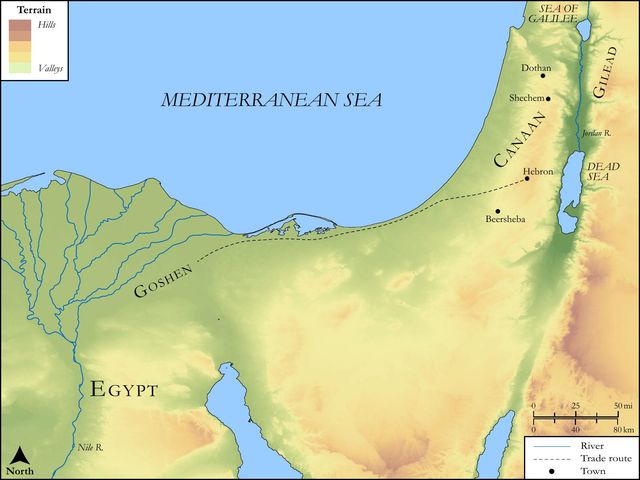
See on the biblical-era maps


Study this verse
Public-domain commentary
Matthew Henry
From his Commentary on the Whole Bible. Henry comments on passages, not single verses — this entry covers Genesis 42:29–38.
Here is, 1. The report which Jacob's sons made to their father of the great distress they had been in in Egypt; how they had been suspected, and threatened, and obliged to leave Simeon a prisoner there, till they should bring Benjamin with them thither. Who would have thought of this when they left home? When we go abroad we should consider how many sad accidents, that we little think of, may befall us before we return home. We know not what a day may bring forth; we ought therefore to be always ready for the worst. 2. The deep impression this made upon the good man. The very bundles of money which Joseph returned, in kindness to his father, frightened him (Gen 42:35); for he concluded it was done with some mischievous design, or perhaps suspected his own sons to have committed some offence, and so to have run themselves into a praemunire - a penalty, which is intimated in what he says (Gen 42:36): Me have you bereaved. He seems to lay the fault upon them; knowing their characters, he feared they had provoked the Egyptians, and perhaps forcibly, or fraudulently, brought home their money. Jacob is here much out of temper. (1.) He has very melancholy apprehensions concerning the present state of his family: Joseph is not, and Simeon is not; whereas Joseph was in honour and Simeon in the way to it. Note, We often perplex ourselves with our own mistakes, even in matters of fact. True griefs may arise from false intelligence and suppositions, Sa2 13:31. Jacob gives up Joseph for gone, and Simeon and Benjamin as being in danger; and he concludes, All these things are against me. It proved otherwise, that all these were for him, were working together for his good and the good of his family: yet here he thinks them all against him. Note, Through our ignorance and mistake, and the weakness of our faith, we often apprehend that to be against us which is really for us. We are afflicted in body, estate, name, and relations; and we think all these things are against us, whereas these are really working for us the weight of glory. (2.) He is at present resolved that Benjamin shall not go down. Reuben will undertake to bring him back in safety (Gen 42:37), not so much as putting in, If the Lord will, nor expecting the common disasters of travellers; but he foolishly bids Jacob slay his two sons (which, it is likely, he was very proud of) if he brought him not back; as if the death of two grandsons could satisfy Jacob for the death of a son. No, Jacob's present thoughts are, My son shall not go down with you. He plainly intimates a distrust of them, remembering that he never saw Joseph since he had been with them; therefore, "Benjamin shall not go with you, by the way in which you go, for you will bring down my gray hairs with sorrow to the grave." Note, It is bad with a family when children conduct themselves so ill that their parents know not how to trust them.
Continue studying Genesis 42:35 across the web’s major study libraries — every link below opens this exact verse, chapter, or book on the destination site.
Read & Compare
 BibleGatewayThis verse in more than 200 translations and 70 languages.
 Bible.comThe YouVersion reader — hundreds of translations, reading plans, and highlights.
 ESV.orgCrossway's official English Standard Version reader.
 NET BibleThe NET translation with 60,000+ translators' notes on every rendering decision.
 STEP BibleTyndale House's free study tool — original text, vocabulary, and scholarly resources.
 BibliaLogos Bible Software's free web reader.
 USCCBThe New American Bible (Revised Edition) with the U.S. bishops' study notes.
Commentaries
 BibleHub CommentariesDozens of classic commentaries on this verse, gathered on one page.
 StudyLightMore than 100 commentary sets — the largest collection on the web.
 BibleRefPlain-English commentary on what this verse means, verse by verse.
 Enduring WordDavid Guzik's free commentary on this chapter, widely used by Bible teachers.
 Bible Study ToolsVerse commentary alongside Greek and Hebrew study aids.
Original Language & Research
- BibleHub InterlinearThe verse word by word — original language, transliteration, and English.
- BibleHub LexiconEvery word's original-language definition and Strong's entry.
 Blue Letter BibleDeep-study tools — Strong's numbers, concordance, and word studies.
 SefariaThe Hebrew text with Rashi and centuries of Jewish commentary.
Sermons, Hymns & Audio


TrulyRandomVerse is not affiliated with these sites and doesn’t control their content. They’re linked because they’re genuinely useful.
Summary
Genesis 42:35 captures the profound moment of fear and bewilderment that seized Jacob's sons and their father upon the startling discovery of the money they had paid for grain mysteriously returned in their sacks. This inexplicable event, uncovered as they emptied their provisions after their initial journey to Egypt, intensified their existing anxieties and deepened their sense of foreboding, serving as a pivotal catalyst in Joseph's intricate, divinely orchestrated plan to reunite his family.
Context
ShowHideLiterary Context
This verse is a dramatic climax following the brothers' first journey to Egypt during a severe famine. Having been accused of being spies by Joseph (whom they did not recognize), they were forced to leave Simeon as a hostage and promised to return with their youngest brother, Benjamin, to prove their honesty. The tension builds as they recount their harrowing experience to their father, Jacob, who is already grieving the presumed loss of Joseph. While Reuben had discovered his money earlier on the journey, causing initial alarm, the full, collective revelation of all the money in all the sacks upon their return home, in Jacob's presence, amplifies the shock and dread, setting the stage for Jacob's desperate resistance to sending Benjamin and the subsequent events leading to the family's full reconciliation.
Historical & Cultural Context
The setting is Jacob's household in Canaan during a widespread famine, a common and devastating occurrence in a largely agrarian world dependent on seasonal rains. Travel for grain, as undertaken by Jacob's sons, was a necessity for survival. The concept of "bundles of money" (H6872, H3701) reflects the practice of carrying precious metals (silver, in this case) as currency, often in tied-up cloths or small bags, rather than standardized coinage. The intense fear of being accused of theft, especially from a powerful foreign official like the Egyptian viceroy (Joseph), was well-founded, as such accusations could lead to severe penalties, including enslavement or death. Furthermore, the patriarchal family structure meant Jacob's word was paramount, and his deep attachment to Benjamin, as the only remaining son of Rachel, was culturally understandable, given the importance of lineage and inheritance.
Key Themes
ShowHideGenesis 42:35 powerfully underscores several overarching themes within the book of Genesis and the broader biblical narrative. The theme of Divine Providence is central; though the characters are gripped by fear and confusion, God's unseen hand is meticulously guiding events, turning human actions and anxieties into steps toward His ultimate purpose of preserving the covenant family and fulfilling Joseph's prophetic dreams. The verse also highlights the theme of Testing and Transformation, as Joseph's actions, including the returned money, serve to test his brothers' character, expose their lingering guilt over their past sin against Joseph, and ultimately lead them to repentance and a profound shift in their moral compass. Their shared fear and the subsequent need to protect Benjamin demonstrate a significant move from their earlier callousness towards true brotherly concern, a crucial step in their spiritual journey.
Exposition and Analysis
ShowHideKey Word Analysis
ShowHideThis term denotes Jacob, the patriarch of the family. Its inclusion here is crucial, as his reaction to the discovery of the money is as significant as that of his sons. His fear underscores the gravity of the situation for the entire family unit, highlighting his parental responsibility and his deep emotional investment, particularly in the fate of Benjamin.
This primitive root means "to see," literally or figuratively. Here, it signifies not just a visual perception but a profound realization and comprehension of the startling reality before them. The act of "seeing" the bundles of money leads directly to their emotional response, indicating that the sight itself was the catalyst for their fear, confirming the inexplicable and potentially dangerous situation.
This word signifies a deep, primitive fear or dread, often with a connotation of awe or reverence when directed towards God. In this context, it conveys a profound terror, far beyond mere surprise. It suggests a sense of being overwhelmed by an unknown threat or a powerful, inexplicable force, perhaps even a sense of divine judgment or retribution for past wrongs.
Verse Breakdown
ShowHide"And it came to pass as they emptied their sacks"
This clause sets the scene, emphasizing the ordinary, domestic act of unpacking provisions after a long journey. The discovery is not made on the road, but in the relative safety of their home, making the subsequent revelation even more jarring and unexpected. The act of emptying the sacks implies a thorough and systematic process, ensuring that the discovery was not accidental or easily dismissed.
"that, behold, every man's bundle of money [was] in his sack"
The interjection "behold" (Hebrew: hinneh) signals a sudden, shocking, and undeniable revelation. The phrase "every man's bundle of money" is critical, indicating that this was not an isolated incident but a universal discovery among all the brothers. The "bundle of money" (Hebrew: tsᵉrôwr keçeph) refers to a specific, identifiable amount of silver, tied up, making its presence undeniable and its return inexplicable, raising immediate questions of theft or entrapment.
"and when [both] they and their father saw the bundles of money, they were afraid"
This final clause highlights the shared and profound emotional impact. The fear (Hebrew: yârêʼ) was not limited to the brothers but extended to Jacob, underscoring the collective nature of their dread. This fear stemmed from multiple sources: the inexplicable nature of the returned money (a trap? an accusation of theft?); the potential for severe repercussions from the powerful Egyptian viceroy; and, perhaps most profoundly, a reawakening of their long-held guilt over their past sin against Joseph, leading them to perceive this strange occurrence as a form of divine retribution or a sign of God's judgment.
Literary Devices
ShowHideThe verse employs several effective literary devices to heighten the drama and emotional impact. The use of irony is prominent, as the very "money" intended for payment, which should have secured their safety and provisions, becomes the source of their greatest fear. The sudden appearance of the bundles, marked by the interjection "behold," functions as a peripeteia, a sudden reversal of fortune or circumstances, transforming a moment of relief (emptying sacks of grain) into one of terror. The collective reaction, "they were afraid," serves as a powerful instance of pathos, evoking a strong sense of shared dread and vulnerability. Furthermore, the narrative uses foreshadowing, as this unsettling discovery propels the plot forward, necessitating a second journey to Egypt and setting the stage for the eventual revelation of Joseph's identity and the family's reconciliation.
Theological and Thematic Connections
ShowHideGenesis 42:35 vividly illustrates the intricate workings of divine providence, demonstrating how God orchestrates seemingly chaotic or frightening events to achieve His benevolent purposes. The brothers' fear, though rooted in their past guilt and present predicament, was a necessary catalyst for their spiritual transformation and a crucial step in Joseph's plan to bring his family to Egypt for their preservation during the famine. This incident powerfully reminds us that even when circumstances appear dire or inexplicable, God remains sovereign, guiding all things towards His ultimate redemptive plan, often using discomfort and fear to expose hidden sin and draw His people closer to Himself.
Reflection and Application
ShowHideThe profound fear experienced by Jacob and his sons in Genesis 42:35, born from an inexplicable situation and their own burdened consciences, offers a powerful lens through which to examine our own responses to life's uncertainties. We often encounter "returned money" moments—situations that defy logic, stir up old anxieties, or seem to threaten our security. This narrative encourages us to look beyond the immediate fear and consider the possibility of God's hidden hand at work. Just as the brothers' terror ultimately led them closer to repentance and the fulfillment of God's plan for their family, our own trials can be opportunities for profound spiritual growth. When faced with the unexplainable, rather than succumbing to despair or accusation, we are invited to cultivate a deeper trust in divine providence, acknowledging that God can use even our deepest fears and most confusing circumstances to expose our need for Him, bring about reconciliation, and advance His good purposes in our lives and the lives of those around us.
Questions for Reflection
ShowHideFAQ
ShowHideWhy did Joseph return the money to his brothers' sacks?
ShowHideJoseph's decision to return the money was a calculated and strategic move within his larger plan to test his brothers and orchestrate their return to Egypt with Benjamin. This act served multiple purposes: it created a compelling pretext for them to return to Egypt, deepened their anxiety and sense of divine judgment (which was part of their process of repentance and self-examination), and provided a means for them to return without appearing to have stolen from him, thus maintaining his benevolent, though disguised, intentions. Ultimately, it was a crucial step in God's sovereign plan to bring the entire family to Egypt for their preservation during the famine, fulfilling Joseph's earlier dreams.
What was the nature of the fear experienced by the brothers and Jacob?
ShowHideTheir fear was profound and multi-faceted, going beyond mere surprise. The Hebrew word yârêʼ (H3372) conveys a deep dread or terror. This fear likely stemmed from several sources: the inexplicable nature of the event itself (was it a trap, a curse, or a sign of divine disfavor?); the severe potential accusation of theft from a powerful Egyptian official, which could lead to dire punishment; and, most significantly, a reawakening of their long-held guilt over their past sin against Joseph. They likely interpreted this strange occurrence as divine retribution or a sign that God was finally addressing their long-suppressed culpability, as evidenced by their earlier confession, "Indeed, we are guilty concerning our brother."
Christ-Centered Fulfillment
ShowHideThe narrative of Joseph, profoundly highlighted by the fear and confusion in Genesis 42:35, serves as a powerful prefigurement of Christ and His redemptive work. Joseph, though innocent, was rejected and sold by his own brothers, much as Christ, the sinless Son of God, was rejected and crucified by His own people. Yet, through this rejection, Joseph ascended to a position of power, becoming a deliverer and provider who ultimately saved his family from famine. Similarly, Christ's crucifixion, seemingly a defeat, led to His resurrection and exaltation, establishing Him as the ultimate Savior and Sustainer of all who believe. The brothers' profound fear and their subsequent journey towards repentance and reconciliation, prompted by Joseph's testing, mirrors humanity's condition before Christ—a state of guilt and separation, desperately needing a deliverer. Through His atoning sacrifice, Christ provides the ultimate "provision," transforming the "fear" of judgment into the "peace" of forgiveness and reconciliation with God, just as Joseph's intricate plan ultimately led his brothers to repentance, a restored relationship with him, and a deeper understanding of God's sovereign hand, paving the way for the lineage through which the Messiah would come, as we see in the genealogy of Matthew 1:1-17.