


2 Samuel 13:31
- וַיָּקָםvai·Ya·komand he aroseH6965Conj-w ¦ V-Qal-ConsecImperf-3msVerb Qal Consecutive Imperfect 3rd Singular Masculineוַandיָּקָםhe arose
- הַמֶּלֶךְha·Me·lekhthe kingH4428Art ¦ N-msNoun Singular Masculine Absoluteהַtheמֶּלֶךְking
- וַיִּקְרַעvai·yik·Ra'and he toreH7167Conj-w ¦ V-Qal-ConsecImperf-3msVerb Qal Consecutive Imperfect 3rd Singular Masculineוַandיִּקְרַעhe tore
- אֶת'et<obj.>H853DirObjMParticle Object Indicator
- בְּגָדָיוbe·ga·Davhis garmentsH899N-mpc ¦ 3msNoun Plural Masculine Constructבְּגָדָיgarmentsוhis
- וַיִּשְׁכַּבvai·yish·Kavand he lay downH7901Conj-w ¦ V-Qal-ConsecImperf-3msVerb Qal Consecutive Imperfect 3rd Singular Masculineוַandיִּשְׁכַּבhe lay down
- אָרְצָה'A·re·tzah[the] ground towardsH776N-fs ¦ SfxNoun Singular Feminine Absoluteאָרְצָ[the] groundהtowards
- וְכָלve·kholand allH3605Conj-w ¦ N-mscNoun Singular Masculine Constructוְandכָלall
- עֲבָדָיו'a·va·Davhis servantsH5650N-mpc ¦ 3msNoun Plural Masculine Constructעֲבָדָיservantsוhis
- נִצָּבִיםni·tza·Vim[were] standingH5324V-Niphal-Prtcpl-mpVerb Niphal Participle Plural Masculine Absolute
- קְרֻעֵיke·ru·'Eitorn ofH7167V-Qal-PassPrtcpl-mpVerb Qal Participle Passive Plural Masculine Construct
- בְגָדִיםve·ga·DimgarmentsH899N-mpNoun Plural Masculine Absolute
English is a literal word-by-word gloss of the Hebrew, not the KJV's wording. Why?
This is the original text the KJV's translators worked from — each Hebrew word with its own literal English meaning in this verse, prepared by scholars at Tyndale House, Cambridge. The KJV translates whole sentences, not word by word, so its wording differs: one Hebrew word can become several English words, and the KJV may choose “the LORD” where the gloss reads “Yahweh”. Both are faithful — they answer different questions. For the KJV's own rendering, switch to the KJV text.
Details
See on the biblical-era map

Study this verse
Public-domain commentary
Matthew Henry
From his Commentary on the Whole Bible. Henry comments on passages, not single verses — this entry covers 2 Samuel 13:30–39.
Here is, I. The fright that David was put into by a false report brought to Jerusalem that Absalom had slain all the king's sons, Sa2 13:30. It is common for fame to make bad worse; and the first news of such a thing as this represents it as more dreadful than afterwards it proves. Let us not therefore be afraid of evil tidings, while they want confirmation, but, when we hear the worst, hope the best, at least hope better. However, this false news gave as much affliction to David, for the present, as if it had been true; he tore his garments, and lay on the earth, while as yet it was only a flying story, Sa2 13:31. It was well that David had grace; he had need enough of it, for he had strong passions.
II.The rectifying of the mistake in two ways:
- 1. By the sly suggestions of Jonadab, David's nephew, who could tell him, Amnon only is dead, and not all the king's sons (Sa2 13:32, Sa2 13:33), and could tell him too that it was done by the appointment of Absalom, and designed from the day Amnon forced his sister Tamar. What a wicked man was he, if he knew all this or had any cause to suspect it, that he did not make David acquainted with it sooner, that means might be used to make up the quarrel, or at least that David might not throw Amnon into the mouth of danger by letting him go to Absalom's house. If we do not our utmost to prevent mischief, we make ourselves accessory to it. If we say, Behold, we knew it not; doth not he that pondereth the heart consider whether we did or no? See Pro 24:11, Pro 24:12. It is well if Jonadab was not as guilty of Amnon's death as he was of his sin; such friends do those prove who are hearkened to as counsellors to do wickedly: he that would not be so kind as to prevent Amnon's sin would not be so kind as to prevent his ruin, when, it should seem, he might have done both. 2. By the safe return of all the king's sons except Amnon. They and their attendants were speedily discovered by the watch (Sa2 13:34, Sa2 13:35), and soon arrived, to show themselves alive, but to bring the certain sad news that Absalom had murdered their brother Amnon. The grief David had been in for that which was not made him the better able to bear that which was, by giving him a sensible occasion, when he was undeceived, to thank God that all his sons were not dead: yet that Amnon was dead, and slain by his own brother is such a treacherous barbarous manner, was enough to put the king and court, the king and kingdom, into real mourning. Sorrow is never more reasonable than when there is sin in the case.
III.Absalom's flight from justice:
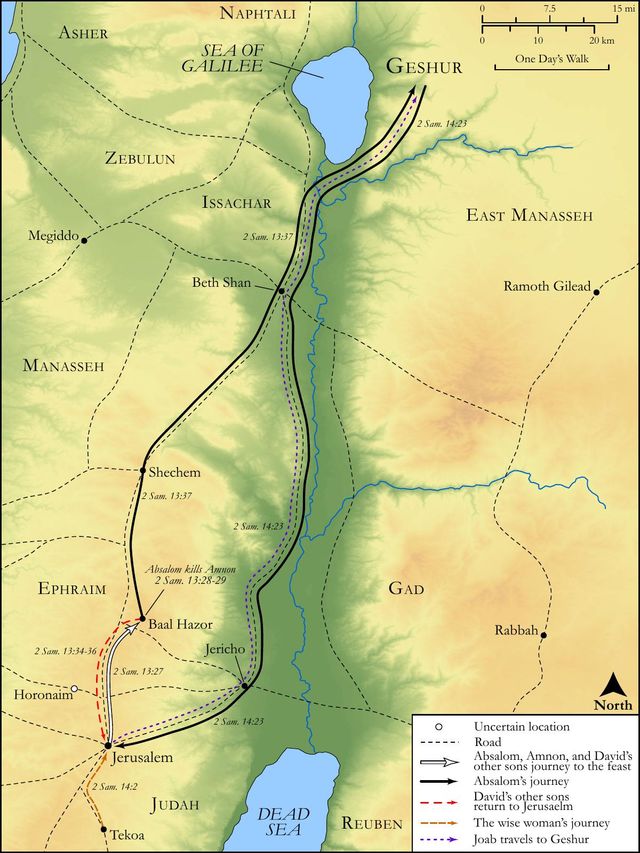
Absalom immediately fled, Sa2 13:34. He was now as much afraid of the king's sons as they were of him; they fled from his malice, he from their justice. No part of the land of Israel could shelter him. The cities of refuge gave no protection to a wilful murderer. Though David had let Amnon's incest go unpunished, Absalom could not promise himself his pardon for this murder; so express was the law in this case, and so well known David's justice, and his dread of blood-guiltiness. He therefore made the best of his way to his mother's relations, and was entertained by his grandfather Talmai, king of Geshur (Sa2 13:37), and there he was protected three years (Sa2 13:38), David not demanding him, and Talmai not thinking himself obliged to send him back unless he were demanded.
IV.David's uneasiness for his absence.
He mourned for Amnon a good while (Sa2 13:37), but, he being past recall, time wore off that grief: he was comforted concerning Amnon. It also wore off too much his detestation of Absalom's sin; instead of loathing him as a murderer, he longs to go forth to him, Sa2 13:39. At first he could not find in his heart to do justice on him; now he can almost find in his heart to take him into his favour again. This was David's infirmity. Something God saw in his heart that made a difference, else we should have thought that he, as much as Eli, honoured his sons more than God.
Continue studying 2 Samuel 13:31 across the web’s major study libraries — every link below opens this exact verse, chapter, or book on the destination site.
Read & Compare
 BibleGatewayThis verse in more than 200 translations and 70 languages.
 Bible.comThe YouVersion reader — hundreds of translations, reading plans, and highlights.
 ESV.orgCrossway's official English Standard Version reader.
 NET BibleThe NET translation with 60,000+ translators' notes on every rendering decision.
 STEP BibleTyndale House's free study tool — original text, vocabulary, and scholarly resources.
 BibliaLogos Bible Software's free web reader.
 USCCBThe New American Bible (Revised Edition) with the U.S. bishops' study notes.
Commentaries
 BibleHub CommentariesDozens of classic commentaries on this verse, gathered on one page.
 StudyLightMore than 100 commentary sets — the largest collection on the web.
 BibleRefPlain-English commentary on what this verse means, verse by verse.
 Enduring WordDavid Guzik's free commentary on this chapter, widely used by Bible teachers.
 Bible Study ToolsVerse commentary alongside Greek and Hebrew study aids.
Original Language & Research
- BibleHub InterlinearThe verse word by word — original language, transliteration, and English.
- BibleHub LexiconEvery word's original-language definition and Strong's entry.
 Blue Letter BibleDeep-study tools — Strong's numbers, concordance, and word studies.
 SefariaThe Hebrew text with Rashi and centuries of Jewish commentary.
Sermons, Hymns & Audio


TrulyRandomVerse is not affiliated with these sites and doesn’t control their content. They’re linked because they’re genuinely useful.
Summary
2 Samuel 13:31 powerfully depicts King David's immediate and overwhelming response to the devastating news of his son Amnon's assassination, a tragic event initially compounded by a false report that all his sons had been slain. This verse captures a moment of profound personal anguish, public mourning, and utter despair within the royal court, underscoring the escalating and painful consequences of sin unfolding within David's family.
Context
ShowHideLiterary Context
This verse marks a critical and tragic turning point in the narrative of David's reign, immediately following Absalom's meticulously planned and brutal assassination of his half-brother Amnon. The motive for this heinous act was Absalom's long-simmering revenge for Amnon's rape of their sister Tamar, an egregious offense that David had failed to adequately address, thereby setting the stage for the escalating familial strife and violence that would plague his household. The news of Amnon's death reached David in a dramatic and exaggerated fashion, initially suggesting that all his sons had been slain, as recounted in 2 Samuel 13:30. This deeply personal tragedy is a bitter fruit of the prophecy delivered by Nathan concerning the consequences of David's own sin with Bathsheba, foretelling that "the sword shall never depart from thine house," a chilling prediction found in 2 Samuel 12:10. The events described in 2 Samuel 13:28-29 directly precede this outpouring of grief, highlighting the immediate and devastating aftermath of Absalom's violent act and his subsequent flight.
Historical & Cultural Context
In ancient Israel and the broader Near East, public displays of grief were not only common but were deeply ingrained cultural and religious practices, serving as a vital part of the mourning process and a communal acknowledgment of profound loss. Tearing one's garments (Hebrew: qara'), as David and his servants do here, was a powerful, non-verbal expression of intense emotion—whether grief, horror, anger, or despair. This act symbolized a tearing of one's inner being, a visceral response to overwhelming sorrow and a public declaration of one's shattered state. Similarly, lying on the earth (or falling to the ground, sitting in ashes) was a posture of profound humility, abject sorrow, and utter brokenness, signifying a complete surrender to grief and a recognition of one's helplessness in the face of tragedy. These actions were deeply ingrained cultural rituals that communicated the magnitude of the loss to the entire community and were understood as appropriate responses to calamity.
Key Themes
ShowHideThis verse powerfully contributes to several key themes within the book of 2 Samuel and the broader Davidic narrative. Firstly, it underscores the theme of Profound Grief and Despair, illustrating that even a powerful king like David is subject to overwhelming human sorrow. His actions—rising, tearing his garments, and lying on the earth—are classic, culturally understood expressions of utter brokenness, demonstrating the depth of his personal pain and the shock of the news. Secondly, it serves as a stark reminder of the Consequences of Sin. While not explicitly stated in this verse, the entire narrative arc from David's sin with Bathsheba through this chapter highlights the painful and far-reaching repercussions of moral failure, even for a forgiven king. The turmoil and violence within his family are a direct, tragic fulfillment of divine judgment, as prophesied by Nathan in 2 Samuel 12:10. Lastly, the verse emphasizes the Public Display of Mourning, as not only David but "all his servants stood by with their clothes rent." This collective shock and shared grief permeating the royal court underscore the magnitude of the tragedy, demonstrating that personal sorrow in a public figure often becomes a communal experience, drawing the entire household into the king's anguish.
Exposition and Analysis
ShowHideKey Word Analysis
ShowHideThis primitive root means "to rise" in various applications. In this context, it signifies a sudden, involuntary movement prompted by the shock and distress of the news. It is not a rising to action or composure, but rather a physical manifestation of an internal jolt, a desperate attempt to grapple with an unbearable reality, leading directly into the subsequent acts of mourning.
This primitive root means "to rend" or "to tear." When applied to garments in biblical contexts, this is a highly symbolic and dramatic act. It signifies extreme emotional distress—whether grief, horror, anger, or despair—and serves as a public, visible declaration of profound internal anguish and a disruption of one's normal state of being. It is a visceral expression of a heart ripped apart by sorrow.
This primitive root means "to lie down." While often referring to rest or sleep, in this context, "lay on the earth" signifies a posture of utter prostration, helplessness, and despair. It is a physical manifestation of being completely overwhelmed by sorrow, a collapse of strength and dignity in the face of unbearable news, indicating a state of profound brokenness and surrender to grief.
Verse Breakdown
ShowHide"Then the king arose"
This phrase immediately conveys the sudden and forceful impact of the news on David. It suggests an involuntary, almost convulsive reaction, as if the shock physically propelled him from his seat or previous state of composure. This marks the initiation of his public and deeply personal display of grief, a sudden shift from normalcy to overwhelming sorrow.
"and tare his garments"
This is a powerful and culturally significant act. David, as king, would have worn fine robes, and the tearing of these garments was a public, non-verbal declaration of profound sorrow, horror, and despair. It symbolized the tearing of his heart and the shattering of his world, a visible sign of his brokenness and the complete disruption of his inner peace.
"and lay on the earth"
This action denotes a complete collapse into grief. Lying prostrate on the ground was a common ancient Near Eastern posture of utter humiliation, submission, and overwhelming sorrow. For a king to do this publicly underscored the depth of his anguish and the devastating blow he had received, demonstrating his helplessness in the face of such tragedy.
"and all his servants stood by with their clothes rent"
This final clause highlights the communal nature of the tragedy and the shared grief within the royal court. The servants' mirroring of David's actions (tearing their clothes) indicates their shock, their empathy with the king's sorrow, and the pervasive sense of calamity that had befallen the royal household. It emphasizes the widespread impact of Absalom's violent act and the collective mourning that gripped the palace.
Literary Devices
ShowHide2 Samuel 13:31 employs several potent literary devices to convey the profound impact of the news on David and his court. The most prominent is Imagery, which creates a vivid mental picture of David's physical response to grief: rising, tearing his clothes, and prostrating himself on the earth. These actions are not merely described but are presented with a raw immediacy that draws the reader into the scene of anguish. Symbolism is also central, as the tearing of garments and lying on the earth are deeply symbolic acts in ancient Israelite culture, universally understood as expressions of extreme sorrow, despair, and brokenness. The act of tearing one's clothes represents the tearing of one's inner being, while lying on the earth signifies utter helplessness and surrender to overwhelming grief. Furthermore, the verse uses Parallelism by showing David's actions mirrored by his servants ("all his servants stood by with their clothes rent"). This parallelism emphasizes the pervasive nature of the tragedy and the collective shock that permeated the royal court, amplifying the sense of widespread calamity and shared mourning. The overall effect is one of intense pathos, evoking deep sympathy for David's suffering and the tragic consequences of his family's dysfunction.
Theological and Thematic Connections
ShowHideDavid's raw display of grief in 2 Samuel 13:31 resonates deeply with the biblical understanding of human suffering and the inevitable consequences of sin. While David was a man after God's own heart, his moral failures, particularly with Bathsheba, unleashed a torrent of familial strife and violence, as prophesied by Nathan. This verse serves as a poignant reminder that even divine forgiveness does not always negate the natural, painful repercussions of our choices in this fallen world. It underscores God's justice, not as vindictive punishment, but as the unfolding of moral order where actions have consequences, even for His chosen ones. David's anguish is a universal human experience of loss, yet it is intensified by the knowledge that this tragedy is intrinsically linked to the unraveling of his own household, a direct result of the "sword" that would not depart from his house. This passage vividly portrays the brokenness that sin inflicts, even upon the righteous, highlighting the deep sorrow that accompanies the disruption of God's intended order.
Reflection and Application
ShowHide2 Samuel 13:31 offers a profound glimpse into the reality of human grief, even for those in positions of power and spiritual favor. David's uninhibited display of sorrow—tearing his garments and prostrating himself—reminds us that authentic emotional expression in times of loss is not a sign of weakness but a necessary part of the human experience. It validates our own struggles with grief, acknowledging that sorrow can be overwhelming and physically debilitating. Furthermore, this verse, embedded within the larger narrative of David's family, serves as a sobering reminder that our actions, particularly our moral failures, can have far-reaching and painful consequences, often impacting those we love most deeply. It calls us to consider the ripple effects of our choices and to seek wisdom and righteousness not only for our own sake but for the well-being of our families and communities. The shared mourning of David's servants also highlights the importance of communal support and empathy in times of tragedy, reminding us to stand with those who grieve and to bear one another's burdens, fostering a spirit of compassion and solidarity within our own communities.
Questions for Reflection
ShowHideFAQ
ShowHideWhy did David tear his garments and lie on the earth?
ShowHideDavid's actions were culturally significant and deeply symbolic expressions of extreme grief, horror, and despair in ancient Israel. Tearing one's garments (Hebrew: qara') was a powerful, public, non-verbal declaration of profound internal anguish, signifying a shattering of one's world and a visceral response to overwhelming sorrow. It was a visible sign that one's inner being was torn apart by tragedy. Lying on the earth, or prostrating oneself, was a posture of utter humility, helplessness, and abject brokenness, signifying a complete surrender to the overwhelming nature of the tragedy. These acts were common and expected responses to devastating news, communicating the magnitude of the loss to all who witnessed it and expressing a profound sense of powerlessness in the face of calamity, as seen in 2 Samuel 13:31.
What was the "false report" that initially compounded David's grief?
ShowHidePrior to the arrival of the messenger with the specific news of Amnon's death, a report had reached David that Absalom had killed all the king's sons at the sheep-shearing feast, as detailed in 2 Samuel 13:30. This exaggerated and terrifying news led David to believe the worst, causing an initial, even greater wave of despair before the truth—that only Amnon had been killed—was revealed. This initial, more devastating report amplified David's immediate reaction of profound sorrow and intensified the shock portrayed in 2 Samuel 13:31, demonstrating the chaotic and emotionally charged atmosphere surrounding the tragic event.
Christ-Centered Fulfillment
ShowHideWhile 2 Samuel 13:31 vividly portrays the profound grief of an earthly king facing the bitter fruit of sin within his own household, it ultimately points to the greater King, Jesus Christ, who perfectly embodies and redeems human suffering. David's sorrow, though immense, is a consequence of his own and his family's sin, a fulfillment of the "sword" that would not depart from his house. In contrast, Jesus, the Son of David, experienced profound grief not for His own sin, but for the sin of the world and the suffering it causes. We see His humanity and empathy in moments like when Jesus wept at Lazarus's tomb, demonstrating a sympathetic heart that fully understands our pain and weakness, as affirmed in Hebrews 4:15. Unlike David, whose actions brought the sword upon his house, Christ came to bring peace and reconciliation, ultimately bearing the full weight of humanity's sin and its consequences on the cross, as prophesied in Isaiah 53. His suffering was not a result of His own failures but a demonstration of God's perfect love for a fallen world (Romans 5:8). Through Christ, the cycle of sin and its devastating consequences, so evident in David's family, is broken, offering true healing, forgiveness, and eternal hope that transcends any earthly sorrow or tragedy, leading to ultimate restoration and peace in His kingdom (Revelation 21:4).