


2 Samuel 13:30
Bible text: King James Version (1769 Blayney text) · Public domain
Bible text: King James Version with Strong's numbers · Public domain
Bible text: Berean Standard Bible · Public domain
Bible text: American Standard Version (1901) · Public domain
Bible text: World English Bible, Messianic edition · Public domain
Bible text: Geneva Bible (1599) · Public domain
Bible text: Young's Literal Translation · Public domain
- וַיְהִיvay·Hiand it wasH1961Conj-w ¦ V-Qal-ConsecImperf-3msVerb Qal Consecutive Imperfect 3rd Singular Masculineוַandיְהִיit was
- הֵמָּהHe·mahtheyH1992Pro-3mpPronoun Personal 3rd Plural Masculine
- בַדֶּרֶךְva·De·rekh[were] on the wayH1870Prep-b ¦ N-csNoun Singular common gender Absoluteבַ[were] on theדֶּרֶךְway
- וְהַשְּׁמֻעָהve·ha·she·mu·'Ahand the reportH8052Conj-w ¦ Art ¦ N-fsNoun Singular Feminine Absoluteוְandהַtheשְּׁמֻעָהreport
- בָאָהVa·'ahit cameH935V-Qal-Perf-3fsVerb Qal Perfect 3rd Singular Feminine
- אֶל'eltoH413PrepPreposition
- דָּוִדda·VidDavidH1732N-proper-mNoun Proper Masculine
- לֵאמֹרle·Mor<to> sayingH559Prep-l ¦ V-Qal-InfVerb Qal Infinitive Constructלֵ<to>אמֹרsaying
- הִכָּהhi·Kahhe has struck downH5221V-Hiphil-Perf-3msVerb Hiphil Perfect 3rd Singular Masculine
- אַבְשָׁלוֹם'av·sha·lOmAbsalomH53N-proper-mNoun Proper Masculine
- אֶת'et<obj.>H853DirObjMParticle Object Indicator
- כָּלkolallH3605N-mscNoun Singular Masculine Construct
- בְּנֵיbe·Nei[the] sons ofH1121N-mpcNoun Plural Masculine Construct
- הַמֶּלֶךְha·Me·lekhthe kingH4428Art ¦ N-msNoun Singular Masculine Absoluteהַtheמֶּלֶךְking
- וְלֹאve·lo'and notH3808Conj-w ¦ NegParticle Negativeוְandלֹאnot
- נוֹתַרno·Tarhe is leftH3498V-Niphal-Perf-3msVerb Niphal Perfect 3rd Singular Masculine
- מֵהֶםme·Hemof <the> themPrep-m ¦ 3mpSuffix Personal 3rd Plural Masculineמֵof <the>הֶםthem
- אֶחָד'e·ChadoneH259N-fsNoun Singular Feminine Absolute
English is a literal word-by-word gloss of the Hebrew, not the KJV's wording. Why?
This is the original text the KJV's translators worked from — each Hebrew word with its own literal English meaning in this verse, prepared by scholars at Tyndale House, Cambridge. The KJV translates whole sentences, not word by word, so its wording differs: one Hebrew word can become several English words, and the KJV may choose “the LORD” where the gloss reads “Yahweh”. Both are faithful — they answer different questions. For the KJV's own rendering, switch to the KJV text.
Details
See on the biblical-era maps

Study this verse
Public-domain commentary
Matthew Henry
From his Commentary on the Whole Bible. Henry comments on passages, not single verses — this entry covers 2 Samuel 13:30–39.
Here is, I. The fright that David was put into by a false report brought to Jerusalem that Absalom had slain all the king's sons, Sa2 13:30. It is common for fame to make bad worse; and the first news of such a thing as this represents it as more dreadful than afterwards it proves. Let us not therefore be afraid of evil tidings, while they want confirmation, but, when we hear the worst, hope the best, at least hope better. However, this false news gave as much affliction to David, for the present, as if it had been true; he tore his garments, and lay on the earth, while as yet it was only a flying story, Sa2 13:31. It was well that David had grace; he had need enough of it, for he had strong passions.
II.The rectifying of the mistake in two ways:
- 1. By the sly suggestions of Jonadab, David's nephew, who could tell him, Amnon only is dead, and not all the king's sons (Sa2 13:32, Sa2 13:33), and could tell him too that it was done by the appointment of Absalom, and designed from the day Amnon forced his sister Tamar. What a wicked man was he, if he knew all this or had any cause to suspect it, that he did not make David acquainted with it sooner, that means might be used to make up the quarrel, or at least that David might not throw Amnon into the mouth of danger by letting him go to Absalom's house. If we do not our utmost to prevent mischief, we make ourselves accessory to it. If we say, Behold, we knew it not; doth not he that pondereth the heart consider whether we did or no? See Pro 24:11, Pro 24:12. It is well if Jonadab was not as guilty of Amnon's death as he was of his sin; such friends do those prove who are hearkened to as counsellors to do wickedly: he that would not be so kind as to prevent Amnon's sin would not be so kind as to prevent his ruin, when, it should seem, he might have done both. 2. By the safe return of all the king's sons except Amnon. They and their attendants were speedily discovered by the watch (Sa2 13:34, Sa2 13:35), and soon arrived, to show themselves alive, but to bring the certain sad news that Absalom had murdered their brother Amnon. The grief David had been in for that which was not made him the better able to bear that which was, by giving him a sensible occasion, when he was undeceived, to thank God that all his sons were not dead: yet that Amnon was dead, and slain by his own brother is such a treacherous barbarous manner, was enough to put the king and court, the king and kingdom, into real mourning. Sorrow is never more reasonable than when there is sin in the case.
III.Absalom's flight from justice:
Absalom immediately fled, Sa2 13:34. He was now as much afraid of the king's sons as they were of him; they fled from his malice, he from their justice. No part of the land of Israel could shelter him. The cities of refuge gave no protection to a wilful murderer. Though David had let Amnon's incest go unpunished, Absalom could not promise himself his pardon for this murder; so express was the law in this case, and so well known David's justice, and his dread of blood-guiltiness. He therefore made the best of his way to his mother's relations, and was entertained by his grandfather Talmai, king of Geshur (Sa2 13:37), and there he was protected three years (Sa2 13:38), David not demanding him, and Talmai not thinking himself obliged to send him back unless he were demanded.
IV.David's uneasiness for his absence.
He mourned for Amnon a good while (Sa2 13:37), but, he being past recall, time wore off that grief: he was comforted concerning Amnon. It also wore off too much his detestation of Absalom's sin; instead of loathing him as a murderer, he longs to go forth to him, Sa2 13:39. At first he could not find in his heart to do justice on him; now he can almost find in his heart to take him into his favour again. This was David's infirmity. Something God saw in his heart that made a difference, else we should have thought that he, as much as Eli, honoured his sons more than God.
Continue studying 2 Samuel 13:30 across the web’s major study libraries — every link below opens this exact verse, chapter, or book on the destination site.
Read & Compare
 BibleGatewayThis verse in more than 200 translations and 70 languages.
 Bible.comThe YouVersion reader — hundreds of translations, reading plans, and highlights.
 ESV.orgCrossway's official English Standard Version reader.
 NET BibleThe NET translation with 60,000+ translators' notes on every rendering decision.
 STEP BibleTyndale House's free study tool — original text, vocabulary, and scholarly resources.
 BibliaLogos Bible Software's free web reader.
 USCCBThe New American Bible (Revised Edition) with the U.S. bishops' study notes.
Commentaries
 BibleHub CommentariesDozens of classic commentaries on this verse, gathered on one page.
 StudyLightMore than 100 commentary sets — the largest collection on the web.
 BibleRefPlain-English commentary on what this verse means, verse by verse.
 Enduring WordDavid Guzik's free commentary on this chapter, widely used by Bible teachers.
 Bible Study ToolsVerse commentary alongside Greek and Hebrew study aids.
Original Language & Research
- BibleHub InterlinearThe verse word by word — original language, transliteration, and English.
- BibleHub LexiconEvery word's original-language definition and Strong's entry.
 Blue Letter BibleDeep-study tools — Strong's numbers, concordance, and word studies.
 SefariaThe Hebrew text with Rashi and centuries of Jewish commentary.
Sermons, Hymns & Audio


TrulyRandomVerse is not affiliated with these sites and doesn’t control their content. They’re linked because they’re genuinely useful.
Summary
This verse captures the dramatic and devastating moment when King David receives a profoundly exaggerated report that Absalom has brutally murdered all of his royal sons. Occurring immediately after Absalom's calculated act of revenge for Amnon's rape of Tamar, the news plunges David's household into a state of profound shock and grief, vividly highlighting the escalating tragedy, moral decay, and the bitter consequences of sin within the royal family.
Context
ShowHideLiterary Context
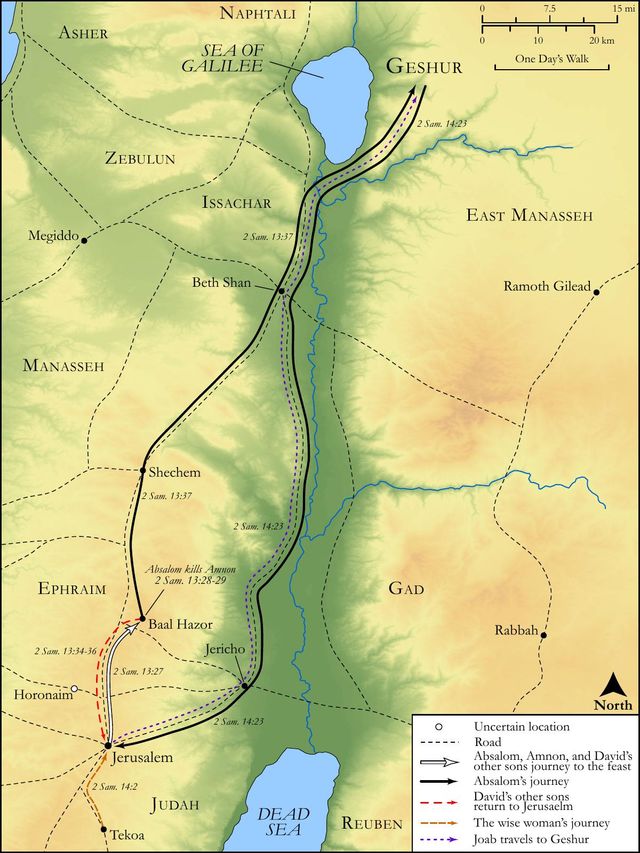
2 Samuel 13:30 is a pivotal and intensely dramatic moment within the tragic narrative of David's family, directly following Absalom's long-simmering resentment and meticulously executed revenge. The preceding verses detail Amnon's heinous rape of Tamar (2 Samuel 13:1-19), David's lamentable failure to administer justice against Amnon, and Absalom's two years of silent, brooding determination. Absalom then cunningly invites all the king's sons to a sheep-shearing feast in Baal-hazor, a seemingly innocuous event that serves as the elaborate setting for his retribution (2 Samuel 13:23-27). While Absalom's specific command was to kill only Amnon (2 Samuel 13:28-29), the panic and chaos that ensued among the fleeing servants and sons led to a dramatically inflated report reaching David. This exaggerated news sets the stage for the king's profound despair described in the verses that immediately follow (2 Samuel 13:31-36), before the truth of Amnon's sole death is eventually confirmed by Jonathan.
Historical & Cultural Context
The events of 2 Samuel 13:30 unfold within the patriarchal and monarchical structure of ancient Israel, where family honor, especially within the royal house, was paramount. Royal justice was not merely expected but demanded, and David's prolonged inaction following Amnon's egregious crime against Tamar was a significant dereliction of his kingly and fatherly duty. Sheep-shearing feasts were common agricultural celebrations, often accompanied by feasting, revelry, and even drunkenness, making them opportune settings for a clandestine and violent plot such as Absalom's. The swift spread of news in this era, typically through runners or word-of-mouth, meant that initial reports, especially in times of panic and chaos, were highly susceptible to exaggeration, misunderstanding, and distortion. The profound sanctity of family honor and the severe societal consequences of sexual assault in this culture underscore the depth of Absalom's perceived justification for his revenge, even as his method was illicit, extreme, and ultimately destructive to his own family.
Key Themes
ShowHideThis verse powerfully contributes to several overarching themes woven throughout the book of 2 Samuel. Firstly, it starkly underscores the Consequences of Sin, particularly how David's own past moral failures (as prophesied by Nathan in 2 Samuel 12:10, declaring that "the sword shall never depart from thine house") continue to manifest as internal strife, violence, and tragedy within his own household. Amnon's sin, David's inaction, and Absalom's vengeful response form a tragic and interconnected chain reaction. Secondly, the verse highlights the pervasive theme of Misinformation and Deception. The core of the verse is the false report, which, though rooted in a real event, is grossly exaggerated, leading to widespread panic and profound grief. This emphasizes the danger of unverified news and the ease with which rumors can spread and cause devastating emotional and social upheaval. Finally, by depicting David's immediate and overwhelming reaction, the verse vividly sets the stage for the theme of Parental Grief and Loss, as the king's profound anguish at believing he has lost all his children foreshadows and compounds the sorrow that would later engulf him through other tragic events involving Absalom himself.
Exposition and Analysis
ShowHideKey Word Analysis
ShowHideThis Hebrew noun (H8052) refers to a "report," "news," or "rumor," derived from a root meaning "to hear." Its use here emphasizes that what reached David was a communication, a piece of information that had been heard and relayed, rather than a direct, eyewitness account confirmed by the king's own intelligence. The nature of "tidings" often implies a degree of uncertainty or the potential for inaccuracy, which is precisely the case in 2 Samuel 13:30, as the report is later proven to be hyperbolic.
A primitive root (H5221) meaning "to strike" (lightly or severely), "smite," or "kill." This word conveys a sense of violent, decisive, and often fatal action. The report uses this strong verb to describe Absalom's alleged act, leaving no ambiguity about the perceived outcome: a complete massacre. The choice of this verb underscores the brutality of the reported event and the terror it would have instilled in those fleeing.
This numeral (H259) primarily means "united" or "one," but also "any" or "only." In the phrase "and there is not one of them left," its inclusion is critical. It signifies the absolute totality of the reported destruction, implying that not even a single son survived. This word, therefore, is central to the hyperbolic element of the report, transforming a singular murder into a perceived dynastic catastrophe and eliciting David's extreme reaction of despair and grief. The contrast between this claim and the later clarification that only Amnon was killed highlights the dramatic irony and the destructive power of misinformation.
Verse Breakdown
ShowHide"And it came to pass, while they were in the way"
This opening clause sets the immediate scene for the unfolding drama. "They" refers to the king's sons and their servants who were returning from Absalom's sheep-shearing feast. The phrase "in the way" suggests they were still traveling, perhaps some distance from Jerusalem, when the news was dispatched, emphasizing the suddenness and unexpected nature of the report's arrival, catching David off guard.
"that tidings came to David"
This indicates the direct and immediate delivery of the news to the king. The speed with which such a grave report would be rushed to the capital highlights the urgency and perceived magnitude of the event. The passive construction "tidings came" emphasizes the external nature of the information's arrival, rather than David actively seeking it, underscoring his vulnerability to external reports.
"saying, Absalom hath slain all the king's sons, and there is not one of them left"
This is the core of the verse, containing the shocking and exaggerated content of the report. The declaration that "all the king's sons" have been killed, with "not one of them left," is a hyperbole that magnifies the tragedy far beyond the actual event (only Amnon was killed). This extreme statement is designed to convey utter devastation and likely reflects the profound panic, fear, and misunderstanding of the messenger or those who first relayed the news. It dramatically sets up the tension for David's subsequent reaction and the eventual clarification of the true events.
Literary Devices
ShowHideThe primary literary device at play in 2 Samuel 13:30 is Hyperbole. The report that "Absalom hath slain all the king's sons, and there is not one of them left" is a deliberate and significant overstatement. While Absalom did indeed kill Amnon, his command was specific to Amnon, not all of David's sons. This exaggeration serves to heighten the dramatic tension and underscore the immediate, overwhelming panic that gripped those fleeing the scene. It effectively conveys the messenger's terror and the perceived magnitude of the tragedy from their perspective, even if factually inaccurate. Additionally, there is a strong element of Dramatic Irony, as the reader is already privy to Absalom's specific instructions to kill only Amnon (2 Samuel 13:28), while David is not. This disparity in knowledge leads to David's profound and misplaced grief, drawing the audience deeper into the emotional turmoil and tragic unfolding of the narrative.
Theological and Thematic Connections
ShowHideThis verse serves as a stark reminder of the devastating ripple effects of unaddressed sin and the profound fragility of peace, even within a powerful royal household. The immediate panic and exaggerated report underscore the human propensity for misinformation and the chaos, fear, and sorrow it can sow. Theologically, it illustrates the enduring principle that actions have consequences, and David's earlier failures to administer justice create a fertile ground for further violence, deception, and division within his own family, tragically fulfilling the prophecy that the sword would never depart from his house. It highlights the profound pain of parental grief and the vulnerability of even the most powerful leaders to personal sorrow and the bitter consequences of moral compromise. The narrative warns against hasty judgment based on incomplete or exaggerated information and emphasizes the critical importance of seeking truth and exercising discernment in the face of alarming reports.
Reflection and Application
ShowHideThe sudden, shocking, and exaggerated news that reaches King David in this verse offers timeless and potent lessons for our own lives. In an age saturated with information, much of it unverified, emotionally charged, or deliberately misleading, the imperative to discern truth from rumor is more critical than ever. We are called to cultivate a spirit of discernment, resisting the urge to react impulsively or spread alarming reports without first seeking confirmation and clarity. Furthermore, this narrative powerfully illustrates the insidious and far-reaching nature of unaddressed sin. Amnon's transgression, David's inaction, and Absalom's vengeful response demonstrate how one moral failing, left unpunished or unrepented, can unleash a torrent of pain, division, and destruction within families, communities, and even nations. It challenges us to confront sin swiftly and justly, seeking reconciliation, repentance, and healing rather than allowing bitterness, resentment, or injustice to fester and poison relationships. Finally, David's raw and overwhelming grief, even if based on a false premise, reminds us of the profound human capacity for sorrow and the necessity of compassion, empathy, and support when others face perceived or actual loss.
Questions for Reflection
ShowHideFAQ
ShowHideWas the messenger intentionally deceptive in reporting that all of David's sons were slain?
ShowHideIt is highly unlikely the messenger was intentionally deceptive in a malicious sense. More probably, the report was a direct product of the extreme panic and chaos that erupted after Amnon's murder. Those fleeing the scene would have been in a state of terror, and in such circumstances, details can easily become exaggerated or misconstrued. The sight of Absalom's men striking down Amnon, coupled with the immediate flight of the other sons, could have led to the terrifying, albeit incorrect, conclusion that a wholesale massacre was underway. The messenger was likely relaying what they genuinely believed or what was being wildly rumored in the immediate aftermath, rather than fabricating a deliberate lie to deceive the king.
How does this event relate to Nathan's prophecy to David?
ShowHideThis event is a direct and tragic fulfillment of Nathan's prophecy to David in 2 Samuel 12:10. After David's grievous sin with Bathsheba and Uriah, Nathan declared, "Now therefore the sword shall never depart from thine house." The murder of Amnon by Absalom, and the subsequent family strife, rebellion, and bloodshed that plague David's remaining reign, are the bitter fruits of this divine judgment. This verse, with its report of fratricide, marks a significant and devastating escalation of the internal violence and division that would continually plague David's household, demonstrating the far-reaching and devastating consequences of sin, even for a man described as being after God's own heart.
What was David's immediate reaction to this devastating news?
ShowHideDavid's immediate reaction, described in the very next verse, 2 Samuel 13:31, was one of profound and utter despair. Upon hearing the news, he tore his clothes, a common and deeply symbolic sign of intense mourning and distress in ancient Israel, and lay on the ground, expressing his overwhelming grief and desolation at the perceived loss of all his sons. His servants also tore their clothes, sharing in the king's sorrow and the shock of the news. This raw and public display of emotion underscores the depth of his paternal love and the devastating impact of the exaggerated report.
Christ-Centered Fulfillment
ShowHideThe chaos, deception, and cycle of violence so tragically evident in David's household, culminating in this verse's report of fratricide, powerfully underscore humanity's desperate need for a perfect King and a true Mediator. David, though a man after God's own heart, was deeply flawed, and his failures led to the "sword" never departing from his house, as prophesied (2 Samuel 12:10). The exaggerated report of all sons being slain highlights the pervasive brokenness of a sin-cursed world and the profound fear of utter loss that sin introduces. In stark contrast, Jesus, the ultimate Son of David, brings an end to this cycle of sin and its devastating consequences. He is the very embodiment of Truth (John 14:6), who dispels all misinformation and offers genuine, lasting peace, unlike the false tidings that plunged David into despair. He is the Lamb of God who truly takes away the sin of the world (John 1:29), offering reconciliation and redemption where David's family knew only revenge and division (Romans 5:10). Unlike David's perceived loss of all his sons, Jesus, the Good Shepherd, lays down His life for His sheep, ensuring that none are lost, but have eternal life in Him (John 10:11, John 10:28). His kingdom is one of righteousness, peace, and joy in the Holy Spirit, where the sword of internal strife is replaced by the peace that surpasses all understanding (Romans 14:17), a peace that is both true and eternal.