


2 Samuel 13:28
- וַיְצַוvay·Tzavand he commandedH6680Conj-w ¦ V-Piel-ConsecImperf-3msVerb Piel Consecutive Imperfect 3rd Singular Masculineוַandיְצַוhe commanded
- אַבְשָׁלוֹם'av·sha·LomAbsalomH53N-proper-mNoun Proper Masculine
- אֶת'et<obj.>H853DirObjMParticle Object Indicator
- נְעָרָיוne·'a·Ravhis servantsH5288N-mpc ¦ 3msNoun Plural Masculine Constructנְעָרָיservantsוhis
- לֵאמֹרle·Mor<to> sayingH559Prep-l ¦ V-Qal-InfVerb Qal Infinitive Constructלֵ<to>אמֹרsaying
- רְאוּre·'UlookH7200V-Qal-Imp-2mpVerb Qal Imperative 2nd Plural Masculine
- נָאna'pleaseH4994PrtParticle Interjection
- כְּטוֹבke·Tovwhen is goodH2895Prep-k ¦ V-Qal-InfVerb Qal Infinitive Constructכְּwhenטוֹבis good
- לֵבlev[the] heart ofH3820N-mscNoun Singular Masculine Construct
- אַמְנוֹן'am·NonAmnonH550N-proper-mNoun Proper Masculine
- בַּיַּיִןbai·Ya·yinwith the wineH3196Prep-b ¦ N-msNoun Singular Masculine Absoluteבַּwith theיַּיִןwine
- וְאָמַרְתִּיve·'a·mar·Tiand I will sayH559Conj-w ¦ V-Qal-ConsecPerf-1csVerb Qal Consecutive Perfect 1st Singular common genderוְandאָמַרְתִּיI will say
- אֲלֵיכֶם'a·lei·Khemto youH413Prep ¦ 2mpPreposition Definiteאֲלֵיtoכֶםyou
- הַכּוּha·Kustrike downH5221V-Hiphil-Imp-2mpVerb Hiphil Imperative 2nd Plural Masculine
- אֶת'et<obj.>H853DirObjMParticle Object Indicator
- אַמְנוֹן'am·NonAmnonH550N-proper-mNoun Proper Masculine
- וַהֲמִתֶּםva·ha·mi·Temand you will killH4191Conj-w ¦ V-Hiphil-ConsecPerf-2mpVerb Hiphil Consecutive Perfect 2nd Plural Masculineוַandהֲמִתֶּםyou will kill
- אֹתוֹ'o·To<obj.> himH853DirObjM ¦ 3msParticle Object Indicatorאֹת<obj.>וֹhim
- אַל'almay notH408NegParticle Negative
- תִּירָאוּti·Ra·'uyou be afraidH3372V-Qal-Imperf-2mpVerb Qal Imperfect 2nd Plural Masculine
- הֲלוֹאha·Lo'¿ In-H3808Interrog ¦ NegParticle Negativeהֲ¿לוֹאIn-
- כִּיkideedH3588PrtParticle Conditional
- אָנֹכִי'a·no·KhiIH595Pro-1csPronoun Personal 1st Singular common gender
- צִוִּיתִיtzi·Vi·tiI have commandedH6680V-Piel-Perf-1csVerb Piel Perfect 1st Singular common gender
- אֶתְכֶם'et·Khem<obj.> youH853DirObjM ¦ 2mpParticle Object Indicatorאֶתְ<obj.>כֶםyou
- חִזְקוּchiz·Kube strongH2388V-Qal-Imp-2mpVerb Qal Imperative 2nd Plural Masculine
- וִהְיוּvih·Yuand becomeH1961Conj-w ¦ V-Qal-Imp-2mpVerb Qal Imperative 2nd Plural Masculineוִandהְיוּbecome
- לִבְנֵיliv·nei<into> sons ofH1121Prep-l ¦ N-mpcNoun Plural Masculine Constructלִ<into>בְנֵיsons of
- חָיִלCha·yilstrengthH2428N-msNoun Singular Masculine Absolute
English is a literal word-by-word gloss of the Hebrew, not the KJV's wording. Why?
This is the original text the KJV's translators worked from — each Hebrew word with its own literal English meaning in this verse, prepared by scholars at Tyndale House, Cambridge. The KJV translates whole sentences, not word by word, so its wording differs: one Hebrew word can become several English words, and the KJV may choose “the LORD” where the gloss reads “Yahweh”. Both are faithful — they answer different questions. For the KJV's own rendering, switch to the KJV text.
Details
See on the biblical-era map
Study this verse
Public-domain commentary
Matthew Henry
From his Commentary on the Whole Bible. Henry comments on passages, not single verses — this entry covers 2 Samuel 13:21–29. His three-level outline is real structure in the source text, so it is rendered as structure.
What Solomon says of the beginning of strife is as true of the beginning of all sin, it is as the letting forth of water; when once the flood-gates are plucked up, an inundation follows; one mischief begets another, and it is hard to say what shall be in the end thereof.
I.We are here told how David resented the tidings of Amnon's sin:
He was very wroth, Sa2 13:21. So he had reason to be, that his own son should do such a wicked thing and draw him to be accessory to it. It would be a reproach to him for not giving him a better education; it would be a blot upon his family, the ruin of his daughter, a bad example to his kingdom, and a wrong to his son's soul. But was it enough for him to be angry? He ought to have punished his son for it, and have put him to open shame; both as a father and as a king he had power to do it. But the Septuagint here adds these words: But he saddened not the spirit of his son Amnon, because he loved him, because he was his first-born. He fell into Eli's error, whose sons made themselves vile, and he frowned not on them. If Amnon was dear to him, his punishing him would have been so much the greater punishment to himself for his own uncleanness. But he cannot bear the shame those must submit to who correct that in others which they are conscious of in themselves, and therefore his anger must serve instead of his justice; and this hardens sinners, Ecc 8:11.
II.How Absalom resented it.
He resolves already to do the part of a judge in Israel; and, since his father will not punish Amnon, he will, from a principle, not of justice or zeal for virtue, but of revenge, because he reckons himself affronted in the abuse done to his sister. Their mother was daughter to a heathen prince (Sa2 3:3), which perhaps they were upbraided with sometimes by their brethren, as children of a stranger. As such a one Absalom thought his sister was now treated; and, if Amnon thought her fit to be made his harlot, he would think him fit to be made his slave. This enraged him, and nothing less than the blood of Amnon will quench his rage. Here we have,
1.The design conceived: Absalom hated Amnon (Sa2 13:22), and he that hateth his brother is a murderer already, and, like Cain, is of that wicked one, Jo1 3:12, Jo1 3:15. Absalom's hatred of his brother's crime would have been commendable, and he might justly have prosecuted him for it by a due course of law, for example to others, and the making of some compensation to his injured sister; but to hate his person, and design his death by assassination, was to put a great affront upon God, by offering to repair the breach of his seventh commandment by the violation of his sixth, as if they were not all alike sacred. But he that said, Do not commit adultery, said also, Do not kill, Jam 2:11.
2.The design concealed. He said nothing to Amnon of this matter, either good or bad, appeared as if he did not know it, and maintained towards him his usual civility, only waiting for a fair opportunity to do him a mischief. That malice is the worst,
(1.)Which is hidden closely, and has no vent given to it. If Absalom had reasoned the matter with Amnon, he might have convinced him of his sin and brought him to repentance; but, saying nothing, Amnon's heart was hardened, and his own more and more embittered against him; therefore rebuking our neighbour is opposed to hating him in our hearts, Lev 19:17. Let passion have vent and it will spend itself.
(2.)Which is gilded over with a show of friendship; so Absalom's was, his words smoother than butter but war in his heart. See Pro 26:26.
(3.)Which is harboured long. Two full years Absalom nursed this root of bitterness, Sa2 13:24. It may be, at first, he did not intend to kill his brother (for, if he had, he might have had as fair an opportunity to do it as he had at last), and only waited for an occasion to disgrace him or do him some other mischief; but in time his hatred ripened to this, that he would be no less than the death of him. If the sun going down once upon the wrath gives such place to the devil (as is intimated, Eph 4:26, Eph 4:27), what would the sunsets of two full years do?
3.The design laid.
(1.)Absalom has a feast at his house in the country, as Nabal had, on occasion of his sheep-shearing, Sa2 13:23. Attentive as Absalom was to his person (Sa2 14:26), and as high as he looked, he knew the state of his flocks and looked well to his herds. Those who have no other care about their estates in the country than how to spend them in the town take a ready way to see the end of them. When Absalom had sheep-shearers he would himself be with them.
(2.)To this feast he invites the king his father, and all the princes of the blood (Sa2 13:24), not only that he might have this opportunity to pay his respects to them, but that he might make himself the more respected among his neighbours. Those that are akin to great folks are apt to value themselves too much on their kindred.
(3.)The king would not go himself, because he would not put him to the expense of his entertainment, Sa2 13:25. It seems Absalom had an estate in his own hands, on which he lived like himself; the king had given it to him, but would have him to be a good husband of it: in both these he is an example to parents, when their children have grown up, to give them a competency to live upon, according to their rank, and then to take care that they do not live above it, especially that they be no way accessory to their doing so. It is prudent for young house-keepers to begin as they can hold out, and not to spend the wool upon the shearing of it.
(4.)Absalom got leave for Amnon, and all the rest of the king's sons, to come and grace his table in the country, Sa2 13:26, Sa2 13:27. Absalom had so effectually concealed his enmity to Amnon that David saw no reason to suspect any design upon him in that particular invitation: "Let my brother Amnon go;" but this would make the stroke more cutting to David that he was himself drawn in to consent to that which gave the opportunity for it, as before, Sa2 13:7. It seems, David's sons, though grown up, continued to pay such a deference to their father as not to go such a small journey as this without leave. Thus ought children, even when they have become men and women, to honour their parents, consult them, and do nothing material without their consent, much less against their mind.
4.The design executed, Sa2 13:28, Sa2 13:29.
(1.)Absalom's entertainment was very plentiful; for he resolves that they shall all be merry with wine, at least concludes that Amnon will be so, for he knew that he was apt to drink to excess. But,
(2.)The orders he gave to his servants concerning Amnon, that they should mingle his blood with his wine, were very barbarous. Had he challenged him, and, in reliance upon the goodness of his cause and the justice of God, fought him himself, though that would have been bad enough, yet it would have been more honourable and excusable (our ancient law, in some cases, allowed trial by battle); but to murder him, as he did, was to copy Cain's example, only that the reason made a difference: Abel was slain for his righteousness, Amnon for his wickedness. Observe the aggravations of this sin: - [1.] He would have Amnon slain when his heart was merry with wine, and he was consequently least apprehensive of danger, least able to resist it, and also least fit to go out of the world; as if his malice aimed to destroy both soul and body, not giving him time to say, Lord, have mercy upon me. What a dreadful surprise hath death been to many, whose hearts have been overcharged with surfeiting and drunkenness! [2.] His servants must be employed to do it, and so involved in the guilt. He was to give the word of command - Smite Amnon; and then they, in obedience to him, and, upon presumption that his authority would bear them out, must kill him. What an impious defiance does he bid to the divine law, when, though the command of God is express, Thou shalt not kill, he bids them kill Amnon, with this warrant, "Have not I commanded you? That is enough. Be courageous, and fear neither God nor man." Those servants are ill taught who obey their masters in contradiction to God, and those are wicked masters who have taught them to do so. Those are too obsequious that will damn their souls to please their masters, whose big words cannot secure them from God's wrath. Masters must always command their servants as those that know they also have a Master in heaven. [3.] He did it in the presence of all the king's sons, of whom it is said (Sa2 8:18) that they were chief rulers; so that it was an affront to public justice which they had the administration of, and to the king his father whom they represented, and a contempt of that sword which should have been a terror to his evil deeds, while his evil deeds, on the contrary, were a terror to those that bore it. [4.] There is reason to suspect that Absalom did this, not only to revenge his sister's quarrel, but to make way for himself to the throne, which he was ambitious of, and which he would stand fair for if Amnon the eldest son was taken off. When the word of command was given Absalom's servants failed not to execute it, being buoyed up with an opinion that their master, being now next heir to the crown (for Chileab was dead, as bishop Patrick thinks), would save them from harm. Now the threatened sword is drawn in David's house which should not depart from it. First, His eldest son falls by it, himself being, by his wickedness, the cause of it, and his father, by his connivance, accessory to it. Secondly, All his sons flee from it, and come home in terror, not knowing how far their brother Absalom's bloody design might extend. See what mischief sin makes in families.
Continue studying 2 Samuel 13:28 across the web’s major study libraries — every link below opens this exact verse, chapter, or book on the destination site.
Read & Compare
 BibleGatewayThis verse in more than 200 translations and 70 languages.
 Bible.comThe YouVersion reader — hundreds of translations, reading plans, and highlights.
 ESV.orgCrossway's official English Standard Version reader.
 NET BibleThe NET translation with 60,000+ translators' notes on every rendering decision.
 STEP BibleTyndale House's free study tool — original text, vocabulary, and scholarly resources.
 BibliaLogos Bible Software's free web reader.
 USCCBThe New American Bible (Revised Edition) with the U.S. bishops' study notes.
Commentaries
 BibleHub CommentariesDozens of classic commentaries on this verse, gathered on one page.
 StudyLightMore than 100 commentary sets — the largest collection on the web.
 BibleRefPlain-English commentary on what this verse means, verse by verse.
 Enduring WordDavid Guzik's free commentary on this chapter, widely used by Bible teachers.
 Bible Study ToolsVerse commentary alongside Greek and Hebrew study aids.
Original Language & Research
- BibleHub InterlinearThe verse word by word — original language, transliteration, and English.
- BibleHub LexiconEvery word's original-language definition and Strong's entry.
 Blue Letter BibleDeep-study tools — Strong's numbers, concordance, and word studies.
 SefariaThe Hebrew text with Rashi and centuries of Jewish commentary.
Sermons, Hymns & Audio


TrulyRandomVerse is not affiliated with these sites and doesn’t control their content. They’re linked because they’re genuinely useful.
Summary
records the chilling, premeditated command from Absalom to his servants for the assassination of his half-brother Amnon. This verse marks the culmination of two years of simmering resentment and calculated plotting, following Amnon's heinous rape of Absalom's full sister, Tamar. Absalom's precise instructions reveal a cold, vengeful act, meticulously designed to be executed when Amnon was most vulnerable due to intoxication, tragically underscoring the escalating consequences of unaddressed sin, familial breakdown, and the destructive pursuit of personal retribution within King David's royal household.
Context
ShowHideLiterary Context
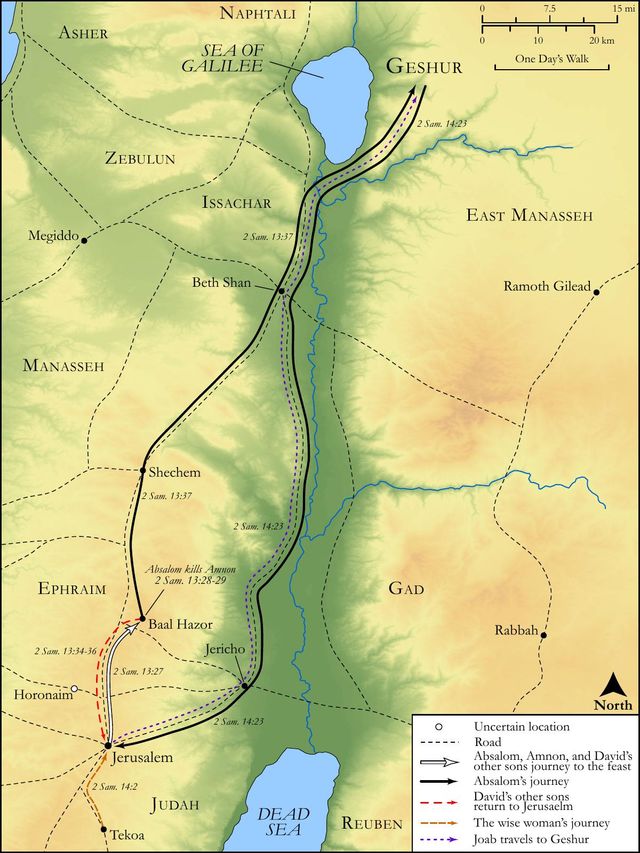
This verse serves as the climactic and tragic turning point in a deeply disturbing narrative of sin and its consequences within David's family. The preceding chapters meticulously detail the moral decay that began with David's own sin with Bathsheba and its prophetic repercussions. Specifically, 2 Samuel 13 opens with Amnon's obsessive desire for Tamar, his half-sister, culminating in her brutal rape (2 Samuel 13:1-19). David's passive and inadequate response to this atrocity (2 Samuel 13:21) leaves the crime unpunished and sets the stage for Absalom's two-year silent harboring of hatred and his meticulous plot for revenge. Absalom's invitation of all the king's sons to a sheep-shearing feast at Baal-hazor (2 Samuel 13:23-27) is not a gesture of reconciliation but a carefully orchestrated trap. The immediate aftermath, described in 2 Samuel 13:29-39, depicts the ensuing chaos, Absalom's flight to Geshur, and David's prolonged grief, which collectively lay the groundwork for Absalom's eventual return and his devastating rebellion against his father in 2 Samuel 15.
Historical & Cultural Context
The events unfold within the patriarchal and monarchical society of ancient Israel, where family honor, purity, and the king's authority were paramount. Sheep-shearing festivals were significant agricultural events, often accompanied by extensive feasting, merriment, and large gatherings, making them ideal settings for both legitimate celebrations and, as tragically demonstrated here, for clandestine plots. In this cultural milieu, a woman's virginity was highly valued, and rape was considered a grave offense, bringing immense shame upon her and her family. The king, as the supreme judge, was expected to uphold justice. David's failure to administer justice for Tamar's rape was a profound dereliction of his royal and paternal duties, deeply undermining his authority and exacerbating the crisis within his own house. While the concept of "blood vengeance" (גאולת הדם - go'alut ha-dam) existed in ancient Israel, it was typically regulated and carried out by a designated "avenger of blood" within specific legal frameworks, often for unintentional homicide. Absalom's act, however, is a personal, calculated murder, driven by his own sense of aggrieved honor and desire for retribution, falling outside any sanctioned legal or cultural practice.
Key Themes
ShowHideThis verse powerfully contributes to several overarching themes woven throughout 2 Samuel. It vividly illustrates the destructive consequences of sin, particularly when it is unaddressed or unpunished, and how it can metastasize through generations. David's inaction concerning Amnon's crime directly precipitates Absalom's murderous revenge, fulfilling, in part, Nathan's chilling prophecy that "the sword shall never depart from your house" (2 Samuel 12:10). The passage also highlights the profound tension between human vengeance and divine justice, demonstrating how personal retribution, even if provoked by grievous wrong, leads to further bloodshed, moral decay, and a spiraling cycle of violence rather than true resolution or healing. Furthermore, it exposes the corrupting influence of power and authority, as Absalom, a prince, manipulates and coerces his servants into committing murder, demonstrating a chilling disregard for life and law, which ominously foreshadows his later usurpation of David's throne and his attempts to seize power through deception and violence (2 Samuel 15:1-12).
Exposition and Analysis
ShowHideKey Word Analysis
ShowHideThis word, meaning "good" or "pleasant," is used here in conjunction with "heart" (lêb) and "wine" (yayin) to describe Amnon's state. It signifies a condition of cheerfulness, contentment, and uninhibitedness brought about by intoxication. Absalom's instruction to wait until Amnon's "heart is merry with wine" indicates his cold, calculated intent to strike when his victim's judgment was impaired, his guard was down, and he was least capable of resistance or self-defense, highlighting the treacherous nature of the plot.
This primitive root means "to fear," "to be afraid," or "to dread." In the negative imperative "fear not" (אַל תִּירְאוּ - 'al tir'u), it is Absalom's direct command to his servants to overcome any apprehension, moral qualms, or fear of reprisal they might feel regarding the grave act he is ordering. Absalom understands the enormity of the deed and seeks to alleviate their natural human hesitation, effectively binding them to his will through a combination of authority and psychological reassurance.
This root means "to constitute," "to enjoin," or "to give a charge." The use of this verb in the perfect tense ("have not I commanded you?") emphasizes that Absalom's order is not merely a suggestion but a firm, decisive, and irreversible decree. It underscores his absolute authority over his servants and his full assumption of responsibility for the act, serving both as a guarantee of protection for his agents and an implicit threat of severe consequences should they disobey his direct and binding instruction.
Verse Breakdown
ShowHide"Now Absalom had commanded his servants, saying,"
This opening clause immediately establishes Absalom's central role as the orchestrator of the crime and highlights the premeditated nature of his actions. It underscores his deliberate planning and the direct issuance of a murderous order to his subordinates, indicating a calculated and cold-blooded intent.
"Mark ye now when Amnon's heart is merry with wine,"
This is Absalom's first specific and strategic instruction, revealing his intent to exploit Amnon's vulnerability. He targets a moment when Amnon would be intoxicated, cheerful, and therefore less alert and capable of defense, indicating a cowardly ambush rather than an honorable confrontation.
"and when I say unto you, Smite Amnon;"
This clause provides the precise trigger for the attack, emphasizing Absalom's absolute control. By reserving the final signal for himself, he maintains command over the execution of his plan, reinforcing his personal involvement and the unwavering authority he wields over his servants. The verb "smite" (הכו - hakku) is a strong imperative, meaning to strike down or kill.
"then kill him, fear not:"
This is the explicit, unequivocal command for murder, immediately followed by a powerful reassurance. The dual imperative "kill him" leaves no room for misinterpretation of the intent, while "fear not" directly addresses the servants' potential apprehension, indicating Absalom's awareness of the enormity of the deed and his determination to overcome any moral or physical resistance from his agents.
"have not I commanded you?"
This rhetorical question serves as Absalom's ultimate guarantee and assertion of responsibility. It is a powerful declaration of his authority and a promise of protection, designed to quell any lingering doubts or fears among his servants by assuring them that the blame and consequences, if any, would fall squarely upon him.
"be courageous, and be valiant."
These final imperatives are a forceful call to action, urging his servants to overcome any moral or physical hesitation and execute the command with strength, resolve, and unwavering loyalty. They serve as a final psychological push, framing the act not as a crime but as a display of loyalty and strength under his leadership, despite the ignoble nature of the deed.
Literary Devices
ShowHideThe verse is saturated with the Imperative Mood, as Absalom issues a rapid succession of direct commands: "Mark ye," "Smite," "kill him," "fear not," "be courageous," and "be valiant." This pervasive use of imperatives powerfully underscores Absalom's absolute authority and his forceful, non-negotiable control over his servants, highlighting the chilling certainty of his murderous decree. There is a strong sense of Foreshadowing in this act; Absalom's willingness to resort to such extreme violence, deception, and manipulation for personal vengeance clearly prefigures his later, more widespread and devastating rebellion against his father, King David, which also involved calculated betrayal and bloodshed. The scene also contains a profound Irony in Absalom's call for his servants to "be courageous and be valiant" in the act of a cowardly ambush against an intoxicated, defenseless man. This starkly contrasts the noble language of valor with the ignoble, dishonorable nature of the deed itself. Furthermore, the concluding phrase "be courageous, and be valiant" exhibits clear Parallelism, reinforcing the call to action through two closely related and emphatically phrased commands, adding rhetorical force to Absalom's final psychological push.
Theological and Thematic Connections
ShowHideThis dark episode stands as a profound theological commentary on the devastating ripple effects of unaddressed sin and the perilous nature of human vengeance. David's failure to administer justice for Tamar's rape created a vacuum of accountability that Absalom tragically filled with his own distorted sense of retribution. This illustrates how a lack of righteous judgment, particularly from those in leadership, can breed deeper corruption, violence, and a perpetuation of harm within a family and, by extension, a nation. The narrative underscores that while God is sovereign and may allow human actions to unfold, personal vengeance, even when provoked by grave injustice, is never the path to true restoration, divine blessing, or lasting peace. Instead, it perpetuates a cycle of bloodshed and sorrow, as seen in the subsequent events of David's reign, where "the sword" indeed never departed from his house. The passage implicitly calls for reliance on God's perfect justice and the difficult, yet necessary, path of forgiveness and reconciliation, rather than succumbing to the destructive impulses of bitterness and revenge. It reminds us that justice truly belongs to the Lord.
Reflection and Application
ShowHideThe chilling precision of Absalom's command in 2 Samuel 13:28 forces us to confront the destructive power of unaddressed sin and the insidious nature of bitterness that, when left to fester, can erupt into premeditated violence. It serves as a stark reminder that while the desire for justice is an innate human longing, taking justice into our own hands, outside of God's prescribed ways, inevitably leads to further brokenness and a perpetuation of the cycle of harm. For believers, this passage challenges us to examine our own hearts for unconfessed sin, unresolved anger, or desires for personal retribution. It calls us to trust in God's ultimate justice, even when human systems fail or seem to move too slowly, and to actively pursue reconciliation and forgiveness, rather than allowing resentment to consume us. We are reminded that true healing and peace come not from vengeance, but from submitting to God's will and seeking His righteous path, even when it is difficult and requires us to lay down our own demands for retribution.
Questions for Reflection
ShowHideFAQ
ShowHideWas Absalom justified in his actions given Amnon's heinous crime against Tamar?
ShowHideWhile Amnon's rape of Tamar was indeed a heinous and unpunished crime that deeply wounded Absalom and his family, Absalom's act of premeditated murder was not a justified response. Biblical law provided for justice through established legal processes, not personal vengeance carried out by individuals. Absalom's actions, though fueled by understandable rage and a desire for retribution, ultimately perpetuated the cycle of violence and sin within David's house, leading to further tragedy and his own eventual downfall. The Bible consistently distinguishes between righteous justice, which is administered by God or through legitimate, divinely appointed authorities, and personal revenge, which is explicitly condemned (e.g., Romans 12:19).
What does "merry with wine" imply about Amnon's state and Absalom's strategy?
ShowHideThe phrase "merry with wine" (Hebrew: ṭôwb lêb bəyayin) signifies that Amnon was in a state of advanced intoxication, likely cheerful, uninhibited, and therefore highly vulnerable. Absalom's instruction to wait for this specific condition reveals a cold, calculated, and deeply dishonorable strategy. He sought to eliminate Amnon when he was least able to defend himself or perceive the impending danger, ensuring the success of his murderous plot with minimal risk to his servants. This detail underscores the treacherous and cowardly nature of Absalom's vengeance, as he chose ambush and exploitation over any form of direct or honorable confrontation.
Christ-Centered Fulfillment
ShowHideThe tragic events of 2 Samuel 13:28, deeply rooted in human sin, vengeance, and the profound failure of earthly justice, find their ultimate contrast and redemptive fulfillment in the person and work of Jesus Christ. Absalom's premeditated murder of Amnon, an act of personal retribution for a grievous wrong, stands in stark opposition to the perfect, redemptive justice of God revealed in Christ. While Amnon was a victim of human vengeance, Jesus, the true Lamb of God, became the innocent victim of humanity's sin, not for personal vengeance, but to bear the righteous wrath of God against sin on behalf of all who believe (Isaiah 53:4-6). Unlike Absalom, who sought to settle a score through violence that only perpetuated the cycle of death, Christ, on the cross, demonstrated divine love and forgiveness, breaking the cycle of retribution and offering reconciliation to a broken and alienated world (Colossians 1:19-20). The failure of David's household to administer justice highlights the desperate need for a perfect King who would rule with righteousness and equity, a role perfectly fulfilled by Jesus, who will one day execute true and final justice, not based on human vengeance, but on divine truth, love, and perfect judgment (Revelation 19:11-16). In Christ, we find the ultimate answer to the brokenness caused by sin and the profound call to forgive those who wrong us, rather than seeking personal revenge, for vengeance belongs to the Lord (Romans 12:19).