


1 Samuel 25:36
Bible text: King James Version (1769 Blayney text) · Public domain
Bible text: King James Version with Strong's numbers · Public domain
Bible text: Berean Standard Bible · Public domain
Bible text: American Standard Version (1901) · Public domain
Bible text: World English Bible, Messianic edition · Public domain
Bible text: Geneva Bible (1599) · Public domain
Bible text: Young's Literal Translation · Public domain
- וַתָּבֹאva·ta·Vo'and she wentH935Conj-w ¦ V-Qal-ConsecImperf-3fsVerb Qal Consecutive Imperfect 3rd Singular Feminineוַandתָּבֹאshe went
- אֲבִיגַיִל'a·vi·Ga·yilAbigailH26N-proper-fNoun Proper Feminine
- אֶל'eltoH413PrepPreposition
- נָבָלna·ValNabalH5037N-proper-mNoun Proper Masculine
- וְהִנֵּהve·hi·nehand there!H2009Conj-w ¦ PrtParticle Interjectionוְandהִנֵּהthere!
- לוֹlo[belonged] to <the> himPrep-l ¦ 3msSuffix Personal 3rd Singular Masculineל[belonged] to <the>וֹhim
- מִשְׁתֶּהmish·Teha feastH4960N-msNoun Singular Masculine Absolute
- בְּבֵיתוֹbe·vei·Toin his houseH1004Prep-b ¦ N-msc ¦ 3msNoun Singular Masculine Constructבְּinבֵיתhouseוֹhis
- כְּמִשְׁתֵּהke·mish·Tehlike [the] feast ofH4960Prep-k ¦ N-mscNoun Singular Masculine Constructכְּlikeמִשְׁתֵּה[the] feast of
- הַמֶּלֶךְha·Me·lekh<the> kingH4428Art ¦ N-msNoun Singular Masculine Absoluteהַ<the>מֶּלֶךְking
- וְלֵבve·Levand [the] heart ofH3820Conj-w ¦ N-mscNoun Singular Masculine Constructוְandלֵב[the] heart of
- נָבָלna·ValNabalH5037N-proper-mNoun Proper Masculine
- טוֹבTovit was goodH2895V-Qal-Perf-3msVerb Qal Perfect 3rd Singular Masculine
- עָלָיו'a·Lavon himH5921Prep ¦ 3msPreposition Definiteעָלָיonוhim
- וְהוּאve·Hu'and heH1931Conj-w ¦ Pro-3msPronoun Personal 3rd Singular Masculineוְandהוּאhe
- שִׁכֹּרshi·Kor[was] drunkH7910Adj-msAdjective Singular Masculine Absolute
- עַד'adup toH5704PrepPreposition
- מְאֹדme·'OdmuchnessH3966Adj-msAdjective Numerical Singular Masculine Absolute
- וְלֹאve·lo'and notH3808Conj-w ¦ NegParticle Negativeוְandלֹאnot
- הִגִּידָהhi·Gi·dahshe toldH5046V-Hiphil-Perf-3fsVerb Hiphil Perfect 3rd Singular Feminine
- לּוֹloto <the> himPrep-l ¦ 3msSuffix Personal 3rd Singular Masculineלּto <the>וֹhim
- דָּבָרda·VaranythingH1697N-msNoun Singular Masculine Absolute
- קָטֹןka·TonsmallH6996Adj-msAdjective Singular Masculine Absolute
- וְגָדוֹלve·ga·Doland greatH1419Conj-w ¦ Adj-msAdjective Singular Masculine Absoluteוְandגָדוֹלgreat
- עַד'aduntilH5704PrepPreposition
- אוֹר'or[the] light ofH216V-Qal-InfVerb Qal Infinitive Construct
- הַבֹּקֶרha·Bo·kerthe morningH1242Art ¦ N-msNoun Singular Masculine Absoluteהַtheבֹּקֶרmorning
English is a literal word-by-word gloss of the Hebrew, not the KJV's wording. Why?
This is the original text the KJV's translators worked from — each Hebrew word with its own literal English meaning in this verse, prepared by scholars at Tyndale House, Cambridge. The KJV translates whole sentences, not word by word, so its wording differs: one Hebrew word can become several English words, and the KJV may choose “the LORD” where the gloss reads “Yahweh”. Both are faithful — they answer different questions. For the KJV's own rendering, switch to the KJV text.
Details
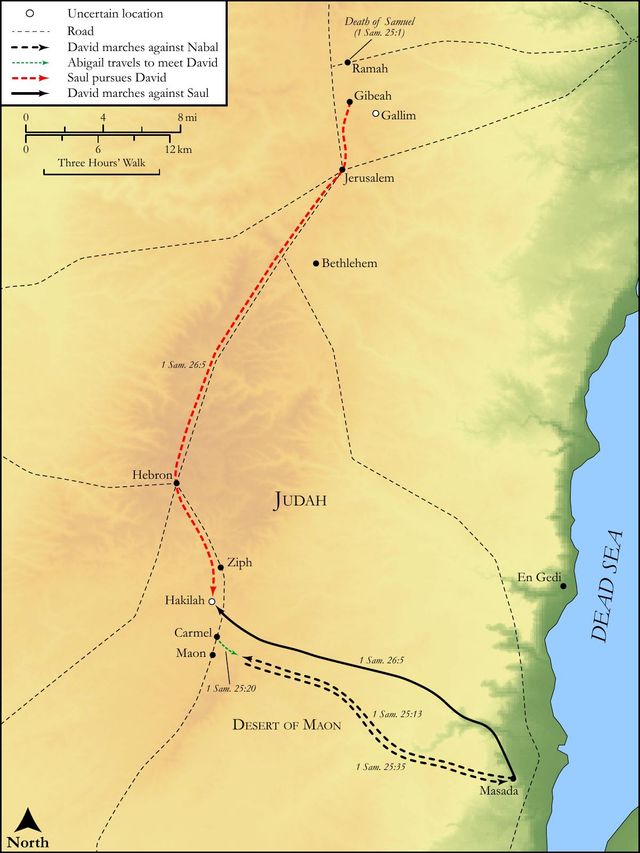
See on the biblical-era map
Study this verse
Public-domain commentary
Matthew Henry
From his Commentary on the Whole Bible. Henry comments on passages, not single verses — this entry covers 1 Samuel 25:36–44. His three-level outline is real structure in the source text, so it is rendered as structure.
We are now to attend Nabal's funeral and Abigail's wedding.
I.Nabal's funeral.
The apostle speaks of some that were twice dead, Jde 1:12. We have hare Nabal thrice dead, though but just now wonderfully rescued from the sword of David and delivered from so great a death; for the preservations of wicked men are but reservations for some further sorer strokes of divine wrath. Here is,
1.Nabal dead drunk, Sa1 25:36. Abigail came home, and, it should seem, he had so many people and so much plenty about him that he neither missed her nor the provisions she took to David; but she found him in the midst of his jollity, little thinking how near he was to ruin by one whom he had foolishly made his enemy. Sinners are often most secure when they are most in danger and destruction is at the door. Observe,
(1.)How extravagant he was in the entertainment of his company: He held a feast like the feast of a king, so magnificent and abundant, though his guests were but his sheep-shearers. This abundance might have been allowed if he had considered what God gave him his estate for, not to look great with, but to do good with. It is very common for those that are most niggardly in any act of piety or charity to be most profuse in gratifying a vain humour or a base lust. A mite is grudged to God and his poor; but, to make a fair show in the flesh, gold is lavished out of the bag. If Nabal had not answered to his name, he would never have been thus secure and jovial, till he had enquired whether he was safe from David's resentments; but (as bishop Hall observes) thus foolish are carnal men, that give themselves over to their pleasures before they have taken any care to make their peace with God.
(2.)How sottish he was in the indulgence of his own brutish appetite: He was very drunk, a sign he was Nabal, a fool, that could not use his plenty without abusing it, could not be pleasant with his friends without making a beast of himself. There is not a surer sign that a man has but little wisdom, nor a surer way to ruin the little he has, than drinking to excess. Nabal, that never thought he could bestow too little in charity, never thought he could bestow too much in luxury. Abigail, finding him in this condition (and probably those about him little better, when the master of the feast set them so bad an example), had enough to do to set the disordered house to-rights a little, but told Nabal nothing of what she had done with reference to David, nothing of his folly in provoking David, of his danger or of his deliverance, for, being drunk, he was as incapable to hear reason as he was to speak it. To give good advice to those that are in drink is to cast pearls before swine; it is better to stay till they are sober.
2.Nabal again dead with melancholy, Sa1 25:37. Next morning, when he had come to himself a little, his wife told him how near to destruction he had brought himself and his family by his own rudeness, and with what difficulty she had interposed to prevent it; and, upon this, his heart died within him and he became as a stone. Some suggest that the expense of the satisfaction made to David, by the present Abigail brought him, broke his heart: it seems rather that the apprehension he now had of the danger he had narrowly escaped put him into a consternation, and seized his spirits so that he could not recover it. He grew sullen, and said little, ashamed of his own folly, put out of countenance by his wife's wisdom. How is he changed! His heart over-night merry with wine, next morning heavy as a stone; so deceitful are carnal pleasures, so transient the laughter of the fool. The end of that mirth is heaviness. Drunkards are sometimes sad when they reflect upon their own folly. Joy in God makes the heart always light. Abigail could never, by her wise reasonings, bring Nabal to repentance; but now, by her faithful reproof, she brings him to despair.
3.Nabal, at last, dead indeed: About ten days after, when he had been kept so long under this pressure and pain, the Lord smote him that he died (Sa1 25:38), and, it should seem, he never held up his head; it is just with God (says bishop Hall) that those who live without grace should die without comfort, nor can we expect better while we go on in our sins. Here is no lamentation made for Nabal. He departed without being lamented. Every one wished that the country might never sustain a greater loss. David, when he heard the news of his death, gave God thanks for it, Sa1 25:39. He blessed God,
(1.)That he had kept him from killing him: Blessed be the lord, who hath kept his servant from evil. He rejoices that Nabal died a natural death and not by his hand. We should take all occasions to mention and magnify God's goodness to us in keeping us from sin.
(2.)That he had taken the work into his own hands, and had vindicated David's honour, and not suffered him to go unpunished who had been abusive to him; hereby his interest would be confirmed, and all would stand in awe of him, as one for whom God fought.
(3.)That he had thereby encouraged him and all others to commit their cause to God, when they are in any way injured, with an assurance that, in his own time, he will redress their wrongs if they sit still and leave the matter to him.
II.Abigail's wedding.
David was so charmed with the beauty of her person, and the uncommon prudence of her conduct and address, that, as soon as was convenient, after he heard she was a widow, he informed her of his attachment to her (Sa1 25:39), not doubting but that she who approved herself so good a wife to so bad a husband as Nabal would much more make a good wife to him, and having taken notice of her respect to him and her confidence of his coming to the throne.
1.He courted by proxy, his affairs, perhaps, not permitting him to come himself.
2.She received the address with great modesty and humility (Sa1 25:41), reckoning herself unworthy of the honour, yet having such a respect for him that she would gladly be one of the poorest servants of his family, to wash the feet of the other servants. None so fit to be preferred as those that can thus humble themselves.
3.She agreed to the proposal, went with his messenger, took a retinue with her agreeable to her quality, and she became his wife, Sa1 25:42. She did not upbraid him with his present distresses, and ask him how he could maintain her, but valued him,
(1.)Because she knew he was a very good man.
(2.)Because she believed he would, in due time, be a very great man. She married him in faith, not questioning but that, though now he had not a house of his own that he durst bring her to, yet God's promise go him would at length be fulfilled. Thus those who join themselves to Christ must be willing now to suffer with him, believing that hereafter they shall reign with him.
Lastly, On this occasion we have some account of David's wives. 1. One that he had lost before he married Abigail, Michal, Saul's daughter, his first, and the wife of his youth, to whom he would have been constant if she would have been so to him, but Saul had given her to another (Sa1 25:44), in token of his displeasure against him and disclaiming the relation of a father-in-law to him. 2. Another that he married besides Abigail (Sa1 25:43), and, as should seem, before her, for she is named first, Sa1 27:3. David was carried away by the corrupt custom of those times; but from the beginning it was not so, nor is it so now that Messias has come, and the times of reformation, Mat 19:4, Mat 19:5. Perhaps Saul's defrauding David of his only rightful wife was the occasion of his running into this irregularity; for, when the knot of conjugal affection is once loosed, it is scarcely ever tied fast again. When David could not keep his first wife he thought that would excuse him if he did not keep to his second. But we deceive ourselves if we think to make others' faults a cloak for our own.
Historical interpretation
Historical reception
2 surviving comments on this verse. Each one is dated, so this reads as a timeline rather than a list.
Select a marker to jump to its quote. Markers stagger vertically where authors wrote within a few decades of each other.
It is better, however, that in correcting these people we shun them when their anger is actually seething; for when they are aroused, they do not perceive what is being said to them. But when they have been restored to their senses, they the more willingly accept words of counsel, as they blush for having been peacefully borne with. For to the mind that is intoxicated with frenzy, everything said that is right appears to be wrong. Wherefore, Abigail laudably did not speak to Nabal about his sin when he was intoxicated, and as laudably told him of it when he became sober. For it was precisely because he did not hear of his fault when drunk that he was able to recognize it.
Moreover, Abigail came to Nabal, and behold, there was a feast in his house. After showing the Lord the affection of her devotion, the Synagogue of believers came to see the life and mind of the unbelievers, in case she might be able to call them to faith as well. But when she saw them satiated with the feasts of legal sacrifices, rejoicing that they were a royal race above other nations, and, what is worse, inflated with a mad intoxication against the word of the Gospel, she was silent for a while about the danger of the crime committed, until she herself, more and more confirmed by the light of the Holy Spirit, proceeded more freely to reprove and they, with the glory of Christ shining openly, would recognize the sin they had committed against Him more evidently, and recognizing, would lament, lamenting would cleanse themselves. However, they, recognizing their guilt, chose not to cleanse it with repentance, but to increase it with pride. For even the apostles and all who repented from the snares of the devil are believed to pertain to Abigail, that is, to the person of the Father's exultation, either as companions or as gifts.
Continue studying 1 Samuel 25:36 across the web’s major study libraries — every link below opens this exact verse, chapter, or book on the destination site.
Read & Compare
 BibleGatewayThis verse in more than 200 translations and 70 languages.
 Bible.comThe YouVersion reader — hundreds of translations, reading plans, and highlights.
 ESV.orgCrossway's official English Standard Version reader.
 NET BibleThe NET translation with 60,000+ translators' notes on every rendering decision.
 STEP BibleTyndale House's free study tool — original text, vocabulary, and scholarly resources.
 BibliaLogos Bible Software's free web reader.
 USCCBThe New American Bible (Revised Edition) with the U.S. bishops' study notes.
Commentaries
 BibleHub CommentariesDozens of classic commentaries on this verse, gathered on one page.
 StudyLightMore than 100 commentary sets — the largest collection on the web.
 BibleRefPlain-English commentary on what this verse means, verse by verse.
 Enduring WordDavid Guzik's free commentary on this chapter, widely used by Bible teachers.
 Bible Study ToolsVerse commentary alongside Greek and Hebrew study aids.
Original Language & Research
- BibleHub InterlinearThe verse word by word — original language, transliteration, and English.
- BibleHub LexiconEvery word's original-language definition and Strong's entry.
 Blue Letter BibleDeep-study tools — Strong's numbers, concordance, and word studies.
 SefariaThe Hebrew text with Rashi and centuries of Jewish commentary.
Sermons, Hymns & Audio


TrulyRandomVerse is not affiliated with these sites and doesn’t control their content. They’re linked because they’re genuinely useful.
Summary
Abigail returns to her home after her courageous and successful intervention with David, only to discover her husband, Nabal, hosting an extravagant and king-like feast. Nabal is profoundly intoxicated and in a state of oblivious revelry, completely unaware of the grave danger he had narrowly escaped. Recognizing his extreme drunkenness and the futility of communicating such critical news in his impaired condition, Abigail wisely chooses to remain silent, deferring the revelation of the averted crisis until the following morning when Nabal would be sober and capable of comprehension. This strategic delay highlights Abigail's exceptional prudence, foresight, and masterful control in a volatile situation.
Context
ShowHideLiterary Context
This verse immediately follows Abigail's remarkable and divinely inspired intercession with David, as detailed in 1 Samuel 25:18-35. She had successfully appeased David, who was enraged by Nabal's insolence and was on his way to annihilate Nabal and his entire household. Abigail's eloquent plea, rich with theological insight and prophetic recognition of David's future kingship, averted bloodshed and earned David's blessing. 1 Samuel 25:36 marks her return home, creating a stark dramatic juxtaposition between the averted catastrophe and Nabal's blissful, drunken ignorance. The narrative swiftly progresses to Nabal's reaction upon hearing the truth the next morning (1 Samuel 25:37), his subsequent divine judgment (1 Samuel 25:38), and Abigail's eventual marriage to David (1 Samuel 25:39-42). This verse is a pivotal moment, setting the stage for the narrative's resolution and Nabal's demise.
Historical & Cultural Context
The events unfold in the wilderness of Paran, a semi-arid region where David and his men lived as fugitives, often relying on the goodwill of wealthy landowners like Nabal for provisions. Nabal, a Calebite, was a man of immense wealth, owning vast flocks in Carmel, a fertile area within southern Judah. Feasts were common in ancient Israel, often associated with significant events such as harvest, sheep-shearing (as mentioned in 1 Samuel 25:2), or celebrations. A "feast of a king" signifies an extraordinary level of opulence, indulgence, and self-importance, reflecting Nabal's vast riches and his inflated ego. While not universally condemned, excessive drunkenness was frequently associated with folly, lack of self-control, and moral degradation in biblical wisdom literature, as exemplified in warnings found in Proverbs 23:20-21. Abigail's actions demonstrate the profound wisdom and initiative of "a woman of good understanding" (25:3), discerning both the moment and the will of God.
Key Themes
ShowHideThe broader narrative of 1 Samuel 25 powerfully illustrates the contrast between foolishness and wisdom. Nabal embodies the epitome of folly, his very name meaning "fool," characterized by his churlishness, arrogance, and self-indulgence, which ultimately lead to his destruction. In stark contrast, Abigail represents profound wisdom, discretion, and spiritual discernment, acting as an instrument of divine providence to prevent David from sinning. This verse specifically highlights prudence in communication, as Abigail's decision to wait underscores the critical importance of proper timing and receptivity when delivering crucial information. It also subtly emphasizes divine timing and sovereignty, as Nabal's drunken state inadvertently ensures that God's judgment, rather than David's hasty vengeance, will ultimately deal with him, a truth David himself acknowledges and praises Abigail for in 1 Samuel 25:33.
Exposition and Analysis
ShowHideKey Word Analysis
ShowHideWhile ṭôwb frequently translates as "good" and can denote genuine joy or well-being, its usage here is immediately qualified by Nabal's extreme drunkenness. In this context, it signifies an excessive, uninhibited, and morally questionable revelry, a state of pleasure derived from indulgence rather than righteousness or sober reflection. It highlights Nabal's self-absorbed and undiscerning "good time," completely detached from the reality of the impending danger he narrowly escaped.
This phrase emphasizes an extreme state of intoxication. Shikkôwr refers to being drunk, and mᵉʼôd intensifies it to "very" or "exceedingly." This detail is crucial for understanding Abigail's strategic silence. Nabal is not merely tipsy but profoundly impaired, rendering him utterly incapable of rational thought, comprehension, or a responsible reaction to the grave news Abigail carries. His condition makes any immediate communication futile and potentially dangerous.
From the root meaning "to speak" or "to arrange," dâbâr refers to a "word," "matter," or "thing." In the phrase "told him nothing," it signifies that Abigail did not utter a single word or convey any piece of information, whether "less or more." Her complete silence, a deliberate withholding of dâbâr, demonstrates her remarkable self-control and strategic intelligence, understanding that speaking would be futile and potentially perilous given Nabal's impaired state. This profound silence contrasts sharply with Nabal's lack of self-control.
Verse Breakdown
ShowHide"And Abigail came to Nabal;"
This clause marks Abigail's return home after her successful and life-saving encounter with David. It immediately sets the scene for the dramatic contrast that follows, bringing the wise, discerning wife back into the presence of her foolish, oblivious husband.
"and, behold, he held a feast in his house, like the feast of a king;"
The interjection "behold" draws the reader's attention to the surprising and deeply ironic scene. Nabal, utterly unaware of the peril he had narrowly escaped, is celebrating lavishly, indulging in an extravagant feast typically reserved for royalty or highly significant occasions. This detail underscores his immense wealth, his inflated self-importance, and his profound disconnect from the imminent destruction he had almost faced.
"and Nabal's heart [was] merry within him, for he [was] very drunken:"
This part reveals Nabal's internal state and its direct cause. His "merry heart" is not a sign of genuine joy, peace, or contentment, but a direct consequence of his extreme intoxication. The causal conjunction "for" (or "because") explicitly links his merriment to his profound drunkenness, emphasizing that his state is one of impaired judgment and self-indulgent revelry, rather than virtuous happiness or a celebration of true blessing.
"wherefore she told him nothing, less or more, until the morning light."
This final clause describes Abigail's decisive and profoundly wise action. Given Nabal's incapacitated state, she understood that any attempt to convey the gravity of the situation would be useless, misunderstood, or even provoke a dangerous, irrational reaction. Her complete silence, withholding "nothing, less or more," demonstrates her strategic thinking, patience, and remarkable self-control, choosing the opportune moment to deliver the critical news when Nabal would be sober and capable of receiving it.
Literary Devices
ShowHideThe verse is rich in Contrast, fundamentally juxtaposing Abigail's sober wisdom, strategic patience, and self-control with Nabal's drunken folly, self-indulgent revelry, and utter lack of awareness. This opposition between the two characters is a dominant theme throughout 1 Samuel 25. There is profound Irony in Nabal's "feast of a king," as he celebrates oblivious to the fact that a true king (David, God's anointed) was just at his doorstep, intent on his destruction, and that his own life had hung by a thread. His "merry heart" is also ironic, as it is born of vice and intoxication rather than virtue, and is completely detached from the reality of his impending doom. The narrative employs Foreshadowing through Abigail's calculated silence; her decision to wait until morning subtly hints at the dramatic and fatal consequences that will inevitably unfold once Nabal learns the truth in his sober state. Furthermore, the vivid description of Nabal's extravagant feast and his extreme drunkenness serves as powerful Characterization, reinforcing his portrayal as a foolish, gluttonous, and arrogant man whose appetites blind him to both spiritual and physical dangers.
Theological and Thematic Connections
ShowHideThis verse powerfully illustrates the biblical principle of divine timing and the profound wisdom of patience, particularly in the realm of communication. Abigail's discerning silence is not a lack of courage but an act of profound wisdom, recognizing that truth, however vital, must be delivered when the recipient is capable of processing it. This aligns with the broader biblical emphasis on speaking "a word fitly spoken" (Proverbs 25:11), and the understanding that there is "a time to keep silence, and a time to speak" (Ecclesiastes 3:7). Nabal's state of drunken revelry also serves as a stark warning against the dangers of self-indulgence and impaired judgment, themes echoed throughout Scripture that highlight how sin can blind individuals to both physical and spiritual realities, ultimately leading to destruction. His folly ensures that divine justice, rather than human vengeance, will prevail.
Reflection and Application
ShowHideAbigail's actions in this verse offer profound and practical lessons for navigating difficult relationships and challenging circumstances in our own lives. Her decision to wait until Nabal was sober before delivering the life-altering news demonstrates remarkable self-control, discernment, and strategic thinking. In a world often characterized by impulsive reactions, immediate gratification, and the urge to speak our minds without forethought, Abigail reminds us of the power of patience and the wisdom of choosing the right moment for crucial conversations. This applies not only to personal relationships, where we might encounter individuals impaired by strong emotions, stress, or literal intoxication, but also to situations where our message might be misunderstood, rejected, or even cause greater harm if delivered prematurely. We are called to cultivate a spirit of discernment, asking ourselves: Is this the right time? Is this person receptive? Will my words be heard and understood, or will they merely escalate conflict or fall on deaf ears? Furthermore, Nabal's oblivious revelry serves as a potent cautionary tale against self-indulgence and the dangers of allowing our appetites to blind us to reality, both temporal and spiritual. True joy and lasting peace come from a sober mind and a heart aligned with God's will, not from fleeting pleasures that obscure truth and invite disaster.
Questions for Reflection
ShowHideFAQ
ShowHideWhy did Abigail wait until the morning to tell Nabal about David's averted attack?
ShowHideAbigail waited until the morning light because Nabal was "very drunken" and holding an extravagant feast, completely oblivious to the near-catastrophe. In his state of extreme intoxication, he would have been incapable of understanding the gravity of the situation – that David and 400 armed men had been on their way to destroy him and his entire household, and that Abigail had narrowly averted this catastrophe through her courageous intervention. Attempting to tell him while he was drunk would have been futile, potentially dangerous (as Nabal was prone to anger and irrationality), and counterproductive. Her decision demonstrates profound wisdom, patience, and strategic thinking, ensuring that her crucial message would be received when Nabal was sober and able to comprehend the immense danger he had escaped and the debt he owed to her intervention. This allowed for the full impact of the news to register, setting the stage for the dramatic events that followed in 1 Samuel 25:37-38.
Christ-Centered Fulfillment
ShowHideThe dramatic contrast between Nabal's drunken revelry and Abigail's sober wisdom in 1 Samuel 25:36 finds its ultimate fulfillment in the person and work of Jesus Christ. Nabal, consumed by his own appetites and utterly oblivious to the impending judgment, embodies humanity's fallen state, often celebrating in ignorance while facing spiritual destruction. His "feast of a king" is a hollow imitation of true kingship, a self-indulgent revelry that leads to death. In stark contrast, Jesus is the true King, who, far from being consumed by earthly pleasures, perfectly embodied sober judgment and divine wisdom. He always knew the opportune time to speak and to remain silent, demonstrating perfect discernment in His interactions, as seen in His quiet endurance before His accusers (Isaiah 53:7 and Matthew 27:12-14). While Nabal's foolishness brought him to the brink of destruction, Jesus, the Lamb of God who takes away the sin of the world, willingly faced the full wrath of God for humanity's sin, offering Himself as the ultimate sacrifice. His coming inaugurates a true "feast of a king"—the marriage supper of the Lamb—a celebration not of self-indulgence but of redemption, reconciliation, and eternal life, to which all who turn from their folly and embrace His wisdom are invited.