


1 Samuel 25:35
Bible text: King James Version (1769 Blayney text) · Public domain
Bible text: King James Version with Strong's numbers · Public domain
Bible text: Berean Standard Bible · Public domain
Bible text: American Standard Version (1901) · Public domain
Bible text: World English Bible, Messianic edition · Public domain
Bible text: Geneva Bible (1599) · Public domain
Bible text: Young's Literal Translation · Public domain
- וַיִּקַּחvai·yi·Kachand he tookH3947Conj-w ¦ V-Qal-ConsecImperf-3msVerb Qal Consecutive Imperfect 3rd Singular Masculineוַandיִּקַּחhe took
- דָּוִדda·VidDavidH1732N-proper-mNoun Proper Masculine
- מִיָּדָהּmi·ya·Dahfrom her handH3027Prep-m ¦ N-csc ¦ 3fsNoun Singular common gender Constructמִfromיָּדָhandהּher
- אֵת'et<obj.>H853DirObjMParticle Object Indicator
- אֲשֶׁר'a·Sher[that] whichH834RelParticle Relative
- הֵבִיאָהhe·Vi·'ahshe had broughtH935V-Hiphil-Perf-3fsVerb Hiphil Perfect 3rd Singular Feminine
- לוֹloto <the> himPrep-l ¦ 3msSuffix Personal 3rd Singular Masculineלto <the>וֹhim
- וְלָהּve·Lahand to <the> herConj-w ¦ Prep-l ¦ 3fsSuffix Personal 3rd Singular Feminineוְandלָto <the>הּher
- אָמַר'a·Marhe saidH559V-Qal-Perf-3msVerb Qal Perfect 3rd Singular Masculine
- עֲלִי'a·Ligo upH5927V-Qal-Imp-2fsVerb Qal Imperative 2nd Singular Feminine
- לְשָׁלוֹםle·sha·lOmto peaceH7965Prep-l ¦ N-msNoun Singular Masculine Absoluteלְtoשָׁלוֹםpeace
- לְבֵיתֵךְle·vei·Tekhto your houseH1004Prep-l ¦ N-msc ¦ 2fsNoun Singular Masculine Constructלְtoבֵיתֵhouseךְyour
- רְאִיre·'IseeH7200V-Qal-Imp-2fsVerb Qal Imperative 2nd Singular Feminine
- שָׁמַעְתִּיsha·Ma'·tiI have listenedH8085V-Qal-Perf-1csVerb Qal Perfect 1st Singular common gender
- בְקוֹלֵךְve·ko·Lekhto your voiceH6963Prep-b ¦ N-msc ¦ 2fsNoun Singular Masculine Constructבְtoקוֹלֵvoiceךְyour
- וָאֶשָּׂאva·'e·Sa'and I have lifted upH5375Conj-w ¦ V-Qal-ConsecImperf-1csVerb Qal Consecutive Imperfect 1st Singular common genderוָandאֶשָּׂאI have lifted up
- פָּנָיִךְpa·Na·yikhyour faceH6440N-mpc ¦ 2fsNoun Plural Masculine Constructפָּנָיִfaceךְyour
English is a literal word-by-word gloss of the Hebrew, not the KJV's wording. Why?
This is the original text the KJV's translators worked from — each Hebrew word with its own literal English meaning in this verse, prepared by scholars at Tyndale House, Cambridge. The KJV translates whole sentences, not word by word, so its wording differs: one Hebrew word can become several English words, and the KJV may choose “the LORD” where the gloss reads “Yahweh”. Both are faithful — they answer different questions. For the KJV's own rendering, switch to the KJV text.
Details
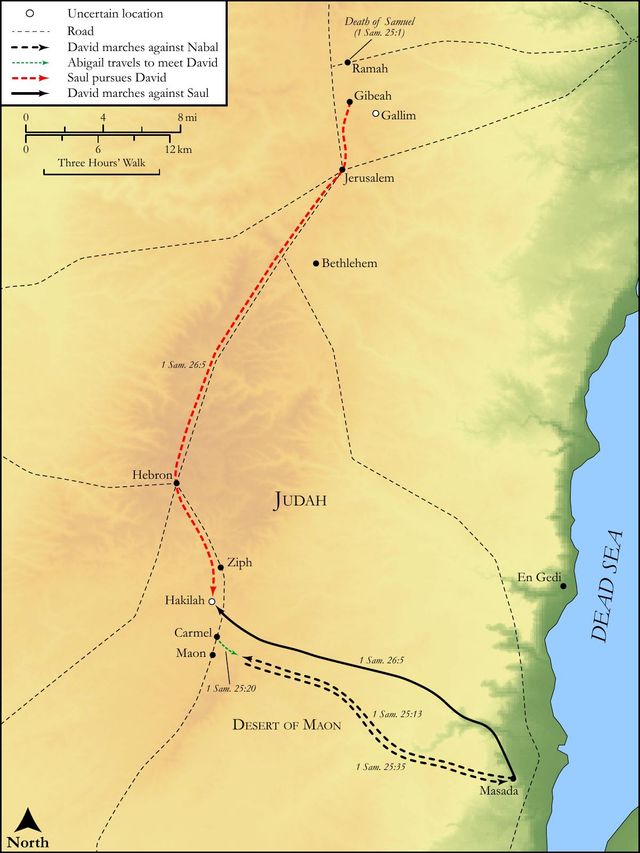
See on the biblical-era map
Study this verse
Public-domain commentary
Matthew Henry
From his Commentary on the Whole Bible. Henry comments on passages, not single verses — this entry covers 1 Samuel 25:32–35. His two-level outline is real structure in the source text, so it is rendered as structure.
As an ear-ring of gold, and an ornament of fine gold, so is a wise reprover upon an obedient ear, Pro 25:12. Abigail was a wise reprover of David's passion, and he gave an obedient ear to the reproof, according to his own principle (Psa 141:5): Let the righteous smite me, it shall be a kindness. Never was such an admonition either better given or better taken.
I.David gives God thanks for sending him this happy check to a sinful way (Sa1 25:32): Blessed be the Lord God of Israel, who sent thee this day to meet me. Note,
1.God is to be acknowledged in all the kindnesses that our friends do us either for soul or body. Whoever meet us with counsel, direction, comfort, caution, or seasonable reproof, we must see God sending them.
2.We ought to be very thankful for those happy providences which are means of preventing sin.
II.He gives Abigail thanks for interposing so opportunely between him and the mischief he was about to do:
Blessed be thy advice, and blessed be thou, Sa1 25:33. Most people think it enough if they take a reproof patiently, but we meet with few that will take it thankfully and will commend those that give it to them and accept it as a favour. Abigail did not rejoice more that she had been instrumental to save her husband and family from death than David did that Abigail had been instrumental to save him and his men from sin.
III.He seems very apprehensive of the great danger he was in, which magnified the mercy of his deliverance.
1.He speaks of the sin as very great. He was coming to shed blood, a sin of which when in his right mind he had a great horror, witness his prayer, Deliver me from blood-guiltiness. He was coming to avenge himself with his own hand, and that would be stepping into the throne of God, who has said, Vengeance is mine; I will repay. The more heinous any sin is the greater mercy it is to be kept from it. He seems to aggravate the evil of his design with this, that it would have been an injury to so wise and good a woman as Abigail: God has kept me back from hurting thee, Sa1 25:34. Or perhaps, at the first sight of Abigail, he was conscious of a thought to do her a mischief for offering to oppose him, and therefore reckons it a great mercy that God gave him patience to hear her speak.
2.He speaks of the danger of his falling into it as very imminent: "Except thou hadst hasted, the bloody execution had been done." The nearer we were to the commission of sin the greater was the mercy of a seasonable restraint - Almost gone (Psa 73:2) and yet upheld.
IV.He dismissed her with an answer of peace, Sa1 25:35.
He does, in effect, own himself overcome by her eloquence: "I have hearkened to thy voice, and will not prosecute the intended revenge, for I have accepted thy person, am well pleased with thee and what thou hast said." Note,
1.Wise and good men will hear reason, and let that rule them, though it come from those that are every way their inferiors, and though their passions are up and their spirits provoked.
2.Oaths cannot, bind us to that which is sinful. David had solemnly vowed the death of Nabal. He did evil to make such a vow, but he would have done worse if he had performed it.
3.A wise and faithful reproof is often better taken, and speeds better, than we expected, such is the hold God has of men's consciences. See Pro 28:23.
Historical interpretation
Three Centuries of Reception
2 surviving comments on this verse. Each one is dated, so this reads as a timeline rather than a list.
Select a marker to jump to its quote. Markers stagger vertically where authors wrote within a few decades of each other.
Further, we are taught at considerable length by other texts of Scripture, too, that we neither should nor can fulfill everything that we decide upon whether with tranquil or upset mind. In them we frequently read that holy men or angels or even almighty God himself altered the things that they had promised. For blessed David determined with the promise of an oath and said, “May God do this and add more to the enemies of David if, of all that belongs to Nabal, I leave one male until morning.” But when his wife, Abigail, interceded and entreated on his behalf, David immediately ceased his threats, softened his words, and preferred to be considered a transgressor of his own intention than to be true to his oath by cruelly carrying it out. And he said, “As the Lord lives, unless you had come quickly to meet me, there would not have been left to Nabal one male until the morning light.” As we do not at all consider the promptness of his rash vow, which proceeded from an upset and disturbed mind, as something to be imitated, so likewise we judge that the cessation and correction of the thing that was decided on is to be pursued.
David then took from her hand everything she had brought him. The Lord accepted the devotion of all believers, which the hand, that is, the work of the Synagogue preaching, had brought to Him on behalf of her children. He kindly advised that after receiving from Him the grace of heavenly peace, they should return to conscience and diligently discern how they should live for themselves.
Continue studying 1 Samuel 25:35 across the web’s major study libraries — every link below opens this exact verse, chapter, or book on the destination site.
Read & Compare
 BibleGatewayThis verse in more than 200 translations and 70 languages.
 Bible.comThe YouVersion reader — hundreds of translations, reading plans, and highlights.
 ESV.orgCrossway's official English Standard Version reader.
 NET BibleThe NET translation with 60,000+ translators' notes on every rendering decision.
 STEP BibleTyndale House's free study tool — original text, vocabulary, and scholarly resources.
 BibliaLogos Bible Software's free web reader.
 USCCBThe New American Bible (Revised Edition) with the U.S. bishops' study notes.
Commentaries
 BibleHub CommentariesDozens of classic commentaries on this verse, gathered on one page.
 StudyLightMore than 100 commentary sets — the largest collection on the web.
 BibleRefPlain-English commentary on what this verse means, verse by verse.
 Enduring WordDavid Guzik's free commentary on this chapter, widely used by Bible teachers.
 Bible Study ToolsVerse commentary alongside Greek and Hebrew study aids.
Original Language & Research
- BibleHub InterlinearThe verse word by word — original language, transliteration, and English.
- BibleHub LexiconEvery word's original-language definition and Strong's entry.
 Blue Letter BibleDeep-study tools — Strong's numbers, concordance, and word studies.
 SefariaThe Hebrew text with Rashi and centuries of Jewish commentary.
Sermons, Hymns & Audio


TrulyRandomVerse is not affiliated with these sites and doesn’t control their content. They’re linked because they’re genuinely useful.
Summary
1 Samuel 25:35 marks the peaceful culmination of a tense confrontation, depicting David's gracious reception of Abigail's offerings and his public declaration of peace and acceptance towards her. This pivotal moment showcases David's capacity for restraint and wisdom, as he acknowledges Abigail's divinely inspired intervention, choosing to abandon his vengeful intentions against Nabal and his household. The verse underscores the power of discerning counsel in averting bloodshed and highlights God's providential hand in guiding events and shaping the character of His chosen leader.
Context
ShowHideLiterary Context
The immediate literary context of 1 Samuel 25 is crucial for understanding David's words in verse 35. Following Nabal's egregious insult and refusal to provide provisions for David's men, David, in a fit of righteous indignation and personal offense, vowed to destroy Nabal and every male in his household by morning (1 Samuel 25:22). Abigail, Nabal's discerning wife, acted swiftly and decisively, intercepting David with a generous offering of food and a humble, eloquent plea. Her speech, rich in theological insight, appealed to David's future as king and urged him to avoid the guilt of shedding innocent blood, reminding him that the Lord would establish his house (1 Samuel 25:28-31). David, recognizing the Lord's hand in her timely intervention, blessed Abigail and acknowledged God's restraint through her (1 Samuel 25:32-33). Verse 35, therefore, serves as the formal declaration of David's change of heart and the peaceful resolution of the crisis, setting the stage for Nabal's divine judgment and Abigail's subsequent marriage to David.
Historical & Cultural Context
Historically and culturally, David was operating as a fugitive leader, having fled from King Saul and gathered a growing band of 600 men (1 Samuel 22:2). These men, living in the wilderness of Paran, often served as protectors for local shepherds and farmers from raiders, in exchange for provisions and hospitality. Nabal, a wealthy Calebite sheep owner in Carmel, was expected by custom to show hospitality and generosity, especially to those who had protected his flocks. His refusal was not merely an insult but a grave breach of customary law and a direct challenge to David's authority and the well-being of his men. David's initial reaction, though extreme, was rooted in the prevailing honor-shame culture where such an affront demanded a strong response to maintain reputation and authority. Abigail's actions, however, transcended these norms, demonstrating a superior wisdom that prioritized peace and divine will over cultural expectations of vengeance.
Key Themes
ShowHideSeveral key themes converge in 1 Samuel 25, and verse 35 is a crucial expression of them. Divine Providence is paramount, as David explicitly acknowledges that God sent Abigail to prevent him from taking vengeance (1 Samuel 25:33). This highlights God's active involvement in human affairs, even in moments of intense personal conflict, guiding His chosen instruments. The stark Contrast Between Wisdom and Folly is central, with Abigail's discerning and humble intervention (Proverbs 14:1) standing in sharp opposition to Nabal's foolishness and insolence (Proverbs 1:7). Furthermore, the theme of Restraint and Righteous Leadership is powerfully illustrated by David's willingness to turn from a path of rash vengeance, demonstrating a crucial characteristic for a future king who would rule justly and mercifully. His decision to 'hearken to thy voice' and 'accept thy person' signifies a profound capacity for self-control and a recognition of a higher moral and spiritual imperative, foreshadowing the kind of king God desires (Psalm 72:12-14).
Exposition and Analysis
ShowHideKey Word Analysis
ShowHideThe Hebrew word שָׁלוֹם (shâlôwm) is far more profound than merely the absence of conflict. Derived from a root meaning "to be safe," it signifies wholeness, completeness, well-being, prosperity, security, and harmony. When David says, "Go up in peace to thine house," he is not just granting safe passage but is bestowing a comprehensive blessing of flourishing and reconciliation. It implies a state of restored order and a cessation of all hostile intent, reflecting a divine blessing upon Abigail and her future.
The verb שָׁמַע (shâmaʻ) means 'to hear,' 'to listen,' but often carries the deeper connotation of 'to obey' or 'to give heed to' intelligently. David's declaration, 'I have hearkened to thy voice,' signifies more than just passively hearing Abigail's words; it means he has listened intently, understood the wisdom and divine counsel embedded in her plea, and has chosen to act in accordance with it. This demonstrates his teachability and responsiveness to God's leading through another person.
The phrase 'accepted thy person' translates the Hebrew idiom נָשָׂא פָּנִים (nâsâʼ pânîym), literally 'to lift up the face.' This idiom denotes showing favor, granting a request, or receiving someone favorably. It implies a change in disposition from anger or rejection to acceptance and approval. In this context, David is not merely accepting Abigail's gifts but is fully embracing her plea, acknowledging her character, wisdom, and the validity of her intervention. It signifies his complete reversal of judgment and a full reception of her, moving from a position of hostility to one of favor.
Verse Breakdown
ShowHide"So David received of her hand [that] which she had brought him,"
This clause establishes the physical act of acceptance, signifying David's immediate and tangible reception of Abigail's generous provisions. By taking the gifts, David formally acknowledges the cessation of hostilities and the acceptance of her peace offering, which was crucial in Israel as a sign of reconciliation and goodwill. This act is the outward manifestation of his internal change of heart.
"and said unto her, Go up in peace to thine house;"
This is David's verbal declaration of peace and safe conduct. The phrase 'Go up in peace' (לְשָׁלוֹם, l'shalom) is a profound blessing, assuring Abigail not only of her physical safety but also of her well-being and the restoration of harmony in her life. It explicitly revokes any threat against her or her household, granting her permission to return home without fear of reprisal from David or his men.
"see, I have hearkened to thy voice,"
Here, David explicitly states the reason for his change of heart: he has listened attentively and responded positively to Abigail's wise counsel. This highlights David's humility and his capacity to be persuaded by reason and divine insight, even when initially consumed by rage. It underscores the power of Abigail's eloquent and Spirit-led intervention.
"and have accepted thy person."
This final clause confirms David's full acceptance of Abigail herself, not just her words or gifts. The idiom 'accepted thy person' indicates that David has shown her favor, granted her petition, and received her with approval. This signifies a complete reversal of his previous intent to destroy her household, demonstrating his recognition of her wisdom and the divine hand at work through her, ultimately leading to a profound respect for her.
Literary Devices
ShowHideThe narrative of 1 Samuel 25 is rich with literary devices, and verse 35 serves as the turning point. Contrast is a dominant feature, most notably between Nabal's foolishness (his name literally means 'fool') and Abigail's profound wisdom and discernment. This dramatic opposition highlights the consequences of each character's choices. The entire episode functions as a form of Divine Intervention or Providence, where God uses Abigail as His instrument to prevent David from committing a rash and sinful act of vengeance, thus preserving David's moral purity for his future kingship. David's acknowledgment of this divine hand in verse 33 and his subsequent acceptance of Abigail's plea in verse 35 underscore this theme. There is also an element of Foreshadowing, as David's capacity for restraint, humility, and responsiveness to divine counsel, as displayed here, anticipates the qualities necessary for his eventual righteous rule as king of Israel. The resolution in verse 35, marked by peace and acceptance, stands in stark Irony to David's earlier vengeful vow, emphasizing the transformative power of Abigail's intervention and God's guiding hand.
Theological and Thematic Connections
ShowHideThe theological significance of 1 Samuel 25:35 extends beyond the immediate narrative, offering profound insights into divine providence, the nature of true leadership, and the power of wise counsel. David's acceptance of Abigail's plea underscores the principle that God often uses human agents to accomplish His purposes, even to restrain His chosen servants from sin. This divine intervention prevents David from incurring bloodguilt, a crucial aspect for a future king. Furthermore, the verse highlights the moral imperative for restraint and self-control, especially in moments of anger, demonstrating that true strength lies not in unchecked vengeance but in the capacity to heed wisdom and choose peace. Abigail's role exemplifies the impact of discernment and humility in averting disaster, serving as a model for intercession and peacemaking within a community.
Reflection and Application
ShowHideThe narrative culminating in 1 Samuel 25:35 offers timeless lessons for contemporary believers. Abigail's courageous and wise intervention serves as a powerful model for how to de-escalate conflict and speak truth in love, even to those in positions of power or consumed by anger. Her example challenges us to consider how we might act as agents of peace and reconciliation in our own relationships and communities, prioritizing discernment and humility over pride or passivity. David's response, marked by his willingness to listen and turn from vengeance, provides a vital illustration of spiritual maturity. It reminds us that even when we feel justified in our anger, God often provides counsel through unexpected channels to prevent us from acting rashly and incurring sin. This passage encourages us to cultivate a spirit of teachability, to seek and heed wise counsel, and to trust in God's perfect justice rather than relying on our own retribution, thereby preserving our integrity and honoring God's sovereignty in all circumstances.
Questions for Reflection
ShowHideFAQ
ShowHideWhat was the significance of David's change of heart in this passage?
ShowHideDavid's change of heart, culminating in 1 Samuel 25:35, was profoundly significant for several reasons. Primarily, it demonstrated his capacity for self-control and his responsiveness to divine guidance, even when fueled by intense personal offense. By heeding Abigail's wise counsel, David avoided committing a rash act of vengeance that would have stained his character and future kingship with innocent blood. This episode served as a crucial test of his leadership, revealing his humility and willingness to submit to God's providential hand, which preserved him from sin and affirmed his suitability to rule Israel righteously. It also highlighted the power of intercession and the importance of choosing peace over personal retribution.
How did Abigail's actions influence David's decision?
ShowHideAbigail's actions were instrumental in influencing David's decision. Her swift and decisive intervention, coupled with her profound wisdom and humility, disarmed David's rage. She approached him not with defiance but with a generous offering and a respectful, yet firm, theological appeal. She reminded him of his future as king, urged him not to incur the guilt of shedding innocent blood, and implicitly pointed to God's sovereignty in establishing his kingdom (1 Samuel 25:28-31). David explicitly acknowledged that God had sent her to prevent him from sinning (1 Samuel 25:32-33). Thus, her actions were seen by David as divinely orchestrated, leading him to 'hearken to her voice' and 'accept her person,' thereby turning him from his vengeful path.
What happened to Nabal after this event?
ShowHideAfter Abigail returned home and informed Nabal of her encounter with David, Nabal suffered a stroke and became like a stone. About ten days later, the Lord struck Nabal, and he died (1 Samuel 25:37-38). This outcome is presented as divine judgment for his foolishness, arrogance, and refusal to show hospitality to David's men. David, upon hearing of Nabal's death, praised the Lord for vindicating him and for preventing him from taking vengeance himself (1 Samuel 25:39). Subsequently, David sent for Abigail and took her as his wife (1 Samuel 25:40-42), further demonstrating the providential unfolding of events.
Christ-Centered Fulfillment
ShowHideThe narrative of David and Abigail, culminating in David's choice for peace in 1 Samuel 25:35, beautifully foreshadows the ultimate peacemaking work of Jesus Christ. Just as Abigail intervened to avert David's wrath and bring about reconciliation, so Christ, our ultimate mediator, intervened to reconcile sinful humanity to a holy God. He is the Lamb of God who takes away the sin of the world, whose sacrifice on the cross absorbed the divine wrath that we deserved (Romans 5:8-9). Jesus embodies the perfect wisdom that Abigail displayed, always speaking and acting in accordance with the Father's will, even to the point of suffering and death (1 Corinthians 1:30). Unlike David, who was prone to anger, Jesus perfectly exemplified divine restraint and mercy, teaching us to love our enemies and pray for those who persecute us. Through His atoning work, He speaks peace to our souls, inviting us to 'go up in peace' to our eternal home, having accepted our person and made us righteous in Him (2 Corinthians 5:21). He is our true shalom, the one who breaks down the dividing wall of hostility and brings us into fellowship with God.