


Luke 8:48
Bible text: King James Version (1769 Blayney text) · Public domain
Bible text: Berean Standard Bible · Public domain
Bible text: American Standard Version (1901) · Public domain
Bible text: World English Bible, Messianic edition · Public domain
Bible text: Geneva Bible (1599) · Public domain
Bible text: Young's Literal Translation · Public domain
- ὁho<the>G3588T-NSMDefinite article Nominative Singular Masculine
- δὲdeAndG1161CONJConjunction
- εἶπενeipenHe saidG2036V-2AAI-3SVerb 2nd Aorist Active Indicative 3rd Singular
- αὐτῇ·autēato herG846P-DSFPersonal pronoun Dative Singular Feminine
- θάρσειtharseiTake courageG2293V-PAM-2SVerb Present Active Imperative 2nd Singular
- θυγάτηρthugatērdaughterG2364N-NSFNoun Nominative Singular Feminine
- ἡhētheG3588T-NSFDefinite article Nominative Singular Feminine
- πίστιςpistisfaithG4102N-NSFNoun Nominative Singular Feminine
- σουsouof youG4771P-2GSPersonal pronoun Genitive 2nd Singular
- σέσωκένsesōkenhas healedG4982V-RAI-3SVerb Perfect Active Indicative 3rd Singular
- σε·seyouG4771P-2ASPersonal pronoun Accusative 2nd Singular
- πορεύουporeuoudo goG4198V-PNM-2SVerb Present Middle Or Passive Deponent Imperative 2nd Singular
- εἰςeisinG1519PREPPreposition
- εἰρήνηνeirēnēnpeaceG1515N-ASFNoun Accusative Singular Feminine
English is a literal word-by-word gloss of the Greek, not the KJV's wording. Why?
This is the original text the KJV's translators worked from — each Greek word with its own literal English meaning in this verse, prepared by scholars at Tyndale House, Cambridge. The KJV translates whole sentences, not word by word, so its wording differs: one Greek word can become several English words, and the KJV may choose “charity” where the gloss reads “love”. Both are faithful — they answer different questions. For the KJV's own rendering, switch to the KJV text.
Details
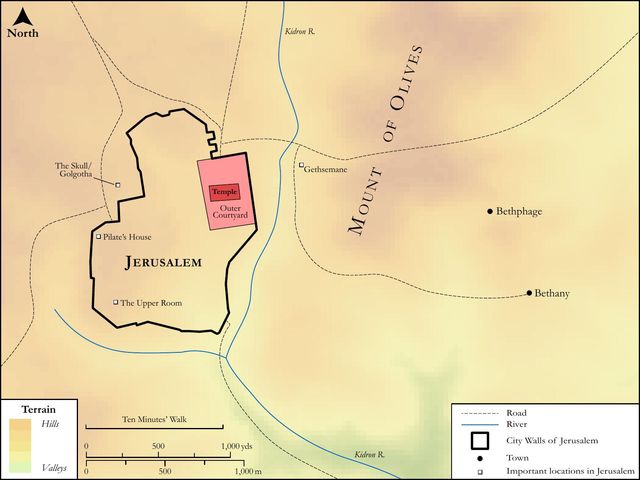
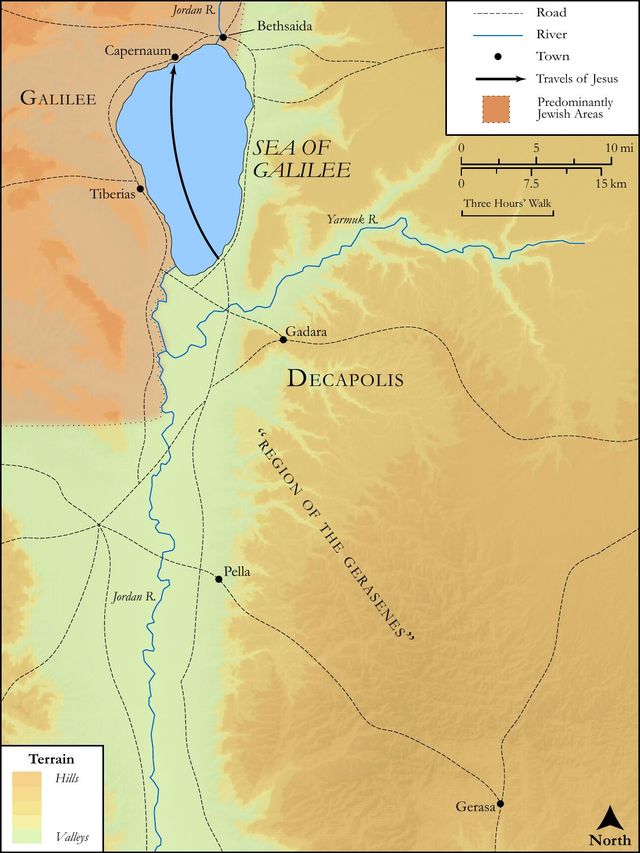
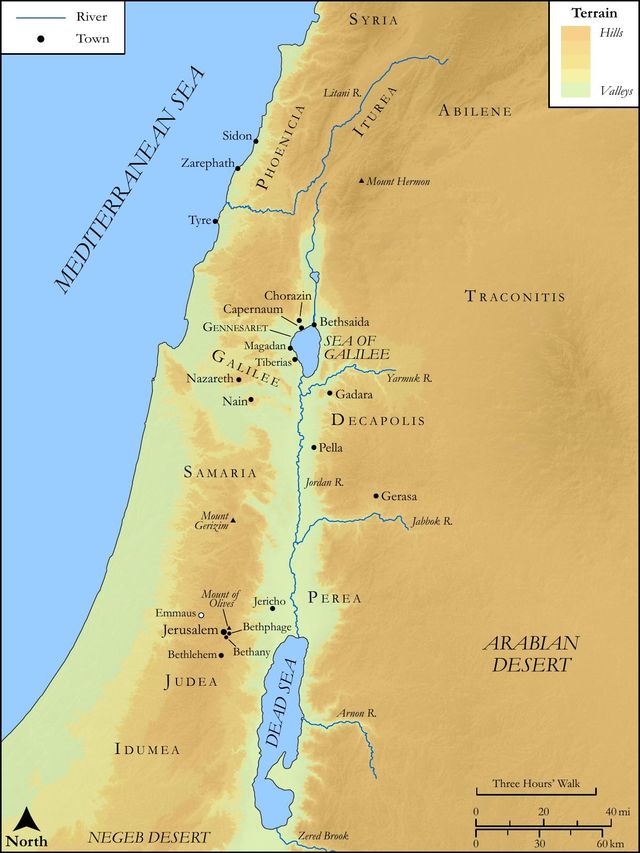
See on the biblical-era maps
Study this verse
Public-domain commentary
Matthew Henry
From his Commentary on the Whole Bible. Henry comments on passages, not single verses — this entry covers Luke 8:40–56. His two-level outline is real structure in the source text, so it is rendered as structure.
Christ was driven away by the Gadarenes; they were weary of him, and willing to be rid of him. But when he had crossed the water, and returned to the Galileans, they gladly received him, wished and waited for his return, and welcomed him with all their hearts when he did return, Luk 8:40. If some will not accept the favours Christ offers them, others will. If the Gadarenes be not gathered, yet there are many among whom Christ shall be glorious. When Christ had done his work on the other side of the water he returned, and found work to do in the place whence he came, fresh work. They that will lay out themselves to do good shall never want occasion for it. The needy you have always with you.
We have here two miracles interwoven, as they were in Matthew and Mark - the raising of Jairus's daughter to life, and the cure of the woman that had an issue of blood, as he was going in a crowd to Jairus's house. We have here,
I.A public address made to Christ by a ruler of the synagogue, whose name was Jairus, on the behalf of a little daughter of his, that was very ill, and, in the apprehension of all about here, lay a dying. This address was very humble and reverent. Jairus, though a ruler, fell down at Jesus's feet, as owning him to be a ruler above him. It was very importunate. He besought him that he would come into his house; not having the faith, at least not having the thought, of the centurion, who desired Christ only to speak the healing word at a distance. But Christ complied with his request; he went along with him. Strong faith shall be applauded, and yet weak faith shall not be rejected. In the houses where sickness and death are, it is very desirable to have the presence of Christ. When Christ was going, the people thronged him, some out of curiosity to see him, others out of an affection to him. Let us not complain of a crowd, and a throng, and a hurry, as long as we are in the way of our duty, and doing good; but otherwise it is what every wise man will keep himself out of as much as he can.
II.Here is a secret application made to Christ by a woman ill of a bloody issue, which had been the consumption of her body and the consumption of her purse too; for she had spent all her living upon physicians, and was never the better, Luk 8:43. The nature of her disease was such that she did not care to make a public complaint of it (it was agreeable to the modesty of her sex to be very shy of speaking of it), and therefore she took this opportunity of coming to Christ in a crowd; and the more people were present the more likely she thought it was that she should be concealed. Her faith was very strong; for she doubted not but that by the touch of the hem of his garment she should derive from him healing virtue sufficient for her relief, looking upon him to be such a full fountain of mercies that she should steal a cure and he not miss it. Thus many a poor soul is healed, and helped, and saved, by Christ, that is lost in a crowd, and that nobody takes notice of. The woman found an immediate change for the better in herself, and that her disease was cured, Luk 8:44. As believers have comfortable communion with Christ, so they have comfortable communications from him incognito - secretly, meat to eat that the world knows not of, and joy that a stranger does not intermeddle with.
III.Here is a discovery of this secret cure, to the glory both of the physician and the patient.
1.Christ takes notice that there is a cure wrought: Virtue is gone out of me, Luk 8:46. Those that have been healed by virtue derived from Christ must own it, for he knows it. He speaks of it here, not in a way of complaint, as if he were hereby either weakened or wronged, but in a way of complacency. It was his delight that virtue was gone out of him to do any good, and he did not grudge it to the meanest; they were as welcome to it as to the light and heat of the sun. Nor had he the less virtue in him for the going out of the virtue from him for he is an overflowing fountain.
2.The poor patient owns her case, and the benefit she had received: When she saw that she was not hid, she came, and fell down before him, Luk 8:47. Note, The consideration of this, that we cannot be hid from Christ, should engage us to pour out our hearts before him, and to show before him all our sin and all our trouble. She came trembling, and yet her faith saved her, Luk 8:48. Note, There may be trembling where yet there is saving faith. She declared before all the people for what cause she had touched him because she believed that a touch would cure her, and it did so. Christ's patients should communicate their experiences to one another.
3.The great physician confirms her cure, and sends her away with the comfort of it: Be of good comfort; thy faith hath made thee whole, Luk 8:48. Jacob got the blessing from Isaac clandestinely, and by a wile; but, when the fraud was discovered, Isaac ratified it designedly. It was obtained surreptitiously and under-hand, but it was secured and seconded above-board. So was the cure here. He is blessed, and he shall be blessed; so here, She is healed, and she shall be healed.
IV.Here is an encouragement to Jairus not to distrust the power of Christ, though his daughter was now dead, and they that brought him the tidings advised him not to give the Master any further trouble about her: Fear not, saith Christ, only believe. Note, Our faith in Christ should be bold and daring, as well as our zeal for him. They that are willing to do any thing for him may depend upon his doing great things for them, above what they are able to ask or think. When the patient is dead there is no room for prayer, or the use of means; but here, though the child is dead, yet believe, and all shall be well. Post mortem medicus - to call in the physician after death, is an absurdity; but not post mortem Christus - to call in Christ after death.
V.The preparatives for the raising of her to life again.
1.The choice Christ made of witnesses that should see the miracle wrought. A crowd followed him, but perhaps they were rude and noisy; however, it was not fit to let such a multitude come into a gentleman's house, especially now that the family was all in sorrow; therefore he sent them back, and not because he was afraid to let the miracle pass their scrutiny; for he raised Lazarus and the widow's son publicly. He took none with him but Peter, and James, and John, that triumvirate of his disciples that he was most intimate with, designing these three, with the parents, to be the only spectators of the miracle, they being a competent number to attest the truth of it.
2.The check he gave to the mourners. They all wept, and bewailed her; for, it seems, she was a very agreeable hopeful child, and dear not only to the parents, but to all the neighbours. But Christ bid them not weep; for she is not dead, but sleepeth. He means, as to her peculiar case, that she was not dead for good and all, but that she should now shortly be raised to life, so that it would be to her friends as if she had been but a few hours asleep. But it is applicable to all that die in the Lord; therefore we should not sorrow for them as those that have no hope, because death is but a sleep to them, not only as it is a rest from all the toils of the days of time, but as there will be a resurrection, a waking and rising again to all the glories of the days of eternity. This was a comfortable word which Christ said to these mourners, yet they wickedly ridiculed it, and laughed him to scorn for it here was a pearl cast before swine. They were ignorant of the scriptures of the Old Testament who bantered it as an absurd thing to call death a sleep; yet this good came out of that evil that hereby the truth of the miracle was evinced; for they knew that she was dead, they were certain of it, and therefore nothing less than a divine power could restore her to life. We find not any answer that he made them; but he soon explained himself, I hope to their conviction, so that they would never again laugh at any word of his. But he put them all out, Luk 8:54. They were unworthy to be the witnesses of this work of wonder; they who in the midst of their mourning were so merrily disposed as to laugh at him for what he said would, it may be, have found something to laugh at in what he did, and therefore are justly shut out.
VI.Her return to life, after a short visit to the congregation of the dead:
He took her by the hand (as we do by one that we would awake out of sleep, and help up), and he called, saying, Maid, arise, Luk 8:55. Thus the hand of Christ's grace goes along with the calls of his word, to make them effectual. Here that is expressed which was only implied in the other evangelists, that her spirit came again; her soul returned again to animate her body. This plainly proves that the soul exists and acts in a state of separation from the body, and therefore is immortal; that death does not extinguish this candle of the Lord, but takes it out of a dark lantern. It is not, as Grotius well observes, the krasis or temperament of the body, or anything that dies with it; but it is anthupostaton ti - something that subsists by itself, which, after death, is somewhere else than where the body is. Where the soul of this child was in this interval we are not told; it was in the hand of the Father of spirits, to whom all souls at death return. When her spirit came again she arose, and made it appear that she was alive by her motion, as she did also by her appetite; for Christ commanded to give her meat. As babes newly born, so those that are newly raised, desire spiritual food, that they may grow thereby. In the last verse, we need not wonder to find her parents astonished; but if that implies that they only were so, and not the other by-standers, who had laughed Christ to scorn, we may well wonder at their stupidity, which perhaps was the reason why Christ would not have it proclaimed, as well as to give an instance of his humility.
Historical interpretation
Eleven Centuries of Reception
19 surviving comments on this verse. Each one is dated, so this reads as a timeline rather than a list.
Select a marker to jump to its quote. Markers stagger vertically where authors wrote within a few decades of each other.
Here, then, is a God who is not merciful by nature, but in hostility! Yet, if we find that such was the merit of this woman's faith, that He said unto her, Thy faith hath saved thee." what are you, that you should detect an hostility to the law in that act, which the Lord Himself shows us to have been done as a reward of faith? But will you have it that this faith of the woman consisted in the contempt which she had acquired for the law? Who can suppose, that a woman who had been.
When Christ approved of the faith of this woman, which simply rested in the Creator, He declared by His answer to her, that He was Himself the divine object of the faith of which He approved.
But the same cure which the woman obtained by touching Him, our Saviour confirmed by His word; as it follows, And he said unto her, Thy faith hath made thee whole; go in peace, that is, Be released from thy scourge. And indeed He first heals her soul by faith, then truly her body.
(Eccles. Hist. l. vii. c. 18.) Now they say that the woman set up in Paneas (Cæsarea Philippi, whence she came) a noble triumphal monument of the mercy vouchsafed to her by the Saviour. For there stood upon a lofty pedestal near the entrance to her house a brasen statue of a woman on bended knees, and with her hands joined as if in prayer; opposite to which was erected another statue like to a man, made of the same material, clothed in a stole, (διπλοῑς.a) and holding forth his hand to the woman. At his feet upon the base itself a strange kind of plant was growing, which reaching to the hem of the brasen stole, was said to be the cure of all diseases. And they said that this statue represents Christ. It was destroyed by Maximinus.
“Who touched me? For a power has gone forth from me.” A detail such as this is not reported about our Physician in any other place. This is because in no other place did our Physician encounter an affliction such as this. This affliction was presented to many physicians, yet only one Physician encountered this affliction to heal it. Many physicians encountered and wearied her. Only one encountered her who was able to give her rest from the toil of many physicians. The art of healing encountered a shameful affliction but added pain after pain to it. The more they came, the worse the affliction got. The fringe of the Lord’s cloak touched her and uprooted this suffering from its root. She perceived within herself that he healed her affliction.Since the art of healing clothed with all our practical wisdom was reduced to silence, the divinity clothed with garments was proclaimed. He clothed himself in the body and came down to humanity, so that humanity might loot him. He revealed his divinity through signs, so that faith in his humanity alone could not be explained. He revealed his humanity that the higher beings might believe that he was a lower being, and he revealed his divinity so that the lower beings would accept that he was a higher being. He took on a human body so that humanity might be able to attain to divinity, and he revealed his divinity so that his humanity might not be trampled under foot.
If the woman once cured had withdrawn from him in secret, our Lord would have deprived her of a crown of victory. It was fitting that the faith that shined out brightly in hidden agony was publicly crowned. He wove an eloquent crown for her, because he said to her, “Go in peace.” The peace he gave was the crown of her victory. When he said, “Go in peace,” he did not end here but also added, “Your faith has saved you,” so that they would know who was this crown’s Lord. This would make known that the peace his mouth wove was the crown that crowned her faith. “Your faith has saved you.” If it was faith that restored her to life, it is clear that he crowned her faith with a crown. This is why he cried out, “Who touched my garments?” He said this so all the people might know who touched more than anyone else did. She chose to honor him more than others do, first, by approaching from behind, and second, in that she touched the fringe of his cloak. It was also fitting that he would honor her before all of these, she who chose to honor him more than all these.
Glory to you, hidden offspring of Being, because the hidden suffering of her that was afflicted proclaimed your healing. Using a woman whom they could see, he enabled them to see the divinity that cannot be seen. The Son’s divinity became known through his healing, and the afflicted woman’s faith was revealed through her being healed. She caused him to be proclaimed, and she was proclaimed with him. Truth was being proclaimed together with its heralds. If she was a witness to his divinity, he in turn was a witness to her faith.She poured faith on him by way of reward, and he bestowed healing on her as the outcome of her reward. Since the woman’s faith had become public, her healing also was proclaimed in public. The physicians were put to shame about their remedies because his power became resplendent and magnified the Son. It became evident how great faith surpasses the healing art and how hidden power surpasses visible remedies.
(Vide Victor. Ant. in Mark 5.) The name is inserted for the sake of the Jews, who at that time well knew the event, that the name might be a demonstrative proof of the miracle. And there came not one of the lowest, but a ruler of the synagogue, that the mouths of the Jews might be the more closed. As it follows, And he was a ruler of the synagogue. Now he came to Christ because of his need; for grief sometimes urges us to do those things which are right, according to the Psalm, Hold their mouths with bit and bridle, who come not nigh unto thee. (Ps. 32:9.)
(non occ.) Of how great praise then is this woman worthy, who with her bodily powers exhausted by the continual issue of blood, and with so great a crowd thronging around Him, in the strength of her affection and faith entered the crowd, and coming behind, secretly touched the hem of His garment.
(non occ.) He calls her daughter, as already healed because of her faith, for faith claims the grace of adoption.
It says, “Servants came to the ruler, saying, ‘Do not trouble him.’ ” Still they were without faith in the resurrection, which Jesus foretold in the law and fulfilled in the gospel. When he came into the house, he approved a few eyewitnesses to the imminent resurrection, because many did not immediately believe the resurrection. Then, as the Lord said, “ ‘The girl is not dead but sleeps,’ they laughed him to scorn.” Whoever does not believe, jeers. Those who think they are dead will weep for their dead, but when there is faith in resurrection, there is the appearance not of death but of sleep.
The assembly of the nations is like the woman who spent all her money on physicians. The assembly of nations also lost all the gifts of nature and squandered the inheritance of life. It was holy, shy, pious, ready in faith, and hesitant in modesty, because it is a sign of modesty to recognize the weakness of faith and not to despair of pardon. The shy woman touched the hem, the faithful approached, the pious believed, the wise knew she was healed. The holy people of the nations that believed in God were so ashamed of their sin that they abandoned it. Brought faith, they believed. They showed devotion, so that they entreated. They put on wisdom, so that they perceived their own health. They took confidence, so that they confessed the alien truth that they snatched.Why is Christ touched from behind? Is it because it is written, “You shall follow the Lord your God”? Why is it that the twelve-year-old daughter of the ruler was dying and the woman with a flow of blood was afflicted for twelve years, except that it is understood that as long as the synagogue flourished, the church suffered? The weakness of the one is the virtue of the other, because by their offense salvation has come to the Gentiles. The consummation of the one is the beginning of the other, the beginning not of nature but of salvation.
But when about to raise the dead, in order to bring faith to the ruler of the synagogue, He first cured the issue of blood. So also a temporal resurrection is celebrated at the Passion of our Lord, that the other might be believed to be eternal. But as he went, the people thronged him.
Now mystically Christ had left the synagogue in Gerasa, and Him whom His own received not we strangers receive.
But whom do we suppose the chief of the synagogue to be, but the Law, from consideration of which our Lord had not entirely abandoned the synagogue.
But while the Word of God hastens to this daughter of the ruler that He might save the children of Israel, the holy Church collected from among the Gentiles which was perishing by its falling away into gross crimes, seized first by faith the health prepared for others.
But what means it that this daughter of the ruler was dying at twelve years, and the woman was afflicted with the issue of blood for twelve years, but that it might be understood that as long as the Synagogue flourished the Church was weak. For almost in the same age of the world, the Synagogue began to grow up among the patriarchs, and idolatry to pollute the Gentile nation.
But as she had spent all her substance upon physicians, so the Gentile nations had lost all the gifts of nature.
Now hearing that the people of the Jews were sick, she begins to hope for the remedy of their salvation; she knew that the time was arrived when a Physician should come from heaven, she rose to meet Him, more ready from faith, more backward from modesty. For this is the part of modesty and faith to acknowledge weakness, not to despair of pardon. From modesty then she touched the hem of His garment; in faith she came, in piety believed, in wisdom knew herself to be healed; so the holy people of the Gentiles which believed God, blushed at its sins so as to desert them, offered its faith in believing, showed its devotion in asking, put on wisdom in itself feeling its own cure, assumed boldness to confess that it had forestalled what was not its own. Now Christ is touched behind, as it is written, Thou shall walk after the Lord thy God (Deut. 13:4.)
For they believe not who throng Him; they believe who touch. By faith Christ is touched, by faith He is seen. Lastly, to express the faith of her who touched Him, He says, I know that virtue is gone out of me, which is a more palpable sign, that the Divine Nature is not confined within the possibility of man's condition, and the compass of the human body, but eternal virtue overflows beyond the bounds of our mediocrity. For the Gentile people is not released by man's aid, but the gathering of nations is the gift of God, which even by its little faith turns to itself the everlasting mercy. For if we think what our faith is, and understand how great the Son of God is, we see that in comparison of Him we touch only the hem, we cannot reach the upper parts of the garment. If then we also wish to be cured, let us touch by faith the hem of Christ. But he who has touched Him is not hidden. Happy the man who has touched the extreme part of the Word. For who can comprehend the whole?
(Hom. 31. in Matt.) But mark his dulness of heart, for it follows, and besought him that he would come into his house; being ignorant in truth that He was able to heal when absent. For if he had known, he would have said as the centurion did, Speak the word, and my daughter shall be healed.
(ubi sup.) But the Lord had come not to judge the world, but to save it. Whereupon He does not weigh the rank of the petitioner, but calmly undertakes the work, knowing that what was to happen would be greater than what was asked. For He was called to heal the sick, but He knew that He would raise up one that was by this time dead, and implant on the earth a firm hope of the resurrection.
(Hom. 31. in Matt.) For by the custom of the Law a malady of this kind was accounted a great uncleanness. (Lev. 15:19-25.) Independently of this also, she had not yet a right estimation of Him, else she would not have thought to remain concealed, but nevertheless she came trusting to be healed.
But not the garments alone saved her, (for the soldiers also allotted them among themselves,) but the earnestness of her faith.
(ubi sup.) For first He removes the woman's fear, lest she should suffer the pangs of conscience, for as it were stealing the grace. Next He reproves her for thinking to lie concealed. Thirdly, He makes known her faith publicly for the sake of others, and betrays no less a miracle than the stanching of blood, by showing that all things are open to His sight.
(ubi sup.) Now our Lord did not immediately discover her, for this reason, that by showing that all things are known to Him, He might make the woman publish what was done, that the miracle might be free from all suspicion. Hence it follows, And when the woman saw that she was not hid, she came trembling.
Then a woman, weak and timid, touched his sacred garment’s hem:
Instant was his blessed healing, and the pallor left her cheek,
As the hemorrhage she had suffered
Through so many years was stopped.
Moreover, He persuaded the ruler of the synagogue to believe undoubtingly that He would rescue his daughter from the hands of death.
(Mor. 3. c. 11. Job 2.) But while the crowd thronged Him, one woman touched our Redeemer, because all carnal men in the Church oppress Him from whom they are afar off, and they alone touch Him who are joined to Him in humility. () The crowd therefore press Him and touch Him not, because it is both importunate in presence, and absent in life.
Or at the end of the world the Lord is about to return to the Jews, and to be gladly received by them through confession of the faith.
Or, by the ruler of the synagogue is understood Moses. Hence he is rightly called Jairus, that is, "enlightening" or "enlightened," as he who receives the words of life to give to us, thereby both enlightens others, and is himself also enlightened by the Holy Spirit. But the ruler of the synagogue fell at the feet of Jesus, because the lawgiver with the whole race of the patriarchs knew that Christ, appearing in the flesh, would be far preferred to them. For if the head of Christ is God, (1 Cor. 11:3.) His feet must agreeably to this be taken for the Incarnation, by which He touched the earth of our mortality. The ruler asked Him to enter into his house, because he was desirous to behold His coming. His only daughter is the Synagogue, which alone was framed with a legal institution; which at twelve years of age, that is, when the time of puberty was approaching, lay dying; for having been brought up nobly by the prophets, as soon as it came to years of discretion, when it ought to bring forth spiritual fruits to God, being suddenly subdued through its weakness and error, it forgot to enter the way of spiritual life, and unless Christ had come to its help, would have fallen away into destruction. But the Lord going to heal the girl is thronged by the crowd, because giving wholesome warnings to the Jewish nation, He was borne down by the customs of a carnal people.
Now the issue of blood may be taken in two ways, that is, both for the prostitution of idolatry, and for those things which are done for the delights of the flesh and blood.
Now by physicians understand either false doctors, or philosophers and teachers of secular laws, who disputing much concerning virtue and vice, promised that they would give to mortals useful instructions for life; or suppose that by the physicians are signified the unclean spirits themselves, who by giving as it were advice to men, procure themselves to be worshipped as God, on listening to whom the Gentiles the more they consumed the strength of their natural industry, so much the less were they able to be cured from the pollution of their iniquity.
And He Himself says, If any man serve me, let him follow me. (John 13:26.) Or, because not seeing Christ present in the flesh, now that the sacraments of the temporary dispensation were completed, the Church began to follow His footsteps through faith.
Or one believing woman touches the Lord, since Christ who is afflicted beyond measure by the diverse heresies multiplying around Him, is faithfully sought by the heart alone of the Catholic Church.
But he said to her: "Daughter, your faith has made you well; go in peace." Therefore, daughter, because your faith has made you well. Nor did He say, your faith will make you well, but has made you well. For in what you have believed, you are now made well.
At once both because of His teaching, and His miracles.
Through urgent need then he fell at His feet, as it follows, And he fell at Jesus' feet; but it were right for him without a pressing necessity to fall at Christ's feet and acknowledge Him to be God.
But as when a man turns his eye to a shining light, or puts fuel to the fire, immediately they have their effects; so indeed he who brings faith to Him who is able to cure, immediately obtains his cure; as it is said, and immediately her issue of blood stanched.
For she believed, and was saved, and as was fitting first touched Christ with her mind, then with her body.
(Asterius.) But the Lord heard the woman's silent thoughts, and silently released her silent, permitting willingly the seizing of her cure. But afterwards He makes known the miracle, as it follows: And Jesus said, Who touched me?
(Victor. Ant.) Now His disciples who knew not what was asked, but supposed He spoke merely of one touching Him, answer our Lord's question, as follows, When all denied, Peter and they that were with him said, Master, the multitude press thee and throng thee, and sayest thou, Who touched me? Our Lord therefore distinguishes the touching by His answer, as it follows, And Jesus said, Somebody has touched me: as He said also, He that hath ears to hear, let him hear, although all had bodily hearing of this kind; but it is not truly hearing if a man hear carelessly, nor truly touching if he touch unfaithfully. He now therefore publishes what was done, as it is added, For I perceive that virtue is gone out of me. He answers rather materially, in consideration of the minds of His hearers. He is here, however, manifested to us to be the true God, both by His miraculous deed, and by His word. For it is beyond us, and perhaps beyond angels also, to be able to communicate virtue as from our own nature. This belongs to the Supreme Nature alone. For nothing created possesses the power of healing, or even of doing any other like miracles, except it be divinely given. But it was not from desire of glory that He suffered not to remain concealed the exhibition of His divine power, Who had so often charged silence about His miracles, but because He looked to their advantage who are called through faith to grace.
Continue studying Luke 8:48 across the web’s major study libraries — every link below opens this exact verse, chapter, or book on the destination site.
Read & Compare
 BibleGatewayThis verse in more than 200 translations and 70 languages.
 Bible.comThe YouVersion reader — hundreds of translations, reading plans, and highlights.
 ESV.orgCrossway's official English Standard Version reader.
 NET BibleThe NET translation with 60,000+ translators' notes on every rendering decision.
 STEP BibleTyndale House's free study tool — original text, vocabulary, and scholarly resources.
 BibliaLogos Bible Software's free web reader.
 USCCBThe New American Bible (Revised Edition) with the U.S. bishops' study notes.
Commentaries
 BibleHub CommentariesDozens of classic commentaries on this verse, gathered on one page.
 StudyLightMore than 100 commentary sets — the largest collection on the web.
 BibleRefPlain-English commentary on what this verse means, verse by verse.
 Enduring WordDavid Guzik's free commentary on this chapter, widely used by Bible teachers.
 Bible Study ToolsVerse commentary alongside Greek and Hebrew study aids.
Original Language & Research
- BibleHub InterlinearThe verse word by word — original language, transliteration, and English.
- BibleHub LexiconEvery word's original-language definition and Strong's entry.
 Blue Letter BibleDeep-study tools — Strong's numbers, concordance, and word studies.
 CNTR CollationThe earliest Greek manuscripts of this verse, collated letter by letter.
Sermons, Hymns & Audio


TrulyRandomVerse is not affiliated with these sites and doesn’t control their content. They’re linked because they’re genuinely useful.
Summary
Luke 8:48 records Jesus' tender and profound words to the woman who had suffered from a hemorrhage for twelve years. After she secretly touched His garment and was instantly healed, Jesus publicly affirmed her, declaring that her faith had made her whole and sending her away with a blessing of peace. This verse encapsulates Jesus' compassion, the transformative power of faith, and the holistic nature of His healing ministry, which extends beyond physical restoration to encompass spiritual and emotional well-being.
Context
ShowHideLiterary Context
This pivotal verse is embedded within the larger narrative of Jesus' ministry, specifically as an interlude in the account of Jairus's daughter. The preceding verses (Luke 8:40-42) describe Jairus, a synagogue official, pleading with Jesus to heal his dying daughter. As Jesus makes His way to Jairus's house, a large crowd presses in on Him. It is in this crowded setting that the woman with the issue of blood, described in Luke 8:43-47, approaches Him. Her secret touch, immediate healing, Jesus' sensing of power, and His subsequent public inquiry set the stage for His compassionate address in verse 48. The narrative then immediately returns to Jairus's daughter in Luke 8:49-56, creating a powerful literary sandwich or "Markan sandwich" structure that highlights the themes of faith, healing, and life over death.
Historical & Cultural Context
The woman's condition, a chronic hemorrhage, rendered her ritually unclean according to Old Testament law (Leviticus 15:25-27). This meant she was ostracized from society, unable to participate in religious life, and anyone she touched would also become unclean. Her twelve years of suffering were not only physical but also social and financial, as she had spent "all her living upon physicians, neither could be healed of any" (Luke 8:43). Her approach to Jesus from behind in the crowd was an act of desperate faith, born out of a desire to avoid public scrutiny and the risk of defiling Jesus. Jesus' public affirmation of her, addressing her as "Daughter" and declaring her healing, not only restored her physical health but also her social standing and spiritual dignity, integrating her back into the community.
Key Themes
ShowHideThis verse powerfully illustrates several key themes prevalent throughout Luke's Gospel and Jesus' ministry. Firstly, it underscores the power of faith as the conduit for divine intervention, demonstrating that genuine trust in Jesus can unlock miraculous healing and transformation. Secondly, it highlights Jesus' profound compassion and universal reach, as He reaches out to an outcast, breaking societal and religious barriers to offer not just physical healing but also emotional and spiritual solace. This aligns with Luke's emphasis on Jesus' ministry to the lowly and forgotten. Thirdly, the concept of holistic salvation or wholeness (Greek: sṓzō) is central, indicating that Jesus' work extends beyond mere physical cure to encompass complete restoration—physically, socially, and spiritually. Finally, the benediction of peace (Greek: eirḗnē) signifies the comprehensive well-being and tranquility that comes from reconciliation with God and release from suffering, a theme that resonates throughout Jesus' teachings, such as in Luke 7:50.
Exposition and Analysis
ShowHideKey Word Analysis
ShowHideThis term, a direct address from Jesus, is profoundly significant. It is not merely a descriptive label but a term of endearment and affirmation, conveying deep affection, acceptance, and dignity. In a society where her condition rendered her an outcast, Jesus' use of "Daughter" elevates her status, restoring her identity and worth. It signifies her inclusion into God's family and demonstrates Jesus' personal, compassionate regard for her as an individual, not just another person in the crowd or a case to be healed.
Derived from a root meaning "to persuade," pístis here refers to her profound trust, conviction, and reliance upon Jesus. It is not merely intellectual assent but an active, persistent, and unwavering belief in Jesus' power and willingness to heal. Jesus explicitly attributes her healing to this quality, emphasizing that while His power was the source, her faith was the channel through which that power was accessed and appropriated. This highlights the active role of the individual in receiving God's grace.
This powerful Greek verb is often translated as "save" or "salvation" elsewhere in the New Testament. In this context, its use indicates that the woman's healing was far more than just the cessation of bleeding. It implies a comprehensive restoration—physical, social, and spiritual. She was not just cured of her ailment; she was delivered from her isolation, preserved from further suffering, and made complete in every aspect of her being. This word encapsulates the holistic nature of Jesus' redemptive work.
Verse Breakdown
ShowHide"And he said unto her, Daughter, be of good comfort:"
Jesus initiates the conversation, not to condemn or expose her, but to tenderly acknowledge her. His address "Daughter" (G2364, thygátēr) is a term of profound affection and acceptance, immediately establishing a relationship of intimacy and care. The command "be of good comfort" (G2293, tharséō) is an imperative to courage and reassurance, dispelling any fear, shame, or anxiety she might have felt after being discovered. It signifies that her secret act was not an intrusion but a welcome approach.
"thy faith hath made thee whole;"
This is the core declaration. Jesus explicitly identifies the catalyst for her healing: her faith (G4102, pístis). It was not the physical touch of His garment in isolation, but her deep conviction and trust in Him that activated the divine power. The verb "hath made thee whole" (G4982, sṓzō) signifies a complete and comprehensive restoration, encompassing not only her physical healing but also her social reintegration and spiritual well-being. It underscores that her healing was a direct result of her active belief.
"go in peace."
This is a profound benediction, a parting blessing from Jesus. "Peace" (G1515, eirḗnē) here refers to the Hebrew concept of shalom, which denotes not merely the absence of conflict but a state of holistic well-being, prosperity, tranquility, and reconciliation. It signifies that her ordeal was truly over, her suffering had ended, and she could now live a life free from her affliction, its associated stigma, and the fear that had driven her. It is a declaration of complete restoration and divine favor.
Literary Devices
ShowHideLuke's concise yet impactful phrasing in this verse employs several literary devices to convey its profound meaning. The most prominent is Direct Address, as Jesus personally speaks to the woman using the intimate and affirming term "Daughter." This immediate and tender address contrasts sharply with her previous state of anonymity and social ostracization, highlighting Jesus' personal compassion and her restoration of dignity. The phrase "be of good comfort" functions as a Benediction or Exhortation, offering solace and courage to a trembling woman. Furthermore, the use of the Greek word sṓzō for "whole" demonstrates Semantic Depth, as it carries the broader theological meaning of "save" or "salvation." This choice of word subtly communicates that her healing was not merely physical but encompassed a complete, holistic restoration—spiritual, social, and physical—foreshadowing the comprehensive salvation offered through Christ.
Theological and Thematic Connections
ShowHideThis powerful declaration by Jesus in Luke 8:48 reveals profound theological truths about the nature of God, the efficacy of faith, and the breadth of salvation. It teaches us that God is intimately concerned with the suffering of individuals, even those overlooked by society, and that His power is accessible through genuine faith. The healing of the woman with the issue of blood is a vivid illustration of Jesus' authority over sickness and impurity, and His desire to offer not just a cure, but a comprehensive "wholeness" that restores dignity, peace, and spiritual well-being. Her physical healing becomes a tangible sign of the deeper spiritual restoration available to all who trust in Him, demonstrating that faith is the key that unlocks God's transformative grace, leading to a life of peace and reconciliation.
Reflection and Application
ShowHideLuke 8:48 stands as a timeless beacon of hope and a profound lesson in the power of faith and the depth of God's compassion. For us today, it serves as a compelling invitation to approach Jesus with our deepest needs, no matter how desperate or shameful they may seem. Just as the woman's persistent, though initially secret, faith connected her to divine power, so too our genuine trust in Christ can bring about transformative healing in every area of our lives—physical, emotional, mental, and spiritual. This passage encourages us to cast aside fear and shame, to believe in God's personal care for us, and to receive His holistic "wholeness" and the profound peace He offers. It reminds us that our faith is not merely a passive belief but an active reliance that can unlock God's restorative work, enabling us to "go in peace" in the midst of life's challenges, confident in His complete provision.
Questions for Reflection
ShowHideFAQ
ShowHideWhat does "thy faith hath made thee whole" truly mean in this context?
ShowHideIn Luke 8:48, "thy faith hath made thee whole" means that the woman's deep trust and reliance on Jesus were the active conduits through which God's healing power flowed. It's crucial to understand that her faith was not the source of the power, but rather the means by which she accessed it. The Greek word for "whole" is sṓzō (G4982), which carries a much broader meaning than just physical healing. It encompasses being saved, delivered, preserved, and made complete. Therefore, Jesus' statement signifies that her faith brought about a holistic restoration: not only was her physical bleeding stopped, but she was also restored socially (from ritual impurity and ostracization) and spiritually (from fear and shame, into a relationship of peace with God). This holistic meaning of sṓzō is also seen in other healing accounts, such as when Jesus tells the blind man, "Thy faith hath saved thee," implying more than just physical sight.
Why did Jesus call her "Daughter" and make her healing public when she tried to keep it a secret?
ShowHideJesus called her "Daughter" (G2364, thygátēr) as a profound act of compassion, affirmation, and restoration of dignity. Given her chronic condition, she was ritually unclean and socially ostracized. Approaching Jesus secretly was likely an attempt to avoid further shame or defiling others. By publicly addressing her as "Daughter" and commending her faith, Jesus did several things:
Christ-Centered Fulfillment
ShowHideThe encounter in Luke 8:48, where Jesus declares, "Daughter, be of good comfort: thy faith hath made thee whole; go in peace," profoundly foreshadows and illuminates the comprehensive salvation offered through Christ. Jesus' compassionate address to the woman as "Daughter" reveals His divine nature as the Son of God who came to bring all who believe into the family of God, fulfilling the promise of a new covenant where God would be a Father and we His children (2 Corinthians 6:18). Her "wholeness" (sṓzō) through faith points directly to the spiritual salvation that Jesus would accomplish on the cross, where He became the ultimate sacrifice for sin, making it possible for all who believe to be truly "made whole"—saved from sin, reconciled to God, and granted eternal life (John 3:16). The "peace" Jesus bestows is not merely the absence of conflict, but the profound shalom that comes from being set right with God through His atoning work (Romans 5:1). This healing miracle, therefore, is a powerful microcosm of Christ's entire redemptive mission: to heal the broken, restore the outcast, and bring comprehensive peace and salvation to a world suffering under the weight of sin and its consequences, ultimately making all things new in Him (Revelation 21:5).