


1 Samuel 20:42
Bible text: King James Version (1769 Blayney text) · Public domain
Bible text: King James Version with Strong's numbers · Public domain
Bible text: Berean Standard Bible · Public domain
Bible text: American Standard Version (1901) · Public domain
Bible text: World English Bible, Messianic edition · Public domain
Bible text: Geneva Bible (1599) · Public domain
Bible text: Young's Literal Translation · Public domain
- וַיֹּאמֶרvai·Yo·merand he saidH559Conj-w ¦ V-Qal-ConsecImperf-3msVerb Qal Consecutive Imperfect 3rd Singular Masculineוַandיֹּאמֶרhe said
- וַיָּקָםvai·Ya·komand he aroseH6965Conj-w ¦ V-Qal-ConsecImperf-3msVerb Qal Consecutive Imperfect 3rd Singular Masculineוַandיָּקָםhe arose
- יְהוֹנָתָןye·ho·na·TanJonathanH3083N-proper-mNoun Proper Masculine
- וַיֵּלַךְvai·ye·Lakhand he wentH1980Conj-w ¦ V-Qal-ConsecImperf-3msVerb Qal Consecutive Imperfect 3rd Singular Masculineוַandיֵּלַךְhe went
- לְדָוִדle·da·Vidto DavidH1732Prep-l ¦ N-proper-mNoun Proper MasculineלְtoדָוִדDavid
- וִיהוֹנָתָןvi·ho·na·Tanand JonathanH3083Conj-w ¦ N-proper-mNoun Proper MasculineוִandיהוֹנָתָןJonathan
- לֵךְlekhgoH1980V-Qal-Imp-2msVerb Qal Imperative 2nd Singular Masculine
- בָּאba'he wentH935V-Qal-Perf-3msVerb Qal Perfect 3rd Singular Masculine
- לְשָׁלוֹםle·sha·Lomto peaceH7965Prep-l ¦ N-msNoun Singular Masculine Absoluteלְtoשָׁלוֹםpeace
- הָעִירha·'Irthe cityH5892Art ¦ N-fsNoun Singular Feminine Absoluteהָtheעִירcity
- אֲשֶׁר'a·SherthatH834RelParticle Relative
- נִשְׁבַּעְנוּnish·Ba'·nuwe have sworn an oathH7650V-Niphal-Perf-1cpVerb Niphal Perfect 1st Plural common gender
- שְׁנֵינוּshe·Nei·nu[the] two of usH8147N-cdc ¦ 1cpNoun Dual common gender Constructשְׁנֵי[the] two ofנוּus
- אֲנַחְנוּ'a·Nach·nuweH587Pro-1cpPronoun Personal 1st Plural common gender
- בְּשֵׁםbe·Shemby [the] name ofH8034Prep-b ¦ N-mscNoun Singular Masculine Constructבְּbyשֵׁם[the] name of
- יְהוָהYah·wehYahwehH3068N-properNoun Proper Title
- לֵאמֹרle·Mor<to> sayingH559Prep-l ¦ V-Qal-InfVerb Qal Infinitive Constructלֵ<to>אמֹרsaying
- יְהוָהYah·wehYahwehH3068N-properNoun Proper Title
- יִהְיֶהyih·Yehhe will beH1961V-Qal-Imperf-3msVerb Qal Imperfect 3rd Singular Masculine
- בֵּינִיbei·Nibetween meH996Adj-msc ¦ 1csAdjective Numerical Singular Masculine Constructבֵּינִbetweenיme
- וּבֵינֶךָu·vei·Ne·khaand between youH996Conj-w ¦ Adj-msc ¦ 2msAdjective Numerical Singular Masculine Constructוּandבֵינֶbetweenךָyou
- וּבֵיןu·Veinand betweenH996Conj-w ¦ Adj-mscAdjective Numerical Singular Masculine Constructוּandבֵיןbetween
- זַרְעִיzar·'Imy offspringH2233N-msc ¦ 1csNoun Singular Masculine Constructזַרְעִoffspringיmy
- וּבֵיןu·Veinand betweenH996Conj-w ¦ Adj-mscAdjective Numerical Singular Masculine Constructוּandבֵיןbetween
- זַרְעֲךָzar·'a·Khayour offspringH2233N-msc ¦ 2msNoun Singular Masculine Constructזַרְעֲoffspringךָyour
- עַד'aduntilH5704PrepPreposition
- עוֹלָםo·LamperpetuityH5769N-msNoun Singular Masculine Absolute
English is a literal word-by-word gloss of the Hebrew, not the KJV's wording. Why?
This is the original text the KJV's translators worked from — each Hebrew word with its own literal English meaning in this verse, prepared by scholars at Tyndale House, Cambridge. The KJV translates whole sentences, not word by word, so its wording differs: one Hebrew word can become several English words, and the KJV may choose “the LORD” where the gloss reads “Yahweh”. Both are faithful — they answer different questions. For the KJV's own rendering, switch to the KJV text.
Details
See on the biblical-era map
Study this verse
Public-domain commentary
Matthew Henry
From his Commentary on the Whole Bible. Henry comments on passages, not single verses — this entry covers 1 Samuel 20:35–42.
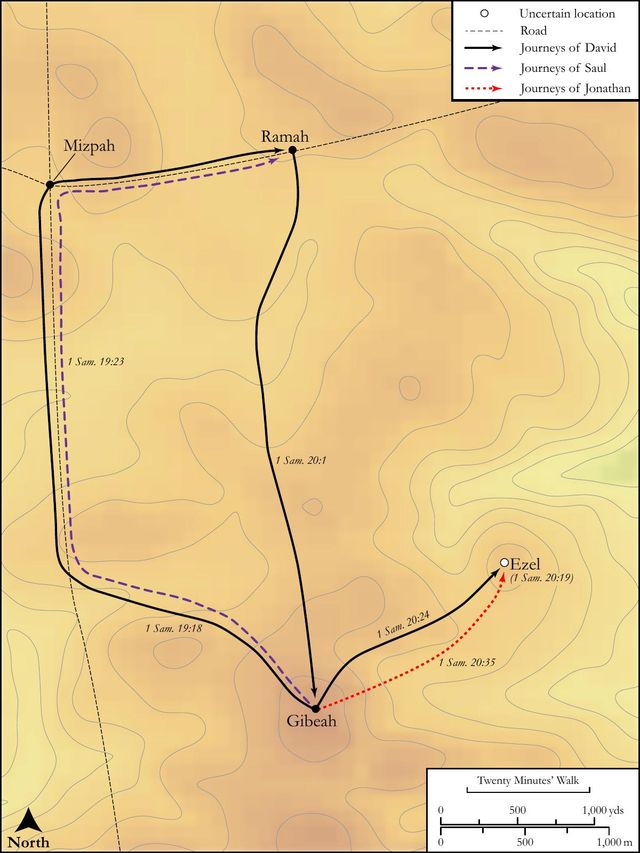
Here is, 1. Jonathan's faithful performance of his promise to give David notice of the success of his dangerous experiment. He went at the time and to the place appointed (Sa1 20:35), within sight of which he knew David lay hid, sent his footboy to fetch his arrows, which he would shoot at random (Sa1 20:36), and gave David the fatal signal by shooting an arrow beyond the lad (Sa1 20:37): Is not the arrow beyond thee? That word [beyond] David knew the meaning of better than the lad. Jonathan dismissed the lad, who knew nothing of the matter, and, finding the coast clear and no danger of a discovery, he presumed upon one minute's personal conversation with David after he had bidden him flee for his life. 2. The most sorrowful parting of these two friends, who, for aught that appears, never came together again but once, and that was by stealth in a wood, Sa1 23:16. (1.) David addressed himself to Jonathan with the reverence of a servant rather than the freedom of a friend: He fell on his face to the ground, and bowed himself three times, as one deeply sensible of his obligations to him for the good services he had done him. (2.) They took leave of each other with the greatest affection imaginable, with kisses and tears; they wept on each other's neck till David exceeded, Sa1 20:41. The separation of two such faithful friends was equally grievous to them both, but David's case was the more deplorable; for, when Jonathan was returning to his family and friends, David was leaving all his comforts, even those of God's sanctuary, and therefore his grief exceeded Jonathan's, or perhaps it was because his temper was more tender and his passions were stronger. (3.) They referred themselves to the covenant of friendship that was between them, both of them comforting themselves with this in this mournful separation: "We have sworn both of us in the name of the Lord, for ourselves and our heirs, that we and they will be faithful and kind to each other from generation to generation." Thus, while we are at home in the body and absent from the Lord, this is our comfort, that he has made with us an everlasting covenant.
Historical interpretation
Historical reception
2 surviving comments on this verse. Each one is dated, so this reads as a timeline rather than a list.
And when the boy had gone, David arose from his place, etc. When the disciples, obeying the command of their elders, went to compile the events of their times according to the writings of their predecessors, the grace of Christ appeared more abundantly, shining forth from the virtues of the saints, those, of course, who kept their hearts open to receive the gifts of the most fervent charity given by the Holy Spirit with humble submission. For this is the most splendid diversity of the growing Church, which the forty-fourth Psalm sings, so that some manifest Christ’s presence in themselves by shining with miracles; others, still intent on sacred writings, consider how the old and new harmonize with each other; others perform various services of the same faith; and still others embody what the following words signify, that divine love suddenly coming to earthly hearts provokes them with diligent contrition to adore more fervently the glory of the Holy Trinity; which our strong and desirable Lord Himself is said to do when He kindles His saints inwardly to act. As it is also said about the Holy Spirit: "The Spirit helps our infirmities (for we do not know how to pray as we ought), but the Spirit Himself intercedes for us with unspeakable groanings" (Romans VIII); that is, He causes; this figure of speech is very common in sacred Scriptures, called "metonymy" by grammarians in Greek, that is, transnaming, while through the efficient the effect is intended to be understood. Just like the lawgiver's words: "The Lord your God tests you to know whether you love Him or not" (Deut. XIII); that is, to make it known. And they kissed each other and wept. Not in vain; for the more mutual love, which inward virtue nourished, sweetly incited those very holy youths to embraces and kisses, the more the everlasting separation, which they now saw impending for them, provoked them more sharply to tears and lamentations. But in the typological sense, it must be said that our Lord bestowed His holy gifts of His mouth on those believing in Him from among the Jews; for the non-believers and those expelling Him by persecution, He did not refuse to weep, saying: "If you too had known." For David and Jonathan kissing each other signifies the Lord bestowing to the Church the salutary gifts of His word, and the Church responding devoutly to the Lord with the same word’s confession or teaching. They weep together, and this signifies the Lord, in our flesh, shedding tears both for awakening the elect to life and for the reprobate remaining in eternal death; one proven in the resurrection of Lazarus, the other in seeing and lamenting the destruction of Jerusalem; and His saints even now, inspired by Him, mourn many who sin and have not cared to return to salvation through repentance. For the believers could not see without pain and sorrow the Lord Christ leaving their compatriots in unbelief to convert to the salvation of the Gentiles. They wept together, he said, but David even more; because whatever the Church works for either her growth, in which she rejoices, or her loss, in which she grieves, it is far less indeed in comparison to what God could do in the flesh for her.
Then Jonathan said to David: Go in peace, etc. However, the Lord rose from the midst of the unbelieving Synagogue, saying: Jerusalem, Jerusalem, you who kill the prophets and stone those who are sent to you, how often I have wanted to gather your children together, as a hen gathers her chicks under her wings, but you were not willing? Behold, your house is left to you desolate (Matthew 23); and He went to seek a Church for Himself from the Gentiles. But even the more perfect returned to the teachers in the primitive Church from the consideration of the aforementioned right hand of the Most High, to complete the new peaks of the city descending from God out of heaven. If the city, as seen above, is pleasing to be understood as the fortification of prophetic reading, from which it is said: And we have the more sure prophetic word, to which you do well to attend, as to a light that shines in a dark place, until the day dawns, and the day star arises in your hearts (2 Peter 1); and it is very pleasing for the afflicted and sorrowful to enter this, so that under its protection each one may either more secretly indulge in tears or more wisely wipe away the tears.
Continue studying 1 Samuel 20:42 across the web’s major study libraries — every link below opens this exact verse, chapter, or book on the destination site.
Read & Compare
 BibleGatewayThis verse in more than 200 translations and 70 languages.
 Bible.comThe YouVersion reader — hundreds of translations, reading plans, and highlights.
 ESV.orgCrossway's official English Standard Version reader.
 NET BibleThe NET translation with 60,000+ translators' notes on every rendering decision.
 STEP BibleTyndale House's free study tool — original text, vocabulary, and scholarly resources.
 BibliaLogos Bible Software's free web reader.
 USCCBThe New American Bible (Revised Edition) with the U.S. bishops' study notes.
Commentaries
 BibleHub CommentariesDozens of classic commentaries on this verse, gathered on one page.
 StudyLightMore than 100 commentary sets — the largest collection on the web.
 BibleRefPlain-English commentary on what this verse means, verse by verse.
 Enduring WordDavid Guzik's free commentary on this chapter, widely used by Bible teachers.
 Bible Study ToolsVerse commentary alongside Greek and Hebrew study aids.
Original Language & Research
- BibleHub InterlinearThe verse word by word — original language, transliteration, and English.
- BibleHub LexiconEvery word's original-language definition and Strong's entry.
 Blue Letter BibleDeep-study tools — Strong's numbers, concordance, and word studies.
 SefariaThe Hebrew text with Rashi and centuries of Jewish commentary.
Sermons, Hymns & Audio


TrulyRandomVerse is not affiliated with these sites and doesn’t control their content. They’re linked because they’re genuinely useful.
Summary
This poignant verse captures the final, deeply emotional farewell between David and Jonathan, sealing their unbreakable covenant. Jonathan, despite being the rightful heir, reaffirms his solemn oath to David, invoking the Lord as the perpetual witness and guarantor of their bond, which extends to their descendants. David departs into a life of fugitive exile, while Jonathan returns to the city, marking the end of their direct fellowship and the beginning of a new, challenging chapter for both, all under the sovereign hand of God.
Context
ShowHideLiterary Context
This verse is the culmination of a tense and tragic narrative arc in 1 Samuel, detailing King Saul's escalating paranoia and murderous jealousy towards David. Following David's victories and growing popularity, Saul repeatedly attempts to kill him. Jonathan, Saul's son and David's closest friend, has consistently interceded for David, often at great personal risk, as seen in 1 Samuel 19:1-7. In 1 Samuel 20, Jonathan devises a clever plan to ascertain his father's true intentions towards David. Through a series of pre-arranged signals, Jonathan confirms Saul's unyielding hatred and murderous intent, realizing that David's life is no longer safe in the kingdom. This farewell, therefore, is not merely a parting but a forced separation driven by Saul's unrighteous rage, signifying the painful end of their direct companionship and the beginning of David's long, arduous period as a fugitive, which would ultimately prepare him for kingship.
Historical & Cultural Context
Covenants in ancient Israel were profoundly significant, serving as binding agreements between individuals, tribes, or even between God and humanity. Swearing "in the name of the LORD" (Yahweh) elevated the agreement to a sacred oath, invoking God as the ultimate witness and enforcer. Such oaths were considered inviolable, carrying severe consequences for breach. The concept of "seed" (descendants) was crucial in Hebrew culture, as lineage determined inheritance, status, and the continuation of family identity. For Jonathan to extend the covenant to "my seed and thy seed for ever" demonstrates an extraordinary commitment, acknowledging God's anointing on David and willingly relinquishing his own dynastic claim in favor of David's future. This act was counter-cultural to typical royal succession, highlighting Jonathan's unique faith and loyalty. The political climate was one of instability, with Saul's reign increasingly marked by erratic behavior and divine disfavor, setting the stage for David's eventual rise to the throne.
Key Themes
ShowHideThis verse powerfully encapsulates several overarching themes present in 1 Samuel and the broader biblical narrative. Firstly, Unbreakable Covenant Loyalty is central, highlighting the profound bond between David and Jonathan, which transcends political ambition and familial duty. Their covenant, first established in 1 Samuel 18:3, is reaffirmed here as a divinely sanctioned oath. Secondly, Divine Sovereignty Amidst Adversity is underscored by the invocation "The LORD be between me and thee." Despite the tragic circumstances of their separation and Saul's relentless pursuit, this phrase affirms God's active role in overseeing and protecting their covenant, ensuring the ultimate fulfillment of His promises concerning David's future as king. It demonstrates God's ability to work His will even through human conflict and suffering. Thirdly, Sacrificial Friendship is exemplified by Jonathan's actions. He consistently prioritizes David's safety and God's plan over his own personal ambition or filial duty to Saul, culminating in this painful farewell where he willingly lets David go, knowing it means permanent separation. This selfless act profoundly illustrates the depth of true, loyal, and sacrificial love.
Exposition and Analysis
ShowHideKey Word Analysis
ShowHideThis word, often translated as "peace," encompasses far more than the absence of conflict. It denotes a holistic state of completeness, wholeness, well-being, prosperity, security, and harmony. When Jonathan tells David to "Go in peace," he is not merely wishing him a calm departure but invoking a comprehensive blessing for his entire being and future, trusting in God's providential care to grant him this profound peace despite the imminent dangers and uncertainties of his exile.
This primitive root means "to seven oneself," implying a solemn declaration made as if repeated seven times, signifying completeness and inviolability. To swear "in the name of the LORD" elevates the oath to the highest possible degree of seriousness, invoking God Himself as the witness, guarantor, and enforcer of the covenant. This act made the agreement between David and Jonathan sacred and enduring, implying that any breach would be an offense against God Himself.
This is the sacred, self-revealed name of God, often translated as "Jehovah" or "Yahweh," signifying "the Self-Existent One" or "the Eternal." Jonathan's repeated invocation of "the LORD" underscores the divine authority and permanence of their covenant. By placing their oath and their future relationship under the name of Yahweh, they acknowledge His sovereign power to uphold their bond and fulfill His purposes, even when human circumstances seem to conspire against them.
Verse Breakdown
ShowHide"And Jonathan said to David, Go in peace"
This opening establishes the deeply personal and emotional nature of the farewell. Jonathan's words are not just a command but a heartfelt blessing, conveying his profound love and concern for David's holistic well-being as he embarks on a dangerous, uncertain journey. It's a wish for comprehensive peace, despite the turmoil.
"forasmuch as we have sworn both of us in the name of the LORD, saying, The LORD be between me and thee, and between my seed and thy seed for ever"
This is the theological and covenantal core of the verse, providing the foundation for Jonathan's blessing and David's departure. The peace David is to experience is rooted not in immediate circumstances but in the inviolable, divinely witnessed oath. The covenant's extension to "my seed and thy seed for ever" highlights its enduring, generational nature, demonstrating Jonathan's unwavering faith in God's plan for David's lineage, even if it meant sacrificing his own claim to the throne. The phrase "The LORD be between me and thee" is an invocation of God's perpetual presence and oversight, not as a barrier, but as the enduring bond.
"And he arose and departed: and Jonathan went into the city"
This final clause describes the physical separation, starkly contrasting David's departure into the wilderness as a fugitive with Jonathan's return to the city, to the very court where his father sought David's life. It marks the definitive end of their direct fellowship, a poignant moment of sacrifice and obedience to God's unfolding plan, highlighting the painful reality of their divinely ordained divergence.
Literary Devices
ShowHideThe passage is rich with literary techniques that amplify its emotional and theological weight. Pathos is palpable, evoking deep sympathy for both David and Jonathan as their profound friendship is tragically severed by Saul's madness. The scene is imbued with a sense of irony, as Jonathan, the rightful heir to the throne, willingly blesses and sends off David, the one destined to take his place, demonstrating a loyalty that transcends personal ambition and familial duty. This also serves as foreshadowing, as the covenant's extension to "seed" anticipates David's later kindness to Jonathan's son, Mephibosheth, in 2 Samuel 9, fulfilling the oath. The formal language of the oath, "sworn... in the name of the LORD," employs covenant language, underscoring the sacred and binding nature of their agreement, which is under divine guardianship. The phrase "The LORD be between me and thee" is a powerful invocation, calling upon God to be the ever-present witness and enforcer of their sacred bond.
Theological and Thematic Connections
ShowHideThe covenant between David and Jonathan, sealed in the name of the Lord and extending to their descendants, offers a profound theological insight into the nature of divine faithfulness and human commitment. It demonstrates that true relationships, grounded in God, can endure even the most trying circumstances and painful separations. Jonathan's selfless act of acknowledging God's chosen king, even at the cost of his own future, mirrors a deeper biblical truth: God's sovereign plan will always prevail, often through the unexpected and sacrificial obedience of His people. This covenant, under God's watchful eye, foreshadows the ultimate, everlasting covenant that God establishes with humanity, a testament to His unwavering commitment to His promises, even when human circumstances seem to contradict them. It reminds us that our peace is found not in the absence of trouble, but in the unwavering presence and promises of God.
Reflection and Application
ShowHideThe poignant farewell between David and Jonathan in 1 Samuel 20:42 offers timeless lessons for our lives today, particularly concerning the nature of true commitment, trust in divine sovereignty, and the power of sacrificial love. In a world often marked by fleeting relationships and self-interest, the covenant between David and Jonathan stands as a powerful testament to the value of deep, committed bonds, especially those forged and sustained "in the name of the LORD." It challenges us to consider the depth of our own loyalty—not just to friends, but to God's calling and His people. David's departure "in peace," despite facing an uncertain and perilous future, reminds us that true peace is not contingent on favorable circumstances but on trusting in God's unchanging promises and His sovereign plan. Even when life demands painful goodbyes or calls us into periods of uncertainty, we can find our anchor in God's faithfulness. This narrative encourages us to prioritize God's will above personal ambition and to leave a legacy of faithfulness that extends beyond our own lifetime, impacting future generations for His glory.
Questions for Reflection
ShowHideFAQ
ShowHideWas this the last time David and Jonathan saw each other?
ShowHideYes, this was indeed the final direct encounter between David and Jonathan recorded in Scripture. Their paths diverged permanently after this farewell. Jonathan later died in battle alongside his father, King Saul, on Mount Gilboa, as recounted in 1 Samuel 31:2.
How did David honor his covenant with Jonathan after becoming king?
ShowHideDavid faithfully honored his covenant with Jonathan, even years after Jonathan's death. Upon becoming king, David sought out any surviving members of Saul's house to show them kindness for Jonathan's sake. He found Mephibosheth, Jonathan's crippled son, and brought him to live in his palace, restoring all the land of Saul's house to him and ensuring he always ate at the king's table, as detailed in 2 Samuel 9:1-13. This act demonstrated David's unwavering faithfulness to his solemn oath made "in the name of the LORD."
What does "The LORD be between me and thee" mean in this context?
ShowHideThis phrase is a powerful invocation of God as the perpetual witness, guardian, and enforcer of their sacred covenant. It does not imply a barrier or separation between them, but rather signifies God's active presence in upholding their solemn oath, ensuring its enduring nature even in their physical absence from each other. It is a declaration that God Himself is the bond that will forever connect them and their descendants, guaranteeing the covenant's fulfillment.
Christ-Centered Fulfillment
ShowHideThe profound covenant between David and Jonathan, marked by sacrificial love and an oath sworn "in the name of the LORD," finds its ultimate fulfillment and deepest meaning in the person and work of Jesus Christ. Jonathan, the rightful heir to Israel's throne, willingly steps aside and blesses David, the divinely chosen king, embodying a self-emptying love that profoundly foreshadows Christ. Jesus, though eternally God and rightful King of all creation, "did not consider equality with God something to be used to his own advantage; rather, he emptied himself" (Philippians 2:6-7). He laid down His life for His friends, demonstrating a love "greater than this, that someone lay down his life for his friends" (John 15:13), far surpassing Jonathan's noble sacrifice. The covenant "in the name of the LORD" points to the New Covenant established in Christ's blood, an everlasting covenant that promises eternal peace and reconciliation with God (Luke 22:20; Hebrews 13:20). David's departure "in peace" despite uncertainty foreshadows the peace that Christ offers to His followers—a peace that the world cannot give, guarding hearts and minds in Him (John 14:27; Philippians 4:7). Ultimately, the faithfulness of God to the covenant between David and Jonathan, extending to their seed, finds its most glorious expression in the eternal reign of Christ, the Son of David, whose kingdom will have no end.