


1 Samuel 23:18
Bible text: King James Version (1769 Blayney text) · Public domain
Bible text: Berean Standard Bible · Public domain
Bible text: American Standard Version (1901) · Public domain
Bible text: World English Bible, Messianic edition · Public domain
Bible text: Geneva Bible (1599) · Public domain
Bible text: Young's Literal Translation · Public domain
- וַיִּכְרְתוּvai·yikh·re·Tuand they madeH3772Conj-w ¦ V-Qal-ConsecImperf-3mpVerb Qal Consecutive Imperfect 3rd Plural Masculineוַandיִּכְרְתוּthey made
- שְׁנֵיהֶםshe·nei·Hem[the] two of themH8147N-cdc ¦ 3mpNoun Dual common gender Constructשְׁנֵי[the] two ofהֶםthem
- בְּרִיתbe·Rita covenantH1285N-fsNoun Singular Feminine Absolute
- לִפְנֵיlif·Nei<to> beforeH6440Prep-l ¦ N-mpcNoun Plural Masculine Constructלִ<to>פְנֵיbefore
- יְהוָהYah·wehYahwehH3068N-properNoun Proper Title
- וַיֵּשֶׁבvai·Ye·shevand he remainedH3427Conj-w ¦ V-Qal-ConsecImperf-3msVerb Qal Consecutive Imperfect 3rd Singular Masculineוַandיֵּשֶׁבhe remained
- דָּוִדda·VidDavidH1732N-proper-mNoun Proper Masculine
- בַּחֹרְשָׁהba·Cho·re·shahat <the> HoreshH2793Prep-b ¦ N-properNoun Proper Locationבַּat <the>חֹרְשָׁהHoresh
- וִיהוֹנָתָןvi·ho·na·Tanand JonathanH3083Conj-w ¦ N-proper-mNoun Proper MasculineוִandיהוֹנָתָןJonathan
- הָלַךְha·Lakhhe wentH1980V-Qal-Perf-3msVerb Qal Perfect 3rd Singular Masculine
- לְבֵיתוֹle·vei·Toto his houseH1004Prep-l ¦ N-msc ¦ 3msNoun Singular Masculine Constructלְtoבֵיתhouseוֹhis
English is a literal word-by-word gloss of the Hebrew, not the KJV's wording. Why?
This is the original text the KJV's translators worked from — each Hebrew word with its own literal English meaning in this verse, prepared by scholars at Tyndale House, Cambridge. The KJV translates whole sentences, not word by word, so its wording differs: one Hebrew word can become several English words, and the KJV may choose “the LORD” where the gloss reads “Yahweh”. Both are faithful — they answer different questions. For the KJV's own rendering, switch to the KJV text.
Details
See on the biblical-era map
Study this verse
Public-domain commentary
Matthew Henry
From his Commentary on the Whole Bible. Henry comments on passages, not single verses — this entry covers 1 Samuel 23:14–18. His two-level outline is real structure in the source text, so it is rendered as structure.
Here is, I. David absconding. He abode in a wilderness, in a mountain (Sa1 23:14), in a wood, Sa1 23:15. We must here, 1. Commend his eminent virtues, his humility, modesty, fidelity to his prince, and patient attendance on the providence of his God, that he did not draw up his forces against Saul, fight him in the field, or surprise him by some stratagem or other, and so avenge his own quarrel and that of the Lord's priests upon him, and put an end to his own troubles and the calamities of the country under Saul's tyrannical government. No, he makes no such attempt; he keeps God's way, waits God's time, and is content to secure himself in woods and wildernesses, though with some it might seem a reproach to that courage for which he had been famous. But, 2. We must also lament his hard fate, that an innocent man should be thus terrified and put in fear of his life, that a man of honour should be thus disgraced, a man of merit thus recompensed for his services, and a man that delighted in the service both of God and his country should be debarred from both and wrapped up in obscurity. What shall we say to this? Let it make us think the worse of this world, which often gives such bad treatment to its best men; let it reconcile even great and active men to privacy and restraint, if Providence make these their lot, for they were David's; and let it make us long for that kingdom where goodness shall for ever be in glory and holiness in honour, and the righteous shall shine as the sun, which cannot be put under a bushel.
II.Saul hunting him, as his implacable enemy.
He sought him every day, so restless was his malice, Sa1 23:14. He sought no less than his life, so cruel was his malice, Sa1 23:15. As it had been from the beginning, so it was now, and will be, he that is born after the flesh persecuteth him that is born after the spirit, Gal 4:29.
III.God defending him, as his powerful protector.
God delivered him not into Saul's hand, as Saul hoped (Sa1 23:7); and, unless God delivered him into his hand, he could not prevail against him, Joh 19:11.
IV.Jonathan comforting him as his faithful and constant friend.
True friends will find out means to get together. David, it is likely, appointed time and place for this interview, and Jonathan observed the appointment, though he exposed himself thereby to his father's displeasure, and, had it been discovered, it might have cost him his life. True friendship will not shrink from danger, but can easily venture, will not shrink from condescension, but can easily stoop, and exchange a palace for a wood, to serve a friend. The very sight of Jonathan was reviving to David; but, besides this, he said that to him which was very encouraging.
1.As a pious friend, he directed him to God, the foundation of his confidence and the fountain of his comfort: He strengthened his hand in God. David, though a strong believer, needed the help of his friends for the perfecting of what was lacking in his faith; and herein Jonathan was helpful to him, by reminding him of the promise of God, the holy oil wherewith he was anointed, the presence of God with him hitherto, and the many experiences he had had of God's goodness to him. Thus he strengthened his hands for action, by encouraging his heart, not in the creature, but in God. Jonathan was not in a capacity of doing any thing to strengthen him, but he assured him God would.
2.As a self-denying friend, he took a pleasure in the prospect of David's advancement to that honour which was his own birthright, Sa1 23:17. "Thou shalt live to be king, and I shall think it preferment enough to be next thee, near thee, though under thee, and will never pretend to be a rival with thee." This resignation which Jonathan made to David of his title would be a great satisfaction to him, and make his way much the more clear. This, he tells him, Saul knew very well, Jonathan having sometimes heard him say as much, whence it appears what a wicked man Saul was, to persecute one whom God favoured, and what a foolish man he was, in thinking to prevent that which God had determined and which would certainly come to pass. How could he disannul what God had purposed?
3.As a constant friend, he renewed his league of friendship with him. They made a covenant now, this third time, before the Lord, calling him to witness to it, Sa1 23:18. True love takes delight in repeating its engagements, giving and receiving fresh assurances of the firmness of the friendship. Our covenant with God should be often renewed, and therein our communion with him kept up. David and Jonathan now parted, and never came together again, that we find, in this world; for Jonathan said what he wished, not what he had ground to expect, when he promised himself that he should be next to David in his kingdom.
Historical interpretation
Historical reception
1 surviving comment on this verse from the historical church.
Therefore, each struck a covenant before the Lord, etc. The Lord and the faithful strike a covenant with each other, that they should follow Him, and He should give them eternal life; and this before His divine presence, in whose faith He commands us to live, and to which He encourages us to aspire, assisting us. And the Lord remains in the Church, a dense forest of peoples, all the days until the consummation of the world (Matthew 8). However, each of the faithful, after completing the service of prayer or exhortation, or any other devotion offered to the Lord, returns to their conscience, so that, vacating external action, they may more freely for a time reflect on all that has been or is to be done by them, more freely purge themselves from what has been done badly, and more perfectly ready themselves for what is to be done well; such as these indeed can say with the prophet: Who will give me wings like a dove, and I will fly and be at rest (Psalm 54)? And deservedly too, with Jonathan, they can be called a gift of doves, indeed and with the apostle Peter they can be called sons of doves.
Continue studying 1 Samuel 23:18 across the web’s major study libraries — every link below opens this exact verse, chapter, or book on the destination site.
Read & Compare
 BibleGatewayThis verse in more than 200 translations and 70 languages.
 Bible.comThe YouVersion reader — hundreds of translations, reading plans, and highlights.
 ESV.orgCrossway's official English Standard Version reader.
 NET BibleThe NET translation with 60,000+ translators' notes on every rendering decision.
 STEP BibleTyndale House's free study tool — original text, vocabulary, and scholarly resources.
 BibliaLogos Bible Software's free web reader.
 USCCBThe New American Bible (Revised Edition) with the U.S. bishops' study notes.
Commentaries
 BibleHub CommentariesDozens of classic commentaries on this verse, gathered on one page.
 StudyLightMore than 100 commentary sets — the largest collection on the web.
 BibleRefPlain-English commentary on what this verse means, verse by verse.
 Enduring WordDavid Guzik's free commentary on this chapter, widely used by Bible teachers.
 Bible Study ToolsVerse commentary alongside Greek and Hebrew study aids.
Original Language & Research
- BibleHub InterlinearThe verse word by word — original language, transliteration, and English.
- BibleHub LexiconEvery word's original-language definition and Strong's entry.
 Blue Letter BibleDeep-study tools — Strong's numbers, concordance, and word studies.
 SefariaThe Hebrew text with Rashi and centuries of Jewish commentary.
Sermons, Hymns & Audio


TrulyRandomVerse is not affiliated with these sites and doesn’t control their content. They’re linked because they’re genuinely useful.
Summary
1 Samuel 23:18 captures a pivotal moment of unwavering loyalty and profound spiritual unity between David and Jonathan, even as their lives are forced onto divergent paths amidst intense adversity. This verse meticulously records their solemn covenant, a sacred agreement made in the very presence of God, which serves to reaffirm their unbreakable bond and Jonathan's steadfast recognition of David's divinely appointed kingship. Despite the immediate and perilous danger David faced as a fugitive from King Saul, this encounter highlights the extraordinary depth of their friendship and underscores God's faithfulness in providing crucial encouragement during David's darkest hour.
Context
ShowHideLiterary Context
This verse is situated at a critical and emotionally charged point in the narrative of David's flight from Saul. The preceding verses, 1 Samuel 23:14-17, vividly describe David's precarious existence as a fugitive, constantly pursued by Saul. It is in this context of extreme vulnerability that Jonathan, with remarkable courage and selflessness, seeks out David in the wilderness of Ziph. Jonathan's visit is not merely a friendly call; it is a divinely orchestrated intervention designed to "strengthen his hand in God" (1 Samuel 23:16). During this encounter, Jonathan explicitly affirms God's unwavering plan for David to be king and, astonishingly, expresses his willingness to be second to David. The covenant recorded in 1 Samuel 23:18 serves as the solemn culmination of this deeply personal and prophetic meeting, solidifying their bond and mutual commitment before their inevitable, painful separation. This interlude of deep fellowship stands in stark contrast to the relentless threat of Saul's pursuit that frames the entire chapter.
Historical & Cultural Context
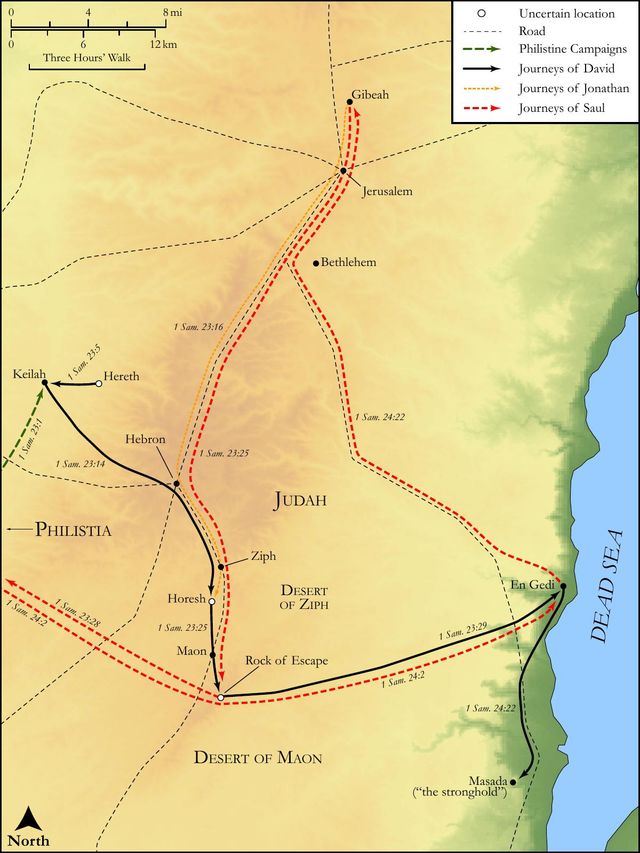
The geographical backdrop for this event is the wilderness of Ziph, a rugged, desolate, and strategically advantageous region in the Judean desert known for its numerous caves, ravines, and strongholds that offered ideal hiding places for fugitives like David. In Israel, oaths and covenants were not mere agreements but deeply significant, binding contracts, often accompanied by solemn rituals and invoked with divine witnesses, as when Jacob said to Laban, "God is witness betwixt me and thee." Covenants made "before the LORD" were considered exceptionally sacred and unbreakable, carrying immense social, legal, and spiritual weight. The political climate of the time was volatile and dangerous, marked by King Saul's escalating paranoia and tyrannical behavior, as he viewed David as an existential threat to his dynasty. Jonathan, as the crown prince and Saul's rightful heir, demonstrated extraordinary self-sacrifice by associating with David and affirming his future kingship. This act of covenant-making was far more than a personal agreement; it was a profound political and spiritual declaration, acknowledging God's ultimate sovereignty over the succession of the throne, even in direct opposition to the reigning monarch's will and the established order.
Key Themes
ShowHide1 Samuel 23:18 powerfully reinforces several overarching themes central to the book of 1 Samuel and the broader biblical narrative. The theme of Divine Sovereignty is paramount, as Jonathan's prophetic affirmation of David's future kingship (1 Samuel 23:17) unequivocally underscores God's unwavering and unstoppable plan, even when circumstances for David appear dire and human opposition is fierce. The theme of Loyalty and Covenant Friendship is profoundly central, portraying an ideal of selfless devotion that transcends personal ambition, political rivalry, and familial ties, standing in stark contrast to Saul's increasing disloyalty to God and his own family. Furthermore, the verse vividly highlights the theme of Encouragement in Adversity, demonstrating God's compassionate provision of spiritual and emotional support through faithful companions during times of intense trial. Jonathan's visit and the renewed covenant serve to strengthen David's faith and resolve amidst his desperate flight from Saul, a recurring motif throughout David's wilderness years, as further elaborated in accounts such as 1 Samuel 24 and 1 Samuel 26.
Exposition and Analysis
ShowHideKey Word Analysis
ShowHideThis term (H1285) denotes a solemn, binding agreement or compact, often established with oaths, promises, and sometimes involving symbolic rituals like the cutting of flesh (as implied by its root). In this context, it signifies a sacred, unbreakable bond of mutual commitment and loyalty between David and Jonathan. Unlike a mere friendship pact, a bᵉrîyth carried significant legal, social, and theological weight, representing a profound and enduring relationship that transcended personal preference or changing circumstances, rooted deeply in a shared understanding of God's will and divine purpose.
This powerful phrase (H6440, H3068) emphasizes the sacredness and divine sanction of the covenant. It literally means "in the face of the LORD" or "in the presence of the LORD," implying that God Himself was the direct witness to the agreement. This elevates the covenant from a purely human arrangement to one with divine backing, approval, and ultimate enforcement. It underscores the solemnity and permanence of their pact, highlighting Jonathan's deep faith and his recognition of God's sovereign hand in David's life, despite his own father's fierce opposition.
Verse Breakdown
ShowHide"And they two made a covenant before the LORD"
This opening clause establishes the profound significance of the encounter. The act of "making a covenant" (Hebrew: kârath bᵉrîyth, literally "to cut a covenant") signifies a formal, sacred, and binding agreement. The crucial addition "before the LORD" elevates this pact beyond a mere human promise, indicating divine witness and sanction. This was likely a renewal and reaffirmation of their earlier covenants (1 Samuel 18:3 and 1 Samuel 20:16), specifically in light of Jonathan's recent affirmation of David's future kingship. It solidifies their unbreakable bond and Jonathan's selfless support, rooted in their shared faith in God's plan.
"and David abode in the wood"
This phrase starkly depicts David's continued precarious existence immediately following this profound spiritual encounter. Despite the deep encouragement and renewed covenant, David remained a hunted fugitive, forced to hide in the desolate, rugged terrain of the wilderness, often referred to as "the wood" or "the stronghold" (Hebrew: chôresh). This emphasizes his vulnerable, unsettled state, constantly on the run from Saul's relentless pursuit. It highlights the harsh reality of his circumstances, even as he received divine assurance and human companionship.
"and Jonathan went to his house."
This concluding phrase marks the immediate and poignant divergence of their paths. Jonathan, though bound by an unbreakable covenant and profound loyalty, returned to the relative safety and privilege of the royal court, to his father's house (Hebrew: bayith) in Gibeah. This separation underscores the immense personal cost of their friendship and the dangerous political reality that prevented them from remaining together. It also foreshadows Jonathan's eventual death in battle, while David's life in the wilderness continues, setting the stage for his eventual ascent to the throne, a path Jonathan would not live to see.
Literary Devices
ShowHideThe verse employs Contrast and Symbolism to convey its powerful message. The most striking literary device is the Contrast between David's continued existence as a hunted fugitive ("David abode in the wood") and Jonathan's return to the relative safety and privilege of the royal court ("Jonathan went to his house"). This sharp juxtaposition highlights the immediate and painful reality of their diverging paths, despite the unbreakable spiritual and emotional bond they had just reaffirmed. It powerfully emphasizes the personal sacrifice inherent in their loyalty and the dangerous circumstances surrounding David. Furthermore, the act of "making a covenant before the LORD" is rich in Symbolism. The covenant itself symbolizes an enduring, divinely sanctioned bond of loyalty and friendship, transcending worldly power dynamics and personal ambition. It is a profound symbol of faithfulness, selfless love, and God's providential care, providing David with crucial spiritual strength and reassurance in his darkest hour.
Theological and Thematic Connections
ShowHide1 Samuel 23:18 serves as a poignant reminder of God's unwavering faithfulness in sustaining His chosen ones through trials, often by providing unexpected sources of encouragement and unwavering companionship. The covenant between David and Jonathan, solemnly made "before the LORD," underscores the divine sanction of their extraordinary bond and, by extension, God's overarching, unstoppable plan for David's kingship. It vividly illustrates that true loyalty, especially when deeply rooted in a shared commitment to God's will, possesses the power to defy the most formidable political pressures and personal dangers. This deep, sacrificial friendship between a future king and a rightful heir beautifully foreshadows the ultimate covenant of grace God makes with His people through Christ, demonstrating His steadfast commitment to them even when their circumstances seem bleak. It also powerfully speaks to the vital importance of spiritual encouragement within the community of faith, where one person's steadfastness and prophetic insight can genuinely "strengthen another's hand in God."
Reflection and Application
ShowHideThe covenant between David and Jonathan, sealed before the LORD, offers a timeless and profound model of friendship rooted in divine purpose and unwavering loyalty. In a world often characterized by fleeting relationships, self-interest, and conditional commitments, this verse calls us to cultivate friendships that are deep, sacrificial, and spiritually enriching. It serves as a powerful reminder that God often uses faithful companions to strengthen our resolve, remind us of His promises, and provide tangible support during our own "wilderness" experiences. Just as Jonathan fortified David's hand in God, we are called to be sources of encouragement, steadfast support, and unwavering loyalty for others, particularly those facing adversity, persecution, or pursuing God-given callings that come with great personal cost. This means choosing to see beyond immediate circumstances, trusting implicitly in God's sovereign plan, and committing to stand by those whom God has placed in our lives, even when it requires significant personal sacrifice or when our individual paths seem to diverge.
Questions for Reflection
ShowHideFAQ
ShowHideWhat was the significance of "making a covenant before the LORD"?
ShowHideMaking a covenant "before the LORD" (1 Samuel 23:18) signified that the agreement was not merely a human promise or a social contract, but a sacred oath witnessed and sanctioned by God Himself. This elevated the covenant to a divine level, making it profoundly binding and unbreakable in the eyes of both parties and carrying immense spiritual weight. It underscored the solemnity of their commitment and implied divine accountability for its fulfillment. For David and Jonathan, it meant their extraordinary bond was rooted in God's will and His overarching plan for David's future as the king of Israel.
Were David and Jonathan's covenants unique, or did they make more than one?
ShowHideDavid and Jonathan made several covenants throughout their relationship, demonstrating the progressive deepening and renewal of their extraordinary bond. Their initial covenant is recorded in 1 Samuel 18:3, where Jonathan "made a covenant with David, because he loved him as his own soul." A second, more elaborate covenant, explicitly involving their descendants and ensuring kindness to David's house, is detailed in 1 Samuel 20:16 and renewed in 1 Samuel 20:42. The covenant mentioned in 1 Samuel 23:18 appears to be a powerful renewal or reaffirmation of their commitment, specifically in the context of Jonathan strengthening David's faith and acknowledging his future kingship, just before their final, poignant separation.
Christ-Centered Fulfillment
ShowHideThe profound covenant between David and Jonathan, solemnly made "before the LORD," beautifully foreshadows the ultimate, eternal covenant established through Jesus Christ. Jonathan's selfless love, his willingness to lay aside his own rightful claim to the throne, and his prophetic affirmation of David's divinely appointed kingship (1 Samuel 23:17) powerfully prefigure Christ's ultimate act of self-sacrifice and His humble submission to the Father's will. Just as Jonathan strengthened David's hand in God during his time of weakness, persecution, and isolation, Jesus, our great High Priest, continually intercedes for us and strengthens us in our trials, having Himself experienced human weakness and temptation (Hebrews 4:15). The unbreakable bond of their covenant, sealed before God, points directly to the New Covenant in Christ's blood, which establishes an eternal, perfect, and indissoluble relationship between God and His people (Luke 22:20). Furthermore, while David and Jonathan's paths diverged physically, their spiritual bond remained. Similarly, Christ, our true Jonathan, ascended to His Father's house, yet He remains eternally united with us through the Holy Spirit, promising to never leave or forsake us (John 14:18). He is the faithful friend who sticks closer than a brother (Proverbs 18:24), the ultimate King who gave His life for His friends (John 15:13-15), fulfilling the deepest longings for loyalty, divine assurance, and eternal companionship found in the poignant covenant of David and Jonathan.