


1 Samuel 20:12
Bible text: King James Version (1769 Blayney text) · Public domain
Bible text: King James Version with Strong's numbers · Public domain
Bible text: Berean Standard Bible · Public domain
Bible text: American Standard Version (1901) · Public domain
Bible text: World English Bible, Messianic edition · Public domain
Bible text: Geneva Bible (1599) · Public domain
Bible text: Young's Literal Translation · Public domain
- וַיֹּאמֶרvai·Yo·merand he saidH559Conj-w ¦ V-Qal-ConsecImperf-3msVerb Qal Consecutive Imperfect 3rd Singular Masculineוַandיֹּאמֶרhe said
- יְהוֹנָתָןye·ho·na·TanJonathanH3083N-proper-mNoun Proper Masculine
- אֶל'eltoH413PrepPreposition
- דָּוִדda·VidDavidH1732N-proper-mNoun Proper Masculine
- יְהוָהYah·wehYahwehH3068N-properNoun Proper Title
- אֱלֹהֵי'e·lo·Hei[the] God ofH430N-mpcNoun Plural Masculine Construct
- יִשְׂרָאֵלYis·ra·'ElIsraelH3478N-properNoun Proper Location
- כִּיkithatH3588PrtParticle Conditional
- אֶחְקֹר'ech·KorI will sound outH2713V-Qal-Imperf-1csVerb Qal Imperfect 1st Singular common gender
- אֶת'et<obj.>H853DirObjMParticle Object Indicator
- אָבִי'a·Vimy fatherH1N-msc ¦ 1csNoun Singular Masculine Constructאָבִfatherיmy
- כָּעֵתka·'Etabout <the> this timeH6256Prep-k ¦ N-cscNoun Singular common gender Constructכָּabout <the>עֵתthis time
- מָחָרma·ChartomorrowH4279N-msNoun Singular Masculine Absolute
- הַשְּׁלִשִׁיתha·she·li·Shitthe thirdH7992Art ¦ Adj-fsAdjective Numerical Position Singular Feminine Absoluteהַtheשְּׁלִשִׁיתthird
- וְהִנֵּהve·hi·nehand there!H2009Conj-w ¦ PrtParticle Interjectionוְandהִנֵּהthere!
- טוֹבTovgoodH2896Adj-msAdjective Singular Masculine Absolute
- אֶל'el[is] toH413PrepPreposition
- דָּוִדda·VidDavidH1732N-proper-mNoun Proper Masculine
- וְלֹאve·lo'and not?H3808Conj-w ¦ NegParticle Negativeוְandלֹאnot?
- אָז'azthenH227AdvAdverb
- אֶשְׁלַח'esh·Lachwill I sendH7971V-Qal-Imperf-1csVerb Qal Imperfect 1st Singular common gender
- אֵלֶיךָ'e·Lei·khato youH413Prep ¦ 2msPreposition Definiteאֵלֶיtoךָyou
- וְגָלִיתִיve·ga·Li·tiand I will uncoverH1540Conj-w ¦ V-Qal-ConsecPerf-1csVerb Qal Consecutive Perfect 1st Singular common genderוְandגָלִיתִיI will uncover
- אֶת'et<obj.>H853DirObjMParticle Object Indicator
- אָזְנֶךָ'a·ze·Ne·khayour earH241N-fsc ¦ 2msNoun Singular Feminine Constructאָזְנֶearךָyour
English is a literal word-by-word gloss of the Hebrew, not the KJV's wording. Why?
This is the original text the KJV's translators worked from — each Hebrew word with its own literal English meaning in this verse, prepared by scholars at Tyndale House, Cambridge. The KJV translates whole sentences, not word by word, so its wording differs: one Hebrew word can become several English words, and the KJV may choose “the LORD” where the gloss reads “Yahweh”. Both are faithful — they answer different questions. For the KJV's own rendering, switch to the KJV text.
Details
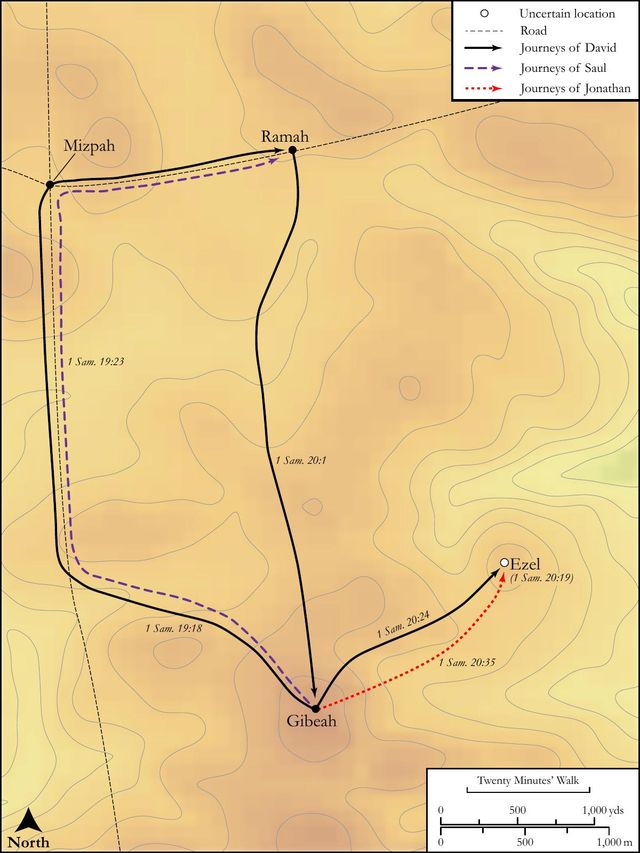
See on the biblical-era map
Study this verse
Public-domain commentary
Matthew Henry
From his Commentary on the Whole Bible. Henry comments on passages, not single verses — this entry covers 1 Samuel 20:9–23. His two-level outline is real structure in the source text, so it is rendered as structure.
Here, I. Jonathan protests his fidelity to David in his distress. Notwithstanding the strong confidence David had in Jonathan, yet, because he might have some reason to fear that his father's influence, and his own interest, should make him warp, or grow cool towards him, Jonathan thought it requisite solemnly to renew the professions of his friendship to him (Sa1 20:9): "Far be it from thee to think that I suspect thee of any crime for which I should either slay thee myself or deliver thee to my father; no, if thou hast any jealousy of that, Come let us go into the field (Sa1 20:11), and talk it over more fully." He did not challenge him to the field to fight him for an affront, but to fix him in his friendship. He faithfully promised him that he would let him know how, upon trial, he found his father affected towards him, and would make the matter neither better nor worse than it was. "If there be good towards thee, I will show it thee, that thou mayest be easy (Sa1 20:12), if evil, I will send thee away, that thou mayest be safe" (Sa1 20:13); and thus he would help to deliver him from the evil if it were real and from the fear of evil if it were but imaginary. For the confirmation of his promise he appeals to God, 1. As a witness (Sa1 20:12): "O Lord God of Israel, thou knowest I mean sincerely, and think as I speak." The strength of his passion made the manner of his speaking concise and abrupt. 2. As a judge: "The Lord do so and much more to Jonathan (Sa1 20:13), if I speak deceitfully, or break my word with my friend." He expressed himself thus solemnly that David might be abundantly assured of his sincerity. And thus God has confirmed his promises to us, that we might have strong consolation, Heb 6:17, Heb 6:18. Jonathan adds to his protestations his hearty prayers: "The Lord be with thee, to protect and prosper thee, as he has been formerly with my father, though now he has withdrawn." Thus he imitates his belief that David would be in his father's place, and his good wishes that he might prosper in it better than his father now did.
II.He provides for the entail of the covenant of friendship with David upon his posterity, Sa1 20:14-16.
He engages David to be a friend to his family when he was gone (Sa1 20:15): Thou shalt promise that thou wilt not cut off thy kindness from my house for ever. This he spoke from a natural affection he had to his children, whom he desired it might go well with after his decease, and for whose future welfare he desired to improve his present interest. It also intimates his firm belief of David's advancement, and that it would be in the power of his hand to do a kindness or unkindness to his seed; for, in process of time, the Lord would cut off his enemies, Saul himself was not expected; then "Do not thou cut off thy kindness from my house, nor revenge my father's wrongs upon my children." The house of David must likewise be bound to the house of Jonathan from generation to generation; he made a covenant (Sa1 20:16) with the house of David. Note, True friends cannot but covet to transmit to theirs after them their mutual affections. Thy own friend, and thy father's friend, forsake not. This kindness,
1.He calls the kindness of the Lord, because it is such kindness as God shows to those he takes into covenant with himself; for he is a God to them and to their seed; they are beloved for the fathers' sakes.
2.He secures it by an imprecation (Sa1 20:16): The Lord require it at the hand of David's seed (for of David himself he had no suspicion) if they prove so far David's enemies as to deal wrongfully with the posterity of Jonathan, David's friend. He feared lest David, or some of his, should hereafter be tempted, for the clearing and confirming of their title to the throne, to do by his seed as Abimelech had done by the sons of Gideon (Jdg 9:5), and this he would effectually prevent; but the reason given (Sa1 20:17) why Jonathan was so earnest to have the friendship entailed is purely generous, and has nothing of self in it; it was because he loved him as he loved his own soul, and therefore desired that he and his might be beloved by him. David, though now in disgrace at court and in distress, was as amiable in the eyes of Jonathan as ever he had been, and he loved him never the less for his father's hating him, so pure were the principles on which his friendship was built. Having himself sworn to David, he caused David to swear to him, and (as we read it) to swear again, which David consented to (for he that bears an honest mind does not startle at assurances), to swear by his love to him, which he looked upon as a sacred thing. Jonathan's heart was so much upon it that, when they parted this time, he concluded with a solemn appeal to God: The Lord be between me and thee for ever (Sa1 20:23), that is, "God himself be judge between us and our families for ever, if on either side this league of friendship be violated." It was in remembrance of this covenant that David was kind to Mephibosheth, Sa2 9:7; Sa2 21:7. It will be a kindness to ourselves and ours to secure an interest in those whom God favours and to make his friends ours.
III.He settles the method of intelligence, and by what signs and tokens he would give him notice how his father stood affected towards him.
David would be missed the first day, or at least the second day, of the new moon, and would be enquired after, Sa1 20:18. On the third day, by which time he would have returned from Bethlehem, he must be at such a place (Sa1 20:19), and Jonathan would come towards that place with his bow and arrows to shoot for diversion (Sa1 20:20), would send his lad to fetch his arrows, and, if they were shot short of the lad, David must take it for a signal of safety, and not be afraid to show his head (Sa1 20:21); but, if he shot beyond the lad, it was a signal of danger, and he must shift for his safety, Sa1 20:22. This expedient he fixed lest he should not have the opportunity, which yet it proved he had, of talking with David, and making the report by word of mouth.
Historical interpretation
Historical reception
1 surviving comment on this verse from the historical church.
But good will also goes together with generosity, for generosity really starts from it, seeing that the habit of giving comes after the desire to give. But generosity may be distinguished from good will. For where generosity is lacking, there good may abide—the parent, as it were, of all in common, uniting and binding friendships together. It is faithful in counsel, joyful in times of prosperity, and in times of sorrow sad. So it happens that any one trusts himself to the counsels of a man of good will rather than to those of a wise one, as David did. For he, though he was the more farseeing, agreed to the counsels of Jonathan, who was the younger.
Continue studying 1 Samuel 20:12 across the web’s major study libraries — every link below opens this exact verse, chapter, or book on the destination site.
Read & Compare
 BibleGatewayThis verse in more than 200 translations and 70 languages.
 Bible.comThe YouVersion reader — hundreds of translations, reading plans, and highlights.
 ESV.orgCrossway's official English Standard Version reader.
 NET BibleThe NET translation with 60,000+ translators' notes on every rendering decision.
 STEP BibleTyndale House's free study tool — original text, vocabulary, and scholarly resources.
 BibliaLogos Bible Software's free web reader.
 USCCBThe New American Bible (Revised Edition) with the U.S. bishops' study notes.
Commentaries
 BibleHub CommentariesDozens of classic commentaries on this verse, gathered on one page.
 StudyLightMore than 100 commentary sets — the largest collection on the web.
 BibleRefPlain-English commentary on what this verse means, verse by verse.
 Enduring WordDavid Guzik's free commentary on this chapter, widely used by Bible teachers.
 Bible Study ToolsVerse commentary alongside Greek and Hebrew study aids.
Original Language & Research
- BibleHub InterlinearThe verse word by word — original language, transliteration, and English.
- BibleHub LexiconEvery word's original-language definition and Strong's entry.
 Blue Letter BibleDeep-study tools — Strong's numbers, concordance, and word studies.
 SefariaThe Hebrew text with Rashi and centuries of Jewish commentary.
Sermons, Hymns & Audio


TrulyRandomVerse is not affiliated with these sites and doesn’t control their content. They’re linked because they’re genuinely useful.
Summary
1 Samuel 20:12 captures a pivotal moment in the profound covenant friendship between Jonathan, King Saul's son, and David, the divinely anointed future king. In this verse, Jonathan invokes the "LORD God of Israel" as he outlines his discreet plan to ascertain his father's true intentions toward David over the next one to two days. He solemnly pledges to communicate Saul's disposition to David, thereby providing crucial information about whether Saul intends "good" or harm, demonstrating his unwavering loyalty and strategic foresight in the face of imminent danger.
Context
ShowHideLiterary Context
This verse is central to the dramatic unfolding of the deep, divinely-sanctioned bond between Jonathan and David, set against the backdrop of King Saul's escalating, irrational jealousy and murderous intent toward David. Following David's desperate appeal to Jonathan for clarity regarding Saul's intentions in 1 Samuel 20:1-3, Jonathan, despite being the heir apparent to the throne, pledges unwavering loyalty to David, recognizing God's hand upon him. The immediate context of 1 Samuel 20 details the elaborate plan Jonathan devises to discover Saul's true disposition and communicate it to David via a secret signal. This particular verse initiates Jonathan's solemn oath, calling God as a witness to his commitment, and sets the stage for the crucial test of Saul's intentions that follows in the chapter. It reinforces the covenant established between them earlier in 1 Samuel 18:3-4.
Historical & Cultural Context
The narrative takes place during the tumultuous early monarchy in Israel, a period marked by the transition from a tribal confederacy to a centralized kingdom. King Saul, Israel's first king, is increasingly consumed by a spirit of madness and jealousy, particularly towards David, who has gained immense popularity after defeating Goliath and achieving significant military successes, as recounted in 1 Samuel 18:7-9. In Israel, oaths and covenants, especially those invoking the LORD, were considered extremely binding and sacred. Jonathan's invocation of "LORD God of Israel" underscores the gravity of his promise and his appeal to divine witness, placing his commitment under divine scrutiny. The king's word was law, and royal displeasure often meant death, making Jonathan's actions incredibly courageous and risky, as he was effectively siding against his own father and the established royal lineage for the sake of a friend and God's chosen one.
Key Themes
ShowHideThis verse powerfully illustrates several key themes within 1 Samuel and the broader biblical narrative. Foremost is the theme of Loyalty and Friendship, exemplified by Jonathan's selfless devotion to David, which transcends familial and political ties. His actions highlight a friendship that "loves at all times" as described in Proverbs 17:17. The invocation of God emphasizes the theme of Divine Sovereignty and Witness, acknowledging God's ultimate authority over human affairs and His active involvement in their covenant. Furthermore, the verse underscores the Peril and Protection David faced from Saul, and Jonathan's role as a faithful protector, a stark contrast to Saul's escalating hostility, which is vividly portrayed in 1 Samuel 19:9-10. Finally, Jonathan's careful plan demonstrates Discernment and Strategic Wisdom, as he seeks to uncover the truth about Saul's intentions through a measured, non-confrontational approach, rather than impulsive action.
Exposition and Analysis
ShowHideKey Word Analysis
ShowHideThis is the Tetragrammaton, YHWH, the personal, covenantal name of God, often translated as "Jehovah" or "the Lord." It signifies "the self-Existent or Eternal One." By invoking this name, Jonathan is not merely using a generic term for deity but is calling upon the sovereign, immutable, covenant-keeping God of Israel as the ultimate witness to his oath. This imbues his words with immense spiritual gravity and underscores the sacredness of the bond between him and David, placing their friendship under divine oversight and guaranteeing the seriousness of his commitment.
This verb means "to penetrate; hence, to examine intimately; to search out, to investigate, to probe, to explore." It implies a careful, thorough, and often discreet inquiry rather than a direct or confrontational questioning. Jonathan intends to subtly discern Saul's true disposition towards David, to "take his measure" or "test his mood," without revealing his own intentions or David's whereabouts. This choice of word highlights Jonathan's prudence and strategic intelligence in navigating a highly volatile and dangerous situation, seeking to uncover the truth without risking immediate exposure.
In this context, "good" refers to well-being, favor, safety, or a favorable disposition. It signifies that which is beneficial, pleasant, or morally upright. Here, it stands in direct opposition to harm, evil, or murderous intent. Jonathan is seeking to determine if Saul's heart is inclined towards David's welfare and safety, or if his murderous jealousy still holds sway. The presence of "good" would mean David's safety and a potential reconciliation, while its absence would necessitate David's immediate flight, as elaborated in the subsequent verses.
Verse Breakdown
ShowHide"And Jonathan said unto David, O LORD God of Israel"
This opening phrase establishes the solemnity and divine witness of Jonathan's oath. By invoking the covenant God of Israel, Jonathan elevates their agreement beyond a mere human promise, placing it under the divine gaze and ensuring its sacred obligation. This invocation reflects the depth of Jonathan's commitment and his understanding of God's active involvement in the destiny of Israel and its leaders, emphasizing that their bond is not merely political or personal but divinely sanctioned.
"when I have sounded my father about to morrow any time, [or] the third [day]"
This clause reveals Jonathan's strategic plan and timeline for discerning Saul's intentions. He intends to discreetly investigate Saul's disposition over the next one to two days. The phrase "sounded my father" indicates a careful, indirect probing of Saul's mood and disposition, rather than a direct confrontation, demonstrating Jonathan's wisdom in dealing with his volatile father. This timeframe allows for a thorough and cautious assessment of Saul's state of mind and true intentions.
"and, behold, [if there be] good toward David, and I then send not unto thee, and shew it thee;"
This is a conditional clause that, in this verse, is left incomplete, forming a protasis (the "if" part) without its explicit apodosis (the "then" part) in this specific verse. Jonathan is stating that if Saul shows a favorable disposition ("good") towards David, and Jonathan then fails to send word to David, it implies a negative outcome for David. The full meaning, completed in 1 Samuel 20:13, is that Jonathan will send word if there is "good," and if he doesn't, it means Saul intends harm. This sets up the critical signal system Jonathan elaborates on in the following verses, highlighting his commitment to transparency and David's safety.
Literary Devices
ShowHideThe verse employs several significant literary devices that enrich its meaning and impact. The most prominent is Oath/Covenant Formula, evident in Jonathan's invocation of "O LORD God of Israel." This solemn declaration elevates his promise to David to a sacred, divinely witnessed covenant, underscoring the gravity of the situation and the unbreakable nature of their bond. There is also clear Foreshadowing, as Jonathan's careful plan to "sound" his father hints at the dangerous and unpredictable nature of Saul's future actions, building suspense for the revelation of Saul's true intentions and the subsequent dramatic events. Finally, a subtle Dramatic Irony is present: Jonathan, the rightful heir to the throne, is actively working to protect David, the one destined by God to replace his father, a reality known to the reader but not fully grasped by Saul. This irony highlights the tragic conflict between Saul's personal ambition and God's divine plan, and Jonathan's unique position caught between them.
Theological and Thematic Connections
ShowHide1 Samuel 20:12 is a powerful testament to the themes of loyalty, divine providence, and covenant faithfulness. Jonathan's unwavering commitment to David, even at the risk of his own life and throne, mirrors the steadfastness of God's covenant love for His people. By invoking the "LORD God of Israel," Jonathan acknowledges God's overarching sovereignty and His witness to their sacred bond, reinforcing the biblical understanding that true covenants are made before God and reflect His own faithfulness. This act of self-sacrificial friendship, driven by a recognition of God's anointing on David, serves as a theological bridge, demonstrating how human relationships, when lived out in integrity and faith, can reflect divine principles. It highlights God's protective hand over His chosen ones, even amidst intense human hostility and political intrigue.
Reflection and Application
ShowHideJonathan's actions in 1 Samuel 20:12 offer profound lessons for contemporary life, particularly concerning the nature of true friendship and courageous discernment. His willingness to risk personal safety and familial loyalty for the sake of his friend David exemplifies a selfless love that prioritizes another's well-being above one's own comfort or advancement. In a world often characterized by self-interest and transactional relationships, Jonathan's example calls us to cultivate friendships marked by unwavering commitment, active protection, and genuine concern, embodying the biblical call to "love your neighbor as yourself." Furthermore, his strategic approach to "sound" his father, rather than acting impulsively, teaches us the importance of wisdom, discernment, and careful planning when navigating difficult or dangerous situations, encouraging us to seek understanding before action. By invoking the "LORD God of Israel," Jonathan also models a profound reliance on divine oversight, reminding us that even in our most challenging circumstances, we can call upon God as our witness and guide, trusting in His providence to reveal truth and provide protection. This verse challenges us to consider what kind of friend we are called to be and how we might courageously stand for what is right, even when it demands significant personal sacrifice.
Questions for Reflection
ShowHideFAQ
ShowHideWhy did Jonathan invoke "LORD God of Israel" in this private conversation with David?
ShowHideJonathan's invocation of "LORD God of Israel" was not a casual utterance but a deeply significant act that underscored the solemnity and sacredness of the oath he was making to David. In ancient Israel, calling upon the name of God in an oath meant that God Himself was being called as a witness to the promise. This elevated the covenant between Jonathan and David beyond a mere human agreement to one witnessed and sanctioned by the Almighty. It demonstrated Jonathan's profound sincerity, his recognition of God's active involvement in their lives and the destiny of Israel, and his commitment to fulfill his promise, knowing he was accountable to God. It also served to reassure David of the absolute seriousness and divine backing of Jonathan's pledge to protect him, a pledge that would ultimately cost Jonathan his life, as seen in 2 Samuel 1:26.
What does "sounded my father" mean in this context?
ShowHideThe phrase "sounded my father" (from the Hebrew chaqar) means to carefully and discreetly investigate, probe, or examine his father's true intentions and disposition towards David. Jonathan was not planning a direct confrontation or an open inquiry that might alert Saul to David's whereabouts or Jonathan's involvement. Instead, he intended to subtly observe Saul's mood, listen to his words, and perhaps engage him in conversations that would reveal his underlying feelings about David. This method highlights Jonathan's prudence and strategic thinking in navigating a highly dangerous and unpredictable situation with his volatile father, whose murderous intent is evident in passages like 1 Samuel 19:9-10. He sought to gather intelligence without exposing himself or David to immediate risk.
Why didn't Jonathan just confront Saul directly about his intentions toward David?
ShowHideDirect confrontation with King Saul would have been extremely perilous and likely counterproductive. Saul was known for his volatile temper, paranoia, and murderous rages, especially concerning David, as detailed throughout 1 Samuel 18-20. A direct challenge from Jonathan, his own son, regarding David's safety would likely have confirmed Saul's suspicions, enraged him further, and potentially endangered both Jonathan and David. Jonathan's goal was to ascertain Saul's true intentions without provoking him or revealing David's location. His indirect, strategic approach was a testament to his wisdom and his understanding of his father's unpredictable nature, prioritizing David's safety above a futile confrontation that could have led to immediate harm for both of them, as demonstrated by Saul's later attempt to kill Jonathan himself in 1 Samuel 20:33.
Christ-Centered Fulfillment
ShowHideJonathan's self-sacrificial loyalty and unwavering commitment to David in 1 Samuel 20:12 beautifully foreshadow the ultimate friendship and redemptive work of Jesus Christ. Jonathan, the son of the reigning king, willingly sets aside his own claim to the throne and risks his life for David, the one God has chosen to be king. This mirrors Christ, the true Son of God, who willingly "emptied himself, by taking the form of a servant" (Philippians 2:7), not for a friend who was already righteous, but for humanity caught in the peril of sin and death. Just as Jonathan acted as an intercessor and protector for David, so Christ, our ultimate advocate, perpetually intercedes for us before the Father (Hebrews 7:25). Jonathan's oath, sealed before the "LORD God of Israel," points to the new covenant established in Christ's blood, a covenant of eternal friendship and reconciliation where God Himself guarantees our safety and well-being, as described in Hebrews 8:6. Jonathan's love for David, which David famously lamented "surpassed the love of women" (2 Samuel 1:26), finds its supreme fulfillment in the love of Jesus, who declared, "Greater love has no one than this, that someone lay down his life for his friends" (John 15:13). He is the true Lamb of God who takes away the sin of the world (John 1:29), securing our eternal safety from the ultimate peril of sin and death through His perfect sacrifice and resurrection.