


1 Samuel 20:13
Bible text: King James Version (1769 Blayney text) · Public domain
Bible text: King James Version with Strong's numbers · Public domain
Bible text: Berean Standard Bible · Public domain
Bible text: American Standard Version (1901) · Public domain
Bible text: World English Bible, Messianic edition · Public domain
Bible text: Geneva Bible (1599) · Public domain
Bible text: Young's Literal Translation · Public domain
- כֹּהkohthusH3541AdvAdverb
- יַעֲשֶׂהya·'a·Sehmay he doH6213V-Qal-Imperf-3msVerb Qal Imperfect 3rd Singular Masculine
- יְהוָהYah·wehYahwehH3068N-properNoun Proper Title
- לִיהוֹנָתָןli·ho·na·Tanto JonathanH3083Prep-l ¦ N-proper-mNoun Proper MasculineלִtoיהוֹנָתָןJonathan
- וְכֹהve·Khohand thusH3541Conj-w ¦ AdvAdverbוְandכֹהthus
- יֹסִיףyo·Sifmay he addH3254V-Hiphil-Imperf-3msVerb Hiphil Imperfect 3rd Singular Masculine
- כִּיkiifH3588PrtParticle Conditional
- יֵיטִבyei·Tivit will make goodH3190V-Hiphil-Imperf-3msVerb Hiphil Imperfect 3rd Singular Masculine
- אֶל'eltoH413PrepPreposition
- אָבִי'a·Vimy fatherH1N-msc ¦ 1csNoun Singular Masculine Constructאָבִfatherיmy
- אֶת'et<obj.>H853DirObjMParticle Object Indicator
- הָרָעָהha·ra·'Ah<the> harmH7451Art ¦ N-fsNoun Singular Feminine Absoluteהָ<the>רָעָהharm
- עָלֶיךָ'a·Lei·khaon youH5921Prep ¦ 2msPreposition Definiteעָלֶיonךָyou
- וְגָלִיתִיve·ga·Li·tiand I will uncoverH1540Conj-w ¦ V-Qal-ConsecPerf-1csVerb Qal Consecutive Perfect 1st Singular common genderוְandגָלִיתִיI will uncover
- אֶת'et<obj.>H853DirObjMParticle Object Indicator
- אָזְנֶךָ'a·ze·Ne·khayour earH241N-fsc ¦ 2msNoun Singular Feminine Constructאָזְנֶearךָyour
- וְשִׁלַּחְתִּיךָve·shi·lach·Ti·khaand I will send away youH7971Conj-w ¦ V-Piel-ConsecPerf-1cs ¦ 2msVerb Piel Consecutive Perfect 1st Singular common genderוְandשִׁלַּחְתִּיI will send awayךָyou
- וְהָלַכְתָּve·ha·lakh·Taand you will goH1980Conj-w ¦ V-Qal-ConsecPerf-2msVerb Qal Consecutive Perfect 2nd Singular Masculineוְandהָלַכְתָּyou will go
- לְשָׁלוֹםle·sha·Lomto peaceH7965Prep-l ¦ N-msNoun Singular Masculine Absoluteלְtoשָׁלוֹםpeace
- וִיהִיvi·Hiand may he beH1961Conj-w ¦ V-Qal-Imperf-3msVerb Qal Imperfect 3rd Singular Masculineוִandיהִיmay he be
- יְהוָהYah·wehYahwehH3068N-properNoun Proper Title
- עִמָּךְ'i·Makhwith youH5973Prep ¦ 2msPreposition Definiteעִמָּwithךְyou
- כַּאֲשֶׁרka·'a·Sherjust asH834Prep-k ¦ RelParticle Relativeכַּjustאֲשֶׁרas
- הָיָהha·Yahhe has beenH1961V-Qal-Perf-3msVerb Qal Perfect 3rd Singular Masculine
- עִם'imwithH5973PrepPreposition
- אָבִי'a·Vimy fatherH1N-msc ¦ 1csNoun Singular Masculine Constructאָבִfatherיmy
English is a literal word-by-word gloss of the Hebrew, not the KJV's wording. Why?
This is the original text the KJV's translators worked from — each Hebrew word with its own literal English meaning in this verse, prepared by scholars at Tyndale House, Cambridge. The KJV translates whole sentences, not word by word, so its wording differs: one Hebrew word can become several English words, and the KJV may choose “the LORD” where the gloss reads “Yahweh”. Both are faithful — they answer different questions. For the KJV's own rendering, switch to the KJV text.
Details
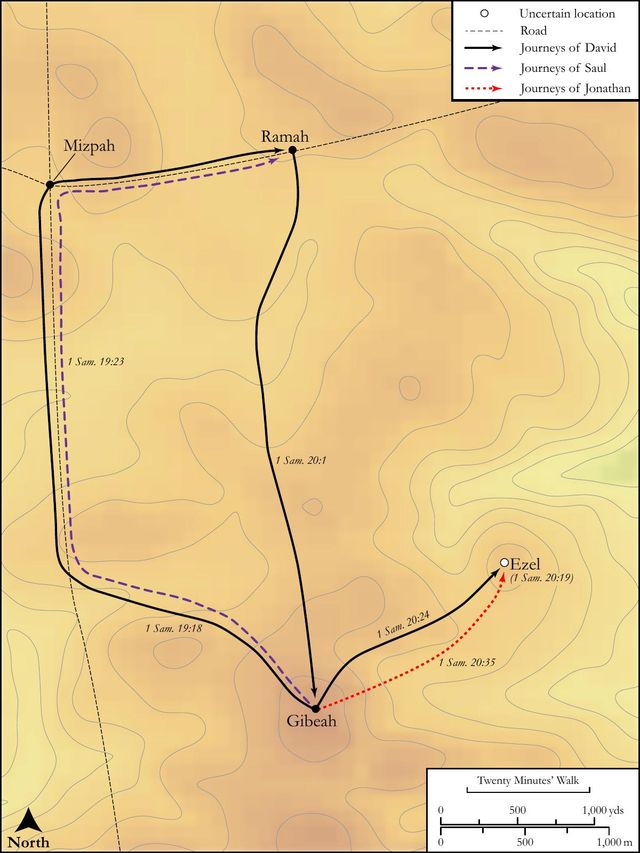
See on the biblical-era map
Study this verse
Public-domain commentary
Matthew Henry
From his Commentary on the Whole Bible. Henry comments on passages, not single verses — this entry covers 1 Samuel 20:9–23. His two-level outline is real structure in the source text, so it is rendered as structure.
Here, I. Jonathan protests his fidelity to David in his distress. Notwithstanding the strong confidence David had in Jonathan, yet, because he might have some reason to fear that his father's influence, and his own interest, should make him warp, or grow cool towards him, Jonathan thought it requisite solemnly to renew the professions of his friendship to him (Sa1 20:9): "Far be it from thee to think that I suspect thee of any crime for which I should either slay thee myself or deliver thee to my father; no, if thou hast any jealousy of that, Come let us go into the field (Sa1 20:11), and talk it over more fully." He did not challenge him to the field to fight him for an affront, but to fix him in his friendship. He faithfully promised him that he would let him know how, upon trial, he found his father affected towards him, and would make the matter neither better nor worse than it was. "If there be good towards thee, I will show it thee, that thou mayest be easy (Sa1 20:12), if evil, I will send thee away, that thou mayest be safe" (Sa1 20:13); and thus he would help to deliver him from the evil if it were real and from the fear of evil if it were but imaginary. For the confirmation of his promise he appeals to God, 1. As a witness (Sa1 20:12): "O Lord God of Israel, thou knowest I mean sincerely, and think as I speak." The strength of his passion made the manner of his speaking concise and abrupt. 2. As a judge: "The Lord do so and much more to Jonathan (Sa1 20:13), if I speak deceitfully, or break my word with my friend." He expressed himself thus solemnly that David might be abundantly assured of his sincerity. And thus God has confirmed his promises to us, that we might have strong consolation, Heb 6:17, Heb 6:18. Jonathan adds to his protestations his hearty prayers: "The Lord be with thee, to protect and prosper thee, as he has been formerly with my father, though now he has withdrawn." Thus he imitates his belief that David would be in his father's place, and his good wishes that he might prosper in it better than his father now did.
II.He provides for the entail of the covenant of friendship with David upon his posterity, Sa1 20:14-16.
He engages David to be a friend to his family when he was gone (Sa1 20:15): Thou shalt promise that thou wilt not cut off thy kindness from my house for ever. This he spoke from a natural affection he had to his children, whom he desired it might go well with after his decease, and for whose future welfare he desired to improve his present interest. It also intimates his firm belief of David's advancement, and that it would be in the power of his hand to do a kindness or unkindness to his seed; for, in process of time, the Lord would cut off his enemies, Saul himself was not expected; then "Do not thou cut off thy kindness from my house, nor revenge my father's wrongs upon my children." The house of David must likewise be bound to the house of Jonathan from generation to generation; he made a covenant (Sa1 20:16) with the house of David. Note, True friends cannot but covet to transmit to theirs after them their mutual affections. Thy own friend, and thy father's friend, forsake not. This kindness,
1.He calls the kindness of the Lord, because it is such kindness as God shows to those he takes into covenant with himself; for he is a God to them and to their seed; they are beloved for the fathers' sakes.
2.He secures it by an imprecation (Sa1 20:16): The Lord require it at the hand of David's seed (for of David himself he had no suspicion) if they prove so far David's enemies as to deal wrongfully with the posterity of Jonathan, David's friend. He feared lest David, or some of his, should hereafter be tempted, for the clearing and confirming of their title to the throne, to do by his seed as Abimelech had done by the sons of Gideon (Jdg 9:5), and this he would effectually prevent; but the reason given (Sa1 20:17) why Jonathan was so earnest to have the friendship entailed is purely generous, and has nothing of self in it; it was because he loved him as he loved his own soul, and therefore desired that he and his might be beloved by him. David, though now in disgrace at court and in distress, was as amiable in the eyes of Jonathan as ever he had been, and he loved him never the less for his father's hating him, so pure were the principles on which his friendship was built. Having himself sworn to David, he caused David to swear to him, and (as we read it) to swear again, which David consented to (for he that bears an honest mind does not startle at assurances), to swear by his love to him, which he looked upon as a sacred thing. Jonathan's heart was so much upon it that, when they parted this time, he concluded with a solemn appeal to God: The Lord be between me and thee for ever (Sa1 20:23), that is, "God himself be judge between us and our families for ever, if on either side this league of friendship be violated." It was in remembrance of this covenant that David was kind to Mephibosheth, Sa2 9:7; Sa2 21:7. It will be a kindness to ourselves and ours to secure an interest in those whom God favours and to make his friends ours.
III.He settles the method of intelligence, and by what signs and tokens he would give him notice how his father stood affected towards him.
David would be missed the first day, or at least the second day, of the new moon, and would be enquired after, Sa1 20:18. On the third day, by which time he would have returned from Bethlehem, he must be at such a place (Sa1 20:19), and Jonathan would come towards that place with his bow and arrows to shoot for diversion (Sa1 20:20), would send his lad to fetch his arrows, and, if they were shot short of the lad, David must take it for a signal of safety, and not be afraid to show his head (Sa1 20:21); but, if he shot beyond the lad, it was a signal of danger, and he must shift for his safety, Sa1 20:22. This expedient he fixed lest he should not have the opportunity, which yet it proved he had, of talking with David, and making the report by word of mouth.
Historical interpretation
Three Centuries of Reception
2 surviving comments on this verse. Each one is dated, so this reads as a timeline rather than a list.
Select a marker to jump to its quote. Markers stagger vertically where authors wrote within a few decades of each other.
But good will also goes together with generosity, for generosity really starts from it, seeing that the habit of giving comes after the desire to give. But generosity may be distinguished from good will. For where generosity is lacking, there good may abide—the parent, as it were, of all in common, uniting and binding friendships together. It is faithful in counsel, joyful in times of prosperity, and in times of sorrow sad. So it happens that any one trusts himself to the counsels of a man of good will rather than to those of a wise one, as David did. For he, though he was the more farseeing, agreed to the counsels of Jonathan, who was the younger.
Descend therefore quickly, etc. That is, on the day when it was allowed to work up to the Kalends, he would go; so that through the Kalends, on which he said all should be silent, he would sit quietly. Jonathan therefore says to David that the Kalends will be tomorrow, and that he will be sought by Saul until the day after tomorrow. The early Church, having learned from him what to say to him, says to Christ; that the time is at hand when the Sun of righteousness will renew in the light of truth those believing or about to believe from the Jews; and that unbelievers will seek him, and in the rising of the new light, which happens through the hearing of the word, and in the increase of the same light, which happens through the operation of the heard word. For to those listening in the Church, and to those performing the commandments of the Gospel, they contrived deceits, of which the Lord speaks: Let my enemies be confounded and ashamed, who seek my soul (Psalm 35, 36, and 69). Jonathan was advising David to descend quickly, and come to the place where he should be hidden, and that on the day when it was allowed to work; and he should sit next to the stone Ezel, which is interpreted as departing, or going. The elders of the early Church were praying to the Lord that by the grace of his inspiration he would descend quickly into the hearts of the faithful, that is, into the place always receptive to his love, of which it is sung in the Psalms, And his place has been made in peace (Psalm 75). Where he should be hidden by faith from those who, disbelieving in Christian peace, would resist, and being given over to external things, would not deserve to view the mysteries of their Creator. The devout were also praying that he would deign to make his dwelling among those strong in faith, who were ready in spirit either to always advance to virtue or, having been perfected in virtues, to depart to behold the joys of heavenly life. But they desired these things in the light of grace for those present, at a time namely of doing good to all, and of running in the way of light, lest anyone be unknowingly overtaken by exterior darkness. These things also today as then, and as long as today is called today, the desires of the saints wish the Lord Savior to accomplish with insatiable prayers.
Continue studying 1 Samuel 20:13 across the web’s major study libraries — every link below opens this exact verse, chapter, or book on the destination site.
Read & Compare
 BibleGatewayThis verse in more than 200 translations and 70 languages.
 Bible.comThe YouVersion reader — hundreds of translations, reading plans, and highlights.
 ESV.orgCrossway's official English Standard Version reader.
 NET BibleThe NET translation with 60,000+ translators' notes on every rendering decision.
 STEP BibleTyndale House's free study tool — original text, vocabulary, and scholarly resources.
 BibliaLogos Bible Software's free web reader.
 USCCBThe New American Bible (Revised Edition) with the U.S. bishops' study notes.
Commentaries
 BibleHub CommentariesDozens of classic commentaries on this verse, gathered on one page.
 StudyLightMore than 100 commentary sets — the largest collection on the web.
 BibleRefPlain-English commentary on what this verse means, verse by verse.
 Enduring WordDavid Guzik's free commentary on this chapter, widely used by Bible teachers.
 Bible Study ToolsVerse commentary alongside Greek and Hebrew study aids.
Original Language & Research
- BibleHub InterlinearThe verse word by word — original language, transliteration, and English.
- BibleHub LexiconEvery word's original-language definition and Strong's entry.
 Blue Letter BibleDeep-study tools — Strong's numbers, concordance, and word studies.
 SefariaThe Hebrew text with Rashi and centuries of Jewish commentary.
Sermons, Hymns & Audio


TrulyRandomVerse is not affiliated with these sites and doesn’t control their content. They’re linked because they’re genuinely useful.
Summary
Jonathan, King Saul's son, makes a solemn, divinely-invoked oath to David, promising to alert him if Saul intends him harm and to facilitate his safe departure. This declaration underscores Jonathan's unwavering loyalty and deep affection for David, even at the risk of his own life and royal succession, while implicitly acknowledging God's guiding hand over David's destiny, contrasting with Saul's diminishing divine favor.
Context
ShowHideLiterary Context
This verse is a pivotal moment within the elaborate plan Jonathan orchestrates with David to ascertain King Saul's true intentions regarding David's life. The preceding verses 1 Samuel 20:1-12 detail David's desperate plea for help and Jonathan's initial disbelief, followed by their forging of a solemn covenant, witnessed by the Lord. They establish a secret signal system involving arrows to communicate Saul's disposition. Verse 13 represents Jonathan's binding vow within this sacred agreement, where he explicitly pledges to reveal Saul's murderous intent should it exist and to ensure David's safe escape. This vow immediately precedes Jonathan's courageous, yet ultimately futile, attempt to intercede for David with Saul during the New Moon festival, an event that tragically confirms Saul's murderous rage and necessitates David's urgent flight.
Historical & Cultural Context
The narrative unfolds against the backdrop of Israel's nascent monarchy, a period marked by the transition from a decentralized tribal system to a more centralized kingdom under King Saul. Saul, the first king, is increasingly unstable, plagued by an evil spirit, and consumed by intense jealousy over David's popularity and military triumphs, as evidenced in passages like 1 Samuel 18:7-9. In ancient Israel, oaths and covenants were profoundly serious commitments, often invoked with divine imprecations, rendering Jonathan's words in this verse a sacred and binding promise before God. The phrase "go in peace" was a common farewell, but here it carries deeper theological weight, signifying a divinely sanctioned departure, emphasizing safety, well-being, and God's protective presence. The poignant reference to the Lord being with David "as he hath been with my father" is a stark reminder of Saul's initial anointing and divine favor, which had demonstrably departed from him, as narrated in 1 Samuel 16:14.
Key Themes
ShowHideThis passage powerfully illuminates several profound themes central to the book of 1 Samuel. Foremost is the theme of unwavering loyalty and sacrificial friendship, exemplified by Jonathan's extraordinary faithfulness to David, even when it means defying his own father and jeopardizing his royal inheritance. It also underscores divine providence and protection, as Jonathan, with remarkable spiritual insight, acknowledges God's active hand in David's life and implicitly recognizes God's choice of David over Saul. The stark contrast between Saul's declining divine favor and David's rising favor with God, a recurring motif throughout 1 Samuel, is subtly reinforced. Furthermore, Jonathan's willingness to sacrifice his personal ambition for David's well-being highlights the theme of selfless submission to God's sovereign plan, demonstrating a profound spiritual maturity that prioritizes God's will above personal gain.
Exposition and Analysis
ShowHideKey Word Analysis
ShowHideThis refers to the covenant name of God, Jehovah, signifying "the self-Existent or Eternal." Jonathan's invocation of "The LORD" in his oath underscores the absolute solemnity and binding nature of his promise, calling upon the supreme divine authority as witness and enforcer of his commitment to David. It highlights that this is not merely a human promise, but one made before God.
Meaning "to denude," "to reveal," or "to disclose." In this context, Jonathan's promise to "shew it thee" means he will explicitly and unambiguously reveal Saul's evil intentions to David. This is not a subtle hint but a direct, clear disclosure, emphasizing Jonathan's commitment to ensuring David is fully aware of the danger he faces.
This word signifies much more than the absence of conflict; it encompasses completeness, well-being, prosperity, and security. Jonathan's desire for David to "go in peace" is a profound blessing, expressing his earnest wish for David's holistic safety, flourishing, and divine protection as he flees. It is a prayer for God's comprehensive presence and favor to accompany David on his perilous journey.
Verse Breakdown
ShowHide"The LORD do so and much more to Jonathan"
This is Jonathan's solemn self-imprecation, a powerful oath formula common in ancient Israel. By invoking this, Jonathan is essentially calling upon God to bring severe, unspecified judgment upon himself if he fails to uphold his promise to David. This underscores the profound depth of his commitment and the absolute seriousness with which he views their covenant.
"but if it please my father [to do] thee evil, then I will shew it thee, and send thee away"
Jonathan here articulates the specific course of action he will take if King Saul's murderous intent against David is confirmed. He pledges to explicitly inform David of the danger ("shew it thee") and then actively facilitate his safe departure ("send thee away"). This demonstrates Jonathan's proactive and protective intervention on behalf of his friend.
"that thou mayest go in peace"
This phrase conveys Jonathan's ultimate desire for David's well-being and security. It functions as both a blessing and a prayer, expressing his earnest hope that David's escape will be successful and that he will find safety and comprehensive peace, despite the perilous circumstances orchestrated by Saul. It reflects Jonathan's selfless concern for David's future.
"and the LORD be with thee, as he hath been with my father"
This concluding blessing is deeply significant and profoundly insightful. Jonathan invokes God's abiding presence and favor upon David, explicitly drawing a parallel to the divine presence that once empowered and guided King Saul. This subtly acknowledges that God's favor has shifted from Saul to David, recognizing David's divine anointing and future kingship, and expressing Jonathan's heartfelt desire for God's continued guidance and protection over David's life.
Literary Devices
ShowHideThe passage is rich with Irony, as Jonathan, the rightful heir to the throne of Israel, is actively working to protect and secure the future of David, who is divinely chosen to replace him. This highlights Jonathan's extraordinary selflessness and his profound recognition of God's sovereign plan overriding human ambition. There is also strong Foreshadowing in Jonathan's invocation, "the LORD be with thee, as he hath been with my father," which subtly predicts David's ascent to the throne and Saul's ultimate downfall, mirroring the departure of God's Spirit from Saul and its powerful presence with David. The entire dialogue functions as a Covenantal Oath, emphasizing the sacred and binding nature of the friendship between David and Jonathan, sealed by divine invocation and carrying profound implications for their future actions and destinies.
Theological and Thematic Connections
ShowHideJonathan's solemn oath in 1 Samuel 20:13 is a powerful testament to the divine orchestration of events and the profound impact of faithful human relationships within God's sovereign plan. His willingness to defy his father, King Saul, and risk his own life for David's safety demonstrates a profound understanding that God's favor had decisively shifted from Saul to David, and that David's life was precious in God's sight. This act of loyal friendship, sealed with a divine imprecation and a blessing for David's peace, underscores the biblical value of covenant faithfulness and selfless love, even in the face of immense personal cost and the relinquishment of personal ambition. It serves as a compelling model of how individuals can align themselves with God's purposes, even when those purposes run counter to familial loyalty or societal expectations, demonstrating a spiritual maturity that prioritizes God's will above all else.
Reflection and Application
ShowHideJonathan's actions in this verse provide a profound challenge and inspiration for our own lives, calling us to a higher standard of commitment and discernment. His unwavering loyalty to David, even when it meant personal danger and defying his own father, compels us to examine the depth of our commitment to those we claim to love and to God's revealed purposes. Are we willing to stand for what is right, to protect the vulnerable, and to act with integrity even when it comes at a significant personal cost or when it requires us to step outside our comfort zones? Jonathan's earnest desire for David to "go in peace" reminds us of the importance of seeking true well-being and security, not just for ourselves, but for others, trusting that God's abiding presence is the ultimate source of that peace. His remarkable recognition of God's hand in David's life, even as God's favor had departed from his own father, compels us to cultivate spiritual discernment and to align our lives with God's unfolding will, rather than clinging to human expectations, earthly power, or personal gain. We are called to be friends who love at all times, demonstrating the selfless love that truly reflects God's character and advances His kingdom.
Questions for Reflection
ShowHideFAQ
ShowHideWhy does Jonathan invoke a curse upon himself ("The LORD do so and much more to Jonathan")?
ShowHideThis is a common and very serious form of oath-taking in ancient Hebrew culture. By saying "The LORD do so and much more to Jonathan," Jonathan is calling upon God to bring severe, unspecified judgment upon himself if he fails to uphold his promise to David. It underscores the absolute solemnity and binding nature of his vow, demonstrating the depth of his commitment and his recognition that God is the ultimate witness and enforcer of covenants. It's a way of saying, "May God punish me severely if I break my word." This kind of imprecation was not taken lightly and indicated a promise made with the utmost sincerity and seriousness, reflecting the profound weight of the covenant he was making with David.
What is the significance of Jonathan saying "the LORD be with thee, as he hath been with my father"?
ShowHideThis phrase carries profound theological weight. Jonathan is not merely offering a polite farewell; he is invoking God's presence and favor upon David. The comparison to Saul ("as he hath been with my father") is a poignant and subtle acknowledgment of the shift in divine favor. God's Spirit had departed from Saul (as noted in 1 Samuel 16:14), and Jonathan, through his deep spiritual insight, recognizes that God's presence is now powerfully with David. This statement subtly affirms David's divine anointing and future kingship, even as Jonathan, the rightful heir, blesses David's journey and acknowledges God's sovereign plan. It's a prayer for David's continued success and divine protection, recognizing that God's presence is the ultimate source of power and authority and that it has been transferred to David.
How do Jonathan's actions in this verse relate to his own position as heir to the throne?
ShowHideJonathan's actions are remarkably selfless and demonstrate a profound spiritual maturity. As King Saul's eldest son, Jonathan was the natural heir to the throne of Israel. However, he consistently recognized God's choice of David as the next king, even before David's anointing was widely known (see 1 Samuel 23:17). In 1 Samuel 20:13, by actively protecting David and facilitating his escape, Jonathan is essentially working against his own dynastic interests. His loyalty to David and to God's plan supersedes his personal ambition or his familial obligation to his father. This highlights his extraordinary character and his willingness to submit to God's sovereign will, even when it meant relinquishing his own claim to power and potentially sacrificing his own life for the one chosen by God.
Christ-Centered Fulfillment
ShowHideJonathan's selfless loyalty and sacrificial love for David, powerfully exemplified in 1 Samuel 20:13, profoundly foreshadow the ultimate friendship and covenant faithfulness found in Jesus Christ. Just as Jonathan willingly risked his life and relinquished his claim to the throne for David's well-being and divinely appointed destiny, so too did Christ, the true Son of God and rightful heir to all things, lay down His life for His friends (and indeed, for His enemies). Jesus declares, "Greater love has no one than this, that someone lay down his life for his friends," a truth perfectly embodied by Jonathan's actions and fully realized in Christ's atoning sacrifice on the cross. Furthermore, Jonathan's invocation, "the LORD be with thee, as he hath been with my father," points to the ultimate divine presence that is fully manifest in Christ, who is "God with us," Emmanuel. Through Christ, believers are granted eternal peace and the abiding presence of God's Holy Spirit, a peace that surpasses all understanding (as promised in Philippians 4:7). Jonathan's act of sending David away "in peace" anticipates the profound and lasting peace that Christ offers to all who trust in Him, a peace that reconciles humanity to God and secures our eternal safety from all spiritual enemies (see Romans 5:1). He is the faithful friend who never abandons us, ensuring our ultimate going "in peace" into the eternal presence of God.