


1 Samuel 20:11
Bible text: King James Version (1769 Blayney text) · Public domain
Bible text: Berean Standard Bible · Public domain
Bible text: American Standard Version (1901) · Public domain
Bible text: World English Bible, Messianic edition · Public domain
Bible text: Geneva Bible (1599) · Public domain
Bible text: Young's Literal Translation · Public domain
- וַיֹּאמֶרvai·Yo·merand he saidH559Conj-w ¦ V-Qal-ConsecImperf-3msVerb Qal Consecutive Imperfect 3rd Singular Masculineוַandיֹּאמֶרhe said
- יְהוֹנָתָןye·ho·na·TanJonathanH3083N-proper-mNoun Proper Masculine
- אֶל'eltoH413PrepPreposition
- דָּוִדda·VidDavidH1732N-proper-mNoun Proper Masculine
- לְכָהle·Khahcome !H1980V-Qal-Imp-2ms ¦ SfxVerb Qal Imperative 2nd Singular Masculineלְכָcomeה!
- וְנֵצֵאve·ne·Tze'so we may go outH3318Conj-w ¦ V-Qal-ConjImperf-1cpVerb Qal Conjunction+Imperfect 1st Plural common genderוְsoנֵצֵאwe may go out
- הַשָּׂדֶהha·sa·Dehthe fieldH7704Art ¦ N-msNoun Singular Masculine Absoluteהַtheשָּׂדֶהfield
- וַיֵּצְאוּvai·ye·tze·'Uand they went outH3318Conj-w ¦ V-Qal-ConsecImperf-3mpVerb Qal Consecutive Imperfect 3rd Plural Masculineוַandיֵּצְאוּthey went out
- שְׁנֵיהֶםshe·nei·Hem[the] two of themH8147N-cdc ¦ 3mpNoun Dual common gender Constructשְׁנֵי[the] two ofהֶםthem
- הַשָּׂדֶהha·sa·Dehthe fieldH7704Art ¦ N-msNoun Singular Masculine Absoluteהַtheשָּׂדֶהfield
English is a literal word-by-word gloss of the Hebrew, not the KJV's wording. Why?
This is the original text the KJV's translators worked from — each Hebrew word with its own literal English meaning in this verse, prepared by scholars at Tyndale House, Cambridge. The KJV translates whole sentences, not word by word, so its wording differs: one Hebrew word can become several English words, and the KJV may choose “the LORD” where the gloss reads “Yahweh”. Both are faithful — they answer different questions. For the KJV's own rendering, switch to the KJV text.
Details
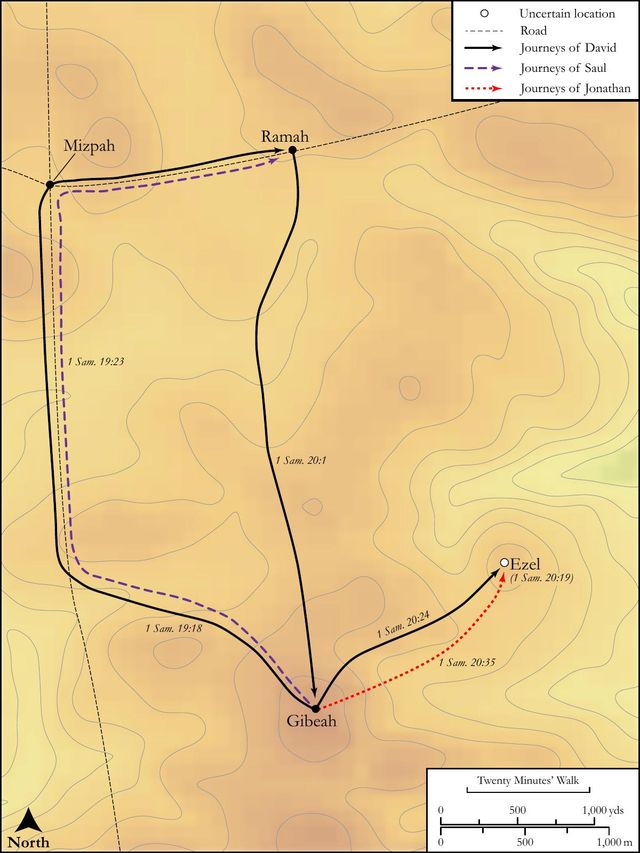
See on the biblical-era map
Study this verse
Public-domain commentary
Matthew Henry
From his Commentary on the Whole Bible. Henry comments on passages, not single verses — this entry covers 1 Samuel 20:9–23. His two-level outline is real structure in the source text, so it is rendered as structure.
Here, I. Jonathan protests his fidelity to David in his distress. Notwithstanding the strong confidence David had in Jonathan, yet, because he might have some reason to fear that his father's influence, and his own interest, should make him warp, or grow cool towards him, Jonathan thought it requisite solemnly to renew the professions of his friendship to him (Sa1 20:9): "Far be it from thee to think that I suspect thee of any crime for which I should either slay thee myself or deliver thee to my father; no, if thou hast any jealousy of that, Come let us go into the field (Sa1 20:11), and talk it over more fully." He did not challenge him to the field to fight him for an affront, but to fix him in his friendship. He faithfully promised him that he would let him know how, upon trial, he found his father affected towards him, and would make the matter neither better nor worse than it was. "If there be good towards thee, I will show it thee, that thou mayest be easy (Sa1 20:12), if evil, I will send thee away, that thou mayest be safe" (Sa1 20:13); and thus he would help to deliver him from the evil if it were real and from the fear of evil if it were but imaginary. For the confirmation of his promise he appeals to God, 1. As a witness (Sa1 20:12): "O Lord God of Israel, thou knowest I mean sincerely, and think as I speak." The strength of his passion made the manner of his speaking concise and abrupt. 2. As a judge: "The Lord do so and much more to Jonathan (Sa1 20:13), if I speak deceitfully, or break my word with my friend." He expressed himself thus solemnly that David might be abundantly assured of his sincerity. And thus God has confirmed his promises to us, that we might have strong consolation, Heb 6:17, Heb 6:18. Jonathan adds to his protestations his hearty prayers: "The Lord be with thee, to protect and prosper thee, as he has been formerly with my father, though now he has withdrawn." Thus he imitates his belief that David would be in his father's place, and his good wishes that he might prosper in it better than his father now did.
II.He provides for the entail of the covenant of friendship with David upon his posterity, Sa1 20:14-16.
He engages David to be a friend to his family when he was gone (Sa1 20:15): Thou shalt promise that thou wilt not cut off thy kindness from my house for ever. This he spoke from a natural affection he had to his children, whom he desired it might go well with after his decease, and for whose future welfare he desired to improve his present interest. It also intimates his firm belief of David's advancement, and that it would be in the power of his hand to do a kindness or unkindness to his seed; for, in process of time, the Lord would cut off his enemies, Saul himself was not expected; then "Do not thou cut off thy kindness from my house, nor revenge my father's wrongs upon my children." The house of David must likewise be bound to the house of Jonathan from generation to generation; he made a covenant (Sa1 20:16) with the house of David. Note, True friends cannot but covet to transmit to theirs after them their mutual affections. Thy own friend, and thy father's friend, forsake not. This kindness,
1.He calls the kindness of the Lord, because it is such kindness as God shows to those he takes into covenant with himself; for he is a God to them and to their seed; they are beloved for the fathers' sakes.
2.He secures it by an imprecation (Sa1 20:16): The Lord require it at the hand of David's seed (for of David himself he had no suspicion) if they prove so far David's enemies as to deal wrongfully with the posterity of Jonathan, David's friend. He feared lest David, or some of his, should hereafter be tempted, for the clearing and confirming of their title to the throne, to do by his seed as Abimelech had done by the sons of Gideon (Jdg 9:5), and this he would effectually prevent; but the reason given (Sa1 20:17) why Jonathan was so earnest to have the friendship entailed is purely generous, and has nothing of self in it; it was because he loved him as he loved his own soul, and therefore desired that he and his might be beloved by him. David, though now in disgrace at court and in distress, was as amiable in the eyes of Jonathan as ever he had been, and he loved him never the less for his father's hating him, so pure were the principles on which his friendship was built. Having himself sworn to David, he caused David to swear to him, and (as we read it) to swear again, which David consented to (for he that bears an honest mind does not startle at assurances), to swear by his love to him, which he looked upon as a sacred thing. Jonathan's heart was so much upon it that, when they parted this time, he concluded with a solemn appeal to God: The Lord be between me and thee for ever (Sa1 20:23), that is, "God himself be judge between us and our families for ever, if on either side this league of friendship be violated." It was in remembrance of this covenant that David was kind to Mephibosheth, Sa2 9:7; Sa2 21:7. It will be a kindness to ourselves and ours to secure an interest in those whom God favours and to make his friends ours.
III.He settles the method of intelligence, and by what signs and tokens he would give him notice how his father stood affected towards him.
David would be missed the first day, or at least the second day, of the new moon, and would be enquired after, Sa1 20:18. On the third day, by which time he would have returned from Bethlehem, he must be at such a place (Sa1 20:19), and Jonathan would come towards that place with his bow and arrows to shoot for diversion (Sa1 20:20), would send his lad to fetch his arrows, and, if they were shot short of the lad, David must take it for a signal of safety, and not be afraid to show his head (Sa1 20:21); but, if he shot beyond the lad, it was a signal of danger, and he must shift for his safety, Sa1 20:22. This expedient he fixed lest he should not have the opportunity, which yet it proved he had, of talking with David, and making the report by word of mouth.
Historical interpretation
Historical reception
1 surviving comment on this verse from the historical church.
And Jonathan said to David, "Come, let us go out into the field," etc. A marvelous way of speaking, as if he began to speak to God, which yet he completed in speaking to a man; but this was due to the incomparably ardent affection between the young men, mutually commending each other in virtue; this as a sign of faith, always and everywhere to be kept with God as witness; which grammarians call the figure paraprosdociam in Greek, that is, an unexpected outcome. Therefore, Jonathan and David, first secretly in the city, then also going out into the field, make a covenant of the Lord, so that Jonathan would not hide from David anything that his father might think good about him; he would not introduce him to his father unless perhaps converted to piety; but also Jonathan himself, if he lives, would receive mercy from David; if indeed he dies, David would show mercy to his house forever. Because the primitive Church at its beginning was to no small extent judaizing, but soon, going out into the fruitful breadth of Christian liberty, entered into a covenant with the Lord of perpetual love; it was agreed that if any of the Jewish persecutors of Christ wished to recognize goodness and turn to him, their faith and conversion would immediately be made known to his faithful members, that is, to the Church itself, so that they might obtain full salvation by its association, and not cast pearls before swine, not profane its sacraments to the unbelievers, but rather believe that they should be piously received by those who would rejoice to live in peace. And if indeed among the Jews the state and life of the Church would remain intact, they would not be crowned by their own merit as believers, but by the compassion and mercy of their Author. And if, by their scorning, the way of life turned to themselves, nevertheless, to any believing among that people individually until the end of the age, and to all converted remnants together at the end, entrance to mercy would not be denied.
Continue studying 1 Samuel 20:11 across the web’s major study libraries — every link below opens this exact verse, chapter, or book on the destination site.
Read & Compare
 BibleGatewayThis verse in more than 200 translations and 70 languages.
 Bible.comThe YouVersion reader — hundreds of translations, reading plans, and highlights.
 ESV.orgCrossway's official English Standard Version reader.
 NET BibleThe NET translation with 60,000+ translators' notes on every rendering decision.
 STEP BibleTyndale House's free study tool — original text, vocabulary, and scholarly resources.
 BibliaLogos Bible Software's free web reader.
 USCCBThe New American Bible (Revised Edition) with the U.S. bishops' study notes.
Commentaries
 BibleHub CommentariesDozens of classic commentaries on this verse, gathered on one page.
 StudyLightMore than 100 commentary sets — the largest collection on the web.
 BibleRefPlain-English commentary on what this verse means, verse by verse.
 Enduring WordDavid Guzik's free commentary on this chapter, widely used by Bible teachers.
 Bible Study ToolsVerse commentary alongside Greek and Hebrew study aids.
Original Language & Research
- BibleHub InterlinearThe verse word by word — original language, transliteration, and English.
- BibleHub LexiconEvery word's original-language definition and Strong's entry.
 Blue Letter BibleDeep-study tools — Strong's numbers, concordance, and word studies.
 SefariaThe Hebrew text with Rashi and centuries of Jewish commentary.
Sermons, Hymns & Audio


TrulyRandomVerse is not affiliated with these sites and doesn’t control their content. They’re linked because they’re genuinely useful.
Summary
1 Samuel 20:11 captures a moment of profound urgency and trust as Jonathan invites David to a secluded location. This seemingly simple command to "go out into the field" is charged with the weight of King Saul's escalating hostility and the desperate need for a private, secure discussion. It sets the stage for a pivotal conversation that will determine David's immediate future, underscore the unwavering loyalty of Jonathan, and highlight the perilous environment in which God's anointed one operated.
Context
ShowHideLiterary Context
This verse immediately follows David's bewildered and fearful plea to Jonathan regarding Saul's murderous intentions, as recounted in 1 Samuel 20:1. Jonathan, having already established a deep covenant of friendship with David in 1 Samuel 18:3, responds to David's distress by taking initiative. The invitation to go "into the field" is a direct and necessary step to facilitate a confidential discussion. The subsequent narrative, particularly 1 Samuel 20:12-23, details Jonathan's elaborate plan to ascertain Saul's true disposition towards David and the solemn renewal of their covenant, emphasizing the life-or-death stakes of their private meeting.
Historical & Cultural Context
The setting is the early monarchy of Israel, a period marked by political instability and the tragic decline of King Saul. Saul, once divinely appointed, has become increasingly consumed by an evil spirit, paranoia, and intense jealousy towards David, whom he perceives as a threat to his reign and dynastic succession (1 Samuel 18:6-9). In the monarchies of that day, court intrigue, espionage, and the arbitrary power of the king were common. A king's disfavor could mean certain death, and conversations concerning the king's intentions, especially murderous ones, had to be conducted with the utmost secrecy. The "field" or open countryside offered a necessary secluded space, away from the prying eyes and ears of court officials or royal loyalists, underscoring the extreme danger David faced and Jonathan's unwavering commitment to his friend's safety.
Key Themes
ShowHideThis passage powerfully articulates several enduring themes central to the book of 1 Samuel and the broader biblical narrative. First, covenant loyalty and unwavering friendship are profoundly illustrated by Jonathan's steadfast commitment to David, even at the cost of defying his own father and potentially jeopardizing his claim to the throne. This bond stands in stark contrast to Saul's erratic and destructive behavior, highlighting the moral and spiritual decay of the king. Second, the theme of imminent danger and divine protection is palpable; David is under constant threat, yet God continually preserves him through human agents like Jonathan, demonstrating His providential care for His chosen one. The need for secrecy underscores the pervasive nature of this danger. Finally, the narrative subtly reinforces the conflict between human ambition and divine purpose; Saul's futile attempts to thwart God's plan for David's kingship are ultimately undermined by Jonathan's protective actions, which safeguard the life of the one God has chosen.
Exposition and Analysis
ShowHideKey Word Analysis
ShowHideThe Hebrew word אָמַר (ʼâmar) is a primitive root meaning "to say," but it carries a broad semantic range, including to command, declare, appoint, or determine. In this context, Jonathan's "saying" is not merely speech but an authoritative and decisive utterance. It signifies his initiative and leadership in a critical moment, conveying a sense of urgency and direct instruction that David immediately heeds. This word emphasizes the weight and intent behind Jonathan's invitation, highlighting his role in orchestrating a secure environment for their vital conversation.
The Hebrew verb יָצָא (yâtsâʼ) is a primitive root meaning "to go (causatively, bring) out," with a wide variety of applications. Here, it denotes a deliberate movement away from their current location, implying a departure from a place of potential danger or observation. The act of "going out" is purposeful and strategic, emphasizing the necessity of leaving a compromised environment to find a secure space. It underscores the gravity of their situation, where even their physical location must be chosen with extreme caution to ensure the confidentiality of their discussion.
The Hebrew word שָׂדֶה (sâdeh), or שָׂדַי (sâday), refers to open country, cultivated land, or an uninhabited area outside city walls. Its significance in this verse is primarily functional and symbolic. It represents a place of seclusion and privacy, a necessary refuge from the watchful eyes and ears of Saul's court and loyalists. In a context of intense political paranoia and danger, the "field" becomes a symbol of a safe haven where truth can be spoken, and life-altering decisions can be made without fear of immediate reprisal. It underscores the extreme measures required for confidential communication when facing a powerful and dangerous adversary.
Verse Breakdown
ShowHide"And Jonathan said unto David,"
This opening clause immediately establishes the speaker and recipient, highlighting the direct, personal, and urgent nature of the interaction. It emphasizes Jonathan's initiative and leadership in this critical moment, taking charge to address David's desperate situation and offering a solution.
"Come, and let us go out into the field."
This is Jonathan's imperative, a direct command and invitation that conveys both urgency and a deliberate movement. The dual verbs "come" and "go out" signal a decisive departure from their current, presumably unsafe, location. The destination, "into the field," is crucial, signaling the absolute necessity of privacy and security for the conversation that is about to unfold, indicating Jonathan's recognition of the pervasive danger and the need for extreme discretion.
"And they went out both of them into the field."
This concluding clause confirms David's immediate compliance and the successful execution of Jonathan's proposal. The phrase "both of them" emphasizes their shared vulnerability, mutual trust, and unity of purpose, highlighting the profound bond between the two friends as they seek a place where they can speak freely about the king's murderous intentions. The repetition of "into the field" underscores the critical importance of the chosen location as a sanctuary for their vital discussion.
Literary Devices
ShowHideThe verse employs several effective literary devices to convey its profound message. Repetition is prominent, with the phrase "into the field" appearing twice, first as an invitation and then as a confirmation of their action. This repetition emphasizes the critical importance of the location for the sensitive conversation that is about to occur, highlighting the absolute necessity of secrecy and security. The "field" itself functions as Symbolism, representing a sanctuary of truth, confidentiality, and safety amidst the treacherous and dangerous environment of Saul's court. It is a place where genuine, life-altering communication can happen, free from the king's spies and the pervasive atmosphere of suspicion. Furthermore, the verse employs Foreshadowing, as the very act of seeking such a private and secluded location strongly hints at the grave nature of the discussion to follow and the imminent danger David faces, thereby building suspense and underscoring the high stakes of their friendship.
Theological and Thematic Connections
ShowHideThis brief verse, though simple in its phrasing, carries profound theological weight, primarily through its portrayal of covenant loyalty and the divine orchestration of events. Jonathan's selfless act of leading David to a secure place exemplifies a friendship rooted in covenant, mirroring the deeper covenant relationship God establishes with His people. It speaks to the providential care of God, who often uses human agents to protect His chosen ones and advance His purposes, even amidst intense hostility. The danger David faces underscores the reality of spiritual warfare and the opposition faced by those aligned with God's will, while Jonathan's actions demonstrate the power of faithful intercession and courageous solidarity, ultimately serving God's larger plan for David's kingship.
Reflection and Application
ShowHide1 Samuel 20:11 offers timeless insights into the nature of true friendship, the necessity of wisdom in adversity, and the profound impact of courageous loyalty. In a world often characterized by self-interest, betrayal, and superficial connections, Jonathan's actions stand as a powerful testament to selfless love and steadfast commitment. It challenges us to consider the quality of our own friendships: are we willing to go out of our way, even at personal risk, to protect and support those we love, especially when they are vulnerable, facing injustice, or in need of a safe space to share their burdens? The need for a private "field" also reminds us of the importance of discretion and finding appropriate, secure environments for sensitive conversations, recognizing that not all truths can be spoken in all places. It encourages us to be discerning about who we trust and to deeply value those who demonstrate unwavering loyalty in times of trouble. Ultimately, this verse calls us to embody the kind of Christ-like love that prioritizes the well-being of others above our own comfort or safety, reflecting the very heart of God's sacrificial love.
Questions for Reflection
ShowHideFAQ
ShowHideWhy was it so important for David and Jonathan to go "into the field" to talk?
ShowHideGoing "into the field" was crucial because it provided a necessary sanctuary for a conversation of life-or-death importance. King Saul's escalating paranoia and murderous intent towards David meant that any discussion about his plans had to be conducted in absolute secrecy. The court and city walls were likely filled with Saul's loyalists and spies, making private conversation impossible. The open "field" or countryside offered a secluded, unobserved space where David and Jonathan could speak freely and plan without fear of being overheard, ensuring their safety and the confidentiality of their desperate strategy. This highlights the extreme danger David was in and the lengths Jonathan had to go to protect him, as seen in the subsequent detailed plan in 1 Samuel 20:12-23.
What does this verse reveal about Jonathan's character?
ShowHideThis verse powerfully reveals Jonathan's unwavering loyalty, courage, and selflessness. Despite being King Saul's son and the presumed heir to the throne, Jonathan consistently prioritizes David's safety and well-being above his own familial allegiance or personal ambition. His initiative to lead David to a secure location demonstrates his protective nature and his deep commitment to the covenant of friendship they had established (see 1 Samuel 18:3). He is willing to defy his father and risk his own position to stand by his friend, showcasing a rare and profound example of integrity and true devotion in the face of immense pressure. Jonathan's actions here are a testament to a love that "loves at all times" (Proverbs 17:17).
Christ-Centered Fulfillment
ShowHideThe profound covenant friendship between David and Jonathan, highlighted by Jonathan's selfless act in 1 Samuel 20:11, serves as a powerful foreshadowing of the ultimate friendship and covenant found in Jesus Christ. Jonathan, the king's son and heir, willingly relinquishes his claim to the throne and risks his life to protect David, the anointed future king. This mirrors Christ, the Son of God and rightful King of all creation, who, though possessing all authority, willingly laid down His life to secure the salvation of His people, whom He calls His friends (as seen in John 15:13). Just as David sought refuge and counsel in the "field" with Jonathan, humanity finds ultimate refuge and truth in Christ, who offers a secure place of grace and guidance away from the dangers of sin and the world. The "field" can also symbolize the vulnerability and exposure of the cross, where Christ, like David in his flight, faced ultimate danger to secure our peace and reconcile us to God (Colossians 1:19-20). Ultimately, Jonathan's loyal, self-sacrificing love points to the perfect, unfailing, and eternal covenant love of God manifested in Jesus, the true King who not only protects His own but also invites them into an eternal kingdom, purchased by His ultimate sacrifice (Colossians 1:13-14).