


1 Samuel 20:1
Bible text: King James Version (1769 Blayney text) · Public domain
Bible text: King James Version with Strong's numbers · Public domain
Bible text: Berean Standard Bible · Public domain
Bible text: American Standard Version (1901) · Public domain
Bible text: World English Bible, Messianic edition · Public domain
Bible text: Geneva Bible (1599) · Public domain
Bible text: Young's Literal Translation · Public domain
- וַיִּבְרַחvai·yiv·Rachand he fledH1272Conj-w ¦ V-Qal-ConsecImperf-3msVerb Qal Consecutive Imperfect 3rd Singular Masculineוַandיִּבְרַחhe fled
- דָּוִדda·VidDavidH1732N-proper-mNoun Proper Masculine
- מִנָּיוֹתmi·noi·vtfrom NaiothH5121Prep-m ¦ N-properNoun Proper LocationמִfromנָּיוֹתNaioth
- בָּרָמָהba·ra·Mahin <the> RamahH7414Prep-b ¦ N-properNoun Proper Locationבָּin <the>רָמָהRamah
- וַיָּבֹאvai·ya·Vo'and he wentH935Conj-w ¦ V-Qal-ConsecImperf-3msVerb Qal Consecutive Imperfect 3rd Singular Masculineוַandיָּבֹאhe went
- וַיֹּאמֶרvai·Yo·merand he saidH559Conj-w ¦ V-Qal-ConsecImperf-3msVerb Qal Consecutive Imperfect 3rd Singular Masculineוַandיֹּאמֶרhe said
- לִפְנֵיlif·Nei<to> beforeH6440Prep-l ¦ N-mpcNoun Plural Masculine Constructלִ<to>פְנֵיbefore
- יְהוֹנָתָןye·ho·na·TanJonathanH3083N-proper-mNoun Proper Masculine
- מֶהmehwhat?H4100InterrogPronoun Interrogative
- עָשִׂיתִי'a·Si·tihave I doneH6213V-Qal-Perf-1csVerb Qal Perfect 1st Singular common gender
- מֶהmehwhat?H4100InterrogPronoun Interrogative
- עֲוֹנִי'a·vo·Ni[is] my iniquityH5771N-msc ¦ 1csNoun Singular Masculine Constructעֲוֹנִ[is] iniquityיmy
- וּמֶהu·mehand what?H4100Conj-w ¦ InterrogPronoun Interrogativeוּandמֶהwhat?
- חַטָּאתִיcha·ta·Ti[is] my sinH2403N-fsc ¦ 1csNoun Singular Feminine Constructחַטָּאתִ[is] sinיmy
- לִפְנֵיlif·Nei<to> beforeH6440Prep-l ¦ N-mpcNoun Plural Masculine Constructלִ<to>פְנֵיbefore
- אָבִיךָ'a·Vi·khayour fatherH1N-msc ¦ 2msNoun Singular Masculine Constructאָבִיfatherךָyour
- כִּיkithatH3588PrtParticle Conditional
- מְבַקֵּשׁme·va·Kesh[is] seekingH1245V-Piel-Prtcpl-msVerb Piel Participle Singular Masculine Absolute
- אֶת'et<obj.>H853DirObjMParticle Object Indicator
- נַפְשִׁיnaf·Shimy lifeH5315N-fsc ¦ 1csNoun Singular Feminine Constructנַפְשִׁlifeיmy
English is a literal word-by-word gloss of the Hebrew, not the KJV's wording. Why?
This is the original text the KJV's translators worked from — each Hebrew word with its own literal English meaning in this verse, prepared by scholars at Tyndale House, Cambridge. The KJV translates whole sentences, not word by word, so its wording differs: one Hebrew word can become several English words, and the KJV may choose “the LORD” where the gloss reads “Yahweh”. Both are faithful — they answer different questions. For the KJV's own rendering, switch to the KJV text.
Details
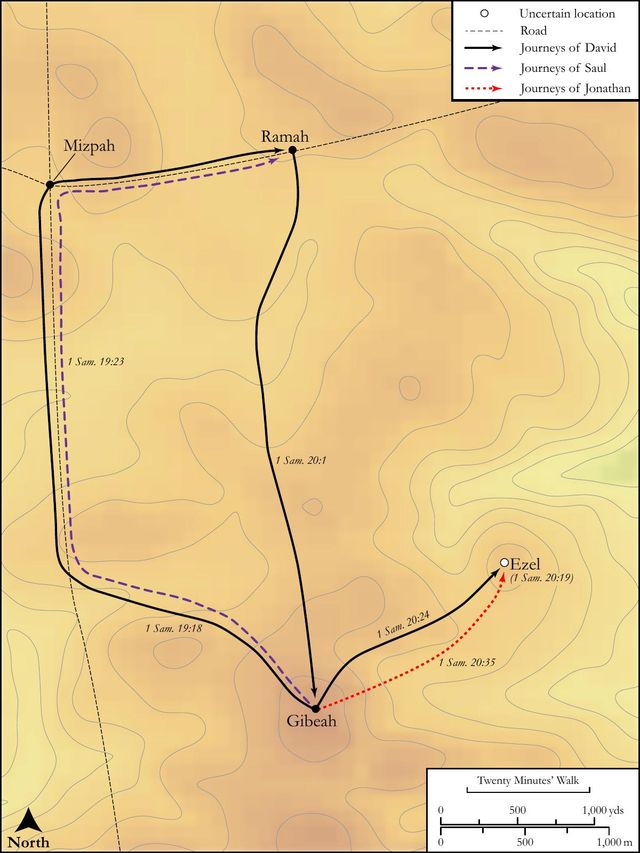
See on the biblical-era map
Study this verse
Public-domain commentary
Matthew Henry
From his Commentary on the Whole Bible. Henry comments on passages, not single verses — this entry covers 1 Samuel 20:1–8. His three-level outline is real structure in the source text, so it is rendered as structure.
Here, I. David makes a representation to Jonathan of his present troubles. While Saul lay bound by his trance at Naioth David escaped to the court, and got to speak with Jonathan. And it was happy for him that he had such a friend at court, when he had such an enemy on the throne. If there be those that hate and despise us, let us not be disturbed at that, for there are those also that love and respect us. God hath set the one over against the other, and so must we. Jonathan was a friend that loved at all times, loved David as well now in his distress, and bade him as welcome into his arms, as he had done when he was in his triumph (Sa1 18:1), and he was a brother that was born for adversity, Pro 17:17. Now, 1. David appeals to Jonathan himself concerning his innocency, and he needed not say much to him for the proof of it, only he desired him that if he knew of any just offence he had given his father he would tell him, that he might humble himself and beg his pardon: What have I done? Sa1 20:1. 2. He endeavors to convince him that, notwithstanding his innocency, Saul sought his life. Jonathan, from a principal of filial respect to his father, was very loth to believe that he designed or would ever do so wicked a thing, Sa1 20:2. He the rather hoped so because he knew nothing of any such design, and he had usually been made privy to all his counsels. Jonathan, as became a dutiful son, endeavored to cover his father's shame, as far as was consistent with justice and fidelity to David. Charity is not forward to think evil of any, especially of a parent, Co1 13:5. David therefore gives him the assurance of an oath concerning his own danger, swears the peace upon Saul, that he was in fear of his life by him: "As the Lord liveth, than which nothing more sure in itself, and as thy soul liveth, than which nothing more certain to thee, whatever thou thinkest, there is but a step between me and death," Sa1 20:3. And, as for Saul's concealing it from Jonathan, it was easy to account for that; he knew the friendship between him and David, and therefore, though in other things he advised with him, yet not in that. None more fit than Jonathan to serve him in every design that was just and honourable, but he knew him to be a man of more virtue than to be his confidant in so base a design as the murder of David.
II.Jonathan generously offers him his service (Sa1 20:4):
Whatsoever thou desirest, he needed not insert the proviso of lawful and honest (for he knew David too well to think he would ask any thing that was otherwise), I will even do it for thee. This is true friendship. Thus Christ testifies his love to us: Ask, and it shall be done for you; and we must testify ours to him by keeping his commandments.
III.David only desires him to satisfy himself, and then to satisfy him whether Saul did really design his death or no.
Perhaps David proposed this more for Jonathan's conviction than his own, for he himself was well satisfied.
1.The method of trial he proposed was very natural, and would certainly discover how Saul stood affected to him. The two next days Saul was to dine publicly, upon occasion of the solemnities of the new moon, when extraordinary sacrifices were offered and feasts made upon the sacrifices. Saul was rejected of God, and the Spirit of the Lord had departed from him, yet he kept up his observance of the holy feasts. There may be the remains of external devotion where there is nothing but the ruins of real virtue. At these solemn feasts Saul had either all his children to sit with him, and David had a seat as one of them, or all his great officers, and David had a seat as one of them. However it was, David resolved his seat should be empty (and that it never used to be at a sacred feast) those two days (Sa1 20:5), and he would abscond till the solemnity was over, and put it upon this issue: if Saul admitted an excuse for his absence, and dispensed with it, he would conclude he had changed his mind and was reconciled to him; but if he resented it, and was put into a passion by it, it was easy to conclude he designed him a mischief, since it was certain he did not love him so well as to desire his presence for any other end than that he might have an opportunity to do him a mischief, Sa1 20:7.
2.The excuse he desired Jonathan to make for his absence, we have reason to think, was true, that he was invited by his elder brother to Bethlehem, his own city, to celebrate this new moon with his relations there, because, besides the monthly solemnity in which they held communion with all Israel, they had now a yearly sacrifice, and a holy feast upon it, for all the family, Sa1 20:6. They kept a day of thanksgiving in their family for the comforts they enjoyed, and of prayer for the continuance of them. By this it appears that the family David was of was a very religious family, a house that had a church in it.
3.The arguments he used with Jonathan to persuade him to do this kindness for him were very pressing, Sa1 20:8.
(1.)That he had entered into a league of friendship with him, and it was Jonathan's own proposal: Thou hast brought thy servant into a covenant of the Lord with thee.
(2.)That he would by no means urge him to espouse his cause if he was not sure that it was a righteous cause: "If there be iniquity in me, I am so far from desiring or expecting that the covenant between us should bind thee to be a confederate with me in that iniquity that I freely release thee from it, and wish that my hand may be first upon me: Slay me thyself." No honest man will urge his friend to do a dishonest thing for his sake.
Historical interpretation
Historical reception
1 surviving comment on this verse from the historical church.
He came and spoke before Jonathan, "What have I done?" etc. Expelled because of disbelief in the Lord by the reprobate, He often returns more sweetly to the hearts of those who love Him, reminding them frequently of His incarnation, innocent life, and unjust persecution, so that rejoicing in Him, they may confess to the memory of His holiness.
Continue studying 1 Samuel 20:1 across the web’s major study libraries — every link below opens this exact verse, chapter, or book on the destination site.
Read & Compare
 BibleGatewayThis verse in more than 200 translations and 70 languages.
 Bible.comThe YouVersion reader — hundreds of translations, reading plans, and highlights.
 ESV.orgCrossway's official English Standard Version reader.
 NET BibleThe NET translation with 60,000+ translators' notes on every rendering decision.
 STEP BibleTyndale House's free study tool — original text, vocabulary, and scholarly resources.
 BibliaLogos Bible Software's free web reader.
 USCCBThe New American Bible (Revised Edition) with the U.S. bishops' study notes.
Commentaries
 BibleHub CommentariesDozens of classic commentaries on this verse, gathered on one page.
 StudyLightMore than 100 commentary sets — the largest collection on the web.
 BibleRefPlain-English commentary on what this verse means, verse by verse.
 Enduring WordDavid Guzik's free commentary on this chapter, widely used by Bible teachers.
 Bible Study ToolsVerse commentary alongside Greek and Hebrew study aids.
Original Language & Research
- BibleHub InterlinearThe verse word by word — original language, transliteration, and English.
- BibleHub LexiconEvery word's original-language definition and Strong's entry.
 Blue Letter BibleDeep-study tools — Strong's numbers, concordance, and word studies.
 SefariaThe Hebrew text with Rashi and centuries of Jewish commentary.
Sermons, Hymns & Audio


TrulyRandomVerse is not affiliated with these sites and doesn’t control their content. They’re linked because they’re genuinely useful.
Summary
1 Samuel 20:1 captures a moment of profound crisis and desperation in David's life, as he flees the escalating, murderous pursuit of King Saul. Having narrowly escaped Saul's attempts on his life even while under the prophetic protection of Samuel in Naioth, David seeks out his most trusted and loyal friend, Jonathan, Saul's son. David's anguished and bewildered questions—"What have I done? what is mine iniquity? and what is my sin before thy father, that he seeketh my life?"—articulate his deep sense of injustice and confusion, setting the stage for a pivotal conversation that will test the bonds of friendship and determine David's immediate future.
Context
ShowHideLiterary Context
This verse immediately plunges the reader into the aftermath of David's dramatic and supernatural escape from Naioth in Ramah, as recounted in 1 Samuel 19:18-24. Prior to this, Saul's intense jealousy and irrational hatred for David had reached a fever pitch, manifesting in repeated attempts to kill David, including hurling a spear at him (1 Samuel 19:9-10). David's flight to Samuel, seeking refuge among the prophets, proved to be only a temporary reprieve, as Saul's relentless pursuit led to a divine intervention where Saul and his messengers were overcome by the Spirit of God, prophesying uncontrollably. This opening verse of chapter 20 thus finds David in an extremely vulnerable and precarious position, having exhausted his immediate options for safety. It serves as the narrative bridge, propelling David from a state of physical escape to a desperate plea for understanding and assistance from Jonathan, his covenant friend, initiating the crucial dialogue that will define their enduring loyalty and secure David's future.
Historical & Cultural Context
The events of 1 Samuel 20:1 are set within the tumultuous early period of the Israelite monarchy, a time characterized by the unstable transition from a tribal confederacy to a centralized kingdom. King Saul, initially chosen by God, was now in a state of spiritual and mental decline, evidenced by his disobedience to God's commands and the torment of an evil spirit (1 Samuel 16:14). The concept of a divinely appointed king was foundational, yet the king's authority was understood to be contingent upon his faithfulness to God. David, God's newly anointed king-designate, represented a direct threat to Saul's insecure and increasingly paranoid reign. Naioth in Ramah was a recognized prophetic center, likely a communal dwelling or school for prophets under Samuel's leadership, offering a degree of sanctuary and spiritual authority. David's anguished questions about "iniquity" and "sin" reflect the deep cultural understanding of covenant law, where a capital offense required clear and demonstrable transgression. David's plea underscores the cultural expectation that a king's actions, especially concerning the life of a loyal subject, should be based on justice and established law, not arbitrary malice or personal vendetta.
Key Themes
ShowHideThe central theme introduced and developed in 1 Samuel 20 is the profound and unwavering covenant friendship between David and Jonathan, which is tested to its limits and ultimately reaffirmed in this chapter. David's desperate questions highlight the theme of unjust persecution, as he, an innocent and loyal servant, is relentlessly hunted by a paranoid king. This situation further underscores Saul's spiritual and mental decline, as his actions become increasingly irrational, driven by jealousy and a departure from God's will, thereby illustrating his unsuitability for continued kingship. Conversely, David's bewilderment speaks to the theme of desperation and confusion in the face of inexplicable malice and existential threat. Ultimately, the narrative also subtly points to divine providence, as God continues to protect His chosen king, David, even through the extraordinary loyalty of an unexpected ally like Jonathan, who stands against his own father for the sake of righteousness and friendship, foreshadowing God's faithfulness to His overarching redemptive plan and promises.
Exposition and Analysis
ShowHideKey Word Analysis
ShowHideThis verb (בָּרַח, H1272) signifies to "bolt," "flee suddenly," or "run away." Its use here immediately conveys the urgency and desperation of David's situation. He is not merely departing; he is making a swift, urgent escape from imminent danger, emphasizing the life-threatening nature of Saul's pursuit. This word highlights David's vulnerability and the immediate need for security.
The term (עָוֹן, H5771) denotes a moral perversity, a twisting or distortion of what is right, often carrying the connotation of guilt or culpability that results in punishment. It suggests a deliberate deviation from a moral standard or a wrong that incurs a just penalty. By using this word, David is asserting that he has committed no such twisted, perverse, or deeply culpable act that would warrant Saul's murderous intent. He is denying any fundamental moral failing.
This term (חַטָּאָה, H2403) is a broader concept, meaning "to miss the mark," "to err," or "to fall short." It can refer to an unintentional offense or a deliberate transgression against God or man, as well as the penalty or sacrifice for such an offense. David's use of both ʿâvôn and chaṭṭâʾâ creates a comprehensive denial: he has neither committed a specific, deliberate transgression (iniquity) nor has he inadvertently erred or fallen short (sin) in a way that could possibly justify Saul's extreme actions. His plea is one of complete and utter innocence.
Verse Breakdown
ShowHide"And David fled from Naioth in Ramah"
This opening clause immediately establishes David's desperate and precarious situation. The verb "fled" (וַיִּבְרַח, wayyiḇraḥ) vividly portrays a swift, urgent escape, emphasizing the immediate and deadly danger he faced. Naioth in Ramah, a known prophetic community under Samuel's leadership, had provided temporary refuge, but even this spiritual sanctuary proved insufficient against Saul's relentless and irrational pursuit, forcing David to once again seek safety.
"and came and said before Jonathan"
David's deliberate action of seeking out Jonathan highlights the extraordinary nature of their covenant friendship. Jonathan, as the king's son and heir apparent, was the last person one might expect David to approach given the circumstances, as his loyalty was ostensibly to his father. Yet, this act signifies David's profound and unwavering trust in Jonathan's loyalty, a bond that transcended familial and political allegiances, recognizing Jonathan as his most trusted confidant and potential intercessor.
"What have I done?"
This is David's initial, bewildered cry, a rhetorical question born of genuine confusion and a deep sense of injustice. David is not merely asking for information; he is expressing his utter lack of understanding regarding the cause of Saul's irrational and murderous hatred. It conveys his innocence and the incomprehensibility of the king's actions.
"what [is] mine iniquity?"
David presses his point, using the term ʿâwôn (perversity, guilt, moral distortion). He is challenging Jonathan to identify any deep-seated moral failing or twisted act on his part that could possibly provoke such a severe reaction from the king. This question underscores David's assertion of his moral uprightness and blamelessness in the face of Saul's accusations.
"and what [is] my sin before thy father, that he seeketh my life?"
This final, climactic question, employing chaṭṭâʾāh (missing the mark, transgression), encapsulates David's desperate plea for clarity and justice. He is asking what specific offense, however minor or unintentional, he could have committed against Saul that would warrant the ultimate penalty—the king actively "seeking his life" (נֶפֶשׁ, nephesh, meaning his very being or soul). The phrase "seeketh my life" underscores the mortal danger David faces, emphasizing the gravity and profound injustice of Saul's relentless and unwarranted pursuit.
Literary Devices
ShowHideThe verse powerfully employs several literary devices to convey David's plight and the escalating tension of the narrative. The most prominent is Rhetorical Question, as David poses three successive questions ("What have I done? what is mine iniquity? and what is my sin?") not to elicit new information, but to express his profound bewilderment, his assertion of innocence, and the sheer injustice of his situation. This triple questioning emphasizes the depth of his confusion and the irrationality of Saul's hatred. There is a strong sense of Irony, as Saul, the divinely appointed king, is now seeking to kill David, God's new anointed, for no justifiable reason, thereby perverting the very justice and order he is meant to uphold. The scene also serves as a form of Foreshadowing, setting the stage for the intense test of David and Jonathan's covenant friendship and David's prolonged period of flight and suffering before he finally assumes the throne. The Contrast between Saul's irrational malice and David's bewildered innocence, alongside Jonathan's steadfast loyalty, is starkly drawn, highlighting the moral and spiritual chasm between the characters and the moral decay of Saul's reign.
Theological and Thematic Connections
ShowHideDavid's anguished cry in 1 Samuel 20:1 resonates deeply with the biblical theme of the suffering righteous. His experience of being unjustly persecuted by a powerful, jealous ruler, despite his demonstrable innocence and unwavering loyalty, mirrors the plight of many faithful individuals throughout Scripture. This scenario highlights the fallen nature of humanity, where envy, insecurity, and a departure from God's will can lead to profound injustice, even from those in positions of authority. Yet, it also underscores God's unwavering faithfulness to His chosen ones, often protecting them through unexpected means—in this case, through the extraordinary and self-sacrificial loyalty of Jonathan. David's questions about his "iniquity" and "sin" force a theological reflection on the nature of true guilt versus false accusation, and the ultimate sovereignty of God who permits such trials but always works for the good of those who love Him, ensuring His divine purposes are fulfilled despite human wickedness.
Reflection and Application
ShowHideDavid's desperate plea to Jonathan in 1 Samuel 20:1 offers profound insights for contemporary believers facing various forms of adversity and injustice. His bewilderment in the face of unjust persecution is a deeply relatable human experience. When we are misunderstood, falsely accused, or targeted without cause, it is natural to feel confused, hurt, and to seek answers or vindication. David's example encourages us to voice our pain and confusion, not necessarily to our persecutors, but to trusted friends, empathetic confidants, and, most importantly, to God in prayer. It reminds us of the invaluable gift of loyal friendship, like that between David and Jonathan, where empathy, trust, and unwavering support can provide a crucial lifeline in times of deep crisis and isolation. Ultimately, David's story, despite its immediate despair and the injustice he faced, points to the enduring truth that God is sovereign over all human affairs, even the most chaotic and unjust. Our trust must remain in His ultimate justice and providence, knowing that He sees, He knows, and He will ultimately vindicate His own, even if the path to vindication involves suffering, confusion, and a period of waiting.
Questions for Reflection
ShowHideFAQ
ShowHideWhy was Saul so intent on killing David?
ShowHideSaul's intense and relentless desire to kill David stemmed primarily from profound jealousy, deep-seated insecurity, and a spiritual torment that afflicted him after the Spirit of the LORD departed from him (1 Samuel 16:14). David's extraordinary military successes, his burgeoning popularity with the people, and the women's song "Saul has slain his thousands, and David his ten thousands" (1 Samuel 18:7) deeply threatened Saul's ego and his insecure position as king. Furthermore, Saul was acutely aware that God's favor had departed from him and was now clearly with David, whom God had secretly anointed as the next king of Israel (1 Samuel 16:13). This potent combination of human envy, spiritual oppression, and the perceived existential threat to his dynasty led to Saul's irrational, paranoid, and ultimately murderous pursuit of David, consuming his reign with bitterness and violence.
Christ-Centered Fulfillment
ShowHideDavid's innocent suffering and unjust persecution at the hands of King Saul serve as a powerful Old Testament type pointing to the ultimate innocent sufferer, Jesus Christ. Like David, who was God's anointed king-designate, Jesus was the true Anointed One, the Messiah, yet He was unjustly rejected and relentlessly persecuted by the very people He came to save, particularly by the religious and political authorities of His day (John 1:11). David's bewildered cry, "What have I done? what is mine iniquity? and what is my sin?", echoes the perfect innocence of Christ, who "committed no sin, nor was deceit found in his mouth" (1 Peter 2:22). Jesus, though utterly blameless and without blemish, was pursued with murderous intent, betrayed by those close to Him, and ultimately condemned to a cruel death, not for His own sin, but as the spotless Lamb of God who takes away the sin of the world (Isaiah 53:5-6). David's flight and eventual enthronement, despite his suffering, foreshadow Christ's journey from rejection and profound suffering to His ultimate exaltation as King of kings and Lord of lords, seated at the right hand of God (Philippians 2:8-11). The remarkable covenant friendship between David and Jonathan, though a beautiful testament to human loyalty, pales in comparison to the eternal covenant of grace established through Christ's sacrifice, where He, as the true friend, lays down His life for us, His enemies, reconciling us to God forever (John 15:13; Romans 5:8).