


1 Samuel 20:2
Bible text: King James Version (1769 Blayney text) · Public domain
Bible text: King James Version with Strong's numbers · Public domain
Bible text: Berean Standard Bible · Public domain
Bible text: American Standard Version (1901) · Public domain
Bible text: World English Bible, Messianic edition · Public domain
Bible text: Geneva Bible (1599) · Public domain
Bible text: Young's Literal Translation · Public domain
- וַיֹּאמֶרvai·Yo·merand he saidH559Conj-w ¦ V-Qal-ConsecImperf-3msVerb Qal Consecutive Imperfect 3rd Singular Masculineוַandיֹּאמֶרhe said
- לוֹloto <the> himPrep-l ¦ 3msSuffix Personal 3rd Singular Masculineלto <the>וֹhim
- חָלִילָהcha·li·Lahfar be itH2486PrtParticle Interjection
- לֹאlo'notH3808NegParticle Negative
- תָמוּתta·Mutyou will dieH4191V-Qal-Imperf-2msVerb Qal Imperfect 2nd Singular Masculine
- הִנֵּהhi·Nehhere!H2009PrtParticle Interjection
- לֹאlo'notH3808NegParticle Negative
- יַעֲשֶׂהya'a·sahhe doesH6213V-Qal-Imperf-3msVerb Qal Imperfect 3rd Singular Masculine
- אָבִי'a·Vimy fatherH1N-msc ¦ 1csNoun Singular Masculine Constructאָבִfatherיmy
- דָּבָרda·VaranythingH1697N-msNoun Singular Masculine Absolute
- גָּדוֹלga·DolgreatH1419Adj-msAdjective Singular Masculine Absolute
- אוֹ'oorH176ConjConjunction
- דָּבָרda·VaranythingH1697N-msNoun Singular Masculine Absolute
- קָטֹןka·TonsmallH6996Adj-msAdjective Singular Masculine Absolute
- וְלֹאve·Lo'and notH3808Conj-w ¦ NegParticle Negativeוְandלֹאnot
- יִגְלֶהyig·Lehhe uncoversH1540V-Qal-Imperf-3msVerb Qal Imperfect 3rd Singular Masculine
- אֶת'et<obj.>H853DirObjMParticle Object Indicator
- אָזְנִי'a·ze·Nimy earH241N-fsc ¦ 1csNoun Singular Feminine Constructאָזְנִearיmy
- וּמַדּוּעַu·ma·du·a'and why?H4069Conj-w ¦ InterrogParticle Interrogativeוּandמַדּוּעַwhy?
- יַסְתִּירyas·Tirwill he hideH5641V-Hiphil-Imperf-3msVerb Hiphil Imperfect 3rd Singular Masculine
- אָבִי'a·Vimy fatherH1N-msc ¦ 1csNoun Singular Masculine Constructאָבִfatherיmy
- מִמֶּנִּיmi·Me·nifrom meH4480Prep ¦ 1csPreposition Definiteמִמֶּfromנִּיme
- אֶת'et<obj.>H853DirObjMParticle Object Indicator
- הַדָּבָרha·da·Varthe thingH1697Art ¦ N-msNoun Singular Masculine Absoluteהַtheדָּבָרthing
- הַזֶּהha·Zeh<the> thisH2088Art ¦ PrtParticle Demonstrativeהַ<the>זֶּהthis
- אֵין'einthere notH369N-mscNoun Singular Masculine Construct
- זֹאתZot[is] thisH2063PrtParticle Demonstrative
English is a literal word-by-word gloss of the Hebrew, not the KJV's wording. Why?
This is the original text the KJV's translators worked from — each Hebrew word with its own literal English meaning in this verse, prepared by scholars at Tyndale House, Cambridge. The KJV translates whole sentences, not word by word, so its wording differs: one Hebrew word can become several English words, and the KJV may choose “the LORD” where the gloss reads “Yahweh”. Both are faithful — they answer different questions. For the KJV's own rendering, switch to the KJV text.
Details
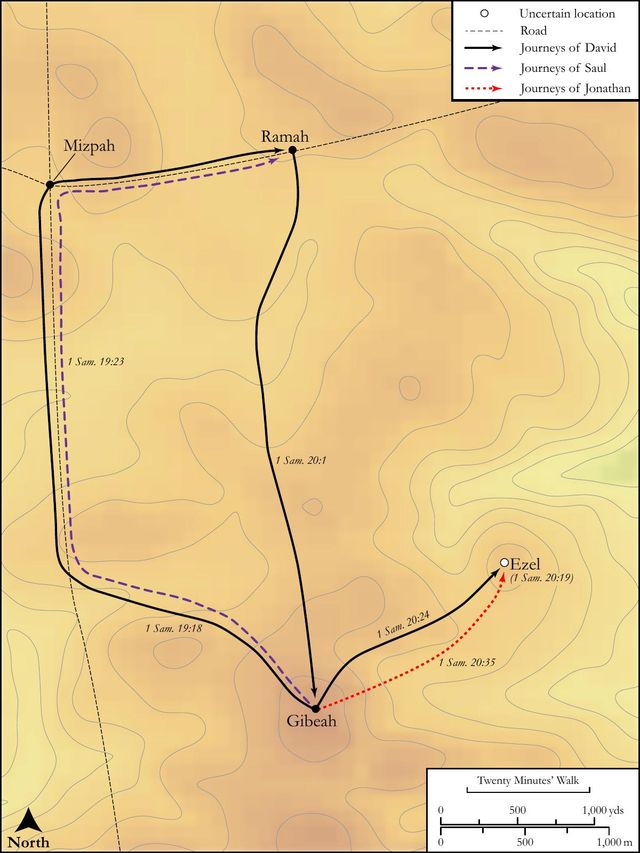
See on the biblical-era map
Study this verse
Public-domain commentary
Matthew Henry
From his Commentary on the Whole Bible. Henry comments on passages, not single verses — this entry covers 1 Samuel 20:1–8. His three-level outline is real structure in the source text, so it is rendered as structure.
Here, I. David makes a representation to Jonathan of his present troubles. While Saul lay bound by his trance at Naioth David escaped to the court, and got to speak with Jonathan. And it was happy for him that he had such a friend at court, when he had such an enemy on the throne. If there be those that hate and despise us, let us not be disturbed at that, for there are those also that love and respect us. God hath set the one over against the other, and so must we. Jonathan was a friend that loved at all times, loved David as well now in his distress, and bade him as welcome into his arms, as he had done when he was in his triumph (Sa1 18:1), and he was a brother that was born for adversity, Pro 17:17. Now, 1. David appeals to Jonathan himself concerning his innocency, and he needed not say much to him for the proof of it, only he desired him that if he knew of any just offence he had given his father he would tell him, that he might humble himself and beg his pardon: What have I done? Sa1 20:1. 2. He endeavors to convince him that, notwithstanding his innocency, Saul sought his life. Jonathan, from a principal of filial respect to his father, was very loth to believe that he designed or would ever do so wicked a thing, Sa1 20:2. He the rather hoped so because he knew nothing of any such design, and he had usually been made privy to all his counsels. Jonathan, as became a dutiful son, endeavored to cover his father's shame, as far as was consistent with justice and fidelity to David. Charity is not forward to think evil of any, especially of a parent, Co1 13:5. David therefore gives him the assurance of an oath concerning his own danger, swears the peace upon Saul, that he was in fear of his life by him: "As the Lord liveth, than which nothing more sure in itself, and as thy soul liveth, than which nothing more certain to thee, whatever thou thinkest, there is but a step between me and death," Sa1 20:3. And, as for Saul's concealing it from Jonathan, it was easy to account for that; he knew the friendship between him and David, and therefore, though in other things he advised with him, yet not in that. None more fit than Jonathan to serve him in every design that was just and honourable, but he knew him to be a man of more virtue than to be his confidant in so base a design as the murder of David.
II.Jonathan generously offers him his service (Sa1 20:4):
Whatsoever thou desirest, he needed not insert the proviso of lawful and honest (for he knew David too well to think he would ask any thing that was otherwise), I will even do it for thee. This is true friendship. Thus Christ testifies his love to us: Ask, and it shall be done for you; and we must testify ours to him by keeping his commandments.
III.David only desires him to satisfy himself, and then to satisfy him whether Saul did really design his death or no.
Perhaps David proposed this more for Jonathan's conviction than his own, for he himself was well satisfied.
1.The method of trial he proposed was very natural, and would certainly discover how Saul stood affected to him. The two next days Saul was to dine publicly, upon occasion of the solemnities of the new moon, when extraordinary sacrifices were offered and feasts made upon the sacrifices. Saul was rejected of God, and the Spirit of the Lord had departed from him, yet he kept up his observance of the holy feasts. There may be the remains of external devotion where there is nothing but the ruins of real virtue. At these solemn feasts Saul had either all his children to sit with him, and David had a seat as one of them, or all his great officers, and David had a seat as one of them. However it was, David resolved his seat should be empty (and that it never used to be at a sacred feast) those two days (Sa1 20:5), and he would abscond till the solemnity was over, and put it upon this issue: if Saul admitted an excuse for his absence, and dispensed with it, he would conclude he had changed his mind and was reconciled to him; but if he resented it, and was put into a passion by it, it was easy to conclude he designed him a mischief, since it was certain he did not love him so well as to desire his presence for any other end than that he might have an opportunity to do him a mischief, Sa1 20:7.
2.The excuse he desired Jonathan to make for his absence, we have reason to think, was true, that he was invited by his elder brother to Bethlehem, his own city, to celebrate this new moon with his relations there, because, besides the monthly solemnity in which they held communion with all Israel, they had now a yearly sacrifice, and a holy feast upon it, for all the family, Sa1 20:6. They kept a day of thanksgiving in their family for the comforts they enjoyed, and of prayer for the continuance of them. By this it appears that the family David was of was a very religious family, a house that had a church in it.
3.The arguments he used with Jonathan to persuade him to do this kindness for him were very pressing, Sa1 20:8.
(1.)That he had entered into a league of friendship with him, and it was Jonathan's own proposal: Thou hast brought thy servant into a covenant of the Lord with thee.
(2.)That he would by no means urge him to espouse his cause if he was not sure that it was a righteous cause: "If there be iniquity in me, I am so far from desiring or expecting that the covenant between us should bind thee to be a confederate with me in that iniquity that I freely release thee from it, and wish that my hand may be first upon me: Slay me thyself." No honest man will urge his friend to do a dishonest thing for his sake.
Continue studying 1 Samuel 20:2 across the web’s major study libraries — every link below opens this exact verse, chapter, or book on the destination site.
Read & Compare
 BibleGatewayThis verse in more than 200 translations and 70 languages.
 Bible.comThe YouVersion reader — hundreds of translations, reading plans, and highlights.
 ESV.orgCrossway's official English Standard Version reader.
 NET BibleThe NET translation with 60,000+ translators' notes on every rendering decision.
 STEP BibleTyndale House's free study tool — original text, vocabulary, and scholarly resources.
 BibliaLogos Bible Software's free web reader.
 USCCBThe New American Bible (Revised Edition) with the U.S. bishops' study notes.
Commentaries
 BibleHub CommentariesDozens of classic commentaries on this verse, gathered on one page.
 StudyLightMore than 100 commentary sets — the largest collection on the web.
 BibleRefPlain-English commentary on what this verse means, verse by verse.
 Enduring WordDavid Guzik's free commentary on this chapter, widely used by Bible teachers.
 Bible Study ToolsVerse commentary alongside Greek and Hebrew study aids.
Original Language & Research
- BibleHub InterlinearThe verse word by word — original language, transliteration, and English.
- BibleHub LexiconEvery word's original-language definition and Strong's entry.
 Blue Letter BibleDeep-study tools — Strong's numbers, concordance, and word studies.
 SefariaThe Hebrew text with Rashi and centuries of Jewish commentary.
Sermons, Hymns & Audio


TrulyRandomVerse is not affiliated with these sites and doesn’t control their content. They’re linked because they’re genuinely useful.
Summary
Jonathan's impassioned denial in 1 Samuel 20:2 reveals his profound trust in his father, King Saul, and his deep affection for David. Unaware of the true depth of Saul's murderous jealousy and paranoia, Jonathan genuinely believes that any significant royal decision, especially one concerning David's life, would be disclosed to him. His vehement assertion that "my father will do nothing either great or small, but that he will shew it me" underscores his conviction that David's dire prediction of death is utterly impossible and unfounded, tragically misjudging the extent of Saul's corrupted heart.
Context
ShowHideLiterary Context
This verse is a pivotal moment in the unfolding drama of Saul's escalating animosity toward David, immediately following David's desperate plea to Jonathan in 1 Samuel 20:1. David, having already survived multiple assassination attempts by Saul—including spear throws and an ambush—has fled the royal court and sought refuge with his closest friend, Jonathan. The preceding chapters meticulously detail David's meteoric rise, his covenant friendship with Jonathan established in 1 Samuel 18:1-4, and Saul's subsequent descent into paranoia and murderous rage, fueled by envy of David's success and popularity (e.g., 1 Samuel 18:8-9). Jonathan's initial response in this verse, born of filial loyalty and a tragic lack of awareness, sets the stage for the dramatic test of Saul's true intentions and the eventual, painful confirmation of David's fears, leading to their final separation.
Historical & Cultural Context
The narrative unfolds within the nascent monarchy of Israel, a period of significant transition from a tribal confederacy to a centralized kingdom. Saul, as Israel's first king, was chosen by God but later rejected due to his disobedience (as detailed in 1 Samuel 15). David, divinely anointed as Saul's successor (1 Samuel 16:13), represents God's chosen future for Israel. The cultural norms of the time emphasized absolute loyalty within the royal court and family, yet also acknowledged the king's supreme authority. Jonathan, as the crown prince and heir apparent, would naturally expect to be privy to his father's significant decisions, especially those impacting the kingdom's stability or the life of a prominent military leader like David. His statement reflects a common expectation of transparency and trust within a royal household, a trust that Saul's unchecked envy and mental instability were about to shatter.
Key Themes
ShowHideThis verse powerfully underscores several major themes prevalent throughout the book of Samuel. Firstly, it highlights the theme of unwavering loyalty and covenant friendship, particularly between Jonathan and David, which stands in stark contrast to the betrayal and animosity displayed by Saul. Jonathan's immediate and passionate defense of his father, even as it proves to be tragically misguided, showcases his deep familial loyalty and trust. Secondly, it foreshadows the corrupting power of unchecked envy and paranoia, as Saul's irrational hatred for David has driven him to secret, murderous plots, even against the counsel and knowledge of his own son. This theme is central to Saul's tragic downfall, vividly illustrated by his later attempts to kill David and even Jonathan himself (e.g., 1 Samuel 20:33). Lastly, it emphasizes the divine protection of God's anointed, as David, despite facing mortal danger from the king, is continually preserved by God's hand, ultimately leading to his ascent to the throne—a truth that Jonathan, in his steadfast loyalty, unwittingly helps to bring about.
Exposition and Analysis
ShowHideKey Word Analysis
ShowHideThis strong interjection (H2486) literally means "profane!" or "far be it!" It is an exclamation of utter rejection and vehement denial. Jonathan's use of this word communicates his profound shock and disbelief that his father, King Saul, would harbor such a murderous intent toward David, especially without his knowledge. It conveys a sense of "may it never be!" or "that would be an abomination!"
This primitive word (H1) refers to a literal and immediate father, but also carries figurative and remote applications like "chief" or "forefather." Jonathan's repeated use of "my father" in this verse underscores his deep filial bond and his expectation of paternal transparency and trust. His inability to conceive of Saul acting against David in secret is rooted in his understanding of their father-son relationship and his role as heir.
This primitive root (H5641) means "to hide (by covering), literally or figuratively," implying to conceal, keep secret, or withhold knowledge. Jonathan's rhetorical question, "why should my father hide this thing from me?" reveals his conviction that Saul would never keep such a vital matter from his heir and trusted confidant. It highlights Jonathan's perception of his relationship with his father as one of complete transparency and shared counsel, a perception that is tragically at odds with Saul's true, secretive malice.
Verse Breakdown
ShowHide"And he said unto him, God forbid; thou shalt not die"
Jonathan's immediate, forceful, and emotional response to David's desperate fear. The phrase "God forbid" (חָלִלָה, chalilah) expresses his utter shock and vehement rejection of David's assertion that Saul intends to kill him. He confidently assures David that death is not imminent, reflecting his deep trust in his father and his inability to fathom the depth of Saul's corrupted intentions.
"behold, my father will do nothing either great or small, but that he will shew it me"
This clause reveals the fundamental basis of Jonathan's confidence. He believes that his father, King Saul, shares everything with him—from the most significant royal decisions ("great") to the most minor matters ("small"). This statement highlights Jonathan's esteemed position as heir apparent and trusted advisor, and his unwavering conviction that he is privy to all of Saul's plans, especially those of such grave consequence.
"and why should my father hide this thing from me?"
A rhetorical question that further emphasizes Jonathan's incredulity and disbelief. He cannot conceive of any logical reason why Saul would conceal such a grave matter, especially from his own son and the one who has a sacred covenant with David. This question underscores his belief in the integrity and transparency of his relationship with his father, a belief that tragically blinds him to Saul's true, deceptive nature.
"it [is] not [so]"
Jonathan's final, emphatic declaration. This short, conclusive statement reiterates his firm belief that David's fears are unfounded and that Saul does not intend to kill him. It is a definitive dismissal of David's accusation, born out of deep filial loyalty and a tragic misunderstanding of his father's increasingly corrupted and paranoid heart.
Literary Devices
ShowHideThe passage employs several potent literary devices that enrich its meaning and emotional impact. Dramatic Irony is paramount, as the audience is fully aware of Saul's murderous intent (e.g., 1 Samuel 19:9-10), while Jonathan remains tragically oblivious. This creates significant tension and pathos, highlighting Jonathan's noble but naive loyalty. The phrase "either great or small" is an example of Merism, a literary device where two contrasting parts represent a comprehensive whole, emphasizing Jonathan's belief that Saul supposedly shares everything with him. Furthermore, the dialogue itself serves as a powerful means of Characterization, revealing Jonathan's unwavering loyalty and trust, David's desperate fear and realistic assessment of the danger, and, by implication, the depth of Saul's secretive malice. The rhetorical question, "why should my father hide this thing from me?" functions as a form of Apostrophe, as Jonathan addresses a presumed logic and integrity in Saul that is, in fact, entirely absent in the king's irrational and sin-hardened state.
Theological and Thematic Connections
ShowHideJonathan's response in 1 Samuel 20:2, though born of genuine affection and filial loyalty, tragically underscores the reality of Saul's spiritual decline and the insidious nature of sin, particularly envy and paranoia, which had consumed the king. It highlights the stark contrast between human perception and divine reality; while Jonathan trusts in his earthly father's integrity, David, guided by a more acute spiritual discernment and direct experience of Saul's madness, rightly perceives the mortal danger. This moment serves as a powerful illustration of how sin can corrupt even the closest relationships and how a heart hardened against God's will can become utterly deceptive, even to those it purports to love. The divine hand is evident in David's preservation, despite Jonathan's initial disbelief, demonstrating God's faithfulness to His chosen one and His sovereign control over the affairs of men, even amidst human treachery.
Reflection and Application
ShowHideJonathan's initial disbelief in 1 Samuel 20:2 offers a poignant lesson about the complexities of human relationships, particularly when trust is challenged by unsettling truths. It reminds us that loyalty, while a profound virtue, must be tempered with discerning wisdom. There are times when the reality of another's brokenness, malicious intent, or spiritual decline is so profound that it defies our desire to believe the best, especially when that person is close to us. This passage encourages us to cultivate a realistic understanding of human nature, acknowledging the potential for even loved ones to succumb to sin's corrupting influence. While we are called to extend grace, forgiveness, and love, we are also wise to heed warnings, protect ourselves, and seek truth, even when it is painful or challenges our comfortable assumptions about those we cherish. It's a call to prayerful discernment, asking God to reveal truth and guide our steps when faced with difficult, potentially harmful relational dynamics.
Questions for Reflection
ShowHideFAQ
ShowHideWhy was Jonathan so confident that his father would not hide such a thing from him?
ShowHideJonathan's confidence stemmed from his esteemed position as the crown prince and his close, albeit tragically misperceived, relationship with King Saul. As the heir apparent, he would naturally expect to be privy to all significant royal decisions, especially those concerning the life of a prominent figure like David, who was a national hero and his own covenant friend. He likely believed in a bond of trust and transparency with his father, assuming that Saul would confide in him regarding any major plans, "either great or small." This expectation was deeply rooted in their familial relationship and his integral role within the court, making David's accusation seem utterly illogical and impossible from his perspective. Tragically, this confidence revealed Jonathan's unawareness of the extent of Saul's paranoia and the secrecy with which he now operated due to his unchecked envy and spiritual decline (see 1 Samuel 18:8-9).
Christ-Centered Fulfillment
ShowHideJonathan's loyal, though initially misguided, defense of his father in 1 Samuel 20:2, and his subsequent painful realization of Saul's murderous intent, foreshadows the ultimate conflict between the kingdom of man and the Kingdom of God, culminating in the person of Jesus Christ. Just as Saul, the earthly king, sought to destroy David, God's anointed, so too did the religious and political powers of Jesus' day conspire to put to death the true King, the Messiah (e.g., Matthew 26:3-4). Jonathan's unwavering friendship with David, even to his own peril, serves as a beautiful type of Christ's perfect friendship and intercession for His people. While Jonathan could not ultimately save David from Saul's wrath, Jesus, the Lamb of God who takes away the sin of the world, willingly laid down His life to deliver humanity from the wrath of sin and death (e.g., Romans 5:8). The tragic irony of Jonathan's initial denial, where he could not fathom his father's treachery, points to the world's inability to recognize its Savior, who came not to condemn but to save (e.g., John 3:17). Ultimately, David's preservation and ascent to the throne, despite the king's murderous intent, prefigures Christ's resurrection and enthronement as King of Kings and Lord of Lords, triumphing over all earthly opposition and establishing an eternal kingdom (e.g., Revelation 19:16).