


1 Samuel 14:45
Bible text: King James Version (1769 Blayney text) · Public domain
Bible text: King James Version with Strong's numbers · Public domain
Bible text: Berean Standard Bible · Public domain
Bible text: American Standard Version (1901) · Public domain
Bible text: World English Bible, Messianic edition · Public domain
Bible text: Geneva Bible (1599) · Public domain
Bible text: Young's Literal Translation · Public domain
- וַיֹּאמֶרvai·Yo·merand it saidH559Conj-w ¦ V-Qal-ConsecImperf-3msVerb Qal Consecutive Imperfect 3rd Singular Masculineוַandיֹּאמֶרit said
- הָעָםha·'Amthe peopleH5971Art ¦ N-msNoun Singular Masculine Absoluteהָtheעָםpeople
- אֶל'eltoH413PrepPreposition
- שָׁאוּלsha·'UlSaulH7586N-proper-mNoun Proper Masculine
- הֲיוֹנָתָןhayo·na·Tan¿ JonathanH3129Interrog ¦ N-proper-mNoun Proper Masculineהֲ¿יוֹנָתָןJonathan
- יָמוּתya·Mutwill he dieH4191V-Qal-Imperf-3msVerb Qal Imperfect 3rd Singular Masculine
- אֲשֶׁר'a·SherwhoH834RelParticle Relative
- עָשָׂה'A·sahhe has doneH6213V-Qal-Perf-3msVerb Qal Perfect 3rd Singular Masculine
- הַיְשׁוּעָהhay·shu·'Ahthe deliveranceH3444Art ¦ N-fsNoun Singular Feminine Absoluteהַtheיְשׁוּעָהdeliverance
- הַגְּדוֹלָהha·ge·do·Lah<the> greatH1419Art ¦ Adj-fsAdjective Singular Feminine Absoluteהַ<the>גְּדוֹלָהgreat
- הַזֹּאתha·zoT<the> thisH2063Art ¦ PrtParticle Demonstrativeהַ<the>זֹּאתthis
- בְּיִשְׂרָאֵלbe·Yis·ra·'Elin IsraelH3478Prep-b ¦ N-properNoun Proper LocationבְּinיִשְׂרָאֵלIsrael
- חָלִילָהcha·Li·lahfar be itH2486PrtParticle Interjection
- חַיchai[by] [the] lifeH2416Adj-msAdjective Singular Masculine Absolute
- יְהוָהYah·wehof YahwehH3068N-properNoun Proper Title
- אִם'imifH518PrtParticle Conditional
- יִפֹּלyi·Polit will fallH5307V-Qal-Imperf-3msVerb Qal Imperfect 3rd Singular Masculine
- מִשַּׂעֲרַתmi·sa·'a·Ratone of [the] hair[s] ofH8185Prep-m ¦ N-fscNoun Singular Feminine Constructמִone ofשַּׂעֲרַת[the] hair[s] of
- רֹאשׁוֹro·Shohis headH7218N-msc ¦ 3msNoun Singular Masculine Constructרֹאשׁheadוֹhis
- אַרְצָה'Ar·tzah[the] ground towardsH776N-fs ¦ SfxNoun Singular Feminine Absoluteאַרְצָ[the] groundהtowards
- כִּיkiforH3588PrtParticle Conditional
- עִם'imwithH5973PrepPreposition
- אֱלֹהִים'E·lo·HimGodH430N-mpNoun Plural Masculine Absolute
- עָשָׂה'a·Sahhe has actedH6213V-Qal-Perf-3msVerb Qal Perfect 3rd Singular Masculine
- הַיּוֹםhai·Yomthe dayH3117Art ¦ N-msNoun Singular Masculine Absoluteהַtheיּוֹםday
- הַזֶּהha·Zeh<the> thisH2088Art ¦ PrtParticle Demonstrativeהַ<the>זֶּהthis
- וַיִּפְדּוּvai·yif·Duand they redeemedH6299Conj-w ¦ V-Qal-ConsecImperf-3mpVerb Qal Consecutive Imperfect 3rd Plural Masculineוַandיִּפְדּוּthey redeemed
- הָעָםha·'Amthe peopleH5971Art ¦ N-msNoun Singular Masculine Absoluteהָtheעָםpeople
- אֶת'et<obj.>H853DirObjMParticle Object Indicator
- יוֹנָתָןyo·na·TanJonathanH3129N-proper-mNoun Proper Masculine
- וְלֹאve·lo'and notH3808Conj-w ¦ NegParticle Negativeוְandלֹאnot
- מֵתMethe diedH4191V-Qal-Perf-3msVerb Qal Perfect 3rd Singular Masculine
English is a literal word-by-word gloss of the Hebrew, not the KJV's wording. Why?
This is the original text the KJV's translators worked from — each Hebrew word with its own literal English meaning in this verse, prepared by scholars at Tyndale House, Cambridge. The KJV translates whole sentences, not word by word, so its wording differs: one Hebrew word can become several English words, and the KJV may choose “the LORD” where the gloss reads “Yahweh”. Both are faithful — they answer different questions. For the KJV's own rendering, switch to the KJV text.
Details
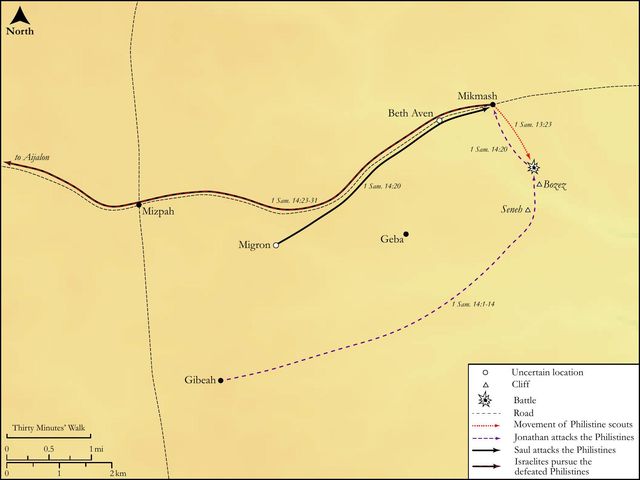
See on the biblical-era map
Study this verse
Public-domain commentary
Matthew Henry
From his Commentary on the Whole Bible. Henry comments on passages, not single verses — this entry covers 1 Samuel 14:36–46. His two-level outline is real structure in the source text, so it is rendered as structure.
Here is, I. Saul's boasting against the Philistines. He proposed, as soon as his soldiers had got their suppers, to pursue them all night, and not leave a man of them, Sa1 14:36. Here he showed much zeal, but little discretion; for his army, thus fatigued, could as ill spare a night's sleep as a meal's meat. But it is common for rash and foolish men to consider nobody but themselves, and, so that they might but have their humour, not to care what hardships they put upon those that are under them. However, the people were so obsequious to their king that they would by no means oppose the motion, but resolved to make the best of it, and, if he will go on, they will follow him: Do whatsoever seemeth good to thee. Only the priest thought it convenient to go on with the devotions that were broken off abruptly (Sa1 14:19), and to consult the oracle: Let us draw near hither unto God. Princes and great men have need of such about them as will thus be their remembrancers, wherever they go, to take God along with them. And, when the priest proposed it, Saul could not for shame reject the proposal, but asked counsel of God (Sa1 14:37): "Shall I go down after the Philistines? And shall I speed?"
II.His falling foul on his son Jonathan:
and the rest of this paragraph is wholly concerning him: for, while he is prosecuted, the Philistines make their escape. We know not what mischief may ensue upon on rash resolve.
1.God, by giving an intimation of his displeasure, put Saul upon searching for an accursed thing. When, by the priest, he consulted the oracle, God answered him not, Sa1 14:37. Note, When God denies our prayers it concerns us to enquire what the sin is that has provoked him to do so. Let us see where the sin is, Sa1 14:38. For God's ear is not heavy that it cannot hear, but it is sin that separates between us and him. If God turns away our prayer, we have reason to suspect it is for some iniquity regarding our hearts, which we are concerned to find out, that we may put it away, may mortify it, and put it to death. Saul swears by his Maker that whoever was the Achan that troubled the camp, by eating the forbidden fruit, should certainly die, though it were Jonathan himself, that is, though ever so dear to himself and the people, little thinking that Jonathan was the man (Sa1 14:39): He shall surely die, the curse shall be executed upon him. But none of the people answered him, that is, none of those who knew Jonathan had broken the order would inform against him.
2.Jonathan was discovered by lot to be the offender. Saul would have lots cast between himself and Jonathan on the one side, and the people on the other, perhaps because he was as confident of Jonathan's innocency in this matter as of his own, Sa1 14:40. The people, seeing him in a heat, durst not gainsay any thing he proposed, but acquiesced: Do as seemeth good unto thee. Before he cast lots, he prayed that God would give a perfect lot (Sa1 14:41), that is, make a full discovery of this matter, or, as it is in the margin, that he would show the innocent. This was with an air of impartial justice. Judges should desire that truth may come out, whoever may suffer by it. Lots should be cast with prayer, because they are a solemn appeal to Providence, and by them we beg of God to direct and determine us (Act 1:24), for which reason some have condemned games that depend purely upon lot or chance as making too bold with a sacred thing. Jonathan at length was taken (Sa1 14:42), Providence designing hereby to countenance and support a lawful authority, and to put an honour upon the administration of public justice in general, reserving another way to bring off one that had done nothing worthy of death.
3.Jonathan ingenuously confesses the fact, and Saul, with an angry curse, passes sentence upon him. Jonathan denies not the truth, nor goes about to conceal it, only he thinks it hard that he must die for it, Sa1 14:43. He might very fairly have pleaded his invincible ignorance of the law, or have insisted upon his merit, but he submitted to the necessity with a great and generous mind: "God's and my father's will be done:" thus he showed as much valour in receiving the messengers of death himself as in sending them among the Philistines. It is as brave to yield in some cases as it is in other cases to fight. Saul is not mollified by his filial submission nor the hardness of his case; but as one that affected to be thought firm to his word, and much more to his oath; even when it bound him hardest, with another imprecation he gives judgment upon Jonathan (Sa1 14:44): "God do so and more also to me if I do not execute the law upon thee, for thou shalt surely die, Jonathan." (1.) He passed this sentence too hastily, without consulting the oracle. Jonathan had a very good plea in arrest of the judgment. What he had done was not malum in se - bad in itself; and, as for the prohibition of it, he was ignorant of that, so that he could not be charged with rebellion or disobedience. (2.) He did it in fury. Had Jonathan been worthy to die, yet it would have become a judge, much more a father, to pass sentence with tenderness and compassion, and not with such an air of triumph, like a man perfectly divested of all humanity and natural affection. Justice is debased when it is administered with wrath and bitterness. (3.) He backed it with a curse upon himself if he did not see the sentence executed; and this curse did return upon his own head. Jonathan escaped, but God did so to Saul, and more also; for he was rejected of God and made anathema. Let none upon any occasion dare to use such imprecations as these, lest God say Amen to them, and make their own tongues to fall upon them, Psa 64:8. This stone will return upon him that rolleth it. Yet we have reason to think that Saul's bowels yearned toward Jonathan, so that he really punished himself, and very justly, when he seemed so severe upon Jonathan. God made him feel the smart of his own rash edict, which might make him fear being again guilty of the like. By all these vexatious accidents God did likewise correct him for his presumption in offering sacrifice without Samuel. An expedition so ill begun could not end without some rebukes.
4.The people rescued Jonathan out of his father's hands, v. 45. Hitherto they had expressed themselves very observant of Saul. What seemed good to him they acquiesced in, v. 36, 40. But, when Jonathan is in danger, Saul's word is no longer a law to them, but with the utmost zeal they oppose the execution of his sentence: "Shall Jonathan die - that blessing, that darling, of his country? Shall that life be sacrificed to a punctilio of law and honour which was so bravely exposed for the public service, and to which we owe our lives and triumphs? No, we will never stand by and see him thus treated whom God delights to honour." It is good to see Israelites zealous for the protection of those whom God has made instruments of public good. Saul had sworn that Jonathan should die, but they oppose their oath to his, and swear he shall not die: "As the Lord liveth there shall not only not his head, but not a hair of his head fall to the ground;" they did not rescue him by violence, but by reason and resolution; and Josephus says they made their prayer to God that he might be loosed from the curse. They pleaded for him that he has wrought with God this day; that is, "he has owned God's cause, and God has owned his endeavours, and therefore his life is too precious to be thrown away upon a nicety." We may suppose Saul had not so perfectly forgotten the relation of a father but that he was willing enough to have Jonathan rescued, and well pleased to have that done which yet he would not do himself: and he that knows the heart of a father knows not how to blame him.
5.The design against the Philistines is quashed by this incident (v. 46): Saul went up from following them, and so an opportunity was lost of completing the victory. When Israel's shields are clashing with one another the public safety and service suffer by it.
Historical interpretation
Two Centuries of Reception
3 surviving comments on this verse. Each one is dated, so this reads as a timeline rather than a list.
Select a marker to jump to its quote. Markers stagger vertically where authors wrote within a few decades of each other.
Jonathan tasted of a honeycomb on a rod, and his eyes were enlightened, and his life was in danger because he acted through ignorance. For Scripture testifies to the fact that he did not know that his father had given strict orders that no one was to taste any food until the victory of the Lord was accomplished. However, the Lord was so angered that the lot disclosed him hiding, and he confessed openly, saying, “I did but taste a little honey with the end of the rod, which was in my hand, and behold I must die.” And he was subsequently delivered through the intercession and prayers of the people, who said to Saul, “Shall Jonathan die, who has wrought this great salvation in Israel? This must not be. As the Lord lives, not one hair of his head shall fall to the ground, for he has wrought with God this day. And the people delivered Jonathan, and he did not die.”
It is no light sin, as I have said, to violate the appointed fast. In order to demonstrate this briefly by examples, we read in the book of Kings [Samuel] that when Saul the king of Israel was waging war against the foreigners he proclaimed a fast for his entire army, and when all were abstaining he began to fight against the opposing forces. This is obviously a good king, who overcame his enemies not so much by arms as by devotion and who fought more by piety than with spears. When, therefore, Saul had proclaimed a day’s abstinence for all his men and his son Jonathan, unaware of the command, had tasted some honeycomb into which the tip of his staff had been dipped as the victorious army was proceeding into the midst of the enemy, suddenly such indignation was aroused that the victory was delayed and the Divinity offended. And neither was an end put to the war nor a prophetic response given to the king. From this we understand that Saul used to overcome his enemies not so much by the might of his soldiers as by the abstinence of his soldiers. And so by the sin of one person guilt is laid upon all, and by the crime of one person weakness is produced in all, for the army’s strength failed when the observance of the fast failed. But since Saul recognized the sin from the fact that the Divinity had been offended, he immediately said that Jonathan should not be pardoned but that the sin which he admitted should be atoned for by the shedding of his blood. See how religious was the behavior of Saul the king, who desired to pacify the offended Lord even by the slaying of his kin! And see what guilt attaches to the broken fast, which is only punished by the shedding of blood! And if the unwitting Jonathan is delivered over to death because he broke the fast proclaimed by his father, what would a person deserve who knowingly broke the fast proclaimed by Christ? Therefore, brothers, let us most carefully observe the fast that has been decreed for us so that we may overcome our spiritual and fleshly enemies. For we have, as you know, fleshly enemies as well. Let us fast, then, so that our army, like Saul’s, might overcome and seize them, and let us not having determined to abstain, turn away for a honeycomb. For a honeycomb is, so to speak, the pleasure and vices of the world, which, as it is written, are sweet in the throat for a time, to be sure, but in the end are more bitter than gall.
It should also be known that the vice of gluttony tempts us in five ways. For it sometimes anticipates the seasons of want, but sometimes [it] does not anticipate them but seeks for daintier food. Sometimes it looks for those things, which must be taken, to be prepared more carefully; but sometimes it agrees with both the quality of, and the season for, its food, but exceeds, in the quantity of what is to be taken, the measure of moderate refreshment. But sometimes that which it longs for is even of a baser kind, and yet it sins more fatally through the heat of unbounded desire. For Jonathan deserved in truth the sentence of death from the mouth of his father, because in taking honey he anticipated the time which had been fixed for eating.
Continue studying 1 Samuel 14:45 across the web’s major study libraries — every link below opens this exact verse, chapter, or book on the destination site.
Read & Compare
 BibleGatewayThis verse in more than 200 translations and 70 languages.
 Bible.comThe YouVersion reader — hundreds of translations, reading plans, and highlights.
 ESV.orgCrossway's official English Standard Version reader.
 NET BibleThe NET translation with 60,000+ translators' notes on every rendering decision.
 STEP BibleTyndale House's free study tool — original text, vocabulary, and scholarly resources.
 BibliaLogos Bible Software's free web reader.
 USCCBThe New American Bible (Revised Edition) with the U.S. bishops' study notes.
Commentaries
 BibleHub CommentariesDozens of classic commentaries on this verse, gathered on one page.
 StudyLightMore than 100 commentary sets — the largest collection on the web.
 BibleRefPlain-English commentary on what this verse means, verse by verse.
 Enduring WordDavid Guzik's free commentary on this chapter, widely used by Bible teachers.
 Bible Study ToolsVerse commentary alongside Greek and Hebrew study aids.
Original Language & Research
- BibleHub InterlinearThe verse word by word — original language, transliteration, and English.
- BibleHub LexiconEvery word's original-language definition and Strong's entry.
 Blue Letter BibleDeep-study tools — Strong's numbers, concordance, and word studies.
 SefariaThe Hebrew text with Rashi and centuries of Jewish commentary.
Sermons, Hymns & Audio


TrulyRandomVerse is not affiliated with these sites and doesn’t control their content. They’re linked because they’re genuinely useful.
Summary
1 Samuel 14:45 captures a pivotal moment of collective defiance and profound theological insight, as the people of Israel rise in unified protest to protect Jonathan, son of King Saul, from his father's rash and ill-conceived oath. Having just spearheaded a miraculous and divinely-empowered victory against the Philistines, the army vehemently rejects the notion of Jonathan's execution, affirming his instrumental role in their deliverance and declaring that his life is sacred because "he hath wrought with God this day." This powerful, moral intervention by the people ultimately saves Jonathan's life, highlighting the tension between rigid legalism and the spirit of divine justice and mercy.
Context
ShowHideLiterary Context
This verse serves as the dramatic and climactic resolution to a series of escalating events detailed throughout 1 Samuel chapter 14. The narrative commences with Jonathan's audacious and faith-filled initiative, where he, accompanied only by his armor-bearer, launches a daring assault on a Philistine garrison, leading to a miraculous rout and a great panic among the enemy (1 Samuel 14:1-15). During the ensuing pursuit, King Saul, in a moment of misguided zeal and an attempt to secure divine favor, pronounces a severe and ill-advised oath: "Cursed be the man that eateth any food until evening, that I may be avenged on my enemies" (1 Samuel 14:24). Unaware of this binding vow, Jonathan, exhausted from battle, tastes a bit of honey to refresh himself (1 Samuel 14:27). When Saul seeks divine guidance and casts lots to identify the transgressor, Jonathan is divinely revealed (1 Samuel 14:41-42). Saul, feeling rigidly bound by his vow and perhaps driven by a desire to appear righteous, declares his intent to execute his own son (1 Samuel 14:44), setting the stage for the people's powerful and decisive intervention in verse 45.
Historical & Cultural Context
The early monarchy in Israel, as exemplified by Saul's reign, was a period of significant transition and tension, marked by the nascent establishment of royal authority amidst lingering tribal structures and prophetic influence. Kings were expected to lead in battle, maintain order, and uphold divine law, but their authority was not absolute; it was fundamentally subject to God's will and, at times, to the moral conscience of the people or the pronouncements of prophets. Vows and oaths were considered extremely serious and binding in ancient Israel, viewed as solemn commitments made before God (Numbers 30:2). Saul's oath reflects a common practice of seeking divine favor and demonstrating piety in warfare, but his specific vow was rash, poorly timed, and ultimately counterproductive, demonstrating a critical lack of discernment. The army's intervention, therefore, highlights their understanding of true divine favor, recognizing that Jonathan's actions were clearly blessed by God and thus his life should be preserved, even if it meant directly challenging the king's decree. This incident also underscores the nascent stage of kingship, where the people still retained significant moral and political influence, particularly when a king's actions threatened the well-being or divinely-ordained prosperity of the nation.
Key Themes
ShowHideThis verse powerfully contributes to several overarching themes within the book of 1 Samuel and the broader Old Testament narrative. Firstly, it starkly underscores the dangers of rash vows and rigid legalism, demonstrating how a poorly conceived oath, when adhered to without discernment or mercy, can lead to grave injustice and unintended, devastating consequences. This contrasts sharply with a spirit of grace and compassion, echoing later prophetic calls for mercy over sacrifice (Hosea 6:6). Secondly, it highlights the intricate interplay between divine deliverance and human agency, as the people acknowledge Jonathan's instrumental role ("wrought this great salvation") while immediately attributing his success to divine partnership ("he hath wrought with God this day"). This illustrates the profound biblical understanding that human effort, when undertaken in faith and aligned with God's will, becomes a powerful conduit for divine action and blessing. Thirdly, the passage vividly portrays the power of the people's voice as a moral and even political check on arbitrary or misguided authority, emphasizing the paramount importance of justice and the sanctity of a righteous life over rigid adherence to a flawed royal decree. This collective moral stand serves as a testament to the community's role in upholding divine principles.
Exposition and Analysis
ShowHideKey Word Analysis
ShowHideThis term (H3444) signifies "deliverance, aid, victory, prosperity." While it refers primarily to the military triumph over the Philistines, its use here carries a profound theological weight, implying more than mere human success. It suggests a divinely orchestrated rescue, a deliverance wrought by God through Jonathan's agency. The people's recognition of this "great salvation" points to their understanding that the victory was not simply a result of Jonathan's bravery but God's active hand.
This strong interjection (H2486) literally means "for a profaned thing" or "far be it!" It expresses utter abhorrence, moral outrage, or firm rejection of an idea. The people's use of this phrase conveys their shock and their absolute refusal to countenance Jonathan's death, signaling a deep moral conviction that such an act would be an abomination, an offense against God and justice, and a profanation of the divine favor clearly resting on Jonathan.
This verb (H6213) is a primitive root meaning "to do or make, in the broadest sense and widest application." When combined with the phrase "with God" (H430, ʼĕlôhîym), it signifies a profound partnership or collaboration. It indicates that Jonathan's actions were not simply heroic human endeavors but were divinely inspired, empowered, and blessed. His success was a direct result of God's active presence and assistance, making his life precious and his actions undeniable evidence of divine favor.
Verse Breakdown
ShowHide"And the people said unto Saul, Shall Jonathan die, who hath wrought this great salvation in Israel?"
This opening clause presents a direct, rhetorical challenge from the assembled people to King Saul. It immediately questions the justice and wisdom of Saul's intended action, highlighting the profound irony and injustice of condemning the very person who, through God's power, had just secured a monumental victory for the nation. The people's voice here represents a collective moral conscience, prioritizing divine favor and national well-being over a king's misguided vow.
"God forbid: [as] the LORD liveth, there shall not one hair of his head fall to the ground;"
The people's response is emphatic and absolute. "God forbid" expresses their utter rejection of Saul's decree as morally repugnant. The subsequent oath, "as the LORD liveth" (invoking the very being of God, H3068, Yᵉhôvâh, who "liveth," H2416, chay), underscores the solemnity and certainty of their declaration. The proverbial phrase, "there shall not one hair (H8185, saʻărâh) of his head (H7218, rôʼsh) fall (H5307, nâphal) to the ground (H776, ʼerets)," is a powerful hyperbole signifying complete safety and protection, emphasizing that not even the slightest harm should come to Jonathan, whose life they deem sacred and divinely protected.
"for he hath wrought with God this day. So the people rescued Jonathan, that he died not."
This final section provides the theological justification for the people's intervention and states the decisive outcome. Jonathan's actions are explicitly linked to divine partnership, making his life invaluable and his death unthinkable. The people's unified action, driven by this conviction and their moral courage, directly results in Jonathan's rescue (H6299, pâdâh, "to sever, i.e. ransom; gener. to release, preserve"), demonstrating their collective power to intervene against an unjust decree and preserve a life that was clearly blessed by God.
Literary Devices
ShowHideThe verse employs several impactful Literary Devices to convey its dramatic message and underscore its theological implications. A prominent one is the Rhetorical Question, "Shall Jonathan die, who hath wrought this great salvation in Israel?" This question is not posed to elicit information but to emphasize the sheer absurdity, profound injustice, and moral outrage of Saul's intention, compelling the audience to agree with the people's righteous indignation and to question the king's judgment. The phrase "there shall not one hair of his head fall to the ground" functions as a powerful Proverbial Expression or Hyperbole, underscoring the absolute certainty of Jonathan's safety and the people's unwavering commitment to protect him. This idiom is found elsewhere in scripture (e.g., 2 Samuel 14:11) to denote complete preservation and divine protection. Furthermore, there is a strong element of Dramatic Irony at play: Saul's oath, intended to secure divine favor and victory, ironically imperils the very person through whom God actually delivered that victory. This highlights Saul's spiritual blindness, his misguided zeal, and the tragic consequences of prioritizing rigid legalism over divine discernment and mercy.
Theological and Thematic Connections
ShowHideThis dramatic intervention by the people in 1 Samuel 14:45 resonates deeply with broader biblical themes concerning the nature of justice, the sanctity of life, and the discernment of God's true will. It presents a powerful contrast between rigid legalism—represented by Saul's unyielding adherence to a rash vow—and the spirit of mercy and grace, championed by the people. The people's declaration that Jonathan "hath wrought with God" elevates his actions beyond mere human heroism, recognizing them as divinely empowered and therefore sacred. This highlights a recurring biblical principle: God desires obedience rooted in discernment and mercy, not blind adherence to human-made rules that contradict His character or lead to injustice. The preservation of Jonathan's life, despite Saul's oath, underscores God's ultimate sovereignty and His ability to work through unexpected channels—even the collective voice of His people—to uphold justice and protect His chosen instruments, demonstrating that true piety values life and divine partnership above legalistic rigidity.
Reflection and Application
ShowHideThe profound narrative of 1 Samuel 14:45 offers invaluable lessons for contemporary life, challenging us to critically consider the true nature of justice, the responsibilities of leadership, and the power of a discerning community. It reminds us that genuine leadership involves not only making decisions but also cultivating the wisdom to discern when a rule or commitment, however well-intentioned, might lead to injustice or contradict a higher moral imperative. We are called to prioritize mercy and the sanctity of life over rigid legalism, understanding that God often desires compassion and righteousness more than blind adherence to human constructs. This passage also celebrates the power of a unified, moral voice within a community to challenge and even overturn misguided authority, urging us to speak up when we witness injustice, especially when a righteous life or divine purpose is at stake. Furthermore, it encourages us to recognize and affirm God's hand at work through others, giving credit where it is due and valuing those who, through their actions and partnership with divine providence, bring about significant good for the collective.
Questions for Reflection
ShowHideFAQ
ShowHideWhy was Saul so determined to kill Jonathan?
ShowHideSaul was driven by a misguided sense of duty to his rash oath, believing that violating it would incur divine wrath and undermine his authority as king. His zeal, though perhaps initially intended to honor God and ensure victory, became a rigid legalism that blinded him to the clear injustice of executing his own son, who had demonstrably been blessed by God in the battle. He prioritized the letter of his self-imposed law over the spirit of mercy and discernment, demonstrating a tragic flaw in his kingship.
What does "wrought with God this day" mean?
ShowHideThis powerful phrase signifies that Jonathan's actions were not merely human heroism but were divinely inspired, empowered, and blessed. It means that God was actively working through Jonathan, making him an instrument of divine deliverance. The victory against the Philistines was ultimately God's, achieved through Jonathan's faith and courage. It highlights a profound partnership between human agency and divine power, where human effort aligns with God's will to produce extraordinary results that transcend mere human capability.
Does this passage suggest that the people's will can override a king's decree?
ShowHideIn this specific instance, yes. The unified, moral outcry of the people, backed by their recognition of divine favor on Jonathan and the clear injustice of Saul's decree, effectively overturned the king's decision. It demonstrates a form of "popular sovereignty" or the people's role as a moral and even political check on arbitrary royal power, especially when the king's actions are perceived as unjust or contrary to God's true will. While not establishing a universal principle for all monarchies, it highlights that even a king's authority is not absolute and can be challenged when it conflicts with divine justice and the well-being of the nation, particularly when God's hand is clearly evident elsewhere.
Christ-Centered Fulfillment
ShowHideThe dramatic rescue of Jonathan in 1 Samuel 14:45, an innocent man facing death due to a flawed human decree, serves as a poignant foreshadowing of the ultimate salvation wrought by Christ. Jonathan was "wrought with God" in a military victory, saving Israel from its physical enemies, and was deemed worthy of life by the people's intervention. Yet, his deliverance was earthly and temporary. In profound contrast, Jesus Christ, truly innocent and perfectly "wrought with God" in every aspect of His life and ministry, faced not a rash vow, but the just and holy decree of God against human sin. He was the Lamb of God, who takes away the sin of the world, who suffered once for sins, the righteous for the unrighteous. Unlike Jonathan, Christ was not rescued from death; instead, He willingly embraced it, laying down His life as the ultimate, atoning sacrifice (Mark 10:45). This supreme act of selfless love, where God demonstrates his own love for us in this: While we were still sinners, Christ died for us, secured a salvation infinitely greater than any military victory—it secured eternal life and reconciliation with God for all who believe. His ultimate "rescue" came not through human intervention, but through His glorious resurrection, where He was raised from the dead, triumphing over sin, death, and the grave forever, fulfilling the divine plan of salvation that Jonathan's earthly deliverance could only dimly hint at.