


2 Peter 2:9
Bible text: King James Version (1769 Blayney text) · Public domain
Bible text: Berean Standard Bible · Public domain
Bible text: American Standard Version (1901) · Public domain
Bible text: World English Bible, Messianic edition · Public domain
Bible text: Geneva Bible (1599) · Public domain
Bible text: Young's Literal Translation · Public domain
- οἶδενoiden[then] knowsG1492V-RAI-3SVerb Perfect Active Indicative 3rd Singular
- κύριοςkurios[the] LordG2962N-NSM-TNoun Nominative Singular Masculine Title
- εὐσεβεῖςeusebeis[the] devoutG2152A-APMAdjective Accusative Plural Masculine
- ἐκekout ofG1537PREPPreposition
- πειρασμοῦpeirasmoutemptationG3986N-GSMNoun Genitive Singular Masculine
- ῥύεσθαιrhuesthaito deliverG4506V-PNNVerb Present Middle Or Passive Deponent Infinitive
- ἀδίκουςadikous[the] unrighteousG94A-APMAdjective Accusative Plural Masculine
- δὲdethenG1161CONJConjunction
- εἰςeisuntoG1519PREPPreposition
- ἡμέρανhēmeran[the] dayG2250N-ASFNoun Accusative Singular Feminine
- κρίσεωςkriseōsof judgmentG2920N-GSFNoun Genitive Singular Feminine
- κολαζομένουςkolazomenousbeing punishedG2849V-PPP-APMVerb Present Passive Participle Accusative Plural Masculine
- τηρεῖνtēreinto keepG5083V-PANVerb Present Active Infinitive
English is a literal word-by-word gloss of the Greek, not the KJV's wording. Why?
This is the original text the KJV's translators worked from — each Greek word with its own literal English meaning in this verse, prepared by scholars at Tyndale House, Cambridge. The KJV translates whole sentences, not word by word, so its wording differs: one Greek word can become several English words, and the KJV may choose “charity” where the gloss reads “love”. Both are faithful — they answer different questions. For the KJV's own rendering, switch to the KJV text.
Details
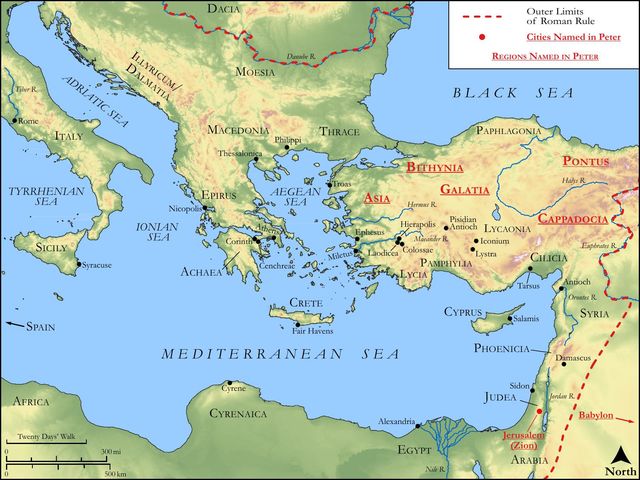
See on the biblical-era maps

Study this verse
Public-domain commentary
Matthew Henry
From his Commentary on the Whole Bible. Henry comments on passages, not single verses — this entry covers 2 Peter 2:7–9.
When God sends destruction on the ungodly, he commands deliverance for the righteous; and, if he rain fire and brimstone on the wicked, he will cover the head of the just, and they shall be hid in the day of his anger. This we have an instance of in his preserving Lot. Here observe, 1. The character given of Lot; he is called a just man; this he was as to the generally prevailing bent of his heart and through the main of his conversation. God does not account men just or unjust from one single act, but from their general course of life. And here is a just man in the midst of a most corrupt and profligate generation universally gone off from all good. He does not follow the multitude to do evil, but in a city of injustice he walks uprightly. 2. The impression the sins of others made upon this righteous man. Though the sinner takes pleasure in his wickedness, it is a grief and vexation to the soul of the righteous. In bad company we cannot escape either guilt or grief. Let the sins of others be a trouble to us, otherwise it will not be possible for us to keep ourselves pure. 3. Here is a particular mention of the duration and continuance of this good man's grief and vexation: it was from day to day. Being accustomed to hear and see their wickedness did not reconcile him to it, nor abate of the horror that was occasioned by it. This is the righteous man whom God preserved from the desolating judgment that destroyed all round about him. From this instance we are taught to argue that God knows how to deliver his people and punish his enemies. It is here presupposed that the righteous must have their temptations and trials. The devil and his instruments will thrust sore at them, that they may fall; and, if we will get to heaven, it must be through many tribulations. It is therefore our duty to reckon upon and prepare for them. Observe here, (1.) The Lord knows those that are his. He has set apart him who is godly for himself; and, if there is but one in five cities, he knows him; and where there is a greater number he cannot be ignorant of nor overlook any one of them. (2.) The wisdom of God is never at a loss about ways and means to deliver his people. They are often utterly at a loss, and can see no way; he can deliver a great many. (3.) The deliverance of the godly is the work of God, that which he concerns himself in, both his wisdom to contrive the way and his power to work out the deliverance out of temptation, to prevent their falling into sin and their being ruined by their troubles. And surely, if he can deliver out of temptation, he could keep from falling into it if he did not see such trials to be necessary. (4.) God makes a very great difference in his dealings with the godly and the wicked. When he saves his people from destruction, he delivers over his enemies to deserved ruin. The unjust has no share in the salvation God works out for the righteous. The wicked are reserved to the day of judgment. Here we see, [1.] There is a day of judgment. God has appointed a day wherein he will judge the world. [2.] The preservation of impenitent sinners is only a reserving of them to the day of the revelation of the righteous judgment of God.
Historical interpretation
Nine Centuries of Reception
4 surviving comments on this verse. Each one is dated, so this reads as a timeline rather than a list.
Select a marker to jump to its quote. Markers stagger vertically where authors wrote within a few decades of each other.
On account of his hospitality and godliness, Lot was saved out of Sodom when all the country round was punished by means of fire and brimstone, the Lord thus making it manifest that He does not forsake those that hope in Him, but gives up such as depart from Him to punishment and torture. [Genesis 19:15-26, 2 Peter 2:6-9] For Lot's wife, who went forth with him, being of a different mind from himself, and not continuing in agreement with him [as to the command which had been given them], was made an example of, so as to be a pillar of salt unto this day. This was done that all might know that those who are of a double mind, and who distrust the power of God, bring down judgment on themselves and become a sign to all succeeding generations.
So, then, brethren, having received no small occasion to repent, while we have opportunity, let us turn to God who called us, while yet we have One to receive us. For if we renounce these indulgences and conquer the soul by not fulfilling its wicked desires, we shall be partakers of the mercy of Jesus. Know that the day of judgment draws near like a burning oven, and certain of the heavens and all the earth will melt, like lead melting in fire; and then will appear the hidden and manifest deeds of men. Good, then, is alms as repentance from sin; better is fasting than prayer, and alms than both; "charity covers a multitude of sins," [1 Peter 4:4] and prayer out of a good conscience delivers from death. Blessed is every one that shall be found complete in these; for alms lightens the burden of sin.
The Lord knows how to deliver the godly out of temptations, etc. He says the unjust are reserved for punishment on the day of judgment, not because they do not suffer torment for their merits even before the day of judgment, freed from the body, but because greater torments await them in judgment when, having received their body back, they will be punished, who are now tormented in spirit alone. Whence the Lord, reproaching those cities that refused to receive the word of the Gospel, concluded in this way: It will be more tolerable for the land of Sodom in the day of judgment than for you.
The Lord knows how to rescue the godly from temptation, but to keep the unjust for the day of judgment, especially those who walk according to the flesh in the lust of pollution and despise authority: bold, brave, who do not fear to speak evil of dignitaries: whereas angels, who are greater in power and might, do not bring a reviling accusation against them before the Lord.
"especially those who walk according to the flesh." Therefore, it cleverly comes from the aforementioned examples to the present argument. Peter speaks, however, of the curses of the Nicolaitans or Gnostics, or Naassenes or Cerdonians, for their wickedness has taken on various names: and as with their wicked deeds, so too is it found to be confused with names. For these, as we have said, having taken on depth and silence, narrate marvelously the first works of the world's existence and certain mothers and ages, just as Marcion who took corrupt seeds from these: then, through this, repulsed from the dominance of institution and oversight or governance of the world, they boldly arrived at all fleshly immorality. But if anyone wishes to learn about these things, taking in hand the book composed by the blessed man Irenaeus of Gaul (Book 1, cap. 1,8-9), which he titled Against Heresies, he will find the impurities of these, especially because of Marcus, the most obscene man, and those who were seduced by him, as well as the corrupted miserable women, "Audacious, reckless." It must be understood who they are. Therefore, rejecting the Overseer or Governor and Creator of the world, it is no wonder that such audacious and reckless individuals are pursuing their own pleasures. But he also speaks of revilers. For those who do not fear authority out of contempt, what is surprising if they also stand boldly against all splendor? However, the blessed Apostle Jude speaks more openly about these things, where he also makes mention of the body of Moses. (Jude 9)
Now, Peter only hinted at this matter in passing, touching upon it and calming the discussion. Therefore, taking this occasion to speak about those things that are proposed, we say that "do not fear to speak evil of dignitaries," that is: they scornfully attack all exceptional dignitaries with curses. And wishing to restrain their boldness regarding such matters, he says: "whereas angels, who are greater in power and might, do not bring a reviling accusation against them before the Lord," saying the same as blessed Jude, as we have said: since he too, restraining the crabbiness and nonsense of certain tongues, made a warning from the same example, and he says more broadly: "Michael the archangel," etc., "did not dare to bring a railing accusation." (Jude 9) Therefore, this is what Peter also wishes to say now, that these evil spirits spare nothing in hurling curses at the dignitaries. However, those indeed who are greater in power and might, namely these unclean ones, do not bring or utter a railing accusation against them, that is, the dignitaries, before the Lord. And of this, Michael the archangel is a witness. For indeed, the Devil also shares in some glory, in that he is the beginning of the creation of the Lord, he did not bring forth a slanderous accusation against him. There is also a more effective argument in this way: For if the Devil, who is more worthy to receive accusations, nevertheless participates in splendor, this was not achieved by Michael before the Lord; it would be utterly unwise for those who rashly attack all splendor or those adorned with splendor with insults, since they are far inferior in honor to the angels; however, he speaks of dignitaries, whether divine virtues or even ecclesiastical principalities, which these most obscene ones do not cease to attack even with curses.
Continue studying 2 Peter 2:9 across the web’s major study libraries — every link below opens this exact verse, chapter, or book on the destination site.
Read & Compare
 BibleGatewayThis verse in more than 200 translations and 70 languages.
 Bible.comThe YouVersion reader — hundreds of translations, reading plans, and highlights.
 ESV.orgCrossway's official English Standard Version reader.
 NET BibleThe NET translation with 60,000+ translators' notes on every rendering decision.
 STEP BibleTyndale House's free study tool — original text, vocabulary, and scholarly resources.
 BibliaLogos Bible Software's free web reader.
 USCCBThe New American Bible (Revised Edition) with the U.S. bishops' study notes.
Commentaries
 BibleHub CommentariesDozens of classic commentaries on this verse, gathered on one page.
 StudyLightMore than 100 commentary sets — the largest collection on the web.
 BibleRefPlain-English commentary on what this verse means, verse by verse.
 Enduring WordDavid Guzik's free commentary on this chapter, widely used by Bible teachers.
 Bible Study ToolsVerse commentary alongside Greek and Hebrew study aids.
Original Language & Research
- BibleHub InterlinearThe verse word by word — original language, transliteration, and English.
- BibleHub LexiconEvery word's original-language definition and Strong's entry.
 Blue Letter BibleDeep-study tools — Strong's numbers, concordance, and word studies.
 CNTR CollationThe earliest Greek manuscripts of this verse, collated letter by letter.
Sermons, Hymns & Audio


TrulyRandomVerse is not affiliated with these sites and doesn’t control their content. They’re linked because they’re genuinely useful.
Summary
Second Peter 2:9 stands as a powerful declaration of God's perfect knowledge and sovereign control over the destinies of humanity, asserting His unwavering commitment to both justice and mercy. It assures believers that the Lord possesses the inherent wisdom and power to rescue the righteous from trials and temptations, while simultaneously guaranteeing that the wicked are being held in secure custody, awaiting the certain and inevitable day of divine judgment and punishment. This verse encapsulates a core theological truth: God's character is consistently just, ensuring that no act of godliness goes unrewarded and no act of injustice goes unpunished.
Context
ShowHideLiterary Context
Second Peter, particularly chapter 2, serves as a stark and urgent warning against the deceptive and destructive teachings of false prophets and teachers who had infiltrated the early Christian communities. Peter meticulously builds his argument by first establishing the certainty of divine judgment through historical precedents, such as the angels who sinned, the antediluvian world, and the cities of Sodom and Gomorrah (2 Peter 2:4-8). These examples underscore God's unwavering commitment to punish sin and deliver the righteous. Verse 9 functions as the climactic summary and theological conclusion to these historical illustrations, explicitly stating the principle that underlies God's past actions and guarantees His future ones. It directly contrasts the two outcomes – deliverance for the godly and judgment for the unjust – setting the stage for Peter's continued denunciation of the false teachers in the subsequent verses (2 Peter 2:10-22).
Historical & Cultural Context
The early church faced significant internal and external pressures. Internally, false teachers, often Gnostics or proto-Gnostics, challenged orthodox doctrine, promoting libertinism and denying the future coming of Christ or the reality of judgment. Externally, believers faced persecution and societal pressures that made their commitment to godliness challenging. Within this milieu, Peter's letter provides crucial pastoral guidance and theological grounding. The concept of a "day of judgment" was deeply rooted in both Jewish apocalyptic tradition and the Gentiles' ideas of divine retribution, though Peter's emphasis is distinctly Christian, focusing on God's personal and active involvement. The assurance of God's knowledge and power to deliver would have been a profound comfort to a community struggling with moral compromise and the apparent prosperity of the wicked, while the certainty of judgment served as a powerful deterrent against spiritual apostasy.
Key Themes
ShowHideThis verse powerfully contributes to several major themes present throughout 2 Peter. Firstly, it highlights Divine Sovereignty and Omniscience, emphasizing that God is not merely aware of human actions but possesses perfect, active knowledge ("knoweth") of how to administer justice and mercy. Secondly, the theme of Divine Justice is paramount; God is portrayed as the ultimate arbiter, ensuring that righteousness is vindicated and wickedness is punished. This directly counters the claims of those who might doubt God's intervention or the reality of future accountability, as seen in 2 Peter 3:3-4. Thirdly, the verse underscores God's Faithfulness to His Covenant People, promising "deliverance for the godly." This assurance of divine protection amidst "temptations" (trials or enticements to sin) provides immense comfort and encouragement, echoing the broader biblical narrative of God's preservation of His elect, as seen in passages like Psalm 34:19. Finally, the explicit mention of "the day of judgment" reinforces the eschatological theme of Future Accountability, reminding both believers and unbelievers of the ultimate reckoning that awaits all humanity.
Exposition and Analysis
ShowHideKey Word Analysis
ShowHideThis word, derived from a primary verb meaning "to see," implies more than mere intellectual apprehension. In its perfect tense, as used here, it signifies a deep, intimate, and experiential knowledge, coupled with the inherent capacity to act upon that knowledge. It conveys God's perfect wisdom and His active, discerning awareness of every situation, enabling Him to perfectly execute His will concerning both the godly and the unjust. It's not just that God knows about deliverance; He knows how to deliver because He fully comprehends the means and the end.
This verb, stemming from an obsolete word akin to "to rush or draw," means to rescue, snatch away, or protect. It emphasizes God's active intervention to save someone from danger, peril, or evil. In the context of "temptations" (which can mean trials or enticements to sin), it speaks to God's power to provide a way of escape, to strengthen, or to preserve His people through difficult circumstances, ensuring they are not overwhelmed or destroyed by them.
This term signifies to guard, keep, or hold in custody, often with the implication of careful preservation or detention. Unlike phylassō (to prevent escaping) or koustōdia (implying a fortress), tēréō suggests keeping an eye upon something to guard it from loss or injury, or, in this context, to detain for a specific purpose. Here, it highlights God's intentional and secure holding of the unjust, not allowing them to escape their destined punishment, but rather preserving them precisely for the "day of judgment."
Verse Breakdown
ShowHide"The Lord knoweth how to deliver the godly out of temptations"
This clause affirms God's perfect wisdom and omnipotence. "The Lord" (κύριος, kýrios) emphasizes His supreme authority and mastery. His "knowing how" (οἶδεν, oíden) denotes not just theoretical understanding but practical capability and effective execution. The "godly" (εὐσεβεῖς, eusebeís) are those who are pious, reverent, and live in accordance with God's will. "Temptations" (πειρασμοῖς, peirasmós) refers to trials, tests, or enticements to sin. God's knowledge enables Him to effectively "deliver" (ῥύεσθαι, rhýesthai) or rescue His faithful ones from these challenges, whether by providing a way of escape, strengthening them to endure, or removing the trial altogether.
"and to reserve the unjust unto the day of judgment to be punished"
This second clause presents a stark contrast and reveals the other side of God's justice. The conjunction "and" (δέ, dé) introduces this antithetical truth. "The unjust" (ἀδίκους, adíkous) are those who are unrighteous, wicked, or treacherous, characterized by a lack of conformity to God's moral standard. God's active role is "to reserve" (τηρεῖν, tēreín) them, meaning to hold them securely in custody. This reservation is "unto the day of judgment" (εἰς ἡμέραν κρίσεως, eis hēméran kríseōs), a specific, appointed time of divine reckoning. The ultimate purpose of this reservation is "to be punished" (κολαζομένους, kolazoménous), indicating that their detention is for the certain infliction of divine chastisement and retribution.
Literary Devices
ShowHideThe verse primarily employs Antithesis or Contrast, juxtaposing the "godly" with the "unjust" and their respective destinies: "deliverance" versus "reservation for judgment." This stark contrast powerfully highlights God's dual nature as both merciful deliverer and righteous judge. The phrase "The Lord knoweth how" functions as a declaration of Divine Sovereignty and Omniscience, attributing perfect wisdom and capability to God. There is also an element of Foreshadowing or Proleptic Language in "to reserve... unto the day of judgment," as it speaks of a future event as if it is already a settled, certain reality, emphasizing the inevitability of divine justice.
Theological and Thematic Connections
ShowHideThis verse profoundly articulates the dual aspects of God's character: His unwavering faithfulness to His people and His absolute commitment to justice for all. It underscores the biblical truth that God is not indifferent to human suffering or wickedness. He actively intervenes in the affairs of humanity, demonstrating His power to protect those who trust Him and His resolve to hold accountable those who reject His ways. This theological balance provides both immense comfort to the persecuted and a solemn warning to the unrepentant, reinforcing the ultimate triumph of God's righteous order over all forms of evil and rebellion. It assures believers that despite present appearances, God's perfect knowledge ensures that justice will ultimately prevail.
Reflection and Application
ShowHideFor the believer, 2 Peter 2:9 offers profound encouragement and a steadfast anchor in times of trial and moral confusion. When faced with temptations, whether internal struggles or external pressures to compromise faith, this verse reminds us that God is not only aware of our plight but possesses the perfect "know-how" to deliver us. This deliverance may not always mean the removal of the trial, but rather the provision of strength to endure, wisdom to navigate, or a way of escape that prevents us from succumbing. It calls us to cultivate a deep trust in God's active involvement in our lives, even when His hand is not immediately visible. Conversely, in a world where injustice often seems to prevail and the wicked appear to prosper, this verse serves as a powerful reassurance of God's ultimate justice. It reminds us that no sin goes unnoticed, and no unrighteousness will escape the divine reckoning. This truth should not only comfort us but also spur us to live lives of greater godliness, knowing that our conduct matters in light of God's certain judgment. It compels us to persevere in righteousness, confident that our labor in the Lord is never in vain.
Questions for Reflection
ShowHideFAQ
ShowHideDoes "temptations" in this verse refer only to enticements to sin, or does it include other types of trials?
ShowHideWhile "temptations" (Greek: peirasmós) can certainly refer to enticements to sin, as seen in James 1:13-14, the broader biblical usage and the context of 2 Peter 2 suggest it encompasses a wider range of trials, tests, and adversities that believers face. These can be external pressures, persecutions, or difficult circumstances that test one's faith and commitment. Peter's emphasis is on God's ability to preserve His people through these challenging experiences, preventing them from falling away or being overcome by evil, just as He delivered Noah from the flood and Lot from Sodom (2 Peter 2:5-8).
How can God "reserve the unjust" for judgment if they seem to be living freely and prospering now?
ShowHideThe term "reserve" (Greek: tēréō) implies a secure, intentional holding or keeping in custody, even if that custody is not immediately visible to human eyes. It signifies that the unjust are not beyond God's reach or forgotten; rather, they are being precisely preserved for a future reckoning. Their present prosperity or freedom is temporary and does not negate the certainty of their ultimate accountability. This concept reassures believers that God's justice is not absent but is being meticulously prepared for its appointed "day of judgment." It highlights God's sovereign control over time and destiny, ensuring that all will ultimately stand before Him to give an account, as prophesied in Revelation 20:12-13.
Christ-Centered Fulfillment
ShowHideSecond Peter 2:9, while speaking of God's general principles of justice and deliverance, finds its ultimate and most profound fulfillment in the person and work of Jesus Christ. He is the embodiment of God's perfect "know-how" to deliver the godly, for it is through His atoning sacrifice that humanity is delivered from the power and penalty of sin and from the ultimate "temptation" of eternal separation from God (Romans 6:23). Christ's life demonstrated perfect godliness, and His resurrection is the ultimate proof of God's power to deliver His righteous one from death itself (Acts 2:24). Furthermore, Jesus is the one through whom all judgment will be administered. He is the appointed judge, the one who will "reserve the unjust" and preside over the "day of judgment," for all authority to judge has been given to Him by the Father (John 5:22). Thus, 2 Peter 2:9 points forward to Christ as both the Deliverer of the saints and the righteous Judge of all humanity, perfectly executing the Father's will for both salvation and condemnation.