


1 Samuel 21:1
Bible text: King James Version (1769 Blayney text) · Public domain
Bible text: King James Version with Strong's numbers · Public domain
Bible text: Berean Standard Bible · Public domain
Bible text: American Standard Version (1901) · Public domain
Bible text: World English Bible, Messianic edition · Public domain
Bible text: Geneva Bible (1599) · Public domain
Bible text: Young's Literal Translation · Public domain
- וַיָּבֹאvai·ya·Vo'and he wentH935Conj-w ¦ V-Qal-ConsecImperf-3msVerb Qal Consecutive Imperfect 3rd Singular Masculineוַandיָּבֹאhe went
- דָוִדda·VidDavidH1732N-proper-mNoun Proper Masculine
- נֹבֶהNoehNob towardsH5011N-proper ¦ SfxNoun Proper LocationנֹבֶNobהtowards
- אֶל'eltoH413PrepPreposition
- אֲחִימֶלֶךְ'a·chi·Me·lekhAhimelechH288N-proper-mNoun Proper Masculine
- הַכֹּהֵןha·ko·Henthe priestH3548Art ¦ N-msNoun Singular Masculine Absoluteהַtheכֹּהֵןpriest
- וַיֶּחֱרַדvai·ye·che·Radand he trembledH2729Conj-w ¦ V-Qal-ConsecImperf-3msVerb Qal Consecutive Imperfect 3rd Singular Masculineוַandיֶּחֱרַדhe trembled
- אֲחִימֶלֶךְ'a·chi·Me·lekhAhimelechH288N-proper-mNoun Proper Masculine
- לִקְרַאתlik·Ratto meetH7122Prep-l ¦ V-Qal-InfVerb Qal Infinitive Constructלִtoקְרַאתmeet
- דָּוִדda·VidDavidH1732N-proper-mNoun Proper Masculine
- וַיֹּאמֶרvai·Yo·merand he saidH559Conj-w ¦ V-Qal-ConsecImperf-3msVerb Qal Consecutive Imperfect 3rd Singular Masculineוַandיֹּאמֶרhe said
- לוֹloto <the> himPrep-l ¦ 3msSuffix Personal 3rd Singular Masculineלto <the>וֹhim
- מַדּוּעַma·Du·a'why?H4069InterrogParticle Interrogative
- אַתָּה'a·Tah[are] youH859Pro-2msPronoun Personal 2nd Singular Masculine
- לְבַדֶּךָle·va·De·khato alone youH905Prep-l ¦ N-msc ¦ 2msNoun Singular Masculine Constructלְtoבַדֶּaloneךָyou
- וְאִישׁve·'Ishand [is] anyoneH376Conj-w ¦ N-msNoun Singular Masculine Absoluteוְandאִישׁ[is] anyone
- אֵין'einthere notH369N-mscNoun Singular Masculine Construct
- אִתָּךְ'i·Takhwith youH854Prep ¦ 2msPreposition Definiteאִתָּwithךְyou
English is a literal word-by-word gloss of the Hebrew, not the KJV's wording. Why?
This is the original text the KJV's translators worked from — each Hebrew word with its own literal English meaning in this verse, prepared by scholars at Tyndale House, Cambridge. The KJV translates whole sentences, not word by word, so its wording differs: one Hebrew word can become several English words, and the KJV may choose “the LORD” where the gloss reads “Yahweh”. Both are faithful — they answer different questions. For the KJV's own rendering, switch to the KJV text.
Details
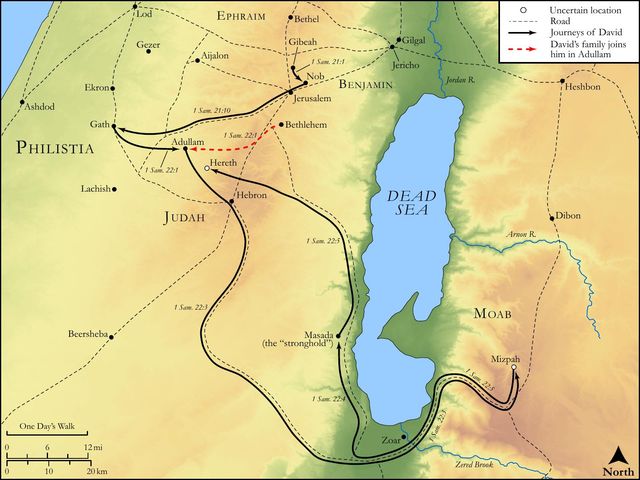
See on the biblical-era map
Study this verse
Public-domain commentary
Matthew Henry
From his Commentary on the Whole Bible. Henry comments on passages, not single verses — this entry covers 1 Samuel 21:1–9. His four-level outline is real structure in the source text, so it is rendered as structure.
Here, I. David, in distress, flies in the tabernacle of God, now pitched at Nob, supposed to be a city in the tribe of Benjamin. Since Shiloh was forsaken, the tabernacle was often removed, though the ark still remained at Kirjath-jearim. Hither David came in his flight from Saul's fury (Sa1 21:1), and applied to Ahimelech the priest. Samuel the prophet could not protect him, Jonathan the prince could not. He therefore has recourse next to Ahimelech the priest. He foresees he must now be an exile, and therefore comes to the tabernacle, 1. To take an affecting leave of it, for he knows not when he shall see it again, and nothing will be more afflictive to him in his banishment than his distance from the house of God, and his restraint from public ordinances, as appears by many of his psalms. He had given an affectionate farewell to his friend Jonathan, and cannot go till he has given the like to the tabernacle. 2. To enquire of the Lord there, and to beg direction from him in the way both of duty and safety, his case being difficult and dangerous. That this was his business appears Sa1 22:10, where it is said that Ahimelech enquired of the Lord for him, as he had done formerly, Sa1 21:15. It is a great comfort to us in a day of trouble that we have a God to go to, to whom we may open our case, and from whom we may ask and expect direction.
II.Ahimelech the priest is surprised to see him in so poor an equipage; having heard that he had fallen into disgrace at court, he looked shy upon him, as most are apt to do upon their friends when the world frowns upon them. He was afraid of incurring Saul's displeasure by entertaining him, and took notice how mean a figure he now made to what he used to make: Why art thou alone? He had some with him (as appears Mar 2:26), but they were only his own servants; he had none of the courtiers, no persons of quality with him, as he used to have at other times, when he came to enquire of the Lord. He says (Psa 42:4) he was wont to go with a multitude to the house of God; and, having now but two or three with him, Ahimelech might well ask, Why art thou alone? He that was suddenly advanced from the solitude of a shepherd's life to the crowd and hurries of the camp is now as soon reduced to the desolate condition of an exile and is alone like a sparrow on the housetop, such charges are there in this world and so uncertain are its smiles! Those that are courted today may be deserted tomorrow.
III.David, under pretence of being sent by Saul upon public services, solicits Ahimelech to supply his present wants, Sa1 21:2, Sa1 21:3.
1.Here David did not behave like himself. He told Ahimelech a gross untruth, that Saul had ordered him business to despatch, that his attendants were dismissed to such a place, and that he was charged to observe secresy and therefore durst not communicate it, no, not to the priest himself. This was all false. What shall we say to this? The scripture does not conceal it, and we dare not justify it. It was ill done, and proved of bad consequence; for it occasioned the death of the priests of the Lord, as David reflected upon it afterwards with regret, Sa1 22:22. It was needless for him thus to dissemble with the priest, for we may suppose that, if he had told him the truth, he would have sheltered and relieved him as readily as Samuel did, and would have known the better how to advise him and enquire of God for him. People should be free with their faithful ministers. David was a man of great faith and courage, and yet now both failed him, and he fell thus foully through fear and cowardice, and both owing to the weakness of his faith. Had he trusted God aright, he would not have used such a sorry sinful shift as this for his own preservation. It is written, not for our imitation, no, not in the greatest straits, but for our admonition. Let him that thinks he stands take heed lest he fall; and let us all pray daily, Lord, lead us not into temptation. Let us all take occasion from this to lament,
(1.)The weakness and infirmity of good men; the best are not perfect on this side heaven. There may be true grace where yet there are many failings.
(2.)The wickedness of bad times, which forces good men into such straits as prove temptations too strong for them. Oppression makes a wise man do foolishly.
2.Two things David begged of Ahimelech, bread and a sword.
(1.)He wanted bread: five loaves, Sa1 21:3. Travelling was then troublesome, when men generally carried their provisions with them in kind, having little money and no public houses, else David would not now have had to seek for bread. It seems David had known the seed of the righteous begging bread occasionally, but not constantly, Psa 37:25. Now,
[1.]The priest objected that he had none but hallowed bread, show-bread, which had stood a week on the golden table in the sanctuary, and was taken thence for the use of the priests and their families, Sa1 21:4. It seems the priest kept no good house, but wanted either a heart to be hospitable or provisions wherewithal to be so. Ahimelech thinks that the young men that attended David might not eat of this bread unless they had for some time abstained from women, even from their own wives; this was required at the giving of the law (Exo 19:15), but otherwise we never find this made the matter of any ceremonial purity on the one side or pollution on the other, and therefore the priest here seems to be over-nice, not to say superstitious.
[2.]David pleads that he and those that were with him, in this case of necessity, might lawfully eat of the hallowed bread, for they were not only able to answer his terms of keeping from women for three days past, but the vessels (that is, the bodies) of the young men were holy, being possessed in sanctification and honour at all times (Th1 4:4, Th1 4:5), and therefore God would take particular care of them, that they wanted not necessary supports, and would have his priest to do so. Being thus holy, holy things were not forbidden them. Poor and pious Israelites were in effect priests to God, and, rather than be starved, might feed on the bread which was appropriated to the priests. Believers are spiritual priests, and the offerings of the Lord shall be their inheritance; they eat the bread of their God. He pleads that the bread is in a manner common, now that what was primarily the religious use of it is over; especially (as our margin reads it) where there is other bread (hot, Sa1 21:6) sanctified that day in the vessel, and put in the room of it upon the table. This was David's plea, and the Son of David approves it, and shows from it that mercy is to be preferred to sacrifice, that ritual observance must give way to moral duties, and that may be done in a case of an urgent providential necessity which may not otherwise be done. He brings it to justify his disciples in plucking the ears of corn on the sabbath day, for which the Pharisees censured them, Mat 12:3, Mat 12:4.
[3.]Ahimelech hereupon supplies him: He gave him hallowed bread (Sa1 21:6), and some think it was about this that he enquired of the Lord, Sa1 22:10. As a faithful servant he would not dispose of his master's provisions without his master's leave. This bread, we may suppose, was the more agreeable to David for its being hallowed, so precious were all sacred things to him. The show-bread was but twelve loaves in all, yet out of these he gave David five (Sa1 21:3), though they had no more in the house; but he trusted Providence.
(2.)He wanted a sword. Persons of quality, though officers of the army, did not then wear their swords so constantly as now they do, else surely David would not have been without one. It was a wonder that Jonathan did not furnish him with his, as he had before done, Sa1 18:4. However, it happened that he had now no weapons with him, the reason of which he pretends to be because he came away in haste, Sa1 21:8. Those that are furnished with the sword of the Spirit and the shield of faith cannot be disarmed of them, nor need they, at any time, to be at a loss. But the priests, it seems, had no swords: the weapons of their warfare were not carnal. There was not a sword to be found about the tabernacle but the sword of Goliath, which was laid up behind the ephod, as a monument of the glorious victory David obtained over him. Probably David had an eye to that when he asked the priest to help him with a sword; for, that being mentioned, O! says he, there is none like that, give it to me, Sa1 21:9. He could not use Saul's armour, for he had not proved it; but this sword of Goliath he had made trial of and done execution with. By this it appears that he was now well grown in strength and stature, that he could wear and wield such a sword as that. God had taught his hands to war, so that he could do wonders, Psa 18:34. Two things we may observe concerning this sword: - [1.] That God had graciously given it to him, as a pledge of his singular favour; so that whenever he drew it, nay, whenever he looked upon it, it would be a great support to his faith, by bringing to mind that great instance of the particular care and countenance of the divine providence respecting him. [2.] That he had gratefully given it back to God, dedicating it to him and to his honour as a token of his thankfulness; and now in his distress it stood him greatly in stead. Note, What we devote to God's praise, and serve him with, is most likely to redound, one way or other, to our own comfort and benefit. What we gave we have.
Thus was David well furnished with arms and victuals; but it fell out very unhappily that there was one of Saul's servants then attending before the Lord, Doeg by name, that proved a base traitor both to David and Ahimelech. He was by birth an Edomite (Sa1 21:7), and though proselyted to the Jewish religion, to get the preferment he now had under Saul, yet he retained the ancient and hereditary enmity of Edom to Israel. He was master of the herds, which perhaps was then a place of as much honour as master of the horse is now. Some occasion or other he had at this time to wait on the priest, either to be purified from some pollution or to pay some vow; but, whatever his business was, it is said, he was detained before the Lord. He must attend and could not help it, but he was sick of the service, snuffed at it, and said, What a weariness is it! Mal 1:13. He would rather have been any where else than before the Lord, and therefore, instead of minding the business he came about, was plotting to do David a mischief and to be revenged on Ahimelech for detaining him. God's sanctuary could never secure such wolves in sheep's clothing. See Gal 2:4.
Historical interpretation
Fourteen Centuries of Reception
3 surviving comments on this verse. Each one is dated, so this reads as a timeline rather than a list.
Select a marker to jump to its quote. Markers stagger vertically where authors wrote within a few decades of each other.
In similar fashion, whenever we have God on our side, even if we are utterly alone, we will live more securely than those who dwell in the cities. After all, the grace of God is the greatest security and the most impregnable fortification. To prove to you how the person who, in fact, lives utterly alone turns out to be more secure and efficacious than a person living in the middle of cities and enjoying plenty of human assistance, let us see how David, though shifting from place to place and living like a nomad, was protected by the hand from above, whereas Saul, who in fact was in the middle of cities and had armies at his command, bodyguards and shieldbearers as well, still spent each day in fear and dread of enemy assaults. Whereas the one man, although alone and with no one else in his company, had no need of assistance from human beings, the other, by contrast, needed his help, despite wearing a diadem and being clad in purple. The king stood in need of the shepherd; the wearer of the crown had need of the peasant.
And Achimelech was astonished, etc. The ancient chosen ones were astonished, and the modern ones are astonished too, whenever they receive the coming of the Lord's visitation with a simple mind. They are not only stunned by the majesty of His vision, but also disturbed by the rarity of those who desire to follow the grace of such great piety. For it is said: Why are you alone, and no one with you? As it is said elsewhere: My escape has perished, and there is no one who seeks my soul (Psalm 141). Though it is certain that during the time of the passion, many saints, although very few compared to the crowd of persecutors, lovingly sought the soul of Christ. But just as where it was not among them, of those whose snares are set for me, those who seek the soul of Christ (Psalm 34), so here there was none of those who expelled Christ who followed the faith of Christ. And elsewhere, when he says: All have turned aside, they have together become worthless; there is none who does good, not even one (Psalm 13). To show that he meant not all men entirely, but all of those who were to be spoken about, he added further and said: They devour my people as they devour bread: they do not call upon the Lord, they trembled with fear where there was no fear, because God is in the generation of the righteous. And in the Gospel the Lord says: Unless a grain of wheat falls into the earth and dies, it remains alone; but if it dies, it bears much fruit (John 12). It is known that the same grain before the passion of its death had many faithful followers. But it is said to be alone without the company of those who were previously unbelievers who were to be called to faith through the same passion. Why then, he says, are you alone, and no one with you? Why are you alone, that is, with your faithful members, and none outside the predetermined number by the Father could be saved from such a multitude? This is said more with astonishment than for the chosen ones to speak by reasoning against proud counsel.
Nobe: A city in the tribe of Benjamin, to which the tabernacle of the Lord had been translated from Silo.
Continue studying 1 Samuel 21:1 across the web’s major study libraries — every link below opens this exact verse, chapter, or book on the destination site.
Read & Compare
 BibleGatewayThis verse in more than 200 translations and 70 languages.
 Bible.comThe YouVersion reader — hundreds of translations, reading plans, and highlights.
 ESV.orgCrossway's official English Standard Version reader.
 NET BibleThe NET translation with 60,000+ translators' notes on every rendering decision.
 STEP BibleTyndale House's free study tool — original text, vocabulary, and scholarly resources.
 BibliaLogos Bible Software's free web reader.
 USCCBThe New American Bible (Revised Edition) with the U.S. bishops' study notes.
Commentaries
 BibleHub CommentariesDozens of classic commentaries on this verse, gathered on one page.
 StudyLightMore than 100 commentary sets — the largest collection on the web.
 BibleRefPlain-English commentary on what this verse means, verse by verse.
 Enduring WordDavid Guzik's free commentary on this chapter, widely used by Bible teachers.
 Bible Study ToolsVerse commentary alongside Greek and Hebrew study aids.
Original Language & Research
- BibleHub InterlinearThe verse word by word — original language, transliteration, and English.
- BibleHub LexiconEvery word's original-language definition and Strong's entry.
 Blue Letter BibleDeep-study tools — Strong's numbers, concordance, and word studies.
 SefariaThe Hebrew text with Rashi and centuries of Jewish commentary.
Sermons, Hymns & Audio


TrulyRandomVerse is not affiliated with these sites and doesn’t control their content. They’re linked because they’re genuinely useful.
Summary
1 Samuel 21:1 inaugurates a critical and perilous phase in David's life, portraying his arrival at Nob, the city of priests, as a solitary fugitive fleeing the murderous jealousy of King Saul. This initial encounter with Ahimelech the high priest is immediately marked by apprehension and suspicion, as Ahimelech's palpable fear and direct inquiry into David's unusual solitude underscore the profound political instability and personal danger that now envelop the anointed future king of Israel. The verse masterfully sets the stage for David's desperate deception and the tragic, far-reaching consequences that will tragically engulf the innocent priestly community.
Context
ShowHideLiterary Context
This verse directly follows the deeply emotional and covenantal farewell between David and Jonathan in 1 Samuel 20, where Jonathan unequivocally confirms Saul's unyielding intent to kill David. Having exhausted all avenues for reconciliation and protection within the royal court, David is now officially a hunted man, compelled to abandon his home, family, and esteemed position. His arrival at Nob signifies the commencement of a protracted period of flight and exile, a stark and painful contrast to his recent celebrated status as a national hero and Saul's son-in-law. This desperate flight powerfully underscores the escalating madness and spiritual decline of Saul, while simultaneously highlighting the profound vulnerability of God's anointed, even when seemingly abandoned by human support.
Historical & Cultural Context
Nob was a highly significant priestly city, widely believed to have housed the Tabernacle and its sacred implements after the destruction of Shiloh. As such, it functioned as a central place of spiritual authority and, ideally, refuge, where the high priest, Ahimelech (a descendant of Eli), would perform religious duties, offer sacrifices, and provide divine counsel. For David, a prominent military commander and the king's son-in-law, to appear alone and unannounced at such a sacred and politically sensitive site was profoundly irregular and deeply suspicious. In those days, a person of David's stature would invariably be accompanied by a retinue of servants, guards, and attendants, making his solitary appearance a clear and alarming signal of distress, political disgrace, or even a covert mission, thereby prompting Ahimelech's immediate fear and pointed inquiry.
Key Themes
ShowHideThis verse introduces several pivotal themes that will resonate throughout David's subsequent narrative. It powerfully highlights the theme of desperation and vulnerability, as David, the divinely chosen future king, is reduced to a solitary wanderer, utterly dependent on the goodwill of others and the unseen hand of divine providence. It also underscores the sanctuary as a place of refuge, demonstrating David's immediate recourse to the religious establishment in his dire time of need, though this very refuge tragically leads to the slaughter of the priests of Nob by Saul later in the narrative. Furthermore, the verse vividly illustrates the corrupting influence of unrighteous leadership in King Saul, whose unchecked paranoia and rage create a terrifying ripple effect of fear and danger for anyone associated with David, even innocent religious figures. This entire episode serves as a powerful foreshadowing of the profound cost of Saul's rejection of God's will, setting the stage for David's eventual, divinely ordained ascension to the throne.
Exposition and Analysis
ShowHideKey Word Analysis
ShowHideFrom the same root as "loving," this name (דָּוִיד) denotes the youngest son of Jesse, who would become Israel's greatest king. In this context, the mention of "David" immediately evokes his celebrated past as a national hero and Saul's son-in-law, creating a stark contrast with his current desperate and solitary state, which is central to Ahimelech's apprehension.
This primitive root (חָרַד) conveys a profound sense of shuddering with terror, quaking, or trembling, indicating more than mere surprise; it signifies a visceral and deep-seated fear or apprehension. Ahimelech's fear upon seeing David alone immediately signals his acute awareness of the volatile political climate and the immense danger of being associated with anyone perceived as an enemy of King Saul, highlighting the precariousness of the situation.
This active participle (כָּהַן) literally means "one officiating," referring to a priest, a sacred officeholder. Ahimelech's title as "the priest" emphasizes his role as the high priest at Nob, the custodian of the Tabernacle and its holy items. His position of spiritual authority and his responsibility for the sanctuary make his fear particularly significant, as it indicates the pervasive reach of Saul's tyranny into even the holiest of places.
This term (אִשָּׁה) refers to an individual man or male person. In Ahimelech's question, "and no man with thee?", the word emphasizes David's complete lack of attendants or companions. For a figure of David's prominence, this absence of any "man" by his side was highly irregular and immediately conveyed his desperate flight and lack of official support, intensifying Ahimelech's concern about the true nature of David's visit.
Verse Breakdown
ShowHide"Then came David to Nob to Ahimelech the priest"
This opening clause establishes the critical shift in David's journey, marking his arrival at Nob, a city of priests, after his flight from Saul. It identifies Ahimelech as the specific high priest David sought out, indicating David's deliberate choice to seek aid or counsel from the religious establishment, perhaps hoping for sanctuary or provisions in his desperate state.
"and Ahimelech was afraid at the meeting of David"
This phrase immediately reveals the high priest's visceral reaction to David's unexpected and solitary appearance. Ahimelech's "fear" (not mere surprise) demonstrates his acute awareness of the political volatility surrounding King Saul and David, recognizing the immense personal and communal danger that could arise from offering assistance to someone out of favor with the king.
"and said unto him, Why [art] thou alone, and no man with thee?"
Ahimelech's direct and pointed question underscores the highly unusual and suspicious nature of David's arrival. For a man of David's military stature and royal connections, appearing without any retinue or attendants was a clear and alarming sign of severe trouble. This question serves not merely as an inquiry but as an expression of deep concern and a veiled demand for an explanation, as Ahimelech instinctively grasps the potential peril this situation poses for himself and the entire priestly community at Nob.
Literary Devices
ShowHideThe verse effectively employs several literary devices to convey its dramatic tension and thematic significance. Foreshadowing is prominently featured, as Ahimelech's immediate fear and David's desperate, solitary state subtly hint at the tragic events that will soon unfold for the priests of Nob, who will be brutally slaughtered by Saul for their unwitting aid to David. There is also a powerful element of Irony, as David, the celebrated hero who slew Goliath and saved Israel, is now reduced to a hunted fugitive, stripped of his glory and forced into deceptive measures for survival. This stark contrast between David's former public image and his current desperate reality profoundly emphasizes his vulnerability. Furthermore, the scene establishes a potent Symbolism of the sanctuary as a place of both potential refuge and profound danger, depending on the political climate and the integrity of the ruling authority. Ahimelech's direct question, "Why [art] thou alone, and no man with thee?", serves as a moment of Inquiry, propelling the narrative forward and forcing David into a deceptive explanation that will have dire and far-reaching consequences.
Theological and Thematic Connections
ShowHide1 Samuel 21:1 powerfully illustrates the precariousness of life under a tyrannical ruler and the profound vulnerability of even God's anointed during periods of intense testing. David's desperate flight to Nob highlights his utter dependence on God's providence, even when all human support has seemingly vanished. It underscores the biblical truth that God often leads His chosen servants through periods of extreme isolation and hardship, not as a sign of abandonment, but as a refining crucible for character formation and a powerful demonstration of His sustaining power amidst human weakness. The palpable fear of Ahimelech also serves as a stark reminder of the far-reaching and often tragic consequences of unrighteous leadership, where innocent individuals can suffer immensely due to the king's sin. This moment also touches upon the sacred role of the priesthood and the sanctuary, which, while divinely intended as a place of refuge and divine encounter, can become a perilous target when political and spiritual authority clash, revealing the corrupting influence of ungodly power.
Reflection and Application
ShowHideDavid's solitary and fearful arrival at Nob resonates deeply with the universal human experience of vulnerability, isolation, and desperation. In moments when our carefully constructed lives unravel, when we feel abandoned by those we trusted, or when circumstances beyond our control strip us of our perceived security and standing, we can profoundly identify with David's precarious position. This verse serves as a powerful reminder that even those called to great purposes by God are not immune to profound hardship, loneliness, and the indignity of flight. It challenges us to honestly consider where we instinctively turn when we are "alone, and no man with thee"—do we seek refuge first and foremost in God's presence, even if it means admitting our weakness, relinquishing control, and relying on His unexpected provisions? Furthermore, Ahimelech's fear and subsequent tragic fate serve as a somber warning about the ripple effects of unrighteousness and the insidious dangers of political pressure compromising spiritual integrity. It prompts us to pray for profound discernment, unwavering courage, and divine wisdom for all leaders, both secular and spiritual, enabling them to stand firm in truth and righteousness even when it is costly or unpopular. Ultimately, this passage encourages us to cultivate an unshakeable trust in God's faithfulness, even when our circumstances seem most dire and hopeless, knowing that He is sovereign over our desperate moments and can powerfully use them to refine our character, deepen our dependence, and reveal His sustaining power.
Questions for Reflection
ShowHideFAQ
ShowHideWhy was Ahimelech afraid of David's solitary arrival?
ShowHideAhimelech's fear (Hebrew, chârad, meaning to tremble or shudder with terror) was far more than mere surprise; it was a deep apprehension stemming from David's highly unusual and alarming appearance. As a prominent military commander and King Saul's son-in-law, David would typically travel with a substantial retinue of soldiers and servants, signifying his status and protection. His arrival "alone, and no man with thee" immediately signaled a severe political crisis, indicating that David was likely out of favor with King Saul or even a fugitive. Ahimelech, as the high priest, would have been acutely aware of the volatile and increasingly hostile relationship between Saul and David. He would have instantly recognized the immense danger that offering aid or sanctuary to someone in David's precarious position could pose to himself, his family, and the entire priestly community at Nob. His fear was a justified concern for the safety of his household and the sanctuary, given Saul's increasingly erratic, paranoid, and violent behavior, which would later be tragically confirmed by the slaughter of the priests by Saul's command.
Christ-Centered Fulfillment
ShowHideDavid's desperate arrival at Nob, a hunted and solitary figure seeking refuge, profoundly foreshadows the ultimate vulnerability, rejection, and suffering experienced by Jesus Christ, the true Son of David and the greater King. Just as David, God's anointed, was unjustly pursued by an unrighteous and jealous king, so too was Jesus, the Messiah, rejected by the religious and political establishments of His day, becoming a "man of sorrows, and acquainted with grief" (Isaiah 53:3). David's reliance on the sanctuary for refuge, even leading to a desperate deception concerning the holy bread, finds its ultimate and perfect fulfillment in Christ, who is Himself the true "bread of life" (John 6:35) and the ultimate High Priest (Hebrews 4:14-16) who provides true and lasting refuge for all who come to Him. Jesus even directly references David's actions at Nob when defending His disciples' actions on the Sabbath, demonstrating that human need and divine mercy transcend rigid legalism (Matthew 12:3-4). David's suffering as the anointed king, though imperfect and marked by human failing, powerfully points to the perfect suffering Servant King, Jesus, who, though innocent, was abandoned, betrayed, and crucified. Through His ultimate sacrifice, Jesus offered Himself as the supreme and spotless Lamb of God, bringing salvation, eternal refuge, and reconciliation to all who believe (Philippians 2:8).