


1 Samuel 16:4
Bible text: King James Version (1769 Blayney text) · Public domain
Bible text: King James Version with Strong's numbers · Public domain
Bible text: Berean Standard Bible · Public domain
Bible text: American Standard Version (1901) · Public domain
Bible text: World English Bible, Messianic edition · Public domain
Bible text: Geneva Bible (1599) · Public domain
Bible text: Young's Literal Translation · Public domain
- וַיַּעַשׂvai·Ya·'asand he didH6213Conj-w ¦ V-Qal-ConsecImperf-3msVerb Qal Consecutive Imperfect 3rd Singular Masculineוַandיַּעַשׂhe did
- שְׁמוּאֵלshe·mu·'ElSamuelH8050N-proper-mNoun Proper Masculine
- אֵת'et<obj.>H853DirObjMParticle Object Indicator
- אֲשֶׁר'a·Sher[that] whichH834RelParticle Relative
- דִּבֶּרdi·Berhe saidH1696V-Piel-Perf-3msVerb Piel Perfect 3rd Singular Masculine
- יְהוָהYah·wehYahwehH3068N-properNoun Proper Title
- וַיָּבֹאvai·ya·Vo'and he cameH935Conj-w ¦ V-Qal-ConsecImperf-3msVerb Qal Consecutive Imperfect 3rd Singular Masculineוַandיָּבֹאhe came
- בֵּיתbeitBeth-H1035N-properNoun Proper Location
- לָחֶםLa·chem-lehemH1035N-properNoun Proper Location
- וַיֶּחֶרְדוּvai·ye·cher·Duand they trembledH2729Conj-w ¦ V-Qal-ConsecImperf-3mpVerb Qal Consecutive Imperfect 3rd Plural Masculineוַandיֶּחֶרְדוּthey trembled
- זִקְנֵיzik·Nei[the] elders ofH2205Adj-mpcAdjective Plural Masculine Construct
- הָעִירha·'Irthe cityH5892Art ¦ N-fsNoun Singular Feminine Absoluteהָtheעִירcity
- לִקְרָאתוֹlik·ra·Toto meet himH7122Prep-l ¦ V-Qal-Inf ¦ 3msVerb Qal Infinitive Constructלִtoקְרָאתmeetוֹhim
- וַיֹּאמֶרvai·Yo·merand someone saidH559Conj-w ¦ V-Qal-ConsecImperf-3msVerb Qal Consecutive Imperfect 3rd Singular Masculineוַandיֹּאמֶרsomeone said
- שָׁלֹםsha·Lom[in] peaceH7965N-msNoun Singular Masculine Absolute
- בּוֹאֶךָbo·'E·kha[are] coming? youH935V-Qal-Inf ¦ 2msVerb Qal Infinitive Constructבּוֹאֶ[are] coming?ךָyou
English is a literal word-by-word gloss of the Hebrew, not the KJV's wording. Why?
This is the original text the KJV's translators worked from — each Hebrew word with its own literal English meaning in this verse, prepared by scholars at Tyndale House, Cambridge. The KJV translates whole sentences, not word by word, so its wording differs: one Hebrew word can become several English words, and the KJV may choose “the LORD” where the gloss reads “Yahweh”. Both are faithful — they answer different questions. For the KJV's own rendering, switch to the KJV text.
Details
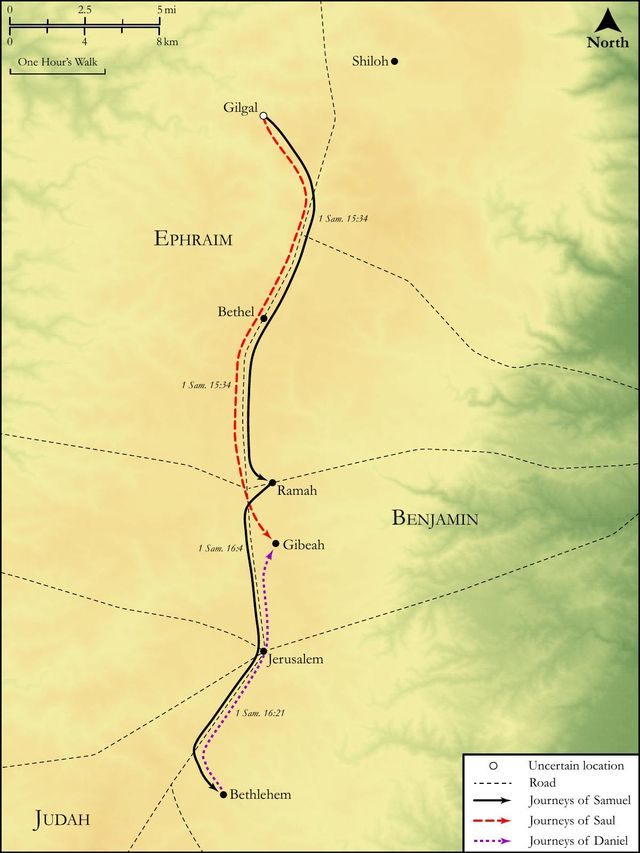
See on the biblical-era map
Study this verse
Public-domain commentary
Matthew Henry
From his Commentary on the Whole Bible. Henry comments on passages, not single verses — this entry covers 1 Samuel 16:1–5. His two-level outline is real structure in the source text, so it is rendered as structure.
Samuel had retired to his own house in Ramah, with a resolution not to appear any more in public business, but to addict himself wholly to the instructing and training up of the sons of the prophets, over whom he presided, as we find, Sa1 19:20. He promised himself more satisfaction in young prophets than in young princes; and we do not find that, to his dying day, God called him out to any public action relating to the state, but only here to anoint David.
I.God reproves him for continuing so long to mourn for the rejection of Saul.
He does not blame him for mourning on that occasion, but for exceeding in his sorrow: How long wilt thou mourn for Saul? Sa1 16:1. We do not find here that he mourned at all for the setting aside of his own family and the deposing of his own sons; but for the rejecting of Saul and his seed he mourns without measure, for the former was done by the people's foolish discontent, this by the righteous wrath of God. Yet he must find time to recover himself, and not go mourning to his grave,
1.Because God has rejected him, and he ought to acquiesce in the divine justice, and forget his affection to Saul; if God will be glorified in his ruin, Samuel ought to be satisfied. Besides, to what purpose should he weep? The decree has gone forth, and all his prayers and tears cannot prevail for the reversing of it, Sa2 12:22, Sa2 12:23.
2.Because Israel shall be no loser by it, and Samuel must prefer the public welfare before his own private affection to his friend. "Mourn not for Saul, for I have provided me a king. The people provided themselves a king and he proved bad, now I will provide myself one, a man after my own heart." See Psa 89:20; Act 13:22. "If Saul be rejected, yet Israel shall not be as sheep having no shepherd. I have another in store for them; let thy joy of him swallow up thy grief for the rejected prince."
II.He sends him to Bethlehem, to anoint one of the sons of Jesse, a person probably not unknown to Samuel.
Fill thy horn with oil. Saul was anointed with a glass vial of oil, scanty and brittle, David with a horn of oil, which was more plentiful and durable; hence we read of a horn of salvation in the house of his servant David, Luk 1:69.
III.Samuel objects the peril of going on this errand (Sa1 16:2): If Saul hear it, he will kill me. By this it appears.
1.That Saul had grown very wicked and outrageous since his rejection, else Samuel would not have mentioned this. What impiety would he not be guilty of who durst kill Samuel?
2.That Samuel's faith was not so strong as one would have expected, else he would not have thus feared the rage of Saul. Would not he that sent him protect him and bear him out? But the best men are not perfect in their faith, nor will fear be wholly cast out any where on this side heaven. But this may be understood as Samuel's desire of direction from heaven how to manage this matter prudently, so as not to expose himself, or any other, more than needed.
IV.God orders him to cover his design with a sacrifice:
Say, I have come to sacrifice; and it was true he did, and it was proper that he should, when he came to anoint a king, Sa1 11:15. As a prophet, he might sacrifice when and where God appointed him; and it was not all inconsistent with the laws of truth to say he came to sacrifice when really he did so, thought he had also a further end, which he thought fit to conceal. Let him give notice of a sacrifice, and invite Jesse (who, it is probable, was the principal man of the city) and his family to come to the feast upon the sacrifice; and, says God, I will show thee what thou shalt do. Those that go about God's work in God's way shall be directed step by step, wherever they are at a loss, to do it in the best manner.
V.Samuel went accordingly to Bethlehem, not in pomp, or with any retinue, only a servant to lead the heifer which he was to sacrifice; yet the elders of Bethlehem trembled at his coming, fearing it was an indication of God's displeasure against them and that he came to denounce some judgment for the iniquities of the place. Guilt causes fear. Yet indeed it becomes us to stand in awe of God's messengers, and to tremble at his word. Or they feared it might be an occasion of Saul's displeasure against them, for probably they knew how much he was exasperated at Samuel, and feared he would pick a quarrel with them for entertaining him. They asked him, "Comest thou peaceably? Art thou in peace thyself, and not flying from Saul? Art thou at peace with us, and not come with any message of wrath?" We should all covet earnestly to stand upon good terms with God's prophets, and dread having the word of God, or their prayers, against us. When the Son of David was born king of the Jews all Jerusalem was troubled, Mat 2:3. Samuel kept at home, and it was a strange thing to see him so far from his own house: they therefore concluded it must needs be some extraordinary occasion that brought him, and feared the worst till he satisfied them (Sa1 16:5): "I come peaceably, for I come to sacrifice, not with a message of wrath against you, but with the methods of peace and reconciliation; and therefore you may bid me welcome and need not fear my coming; therefore sanctify yourselves, and prepare to join with me in the sacrifice, that you may have the benefit of it." Note, Before solemn ordinances there must be a solemn protestation. When we are to offer spiritual sacrifices it concerns us, by sequestering ourselves from the world and renewing the dedication of ourselves to God, to sanctify ourselves. When our Lord Jesus came into the world, though men had reason enough to tremble, fearing that his errand was to condemn the world, yet he gave full assurance that he came peaceably, for he came to sacrifice, and he brought his offering along with him: A body hast thou prepared me. Let us sanctify ourselves, that we may have an interest in his sacrifice. Note, Those that come to sacrifice should come peaceably; religious exercises must not be performed tumultuously.
VI.He had a particular regard to Jesse and his sons, for with them his private business lay, with which, it is likely, he acquainted Jesse at his first coming, and took up his lodging at his house. He spoke to all the elders to sanctify themselves, but he sanctified Jesse and his sons by praying with them and instructing them. Perhaps he had acquaintance with them before, and it appears (Sa1 20:29, where we read of the sacrifices that family had) that it was a devout religious family. Samuel assisted them in their family preparations for the public sacrifice, and, it is probable, chose out David, and anointed him, at the family-solemnities, before the sacrifice was offered or the holy feast solemnized. Perhaps he offered private sacrifices, like Job, according to the number of them all (Job 1:5), and, under colour of that, called for them all to appear before him. When signal blessings are coming into a family they ought to sanctify themselves.
Historical interpretation
Historical reception
1 surviving comment on this verse from the historical church.
And he came to Bethlehem, etc. When the prophecies about Christ arose in the world from the prophets, those who were more prudent, meeting the same prophets with a devout mind, already deemed their words worthy of a miracle, and with eager intention inquired whether these same oracles of the prophets signaled peace to come to the ages; or if they were going to impose an unbearable yoke similar to the Mosaic Law upon the necks of the disciples. And the prophets answered, and each of them proclaimed in their books, that they were sent to the city by God to bear witness to the one who was to come to reconcile the earthly with the heavenly; and after the long discriminations of enmity that human iniquity deserved, to reconcile the world to God through the venerable mysteries of His blood. This can be understood in the same manner about John, because the people, admiring his life and doctrine, thought he was Christ, and inquired deeply about his situation. But he testified that he was announcing peace to come to the earth,
Continue studying 1 Samuel 16:4 across the web’s major study libraries — every link below opens this exact verse, chapter, or book on the destination site.
Read & Compare
 BibleGatewayThis verse in more than 200 translations and 70 languages.
 Bible.comThe YouVersion reader — hundreds of translations, reading plans, and highlights.
 ESV.orgCrossway's official English Standard Version reader.
 NET BibleThe NET translation with 60,000+ translators' notes on every rendering decision.
 STEP BibleTyndale House's free study tool — original text, vocabulary, and scholarly resources.
 BibliaLogos Bible Software's free web reader.
 USCCBThe New American Bible (Revised Edition) with the U.S. bishops' study notes.
Commentaries
 BibleHub CommentariesDozens of classic commentaries on this verse, gathered on one page.
 StudyLightMore than 100 commentary sets — the largest collection on the web.
 BibleRefPlain-English commentary on what this verse means, verse by verse.
 Enduring WordDavid Guzik's free commentary on this chapter, widely used by Bible teachers.
 Bible Study ToolsVerse commentary alongside Greek and Hebrew study aids.
Original Language & Research
- BibleHub InterlinearThe verse word by word — original language, transliteration, and English.
- BibleHub LexiconEvery word's original-language definition and Strong's entry.
 Blue Letter BibleDeep-study tools — Strong's numbers, concordance, and word studies.
 SefariaThe Hebrew text with Rashi and centuries of Jewish commentary.
Sermons, Hymns & Audio


TrulyRandomVerse is not affiliated with these sites and doesn’t control their content. They’re linked because they’re genuinely useful.
Summary
Samuel's arrival in Bethlehem, as recorded in 1 Samuel 16:4, records the immediate and faithful obedience of the prophet Samuel to the Lord's command to journey to Bethlehem. Upon his unexpected arrival, the elders of the town are seized with profound fear and apprehension, questioning the very nature of his visit and whether it portends peace or judgment. This pivotal moment not only highlights Samuel's unwavering commitment to divine instruction but also underscores the awe and trepidation inspired by a prophet of God, all while setting the stage for the sovereign and often concealed unfolding of God's redemptive plan to anoint a new king for Israel.
Context
ShowHideLiterary Context
This verse is a direct continuation of the narrative flow initiated by God's definitive rejection of King Saul due to his persistent disobedience, particularly his failure to carry out the divine command regarding the Amalekites 1 Samuel 15:23. Following this, the Lord instructs a grieving Samuel to cease mourning for Saul and instead to prepare for a new mission: to go to Bethlehem with a horn of oil, for God has chosen a king from among Jesse's sons 1 Samuel 16:1. Samuel expresses a very real fear of Saul's violent reaction should he discover the true purpose of the journey. In response, God provides a strategic cover story, instructing Samuel to take a heifer for a sacrifice and to invite Jesse and his sons to it 1 Samuel 16:2-3. Verse 4 then depicts Samuel's immediate and unwavering obedience to this divine directive, marking the physical commencement of his journey to Bethlehem and setting the stage for the dramatic anointing of David.
Historical & Cultural Context
In ancient Israel, prophets like Samuel wielded immense spiritual, moral, and often political authority, serving as God's direct spokespersons. Their unannounced arrival in a town was rarely a casual event; it typically signaled a momentous divine message, which could be one of blessing, instruction, or, more frequently, a pronouncement of judgment for communal or individual sin. This inherent uncertainty naturally generated significant apprehension among the populace, as a prophet's visit often carried profound implications for the community's well-being. Bethlehem, a relatively small Judean town, was not a major administrative or religious center at this time, making Samuel's presence there particularly unusual and attention-grabbing. The town's elders, as the local civic and spiritual leaders, would have been acutely aware of the spiritual weight of a prophet's presence and the potential for divine reckoning, hence their trembling. This setting also subtly foreshadows Bethlehem's future significance as the hometown of King David Ruth 4:17 and, centuries later, as the prophesied birthplace of the Messiah Micah 5:2.
Key Themes
ShowHideSeveral profound themes emerge from this verse and its immediate context. Divine Obedience stands paramount, as Samuel, despite his initial and understandable fear of King Saul, immediately "did that which the LORD spake," demonstrating an unwavering commitment to God's will above personal safety. This highlights the critical importance of obedience, even when the path is uncertain or fraught with danger. The Prophetic Authority and Awe surrounding Samuel is vividly portrayed in the elders' "trembling," signifying the deep respect, reverence, and even fear associated with a prophet of his stature, whose very presence implied a significant divine intervention. Furthermore, the elders' anxious question, "Comest thou peaceably?" reveals a deep-seated Fear of Judgment, as prophets were often the bearers of divine wrath or calls to communal repentance for sin. Finally, the Hidden Purpose of Samuel's visit—to anoint Israel's future king, David 1 Samuel 16:13—remains entirely concealed from the elders, underscoring God's sovereign and often mysterious ways of working behind the scenes to accomplish His redemptive plans, often through humble and unexpected means.
Exposition and Analysis
ShowHideKey Word Analysis
ShowHideThe Hebrew verb חָרַד (chârad) denotes a profound, inward fear, anxiety, or dread, frequently accompanied by physical trembling or agitation. It conveys a stronger sense than mere surprise or apprehension, suggesting the elders were deeply disturbed and genuinely terrified. In this context, it indicates that Samuel's unexpected and unannounced arrival portended something momentous and potentially ominous, likely a message of judgment or impending calamity, rather than a benign visit.
The Hebrew word שָׁלֹום (shâlôwm), here used adverbially as "in peace" (בְּשָׁלֹום), is far more than a simple greeting. It represents a comprehensive state of well-being, wholeness, prosperity, and reconciliation. The elders' question is a profound inquiry into the nature and intent of Samuel's mission: does his visit signify divine favor, health, and harmonious relations, or does it herald conflict, judgment, or trouble? It reflects their acute awareness that a prophet's visit could bring either blessing or curse, and their immediate concern was to ascertain the purpose of his presence.
Verse Breakdown
ShowHide"And Samuel did that which the LORD spake"
This opening clause immediately establishes Samuel's unwavering faithfulness and prompt obedience to God's specific and potentially dangerous instructions outlined in 1 Samuel 16:1-3. Despite his initial apprehension regarding King Saul's reaction, Samuel prioritizes divine command over personal fear, demonstrating a foundational characteristic of a true servant of God.
"and came to Bethlehem."
This concise statement marks the physical culmination of Samuel's journey and the precise geographical location where God's sovereign plan for a new king would begin to unfold. Bethlehem, a seemingly insignificant Judean town, is divinely chosen as the stage for a pivotal moment in Israelite history, highlighting God's consistent pattern of working through humble and often overlooked beginnings.
"And the elders of the town trembled at his coming"
The visceral reaction of Bethlehem's elders underscores the immense spiritual authority and the potential for direct divine intervention associated with a prophet of Samuel's stature. Their "trembling" (from chârad) signifies a deep-seated fear and apprehension, indicating that they immediately perceived his arrival as a momentous, potentially ominous, event rather than a routine or casual visit.
"and said, Comest thou peaceably?"
This direct question, posed by the fearful elders, reveals their primary concern: the very nature and intent of Samuel's mission. They are not merely inquiring about his physical well-being, but whether his presence signifies a message of peace, blessing, and divine favor, or one of judgment, conflict, and trouble. It reflects the common understanding in ancient Israel that a prophet's visit often brought a divine reckoning or a call to account.
Literary Devices
ShowHideThe verse effectively employs several significant literary devices. Foreshadowing is prominently featured in the specific choice of Bethlehem, a relatively small and unassuming town that would later gain immense historical and theological significance as the birthplace of both Israel's greatest king, David, and ultimately, the Messiah. The elders' palpable fear, while rooted in their immediate socio-religious context, also subtly foreshadows the awe, apprehension, and often mixed reactions that God's messengers and divine interventions frequently evoke throughout biblical history. There is a strong element of Irony present: Samuel comes not to bring judgment or calamity (as the elders fear), but to initiate the anointing of a king who will usher in an era of blessing, stability, and divine favor for Israel, though this profound, redemptive purpose is entirely hidden from the elders at this moment. The elders' question, "Comest thou peaceably?", also functions as a form of Rhetorical Question, designed not merely for information but to elicit a specific reassurance, thereby highlighting their profound anxiety and the perceived gravity of Samuel's unexpected presence.
Theological and Thematic Connections
ShowHideThis passage profoundly illustrates the tension between human fear and divine sovereignty, serving as a powerful testament to God's orchestrating hand in history. Samuel's immediate and faithful obedience, even in the face of genuine fear, serves as a compelling model for all believers, calling us to trust and act upon God's word regardless of perceived risks or personal discomfort. The elders' trembling underscores the appropriate awe and reverence due to God's messengers and, by extension, to God Himself, reminding us of the gravity of His holiness and authority. Their anxious question about "peace" reflects a universal human desire for security, well-being, and blessing, particularly when confronted with the unknown or the manifest presence of the divine. The hidden nature of Samuel's true mission—to anoint a king—reminds us that God often works in ways that are not immediately discernible or understandable to human eyes, orchestrating events behind the scenes to fulfill His greater redemptive purposes. This divine mystery cultivates humility and profound dependence on God's perfect timing and unfathomable wisdom.
Reflection and Application
ShowHideThe scene in Bethlehem challenges us to deeply consider our own responses when God's sovereign hand moves in unexpected or seemingly unsettling ways in our lives. Like Samuel, are we willing to step out in courageous obedience to God's directives, even when they involve personal risk, uncertainty, or require us to move beyond our comfort zones? His unwavering faithfulness, despite his genuine fear of Saul, serves as a powerful model for trusting God's provision and protection when called to difficult or counter-intuitive tasks. Furthermore, the elders' apprehension invites us to reflect on our own posture before the living God. Do we approach His presence with a healthy reverence and awe, recognizing the gravity of His holiness and the transformative potential of His work in our lives? Or do we, perhaps, take His presence for granted, or only seek Him when we desire comfort? This narrative also profoundly encourages us to trust in God's sovereign and often veiled plan, even when its full scope and ultimate purpose are hidden from our immediate understanding. Just as Bethlehem's elders were entirely unaware of the world-changing purpose behind Samuel's visit, we too may not always grasp the deeper meaning or ultimate outcome of God's work in our personal lives or in the broader world. Our call is to remain obedient, watchful, and to trust implicitly that God is always working for His glory and our ultimate good, often in ways far grander and more intricate than we can possibly imagine.
Questions for Reflection
ShowHideFAQ
ShowHideWhy were the elders of Bethlehem so afraid of Samuel's arrival?
ShowHideThe elders' profound fear stemmed directly from the significant role and immense authority of prophets in ancient Israel. Prophets were not merely religious figures; they were understood to be direct, authoritative messengers of God, often tasked with delivering messages of judgment, rebuke, or a call to national repentance. Samuel, in particular, was a highly respected, powerful, and long-serving prophet who had judged Israel for decades and had been instrumental in anointing and later rejecting King Saul. His unexpected and unannounced arrival in a relatively small town like Bethlehem, without a clear public purpose, would naturally lead the elders to assume he was there to address some specific sin or to pronounce divine judgment upon their community. Their anxious question, "Comest thou peaceably?" 1 Samuel 16:4, highlights their immediate and pressing concern about the true nature of his mission—was it for blessing and peace, or for condemnation and trouble?
Why did God instruct Samuel to use a "cover story" about a sacrifice?
ShowHideGod instructed Samuel to take a heifer for a sacrifice and to invite Jesse and his sons to the sacrifice as a strategic and divinely provided measure to protect Samuel from King Saul. Samuel had expressed a legitimate fear, stating, "If Saul hear it, he will kill me" 1 Samuel 16:2. King Saul was by this point consumed by increasing paranoia, jealousy, and a volatile temperament, especially after his rejection by God. If he were to discover that Samuel was on a mission to anoint a new king, he would undoubtedly seek to eliminate both Samuel and the chosen successor. The instruction to offer a sacrifice provided a legitimate, common, and entirely plausible reason for a prophet to visit a town, thereby diverting suspicion and allowing God's sovereign plan for the anointing of David to unfold discreetly and safely. This demonstrates God's practical care for His servant and His meticulous orchestration of events to achieve His purposes.
Christ-Centered Fulfillment
ShowHideThe narrative of Samuel's fearful yet obedient journey to Bethlehem, culminating in the hidden anointing of David, finds profound Christ-centered fulfillment in the person and work of Jesus Christ. Bethlehem, the seemingly insignificant town where Israel's greatest king was chosen, becomes the prophesied birthplace of the ultimate King, the Messiah Micah 5:2. Just as Samuel's true, world-altering mission was veiled from the elders, Jesus' first coming was marked by profound humility and relative obscurity, His divine kingship hidden from the world's powerful, arriving not with fanfare or earthly might but as a vulnerable baby in a manger Luke 2:7. The elders' anxious question, "Comest thou peaceably?", resonates deeply with the reality of Jesus' arrival: He indeed came "peaceably," not to condemn the world but to save it John 3:17, bringing the ultimate and eternal peace between a holy God and sinful humanity through His atoning sacrifice on the cross Colossians 1:20. Yet, His presence also brought a spiritual division and judgment for those who rejected Him Luke 12:51, fulfilling the prophetic dual nature of a divine messenger. Ultimately, the anointing of David in Bethlehem by Samuel foreshadows the anointing of Jesus, the true Son of David, by the Holy Spirit, who is the Lamb of God who takes away the sin of the world John 1:29, establishing an eternal kingdom of righteousness and everlasting peace that will never end.