


1 Samuel 16:2
Bible text: King James Version (1769 Blayney text) · Public domain
Bible text: King James Version with Strong's numbers · Public domain
Bible text: Berean Standard Bible · Public domain
Bible text: American Standard Version (1901) · Public domain
Bible text: World English Bible, Messianic edition · Public domain
Bible text: Geneva Bible (1599) · Public domain
Bible text: Young's Literal Translation · Public domain
- וַיֹּאמֶרvai·Yo·merand he saidH559Conj-w ¦ V-Qal-ConsecImperf-3msVerb Qal Consecutive Imperfect 3rd Singular Masculineוַandיֹּאמֶרhe said
- שְׁמוּאֵלshe·mu·'ElSamuelH8050N-proper-mNoun Proper Masculine
- אֵיךְ'eikhhow?H349InterrogParticle Interrogative
- אֵלֵךְ'e·Lekhwill I goH1980V-Qal-Imperf-1csVerb Qal Imperfect 1st Singular common gender
- וְשָׁמַעve·sha·Ma'and he will hearH8085Conj-w ¦ V-Qal-ConsecPerf-3msVerb Qal Consecutive Perfect 3rd Singular Masculineוְandשָׁמַעhe will hear
- שָׁאוּלsha·'UlSaulH7586N-proper-mNoun Proper Masculine
- וַהֲרָגָנִיva·ha·ra·Ga·niand he will kill meH2026Conj-w ¦ V-Qal-ConsecPerf-3ms ¦ 1csVerb Qal Consecutive Perfect 3rd Singular Masculineוַandהֲרָגָhe will killנִיme
- וַיֹּאמֶרvai·Yo·merand he saidH559Conj-w ¦ V-Qal-ConsecImperf-3msVerb Qal Consecutive Imperfect 3rd Singular Masculineוַandיֹּאמֶרhe said
- יְהוָהYah·wehYahwehH3068N-properNoun Proper Title
- עֶגְלַת'eg·Lata heifer ofH5697N-fscNoun Singular Feminine Construct
- בָּקָרba·KarcattleH1241N-csNoun Singular common gender Absolute
- תִּקַּחti·Kachyou will takeH3947V-Qal-Imperf-2msVerb Qal Imperfect 2nd Singular Masculine
- בְּיָדֶךָbe·ya·De·khain your handH3027Prep-b ¦ N-csc ¦ 2msNoun Singular common gender Constructבְּinיָדֶhandךָyour
- וְאָמַרְתָּve·'A·mar·taand you will sayH559Conj-w ¦ V-Qal-ConsecPerf-2msVerb Qal Consecutive Perfect 2nd Singular Masculineוְandאָמַרְתָּyou will say
- לִזְבֹּחַliz·Bo·achto sacrificeH2076Prep-l ¦ V-Qal-InfVerb Qal Infinitive Constructלִtoזְבֹּחַsacrifice
- לַיהוָהla·Yah·wehto YahwehH3068Prep-l ¦ N-properNoun Proper TitleלַtoיהוָהYahweh
- בָּאתִיBa·tiI have comeH935V-Qal-Perf-1csVerb Qal Perfect 1st Singular common gender
English is a literal word-by-word gloss of the Hebrew, not the KJV's wording. Why?
This is the original text the KJV's translators worked from — each Hebrew word with its own literal English meaning in this verse, prepared by scholars at Tyndale House, Cambridge. The KJV translates whole sentences, not word by word, so its wording differs: one Hebrew word can become several English words, and the KJV may choose “the LORD” where the gloss reads “Yahweh”. Both are faithful — they answer different questions. For the KJV's own rendering, switch to the KJV text.
Details
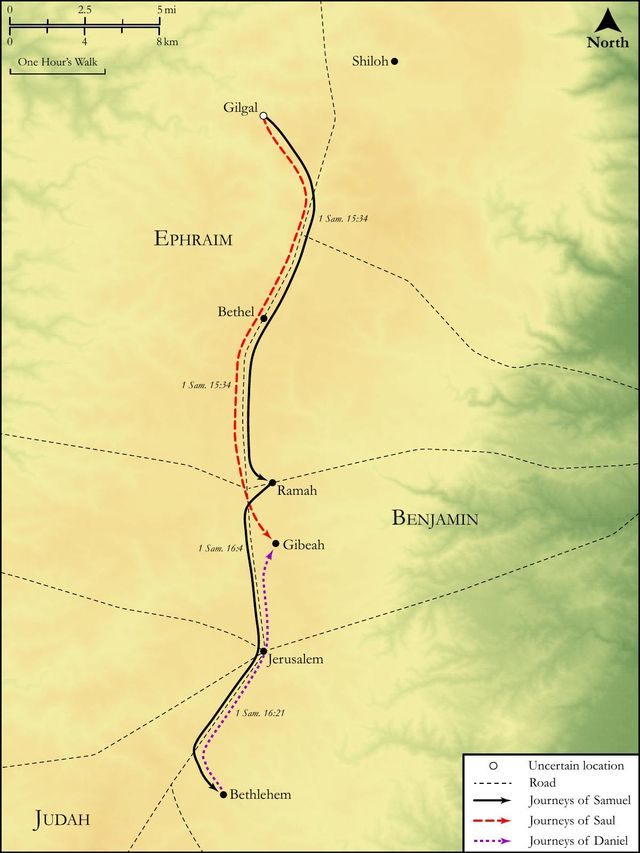
See on the biblical-era map
Study this verse
Public-domain commentary
Matthew Henry
From his Commentary on the Whole Bible. Henry comments on passages, not single verses — this entry covers 1 Samuel 16:1–5. His two-level outline is real structure in the source text, so it is rendered as structure.
Samuel had retired to his own house in Ramah, with a resolution not to appear any more in public business, but to addict himself wholly to the instructing and training up of the sons of the prophets, over whom he presided, as we find, Sa1 19:20. He promised himself more satisfaction in young prophets than in young princes; and we do not find that, to his dying day, God called him out to any public action relating to the state, but only here to anoint David.
I.God reproves him for continuing so long to mourn for the rejection of Saul.
He does not blame him for mourning on that occasion, but for exceeding in his sorrow: How long wilt thou mourn for Saul? Sa1 16:1. We do not find here that he mourned at all for the setting aside of his own family and the deposing of his own sons; but for the rejecting of Saul and his seed he mourns without measure, for the former was done by the people's foolish discontent, this by the righteous wrath of God. Yet he must find time to recover himself, and not go mourning to his grave,
1.Because God has rejected him, and he ought to acquiesce in the divine justice, and forget his affection to Saul; if God will be glorified in his ruin, Samuel ought to be satisfied. Besides, to what purpose should he weep? The decree has gone forth, and all his prayers and tears cannot prevail for the reversing of it, Sa2 12:22, Sa2 12:23.
2.Because Israel shall be no loser by it, and Samuel must prefer the public welfare before his own private affection to his friend. "Mourn not for Saul, for I have provided me a king. The people provided themselves a king and he proved bad, now I will provide myself one, a man after my own heart." See Psa 89:20; Act 13:22. "If Saul be rejected, yet Israel shall not be as sheep having no shepherd. I have another in store for them; let thy joy of him swallow up thy grief for the rejected prince."
II.He sends him to Bethlehem, to anoint one of the sons of Jesse, a person probably not unknown to Samuel.
Fill thy horn with oil. Saul was anointed with a glass vial of oil, scanty and brittle, David with a horn of oil, which was more plentiful and durable; hence we read of a horn of salvation in the house of his servant David, Luk 1:69.
III.Samuel objects the peril of going on this errand (Sa1 16:2): If Saul hear it, he will kill me. By this it appears.
1.That Saul had grown very wicked and outrageous since his rejection, else Samuel would not have mentioned this. What impiety would he not be guilty of who durst kill Samuel?
2.That Samuel's faith was not so strong as one would have expected, else he would not have thus feared the rage of Saul. Would not he that sent him protect him and bear him out? But the best men are not perfect in their faith, nor will fear be wholly cast out any where on this side heaven. But this may be understood as Samuel's desire of direction from heaven how to manage this matter prudently, so as not to expose himself, or any other, more than needed.
IV.God orders him to cover his design with a sacrifice:
Say, I have come to sacrifice; and it was true he did, and it was proper that he should, when he came to anoint a king, Sa1 11:15. As a prophet, he might sacrifice when and where God appointed him; and it was not all inconsistent with the laws of truth to say he came to sacrifice when really he did so, thought he had also a further end, which he thought fit to conceal. Let him give notice of a sacrifice, and invite Jesse (who, it is probable, was the principal man of the city) and his family to come to the feast upon the sacrifice; and, says God, I will show thee what thou shalt do. Those that go about God's work in God's way shall be directed step by step, wherever they are at a loss, to do it in the best manner.
V.Samuel went accordingly to Bethlehem, not in pomp, or with any retinue, only a servant to lead the heifer which he was to sacrifice; yet the elders of Bethlehem trembled at his coming, fearing it was an indication of God's displeasure against them and that he came to denounce some judgment for the iniquities of the place. Guilt causes fear. Yet indeed it becomes us to stand in awe of God's messengers, and to tremble at his word. Or they feared it might be an occasion of Saul's displeasure against them, for probably they knew how much he was exasperated at Samuel, and feared he would pick a quarrel with them for entertaining him. They asked him, "Comest thou peaceably? Art thou in peace thyself, and not flying from Saul? Art thou at peace with us, and not come with any message of wrath?" We should all covet earnestly to stand upon good terms with God's prophets, and dread having the word of God, or their prayers, against us. When the Son of David was born king of the Jews all Jerusalem was troubled, Mat 2:3. Samuel kept at home, and it was a strange thing to see him so far from his own house: they therefore concluded it must needs be some extraordinary occasion that brought him, and feared the worst till he satisfied them (Sa1 16:5): "I come peaceably, for I come to sacrifice, not with a message of wrath against you, but with the methods of peace and reconciliation; and therefore you may bid me welcome and need not fear my coming; therefore sanctify yourselves, and prepare to join with me in the sacrifice, that you may have the benefit of it." Note, Before solemn ordinances there must be a solemn protestation. When we are to offer spiritual sacrifices it concerns us, by sequestering ourselves from the world and renewing the dedication of ourselves to God, to sanctify ourselves. When our Lord Jesus came into the world, though men had reason enough to tremble, fearing that his errand was to condemn the world, yet he gave full assurance that he came peaceably, for he came to sacrifice, and he brought his offering along with him: A body hast thou prepared me. Let us sanctify ourselves, that we may have an interest in his sacrifice. Note, Those that come to sacrifice should come peaceably; religious exercises must not be performed tumultuously.
VI.He had a particular regard to Jesse and his sons, for with them his private business lay, with which, it is likely, he acquainted Jesse at his first coming, and took up his lodging at his house. He spoke to all the elders to sanctify themselves, but he sanctified Jesse and his sons by praying with them and instructing them. Perhaps he had acquaintance with them before, and it appears (Sa1 20:29, where we read of the sacrifices that family had) that it was a devout religious family. Samuel assisted them in their family preparations for the public sacrifice, and, it is probable, chose out David, and anointed him, at the family-solemnities, before the sacrifice was offered or the holy feast solemnized. Perhaps he offered private sacrifices, like Job, according to the number of them all (Job 1:5), and, under colour of that, called for them all to appear before him. When signal blessings are coming into a family they ought to sanctify themselves.
Historical interpretation
Historical reception
1 surviving comment on this verse from the historical church.
And Samuel said: How shall I go? etc. The prophets said to the Lord, and the apostles said: How can we preach the kingdom of the New Testament? For the zealous Jews of the law will hear and kill us. Which of the prophets did they not persecute? They killed those who foretold the coming of Christ. To whom the Lord responding, commanded that his body, separated from the conversation of the people, be taken up by the hand of stricter continence, and worn ready to embrace death for the Lord, and also to inflame his listeners to undertake the glory of martyrdom, as if commanded to call Isaiah to the sacrifice. For death is never better overcome than when it is endured with divine love. And I, he said, to you, O my prophets, and heralds of the future, not by men but by the infusion of my Spirit, will show what you should say or do, and who, where, or when Christ will come. These can be specially understood of John the Baptist, whom the Jews heard evangelizing about Christ and killed; but he, ready in body and mind for martyrdom, called his listeners to the sacrifice, that is to the baptism of repentance. Not any human teacher, but God Himself showed him what he should do; and having given the sign of the Holy Spirit, he taught to whom he should give the testimony of divinity from all those who he baptized.
Continue studying 1 Samuel 16:2 across the web’s major study libraries — every link below opens this exact verse, chapter, or book on the destination site.
Read & Compare
 BibleGatewayThis verse in more than 200 translations and 70 languages.
 Bible.comThe YouVersion reader — hundreds of translations, reading plans, and highlights.
 ESV.orgCrossway's official English Standard Version reader.
 NET BibleThe NET translation with 60,000+ translators' notes on every rendering decision.
 STEP BibleTyndale House's free study tool — original text, vocabulary, and scholarly resources.
 BibliaLogos Bible Software's free web reader.
 USCCBThe New American Bible (Revised Edition) with the U.S. bishops' study notes.
Commentaries
 BibleHub CommentariesDozens of classic commentaries on this verse, gathered on one page.
 StudyLightMore than 100 commentary sets — the largest collection on the web.
 BibleRefPlain-English commentary on what this verse means, verse by verse.
 Enduring WordDavid Guzik's free commentary on this chapter, widely used by Bible teachers.
 Bible Study ToolsVerse commentary alongside Greek and Hebrew study aids.
Original Language & Research
- BibleHub InterlinearThe verse word by word — original language, transliteration, and English.
- BibleHub LexiconEvery word's original-language definition and Strong's entry.
 Blue Letter BibleDeep-study tools — Strong's numbers, concordance, and word studies.
 SefariaThe Hebrew text with Rashi and centuries of Jewish commentary.
Sermons, Hymns & Audio


TrulyRandomVerse is not affiliated with these sites and doesn’t control their content. They’re linked because they’re genuinely useful.
Summary
1 Samuel 16:2 masterfully encapsulates the tension between Samuel's legitimate human fear and God's sovereign, protective provision. Tasked by the LORD to anoint a new king for Israel in place of the rejected Saul, Samuel expresses profound apprehension, anticipating Saul's violent retribution if his true mission were discovered. In response, God does not rebuke Samuel's fear but provides a divinely sanctioned strategy: Samuel is to take a heifer and declare his journey to Bethlehem is for the purpose of offering a sacrifice, thereby providing a credible and legitimate cover for his dangerous yet crucial assignment.
Context
ShowHideLiterary Context
This pivotal verse follows directly from God's definitive rejection of King Saul due to his persistent disobedience and His subsequent command to Samuel to go to Bethlehem to anoint one of Jesse's sons as the next king of Israel (1 Samuel 16:1). The preceding chapters of 1 Samuel have meticulously chronicled Saul's spiritual decline, his impulsive actions, and his increasing unfitness to lead God's people. The transition of the monarchy from Saul to David is a central theological and narrative thread running through the book, and 1 Samuel 16 marks the critical moment when God's chosen successor is identified and divinely empowered. Samuel's expressed fear in this verse is not a sign of weakness but a realistic assessment of the mortal danger inherent in challenging a reigning, volatile monarch, underscoring the high stakes of this divine mandate.
Historical & Cultural Context
In ancient Israel, especially during the nascent monarchy, the transfer of royal power was often a tumultuous and perilous affair, fraught with intrigue and violence. King Saul's reign, particularly in its later stages, was characterized by paranoia and a propensity for extreme violence, as evidenced by his massacre of the priests of Nob (1 Samuel 22:18) and his repeated, desperate attempts on David's life, even extending to his own son, Jonathan (1 Samuel 20:33). Prophets like Samuel, while possessing immense spiritual authority and influence, were not immune to the wrath of a despotic king. The practice of offering sacrifices was a deeply ingrained and legitimate religious activity in Israelite society, integral to their covenant relationship with God. This widespread and accepted religious custom provided a perfect, inconspicuous public pretext for Samuel's journey to Bethlehem, a small Judean town that would later become renowned as the birthplace of King David and, ultimately, the Messiah.
Key Themes
ShowHideThe exchange between Samuel and the LORD in 1 Samuel 16:2 illuminates several profound theological and practical themes. Firstly, it highlights Samuel's Human Vulnerability and God's Gracious Provision. Despite decades of intimate communion with God and a distinguished prophetic ministry, Samuel experiences genuine fear when confronted with a life-threatening assignment. God's immediate response is not a rebuke of this fear but a compassionate and practical solution, demonstrating His attentiveness to His servants' needs. Secondly, the verse showcases Divine Wisdom and Strategic Guidance. God's instruction to take a "heifer" and declare a "sacrifice to the LORD" is a divinely orchestrated "cover story." It is not a command to deceive with falsehood, as Samuel would indeed perform a legitimate sacrifice, but rather a wise and discreet means of navigating a politically charged environment to achieve His sovereign purposes. This illustrates God's practical engagement with human realities. Finally, the passage emphasizes Obedience Amidst Peril. Despite his initial apprehension, Samuel is enabled to obey God's command because of the divine provision. This underscores the principle that God often clears the path and equips His servants to fulfill His will, even when the task appears dangerous, demanding both faith and courage.
Exposition and Analysis
ShowHideKey Word Analysis
ShowHideThis term (H5697) specifically denotes a young female bovine, often one that has not yet borne a calf, making it suitable for sacrificial use as it would typically be unblemished. The selection of a heifer for sacrifice was a common and accepted religious practice in ancient Israel, as prescribed in Mosaic Law (e.g., Numbers 19:2). Its presence would lend immediate credibility and religious legitimacy to Samuel's stated purpose for visiting Bethlehem, making his journey appear routine and religiously motivated rather than politically subversive.
This verb (H2026) signifies "to smite with deadly intent," "to murder," or "to slay." Samuel's use of this word reflects his acute awareness of Saul's escalating paranoia and violent tendencies. It indicates that Samuel perceives a very real and immediate mortal threat should Saul discover the true, politically charged nature of his mission to anoint a new king. This word underscores the gravity of Samuel's fear and the genuine danger involved.
This primitive root (H2076) means "to slaughter an animal, usually in sacrifice." In this context, it refers to the act of offering an animal as an act of worship to the LORD. Sacrifices were integral to Israelite religious life, serving various purposes including atonement, thanksgiving, and communion with God. By instructing Samuel to declare his intention to sacrifice, God provides a publicly acceptable and religiously legitimate reason for Samuel's presence in Bethlehem, effectively masking the true, sensitive nature of his mission to anoint a new king.
Verse Breakdown
ShowHide"And Samuel said, How can I go? if Saul hear [it], he will kill me."
This opening clause vividly portrays Samuel's profound and entirely legitimate fear. Having witnessed King Saul's increasingly erratic, violent, and paranoid behavior—including the massacre of priests and attempts on his own son's life—Samuel fully comprehends the mortal danger inherent in anointing a replacement for a reigning, unstable monarch. His question is not an outright refusal of God's command but an honest, vulnerable expression of his human apprehension and a plea for divine guidance on how to navigate such a perilous situation. It highlights the very real risks involved in faithfully serving God in a hostile political environment.
"And the LORD said, Take an heifer with thee, and say, I am come to sacrifice to the LORD."
God's immediate and direct response demonstrates His understanding of Samuel's predicament and His compassionate provision for His servant. The instruction is a divinely sanctioned strategy, providing a plausible, publicly acceptable, and religiously legitimate reason for Samuel's journey to Bethlehem. This is not a command to utter a falsehood, as Samuel would indeed perform a genuine sacrifice; rather, it is a wise and discreet means of concealing the more politically volatile aspect of his mission—the anointing of a new king. This reveals God's practical wisdom in working within human realities and political complexities to achieve His sovereign purposes without unnecessarily exposing His servant to danger.
Literary Devices
ShowHideThe passage effectively employs Dialogue to convey the immediate and urgent interaction between Samuel and God, highlighting Samuel's human fear and God's divine, practical response. The brevity and directness of their exchange underscore the gravity and immediacy of the situation. There is also a subtle yet profound Irony at play: Samuel's legitimate act of worship (offering a sacrifice), which is a common and expected religious duty, serves as a divinely sanctioned cover for a profoundly political and transformative act (anointing a new king). This demonstrates God's ability to use the mundane, the ordinary, and the expected to accomplish the extraordinary and unexpected. Furthermore, the divine instruction can be seen as a clear instance of Divine Provision, where God actively intervenes with wisdom and strategy to protect His servant and enable the fulfillment of His will, even when the path is fraught with danger and requires discreet action.
Theological and Thematic Connections
ShowHideThis passage profoundly illustrates God's sovereign hand actively guiding history, working through human agents despite their fears and limitations. It demonstrates that God's plans are not thwarted by human obstacles, political dangers, or the malevolence of rulers; rather, He provides practical wisdom and the necessary means for His purposes to be accomplished. Samuel's genuine fear is acknowledged and addressed by God, showcasing a divine compassion that meets human vulnerability with strategic and protective provision. This dynamic highlights the tension between divine command and human apprehension, a tension ultimately resolved by God's faithfulness and wisdom. The anointing of David, initiated in this very context, marks a crucial turning point in Israel's history, establishing the lineage through which the Messiah would ultimately come, fulfilling God's covenant promises.
Reflection and Application
ShowHide1 Samuel 16:2 offers profound encouragement and practical insight for believers navigating difficult or dangerous callings in their own lives. Samuel, a seasoned prophet who had walked closely with God for decades, experiences very real and understandable fear, demonstrating that apprehension is a natural human response, even for those deeply committed to God's will. His honest expression of this fear to God is met not with rebuke or condemnation, but with a wise, practical, and protective solution. This teaches us a vital lesson: it is permissible, even healthy, to voice our fears, anxieties, and uncertainties to God, rather than suppressing them. More importantly, it reminds us that God is actively and intimately involved in our circumstances, providing the means, wisdom, and protection necessary to fulfill His purposes for our lives. We are called to trust in His sovereign wisdom, knowing that He often works in ways we might not initially understand, using ordinary means to accomplish extraordinary ends. Our obedience, even when the path seems perilous or requires discretion and strategic action, is foundational to seeing God's will unfold and experiencing His faithful provision.
Questions for Reflection
ShowHideFAQ
ShowHideWas God instructing Samuel to lie to Saul by telling him to say he was going to sacrifice?
ShowHideNo, God was not instructing Samuel to lie in the sense of uttering a falsehood. The text states, "Take an heifer with thee, and say, I am come to sacrifice to the LORD." Samuel genuinely would offer a legitimate sacrifice in Bethlehem, as the narrative confirms he did (1 Samuel 16:3-5). The instruction provides a legitimate, publicly acceptable reason for his journey, which simultaneously conceals the more politically sensitive and dangerous purpose of anointing a new king. This is not deception in the sense of falsehood, but rather a divinely sanctioned act of discretion and wisdom to protect Samuel and ensure the fulfillment of God's plan without needlessly provoking a volatile and paranoid king. It's an example of God's strategic guidance in a dangerous political climate, allowing His servant to operate with truth and prudence, as seen in various biblical narratives where divine purposes are subtly advanced or protected (e.g., Exodus 3:18 or Joshua 2:1-7).
Christ-Centered Fulfillment
ShowHideThe narrative of Samuel's anointing of David, initiated in this verse, profoundly foreshadows the ultimate Anointed One, Jesus Christ. Just as Samuel was sent on a dangerous, discreet mission to anoint God's chosen king, so too was God's ultimate plan of salvation unfolded in a way that often seemed hidden or counter-intuitive to the world. Jesus, the true Son of David, came not with political fanfare or overt displays of power that would immediately provoke opposition, but in humility, his true identity and messianic mission often obscured from those who would oppose him (John 1:10-11). He operated with divine wisdom, knowing when to speak openly and when to use parables or retreat from the crowds to fulfill His Father's will and avoid premature confrontation (Mark 4:11-12). Like Samuel, Jesus faced mortal threats from jealous rulers and religious authorities, yet He resolutely obeyed His Father's command, even to the point of death on the cross, the ultimate sacrifice that truly took away the sin of the world (Philippians 2:8). His anointing was not with oil, but with the Holy Spirit, empowering Him for His messianic mission (Acts 10:38). Thus, Samuel's fearful obedience and God's protective wisdom in 1 Samuel 16:2 point forward to the greater obedience of Christ and the perfect wisdom of God's redemptive plan, which was accomplished through a path of both divine power and strategic humility.