


1 Samuel 9:12
- וַתַּעֲנֶינָהva·ta·'a·Nei·nahand they answeredH6030Conj-w ¦ V-Qal-ConsecImperf-3fpVerb Qal Consecutive Imperfect 3rd Plural Feminineוַandתַּעֲנֶינָהthey answered
- אוֹתָם'o·Tam<obj.> themH853DirObjM ¦ 3mpParticle Object Indicatorאוֹתָ<obj.>םthem
- וַתֹּאמַרְנָהva·to·Mar·nahand they saidH559Conj-w ¦ V-Qal-ConsecImperf-3fpVerb Qal Consecutive Imperfect 3rd Plural Feminineוַandתֹּאמַרְנָהthey said
- יֵּשׁyeshthere isH3426Adj-csAdjective Numerical Singular common gender Absolute
- הִנֵּהhi·Nehthere!H2009PrtParticle Interjection
- לְפָנֶיךָle·fa·Nei·kha<to> before youH6440Prep-l ¦ N-mpc ¦ 2msNoun Plural Masculine Constructלְ<to>פָנֶיbeforeךָyou
- מַהֵרma·HerhurryH4116V-Piel-Imp-2msVerb Piel Imperative 2nd Singular Masculine
- עַתָּה'a·TahnowH6258AdvAdverb
- כִּיkiforH3588PrtParticle Conditional
- הַיּוֹםhai·yOmthis dayH3117Art ¦ N-msNoun Singular Masculine Absoluteהַthisיּוֹםday
- בָּאba'he has comeH935V-Qal-Perf-3msVerb Qal Perfect 3rd Singular Masculine
- לָעִירla·'Irto the cityH5892Prep-l ¦ N-fsNoun Singular Feminine Absoluteלָto theעִירcity
- כִּיkiforH3588PrtParticle Conditional
- זֶבַחZe·vacha sacrificeH2077N-mscNoun Singular Masculine Construct
- הַיּוֹםhai·Yomthis dayH3117Art ¦ N-msNoun Singular Masculine Absoluteהַthisיּוֹםday
- לָעָםla·'Am[belongs] to the peopleH5971Prep-l ¦ N-msNoun Singular Masculine Absoluteלָ[belongs] to theעָםpeople
- בַּבָּמָהba·ba·Mahat the high placeH1116Prep-b ¦ N-fsNoun Singular Feminine Absoluteבַּat theבָּמָהhigh place
English is a literal word-by-word gloss of the Hebrew, not the KJV's wording. Why?
This is the original text the KJV's translators worked from — each Hebrew word with its own literal English meaning in this verse, prepared by scholars at Tyndale House, Cambridge. The KJV translates whole sentences, not word by word, so its wording differs: one Hebrew word can become several English words, and the KJV may choose “the LORD” where the gloss reads “Yahweh”. Both are faithful — they answer different questions. For the KJV's own rendering, switch to the KJV text.
Details
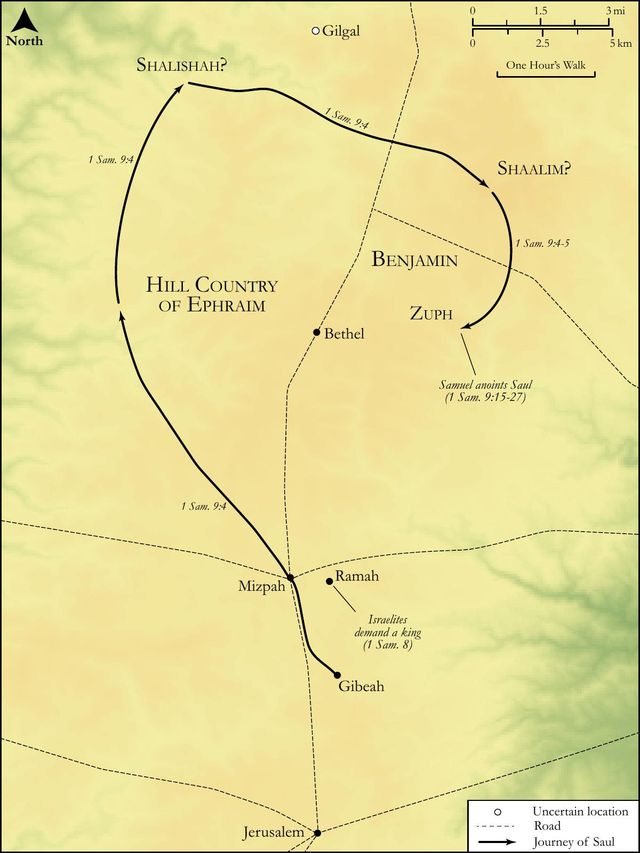
See on the biblical-era map
Study this verse
Public-domain commentary
Matthew Henry
From his Commentary on the Whole Bible. Henry comments on passages, not single verses — this entry covers 1 Samuel 9:11–17. His four-level outline is real structure in the source text, so it is rendered as structure.
Here, I. Saul, by an ordinary enquiry, is directed to Samuel, Sa1 9:11-14. Gibeah of Saul was not twenty miles from Ramah where Samuel dwelt, and was near to Mizpeh where he often judged Israel, and yet, it seems, Saul had lived so very privately, and had taken so little notice of public affairs, that he had never seen Samuel, for when he met him (Sa1 9:18) he did not know him, so that there was no cause to suspect any secret compact or collusion between them in this matter. I knew him not, says John Baptist concerning Christ, Joh 1:31. Yet I do not think it any commendation to Saul that he was a stranger to Samuel. However,
1.The maid-servants of Ramah, whom they met with at the places of drawing water, could give him and his servant intelligence concerning Samuel; and very particular they were in their directions, Sa1 9:12, Sa1 9:13. We should always be ready to give what assistance we can to those that are enquiring after God's prophets, and to further them in their enquiries. Even the maid-servants could tell them,
(1.)That there was a sacrifice that day in the high place, it being either an ordinary festival or an extraordinary day of prayer and thanksgiving, with which sacrifices were joined. The tabernacle being deprived of the ark, the altar there had not now the reputation it formerly had, nor were they confined to it, as they would be when God had again chosen a place to put his name in; and therefore now other places were allowed. Samuel had built an altar at Ramah (Sa1 7:17), and here we have him making use of that altar.
(2.)That Samuel came that day to the city, either from his circuit or from his country seat. He was such a public person that his movements were generally known.
(3.)That this was just the time of their meeting to feast before the Lord upon the sacrifice: "About this time you will find him in the street going up to the high place." They knew the hour of the solemn feast.
(4.)That the people would not eat till Samuel came, not only because he was the worthiest person, and they ought in good manners to stay for him, and he was, as some think, the maker of this feast, the sacrifice being offered at his charge and upon his account; but because, as a man of God, whoever made the feast, he must bless the sacrifice, that is, those parts of the sacrifice which they feasted upon, which may be considered,
[1.]As a common meal, and so this is an instance of the great duty of craving a blessing upon our meat before we partake of it. We cannot expect benefit from our food without that blessing, and we have no reason to expect that blessing if we do not pray for it. Thus we must give glory to God as our benefactor, and own our dependence upon him and our obligations to him. Or,
[2.]As a religious assembly. When the sacrifice was offered, which was the ceremony, Samuel blessed it, that is, he prayed over it, and offered up spiritual sacrifices with it, which were the substance; and afterwards, when the holy duties were performed, they did eat. Let the soul first be served. The feast upon the sacrifice being a sacred rite, it was requisite that it should in a particular manner be blessed, as is the Christian eucharist. They feasted in token of their reconciliation to God by virtue of the sacrifice, and their participation of the benefits of it; and Samuel blessed the feast, that is, he prayed to God to grace the solemnity with his special presence, that it might answer those great ends. Bishop Hall observes what a particular account those maid-servants could give of the usages of those sacred feasts, and infers from it that, "where there is the practice and example of piety in the better sort, there will be a reflection of it upon the meanest. It is no small advantage to live in religious places; for we shall be much to blame if all goodness fall beside us."
2.Saul and his servant followed the directions given them, and very opportunely met Samuel going to the high place, the synagogue of the city, Sa1 9:14. This seemed purely accidental, but the divine providence ordered it for the forwarding of this great event. The wise God serves very great and certain purposes by very small and casual occurrences. A sparrow falls not to the ground without our Father.
II.Samuel, by an extraordinary revelation, is informed concerning Saul. He was a seer, and therefore must see this in a way peculiar to himself.
1.God had told him, the day before, that he would, at this time, send him the man that should serve the people of Israel for such a king as they wished to have, like all the nations, Sa1 9:15, Sa1 9:16. He told him in his ear, that is, privately, by a secret whisper to his mind, or perhaps by a still small voice, some soft and gentle sounds conveyed to his ear, probably when he was praying in secret for direction in that and other affairs of the nation. He had spoken in the ears of the Lord (Sa1 8:21), and now God spoke in his ear, in token of friendship and familiarity, for he revealeth his secret to his servants the prophets, as secrets in their ear, Amo 3:7. God told him before, that it might not be a surprise to him; and perhaps it was in expectation of it that he appointed the feast and the sacrifice, for the imploring of God's blessing upon this great and important affair, though he might keep the particular occasion in his own breast, God having only told it to him in his ear. The Hebrew phrase is, He uncovered the ear of Samuel, to which some allude for the explication of the way of God's revealing himself to us; he not only speaks, but uncovers our ear. We have naturally a covering on our ears, so that we perceive not what God says (Job 33:14), but, when God will manifest himself to a soul, he uncovers the ear, says, Ephphratha, Be opened; he takes the veil from off the heart, Co2 3:16. Though God had, in displeasure, granted their request for a king, yet here he speaks tenderly of Israel; for even in wrath he remembers mercy.
(1.)He calls them again and again his people; though a peevish and provoking people, yet mine still.
(2.)He sends them a man to be captain over them, that they might not be a body without a head, and to save them out of the hand of the Philistines, which perhaps was more than many of them aimed at in desiring a king.
(3.)He does it with a gracious respect to them and to their cry: I have looked upon my people, and their cry has come unto me. He gratified them with what they cried for, as the tender mother humours the froward child, lest it should break its heart. And (as bishop Patrick observes), though he would not hear their cry to relieve them against the oppression of their kings (Sa1 8:18), yet he was so gracious as to make those kings instruments of their deliverance from the oppression of their neighbours, which was more than they had reason to expect.
2.When Saul came up towards him in the street God again whispered Samuel in the ear (Sa1 9:17): Behold the man whom I spoke to thee of! Saul being a man of unusual stature, it is natural to think that Samuel fixed his eye upon him at a distance, and perhaps looked the more wistfully towards him because the hour had now come when God would send him the man that should be king of Israel, and he fancied this might be he; but, that he might be fully satisfied, God told him expressly, That is the man that shall restrain (for magistrates are heirs of restraint) my people Israel.
Historical interpretation
Ten Centuries of Reception
3 surviving comments on this verse. Each one is dated, so this reads as a timeline rather than a list.
Select a marker to jump to its quote. Markers stagger vertically where authors wrote within a few decades of each other.
Those answering said to them: Here he is, behold before you, etc. The simple souls answering to Christ, to whom the conscience of each, whatever they think, is open: Here, they say, is John, taught to see heavenly things, made a forerunner for you, and you hasten to follow him, we ask, to save us; for you are our helper and deliverer, O Lord, do not delay (Psalm 39). For he also today, that is, the preacher of the same grace and faith bright with light as you, came into the world. Because it is the time that all the chosen people may spiritually consecrate to God the sacrifice on the high summit of new conversation; for he himself who stands among us, not yet recognized, after I have wished to manifest you to the world, you will immediately find him prepared for the services of your coming. For neither that man of such great grace, before he has deserved to see you, nor can he ascend to the summits of the highest virtues, nor be refreshed by the perfect feasts of spiritual joy.
A sacrifice: The law did not allow of sacrifices in any other place, but at the tabernacle, or temple, in which the ark of the covenant was kept; but Samuel, by divine dispensation, offered sacrifices in other places. For which dispensation this reason may be alleged, that the house of God in Silo, having lost the ark, was now cast off; as a figure of the reprobation of the Jews, Ps. 77. 60, 67. And in Cariathiarim where the ark was, there was neither tabernacle, nor altar.-- Ibid.
The high place: Excelsum. The excelsa, or high places, so often mentioned in scripture, were places of worship, in which were altars for sacrifice. These were sometimes employed in the service of the true God, as in the present case: but more frequently in the service of idols; and were called excelsa, which is commonly (though perhaps not so accurately) rendered high places; not because they were always upon hills, for the very worst of all, which was that of Topheth, or Geennom, (Jer. 19.) was in a valley; but because of the high altars, and pillars, or monuments, erected there, on which were set up the idols, or images of their deities.
Continue studying 1 Samuel 9:12 across the web’s major study libraries — every link below opens this exact verse, chapter, or book on the destination site.
Read & Compare
 BibleGatewayThis verse in more than 200 translations and 70 languages.
 Bible.comThe YouVersion reader — hundreds of translations, reading plans, and highlights.
 ESV.orgCrossway's official English Standard Version reader.
 NET BibleThe NET translation with 60,000+ translators' notes on every rendering decision.
 STEP BibleTyndale House's free study tool — original text, vocabulary, and scholarly resources.
 BibliaLogos Bible Software's free web reader.
 USCCBThe New American Bible (Revised Edition) with the U.S. bishops' study notes.
Commentaries
 BibleHub CommentariesDozens of classic commentaries on this verse, gathered on one page.
 StudyLightMore than 100 commentary sets — the largest collection on the web.
 BibleRefPlain-English commentary on what this verse means, verse by verse.
 Enduring WordDavid Guzik's free commentary on this chapter, widely used by Bible teachers.
 Bible Study ToolsVerse commentary alongside Greek and Hebrew study aids.
Original Language & Research
- BibleHub InterlinearThe verse word by word — original language, transliteration, and English.
- BibleHub LexiconEvery word's original-language definition and Strong's entry.
 Blue Letter BibleDeep-study tools — Strong's numbers, concordance, and word studies.
 SefariaThe Hebrew text with Rashi and centuries of Jewish commentary.
Sermons, Hymns & Audio


TrulyRandomVerse is not affiliated with these sites and doesn’t control their content. They’re linked because they’re genuinely useful.
Summary
1 Samuel 9:12 captures a pivotal, divinely orchestrated moment where young women confirm the prophet Samuel's presence and the urgency of meeting him to Saul and his servant. This seemingly ordinary exchange, prompted by a search for lost donkeys, is in fact a crucial step in God's meticulous plan to introduce Saul to Samuel, setting the stage for Saul's anointing as Israel's first king and powerfully illustrating God's sovereign guidance in leading individuals toward His purposes through unexpected circumstances.
Context
ShowHideLiterary Context
This verse is strategically placed within the narrative of 1 Samuel 9, serving as the immediate bridge between Saul's mundane search for his father Kish's lost donkeys and his divine appointment with Samuel. The chapter opens with Saul's journey, which leads him far from home, eventually prompting his servant to suggest consulting a "man of God" renowned for his prophetic insight (1 Samuel 9:6-8). As Saul and his servant approach the city, their encounter with these young women drawing water—a common biblical motif for significant encounters (e.g., Genesis 24:10-27 or Exodus 2:15-21)—is perfectly timed. Saul's direct inquiry about the seer's location is met with an equally direct and urgent response in verse 12, immediately preceding his fated meeting with Samuel, whom God had already prepared for Saul's arrival (1 Samuel 9:15-16). This interaction is the divinely engineered mechanism that brings Saul directly into Samuel's path.
Historical & Cultural Context
The setting of 1 Samuel reflects a transitional period in Israelite history, moving from the charismatic leadership of judges to the establishment of a monarchy. Samuel serves as the last judge and a preeminent prophet, acting as God's primary voice to the nation. The mention of a "high place" (Hebrew: bāmâ) is culturally significant. In this early period, prior to the construction of the centralized Temple in Jerusalem, "high places" were often legitimate, local sites for worship, sacrifice, and communal feasts to Yahweh. These were not inherently idolatrous but served as regional altars where people gathered for religious observances. The "sacrifice of the people" implies a communal peace offering or fellowship offering (zevach sh'lamim), which typically concluded with a shared meal, highlighting the social and celebratory dimensions of worship. The urgency conveyed by the young women ("make haste now") indicates that the sacrificial meal was imminent, and Samuel, as the presiding figure, was essential for its commencement. This context illuminates the decentralized nature of Israelite worship before the establishment of a central sanctuary.
Key Themes
ShowHideThe events of 1 Samuel 9, particularly culminating in this verse, powerfully illustrate several profound themes. Divine Providence and Guidance is paramount; what appears to be a series of coincidences—lost donkeys, the servant's timely suggestion, the chance encounter with the young women—is meticulously orchestrated by God to bring Saul to Samuel. This underscores God's sovereign hand in directing human steps, even in seemingly ordinary circumstances, as highlighted in Proverbs 16:9. Another significant theme is Preparation for Leadership, as Saul, completely unaware of his destiny, is being led to his divine appointment as Israel's first king. God had already revealed His plan to Samuel the day before, stating He would send a man from Benjamin to be anointed as leader over His people (1 Samuel 9:16). This moment also offers a valuable glimpse into Israelite Worship Practices during the pre-monarchy period, showcasing the vital role of prophets like Samuel in presiding over communal sacrifices at local altars, which served as crucial centers for both religious devotion and social cohesion.
Exposition and Analysis
ShowHideKey Word Analysis
ShowHideFrom an unused root meaning "to be high," this term refers to an elevation, often a natural hill or an artificial mound, designated for religious worship. While later in Israelite history, bāmôt (plural) became associated with forbidden idolatrous practices and were frequently condemned (e.g., 1 Kings 14:23), in the time of Samuel and the early monarchy, they were often accepted sites for legitimate worship and communal gatherings. Here, it signifies a recognized and legitimate place where Samuel, as a prophet, would lead the community in sacrifice and feasting, underscoring the decentralized nature of worship before the Temple's construction.
Derived from a root meaning "to slaughter," this word properly denotes the flesh of an animal offered, and by implication, the act of sacrifice itself. In this context, it specifically refers to an animal sacrifice that culminates in a communal meal. It is most likely a zevach sh'lamim (peace offering or fellowship offering), where a portion of the animal was offered to God, and the remainder was shared by the worshipers and priests. The "sacrifice of the people" emphasizes the communal aspect, indicating a significant shared meal following the offering, a key social and religious event that explains the urgency for Saul and his servant to arrive before its commencement.
From an unused root meaning "to be hot," this word primarily denotes a day (as the warm hours), whether literal (sunrise to sunset) or figurative (a space of time). Its repetition in the verse ("he came to day to the city; for [there is] a sacrifice of the people to day") emphasizes the immediate and current nature of Samuel's arrival and the communal sacrifice. This temporal specificity highlights the precise timing of Saul's arrival, reinforcing the sense of divine orchestration and the narrow window of opportunity for this crucial encounter.
Verse Breakdown
ShowHide"And they answered them, and said, He is; behold, [he is] before you:"
The young women's response is immediate, direct, and emphatically confirms Samuel's presence in the city. The phrase "He is; behold, he is before you" serves as a powerful affirmation, leaving no room for doubt about the seer's proximity. This directness provides a stark contrast to the uncertainty Saul and his servant had previously experienced in their search, signaling a turning point in their quest.
"make haste now, for he came to day to the city;"
This clause introduces a compelling element of urgency into the narrative. The women explicitly instruct Saul and his servant to hurry, providing the crucial detail that Samuel had only just arrived in the city that very day. This precise timing is critical, implying a narrow window of opportunity to meet him and reinforcing the pervasive sense of divine orchestration at play in Saul's journey.
"for [there is] a sacrifice of the people to day in the high place:"
This final clause provides the fundamental reason for Samuel's presence and the imperative for haste. Samuel is in the city specifically to preside over a communal sacrifice at the local high place. This is not merely a private ritual but a "sacrifice of the people," indicating a significant public event involving the entire community, which would likely be followed by a shared meal. Samuel's central role as the presiding figure underscores his authority and importance as God's representative in that region, making his presence indispensable for the ceremony.
Literary Devices
ShowHideThe narrative of 1 Samuel 9:12 masterfully employs several literary devices to deepen its impact. Irony is profoundly present, as Saul, diligently searching for lost donkeys, is unwittingly led directly to Samuel, who will anoint him as Israel's first king. The women's casual revelation of Samuel's presence and purpose stands in stark contrast to the momentous destiny awaiting Saul, highlighting the divine humor in God's ways. There is also a strong element of Divine Orchestration, as the entire sequence of events, from the lost donkeys to the servant's suggestion and this timely encounter, is clearly guided by God's unseen hand, meticulously preparing Saul for his unexpected calling. The urgency conveyed by the repeated "to day" and the imperative "make haste now" creates Suspense, building anticipation for the divinely appointed meeting between Saul and Samuel. Furthermore, the phrase "behold, he is before you" serves as a powerful form of Foreshadowing, signaling the immediate and impactful encounter that is about to unfold, an encounter that will irrevocably alter the course of Israel's history.
Theological and Thematic Connections
ShowHideThis verse powerfully illustrates the theme of God's meticulous providence, demonstrating how He orchestrates seemingly mundane events and everyday encounters to fulfill His grand sovereign purposes. Saul's journey, initially driven by the simple, earthly task of finding lost donkeys, becomes a divinely guided path leading directly to his anointing as king. This highlights that God is intimately involved in the intricate details of our lives, often working behind the scenes in ways we do not immediately perceive, subtly leading us to our appointed places and tasks. The communal sacrifice mentioned also underscores the importance of corporate worship and the vital role of God's appointed leaders in facilitating spiritual life within the community, even in the absence of a centralized sanctuary, emphasizing the communal nature of faith and devotion.
Reflection and Application
ShowHide1 Samuel 9:12 serves as a profound and comforting reminder that God's plans often unfold in unexpected ways, through ordinary circumstances and seemingly insignificant encounters. We, much like Saul, can become so narrowly focused on our immediate concerns—our "lost donkeys," our daily anxieties, or our personal ambitions—that we inadvertently miss the larger, more profound divine narrative unfolding around us. This verse encourages us to cultivate a posture of spiritual attentiveness and unwavering trust, recognizing that even when our paths seem circuitous, our efforts appear unfruitful, or our circumstances mundane, God is actively working to guide us toward His ultimate purposes. It challenges us to look beyond the surface of our daily lives and prayerfully discern the hand of God at work, trusting that He is sovereignly directing our steps, even when we remain unaware of the grand design. Our most ordinary tasks and encounters can become the very means through which God leads us to our divine appointments, if only we remain open, responsive, and faithful to His subtle guidance.
Questions for Reflection
ShowHideFAQ
ShowHideWhy were "high places" acceptable for worship in Samuel's time but later condemned?
ShowHideIn the early period of Israel's history, before the construction of the centralized Temple in Jerusalem, "high places" (Hebrew: bāmôt) were common and often legitimate sites for worship and sacrifice to Yahweh. They served as local altars where prophets like Samuel could preside over communal offerings, especially in the absence of a central sanctuary. However, over time, these sites became problematic. Many were corrupted by syncretistic practices, where Israelites blended the worship of Yahweh with the worship of Canaanite deities, or they were used for unauthorized and illegitimate forms of worship, often becoming centers of idolatry. Consequently, later biblical texts, particularly in the books of 1 Kings and 2 Kings, and 2 Chronicles, strongly condemn the high places, advocating for a centralized worship system at the Temple in Jerusalem as the sole legitimate place for sacrifice (see Deuteronomy 12:5-14). The mention in 1 Samuel 9:12 reflects the earlier, more decentralized, and often legitimate, worship practices of the time, before their widespread corruption and subsequent condemnation.
Christ-Centered Fulfillment
ShowHideThe seemingly ordinary events of 1 Samuel 9:12, where Saul is providentially guided to Samuel for anointing, find a profound Christ-centered fulfillment in the ultimate King, Jesus. Just as Saul was chosen and anointed to lead Israel, Jesus is the Anointed One, the true and eternal King of Israel and the world, whose kingship is not temporary or flawed like Saul's, but everlasting and perfect (Luke 1:33). The "sacrifice of the people" at the high place, a communal act of worship and atonement, powerfully foreshadows Christ's singular and ultimate sacrifice on the cross. This was not merely a communal meal but the perfect, once-for-all offering of the Lamb of God who takes away the sin of the world. His sacrifice at Calvary, the ultimate "high place," established a new covenant, providing complete atonement for all people and inviting all to partake in the spiritual feast of His salvation (Hebrews 9:26-28). Thus, Saul's journey to a provisional king and a temporary sacrifice ultimately directs our gaze to Jesus, the King of kings, whose perfect life, sacrificial death, and glorious resurrection provide eternal kingship and everlasting fellowship with God.