


1 Samuel 9:11
Bible text: King James Version (1769 Blayney text) · Public domain
Bible text: Berean Standard Bible · Public domain
Bible text: American Standard Version (1901) · Public domain
Bible text: World English Bible, Messianic edition · Public domain
Bible text: Geneva Bible (1599) · Public domain
Bible text: Young's Literal Translation · Public domain
- הֵמָּהHe·mahtheyH1992Pro-3mpPronoun Personal 3rd Plural Masculine
- עֹלִים'o·Lim[were] going upH5927V-Qal-Prtcpl-mpVerb Qal Participle Plural Masculine Absolute
- בְּמַעֲלֵהbe·ma·'a·Lehon [the] ascent ofH4608Prep-b ¦ N-mscNoun Singular Masculine Constructבְּonמַעֲלֵה[the] ascent of
- הָעִירha·'Irthe cityH5892Art ¦ N-fsNoun Singular Feminine Absoluteהָtheעִירcity
- וְהֵמָּהve·He·mahand theyH1992Conj-w ¦ Pro-3mpPronoun Personal 3rd Plural Masculineוְandהֵמָּהthey
- מָצְאוּma·tze·'Uthey foundH4672V-Qal-Perf-3cpVerb Qal Perfect 3rd Plural common gender
- נְעָרוֹתne·'a·Rotyoung womenH5291N-fpNoun Plural Feminine Absolute
- יֹצְאוֹתyo·tze·'otcoming outH3318V-Qal-Prtcpl-fpVerb Qal Participle Plural Feminine Absolute
- לִשְׁאֹבlish·'Oto drawH7579Prep-l ¦ V-Qal-InfVerb Qal Infinitive Constructלִtoשְׁאֹבdraw
- מָיִםMa·yimwaterH4325N-mpNoun Plural Masculine Absolute
- וַיֹּאמְרוּvai·yo·me·Ruand they saidH559Conj-w ¦ V-Qal-ConsecImperf-3mpVerb Qal Consecutive Imperfect 3rd Plural Masculineוַandיֹּאמְרוּthey said
- לָהֶןla·Hento <the> themPrep-l ¦ 3fpSuffix Personal 3rd Plural Feminineלָto <the>הֶןthem
- הֲיֵשׁha·Yesh¿ [is] thereH3426Interrog ¦ Adj-csAdjective Numerical Singular common gender Absoluteהֲ¿יֵשׁ[is] there
- בָּזֶהba·Zehin this [place]H2088Prep-b ¦ PrtParticle Demonstrativeבָּinזֶהthis [place]
- הָרֹאֶהha·ro·'Ehthe seerH7203Art ¦ N-msNoun Singular Masculine Absoluteהָtheרֹאֶהseer
English is a literal word-by-word gloss of the Hebrew, not the KJV's wording. Why?
This is the original text the KJV's translators worked from — each Hebrew word with its own literal English meaning in this verse, prepared by scholars at Tyndale House, Cambridge. The KJV translates whole sentences, not word by word, so its wording differs: one Hebrew word can become several English words, and the KJV may choose “the LORD” where the gloss reads “Yahweh”. Both are faithful — they answer different questions. For the KJV's own rendering, switch to the KJV text.
Details
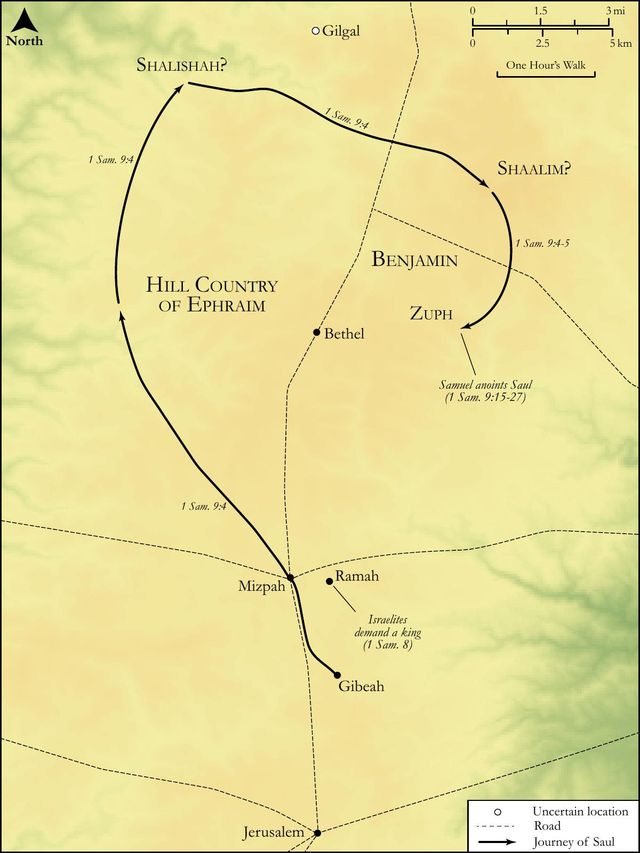
See on the biblical-era map
Study this verse
Public-domain commentary
Matthew Henry
From his Commentary on the Whole Bible. Henry comments on passages, not single verses — this entry covers 1 Samuel 9:11–17. His four-level outline is real structure in the source text, so it is rendered as structure.
Here, I. Saul, by an ordinary enquiry, is directed to Samuel, Sa1 9:11-14. Gibeah of Saul was not twenty miles from Ramah where Samuel dwelt, and was near to Mizpeh where he often judged Israel, and yet, it seems, Saul had lived so very privately, and had taken so little notice of public affairs, that he had never seen Samuel, for when he met him (Sa1 9:18) he did not know him, so that there was no cause to suspect any secret compact or collusion between them in this matter. I knew him not, says John Baptist concerning Christ, Joh 1:31. Yet I do not think it any commendation to Saul that he was a stranger to Samuel. However,
1.The maid-servants of Ramah, whom they met with at the places of drawing water, could give him and his servant intelligence concerning Samuel; and very particular they were in their directions, Sa1 9:12, Sa1 9:13. We should always be ready to give what assistance we can to those that are enquiring after God's prophets, and to further them in their enquiries. Even the maid-servants could tell them,
(1.)That there was a sacrifice that day in the high place, it being either an ordinary festival or an extraordinary day of prayer and thanksgiving, with which sacrifices were joined. The tabernacle being deprived of the ark, the altar there had not now the reputation it formerly had, nor were they confined to it, as they would be when God had again chosen a place to put his name in; and therefore now other places were allowed. Samuel had built an altar at Ramah (Sa1 7:17), and here we have him making use of that altar.
(2.)That Samuel came that day to the city, either from his circuit or from his country seat. He was such a public person that his movements were generally known.
(3.)That this was just the time of their meeting to feast before the Lord upon the sacrifice: "About this time you will find him in the street going up to the high place." They knew the hour of the solemn feast.
(4.)That the people would not eat till Samuel came, not only because he was the worthiest person, and they ought in good manners to stay for him, and he was, as some think, the maker of this feast, the sacrifice being offered at his charge and upon his account; but because, as a man of God, whoever made the feast, he must bless the sacrifice, that is, those parts of the sacrifice which they feasted upon, which may be considered,
[1.]As a common meal, and so this is an instance of the great duty of craving a blessing upon our meat before we partake of it. We cannot expect benefit from our food without that blessing, and we have no reason to expect that blessing if we do not pray for it. Thus we must give glory to God as our benefactor, and own our dependence upon him and our obligations to him. Or,
[2.]As a religious assembly. When the sacrifice was offered, which was the ceremony, Samuel blessed it, that is, he prayed over it, and offered up spiritual sacrifices with it, which were the substance; and afterwards, when the holy duties were performed, they did eat. Let the soul first be served. The feast upon the sacrifice being a sacred rite, it was requisite that it should in a particular manner be blessed, as is the Christian eucharist. They feasted in token of their reconciliation to God by virtue of the sacrifice, and their participation of the benefits of it; and Samuel blessed the feast, that is, he prayed to God to grace the solemnity with his special presence, that it might answer those great ends. Bishop Hall observes what a particular account those maid-servants could give of the usages of those sacred feasts, and infers from it that, "where there is the practice and example of piety in the better sort, there will be a reflection of it upon the meanest. It is no small advantage to live in religious places; for we shall be much to blame if all goodness fall beside us."
2.Saul and his servant followed the directions given them, and very opportunely met Samuel going to the high place, the synagogue of the city, Sa1 9:14. This seemed purely accidental, but the divine providence ordered it for the forwarding of this great event. The wise God serves very great and certain purposes by very small and casual occurrences. A sparrow falls not to the ground without our Father.
II.Samuel, by an extraordinary revelation, is informed concerning Saul. He was a seer, and therefore must see this in a way peculiar to himself.
1.God had told him, the day before, that he would, at this time, send him the man that should serve the people of Israel for such a king as they wished to have, like all the nations, Sa1 9:15, Sa1 9:16. He told him in his ear, that is, privately, by a secret whisper to his mind, or perhaps by a still small voice, some soft and gentle sounds conveyed to his ear, probably when he was praying in secret for direction in that and other affairs of the nation. He had spoken in the ears of the Lord (Sa1 8:21), and now God spoke in his ear, in token of friendship and familiarity, for he revealeth his secret to his servants the prophets, as secrets in their ear, Amo 3:7. God told him before, that it might not be a surprise to him; and perhaps it was in expectation of it that he appointed the feast and the sacrifice, for the imploring of God's blessing upon this great and important affair, though he might keep the particular occasion in his own breast, God having only told it to him in his ear. The Hebrew phrase is, He uncovered the ear of Samuel, to which some allude for the explication of the way of God's revealing himself to us; he not only speaks, but uncovers our ear. We have naturally a covering on our ears, so that we perceive not what God says (Job 33:14), but, when God will manifest himself to a soul, he uncovers the ear, says, Ephphratha, Be opened; he takes the veil from off the heart, Co2 3:16. Though God had, in displeasure, granted their request for a king, yet here he speaks tenderly of Israel; for even in wrath he remembers mercy.
(1.)He calls them again and again his people; though a peevish and provoking people, yet mine still.
(2.)He sends them a man to be captain over them, that they might not be a body without a head, and to save them out of the hand of the Philistines, which perhaps was more than many of them aimed at in desiring a king.
(3.)He does it with a gracious respect to them and to their cry: I have looked upon my people, and their cry has come unto me. He gratified them with what they cried for, as the tender mother humours the froward child, lest it should break its heart. And (as bishop Patrick observes), though he would not hear their cry to relieve them against the oppression of their kings (Sa1 8:18), yet he was so gracious as to make those kings instruments of their deliverance from the oppression of their neighbours, which was more than they had reason to expect.
2.When Saul came up towards him in the street God again whispered Samuel in the ear (Sa1 9:17): Behold the man whom I spoke to thee of! Saul being a man of unusual stature, it is natural to think that Samuel fixed his eye upon him at a distance, and perhaps looked the more wistfully towards him because the hour had now come when God would send him the man that should be king of Israel, and he fancied this might be he; but, that he might be fully satisfied, God told him expressly, That is the man that shall restrain (for magistrates are heirs of restraint) my people Israel.
Historical interpretation
Historical reception
1 surviving comment on this verse from the historical church.
And when they ascended the slope of the city, they found the maidens, etc. With his followers of his incarnation, and as the Lord began to teach the sublime precepts of the new life to the first believers, humble and chaste souls appeared, having come forth from the hiding places of their sins by confessing, and to draw waters in joy from the wells of the Savior, taught beforehand by John, which he eagerly seeks, if he seeing asks among them, because, examining the consciences of each coming to him, he investigates whether they have understood John the prophet of truth or received his words with love.
Continue studying 1 Samuel 9:11 across the web’s major study libraries — every link below opens this exact verse, chapter, or book on the destination site.
Read & Compare
 BibleGatewayThis verse in more than 200 translations and 70 languages.
 Bible.comThe YouVersion reader — hundreds of translations, reading plans, and highlights.
 ESV.orgCrossway's official English Standard Version reader.
 NET BibleThe NET translation with 60,000+ translators' notes on every rendering decision.
 STEP BibleTyndale House's free study tool — original text, vocabulary, and scholarly resources.
 BibliaLogos Bible Software's free web reader.
 USCCBThe New American Bible (Revised Edition) with the U.S. bishops' study notes.
Commentaries
 BibleHub CommentariesDozens of classic commentaries on this verse, gathered on one page.
 StudyLightMore than 100 commentary sets — the largest collection on the web.
 BibleRefPlain-English commentary on what this verse means, verse by verse.
 Enduring WordDavid Guzik's free commentary on this chapter, widely used by Bible teachers.
 Bible Study ToolsVerse commentary alongside Greek and Hebrew study aids.
Original Language & Research
- BibleHub InterlinearThe verse word by word — original language, transliteration, and English.
- BibleHub LexiconEvery word's original-language definition and Strong's entry.
 Blue Letter BibleDeep-study tools — Strong's numbers, concordance, and word studies.
 SefariaThe Hebrew text with Rashi and centuries of Jewish commentary.
Sermons, Hymns & Audio


TrulyRandomVerse is not affiliated with these sites and doesn’t control their content. They’re linked because they’re genuinely useful.
Summary
1 Samuel 9:11 captures a pivotal, divinely orchestrated encounter that subtly yet powerfully redirects Saul's mundane search for lost donkeys into a providential journey towards his anointing as Israel's first king. As Saul and his servant ascend to a city, they encounter young women drawing water, an ordinary scene that serves as the precise means by which Saul can inquire about and locate Samuel, the esteemed prophet, thereby highlighting God's sovereign and often hidden hand in the unfolding of His redemptive purposes.
Context
ShowHideLiterary Context
This verse is a crucial turning point within the broader narrative of 1 Samuel 9. The chapter opens with Saul, a tall and handsome Benjamite, being sent by his father Kish to search for lost donkeys, a seemingly trivial domestic task that sets in motion a series of divinely guided events. Saul's initial frustration and desire to return home are overcome by his servant's suggestion to consult a "man of God" (Samuel), renowned for his prophetic insight and accurate predictions, as detailed in 1 Samuel 9:6. The encounter with the maidens in verse 11 directly facilitates Saul's meeting with Samuel, who, unbeknownst to Saul, has already been prepared by God to anoint him king, a divine revelation described in 1 Samuel 9:15-17. Thus, this verse transforms a simple quest for livestock into a providential journey toward national leadership, demonstrating God's meticulous orchestration of events.
Historical & Cultural Context
In ancient Israel, wells and springs were indispensable for daily life, serving as primary sources of water for domestic use, livestock, and agriculture. Drawing water was typically a task performed by women, often in groups, making these locations significant social hubs where news and information were exchanged. The time of day, often morning or evening, was chosen to avoid the heat. Travelers like Saul and his servant would naturally approach those engaged in such a common activity for directions or information about local dignitaries. The concept of a "seer" or prophet was well-established, with such figures often residing in specific towns or prophetic centers, offering counsel and divine guidance to the community. This cultural reality makes the interaction in 1 Samuel 9:11 entirely plausible and highlights the organic way in which God often works through the established rhythms of daily life and communal interaction.
Key Themes
ShowHideThe encounter in 1 Samuel 9:11 powerfully illustrates several key themes prevalent in the book of 1 Samuel and the broader Old Testament. Firstly, Divine Providence is paramount; God orchestrates seemingly random or mundane events—like lost donkeys and a chance encounter at a well—to fulfill His sovereign purposes. Saul's journey, initially driven by a trivial concern, is meticulously guided by God's unseen hand towards his destiny as king, a theme echoed in passages like Proverbs 16:9. Secondly, the verse highlights The Role of the Prophet/Seer as a vital intermediary between God and His people. Samuel's reputation as a "seer" underscores his authority and the community's reliance on his divine insight, establishing him as the recognized spiritual and political authority in Israel, as seen in his later interactions with both Saul and David. Lastly, the scene emphasizes God Working Through Ordinary Life. The simple act of women drawing water, a common daily chore, becomes the stage for a pivotal moment in Israel's history, demonstrating that God's grand plans often unfold not in miraculous spectacles but within the fabric of everyday human experience, a principle also evident in stories like Rebekah at the well or Moses' encounter with Zipporah.
Exposition and Analysis
ShowHideKey Word Analysis
ShowHideThe Hebrew word רָאָה (râʼâh), translated as "seer" (from the root H7200, which means "to see"), literally refers to "one who sees" or "a visionary." This term emphasizes the prophet's ability to perceive divine revelations, visions, or insights that are hidden from ordinary perception. In ancient Israel, "seer" was an early designation for a prophet, highlighting their function as recipients and communicators of God's will. The text itself clarifies this in 1 Samuel 9:9, stating, "he that is now called a Prophet was beforetime called a Seer." This indicates a functional synonymy, with râʼâh underscoring the visual or perceptive aspect of prophetic ministry, distinguishing them as individuals specially gifted by God to "see" into the spiritual realm and discern His purposes.
The Hebrew word נַעֲרָה (naʻărâh, H5291), refers to a "girl" or "damsel," typically from infancy to adolescence. In this context, it denotes unmarried young women. Their presence at the well drawing water is culturally significant, as this was a common and essential daily task for women in ancient Israel. The term highlights their youth and perhaps their innocence, making their encounter with Saul and his servant a natural and unremarkable occurrence within the daily rhythm of the city, yet one that God uses for extraordinary purposes.
The Hebrew word שָׁאַב (shâʼab, H7579), means "to bale up water" or "to draw water." This verb describes the physical act of fetching water from a well or spring, usually with a bucket and rope. The act of "drawing water" was a fundamental and laborious part of daily life, essential for survival. Its inclusion here grounds the narrative in the mundane realities of the time, emphasizing how God's grand plans often intersect with and utilize the most ordinary human activities.
Verse Breakdown
ShowHide"And as they went up the hill to the city"
This clause describes the physical ascent of Saul and his servant towards the urban center where Samuel resides. The "hill" (Hebrew, maʻăleh, H4608, "an elevation" or "acclivity") suggests an elevated position, common for fortified cities in ancient Israel, implying effort and anticipation. The journey itself, initially undertaken for a mundane purpose (finding donkeys), is depicted as a direct path towards a divine appointment, subtly hinting at the providential nature of their travel.
"they found young maidens going out to draw water"
This detail grounds the narrative in the realities of daily life in ancient Israel. The encounter with "young maidens" (Hebrew, naʻărâh, H5291) performing the essential task of drawing water from a well or spring was a common sight. This seemingly coincidental meeting at a public water source, a natural gathering place, provides the perfect, unforced opportunity for Saul to seek information, underscoring the ordinary means God often employs for extraordinary ends. The verb "found" (Hebrew, mâtsâʼ, H4672, "to attain, find, acquire") suggests an unexpected discovery, yet one that is clearly orchestrated.
"and said unto them, Is the seer here?"
This direct question reveals Saul's immediate objective and Samuel's public reputation. Saul, having been advised by his servant to consult the "man of God," seeks confirmation of the prophet's presence in the city. The use of "the seer" implies Samuel's well-known status and the community's reliance on his prophetic guidance. This inquiry, seemingly simple, is the pivotal moment that connects Saul's mundane quest with his divine destiny, setting the stage for his encounter with Samuel. The word "Is" (Hebrew, yêsh, H3426, "there is or are") functions as a direct inquiry about existence or presence.
Literary Devices
ShowHide1 Samuel 9:11 skillfully employs several literary devices to enhance its narrative and thematic depth. Irony is subtly present, as Saul's desperate search for lost donkeys ironically leads him to the discovery of a kingdom. His mundane task is a divinely orchestrated detour to his royal destiny. This encounter also serves as a form of Foreshadowing, hinting at the significant meeting with Samuel that will irrevocably alter Saul's life and the course of Israel's history. The narrative's focus on a seemingly ordinary event—women drawing water—highlights the theme of Divine Providence working through the commonplace. This scene acts as a Catalyst, the seemingly random interaction propelling the plot forward by providing Saul with the crucial information he needs. Furthermore, the well or water source itself can be seen as a Symbol of life, sustenance, and often, significant encounters and divine appointments in biblical narratives, echoing other pivotal meetings at wells throughout the Old Testament.
Theological and Thematic Connections
ShowHideThe encounter in 1 Samuel 9:11 profoundly illustrates God's meticulous and often hidden providence, demonstrating how He orchestrates even the most ordinary circumstances to achieve His grand purposes. Saul's journey, initially driven by a trivial concern for lost donkeys, is divinely redirected through a series of seemingly coincidental events, culminating in his encounter with Samuel. This highlights that God's plan is not limited to dramatic interventions but often unfolds within the fabric of everyday life, using common people and mundane interactions as instruments for His will. It underscores the principle that God's sovereignty extends to every detail, guiding individuals to their appointed roles and fulfilling His redemptive narrative through unexpected paths, often revealing His hand only in retrospect.
Reflection and Application
ShowHideThe brief interaction in 1 Samuel 9:11 offers profound insights into how God works in our lives, often through the unexpected and the ordinary. It encourages us to cultivate an awareness of God's presence and activity even in the mundane details of our daily routines. Just as Saul's search for donkeys led him to a kingdom, our seemingly insignificant tasks or detours might be precisely where God intends to reveal His next step for us, or connect us with someone crucial to our journey. This verse challenges us to trust in God's overarching providence, even when our immediate circumstances seem disconnected from our ultimate hopes or callings. It calls us to be attentive to the subtle nudges of the Spirit, to listen to the counsel of others, and to seek wise guidance, recognizing that God's direction can come through unexpected channels and common interactions, transforming the ordinary into the extraordinary.
Questions for Reflection
ShowHideFAQ
ShowHideWhy did Saul and his servant ask young maidens for directions instead of men?
ShowHideIn ancient Israel, drawing water was primarily a task performed by women, often young maidens, who would gather at the community's well or spring. These water sources were not just for practical needs but also served as significant social hubs where people gathered and exchanged information. It was entirely natural and common for travelers to approach those engaged in such a public and essential daily activity for local information, directions, or news about prominent figures like Samuel. The maidens would likely be well-informed about the comings and goings in the city, making them an accessible and reliable source of local intelligence.
What is the significance of the term "seer" (ro'eh) in this context?
ShowHideThe term "seer" (Hebrew: ro'eh) was an early and common designation for a prophet in ancient Israel, emphasizing their ability to "see" or perceive divine revelations and visions. 1 Samuel 9:9 explicitly states that "he that is now called a Prophet was beforetime called a Seer," indicating a functional equivalence. In this context, it highlights Samuel's recognized spiritual authority and his role as a trusted intermediary through whom God's will could be discerned. Saul's inquiry for "the seer" immediately establishes Samuel's prominence in the community and underscores the public's reliance on his prophetic guidance.
How does this seemingly ordinary encounter demonstrate God's providence?
ShowHideThis encounter is a powerful demonstration of God's meticulous providence, where seemingly coincidental events are divinely orchestrated to fulfill His greater plan. Saul's initial mission was simply to find lost donkeys. However, God used this mundane task, the servant's suggestion to consult Samuel, and this chance meeting with the maidens at the well, to guide Saul directly to the prophet who would anoint him as Israel's first king. It illustrates that God's hand is at work even in the ordinary details of life, subtly directing steps towards His sovereign purposes, as affirmed in Proverbs 16:9. This narrative emphasizes that God's plans often unfold through natural means and human interactions, rather than solely through overt miracles.
Christ-Centered Fulfillment
ShowHideThe providential encounter in 1 Samuel 9:11, where a mundane search leads to a divine appointment and the anointing of a king, profoundly foreshadows the ultimate divine orchestration culminating in Jesus Christ. Just as Saul was subtly guided by God's hand to fulfill a specific, albeit flawed, role in Israel's history, the entire sweep of Old Testament history points to the coming of the Messiah. Jesus is the ultimate "Seer" and Prophet, not merely one who "sees" visions, but the very Word of God incarnate, who perfectly reveals the Father (John 1:18). God's plan for salvation, meticulously unfolded through centuries of seemingly ordinary human history and everyday events, finds its climax in Christ's birth, life, death, and resurrection. The "lost" that Saul sought were donkeys, but Jesus came to seek and to save that which was truly lost—humanity alienated from God (Luke 19:10). The unexpected path to kingship for Saul ultimately points to the King of Kings, whose kingdom is not of this world (John 18:36), established not through human anointing but through divine sacrifice and resurrection, offering eternal life to all who believe (John 3:16). This passage reminds us that God's sovereign hand is always at work, guiding history towards its ultimate fulfillment in Christ.