


1 Samuel 9:6
- וַיֹּאמֶרvai·Yo·merand he saidH559Conj-w ¦ V-Qal-ConsecImperf-3msVerb Qal Consecutive Imperfect 3rd Singular Masculineוַandיֹּאמֶרhe said
- לוֹloto <the> himPrep-l ¦ 3msSuffix Personal 3rd Singular Masculineלto <the>וֹhim
- הִנֵּהhi·nehhere!H2009PrtParticle Interjection
- נָאna'pleaseH4994PrtParticle Interjection
- אִישׁ'isha man ofH376N-mscNoun Singular Masculine Construct
- אֱלֹהִים'E·lo·HimGodH430N-mpNoun Plural Masculine Absolute
- בָּעִירba·'Ir[is] in the cityH5892Prep-b ¦ N-fsNoun Singular Feminine Absoluteבָּ[is] in theעִירcity
- הַזֹּאתha·Zot<the> thisH2063Art ¦ PrtParticle Demonstrativeהַ<the>זֹּאתthis
- וְהָאִישׁve·ha·'Ishand the manH376Conj-w ¦ Art ¦ N-msNoun Singular Masculine Absoluteוְandהָtheאִישׁman
- נִכְבָּדnikh·Bad[is] honoredH3513V-Niphal-Prtcpl-msVerb Niphal Participle Singular Masculine Absolute
- כֹּלkolallH3605N-msNoun Singular Masculine Absolute
- אֲשֶׁר'a·SherthatH834RelParticle Relative
- יְדַבֵּרye·da·Berhe speaksH1696V-Piel-Imperf-3msVerb Piel Imperfect 3rd Singular Masculine
- בּוֹאBo'actually <come>H935V-Qal-InfVerb Qal Infinitive Construct
- יָבוֹאya·Vo'it comesH935V-Qal-Imperf-3msVerb Qal Imperfect 3rd Singular Masculine
- עַתָּה'a·TahnowH6258AdvAdverb
- נֵלֲכָהNe·la·khahlet us goH1980V-Qal-Imperf-1cpVerb Qal Imperfect 1st Plural common gender
- שָּׁםShamthereH8033AdvAdverb
- אוּלַי'u·LaiperhapsH194AdvAdverb
- יַגִּידya·Gidhe will tellH5046V-Hiphil-Imperf-3msVerb Hiphil Imperfect 3rd Singular Masculine
- לָנוּLa·nuto <the> usPrep-l ¦ 1cpSuffix Personal 1st Plural common genderלָto <the>נוּus
- אֶת'et<obj.>H853DirObjMParticle Object Indicator
- דַּרְכֵּנוּdar·Ke·nuour journeyH1870N-csc ¦ 1cpNoun Singular common gender Constructדַּרְכֵּjourneyנוּour
- אֲשֶׁר'a·SherwhichH834RelParticle Relative
- הָלַכְנוּha·Lakh·nuwe have walkedH1980V-Qal-Perf-1cpVerb Qal Perfect 1st Plural common gender
- עָלֶיהָ'a·Lei·haon itH5921Prep ¦ 3fsPreposition Definiteעָלֶיonהָit
English is a literal word-by-word gloss of the Hebrew, not the KJV's wording. Why?
This is the original text the KJV's translators worked from — each Hebrew word with its own literal English meaning in this verse, prepared by scholars at Tyndale House, Cambridge. The KJV translates whole sentences, not word by word, so its wording differs: one Hebrew word can become several English words, and the KJV may choose “the LORD” where the gloss reads “Yahweh”. Both are faithful — they answer different questions. For the KJV's own rendering, switch to the KJV text.
Details
See on the biblical-era map
Study this verse
Public-domain commentary
Matthew Henry
From his Commentary on the Whole Bible. Henry comments on passages, not single verses — this entry covers 1 Samuel 9:3–10. His three-level outline is real structure in the source text, so it is rendered as structure.
Here is, I. A great man rising from small beginnings. It does not appear that Saul had any preferment at all, or was in any post of honour or trust, till he was chosen king of Israel. Most that are advanced rise gradually, but Saul, from the level with his neighbours, stepped at once into the throne, according to that of Hannah, He raiseth up the poor out of the dust, to set them among princes, Sa1 2:8. Saul, it should seem, though he was himself married and had children grown up, yet lived in his father's house, and was subject to him. Promotion comes not by chance nor human probabilities, but God is the Judge.
II.A great event arising from small occurrences.
How low does the history begin! Having to trace Saul to the crown, we find him first employed as meanly as any we meet with called out to preferment.
1.Saul's father sends him with one of his servants to seek some asses that he had lost. It may be they had no way then to give public notice of such a number of asses strayed or stolen out of the grounds of Kish the Benjamite. A very good law they had to oblige men to bring back an ox or an ass that went astray, but it is to be feared that was, as other good laws, neglected and forgotten. It is easy to observe here that those who have must expect to lose, that it is wisdom to look after what is lost, that no man should think it below him to know the state of his flocks, that children should be forward to serve their parents' interests. Saul readily went to seek his father's asses, Sa1 9:3, Sa1 9:4. His taking care of the asses is to be ascribed, not so much to the humility of his spirit as to the plainness and simplicity of those times. But his obedience to his father in it was very commendable. Seest thou a man diligent in his business, and dutiful to his superiors, willing to stoop and willing to take pains? he does as Saul stand fair for preferment. The servant of Kish would be faithful only as a servant, but Saul as a son, in his own business, and therefore he was sent with him. Saul and his servants travelled far (probably on foot) in quest of the asses, but in vain: they found them not. He missed of what he sought, but had no reason to complain of the disappointment, for he met with the kingdom, which he never dreamed of.
2.When he could not find them, he determined to return to his father (Sa1 9:5), in consideration of his father's tender concern for him, being apprehensive that if they staid out any longer his aged father would begin to fear, as Jacob concerning Joseph, that an evil beast had devoured them or some mischief had befallen them; he will leave caring for the asses, as much as he was in care about them, and will take thought for us. Children should take care that they do nothing to grieve or frighten their parents, but be tender of their tenderness.
3.His servant proposed (for, it should seem, he had more religion in him than his master) that, since they were now at Ramah, they should call on Samuel, and take his advice in this important affair. Observe here,
(1.)They were close by the city where Samuel lived, and that put it into their heads to consult him (Sa1 9:6): There is in this city a man of God. Note, Wherever we are we should improve our opportunities of acquainting ourselves with those that are wise and good. But there are many that will consult a man of God, if he comes in their way, that would not go a step out of their way to get wisdom.
(2.)The servant spoke very respectfully concerning Samuel, though he had not personal knowledge of him, but by common fame only: He is a man of God, and an honourable man. Note, Men of God are honourable men, and should be so in our eyes. Acquaintance with the things of God, and serviceableness to the kingdom of God, put true honour upon men, and make them great. This was the honour of Samuel, as a man of God, that all he saith comes surely to pass. This was observed concerning him when he was a young prophet (Sa1 3:19), God did let none of his words fall to the ground; and still it held true.
(3.)They agreed to consult him concerning the way that they should go; peradventure he can show us. All the use they would make of the man of God was to be advised by him whether they should return home, or, if there were any hopes of finding the asses, which way they must go next - a poor business to employ a prophet about! Had they said, "Let us give up the asses for lost, and, now that we are so near the man of God, let us go and learn from him the good knowledge of God, let us consult him how we may order our conversations aright, and enquire the law at his mouth, since we may not have such another opportunity, and then we shall not lose our journey" - the proposal would have been such as became Israelites; but to make prophecy, that glory of Israel, serve so mean a turn as this, discovered too much what manner of spirit they were of. Note, Most people would rather be told their fortune than told their duty, how to be rich than how to be saved. If it were the business of the men of God to direct for the recovery of lost asses, they would be consulted much more than they are now that it is their business to direct for the recovery of lost souls; so preposterous is the care of most men!
(4.)Saul was thoughtful what present they should bring to the man of God, what fee they should give him for his advice (Sa1 9:7): What shall we bring the man? They could not present him, as Jeroboam's wife did Ahijah, with loaves and cakes (Kg1 14:3), for their bread was spent; but the servant bethought himself that he had in his pocket the fourth part of a shekel, about seven-pence halfpenny in value, and that he would give to the man of God to direct them, Sa1 9:8. "That will do," says Saul; "let us go," Sa1 9:10. Some think that when Saul talked of giving Samuel a fee he measured him by himself, or by his sons, as if he must be hired to do an honest Israelite a kindness, and was like the false prophets, that divined for money, Mic 3:11. He came to him as a fortune-teller, rather than as a prophet, and therefore thought the fourth part of a shekel was enough to give him. But it rather seems to be agreeable to the general usage of those times, as it is to natural equity, that those who sowed spiritual things should reap not only eternal things from him that employs them, but temporal things from those for whom they are employed. Samuel needed not their money, nor would he have denied them his advice if they had not brought it (it is probable, when he had it, he gave it to the por); but they brought it to him as a token of their respect and the value they put upon his office; nor did he refuse it, for they were able to give it, and, though it was but little, it was the widow's mite. But Saul, as he never thought of going to the man of God till the servant proposed it, so, it should seem, he mentioned the want of a present as an objection against their going; he would not own that he had money in his pocket, but, when the servant generously offered to be at the charge, then, "Well, said," says Saul; "come, let us go." Most people love a cheap religion, and like it best when they can devolve the expense of it on others.
(5.)The historian here takes notice of the name then given to the prophets: they called them Seers, or seeing men (Sa1 9:9), not but that the name prophet was then used, and applied to such persons, but that of seers was more in use. Note, Those that are prophets must first be seers; those who undertake to speak to others of the things of God must have an insight into those things themselves.
Historical interpretation
Historical reception
2 surviving comments on this verse. Each one is dated, so this reads as a timeline rather than a list.
He said to him: Behold, there is a man of God in this city, etc. For this is the patience and faith of the saints, this is continuous love, this long expectation seeing from afar and greeting the joy of the Lord’s incarnation and the restoration of humanity; this, I say, is the frequent plea in the Scriptures of saving grace: Stir up your strength, and come to make us safe. Arise, why do you sleep, Lord? arise, and do not reject us to the end; why do you turn your face away (Psalm 79, 43)? and other such things. Behold, they say, there is in the city of worldly conversation, most noble by heavenly grace, and without any doubt the truest chorus of the prophets. Now therefore let us go there, and from contemplating the glory of your divinity, which is only apparent to pure hearts, let us also come to perceive the mysteries of humanity, once promised and now long desired. Blessed indeed are the eyes that have seen, and the ears that have deserved to hear these things (Matthew 12). Perhaps with these things resounding about you, and affirming the path of our devotion, with the help of the proclamations of the prophets, the world will begin to believe, and we ourselves, with those who were lost brought back to life, will rest from the long effort of so much time. The word of doubt is placed to show the severity of human error and the difficulty of healing, according to the Savior’s saying: Do you think he will find faith on earth? and: If you believed Moses, you would perhaps believe me too (Luke 18). Similar to this passage, the wise lover speaks to Christ in the song of her love: Who will give you to me, my brother, nursing at the breasts of my mother, that I might find you outside and kiss you (Cant. 8)? As if she openly said: Whom I believe, confess, and adore as invisible God within, him also I long to see and speak to outside in the form of my substance.
Saul said to his servant: Behold, we will go, etc. Saul, indeed, and his servant were wandering, in that they thought to seek the gifts of prophecy from the man of God, and therefore they were disturbed in vain, because they had not even taken a small offering with them, which could have been given to him as a travel provision. The small offering, beautifully woven from palm leaves, though the bread which was within it had run out, is usually given as a gift during a greeting, if the holy man had not been accustomed to say truthfully to everyone of his own accord. But the order of the allegorical sense does not err, because the Lord diligently urges His chosen servants with frequent chastening, so that they may not come empty in mind or deed to hear the word of God and to seek His way, which is Christ (for no one comes to the Father except through Him), but may carefully inquire what of appropriate obedience, what of other virtues they should show to their teacher, to whom the word should be rightly entrusted. And also in the Old Testament, whoever desired that Christ would come into the world to fulfill the prophecies of the prophets, who wished that Saul would enter the city of Samuel and do what he taught, were then taught by Christ Himself through secret inspiration to pursue good works, so that they might be found worthy to see and hear what many just men and kings had previously desired but did not hear or see. Behold, he says, we will go; what shall we bring to the man? The bread has run out in our supplies, and we do not have a small offering. Behold, the time is pressing for the prophecy to be fulfilled in Christ, what good works do we have, by which we may recommend ourselves to the preachers of that time, and deserve to learn from Him whom we need? Indeed, the observance of the law has been corrupted by the traditions of the Pharisees, or rather it has itself been worn out by its antiquity and as if by long use, it has run out in our deeds; and we have not been able to achieve the conversation of new grace, which awaits the kingdom of heaven, before He comes and teaches to whom it is reserved. For the plaited palms, which used to be given as a reward to the victors, signify actions worthy of heavenly reward; vessels woven from palm leaves demonstrate hearts expanded with the hope of eternal joys.
Continue studying 1 Samuel 9:6 across the web’s major study libraries — every link below opens this exact verse, chapter, or book on the destination site.
Read & Compare
 BibleGatewayThis verse in more than 200 translations and 70 languages.
 Bible.comThe YouVersion reader — hundreds of translations, reading plans, and highlights.
 ESV.orgCrossway's official English Standard Version reader.
 NET BibleThe NET translation with 60,000+ translators' notes on every rendering decision.
 STEP BibleTyndale House's free study tool — original text, vocabulary, and scholarly resources.
 BibliaLogos Bible Software's free web reader.
 USCCBThe New American Bible (Revised Edition) with the U.S. bishops' study notes.
Commentaries
 BibleHub CommentariesDozens of classic commentaries on this verse, gathered on one page.
 StudyLightMore than 100 commentary sets — the largest collection on the web.
 BibleRefPlain-English commentary on what this verse means, verse by verse.
 Enduring WordDavid Guzik's free commentary on this chapter, widely used by Bible teachers.
 Bible Study ToolsVerse commentary alongside Greek and Hebrew study aids.
Original Language & Research
- BibleHub InterlinearThe verse word by word — original language, transliteration, and English.
- BibleHub LexiconEvery word's original-language definition and Strong's entry.
 Blue Letter BibleDeep-study tools — Strong's numbers, concordance, and word studies.
 SefariaThe Hebrew text with Rashi and centuries of Jewish commentary.
Sermons, Hymns & Audio


TrulyRandomVerse is not affiliated with these sites and doesn’t control their content. They’re linked because they’re genuinely useful.
Summary
In 1 Samuel 9:6, the narrative subtly pivots from a mundane search for lost donkeys to a divinely orchestrated encounter that will profoundly alter the course of Israel's history. Saul's servant, demonstrating remarkable insight and practical wisdom, suggests consulting a highly respected "man of God" in a nearby city. This revered figure is described as an "honourable man" whose every word is unfailingly reliable, indicating a prophet of significant standing. The servant's proposal to seek guidance for their lost path subtly foreshadows the far greater divine direction Saul is about to receive, setting the stage for his anointing as Israel's first king.
Context
ShowHideLiterary Context
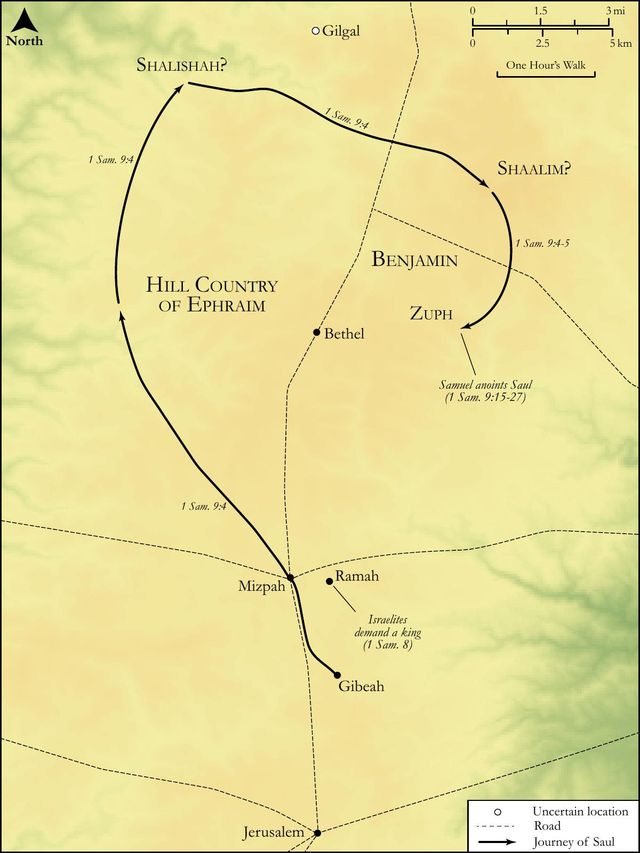
This verse serves as a crucial hinge in the unfolding narrative of Saul's introduction and eventual anointing. Prior to this, Saul, a young man of impressive stature from the tribe of Benjamin, has been diligently searching for his father Kish's lost donkeys for three days, a task that has led him and his servant far from their home in Gibeah, through the land of Shalisha, Shaalim, and Benjamite territory. Exhausted and contemplating a return to avoid worrying his father, Saul is met with his servant's unexpected and providentially inspired suggestion. The servant's knowledge of a "man of God" in the city of Zuph (later identified as Ramah, where Samuel resided) provides the necessary impetus for Saul to move from a personal errand to a divine appointment, unknowingly stepping into the fulfillment of God's plan for Israel's monarchy. The immediate verses following this confirm the identity of the "man of God" as Samuel and detail the divine preparation for Saul's arrival, highlighting God's sovereign hand in seemingly ordinary events, as seen in the divine revelation to Samuel.
Historical & Cultural Context
In ancient Israel, prophets, often referred to as "men of God" or "seers" (as explained in 1 Samuel 9:9), played a vital role as intermediaries between God and His people. They were sought out not only for major theological or national guidance but also for practical, everyday concerns, such as finding lost items, discerning the will of God before battle, or seeking counsel on personal matters. Their authority stemmed from their perceived direct communication with Yahweh, and their words were considered binding and trustworthy. The cultural expectation was that a true prophet's words would "surely come to pass," validating their divine commission. This period also reflects Israel's significant transition from a tribal confederacy led by judges to a monarchy, a shift that Samuel, as the last judge, was instrumental in facilitating, albeit with reservations about the people's desire for a king over God's direct rule, as detailed in Israel's demand for a king.
Key Themes
ShowHideThe verse powerfully illustrates Divine Providence and Guidance, showing how God orchestrates seemingly mundane circumstances—like lost donkeys—to bring about His greater purposes. It underscores the truth that God's hand is actively at work even in the most ordinary and frustrating aspects of life, guiding individuals toward their destiny within His sovereign plan. Another prominent theme is the Value of Seeking Spiritual Counsel. The servant's initiative to consult a "man of God" highlights the importance of discerning wisdom and direction from those who are spiritually mature and connected to God. His trust in the prophet's words emphasizes the significance of divine revelation as a guide for life's journey. Furthermore, the description of the "man of God" as "an honourable man" whose words "cometh surely to pass" speaks to the Prophetic Authority and Reliability in ancient Israel. True prophets were recognized for their trustworthiness, and their words were regarded as God's own declarations, carrying divine weight and certainty, a concept echoed in Deuteronomy 18:22.
Exposition and Analysis
ShowHideKey Word Analysis
ShowHideThis is a significant and reverent title used throughout the Old Testament, primarily for prophets (e.g., Moses, Elijah, Elisha) but also for other individuals specially chosen and empowered by God to deliver His message or perform His will. The term 'îysh (H376) refers to a man as an individual, while 'ĕlôhîym (H430) refers to the supreme God. Together, "man of God" signifies a person deeply devoted to God, acting as His representative, and possessing divine authority. The servant's use of this title immediately elevates the figure he is suggesting beyond a mere soothsayer or diviner, implying a profound spiritual connection and reliable prophetic insight.
Derived from the root kâbad (H3513), meaning "to be heavy, weighty, glorious." When applied to a person, it conveys the idea of being respected, esteemed, and possessing gravitas or influence. It suggests that the prophet's character and reputation are impeccable, adding to the credibility of his prophetic utterances. His words are not taken lightly but carry significant weight due to his personal integrity and divine connection.
This phrase uses an infinitive absolute construction (bô' yābō', from H935), which is a Hebrew grammatical device to express absolute certainty, emphasis, and inevitability. It literally means "coming, it will come" or "it will certainly come to pass." This strong affirmation underscores the absolute reliability and fulfillment of the prophet's words, reflecting God's own faithfulness to His declarations and His sovereign control over events. It implies a divine guarantee behind the prophet's pronouncements.
Verse Breakdown
ShowHide"And he said unto him, Behold now, [there is] in this city a man of God"
The speaker is Saul's servant, who displays a practical wisdom and an awareness of spiritual resources. The phrase "Behold now" (Hebrew hinneh-na') serves as an urgent interjection, drawing Saul's immediate attention to a significant discovery or idea. The identification of a "man of God" in the specific city indicates a known and respected figure, suggesting that the prophet's reputation extended beyond his immediate locale, making him a credible source of divine guidance.
"and [he is] an honourable man; all that he saith cometh surely to pass"
This clause serves as the servant's powerful testimonial to the prophet's character and prophetic accuracy. The prophet's "honourable" reputation signifies his integrity and the public trust he commands. The declaration that "all that he saith cometh surely to pass" is a strong affirmation of his divine authority and the unfailing reliability of his prophecies, implying that his words are not merely human predictions but divine decrees. This testimony establishes the prophet's credibility before Saul's direct encounter.
"now let us go thither; peradventure he can shew us our way that we should go"
This is the servant's practical suggestion, born out of desperation and belief. The phrase "now let us go thither" is a direct call to action, indicating a pragmatic solution to their immediate problem. The request to "shew us our way that we should go" initially refers to finding the lost donkeys, but in the broader narrative, it subtly foreshadows the much larger "way" that Saul is about to be shown—his path to kingship and the future direction of his life, which will be revealed through this very encounter. This statement highlights the servant's faith in the prophet's ability to provide divine direction for both immediate and unforeseen needs.
Literary Devices
ShowHideThe verse employs several significant literary devices that enrich its meaning and foreshadow future events. Irony is prominent, as the seemingly trivial search for lost donkeys becomes the unexpected means by which Saul is led to his divine appointment as king. The mundane task serves as a vehicle for God's grand plan. Foreshadowing is also evident in the servant's request that the man of God "shew us our way that we should go." While immediately referring to the donkeys, this phrase subtly hints at the much greater "way" or life path that Saul is about to embark upon as the future king of Israel. The Characterization of the servant reveals his practical wisdom and spiritual discernment, contrasting with Saul's initial weariness and desire to give up. The description of the prophet as "an honourable man" whose words "cometh surely to pass" uses Testimonial to establish his credibility and divine authority before his direct introduction. Finally, the entire sequence is an example of Divine Providence, where God's unseen hand orchestrates seemingly random events to fulfill His sovereign will, demonstrating His meticulous care and control over human affairs.
Theological and Thematic Connections
ShowHideThis pivotal verse underscores the profound truth of God's active involvement in the mundane details of human life, orchestrating circumstances, even frustrating ones like lost donkeys, to bring about His greater, often hidden, purposes. It highlights the divine wisdom in seeking counsel from those genuinely connected to God, whose words carry the weight of divine revelation. The servant's faith in the prophet's reliability serves as a model for trusting in God's word and His chosen messengers, recognizing that His plans, though sometimes unveiled through unexpected paths, are always certain to come to pass. This narrative beautifully illustrates how God uses ordinary means to achieve extraordinary ends, inviting believers to look for His hand in every aspect of their journey.
Reflection and Application
ShowHideThe narrative of Saul's lost donkeys and the servant's wise counsel offers profound lessons for contemporary believers. It challenges us to recognize that God's guidance is not limited to grand spiritual epiphanies but often manifests in the everyday, in the midst of our "lost donkeys"—our frustrations, anxieties, or seemingly insignificant problems. These very challenges can be the unexpected pathways through which God leads us to our next divine appointment or reveals a deeper aspect of His plan for our lives. This verse encourages us to cultivate a posture of discernment, seeking wise counsel from mature, godly individuals who are deeply rooted in God's Word and Spirit, just as Saul's servant knew to seek a "man of God." It reminds us that even when the path ahead seems unclear, God is sovereignly working behind the scenes, orchestrating events for our good and His glory. Our faith is not merely in finding answers but in trusting the One who knows "the way that we should go," even when we cannot see it, confidently walking in His divine providence.
Questions for Reflection
ShowHideFAQ
ShowHideWho is the "man of God" mentioned in this verse?
ShowHideAlthough not explicitly named in this verse, the "man of God" is Samuel, the great prophet and last judge of Israel. The narrative deliberately withholds his name initially to build suspense and to emphasize the common cultural understanding of such a revered figure. 1 Samuel 9:9 clarifies that "he that is now called a Prophet was beforetime called a Seer," and subsequent verses (e.g., 1 Samuel 9:14) confirm that Saul indeed met Samuel. Samuel was God's chosen instrument to anoint Israel's first king, and his encounter with Saul was divinely orchestrated.
Why were Saul and his servant seeking a "man of God" for lost donkeys?
ShowHideIn ancient Israel, prophets were consulted for a wide range of issues, not just major national or theological matters. People believed that God could provide guidance on practical, everyday concerns, including finding lost items, through His chosen messengers. This practice highlights the pervasive belief in divine providence and the accessibility of God's wisdom for all aspects of life. It also demonstrates the prophet's role as a community resource, a person of spiritual authority whom people trusted for reliable information and divine insight, even for something as mundane as lost livestock.
What does it mean that "all that he saith cometh surely to pass"?
ShowHideThis phrase emphasizes the absolute certainty and divine guarantee behind the prophet's words. It signifies that the prophet is a true messenger of God, and therefore, his pronouncements are not mere human predictions but divinely inspired declarations that will unfailingly be fulfilled. In Hebrew, the use of the infinitive absolute ("coming, it will come") provides a strong emphasis on the inevitability of the prophecy. This reliability was a crucial test for discerning a true prophet from a false one (as seen in Deuteronomy 18:22), and the servant's testimony here affirms Samuel's genuine prophetic authority.
Christ-Centered Fulfillment
ShowHideThe encounter in 1 Samuel 9:6, where a "man of God" is sought to show "our way that we should go," finds its ultimate and profound fulfillment in Jesus Christ. While Samuel was a faithful "man of God" who guided Israel to its first king, Jesus is the definitive and supreme "Man of God," the Prophet greater than Moses (as prophesied in Deuteronomy 18:15) and the ultimate revealer of God's will. He is not merely one who shows "our way," but He is "the way, the truth, and the life" (John 14:6). Just as Samuel's words "cometh surely to pass," Jesus declares that His words are eternal and will never pass away (Matthew 24:35), carrying ultimate divine authority and certainty. The divine providence that led Saul, through a mundane search for donkeys, to his anointing as king, foreshadows God's infinitely greater sovereign plan to bring humanity to salvation through the "anointed one," Christ. Through Christ, we are not just shown a way, but we are reconciled to God and made part of His eternal kingdom, inheriting a kingship far surpassing that of Saul (1 Peter 2:9). The seemingly lost path of humanity finds its true direction and ultimate purpose in Him, the Good Shepherd who seeks out the lost and leads them to abundant life (John 10:10-11).