


1 Samuel 9:4
- וַיַּעֲבֹרvai·ya·'a·Vorand he passedH5674Conj-w ¦ V-Qal-ConsecImperf-3msVerb Qal Consecutive Imperfect 3rd Singular Masculineוַandיַּעֲבֹרhe passed
- בְּהַרbe·harin [the] hill country ofH2022Prep-b ¦ N-mscNoun Singular Masculine Constructבְּinהַר[the] hill country of
- אֶפְרַיִם'ef·Ra·yimEphraimH669N-proper-mNoun Proper Masculine
- וַיַּעֲבֹרvai·ya·'a·Vorand he passedH5674Conj-w ¦ V-Qal-ConsecImperf-3msVerb Qal Consecutive Imperfect 3rd Singular Masculineוַandיַּעֲבֹרhe passed
- בְּאֶרֶץbe·'e·retzin [the] land ofH776Prep-b ¦ N-fscNoun Singular Feminine Constructבְּinאֶרֶץ[the] land of
- שָׁלִשָׁהsha·Li·shahShalishaH8031N-properNoun Proper Location
- וְלֹאve·Lo'and notH3808Conj-w ¦ NegParticle Negativeוְandלֹאnot
- מָצָאוּma·Tza·'uthey found [them]H4672V-Qal-Perf-3cpVerb Qal Perfect 3rd Plural common gender
- וַיַּעַבְרוּvai·ya·'av·Ruand they passedH5674Conj-w ¦ V-Qal-ConsecImperf-3mpVerb Qal Consecutive Imperfect 3rd Plural Masculineוַandיַּעַבְרוּthey passed
- בְאֶרֶץve·'e·retzin [the] land ofH776Prep-b ¦ N-fscNoun Singular Feminine Constructבְinאֶרֶץ[the] land of
- שַׁעֲלִיםsha·'a·LimShaalimH8171N-properNoun Proper Location
- וָאַיִןva·'A·yinand there notH369Conj-w ¦ N-msNoun Singular Masculine Absoluteוָandאַיִןthere not
- וַיַּעֲבֹרvai·ya·'a·Vorand he passedH5674Conj-w ¦ V-Qal-ConsecImperf-3msVerb Qal Consecutive Imperfect 3rd Singular Masculineוַandיַּעֲבֹרhe passed
- בְּאֶרֶץbe·'e·retzin [the] land ofH776Prep-b ¦ N-fscNoun Singular Feminine Constructבְּinאֶרֶץ[the] land of
- יְמִינִיye·mi·Ni[the] Jaminite[s]H3227N-msNoun Gentilic Singular Masculine Absolute
- וְלֹאve·Lo'and notH3808Conj-w ¦ NegParticle Negativeוְandלֹאnot
- מָצָאוּma·Tza·'uthey found [them]H4672V-Qal-Perf-3cpVerb Qal Perfect 3rd Plural common gender
English is a literal word-by-word gloss of the Hebrew, not the KJV's wording. Why?
This is the original text the KJV's translators worked from — each Hebrew word with its own literal English meaning in this verse, prepared by scholars at Tyndale House, Cambridge. The KJV translates whole sentences, not word by word, so its wording differs: one Hebrew word can become several English words, and the KJV may choose “the LORD” where the gloss reads “Yahweh”. Both are faithful — they answer different questions. For the KJV's own rendering, switch to the KJV text.
Details
See on the biblical-era map
Study this verse
Public-domain commentary
Matthew Henry
From his Commentary on the Whole Bible. Henry comments on passages, not single verses — this entry covers 1 Samuel 9:3–10. His three-level outline is real structure in the source text, so it is rendered as structure.
Here is, I. A great man rising from small beginnings. It does not appear that Saul had any preferment at all, or was in any post of honour or trust, till he was chosen king of Israel. Most that are advanced rise gradually, but Saul, from the level with his neighbours, stepped at once into the throne, according to that of Hannah, He raiseth up the poor out of the dust, to set them among princes, Sa1 2:8. Saul, it should seem, though he was himself married and had children grown up, yet lived in his father's house, and was subject to him. Promotion comes not by chance nor human probabilities, but God is the Judge.
II.A great event arising from small occurrences.
How low does the history begin! Having to trace Saul to the crown, we find him first employed as meanly as any we meet with called out to preferment.
1.Saul's father sends him with one of his servants to seek some asses that he had lost. It may be they had no way then to give public notice of such a number of asses strayed or stolen out of the grounds of Kish the Benjamite. A very good law they had to oblige men to bring back an ox or an ass that went astray, but it is to be feared that was, as other good laws, neglected and forgotten. It is easy to observe here that those who have must expect to lose, that it is wisdom to look after what is lost, that no man should think it below him to know the state of his flocks, that children should be forward to serve their parents' interests. Saul readily went to seek his father's asses, Sa1 9:3, Sa1 9:4. His taking care of the asses is to be ascribed, not so much to the humility of his spirit as to the plainness and simplicity of those times. But his obedience to his father in it was very commendable. Seest thou a man diligent in his business, and dutiful to his superiors, willing to stoop and willing to take pains? he does as Saul stand fair for preferment. The servant of Kish would be faithful only as a servant, but Saul as a son, in his own business, and therefore he was sent with him. Saul and his servants travelled far (probably on foot) in quest of the asses, but in vain: they found them not. He missed of what he sought, but had no reason to complain of the disappointment, for he met with the kingdom, which he never dreamed of.
2.When he could not find them, he determined to return to his father (Sa1 9:5), in consideration of his father's tender concern for him, being apprehensive that if they staid out any longer his aged father would begin to fear, as Jacob concerning Joseph, that an evil beast had devoured them or some mischief had befallen them; he will leave caring for the asses, as much as he was in care about them, and will take thought for us. Children should take care that they do nothing to grieve or frighten their parents, but be tender of their tenderness.
3.His servant proposed (for, it should seem, he had more religion in him than his master) that, since they were now at Ramah, they should call on Samuel, and take his advice in this important affair. Observe here,
(1.)They were close by the city where Samuel lived, and that put it into their heads to consult him (Sa1 9:6): There is in this city a man of God. Note, Wherever we are we should improve our opportunities of acquainting ourselves with those that are wise and good. But there are many that will consult a man of God, if he comes in their way, that would not go a step out of their way to get wisdom.
(2.)The servant spoke very respectfully concerning Samuel, though he had not personal knowledge of him, but by common fame only: He is a man of God, and an honourable man. Note, Men of God are honourable men, and should be so in our eyes. Acquaintance with the things of God, and serviceableness to the kingdom of God, put true honour upon men, and make them great. This was the honour of Samuel, as a man of God, that all he saith comes surely to pass. This was observed concerning him when he was a young prophet (Sa1 3:19), God did let none of his words fall to the ground; and still it held true.
(3.)They agreed to consult him concerning the way that they should go; peradventure he can show us. All the use they would make of the man of God was to be advised by him whether they should return home, or, if there were any hopes of finding the asses, which way they must go next - a poor business to employ a prophet about! Had they said, "Let us give up the asses for lost, and, now that we are so near the man of God, let us go and learn from him the good knowledge of God, let us consult him how we may order our conversations aright, and enquire the law at his mouth, since we may not have such another opportunity, and then we shall not lose our journey" - the proposal would have been such as became Israelites; but to make prophecy, that glory of Israel, serve so mean a turn as this, discovered too much what manner of spirit they were of. Note, Most people would rather be told their fortune than told their duty, how to be rich than how to be saved. If it were the business of the men of God to direct for the recovery of lost asses, they would be consulted much more than they are now that it is their business to direct for the recovery of lost souls; so preposterous is the care of most men!
(4.)Saul was thoughtful what present they should bring to the man of God, what fee they should give him for his advice (Sa1 9:7): What shall we bring the man? They could not present him, as Jeroboam's wife did Ahijah, with loaves and cakes (Kg1 14:3), for their bread was spent; but the servant bethought himself that he had in his pocket the fourth part of a shekel, about seven-pence halfpenny in value, and that he would give to the man of God to direct them, Sa1 9:8. "That will do," says Saul; "let us go," Sa1 9:10. Some think that when Saul talked of giving Samuel a fee he measured him by himself, or by his sons, as if he must be hired to do an honest Israelite a kindness, and was like the false prophets, that divined for money, Mic 3:11. He came to him as a fortune-teller, rather than as a prophet, and therefore thought the fourth part of a shekel was enough to give him. But it rather seems to be agreeable to the general usage of those times, as it is to natural equity, that those who sowed spiritual things should reap not only eternal things from him that employs them, but temporal things from those for whom they are employed. Samuel needed not their money, nor would he have denied them his advice if they had not brought it (it is probable, when he had it, he gave it to the por); but they brought it to him as a token of their respect and the value they put upon his office; nor did he refuse it, for they were able to give it, and, though it was but little, it was the widow's mite. But Saul, as he never thought of going to the man of God till the servant proposed it, so, it should seem, he mentioned the want of a present as an objection against their going; he would not own that he had money in his pocket, but, when the servant generously offered to be at the charge, then, "Well, said," says Saul; "come, let us go." Most people love a cheap religion, and like it best when they can devolve the expense of it on others.
(5.)The historian here takes notice of the name then given to the prophets: they called them Seers, or seeing men (Sa1 9:9), not but that the name prophet was then used, and applied to such persons, but that of seers was more in use. Note, Those that are prophets must first be seers; those who undertake to speak to others of the things of God must have an insight into those things themselves.
Continue studying 1 Samuel 9:4 across the web’s major study libraries — every link below opens this exact verse, chapter, or book on the destination site.
Read & Compare
 BibleGatewayThis verse in more than 200 translations and 70 languages.
 Bible.comThe YouVersion reader — hundreds of translations, reading plans, and highlights.
 ESV.orgCrossway's official English Standard Version reader.
 NET BibleThe NET translation with 60,000+ translators' notes on every rendering decision.
 STEP BibleTyndale House's free study tool — original text, vocabulary, and scholarly resources.
 BibliaLogos Bible Software's free web reader.
 USCCBThe New American Bible (Revised Edition) with the U.S. bishops' study notes.
Commentaries
 BibleHub CommentariesDozens of classic commentaries on this verse, gathered on one page.
 StudyLightMore than 100 commentary sets — the largest collection on the web.
 BibleRefPlain-English commentary on what this verse means, verse by verse.
 Enduring WordDavid Guzik's free commentary on this chapter, widely used by Bible teachers.
 Bible Study ToolsVerse commentary alongside Greek and Hebrew study aids.
Original Language & Research
- BibleHub InterlinearThe verse word by word — original language, transliteration, and English.
- BibleHub LexiconEvery word's original-language definition and Strong's entry.
 Blue Letter BibleDeep-study tools — Strong's numbers, concordance, and word studies.
 SefariaThe Hebrew text with Rashi and centuries of Jewish commentary.
Sermons, Hymns & Audio


TrulyRandomVerse is not affiliated with these sites and doesn’t control their content. They’re linked because they’re genuinely useful.
Summary
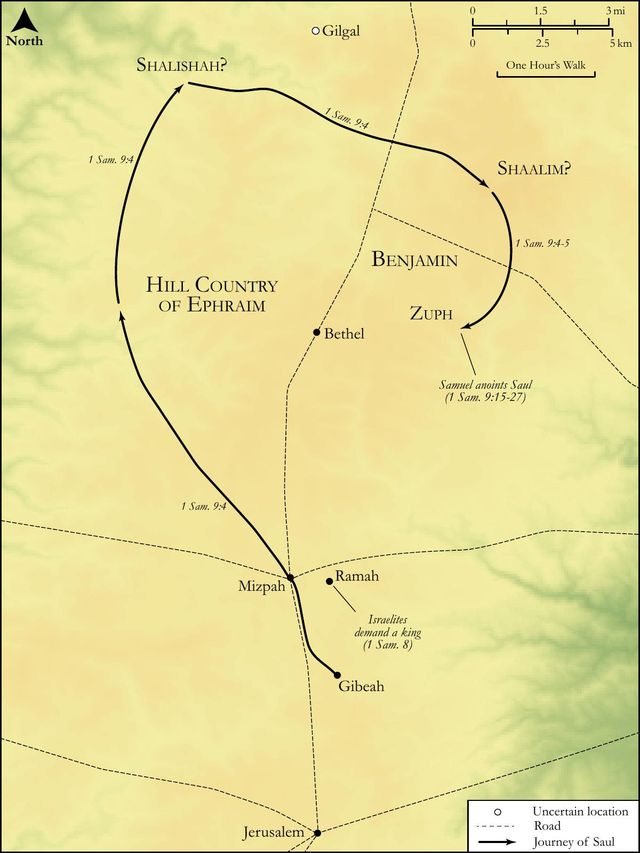
1 Samuel 9:4 meticulously chronicles the extensive and ultimately fruitless journey undertaken by Saul and his servant in their search for his father Kish's lost donkeys. This seemingly mundane and frustrating endeavor, spanning various regions of central Israel, serves as a divinely orchestrated prelude, meticulously guiding Saul away from his familiar surroundings and towards the pivotal encounter with the prophet Samuel, an encounter that would irrevocably alter the course of his life and the history of Israel by setting the stage for his anointing as the nation's first king.
Context
ShowHideLiterary Context
This verse is deeply embedded within the narrative of 1 Samuel 9, which opens with the introduction of Saul, a striking figure from the tribe of Benjamin. The immediate preceding verse, 1 Samuel 9:3, details Kish's instruction to Saul to find the lost donkeys, setting the primary objective of their journey. Verse 4 then elaborates on the vast geographical scope of their search, emphasizing their diligence and the initial lack of success. This meticulous detailing of their itinerary underscores the human effort involved, which stands in stark contrast to the divine intervention that is about to unfold. The frustration of their unfruitful search in this verse directly leads to Saul's growing concern for his father in 1 Samuel 9:5, prompting his servant's suggestion to consult the man of God, Samuel, thereby transitioning the narrative from a simple errand to a divinely appointed meeting.
Historical & Cultural Context
At this point in Israel's history, the nation was still operating under the system of judges, a period marked by decentralization, tribal conflicts, and a longing for stable leadership, as highlighted in the recurring phrase, "In those days there was no king in Israel" (Judges 17:6). Donkeys were invaluable assets in ancient Israelite society, serving as primary means of transport and beasts of burden, making their loss a significant economic concern for a family like Kish's, who is described as "a mighty man of power" (1 Samuel 9:1). The geographical locations mentioned—Mount Ephraim, Shalisha, Shalim, and the land of the Benjamites—represent a significant circuit through the central highlands of Israel, indicating a thorough and extensive search. Mount Ephraim was a populous and fertile region, while Shalisha and Shalim were likely more remote or less defined areas, suggesting that Saul and his servant ventured far from their home territory in their diligent pursuit.
Key Themes
ShowHideThe search detailed in 1 Samuel 9:4 is saturated with the theme of Divine Providence. What appears to be a mundane and even frustrating task is, in fact, God's sovereign hand at work, meticulously orchestrating events to bring Saul to his destined appointment. This journey exemplifies how God often uses ordinary circumstances and human diligence to accomplish His extraordinary purposes, a principle echoed in Proverbs 16:9, which states that while a man plans his way, the Lord directs his steps. Another prominent theme is Obedience and Diligence. Saul's unwavering commitment to his father's command, evident in the vast distances covered, highlights his dutiful character, which is a prerequisite for leadership. This faithfulness in a seemingly small task foreshadows his future responsibilities, aligning with the biblical teaching that faithfulness in little things can lead to greater responsibilities (Luke 16:10). Finally, the verse subtly introduces the theme of God's Unseen Hand, where human effort, though diligent, proves insufficient, paving the way for divine intervention. Saul was searching for donkeys, but God was preparing him to find a kingdom, a reality that becomes clear when Samuel reveals God's plan for Saul's anointing in 1 Samuel 9:15-17.
Exposition and Analysis
ShowHideKey Word Analysis
ShowHideDerived from a root meaning "double fruit," this word refers to the tribal territory of Ephraim, a son of Joseph, and subsequently the tribe descended from him and their allocated land. Saul's passage through this region signifies a journey through a significant and well-known part of central Israel.
Meaning "trebled land," Shalisha refers to a specific place in Palestine. Its inclusion in Saul's itinerary indicates the extensive and thorough nature of his search, venturing into distinct geographical areas.
Derived from a word meaning "foxes," Shaalim is identified as a specific place in Palestine. The mention of this location suggests Saul's journey took him through areas potentially characterized by wildlife or remoteness, further emphasizing the breadth of his unfruitful search.
Verse Breakdown
ShowHide"And he passed through mount Ephraim, and passed through the land of Shalisha, but they found [them] not"
This initial clause establishes the extensive geographical scope of Saul's search, beginning in the well-known central highlands of Ephraim and extending into the less defined, possibly more remote, land of Shalisha. The immediate declaration "but they found [them] not" highlights the futility of their human efforts, setting a tone of mounting frustration and emphasizing the absence of the desired outcome despite diligent searching.
"then they passed through the land of Shalim, and [there they were] not"
This continues the narrative of their exhaustive search, indicating a further trek into another distinct region, Shalim. The repetition of the negative outcome, "and [there they were] not," reinforces the persistent failure to locate the donkeys, building a sense of an impasse and underscoring the seemingly fruitless nature of their quest from a purely human perspective.
"and he passed through the land of the Benjamites, but they found [them] not"
This final segment of the verse brings Saul's journey full circle, as he returns to his own tribal territory, the land of Benjamin. The concluding "but they found [them] not" reiterates the complete lack of success in their primary objective, even on their home ground. This serves to heighten the narrative tension and prepare the reader for the unexpected divine intervention that will soon redirect Saul's path.
Literary Devices
ShowHideThe verse effectively employs several literary devices to convey its message. Repetition is a key element, with the phrase "but they found [them] not" or its equivalent appearing three times. This repetition underscores the futility and frustration of Saul's human efforts, building narrative tension and emphasizing the complete lack of success in his immediate objective. This sets the stage for the Irony that pervades the chapter: Saul is diligently searching for lost donkeys, unaware that his journey is providentially leading him to find a kingdom. The mundane task is a divine setup. The Geographical Progression through distinct regions (Mount Ephraim, Shalisha, Shalim, Benjamites) highlights the extensive nature of the search, demonstrating Saul's diligence and the vastness of the area covered. This detailed itinerary also subtly hints at the divine orchestration, as each step, though seemingly random, is guiding Saul closer to his destiny. Furthermore, the narrative employs Foreshadowing, as the arduous and seemingly unfruitful journey for donkeys subtly prepares the reader for the unexpected and divinely appointed turn of events that will lead Saul to Samuel and his anointing as king.
Theological and Thematic Connections
ShowHideThis seemingly simple verse, detailing a failed search for lost animals, profoundly illustrates the principle of divine sovereignty and providence. It teaches us that God's plans often unfold in unexpected ways, using ordinary circumstances and even frustrating setbacks to achieve His extraordinary purposes. Saul's diligent but unsuccessful search was not a waste of time; it was the very path God ordained to bring him to Samuel, demonstrating that our "detours" or "failures" can be precisely where God is leading us to our divine appointments. It underscores that God is at work behind the scenes, orchestrating events in ways we cannot comprehend, ultimately for our good and His glory.
Reflection and Application
ShowHideThe narrative of Saul's donkey search in 1 Samuel 9:4 offers a powerful reminder that our daily responsibilities, even the most mundane or frustrating ones, can be the very avenues through which God guides us toward His greater purposes. We often focus on our immediate objectives, much like Saul was focused on finding donkeys, while God is simultaneously working on a much grander scale, preparing us for something far beyond our current understanding. This passage encourages us to cultivate diligence and faithfulness in all our tasks, no matter how small or insignificant they may seem, trusting that God can use every situation—including apparent setbacks or prolonged periods of unfruitful effort—to position us exactly where He intends to be. It challenges us to look beyond the immediate outcome and discern the unseen hand of God at work, shaping our character and directing our steps, even when the path seems unclear or the desired result remains elusive. Our obedience and perseverance in the "little things" can indeed pave the way for God's significant work in our lives.
Questions for Reflection
ShowHideFAQ
ShowHideWhy did God use lost donkeys to lead Saul to Samuel?
ShowHideGod used the lost donkeys as a providential means to bring Saul to Samuel, demonstrating His sovereignty over seemingly ordinary and even frustrating events. This method served several purposes: it ensured Saul, a humble Benjamite, would be found by Samuel, who was divinely instructed to anoint Israel's first king (1 Samuel 9:15-16). It also highlighted that God's call often comes through unexpected channels, not necessarily through grand pronouncements but through the daily routines and responsibilities of life. This humble beginning for Saul's kingship underscored that his anointing was entirely God's initiative, not a result of human ambition or a search for power.
What is the significance of the geographical locations mentioned in Saul's search?
ShowHideThe mention of Mount Ephraim, the land of Shalisha, the land of Shalim, and the land of the Benjamites signifies the extensive and wide-ranging nature of Saul's search. These locations cover a significant portion of the central highlands of Israel, indicating Saul's diligence and perseverance in fulfilling his father's command. More importantly, this detailed geographical progression highlights the providential path God was orchestrating. Each step, though seemingly part of a fruitless search for donkeys, was actually guiding Saul further away from his home and closer to Ramah, where Samuel resided, ensuring the divine appointment would take place at the precise moment God intended (1 Samuel 9:6-10).
Christ-Centered Fulfillment
ShowHideThe narrative of Saul's extensive and ultimately fruitless search for lost donkeys, which providentially leads him to his anointing as king, serves as a powerful Old Testament shadow pointing to the ultimate King, Jesus Christ. While Saul was diligently searching for lost animals, God was orchestrating his encounter with Samuel to establish an earthly kingdom. In profound contrast, Jesus, the true King, did not come to search for lost animals, but to "seek and to save the lost" humanity (Luke 19:10). His journey to the cross, much like Saul's arduous trek, was a divinely orchestrated path, seemingly a failure from a human perspective, yet it was the very means by which God's ultimate kingdom would be established. Just as Saul's mundane task was a prelude to his kingship, so too was the humble, self-emptying life and sacrificial death of Christ the necessary prelude to His exaltation and the inauguration of His eternal reign (Philippians 2:7-11). The sovereign hand of God, evident in leading Saul to his earthly throne, is supremely manifest in the Father's plan to send His Son, the Lamb of God, who takes away the sin of the world (John 1:29), to establish a spiritual kingdom that knows no end (Daniel 7:14).