


Genesis 33:18
- וַיָּבֹאvai·ya·Vo'and he cameH935Conj-w ¦ V-Qal-ConsecImperf-3msVerb Qal Consecutive Imperfect 3rd Singular Masculineוַandיָּבֹאhe came
- יַעֲקֹבya·'a·KoJacobH3290N-proper-mNoun Proper Masculine
- שָׁלֵםsha·LemsafeH8003Adj-msAdjective Singular Masculine Absolute
- עִיר'ir[the] city ofH5892N-fscNoun Singular Feminine Construct
- שְׁכֶםshe·KhemShechemH7927N-properNoun Proper Location
- אֲשֶׁר'a·SherwhichH834RelParticle Relative
- בְּאֶרֶץbe·'E·retz[is] in [the] land ofH776Prep-b ¦ N-fscNoun Singular Feminine Constructבְּ[is] inאֶרֶץ[the] land of
- כְּנַעַןke·Na·'anCanaanH3667N-properNoun Proper Location
- בְּבֹאוֹbe·vo·'Owhen he cameH935Prep-b ¦ V-Qal-Inf ¦ 3msVerb Qal Infinitive Constructבְּwhenבֹאcameוֹhe
- מִפַּדַּןmi·pa·Danfrom PaddanH6307Prep-m ¦ N-properNoun Proper LocationמִfromפַּדַּןPaddan
- אֲרָם'a·RamAramH758N-properNoun Proper Location
- וַיִּחַןvai·Yi·chanand he campedH2583Conj-w ¦ V-Qal-ConsecImperf-3msVerb Qal Consecutive Imperfect 3rd Singular Masculineוַandיִּחַןhe camped
- אֶת'etwithH854PrepPreposition
- פְּנֵיpe·Nei[the] face ofH6440N-mpcNoun Plural Masculine Construct
- הָעִירha·'Irthe cityH5892Art ¦ N-fsNoun Singular Feminine Absoluteהָtheעִירcity
English is a literal word-by-word gloss of the Hebrew, not the KJV's wording. Why?
This is the original text the KJV's translators worked from — each Hebrew word with its own literal English meaning in this verse, prepared by scholars at Tyndale House, Cambridge. The KJV translates whole sentences, not word by word, so its wording differs: one Hebrew word can become several English words, and the KJV may choose “the LORD” where the gloss reads “Yahweh”. Both are faithful — they answer different questions. For the KJV's own rendering, switch to the KJV text.
Details
See on the biblical-era map


Study this verse
Public-domain commentary
Matthew Henry
From his Commentary on the Whole Bible. Henry comments on passages, not single verses — this entry covers Genesis 33:16–20.
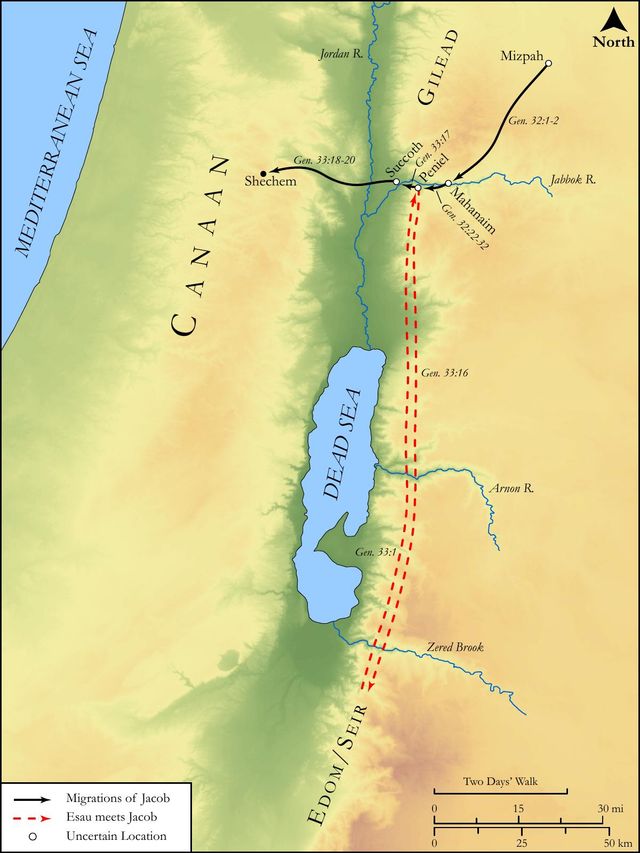
Here, 1. Jacob comes to Succoth. Having in a friendly manner parted with Esau, who had gone to his own country (Gen 33:16), he comes to a place where, it should seem, he rested for some time, set up booths for his cattle, and other conveniences for himself and family. The place was afterwards known by the name of Succoth, a city in the tribe of Gad, on the other side Jordan (it signifies booths), that when his posterity afterwards dwelt in houses of stone, they might remember that the Syrian ready to perish was their father, who was glad of booths (Deu 26:5); such was the rock whence they were hewn. 2. He comes to Shechem; we read it, to Shalem, a city of Shechem; the critics generally incline to read it appellatively: he came safely, or in peace, to the city of Shechem. After a perilous journey, in which he had met with many difficulties, he came safely, at last, into Canaan. Note, Diseases and dangers should teach us how to value health and safety, and should help to enlarge our hearts in thankfulness, when our going out and coming in have been signally preserved. Here, (1.) He buys a field, Gen 33:19. Though the land of Canaan was his by promise, yet, the time for taking possession not having yet come, he is content to pay for his own, to prevent disputes with the present occupants. Note, Dominion is not founded in grace. Those that have heaven on free-cost must not expect to have earth so. (2.) He builds an altar, Gen 33:20. [1.] In thankfulness to God, for the good hand of his providence over him. He did not content himself with verbal acknowledgments of God's favour to him, but made real ones: [2.] That he might keep up religion, and the worship of God, in his family. Note, Where we have a tent God must have an altar, where we have a house he must have a church in it. He dedicated this altar, where we have a house he must have a church in it. He dedicated this altar to the honour of El-elohe-Israel - God, the God of Israel, to the honour of God, in general, the only living and true God, the best of beings and first of causes; and to the honour of the God of Israel, as a God in covenant with him. Note, In our worship of God we must be guided and governed by the joint-discoveries both of natural and revealed religion. God had lately called him by the name of Israel, and now he calls God the God of Israel; though he is styled a prince with God, God shall still be a prince with him, his Lord and his God. Note, Our honours then become honours indeed to us when they are consecrated to God's honour; Israel's God is Israel's glory.
Historical interpretation
Historical reception
1 surviving comment on this verse from the historical church.
(Verse 18) And Jacob came to the city of Shechem, which is in the land of Canaan, when he came from Mesopotamia of Syria. A confusion arises, as to how Shechem is called the city of Salem, when Jerusalem, where Melchizedek reigned, was previously called Salem. Therefore, it seems that both cities have the same name, which we can also find for various places in Judea: that the same name of the city and place is in different tribes; or certainly we can say that the Shechem which is now called Sichem, translates to "consummated" or "perfect" in our language, and that the one which was later called Jerusalem is transferred to "peaceful". For both meanings of the word, with a slight difference in accent, this word is used. The Hebrews say that it refers to the limp of Jacob's thigh, where he became weakened and was healed. Therefore, they consider this city the same as the one that received the name of the cured and perfected.
Continue studying Genesis 33:18 across the web’s major study libraries — every link below opens this exact verse, chapter, or book on the destination site.
Read & Compare
 BibleGatewayThis verse in more than 200 translations and 70 languages.
 Bible.comThe YouVersion reader — hundreds of translations, reading plans, and highlights.
 ESV.orgCrossway's official English Standard Version reader.
 NET BibleThe NET translation with 60,000+ translators' notes on every rendering decision.
 STEP BibleTyndale House's free study tool — original text, vocabulary, and scholarly resources.
 BibliaLogos Bible Software's free web reader.
 USCCBThe New American Bible (Revised Edition) with the U.S. bishops' study notes.
Commentaries
 BibleHub CommentariesDozens of classic commentaries on this verse, gathered on one page.
 StudyLightMore than 100 commentary sets — the largest collection on the web.
 BibleRefPlain-English commentary on what this verse means, verse by verse.
 Enduring WordDavid Guzik's free commentary on this chapter, widely used by Bible teachers.
 Bible Study ToolsVerse commentary alongside Greek and Hebrew study aids.
Original Language & Research
- BibleHub InterlinearThe verse word by word — original language, transliteration, and English.
- BibleHub LexiconEvery word's original-language definition and Strong's entry.
 Blue Letter BibleDeep-study tools — Strong's numbers, concordance, and word studies.
 SefariaThe Hebrew text with Rashi and centuries of Jewish commentary.
Sermons, Hymns & Audio


TrulyRandomVerse is not affiliated with these sites and doesn’t control their content. They’re linked because they’re genuinely useful.
Summary
Genesis 33:18 chronicles Jacob's long-awaited arrival at Shalem, a city near Shechem in the promised land of Canaan, following his two-decade sojourn in Padanaram. This verse marks a significant milestone in Jacob's life, signifying the culmination of his arduous journey home, his profound reconciliation with Esau, and a moment of temporary but peaceful settlement within the covenant territory, thereby underscoring God's unwavering faithfulness in guiding and protecting him.
Context
ShowHideLiterary Context
This verse serves as a crucial geographical and narrative transition point immediately following Jacob's intense and ultimately successful reconciliation with his brother Esau. The preceding chapters detail Jacob's elaborate preparations, his wrestling with God at Peniel, and his fearful anticipation of meeting Esau, whom he had wronged years prior. His arrival at Shalem, therefore, signifies a moment of relief and relative peace after a period of profound anxiety and uncertainty, marking the successful completion of his return journey from Laban's household, which began in Genesis 31. It sets the stage for future interactions in the land, including the tragic events involving Dinah in the very next chapter.
Historical & Cultural Context
Jacob's journey from Padanaram to Canaan reflects the typical movements of patriarchal nomadic or semi-nomadic peoples in the ancient Near East. Their "cities" were often fortified settlements, and it was common for pastoralists like Jacob to "pitch their tents" outside the city walls, allowing access to water, markets, and protection while maintaining their distinct lifestyle and avoiding full integration into urban life. Shechem itself was an ancient and strategically important city, located in a fertile valley between Mount Gerizim and Mount Ebal, and was a significant cultic center. Its mention here grounds Jacob's narrative in a recognizable and historically relevant geographical framework within the land of Canaan.
Key Themes
ShowHideGenesis 33:18 powerfully contributes to several overarching themes in the book of Genesis. Foremost is the theme of God's Covenant Faithfulness, as Jacob's safe return to Canaan directly fulfills God's repeated promises to bring him back to the land given to Abraham and Isaac (e.g., Genesis 28:15). It also highlights the theme of Divine Guidance and Protection, demonstrating how God sovereignly orchestrated events, including the reconciliation with Esau, to ensure Jacob's safe passage. Furthermore, the verse subtly introduces the theme of Rest and Settlement after a long period of toil and wandering, contrasting with the hurried flight from Esau years earlier and the subsequent years of labor under Laban, as described in Genesis 29, Genesis 30, Genesis 31.
Exposition and Analysis
ShowHideKey Word Analysis
ShowHideMeaning "heel-catcher" or "supplanter." This name, given at birth, has defined much of Jacob's early life and character, marked by cunning and struggle. His safe arrival at Shalem signifies a transformation, a "coming home" not just geographically but spiritually, after his wrestling with God (H3290 is a derivative of H6117 'aqab). The journey culminates in a moment of peace, contrasting with his former identity.
A primitive root meaning "to incline; by implication, to decline (of the slanting rays of evening); specifically, to pitch a tent; gen. to encamp (for abode or siege); abide (in tents), camp, dwell, encamp." This word emphasizes Jacob's continued nomadic lifestyle, even upon returning to the promised land. It denotes a deliberate, albeit temporary, establishment, signifying a pause and a period of rest after his long journey, rather than a permanent dwelling within the city walls.
A plural noun meaning "the face (as the part that turns); used in a great variety of applications (literally and figuratively); also (with prepositional prefix) as a preposition (before, etc.)." In this context, "before the city" (literally "in the face of the city") indicates a location immediately adjacent to or in full view of the city. It implies a strategic and secure position, allowing access to the city's resources while maintaining a distinct, separate encampment, typical for a powerful tribal leader.
Verse Breakdown
ShowHide"And Jacob came to Shalem, a city of Shechem, which [is] in the land of Canaan,"
This clause details Jacob's specific destination within the promised land. "Shalem" (H8004) is linguistically linked to the Hebrew word shalom, meaning "peace" or "completeness," suggesting Jacob's arrival "in peace" or "safely" after his tumultuous journey and reconciliation with Esau. The identification of Shalem as "a city of Shechem" places it in a historically and covenantally significant region, where Abraham first built an altar upon entering Canaan. This highlights the continuity of the patriarchal narrative and the fulfillment of God's land promises.
"when he came from Padanaram;"
This phrase serves as a crucial temporal and geographical marker, emphasizing the completion of Jacob's long and arduous journey from Laban's household in Mesopotamia (H6307). It signifies the end of a major chapter in his life—two decades of labor, family formation, and complex relationships—and the beginning of a new phase in the land promised to his forefathers. This return underscores God's faithfulness in guiding Jacob back to the covenant land despite his past deceptions and wanderings.
"and pitched his tent before the city."
This final clause describes the nature of Jacob's initial settlement. The act of "pitching his tent" (H2583) indicates a deliberate, though not necessarily permanent, encampment. "Before the city" (H6440) implies a position outside the city walls but in close proximity, allowing access to urban resources while maintaining the distinct, semi-nomadic lifestyle of the patriarchs. This signifies a moment of relative stability, rest, and security after overcoming significant challenges, including the confrontation with Esau and the years of service to Laban.
Literary Devices
ShowHideThe verse employs several literary devices to convey its profound significance. Geographical Specificity is paramount, with the naming of "Shalem," "Shechem," "Canaan," and "Padanaram." This precision grounds the narrative in a tangible world, emphasizing the reality of Jacob's journey and the fulfillment of divine promises tied to specific territories. The subtle Symbolism of "Shalem," a name related to "peace" (shalom), suggests a divine intention for Jacob's well-being and the culmination of his journey in a state of tranquility. Furthermore, the narrative implies a Contrast between Jacob's fearful flight from Esau years prior and his current peaceful, deliberate arrival and settlement, highlighting his personal growth and God's transformative work in his life. The phrase "pitched his tent" also serves as a Metonymy for establishing a temporary dwelling, underscoring Jacob's continued identity as a sojourner in the land, even as he reclaims his ancestral heritage.
Theological and Thematic Connections
ShowHideJacob's safe return to Canaan, culminating in his arrival at a place symbolically named "Shalem" (peace), is a profound testament to God's unwavering faithfulness to His covenant promises. Despite Jacob's flaws, his past deceptions, and the dangers of his journey, God guided and protected him, fulfilling His word to bring him back to the land promised to Abraham and Isaac. This event underscores the reliability of God's word and His persistent commitment to His chosen people, even through their imperfections and trials.
Reflection and Application
ShowHideJacob's journey, culminating in his arrival at Shalem, offers profound lessons about God's unwavering faithfulness in guiding His people through trials and bringing them to a place of rest and fulfillment. His return to the promised land, despite his past mistakes and fears, illustrates divine grace and perseverance. For believers today, this verse serves as a powerful encouragement that even after long periods of struggle, wandering, or uncertainty, God directs our paths and brings us to our intended destination, often providing a season of peace and stability. It reminds us to trust in God's overarching plan for our lives, knowing that He will ultimately bring His promises to fruition, just as He did for Jacob in the land of Canaan. Our spiritual pilgrimage, like Jacob's, is marked by divine leading, even through difficult terrains, towards the ultimate peace found in God's presence. We are called to live with an eternal perspective, recognizing that our earthly dwellings are temporary, and our true home and ultimate peace are found in God's eternal presence.
Questions for Reflection
ShowHideFAQ
ShowHideWhat is the significance of Jacob arriving at "Shalem"?
ShowHideThe name "Shalem" (שָׁלֵם, H8004) is closely related to the Hebrew word shalom (שָׁלוֹם), meaning "peace" or "completeness." While a geographical location, its name symbolically reflects the state of peace and safety Jacob found after his tumultuous journey and profound reconciliation with Esau. It signifies a period of rest, divine provision, and a sense of "completeness" in his return to the promised land, contrasting sharply with the fear and anxiety that had preceded this moment.
Why did Jacob "pitch his tent before the city" instead of entering it?
ShowHidePitching a tent "before" or "in front of" the city (H6440, pânîym) was a common practice for nomadic or semi-nomadic peoples in the ancient Near East. It allowed Jacob and his large household access to the city's resources, such as water and markets, while maintaining their distinct identity and pastoral lifestyle. It also suggests a temporary, yet stable, settlement rather than a permanent integration into the city's population, aligning with the patriarchal understanding of being sojourners in the land, even as they possessed the divine promise of the land (see Hebrews 11:9).
How does Jacob's return to Canaan fulfill God's promises?
ShowHideGod had repeatedly promised Abraham, Isaac, and Jacob that their descendants would inherit the land of Canaan (e.g., Genesis 12:7, Genesis 28:15). Jacob's safe return from Padanaram directly fulfills this covenantal promise, demonstrating God's unwavering faithfulness to His word. His arrival in Shechem, a significant site where Abraham first built an altar, further emphasizes this continuity of divine promise and the re-establishment of the patriarchal presence in the promised land, laying groundwork for the future nation of Israel.
Christ-Centered Fulfillment
ShowHideJacob's journey to Shalem, a place of peace and safety in the promised land, beautifully prefigures the greater spiritual journey of humanity towards the ultimate peace and eternal rest found in Jesus Christ. Just as Jacob was brought safely home despite his wanderings, deceptions, and fears, believers are brought into a spiritual inheritance and profound peace through Christ's atoning work. He is our true "Shalem," the source of perfect peace and completeness, who gathers His people from their spiritual "Padanaram"—a life of toil, sin, and separation from God—into His eternal kingdom, the ultimate promised land. His perfect sacrifice on the cross achieved the ultimate reconciliation (see 2 Corinthians 5:18-19), providing the true shalom that Jacob's arrival only foreshadowed. In Christ, we find our secure dwelling place, our rest from labor (as promised in Matthew 11:28), and the fulfillment of all God's promises, for He Himself "is our peace" (Ephesians 2:14).