


Genesis 33:12
Bible text: King James Version (1769 Blayney text) · Public domain
Bible text: Berean Standard Bible · Public domain
Bible text: American Standard Version (1901) · Public domain
Bible text: World English Bible, Messianic edition · Public domain
Bible text: Geneva Bible (1599) · Public domain
Bible text: Young's Literal Translation · Public domain
- וַיֹּאמֶרvai·Yo·merand he saidH559Conj-w ¦ V-Qal-ConsecImperf-3msVerb Qal Consecutive Imperfect 3rd Singular Masculineוַandיֹּאמֶרhe said
- נִסְעָהnis·'Ahlet us set outH5265V-Qal-Imperf-1cpVerb Qal Imperfect 1st Plural common gender
- וְנֵלֵכָהve·ne·Le·khahand let us goH1980Conj-w ¦ V-Qal-Imperf-1cpVerb Qal Imperfect 1st Plural common genderוְandנֵלֵכָהlet us go
- וְאֵלְכָהve·'e·le·Khahand I will goH1980Conj-w ¦ V-Qal-Imperf-1csVerb Qal Imperfect 1st Singular common genderוְandאֵלְכָהI will go
- לְנֶגְדֶּךָle·neg·De·khato before youH5048Prep-l ¦ Adj-msc ¦ 2msAdjective Numerical Singular Masculine Constructלְtoנֶגְדֶּbeforeךָyou
English is a literal word-by-word gloss of the Hebrew, not the KJV's wording. Why?
This is the original text the KJV's translators worked from — each Hebrew word with its own literal English meaning in this verse, prepared by scholars at Tyndale House, Cambridge. The KJV translates whole sentences, not word by word, so its wording differs: one Hebrew word can become several English words, and the KJV may choose “the LORD” where the gloss reads “Yahweh”. Both are faithful — they answer different questions. For the KJV's own rendering, switch to the KJV text.
Details
See on the biblical-era maps


Study this verse
Public-domain commentary
Matthew Henry
From his Commentary on the Whole Bible. Henry comments on passages, not single verses — this entry covers Genesis 33:5–15. His three-level outline is real structure in the source text, so it is rendered as structure.
We have here the discourse between the two brothers at their meeting, which is very free and friendly, without the least intimation of the old quarrel. It was the best way to say nothing of it. They converse,
I.About Jacob's retinue, Gen 33:5-7.
Eleven or twelve little ones, the eldest of them no fourteen years old, followed Jacob closely: Who are these? says Esau. Jacob had sent him an account of the increase of his estate (Gen 32:5), but made no mention of his children; perhaps because he would not expose them to his rage if he should meet him as an enemy, or would please him with the unexpected sight if he should meet him as a friend: Esau therefore had reason to ask, Who are those with thee? to which common question Jacob returns a serious answer, such as became his character: They are the children which God hath graciously given they servant. It had been a sufficient answer to the question, and fit enough to be given to profane Esau, if he had only said, "They are my children;" but then Jacob would not have spoken like himself, like a man whose eyes were ever towards the Lord. Note, It becomes us not only to do common actions, but to speak of them, after a godly sort, Jo3 1:6. Jacob speaks of his children,
1.As God's gifts; they are a heritage of the Lord, Psa 128:3; Psa 112:9; Psa 107:41.
2.As choice gifts; he hath graciously given them. Though they were many, and now much his care, and as yet but slenderly provided for, yet he accounts them great blessings. His wives and children, hereupon, come up in order, and pay their duty to Esau, as he had done before them (Gen 33:6, Gen 33:7); for it becomes the family to show respect to those to whom the master of the family shows respect.
II.About the present he had sent him.
1.Esau modestly refused it because he had enough, and did not need it, Gen 33:9. Note, Those who wish to be considered men of honour will not seem to be mercenary in their friendship: whatever influence Jacob's present had upon Esau to pacify him, he would not have it thought that it had any, and therefore he refused it. His reason is I have enough, I have much (so the word is), so much that he was not willing to take any thing that was his brother's. Note,
(1.)Many that come short of spiritual blessings, and are out of covenant, yet have much of this world's wealth. Esau had what was promised him, the fatness of the earth and a livelihood by his sword.
(2.)It is a good thing for those that have much to know that they have enough, though they have not so much as some others have. Even Esau can say, I have enough.
(3.)Those that are content with what they have must show it by not coveting what others have. Esau, for his part, needs it not, either to supply him, for he was rich, or to pacify him, for he was reconciled: we should take heed lest at any time our covetousness impose upon the courtesy of others, and meanly take advantage of their generosity.
2.Jacob affectionately urges him to accept it, and prevails, Gen 33:10, Gen 33:11. Jacob sent it, through fear (Gen 32:20), but, the fear being over, he now importunes his acceptance of it for love, to show that he desired his brother's friendship, and did not merely dread his wrath; two things he urges: - (1.) The satisfaction he had in his brother's favour, of which he thought himself bound to make this thankful acknowledgment. It is a very high compliment that he passes upon him: I have seen thy face, as though I had seen the face of God, that is, "I have seen thee reconciled to me, and at peace with me, as I desire to see God reconciled." Or the meaning is that Jacob saw God's favour to him in Esau's: it was a token for good to him that God had accepted his prayers. Note, Creature-comforts are comforts indeed to us when they are granted as answers to prayer, and are tokens of our acceptance with God. Again, It is matter of great joy to those that are of a peaceable and affectionate disposition to recover the friendship of those relations with whom they have been at variance. (2.) The competency he had of this world's goods: God has dealt graciously with me. Note, If what we have in this world increase under our hands, we must take notice of it with thankfulness, to the glory of God, and own that therein he has dealt graciously with us, better than we deserve. It is he that gives power to get wealth, Deu 8:18. He adds, "And I have enough; I have all," so the word is. Esau's enough was much, but Jacob's enough was all. Note, a godly man, though he have but little in the world, yet may truly say, "I have all," [1.] Because he has the God of all, and has all in him; all is yours if you be Christ's, Co1 3:22. [2.] Because he has the comfort of all. I have all, and abound, Phi 4:18. He that thinks he has all is sure he has enough. He has all in prospect; he will have all shortly, when he comes to heaven: upon this principle Jacob urged Esau, and he took his present. Note, It is an excellent thing when men's religion makes them generous, free-hearted, and open-handed, scorning to do a thing that is paltry and sneaking.
III.About the progress of their journey.
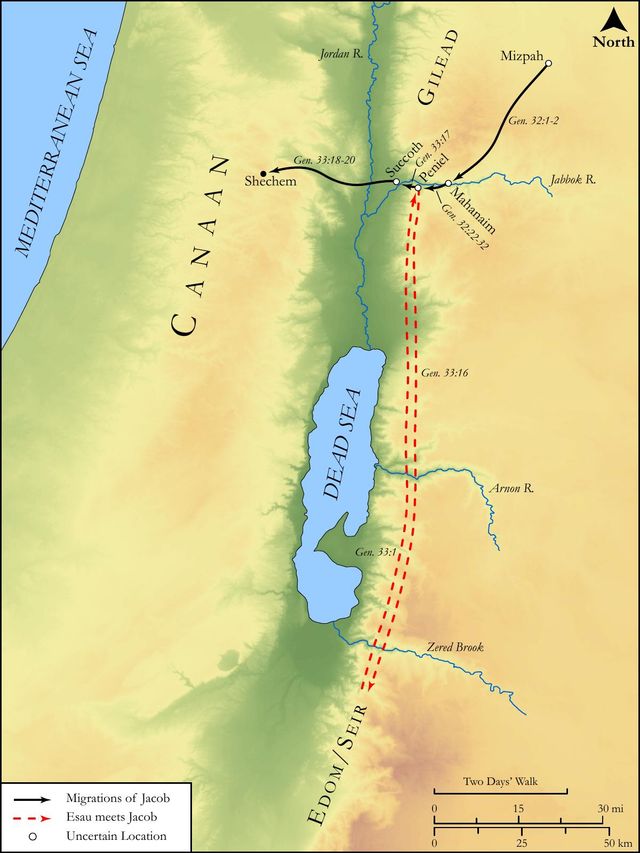
1.Esau offers himself to be his guide and companion, in token of sincere reconciliation, Gen 33:12. We never find that Jacob and Esau were so sociable with one another, and so affectionate, as they were now. Note, As for God his work is perfect. He made Esau, not only not an enemy, but a friend. This bone that had been broken, being well set, became stronger than ever. Esau has become fond of Jacob's company, courts him to Mount Seir: let us never despair of any, nor distrust God in whose hand all hearts are. Yet Jacob saw cause modestly to refuse this offer (Gen 33:13, Gen 33:14), wherein he shows a tender concern for his own family and flocks, like a good shepherd and a good father. He must consider the children, and the flocks, with young, and not lead the one, nor drive the other, too fast. This prudence and tenderness of Jacob ought to be imitated by those that have the care and charge of young people in the things of God. They must not be over-driven, at first, by heavy tasks in religious services, but led, as they can bear, having their work made as easy to them as possible. Christ, the good Shepherd, does so, Isa 40:11. Now Jacob will not desire Esau to slacken his pace, nor force his family to quicken theirs, nor leave them, to keep company with his brother, as many would have done, that love any society better than their own house; but he desires Esau to march before, and promises to follow him leisurely, as he could get forward. Note, It is an unreasonable thing to tie others to our rate; we may come with comfort, at last, to the same journey's end, though we do not journey together, either in the same path or with the same pace. There may be those with whom we cannot fall in and yet with whom we need not fall out by the way. Jacob intimates to him that it was his present design to come to him to Mount Seir; and we may presume he did so, after he had settled his family and concerns elsewhere, though that visit is not recorded. Note, When we have happily recovered peace with our friends we must take care to cultivate it, and not to be behind-hand with them in civilities.
2.Esau offers some of his men to be his guard and convoy, Gen 33:15. He saw Jacob but poorly attended, no servants but his husbandmen and shepherds, no pages or footmen; and therefore, thinking he was as desirous as himself (if he could afford it) to take state upon him, and look great, he would needs lend him some of his retinue, to attend upon him, that he might appear like Esau's brother; but Jacob humbly refuses his offer, only desiring he would not take it amiss that he did not accept it: What needeth it?
(1.)Jacob is humble, and needs it not for state; he desires not to make a fair show in the flesh, by encumbering himself with a needless retinue. Note, It is the vanity of pomp and grandeur that they are attended with a great deal of which it may be said, What needeth it?
(2.)Jacob is under the divine protection, and needs it not for safety. Note, Those are sufficiently guarded that have God for their guard and are under a convoy of his hosts, as Jacob was. Those need not be beholden to an arm of flesh that have God for their arm every morning. Jacob adds, "Only let me find grace in the sight of my lord; having thy favour, I have all I need, all I desire from thee." If Jacob thus valued the good-will of a brother, much more reason have we to reckon that we have enough if we have the good-will of our God.
Continue studying Genesis 33:12 across the web’s major study libraries — every link below opens this exact verse, chapter, or book on the destination site.
Read & Compare
 BibleGatewayThis verse in more than 200 translations and 70 languages.
 Bible.comThe YouVersion reader — hundreds of translations, reading plans, and highlights.
 ESV.orgCrossway's official English Standard Version reader.
 NET BibleThe NET translation with 60,000+ translators' notes on every rendering decision.
 STEP BibleTyndale House's free study tool — original text, vocabulary, and scholarly resources.
 BibliaLogos Bible Software's free web reader.
 USCCBThe New American Bible (Revised Edition) with the U.S. bishops' study notes.
Commentaries
 BibleHub CommentariesDozens of classic commentaries on this verse, gathered on one page.
 StudyLightMore than 100 commentary sets — the largest collection on the web.
 BibleRefPlain-English commentary on what this verse means, verse by verse.
 Enduring WordDavid Guzik's free commentary on this chapter, widely used by Bible teachers.
 Bible Study ToolsVerse commentary alongside Greek and Hebrew study aids.
Original Language & Research
- BibleHub InterlinearThe verse word by word — original language, transliteration, and English.
- BibleHub LexiconEvery word's original-language definition and Strong's entry.
 Blue Letter BibleDeep-study tools — Strong's numbers, concordance, and word studies.
 SefariaThe Hebrew text with Rashi and centuries of Jewish commentary.
Sermons, Hymns & Audio


TrulyRandomVerse is not affiliated with these sites and doesn’t control their content. They’re linked because they’re genuinely useful.
Summary
Genesis 33:12 records Esau's remarkable and unexpected invitation to Jacob, proposing that they journey together with Esau leading the way. This pivotal moment of reconciliation follows decades of estrangement and Jacob's profound fear, encapsulating Esau's complete forgiveness and his earnest desire to restore their fractured brotherhood, marking a profound shift from past animosity to genuine fellowship.
Context
ShowHideLiterary Context
This verse is a climactic point in the long-anticipated reunion between Jacob and Esau, brothers who had been estranged for over two decades due to Jacob's deception in securing the birthright and blessing, as detailed in Genesis 27:1-46. Jacob had approached this encounter with extreme trepidation, having meticulously prepared by sending numerous peace offerings ahead of him and wrestling with a divine being at Peniel, an event recounted in Genesis 32:22-32. Contrary to Jacob's anxieties, Esau's reaction was one of overwhelming embrace and tears, a powerful display of forgiveness described in Genesis 33:4. Esau's offer in Genesis 33:12 to journey together further solidifies this newfound peace, demonstrating his desire for a restored relationship rather than mere tolerance.
Historical & Cultural Context
In the days of the patriarchs, travel was arduous and often dangerous, especially for a large company like Jacob's, which included women, children, and extensive livestock. The offer to "go before thee" (to lead) was not merely a navigational suggestion but a significant gesture of protection, provision, and hospitality. It implied taking responsibility for the safety and well-being of the group. Furthermore, the concept of brotherhood and family honor was paramount, making the reconciliation between Jacob and Esau a culturally significant event that restored familial integrity. Esau's willingness to lead indicated a complete reversal of the power dynamics and animosity that had previously defined their relationship.
Key Themes
ShowHideGenesis 33:12 contributes significantly to several overarching themes within the book of Genesis and the broader biblical narrative. Foremost among these is the theme of reconciliation and forgiveness, powerfully demonstrated by Esau's unexpected grace, which stands in stark contrast to Jacob's deep-seated fear. This encounter also highlights divine providence, as God sovereignly orchestrates events to transform hearts and bring about peace, fulfilling His promises to Jacob despite the patriarch's past failings and anxieties (Genesis 28:15). The verse also underscores the theme of restoration of relationship, moving beyond mere cessation of conflict to an active desire for shared journey and fellowship, reflecting God's desire for restored communion with humanity.
Exposition and Analysis
ShowHideKey Word Analysis
ShowHideThis primitive root is used with great latitude, meaning "to say," "speak," "declare," or "command." In this context, Esau's "saying" is not merely a verbal utterance but an active proposition, an initiative to establish a new dynamic. It signifies his intentionality and the weight of his offer, demonstrating a deliberate move towards reconciliation and companionship.
This root primarily means "to pull up," especially tent-pins, signifying the act of breaking camp and starting a journey. It denotes a decisive movement or departure. Esau's use of this word implies a shared, immediate, and purposeful commencement of travel, inviting Jacob into a collective undertaking rather than a solitary path, emphasizing the communal aspect of his invitation.
A primitive root meaning "to walk" or "to go," literally or figuratively. It can also imply leading or accompanying. In Esau's repeated use ("let us go" and "I will go"), it underscores the idea of movement and companionship. His promise to "go before thee" (literally, "I will walk before your face") signifies leadership, protection, and a willingness to clear the path, acting as a guide and guardian for Jacob and his vulnerable company.
Verse Breakdown
ShowHide"And he said,"
This simple introduction sets the stage for Esau's unexpected and gracious initiative. It marks the shift from the emotional reunion to a practical proposal for their immediate future, highlighting Esau's active role in shaping the reconciliation.
"Let us take our journey, and let us go,"
This double invitation emphasizes Esau's earnest desire for shared companionship. The repetition of "let us" (a cohortative form in Hebrew) conveys a sense of urgency and shared purpose. It's an invitation not just to travel, but to travel together, signifying a desire for renewed fellowship and a future shared path, rather than a mere formal parting.
"and I will go before thee."
This declaration is the most significant part of Esau's offer. To "go before" someone among the patriarchs implied leadership, protection, and responsibility for the journey's safety and success. Given Jacob's large family, flocks, and the inherent dangers of travel, Esau's offer to lead is a profound gesture of care, security, and benevolence. It dispels any lingering fears Jacob might have harbored about Esau's intentions, underscoring Esau's complete forgiveness and his active desire to participate in the restoration of their brotherhood.
Literary Devices
ShowHideGenesis 33:12 is rich with Symbolism and Irony. The act of "going before" Jacob is symbolic of Esau's transformed heart and his willingness to take on the role of protector and guide, a stark contrast to the vengeful brother Jacob had feared. It symbolizes a new beginning and a complete reversal of their past animosity. The entire scene is imbued with Irony, as Jacob, who had meticulously planned and feared for his life, is met not with wrath but with overwhelming grace and an offer of companionship from the very brother he had wronged. This unexpected outcome highlights the theme of Divine Providence, demonstrating how God can work beyond human expectations and fears to bring about reconciliation and peace, turning Jacob's deepest anxieties into a moment of profound relief and restoration.
Theological and Thematic Connections
ShowHideThe peaceful outcome of the meeting between Jacob and Esau, particularly Esau's gracious offer in Genesis 33:12, powerfully illustrates God's sovereign ability to transform hearts and orchestrate reconciliation even in the most strained relationships. This divine intervention affirms God's faithfulness to His covenant promises, demonstrating that His purposes will prevail despite human sin and fear. It serves as a profound testament to the transformative power of forgiveness and the possibility of genuine restoration in broken relationships, echoing the broader biblical narrative of God's initiative in reconciling humanity to Himself.
Reflection and Application
ShowHideGenesis 33:12 offers profound lessons for believers today, underscoring the importance of seeking reconciliation and extending forgiveness in fractured relationships, even when past hurts run deep. Esau's unexpected grace reminds us that God can work powerfully in the hearts of others, often exceeding our expectations and fears, transforming animosity into genuine fellowship. This narrative encourages us to trust in God's providence, to step out in faith towards healing, and to be open to surprising acts of restoration and brotherly love in our own lives and communities. It calls us to examine our own hearts: are we willing to initiate reconciliation like Esau, or are we, like Jacob, clinging to fear when God desires to bring peace? True peace often requires both the humility to seek reconciliation and the radical grace to extend it, mirroring the divine initiative in our own salvation.
Questions for Reflection
ShowHideFAQ
ShowHideWas Esau's offer to travel together truly sincere, given his past anger?
ShowHideYes, the biblical narrative strongly suggests Esau's offer was profoundly sincere. His earlier actions—running to embrace Jacob, weeping, and refusing Jacob's numerous gifts until persuaded—all indicate a complete and genuine transformation of his heart. His offer in Genesis 33:12 to "go before thee" further solidifies his benevolent intentions, signifying a desire to provide leadership, protection, and companionship, not just a fleeting moment of peace. This unexpected and profound grace highlights God's sovereign work in softening Esau's heart, turning potential vengeance into heartfelt reconciliation.
Why did Jacob decline Esau's offer to travel together in the subsequent verses?
ShowHideWhile Genesis 33:12 clearly shows Esau's sincerity, Jacob's subsequent decision to travel separately (as seen in Genesis 33:13-14) was likely a combination of practical considerations and perhaps a lingering, cautious independence. Jacob had a very large, slow-moving company with young children and extensive livestock, making it difficult to keep pace with Esau's swifter entourage. More significantly, Jacob had a divine mandate to journey towards the promised land and fulfill his vow to God at Bethel (Genesis 28:20-22). Traveling independently allowed him to proceed at his own pace and direction, ensuring his focus remained on his divinely appointed path rather than being led by Esau back towards Seir.
Christ-Centered Fulfillment
ShowHideThe profound reconciliation between Jacob and Esau, culminating in Esau's gracious and unexpected offer to "take our journey" and "go before thee" in Genesis 33:12, powerfully foreshadows the ultimate and greater reconciliation achieved through Jesus Christ. Just as Esau, the wronged brother, extended unmerited grace and an astonishing offer of companionship and protection to Jacob, so too does Christ, though perfectly righteous and infinitely wronged by humanity's sin, extend an unmerited offer of peace and reconciliation to a humanity estranged from God. He does not merely forgive our transgressions; He actively invites us into a restored relationship, offering to "go before us" as our Good Shepherd (John 10:11), our Forerunner into the heavenly sanctuary (Hebrews 6:20), and our faithful High Priest (Hebrews 4:14-16). This narrative thus points to the ultimate divine act of reconciliation where God, in Christ, takes the initiative to restore broken fellowship, leading us into eternal life and communion with Him, securing our well-being and guiding our path.