


Genesis 33:11
Bible text: King James Version (1769 Blayney text) · Public domain
Bible text: King James Version with Strong's numbers · Public domain
Bible text: Berean Standard Bible · Public domain
Bible text: American Standard Version (1901) · Public domain
Bible text: World English Bible, Messianic edition · Public domain
Bible text: Geneva Bible (1599) · Public domain
Bible text: Young's Literal Translation · Public domain
- קַחkachtakeH3947V-Qal-Imp-2msVerb Qal Imperative 2nd Singular Masculine
- נָאna'pleaseH4994PrtParticle Interjection
- אֶת'et<obj.>H853DirObjMParticle Object Indicator
- בִּרְכָתִיbir·kha·Timy blessingH1293N-fsc ¦ 1csNoun Singular Feminine Constructבִּרְכָתִblessingיmy
- אֲשֶׁר'a·SherwhichH834RelParticle Relative
- הֻבָאתhu·Vatit was broughtH935V-Hophal-Perf-3fsVerb Hophal Perfect 3rd Singular Feminine
- לָךְLakhto <the> youPrep-l ¦ 2msSuffix Personal 2nd Singular Masculineלָto <the>ךְyou
- כִּיkiforH3588PrtParticle Conditional
- חַנַּנִיcha·Na·nihe has shown favor to meH2603V-Qal-Perf-3ms ¦ 1csVerb Qal Perfect 3rd Singular Masculineחַנַּhe has shown favor toנִיme
- אֱלֹהִים'E·lo·HimGodH430N-mpNoun Plural Masculine Absolute
- וְכִיve·Khiand thatH3588Conj-w ¦ PrtParticle Conditionalוְandכִיthat
- יֶשׁyeshthereH3426Adj-csAdjective Numerical Singular common gender Absolute
- לִיli[belongs] to <the> mePrep-l ¦ 1csSuffix Personal 1st Singular common genderלִ[belongs] to <the>יme
- כֹלKholeverythingH3605N-msNoun Singular Masculine Absolute
- וַיִּפְצַרvai·yif·tzarand he urgedH6484Conj-w ¦ V-Qal-ConsecImperf-3msVerb Qal Consecutive Imperfect 3rd Singular Masculineוַandיִּפְצַרhe urged
- בּוֹbo<in> <the> himPrep-b ¦ 3msSuffix Personal 3rd Singular Masculineבּ<in> <the>וֹhim
- וַיִּקָּחvai·yi·Kachand he took [it]H3947Conj-w ¦ V-Qal-ConsecImperf-3msVerb Qal Consecutive Imperfect 3rd Singular Masculineוַandיִּקָּחhe took [it]
English is a literal word-by-word gloss of the Hebrew, not the KJV's wording. Why?
This is the original text the KJV's translators worked from — each Hebrew word with its own literal English meaning in this verse, prepared by scholars at Tyndale House, Cambridge. The KJV translates whole sentences, not word by word, so its wording differs: one Hebrew word can become several English words, and the KJV may choose “the LORD” where the gloss reads “Yahweh”. Both are faithful — they answer different questions. For the KJV's own rendering, switch to the KJV text.
Details
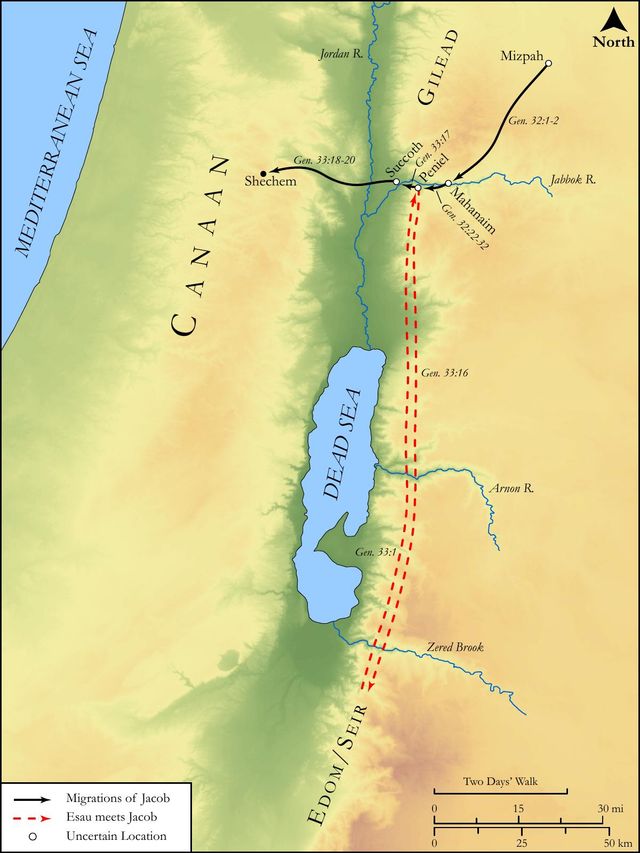
See on the biblical-era maps


Study this verse
Public-domain commentary
Matthew Henry
From his Commentary on the Whole Bible. Henry comments on passages, not single verses — this entry covers Genesis 33:5–15. His three-level outline is real structure in the source text, so it is rendered as structure.
We have here the discourse between the two brothers at their meeting, which is very free and friendly, without the least intimation of the old quarrel. It was the best way to say nothing of it. They converse,
I.About Jacob's retinue, Gen 33:5-7.
Eleven or twelve little ones, the eldest of them no fourteen years old, followed Jacob closely: Who are these? says Esau. Jacob had sent him an account of the increase of his estate (Gen 32:5), but made no mention of his children; perhaps because he would not expose them to his rage if he should meet him as an enemy, or would please him with the unexpected sight if he should meet him as a friend: Esau therefore had reason to ask, Who are those with thee? to which common question Jacob returns a serious answer, such as became his character: They are the children which God hath graciously given they servant. It had been a sufficient answer to the question, and fit enough to be given to profane Esau, if he had only said, "They are my children;" but then Jacob would not have spoken like himself, like a man whose eyes were ever towards the Lord. Note, It becomes us not only to do common actions, but to speak of them, after a godly sort, Jo3 1:6. Jacob speaks of his children,
1.As God's gifts; they are a heritage of the Lord, Psa 128:3; Psa 112:9; Psa 107:41.
2.As choice gifts; he hath graciously given them. Though they were many, and now much his care, and as yet but slenderly provided for, yet he accounts them great blessings. His wives and children, hereupon, come up in order, and pay their duty to Esau, as he had done before them (Gen 33:6, Gen 33:7); for it becomes the family to show respect to those to whom the master of the family shows respect.
II.About the present he had sent him.
1.Esau modestly refused it because he had enough, and did not need it, Gen 33:9. Note, Those who wish to be considered men of honour will not seem to be mercenary in their friendship: whatever influence Jacob's present had upon Esau to pacify him, he would not have it thought that it had any, and therefore he refused it. His reason is I have enough, I have much (so the word is), so much that he was not willing to take any thing that was his brother's. Note,
(1.)Many that come short of spiritual blessings, and are out of covenant, yet have much of this world's wealth. Esau had what was promised him, the fatness of the earth and a livelihood by his sword.
(2.)It is a good thing for those that have much to know that they have enough, though they have not so much as some others have. Even Esau can say, I have enough.
(3.)Those that are content with what they have must show it by not coveting what others have. Esau, for his part, needs it not, either to supply him, for he was rich, or to pacify him, for he was reconciled: we should take heed lest at any time our covetousness impose upon the courtesy of others, and meanly take advantage of their generosity.
2.Jacob affectionately urges him to accept it, and prevails, Gen 33:10, Gen 33:11. Jacob sent it, through fear (Gen 32:20), but, the fear being over, he now importunes his acceptance of it for love, to show that he desired his brother's friendship, and did not merely dread his wrath; two things he urges: - (1.) The satisfaction he had in his brother's favour, of which he thought himself bound to make this thankful acknowledgment. It is a very high compliment that he passes upon him: I have seen thy face, as though I had seen the face of God, that is, "I have seen thee reconciled to me, and at peace with me, as I desire to see God reconciled." Or the meaning is that Jacob saw God's favour to him in Esau's: it was a token for good to him that God had accepted his prayers. Note, Creature-comforts are comforts indeed to us when they are granted as answers to prayer, and are tokens of our acceptance with God. Again, It is matter of great joy to those that are of a peaceable and affectionate disposition to recover the friendship of those relations with whom they have been at variance. (2.) The competency he had of this world's goods: God has dealt graciously with me. Note, If what we have in this world increase under our hands, we must take notice of it with thankfulness, to the glory of God, and own that therein he has dealt graciously with us, better than we deserve. It is he that gives power to get wealth, Deu 8:18. He adds, "And I have enough; I have all," so the word is. Esau's enough was much, but Jacob's enough was all. Note, a godly man, though he have but little in the world, yet may truly say, "I have all," [1.] Because he has the God of all, and has all in him; all is yours if you be Christ's, Co1 3:22. [2.] Because he has the comfort of all. I have all, and abound, Phi 4:18. He that thinks he has all is sure he has enough. He has all in prospect; he will have all shortly, when he comes to heaven: upon this principle Jacob urged Esau, and he took his present. Note, It is an excellent thing when men's religion makes them generous, free-hearted, and open-handed, scorning to do a thing that is paltry and sneaking.
III.About the progress of their journey.
1.Esau offers himself to be his guide and companion, in token of sincere reconciliation, Gen 33:12. We never find that Jacob and Esau were so sociable with one another, and so affectionate, as they were now. Note, As for God his work is perfect. He made Esau, not only not an enemy, but a friend. This bone that had been broken, being well set, became stronger than ever. Esau has become fond of Jacob's company, courts him to Mount Seir: let us never despair of any, nor distrust God in whose hand all hearts are. Yet Jacob saw cause modestly to refuse this offer (Gen 33:13, Gen 33:14), wherein he shows a tender concern for his own family and flocks, like a good shepherd and a good father. He must consider the children, and the flocks, with young, and not lead the one, nor drive the other, too fast. This prudence and tenderness of Jacob ought to be imitated by those that have the care and charge of young people in the things of God. They must not be over-driven, at first, by heavy tasks in religious services, but led, as they can bear, having their work made as easy to them as possible. Christ, the good Shepherd, does so, Isa 40:11. Now Jacob will not desire Esau to slacken his pace, nor force his family to quicken theirs, nor leave them, to keep company with his brother, as many would have done, that love any society better than their own house; but he desires Esau to march before, and promises to follow him leisurely, as he could get forward. Note, It is an unreasonable thing to tie others to our rate; we may come with comfort, at last, to the same journey's end, though we do not journey together, either in the same path or with the same pace. There may be those with whom we cannot fall in and yet with whom we need not fall out by the way. Jacob intimates to him that it was his present design to come to him to Mount Seir; and we may presume he did so, after he had settled his family and concerns elsewhere, though that visit is not recorded. Note, When we have happily recovered peace with our friends we must take care to cultivate it, and not to be behind-hand with them in civilities.
2.Esau offers some of his men to be his guard and convoy, Gen 33:15. He saw Jacob but poorly attended, no servants but his husbandmen and shepherds, no pages or footmen; and therefore, thinking he was as desirous as himself (if he could afford it) to take state upon him, and look great, he would needs lend him some of his retinue, to attend upon him, that he might appear like Esau's brother; but Jacob humbly refuses his offer, only desiring he would not take it amiss that he did not accept it: What needeth it?
(1.)Jacob is humble, and needs it not for state; he desires not to make a fair show in the flesh, by encumbering himself with a needless retinue. Note, It is the vanity of pomp and grandeur that they are attended with a great deal of which it may be said, What needeth it?
(2.)Jacob is under the divine protection, and needs it not for safety. Note, Those are sufficiently guarded that have God for their guard and are under a convoy of his hosts, as Jacob was. Those need not be beholden to an arm of flesh that have God for their arm every morning. Jacob adds, "Only let me find grace in the sight of my lord; having thy favour, I have all I need, all I desire from thee." If Jacob thus valued the good-will of a brother, much more reason have we to reckon that we have enough if we have the good-will of our God.
Continue studying Genesis 33:11 across the web’s major study libraries — every link below opens this exact verse, chapter, or book on the destination site.
Read & Compare
 BibleGatewayThis verse in more than 200 translations and 70 languages.
 Bible.comThe YouVersion reader — hundreds of translations, reading plans, and highlights.
 ESV.orgCrossway's official English Standard Version reader.
 NET BibleThe NET translation with 60,000+ translators' notes on every rendering decision.
 STEP BibleTyndale House's free study tool — original text, vocabulary, and scholarly resources.
 BibliaLogos Bible Software's free web reader.
 USCCBThe New American Bible (Revised Edition) with the U.S. bishops' study notes.
Commentaries
 BibleHub CommentariesDozens of classic commentaries on this verse, gathered on one page.
 StudyLightMore than 100 commentary sets — the largest collection on the web.
 BibleRefPlain-English commentary on what this verse means, verse by verse.
 Enduring WordDavid Guzik's free commentary on this chapter, widely used by Bible teachers.
 Bible Study ToolsVerse commentary alongside Greek and Hebrew study aids.
Original Language & Research
- BibleHub InterlinearThe verse word by word — original language, transliteration, and English.
- BibleHub LexiconEvery word's original-language definition and Strong's entry.
 Blue Letter BibleDeep-study tools — Strong's numbers, concordance, and word studies.
 SefariaThe Hebrew text with Rashi and centuries of Jewish commentary.
Sermons, Hymns & Audio


TrulyRandomVerse is not affiliated with these sites and doesn’t control their content. They’re linked because they’re genuinely useful.
Summary
Genesis 33:11 encapsulates Jacob's profound insistence that his brother Esau accept a substantial gift, which Jacob poignantly refers to as his "blessing." This act is a pivotal moment in their long-awaited reconciliation, underscoring Jacob's earnest desire for peace and the restoration of their fractured relationship after decades of estrangement. Crucially, Jacob attributes his capacity for such generosity, and indeed his entire prosperity, directly to God's unmerited favor and faithful provision, declaring a deep sense of contentment and sufficiency in the Lord's abundant grace.
Context
ShowHideLiterary Context
This verse is the culmination of a deeply anticipated and fraught reunion between Jacob and Esau, two brothers whose relationship was shattered by deceit and betrayal decades prior. Jacob, having fled Esau's wrath, returns to Canaan filled with apprehension, meticulously preparing for the encounter by sending numerous waves of gifts ahead of him to appease his brother (Genesis 32:7-8 and Genesis 32:13-20). The preceding verses describe the astonishing and unexpected embrace between the brothers, where Esau, contrary to Jacob's fears, runs to meet him, embraces him, and weeps (Genesis 33:4). Esau initially declines Jacob's gifts, stating, "I have enough, my brother; keep that thou hast unto thyself" (Genesis 33:9), setting the stage for Jacob's fervent insistence in verse 11, which highlights his profound desire for genuine reconciliation beyond mere appeasement.
Historical & Cultural Context
In that age, gift-giving was far more than a simple exchange; it was a complex social and political act. Gifts could signify tribute, establish alliances, appease anger, or seal covenants. Jacob's "present" (minḥāh, often translated as "offering" or "tribute" in Genesis 32:13) was intended to "appease" Esau's face, or "gain his favor" (Genesis 32:20). Esau's initial refusal, stating he had "enough" (Genesis 33:9), was a gesture of magnanimity, indicating he was not seeking recompense. Jacob's subsequent insistence, however, was crucial. For a gift to truly seal reconciliation, it needed to be accepted. His persistent urging and Esau's eventual acceptance transformed the offering from mere appeasement into a tangible symbol of renewed brotherhood and peace, solidifying the mending of their relationship in a culturally significant manner.
Key Themes
ShowHideGenesis 33:11 contributes significantly to several overarching themes in the book of Genesis and the broader biblical narrative. The most prominent is Divine Providence and Faithfulness, as Jacob explicitly attributes his abundance and the peaceful outcome to God's gracious dealing with him, echoing God's promises made to him at Bethel (Genesis 28:15) and his wrestling encounter at Peniel (Genesis 32:28-30). Another key theme is Reconciliation and Forgiveness, powerfully demonstrated by Esau's unexpected embrace and Jacob's persistent offering, which moves beyond fear-driven appeasement to a genuine desire for restored fellowship. Finally, the verse highlights Transformation of Character in Jacob, who, once a deceiver driven by fear and self-reliance, now expresses profound contentment and generosity, acknowledging God as the true source of his "enough."
Exposition and Analysis
ShowHideKey Word Analysis
ShowHideFrom the root בָרַךְ (barak), meaning "to bless." In this context (H1293), it signifies more than just a material gift or present. It carries the connotation of divine favor and prosperity. Jacob is not just offering goods; he is offering a tangible portion of the "blessing" or "benediction" that God has bestowed upon him, inviting Esau to partake in the peace and abundance he has received. It implies a gift given from a place of divine favor and goodwill, intended to convey peace and reconciliation.
A primitive root (H2603) meaning "to bend or stoop in kindness to an inferior; to favor, bestow." Jacob's declaration "God hath dealt graciously with me" emphasizes God's unmerited favor and mercy. It speaks to God's compassionate and benevolent action towards Jacob, not as something earned, but as a freely given kindness. This word highlights the divine initiative and undeserved nature of God's provision and protection in Jacob's life, leading to his current state of prosperity and peace.
While the KJV translates H3605 as "enough" here, the Hebrew word kôl primarily means "the whole; hence, all, any or every." Coupled with H3426 (yêsh), meaning "there is" or "to have," Jacob's statement "I have enough" (literally, "there is to me all" or "I have all") is a profound declaration of complete sufficiency and contentment. It signifies that Jacob feels fully provided for by God, lacking nothing. This is not merely a statement of material wealth but a spiritual posture of gratitude and satisfaction in God's comprehensive provision.
Verse Breakdown
ShowHide"Take, I pray thee, my blessing that is brought to thee;"
Jacob's opening plea is a heartfelt and persistent invitation for Esau to accept the gifts. The term "my blessing" (birkatî) elevates the offering beyond mere goods to a tangible expression of goodwill and divine favor that Jacob wishes to share. His insistence ("I pray thee") underscores the depth of his desire for genuine reconciliation, not just a superficial truce.
"because God hath dealt graciously with me,"
This clause reveals the theological foundation for Jacob's generosity and peace. He attributes his current state of prosperity, safety, and the miraculous reconciliation with Esau directly to God's unmerited favor. This statement reflects a matured faith, acknowledging God's sovereign hand in orchestrating his circumstances, including the softening of Esau's heart, and fulfilling His promises.
"and because I have enough."
This powerful declaration, "I have all" or "I have everything," signifies Jacob's profound contentment and sufficiency in God's provision. It contrasts sharply with the fearful, grasping Jacob of the past. He is not giving out of fear or obligation, but from a place of true abundance and gratitude, demonstrating that his security and satisfaction come from God, not from his possessions.
"And he urged him, and he took [it]."
The verb "urged" (H6484, pâtsar) implies a strong, persistent insistence. Jacob's relentless persuasion ultimately leads to Esau's acceptance of the gifts. This acceptance is a crucial symbolic act, signifying the mending of their broken relationship, Esau's genuine forgiveness, and the validation of Jacob's efforts and God's work in their lives. It seals the reconciliation.
Literary Devices
ShowHideThe passage employs several significant literary devices. Repetition is evident in the theme of "enough," first uttered by Esau ("I have enough," Genesis 33:9) and then by Jacob ("I have enough"). This repetition highlights a shared state of contentment, fostering mutual respect and facilitating reconciliation. Symbolism is powerfully present in Jacob's "blessing" (gifts). These are not mere material possessions but symbolize Jacob's desire for peace, his acknowledgment of God's grace, and a tangible expression of his transformed heart. The act of Esau finally taking the gifts symbolizes the acceptance of reconciliation and the mending of their fractured brotherhood. There is also a strong element of Thematic Contrast between the fearful, manipulative Jacob who fled Esau in Genesis 27 and the confident, generous, God-dependent Jacob who returns, demonstrating a profound spiritual transformation.
Theological and Thematic Connections
ShowHideGenesis 33:11 is a profound theological statement, revealing Jacob's matured understanding of God's sovereign grace and faithfulness. His declaration that "God hath dealt graciously with me" underscores the theme of divine providence, demonstrating how God works through complex human relationships and even past failings to bring about His purposes and fulfill His promises. The exchange also powerfully illustrates the biblical imperative for reconciliation and forgiveness, showing that genuine peace often requires humility, persistent effort, and generous giving. Jacob's contentment, expressed in "I have enough," teaches that true abundance is found in God's provision, leading to a spirit of generosity rather than accumulation.
Reflection and Application
ShowHideGenesis 33:11 offers profound lessons for believers today, primarily emphasizing the transformative power of God's grace in human relationships and personal character. Jacob's earnest insistence on giving, rooted in his acknowledgment of God's gracious provision, challenges us to actively pursue reconciliation in strained relationships, even when it requires humility, persistence, and generous giving, mirroring Jacob's earnest efforts. This passage reminds us that true peace often demands we initiate and persist in acts of goodwill, even when met with initial resistance, just as Jacob did with Esau. Furthermore, Jacob's declaration of God's grace and his own sufficiency ("I have enough") calls us to cultivate a spirit of contentment and gratitude for all that the Lord provides. Recognizing that true abundance stems from Him frees us from anxiety and compels us to be generous with our resources, fostering peace, demonstrating our faith in God's unfailing provision, and reflecting His character to a broken world.
Questions for Reflection
ShowHideFAQ
ShowHideWhy did Jacob insist Esau take the gifts when Esau initially refused?
ShowHideJacob's insistence stemmed from several deeply significant factors. Firstly, it was a genuine act of reconciliation and a desire to make amends for past wrongs. He wanted to demonstrate his sincerity and humility, not merely through words but through a tangible, culturally significant offering. Secondly, among the patriarchs, the acceptance of a gift was crucial for sealing a covenant or confirming reconciliation. Esau's initial refusal, while magnanimous, might have left an unspoken tension. By accepting the gifts, Esau would acknowledge Jacob's prosperity, which Jacob attributed to God's grace, and implicitly accept Jacob's return as a blessed man. Jacob's persistence ensured the gift moved from a token of appeasement to a symbol of genuine, accepted brotherhood, solidifying the peace between them.
What is the significance of Jacob saying, "God hath dealt graciously with me"?
ShowHideThis statement is a pivotal theological declaration, revealing Jacob's matured faith and understanding of God's providence. It signifies that Jacob recognized God's unmerited favor (H2603, chânan) as the ultimate source of his wealth, safety, and the miraculous, peaceful reunion with Esau. It echoes his recent transformative encounter at Peniel (Genesis 32:28), where he wrestled with God and received a blessing, indicating a deeper reliance on God's grace rather than his own cunning or strength. It marks a profound shift from a self-reliant schemer to a man who humbly acknowledges God's sovereign and benevolent hand in his life.
How does "I have enough" relate to Christian giving today?
ShowHideJacob's declaration "I have enough" (Hebrew: kôl, meaning "all" or "everything," coupled with "I have") signifies a spirit of contentment and sufficiency in God's provision. For believers today, this teaches that generosity should flow from a heart satisfied in God, not from obligation, fear, or a desire for gain. When we recognize that God has provided "enough" for us—indeed, "all things richly to enjoy" (1 Timothy 6:17)—we are freed to give cheerfully and abundantly, trusting in His continued faithfulness and demonstrating our gratitude for His blessings. This contentment allows us to be generous without fear of lacking, knowing that our ultimate security is in God's unfailing supply (Philippians 4:19).
Christ-Centered Fulfillment
ShowHideWhile Genesis 33:11 describes a profound act of human reconciliation and God's grace in Jacob's life, it ultimately points forward to the greater, eternal reconciliation accomplished through Jesus Christ. Jacob's offering of a "blessing" from his abundance, given because God had dealt graciously with him, foreshadows Christ's ultimate sacrifice. Jesus, who was truly "enough" and the very embodiment of God's grace and all divine fullness (Colossians 2:9), offered Himself as the ultimate "blessing" of salvation and reconciliation. Through His death and resurrection, Christ reconciled not merely estranged brothers, but a holy God with estranged humanity (2 Corinthians 5:18-19). Just as Jacob's persistent gifts paved the way for peace with Esau, Christ's perfect, once-for-all offering provides the only way for sinners to be reconciled to a holy God, demonstrating God's ultimate grace and provision for all who believe, granting us peace with God through our Lord Jesus Christ (Romans 5:1).