


Genesis 33:13
- וַיֹּאמֶרvai·Yo·merand he saidH559Conj-w ¦ V-Qal-ConsecImperf-3msVerb Qal Consecutive Imperfect 3rd Singular Masculineוַandיֹּאמֶרhe said
- אֵלָיו'e·Lavto himH413Prep ¦ 3msPreposition Definiteאֵלָיtoוhim
- אֲדֹנִי'a·do·Nimy lordH113N-msc ¦ 1csNoun Singular Masculine Constructאֲדֹנִlordיmy
- יֹדֵעַyo·De·a'[is] knowingH3045V-Qal-Prtcpl-msVerb Qal Participle Singular Masculine Absolute
- כִּיkithatH3588PrtParticle Conditional
- הַיְלָדִיםhay·la·Dimthe childrenH3206Art ¦ N-mpNoun Plural Masculine Absoluteהַtheיְלָדִיםchildren
- רַכִּיםra·Kim[are] weakH7390Adj-mpAdjective Plural Masculine Absolute
- וְהַצֹּאןve·ha·Tzonand the sheepH6629Conj-w ¦ Art ¦ N-csNoun Singular common gender Absoluteוְandהַtheצֹּאןsheep
- וְהַבָּקָרve·ha·ba·Karand the cattleH1241Conj-w ¦ Art ¦ N-csNoun Singular common gender Absoluteוְandהַtheבָּקָרcattle
- עָלוֹתa·Lot[are] nursingH5763V-Qal-Prtcpl-fpVerb Qal Participle Plural Feminine Absolute
- עָלָי'a·Laiwith meH5921Prep ¦ 1csPreposition Definiteעָלָwithיme
- וּדְפָקוּםu·de·fa·Kumand people will drive hard themH1849Conj-w ¦ V-Qal-ConsecPerf-3cp ¦ 3mpVerb Qal Consecutive Perfect 3rd Plural common genderוּandדְפָקוּpeople will drive hardםthem
- יוֹםYoma dayH3117N-msNoun Singular Masculine Absolute
- אֶחָד'e·ChadoneH259Adj-fsAdjective Numerical Singular Feminine Absolute
- וָמֵתוּva·Me·tuand they will dieH4191Conj-w ¦ V-Qal-ConsecPerf-3cpVerb Qal Consecutive Perfect 3rd Plural common genderוָandמֵתוּthey will die
- כָּלkolallH3605N-mscNoun Singular Masculine Construct
- הַצֹּאןha·Tzonthe flockH6629Art ¦ N-csNoun Singular common gender Absoluteהַtheצֹּאןflock
English is a literal word-by-word gloss of the Hebrew, not the KJV's wording. Why?
This is the original text the KJV's translators worked from — each Hebrew word with its own literal English meaning in this verse, prepared by scholars at Tyndale House, Cambridge. The KJV translates whole sentences, not word by word, so its wording differs: one Hebrew word can become several English words, and the KJV may choose “the LORD” where the gloss reads “Yahweh”. Both are faithful — they answer different questions. For the KJV's own rendering, switch to the KJV text.
Details
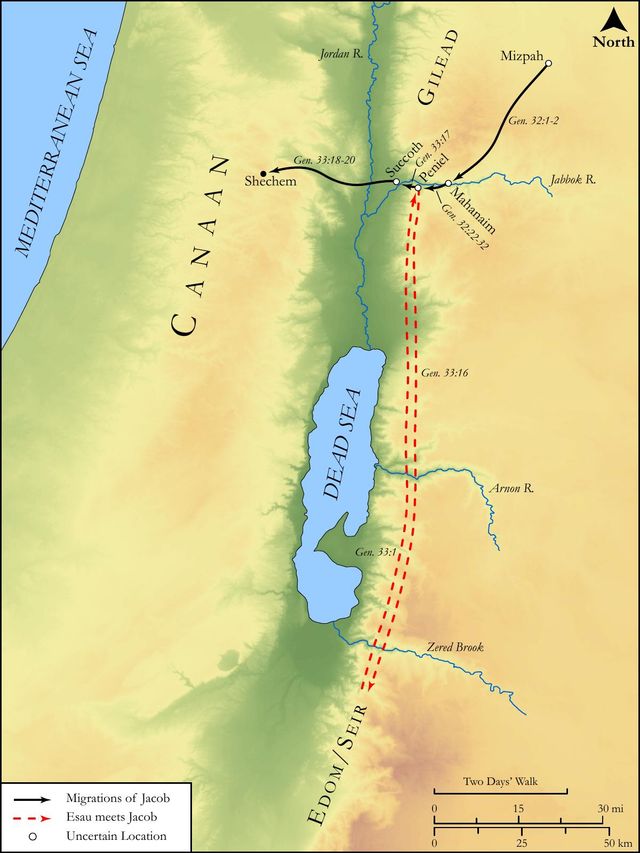
See on the biblical-era map


Study this verse
Public-domain commentary
Matthew Henry
From his Commentary on the Whole Bible. Henry comments on passages, not single verses — this entry covers Genesis 33:5–15. His three-level outline is real structure in the source text, so it is rendered as structure.
We have here the discourse between the two brothers at their meeting, which is very free and friendly, without the least intimation of the old quarrel. It was the best way to say nothing of it. They converse,
I.About Jacob's retinue, Gen 33:5-7.
Eleven or twelve little ones, the eldest of them no fourteen years old, followed Jacob closely: Who are these? says Esau. Jacob had sent him an account of the increase of his estate (Gen 32:5), but made no mention of his children; perhaps because he would not expose them to his rage if he should meet him as an enemy, or would please him with the unexpected sight if he should meet him as a friend: Esau therefore had reason to ask, Who are those with thee? to which common question Jacob returns a serious answer, such as became his character: They are the children which God hath graciously given they servant. It had been a sufficient answer to the question, and fit enough to be given to profane Esau, if he had only said, "They are my children;" but then Jacob would not have spoken like himself, like a man whose eyes were ever towards the Lord. Note, It becomes us not only to do common actions, but to speak of them, after a godly sort, Jo3 1:6. Jacob speaks of his children,
1.As God's gifts; they are a heritage of the Lord, Psa 128:3; Psa 112:9; Psa 107:41.
2.As choice gifts; he hath graciously given them. Though they were many, and now much his care, and as yet but slenderly provided for, yet he accounts them great blessings. His wives and children, hereupon, come up in order, and pay their duty to Esau, as he had done before them (Gen 33:6, Gen 33:7); for it becomes the family to show respect to those to whom the master of the family shows respect.
II.About the present he had sent him.
1.Esau modestly refused it because he had enough, and did not need it, Gen 33:9. Note, Those who wish to be considered men of honour will not seem to be mercenary in their friendship: whatever influence Jacob's present had upon Esau to pacify him, he would not have it thought that it had any, and therefore he refused it. His reason is I have enough, I have much (so the word is), so much that he was not willing to take any thing that was his brother's. Note,
(1.)Many that come short of spiritual blessings, and are out of covenant, yet have much of this world's wealth. Esau had what was promised him, the fatness of the earth and a livelihood by his sword.
(2.)It is a good thing for those that have much to know that they have enough, though they have not so much as some others have. Even Esau can say, I have enough.
(3.)Those that are content with what they have must show it by not coveting what others have. Esau, for his part, needs it not, either to supply him, for he was rich, or to pacify him, for he was reconciled: we should take heed lest at any time our covetousness impose upon the courtesy of others, and meanly take advantage of their generosity.
2.Jacob affectionately urges him to accept it, and prevails, Gen 33:10, Gen 33:11. Jacob sent it, through fear (Gen 32:20), but, the fear being over, he now importunes his acceptance of it for love, to show that he desired his brother's friendship, and did not merely dread his wrath; two things he urges: - (1.) The satisfaction he had in his brother's favour, of which he thought himself bound to make this thankful acknowledgment. It is a very high compliment that he passes upon him: I have seen thy face, as though I had seen the face of God, that is, "I have seen thee reconciled to me, and at peace with me, as I desire to see God reconciled." Or the meaning is that Jacob saw God's favour to him in Esau's: it was a token for good to him that God had accepted his prayers. Note, Creature-comforts are comforts indeed to us when they are granted as answers to prayer, and are tokens of our acceptance with God. Again, It is matter of great joy to those that are of a peaceable and affectionate disposition to recover the friendship of those relations with whom they have been at variance. (2.) The competency he had of this world's goods: God has dealt graciously with me. Note, If what we have in this world increase under our hands, we must take notice of it with thankfulness, to the glory of God, and own that therein he has dealt graciously with us, better than we deserve. It is he that gives power to get wealth, Deu 8:18. He adds, "And I have enough; I have all," so the word is. Esau's enough was much, but Jacob's enough was all. Note, a godly man, though he have but little in the world, yet may truly say, "I have all," [1.] Because he has the God of all, and has all in him; all is yours if you be Christ's, Co1 3:22. [2.] Because he has the comfort of all. I have all, and abound, Phi 4:18. He that thinks he has all is sure he has enough. He has all in prospect; he will have all shortly, when he comes to heaven: upon this principle Jacob urged Esau, and he took his present. Note, It is an excellent thing when men's religion makes them generous, free-hearted, and open-handed, scorning to do a thing that is paltry and sneaking.
III.About the progress of their journey.
1.Esau offers himself to be his guide and companion, in token of sincere reconciliation, Gen 33:12. We never find that Jacob and Esau were so sociable with one another, and so affectionate, as they were now. Note, As for God his work is perfect. He made Esau, not only not an enemy, but a friend. This bone that had been broken, being well set, became stronger than ever. Esau has become fond of Jacob's company, courts him to Mount Seir: let us never despair of any, nor distrust God in whose hand all hearts are. Yet Jacob saw cause modestly to refuse this offer (Gen 33:13, Gen 33:14), wherein he shows a tender concern for his own family and flocks, like a good shepherd and a good father. He must consider the children, and the flocks, with young, and not lead the one, nor drive the other, too fast. This prudence and tenderness of Jacob ought to be imitated by those that have the care and charge of young people in the things of God. They must not be over-driven, at first, by heavy tasks in religious services, but led, as they can bear, having their work made as easy to them as possible. Christ, the good Shepherd, does so, Isa 40:11. Now Jacob will not desire Esau to slacken his pace, nor force his family to quicken theirs, nor leave them, to keep company with his brother, as many would have done, that love any society better than their own house; but he desires Esau to march before, and promises to follow him leisurely, as he could get forward. Note, It is an unreasonable thing to tie others to our rate; we may come with comfort, at last, to the same journey's end, though we do not journey together, either in the same path or with the same pace. There may be those with whom we cannot fall in and yet with whom we need not fall out by the way. Jacob intimates to him that it was his present design to come to him to Mount Seir; and we may presume he did so, after he had settled his family and concerns elsewhere, though that visit is not recorded. Note, When we have happily recovered peace with our friends we must take care to cultivate it, and not to be behind-hand with them in civilities.
2.Esau offers some of his men to be his guard and convoy, Gen 33:15. He saw Jacob but poorly attended, no servants but his husbandmen and shepherds, no pages or footmen; and therefore, thinking he was as desirous as himself (if he could afford it) to take state upon him, and look great, he would needs lend him some of his retinue, to attend upon him, that he might appear like Esau's brother; but Jacob humbly refuses his offer, only desiring he would not take it amiss that he did not accept it: What needeth it?
(1.)Jacob is humble, and needs it not for state; he desires not to make a fair show in the flesh, by encumbering himself with a needless retinue. Note, It is the vanity of pomp and grandeur that they are attended with a great deal of which it may be said, What needeth it?
(2.)Jacob is under the divine protection, and needs it not for safety. Note, Those are sufficiently guarded that have God for their guard and are under a convoy of his hosts, as Jacob was. Those need not be beholden to an arm of flesh that have God for their arm every morning. Jacob adds, "Only let me find grace in the sight of my lord; having thy favour, I have all I need, all I desire from thee." If Jacob thus valued the good-will of a brother, much more reason have we to reckon that we have enough if we have the good-will of our God.
Continue studying Genesis 33:13 across the web’s major study libraries — every link below opens this exact verse, chapter, or book on the destination site.
Read & Compare
 BibleGatewayThis verse in more than 200 translations and 70 languages.
 Bible.comThe YouVersion reader — hundreds of translations, reading plans, and highlights.
 ESV.orgCrossway's official English Standard Version reader.
 NET BibleThe NET translation with 60,000+ translators' notes on every rendering decision.
 STEP BibleTyndale House's free study tool — original text, vocabulary, and scholarly resources.
 BibliaLogos Bible Software's free web reader.
 USCCBThe New American Bible (Revised Edition) with the U.S. bishops' study notes.
Commentaries
 BibleHub CommentariesDozens of classic commentaries on this verse, gathered on one page.
 StudyLightMore than 100 commentary sets — the largest collection on the web.
 BibleRefPlain-English commentary on what this verse means, verse by verse.
 Enduring WordDavid Guzik's free commentary on this chapter, widely used by Bible teachers.
 Bible Study ToolsVerse commentary alongside Greek and Hebrew study aids.
Original Language & Research
- BibleHub InterlinearThe verse word by word — original language, transliteration, and English.
- BibleHub LexiconEvery word's original-language definition and Strong's entry.
 Blue Letter BibleDeep-study tools — Strong's numbers, concordance, and word studies.
 SefariaThe Hebrew text with Rashi and centuries of Jewish commentary.
Sermons, Hymns & Audio


TrulyRandomVerse is not affiliated with these sites and doesn’t control their content. They’re linked because they’re genuinely useful.
Summary
Genesis 33:13 presents Jacob's sagacious and compassionate response to Esau's offer of shared travel, revealing his profound commitment to the welfare of his vulnerable family and livestock. Jacob articulates the delicate condition of his young children and nursing animals, emphasizing the catastrophic risk of traveling at a rapid pace, thereby prioritizing their safety and well-being over social expediency or personal convenience. This verse underscores Jacob's responsible leadership and his deep understanding of the limitations of those under his care.
Context
ShowHideLiterary Context
This verse is situated at a pivotal moment in the narrative of Jacob and Esau's reconciliation. Following twenty years of separation and Jacob's intense fear of his brother's potential vengeance, the brothers' reunion in Genesis 33:1-11 is surprisingly tender and emotional. Esau, instead of hostility, greets Jacob with an embrace. After exchanging pleasantries and gifts, Esau proposes that they travel together back to Seir. Jacob's response in Genesis 33:13 is a careful and diplomatic refusal, setting the stage for their eventual geographical separation, with Jacob heading to Succoth and Esau returning to Seir. This passage highlights Jacob's continued prudence and strategic thinking, even in moments of reconciliation.
Historical & Cultural Context
In the ancient Near East, nomadic and semi-nomadic peoples like Jacob's household relied heavily on their livestock for sustenance, wealth, and mobility. Traveling with large flocks, especially those with young, was a slow and arduous process. Young children and nursing animals were particularly vulnerable to the rigors of travel, including fatigue, injury, and disease, which could be exacerbated by forced marches. The patriarchal society placed a high value on the protection and propagation of one's lineage and possessions. Jacob's concern for his "tender" children and "flocks and herds with young" reflects the very real challenges and responsibilities of a tribal leader in that era, where the loss of livestock could mean economic ruin and the loss of children, a profound personal and communal tragedy.
Key Themes
ShowHideGenesis 33:13 contributes significantly to several overarching themes within the book of Genesis and the broader biblical narrative. It reinforces the theme of divine providence and protection, as Jacob, having wrestled with God and man (Genesis 32:22-32), now demonstrates practical wisdom in safeguarding his family, a testament to God's continued care for His covenant people. The verse also highlights the theme of responsible leadership and stewardship, showcasing Jacob's devotion to those entrusted to his care, contrasting with potential self-interest. Furthermore, it subtly underscores the theme of reconciliation and boundaries, as Jacob, while accepting Esau's goodwill, wisely establishes a practical boundary that preserves the well-being of his dependents, allowing for a peaceful, albeit separate, future for the brothers, as implied by their eventual divergence in Genesis 36:6-8.
Exposition and Analysis
ShowHideKey Word Analysis
ShowHideThis word describes something soft, delicate, or weak. In the context of "children," it emphasizes their physical fragility, susceptibility to hardship, and inability to endure strenuous travel. It conveys their need for gentle care and protection, highlighting Jacob's paternal concern.
A primitive root meaning "to knock" or, by analogy, "to press severely." Here, it vividly portrays the act of forcing animals beyond their natural capacity or endurance. It implies a harsh, relentless pace that would inflict undue stress and harm, leading to severe consequences for the vulnerable flock.
A primitive root meaning "to die" (literally or figuratively), or causatively, "to kill." In this verse, it represents the ultimate, catastrophic consequence of overdriving the flock. It is a stark and absolute term, underscoring the irreversible nature of the potential loss and emphasizing the gravity of Jacob's concern for his animals' lives.
Verse Breakdown
ShowHide"And he said unto him,"
This simple introductory phrase sets the stage for Jacob's diplomatic and carefully considered response to Esau's invitation. It signals a shift from Esau's offer to Jacob's counter-proposal, demonstrating Jacob's agency and thoughtful communication.
"My lord knoweth that the children [are] tender,"
Jacob begins by acknowledging Esau's understanding and status ("My lord knoweth"), a respectful and deferential opening that softens his subsequent refusal. He then immediately states the primary reason for his inability to keep pace: the delicate nature of his young children, who cannot endure a rapid or strenuous journey. This highlights Jacob's prioritization of his family's well-being.
"and the flocks and herds with young [are] with me:"
Jacob further elaborates on the vulnerability of his traveling party, including the nursing livestock. This refers to ewes, cows, and other animals that have recently given birth and are still suckling their young. Both the mothers and their offspring are particularly fragile and susceptible to stress, fatigue, and illness if pushed too hard, making a fast journey impractical and dangerous.
"and if men should overdrive them one day,"
This clause presents a hypothetical but dire scenario. Jacob explains that even a single day of forced, rapid travel—being "overdriven" or pushed beyond their limits—would have devastating consequences. This demonstrates Jacob's foresight and his understanding of the delicate balance required in managing a large, vulnerable caravan.
"all the flock will die."
This stark and absolute statement reveals the extreme risk involved. Jacob is not merely concerned about discomfort or minor loss but about the total annihilation of his livestock. This emphasizes the gravity of his situation and the profound responsibility he feels for the lives of his animals, which are both his wealth and a vital part of his household's survival.
Literary Devices
ShowHideJacob's response in Genesis 33:13 employs several effective literary devices. The most prominent is Hyperbole, seen in the phrase "all the flock will die." While overdriving could certainly lead to significant losses, the absolute statement "all" serves to dramatically emphasize the severity of the potential outcome and the extreme risk Jacob perceives. This rhetorical exaggeration underscores his deep concern and the non-negotiable nature of his priorities. Additionally, there is an element of Foreshadowing of potential disaster if prudence is not exercised, creating a sense of urgency and validating Jacob's cautious approach. The entire verse also functions as a form of Diplomacy, where Jacob respectfully but firmly states his limitations, acknowledging Esau's position ("My lord knoweth") while clearly articulating his own constraints, a masterful use of language to navigate a sensitive social situation without causing offense.
Theological and Thematic Connections
ShowHideJacob's prudent and compassionate response in Genesis 33:13 offers profound theological insights into responsible leadership and the divine value of vulnerable life. His prioritization of the "tender" children and "flocks and herds with young" over personal convenience or social pressure reflects a divinely inspired wisdom that aligns with God's own character. This passage underscores the biblical mandate for stewardship, not only of human life but also of creation, demonstrating that true leadership involves discerning the limitations of those under one's care and acting with foresight to protect them from harm. It portrays a leader who understands that rushing can lead to catastrophic loss, emphasizing patience and a deep commitment to the well-being of the led.
Reflection and Application
ShowHideGenesis 33:13 provides timeless principles for our contemporary lives, urging us to cultivate a spirit of responsible stewardship and compassionate leadership. Like Jacob, we are called to be acutely aware of the limitations and vulnerabilities of those entrusted to our care—whether our children, elderly parents, employees, or even the natural resources God has placed under our dominion. This verse challenges us to resist the societal pressure to always move faster, to prioritize efficiency over well-being, or to compromise safety for convenience. True wisdom often lies in slowing down, assessing the capacity of the weakest among us, and making decisions that protect and preserve, even if it means foregoing immediate opportunities or social expectations. It reminds us that neglecting the "tender" aspects of our lives, or "overdriving" ourselves or others, can lead to irreparable harm. Ultimately, Jacob's example encourages us to lead with empathy, patience, and a deep commitment to the flourishing of all life under our influence, reflecting the heart of God for His creation.
Questions for Reflection
ShowHideFAQ
ShowHideWhy did Jacob not simply accept Esau's offer to travel together?
ShowHideJacob's refusal was not born of distrust or lingering fear, but of profound practical wisdom and responsible leadership. He recognized that his "tender" children (H3206, yeled) and nursing livestock (H5763, ʻûwl) could not keep pace with Esau's experienced men without severe risk to their health and even their lives. His statement that "if men should overdrive (H1849, dâphaq) them one day, all the flock will die (H4191, mûwth)" underscores the absolute necessity of a slower pace. His priority was the well-being of his vulnerable dependents, demonstrating a commitment to stewardship over social convenience or perceived obligation. This decision allowed for a peaceful separation, preventing potential conflict or hardship that a forced march might have caused, as they eventually parted ways, with Jacob settling in Succoth and Esau returning to Seir (Genesis 33:17-18).
Christ-Centered Fulfillment
ShowHideJacob's tender care for the "tender" children and vulnerable flocks in Genesis 33:13 beautifully foreshadows the compassionate heart of Christ, the ultimate Good Shepherd. Just as Jacob prioritized the weak and slow, Jesus consistently demonstrates profound care for the vulnerable, the weary, and the burdened, inviting them to find rest in Him, declaring, "Come to me, all who labor and are heavy laden, and I will give you rest" (Matthew 11:28-30). He does not "overdrive" His flock but leads them gently by still waters and restores their souls (Psalm 23:2-3). Christ, as the embodiment of divine wisdom and love, lays down His life for His sheep, ensuring their ultimate protection and salvation (John 10:11). His concern for His "little ones" is absolute, for it is not the will of the Father that one of them should perish (Matthew 18:14). Jacob's prudence prefigures the perfect, self-sacrificial care of the Savior, who understands our limitations and shepherds us with infinite patience and grace.