


Genesis 28:2
- קוּםkumariseH6965V-Qal-Imp-2msVerb Qal Imperative 2nd Singular Masculine
- לֵךְleKhgoH1980V-Qal-Imp-2msVerb Qal Imperative 2nd Singular Masculine
- פַּדֶּנָהpa·De·nahPaddan towardsH6307N-proper ¦ SfxNoun Proper LocationפַּדֶּנָPaddanהtowards
- אֲרָם'a·RamAramH758N-properNoun Proper Location
- בֵּיתָהBei·tah[the] house of towardsH1004N-msc ¦ SfxNoun Singular Masculine Constructבֵּיתָ[the] house ofהtowards
- בְתוּאֵלve·tu·'ElBethuelH1328N-proper-mNoun Proper Masculine
- אֲבִי'a·Vi[the] father ofH1N-mscNoun Singular Masculine Construct
- אִמֶּךָ'i·Me·khayour motherH517N-fsc ¦ 2msNoun Singular Feminine Constructאִמֶּmotherךָyour
- וְקַחve·kachand takeH3947Conj-w ¦ V-Qal-Imp-2msVerb Qal Imperative 2nd Singular Masculineוְandקַחtake
- לְךָle·Khafor <the> yourselfPrep-l ¦ 2msSuffix Personal 2nd Singular Masculineלְfor <the>ךָyourself
- מִשָּׁםmi·Shamfrom thereH8033Prep-m ¦ AdvAdverbמִfromשָּׁםthere
- אִשָּׁה'i·Shaha wifeH802N-fsNoun Singular Feminine Absolute
- מִבְּנוֹתmi·be·Notone of [the] daughters ofH1323Prep-m ¦ N-fpcNoun Plural Feminine Constructמִone ofבְּנוֹת[the] daughters of
- לָבָןla·VanLabanH3837N-proper-mNoun Proper Masculine
- אֲחִי'a·Chi[the] brother ofH251N-mscNoun Singular Masculine Construct
- אִמֶּךָ'i·Me·khayour motherH517N-fsc ¦ 2msNoun Singular Feminine Constructאִמֶּmotherךָyour
English is a literal word-by-word gloss of the Hebrew, not the KJV's wording. Why?
This is the original text the KJV's translators worked from — each Hebrew word with its own literal English meaning in this verse, prepared by scholars at Tyndale House, Cambridge. The KJV translates whole sentences, not word by word, so its wording differs: one Hebrew word can become several English words, and the KJV may choose “the LORD” where the gloss reads “Yahweh”. Both are faithful — they answer different questions. For the KJV's own rendering, switch to the KJV text.
Details
See on the biblical-era maps


Study this verse
Public-domain commentary
Matthew Henry
From his Commentary on the Whole Bible. Henry comments on passages, not single verses — this entry covers Genesis 28:1–5. His three-level outline is real structure in the source text, so it is rendered as structure.
Jacob had no sooner obtained the blessing than immediately he was forced to flee from his country; and, as it if were not enough that he was a stranger and sojourner there, he must go to be more so, and no better than an exile, in another country. Now Jacob fled into Syria, Hos 12:12. He was blessed with plenty of corn and wine, and yet he went away poor, was blessed with government, and yet went out to service, a hard service. This was, 1. Perhaps to correct him for his dealing fraudulently with his father. The blessing shall be confirmed to him, and yet he shall smart for the indirect course he took to obtain it. While there is such an alloy as there is of sin in our duties, we must expect an alloy of trouble in our comforts. However, 2. It was to teach us that those who inherit the blessing must expect persecution; those who have peace in Christ shall have tribulation in the world, Joh 16:33. Being told of his before, we must not think it strange, and, being assured of a recompence hereafter, we must not think it hard. We may observe, likewise, that God's providences often seem to contradict his promises, and to go cross to them; and yet, when the mystery of God shall be finished, we shall see that all was for the best, and that cross providences did but render the promises and the accomplishment of them the more illustrious. Now Jacob is here dismissed by his father,
I.With a solemn charge:
He blessed him, and charged him, Gen 28:1, Gen 28:2. Note, Those that have the blessing must keep the charge annexed to it, and not think to separate what God has joined. The charge is like that in Co2 6:14, Be not unequally yoked with unbelievers; and all that inherit the promises of the remission of sins, and the gift of the Holy Ghost, must keep this charge, which follows those promises, Save yourselves from this untoward generation, Act 2:38-40. Those that are entitled to peculiar favours must be a peculiar people. If Jacob be an heir of promise, he must not take a wife of the daughters of Canaan; those that profess religion should not marry those that are irreligious.
II.With a solemn blessing, Gen 28:3, Gen 28:4.
He had before blessed him unwittingly; now he does it designedly, for the greater encouragement of Jacob in that melancholy condition to which he was now removing. This blessing is more express and full than the former; it is an entail of the blessing of Abraham, that blessing which was poured on the head of Abraham like the anointing oil, thence to run down to his chosen seed, as the skirts of his garments. It is a gospel blessing, the blessing of church-privileges, that is the blessing of Abraham, which upon the Gentiles through faith, Gal 3:14. It is a blessing from God Almighty, by which name God appeared to the patriarchs, Exo 6:3. Those are blessed indeed whom God Almighty blesses; for he commands and effects the blessing. Two great promises Abraham was blessed with, and Isaac here entails them both upon Jacob.
1.The promise of heirs: God make thee fruitful, and multiply thee, Gen 28:3.
(1.)Through his loins should descend from Abraham that people who should be numerous as the stars of heaven, and the sand of the sea, and who should increase more than the rest of the nations, so as to be an assembly of people, as the margin reads it. And never was such a multitude of people so often gathered into one assembly as the tribes of Israel were in the wilderness, and afterwards.
(2.)Through his loins should descend from Abraham that person in whom all the families of the earth should be blessed, and to whom the gathering of the people should be. Jacob had in him a multitude of people indeed, for all things in heaven and earth are united in Christ (Eph 1:10), all centre in him, that corn of wheat, which falling to the ground, produced much fruit, Joh 12:24.
2.The promise of an inheritance for those heirs: That thou mayest inherit the land of thy sojournings, Gen 28:4. Canaan was hereby entailed upon the seed of Jacob, exclusive of the seed of Esau. Isaac was now sending Jacob away into a distant country, to settle there for some time; and, lest this should look like disinheriting him, he here confirms the settlement of it upon him, that he might be assured that the discontinuance of his possession should be no defeasance of his right. Observe, He is here told that he should inherit the land wherein he sojourned. Those that are sojourners now shall be heirs for ever: and, even now, those do most inherit the earth (though they do not inherit most of it) that are most like strangers in it. Those have the best enjoyment of present things that sit most loose to them. This promise looks as high as heaven, of which Canaan was a type. This was the better country, which Jacob, with the other patriarchs, had in his eye, when he confessed himself a stranger and pilgrim upon the earth, Heb 11:13.
Jacob, having taken leave of his father, was hastened away with all speed, lest his brother should find an opportunity to do him a mischief, and away he went to Padan-aram, Gen 28:5. How unlike was his taking a wife thence to his father's! Isaac had servants and camels sent to fetch his; Jacob must go himself, go alone, and go afoot, to fetch his: he must go too in a fright from his father's house, not knowing when he might return. Note, If God, in his providence, disable us, we must be content, though we cannot keep up the state and grandeur of our ancestors. We should be more in care to maintain their piety than to maintain their dignity, and to be as good as they were than to be as great. Rebekah is here called Jacob's and Esau's mother. Jacob is named first, not only because he had always been his mother's darling, but because he was now make his father's heir, and Esau was, in this sense, set aside. Note, The time will come when piety will have precedency, whatever it has now.
Historical interpretation
Historical reception
1 surviving comment on this verse from the historical church.
When the lesson was read just now, dearly beloved, we heard that in reply to holy Rebekah’s plea Isaac called his son Jacob and told him to proceed to Mesopotamia of Syria and take a wife from there. Jacob departed in humble obedience to his father and on the way came to a certain place where he put a stone under his head and went to sleep. In his slumber he saw a ladder extending to heaven with angels of God ascending and descending on it, while the Lord leaned on the ladder and said to him, “Jacob, Jacob, do not be afraid, I am with you, and I will be the companion of your journey.” Now when blessed Isaac directed his son to Mesopotamia, dearly beloved, Isaac represented a type of God the Father, while Jacob signified Christ the Lord. Disregarding the women of the region in which he lived, blessed Isaac sent his son into a distant country to take a wife, because God the Father would reject the synagogue of Jews and send his only-begotten Son to form a church out of the Gentiles. This was fulfilled in truth when the apostles said to the Jews, “It was necessary that the Word of God should be spoken to you first, but since you judge yourselves unworthy of eternal life, behold, we now turn to the Gentiles.”
Continue studying Genesis 28:2 across the web’s major study libraries — every link below opens this exact verse, chapter, or book on the destination site.
Read & Compare
 BibleGatewayThis verse in more than 200 translations and 70 languages.
 Bible.comThe YouVersion reader — hundreds of translations, reading plans, and highlights.
 ESV.orgCrossway's official English Standard Version reader.
 NET BibleThe NET translation with 60,000+ translators' notes on every rendering decision.
 STEP BibleTyndale House's free study tool — original text, vocabulary, and scholarly resources.
 BibliaLogos Bible Software's free web reader.
 USCCBThe New American Bible (Revised Edition) with the U.S. bishops' study notes.
Commentaries
 BibleHub CommentariesDozens of classic commentaries on this verse, gathered on one page.
 StudyLightMore than 100 commentary sets — the largest collection on the web.
 BibleRefPlain-English commentary on what this verse means, verse by verse.
 Enduring WordDavid Guzik's free commentary on this chapter, widely used by Bible teachers.
 Bible Study ToolsVerse commentary alongside Greek and Hebrew study aids.
Original Language & Research
- BibleHub InterlinearThe verse word by word — original language, transliteration, and English.
- BibleHub LexiconEvery word's original-language definition and Strong's entry.
 Blue Letter BibleDeep-study tools — Strong's numbers, concordance, and word studies.
 SefariaThe Hebrew text with Rashi and centuries of Jewish commentary.
Sermons, Hymns & Audio


TrulyRandomVerse is not affiliated with these sites and doesn’t control their content. They’re linked because they’re genuinely useful.
Summary
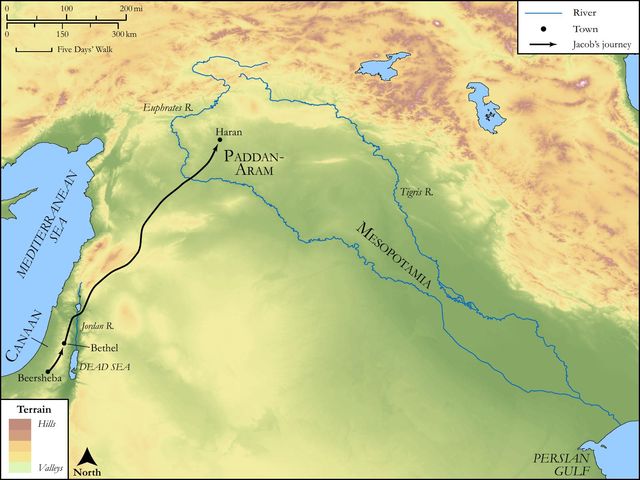
Genesis 28:2 records Isaac's definitive instruction to Jacob, commanding him to journey to Padanaram, specifically to the household of his maternal grandfather Bethuel and his uncle Laban, for the express purpose of securing a wife from among his kin. This directive is a crucial moment in the patriarchal narrative, designed to safeguard the integrity of the Abrahamic covenant lineage and to underscore the profound importance of parental authority and wise counsel in pivotal life decisions, particularly marriage, as Jacob embarks on a perilous flight from his brother Esau.
Context
ShowHideLiterary Context
This verse immediately follows Isaac's blessing of Jacob, a blessing obtained through deception, and Rebekah's urgent counsel for Jacob to flee from Esau's murderous wrath. Genesis 27 details the intricate web of family dynamics leading to this point. Isaac's command in Genesis 28:1 sets the stage, where he blesses Jacob and explicitly forbids him from marrying a Canaanite woman, reinforcing the covenantal purity. Verse 2 then specifies the destination and the purpose of the journey, intertwining the practical necessity of escape with the spiritual imperative of a proper marriage. This instruction also echoes the earlier narrative of Abraham sending his servant to find a wife for Isaac from their own people, demonstrating a consistent patriarchal concern for lineage.
Historical & Cultural Context
In the ancient Near East, marriage was rarely a purely individual choice; it was a communal and familial affair, particularly for prominent families. Marrying within one's kin (endogamy) was a common practice, serving multiple purposes: preserving family wealth and property, maintaining social status, and, crucially for the patriarchs, safeguarding ethnic and religious identity. The Canaanites, with their polytheistic and often immoral practices, posed a significant spiritual threat to the nascent covenant community. Esau's earlier marriages to Hittite women, which were "a grief of mind to Isaac and to Rebekah" (Genesis 26:35), highlighted the dangers of exogamy. Padanaram, or Paddan-Aram, located in Mesopotamia, was the ancestral homeland of Rebekah, making it the natural place to seek a suitable, non-Canaanite spouse.
Key Themes
ShowHideGenesis 28:2 contributes significantly to several overarching themes in the book of Genesis. The primary theme is the preservation of the Abrahamic covenant lineage, emphasizing the distinctness of God's chosen people and the importance of maintaining spiritual purity through marriage. This verse also highlights parental authority and guidance in major life decisions, showcasing Isaac and Rebekah's unified concern for Jacob's future and the covenant's continuation. Furthermore, it subtly underscores divine providence, as even amid human deception and family strife, God's plan for Jacob to be the heir of the covenant is advanced through this specific directive. The journey itself also foreshadows Jacob's pilgrimage and transformation, a recurring motif in his life.
Exposition and Analysis
ShowHideGenesis 28:2 is a concise yet profoundly significant command from Isaac to Jacob, outlining the immediate next steps in Jacob's life, which are deeply intertwined with the future of the Abrahamic covenant.
Key Word Analysis
ShowHideThis imperative verb (H6965) signifies not merely to stand up, but to "rise up" with purpose, to "get up" and begin a significant action or journey. In this context, it conveys urgency and the initiation of a momentous undertaking, marking a decisive turning point in Jacob's life. It implies a call to action, a departure from the current situation.
The verb (H3947) means "to take" in a broad sense, including to acquire, to fetch, or to receive. Here, it specifically refers to the act of acquiring a wife, emphasizing the active role Jacob is to play in securing his spouse from his kin, a process that would involve negotiation and agreement within the family structure. This "taking" is not forceful but a formal acquisition within established cultural norms.
This feminine noun (H1323) refers to female offspring. In this context, "daughters of Laban" specifies the pool of potential wives for Jacob. The use of "daughters" rather than a singular "daughter" implies that Laban had multiple eligible female children, allowing for a choice (though the narrative will show it was not entirely Jacob's choice). This term reinforces the familial connection and the specific lineage from which Jacob is to marry.
Verse Breakdown
ShowHide"Arise, go to Padanaram,"
This is Isaac's immediate and urgent command, initiating Jacob's journey. "Arise" (קוּם, qûwm) implies a decisive and purposeful departure, while "go" (הָלַךְ, yâlak) directs his movement. Padanaram (פַּדָּן אֲרָם, Paddân ʼĂrâm) is identified as the destination, a region in Mesopotamia, the ancestral home of Rebekah's family. This geographical specification underscores the deliberate nature of the journey and its connection to his mother's kin.
"to the house of Bethuel thy mother's father;"
This clause further refines the destination, pinpointing the specific household within Padanaram. Bethuel (בְּתוּאֵל, Bᵉthûwʼêl) is identified as Jacob's maternal grandfather, making the destination a family residence. This detail highlights the importance of familial ties and the expectation of hospitality and support from his mother's side of the family.
"and take thee a wife from thence of the daughters of Laban thy mother's brother."
This final clause states the explicit purpose of the journey: to secure a wife. The instruction specifies that the wife must come "from thence," meaning from Padanaram, and more precisely, from "the daughters of Laban" (לָבָן, Lâbân), who is identified as Jacob's maternal uncle. This ensures that Jacob marries within his extended family, preserving the purity of the covenant lineage and avoiding marriage to Canaanite women, a concern that had previously caused distress to Isaac and Rebekah.
Literary Devices
ShowHideThe verse employs several literary devices to convey its urgency and significance. The primary device is Command/Imperative, as Isaac issues direct, forceful instructions ("Arise, go," "take"). This highlights his patriarchal authority and the non-negotiable nature of the directive. There is also a subtle use of Repetition through the emphasis on familial relationships: "mother's father" and "mother's brother." This reiteration underscores the importance of kinship and the specific lineage from which Jacob is to marry, reinforcing the theme of covenant preservation. Furthermore, the journey to Padanaram carries Symbolism; it is not merely a physical escape but a symbolic pilgrimage to secure the future of the covenant, marking a transition from Jacob's deceptive past to his future as the patriarch through whom God's promises will be fulfilled.
Theological and Thematic Connections
ShowHideGenesis 28:2 profoundly illustrates the intricate interplay between human decisions and divine sovereignty in the unfolding of God's redemptive plan. While Isaac's command is a human directive, it aligns perfectly with God's overarching purpose to establish His covenant through a distinct and pure lineage. The emphasis on endogamous marriage for Jacob, contrasting sharply with Esau's choices, underscores the biblical principle of separation for God's chosen people, a separation not merely ethnic but spiritual, designed to preserve the integrity of the lineage through whom the Messiah would eventually come. This passage reveals that marriage, especially for the patriarchs, was not just a personal union but a foundational act for the continuation of the covenant, directly impacting the spiritual trajectory of future generations and the fulfillment of God's promises.
Reflection and Application
ShowHideGenesis 28:2 offers enduring wisdom for believers today, particularly concerning the intentionality and wisdom required in life's most significant decisions, especially marriage. It powerfully illustrates the profound impact a spouse has on one's spiritual heritage, family legacy, and the potential for God's purposes to unfold through one's life. While modern marital customs differ from the patriarchal arranged marriages, the underlying principles remain vitally relevant: the importance of seeking wise counsel from trusted spiritual mentors and family, and, most importantly, diligent prayer and guidance from God, when choosing a life partner. Jacob's journey, though initiated by flight from Esau, was simultaneously an act of obedience that positioned him to receive God's continued blessings and contribute to the unfolding of the Abrahamic covenant, reminding us that obedience, even in difficult circumstances, often leads to divine favor and the fulfillment of God's plans for our lives.
Questions for Reflection
ShowHideFAQ
ShowHideWhy was it so important for Jacob to marry within his family?
ShowHideIt was critically important for Jacob to marry within his family to preserve the purity and distinctness of the Abrahamic covenant lineage. God had chosen Abraham's descendants to be a unique people through whom His promises, including the coming Messiah, would be fulfilled. Marrying outside this kin, particularly with the idolatrous Canaanites, risked spiritual assimilation, the adoption of foreign gods, and the dilution of the covenant identity. This concern is explicitly seen in Genesis 26:34-35, where Esau's marriages to Hittite women caused "grief of mind" to his parents, Isaac and Rebekah, highlighting the negative spiritual consequences of such unions.
Does this passage advocate for arranged marriages in contemporary society?
ShowHideWhile Genesis 28:2 describes an arranged marriage within a specific cultural and covenantal context of the ancient Near East, it does not mandate arranged marriages for all believers today. Instead, it highlights timeless principles that transcend cultural methods of spouse selection. The passage underscores the importance of parental wisdom, seeking God's guidance in significant life decisions like marriage, and choosing a spouse who shares one's core spiritual beliefs and values. The emphasis is on the purpose—preserving a unified spiritual heritage and honoring God's design for marriage—rather than the method of spouse selection. For believers today, the principle of being "unequally yoked" (2 Corinthians 6:14) remains paramount.
Christ-Centered Fulfillment
ShowHideGenesis 28:2, with its meticulous focus on preserving the covenant lineage through a divinely guided marriage, ultimately serves as a powerful foreshadowing of God's faithfulness in preparing the way for the ultimate "seed" of Abraham—Jesus Christ. Jacob's journey to secure a wife from his own kin was a vital, providential step in maintaining the pure, distinct genealogical line through which the Messiah would eventually be born. The careful attention given to this marriage underscores God's sovereign oversight of the entire redemptive history, ensuring that the promised deliverer would come through the chosen lineage. Christ, as the true heir of the Abrahamic covenant, fulfills all its promises, not merely for one family or nation, but for all who believe, bringing spiritual blessings and eternal life through His atoning work on the cross (Galatians 3:16 and Galatians 3:29). He is the one who ultimately takes away the sin of the world (John 1:29) and establishes a new covenant, making all who are in Him children of God, regardless of their earthly lineage (John 1:12-13).