


Genesis 28:4
Bible text: King James Version (1769 Blayney text) · Public domain
Bible text: King James Version with Strong's numbers · Public domain
Bible text: Berean Standard Bible · Public domain
Bible text: American Standard Version (1901) · Public domain
Bible text: World English Bible, Messianic edition · Public domain
Bible text: Geneva Bible (1599) · Public domain
Bible text: Young's Literal Translation · Public domain
- וְיִתֶּןve·yi·tenand may he giveH5414Conj-w ¦ V-Qal-ConjImperf-3msVerb Qal Conjunction+Imperfect 3rd Singular Masculineוְandיִתֶּןmay he give
- לְךָle·Khato <the> youPrep-l ¦ 2msSuffix Personal 2nd Singular Masculineלְto <the>ךָyou
- אֶת'et<obj.>H853DirObjMParticle Object Indicator
- בִּרְכַּתbir·Kat[the] blessing ofH1293N-fscNoun Singular Feminine Construct
- אַבְרָהָם'av·ra·HamAbrahamH85N-proper-mNoun Proper Masculine
- לְךָle·Khato youPrep-l ¦ 2msSuffix Personal 2nd Singular Masculineלְtoךָyou
- וּלְזַרְעֲךָu·le·zar·'a·Khaand to your offspringH2233Conj-w ¦ Prep-l ¦ N-msc ¦ 2msNoun Singular Masculine Constructוּandלְtoזַרְעֲoffspringךָyour
- אִתָּךְ'i·Takhwith youH854Prep ¦ 2msPreposition Definiteאִתָּwithךְyou
- לְרִשְׁתְּךָle·rish·te·Khato take possession of youH3423Prep-l ¦ V-Qal-Inf ¦ 2msVerb Qal Infinitive Constructלְtoרִשְׁתְּtake possession ofךָyou
- אֶת'et<obj.>H853DirObjMParticle Object Indicator
- אֶרֶץ'E·retz[the] land ofH776N-fscNoun Singular Feminine Construct
- מְגֻרֶיךָme·gu·Rei·khayour sojourningsH4033N-mpc ¦ 2msNoun Plural Masculine Constructמְגֻרֶיsojourningsךָyour
- אֲשֶׁר'a·SherwhichH834RelParticle Relative
- נָתַןna·Tanhe gaveH5414V-Qal-Perf-3msVerb Qal Perfect 3rd Singular Masculine
- אֱלֹהִים'E·lo·HimGodH430N-mpNoun Plural Masculine Absolute
- לְאַבְרָהָםle·'av·ra·Hamto AbrahamH85Prep-l ¦ N-proper-mNoun Proper MasculineלְtoאַבְרָהָםAbraham
English is a literal word-by-word gloss of the Hebrew, not the KJV's wording. Why?
This is the original text the KJV's translators worked from — each Hebrew word with its own literal English meaning in this verse, prepared by scholars at Tyndale House, Cambridge. The KJV translates whole sentences, not word by word, so its wording differs: one Hebrew word can become several English words, and the KJV may choose “the LORD” where the gloss reads “Yahweh”. Both are faithful — they answer different questions. For the KJV's own rendering, switch to the KJV text.
Details
See on the biblical-era maps


Study this verse
Public-domain commentary
Matthew Henry
From his Commentary on the Whole Bible. Henry comments on passages, not single verses — this entry covers Genesis 28:1–5. His three-level outline is real structure in the source text, so it is rendered as structure.
Jacob had no sooner obtained the blessing than immediately he was forced to flee from his country; and, as it if were not enough that he was a stranger and sojourner there, he must go to be more so, and no better than an exile, in another country. Now Jacob fled into Syria, Hos 12:12. He was blessed with plenty of corn and wine, and yet he went away poor, was blessed with government, and yet went out to service, a hard service. This was, 1. Perhaps to correct him for his dealing fraudulently with his father. The blessing shall be confirmed to him, and yet he shall smart for the indirect course he took to obtain it. While there is such an alloy as there is of sin in our duties, we must expect an alloy of trouble in our comforts. However, 2. It was to teach us that those who inherit the blessing must expect persecution; those who have peace in Christ shall have tribulation in the world, Joh 16:33. Being told of his before, we must not think it strange, and, being assured of a recompence hereafter, we must not think it hard. We may observe, likewise, that God's providences often seem to contradict his promises, and to go cross to them; and yet, when the mystery of God shall be finished, we shall see that all was for the best, and that cross providences did but render the promises and the accomplishment of them the more illustrious. Now Jacob is here dismissed by his father,
I.With a solemn charge:
He blessed him, and charged him, Gen 28:1, Gen 28:2. Note, Those that have the blessing must keep the charge annexed to it, and not think to separate what God has joined. The charge is like that in Co2 6:14, Be not unequally yoked with unbelievers; and all that inherit the promises of the remission of sins, and the gift of the Holy Ghost, must keep this charge, which follows those promises, Save yourselves from this untoward generation, Act 2:38-40. Those that are entitled to peculiar favours must be a peculiar people. If Jacob be an heir of promise, he must not take a wife of the daughters of Canaan; those that profess religion should not marry those that are irreligious.
II.With a solemn blessing, Gen 28:3, Gen 28:4.
He had before blessed him unwittingly; now he does it designedly, for the greater encouragement of Jacob in that melancholy condition to which he was now removing. This blessing is more express and full than the former; it is an entail of the blessing of Abraham, that blessing which was poured on the head of Abraham like the anointing oil, thence to run down to his chosen seed, as the skirts of his garments. It is a gospel blessing, the blessing of church-privileges, that is the blessing of Abraham, which upon the Gentiles through faith, Gal 3:14. It is a blessing from God Almighty, by which name God appeared to the patriarchs, Exo 6:3. Those are blessed indeed whom God Almighty blesses; for he commands and effects the blessing. Two great promises Abraham was blessed with, and Isaac here entails them both upon Jacob.
1.The promise of heirs: God make thee fruitful, and multiply thee, Gen 28:3.
(1.)Through his loins should descend from Abraham that people who should be numerous as the stars of heaven, and the sand of the sea, and who should increase more than the rest of the nations, so as to be an assembly of people, as the margin reads it. And never was such a multitude of people so often gathered into one assembly as the tribes of Israel were in the wilderness, and afterwards.
(2.)Through his loins should descend from Abraham that person in whom all the families of the earth should be blessed, and to whom the gathering of the people should be. Jacob had in him a multitude of people indeed, for all things in heaven and earth are united in Christ (Eph 1:10), all centre in him, that corn of wheat, which falling to the ground, produced much fruit, Joh 12:24.
2.The promise of an inheritance for those heirs: That thou mayest inherit the land of thy sojournings, Gen 28:4. Canaan was hereby entailed upon the seed of Jacob, exclusive of the seed of Esau. Isaac was now sending Jacob away into a distant country, to settle there for some time; and, lest this should look like disinheriting him, he here confirms the settlement of it upon him, that he might be assured that the discontinuance of his possession should be no defeasance of his right. Observe, He is here told that he should inherit the land wherein he sojourned. Those that are sojourners now shall be heirs for ever: and, even now, those do most inherit the earth (though they do not inherit most of it) that are most like strangers in it. Those have the best enjoyment of present things that sit most loose to them. This promise looks as high as heaven, of which Canaan was a type. This was the better country, which Jacob, with the other patriarchs, had in his eye, when he confessed himself a stranger and pilgrim upon the earth, Heb 11:13.
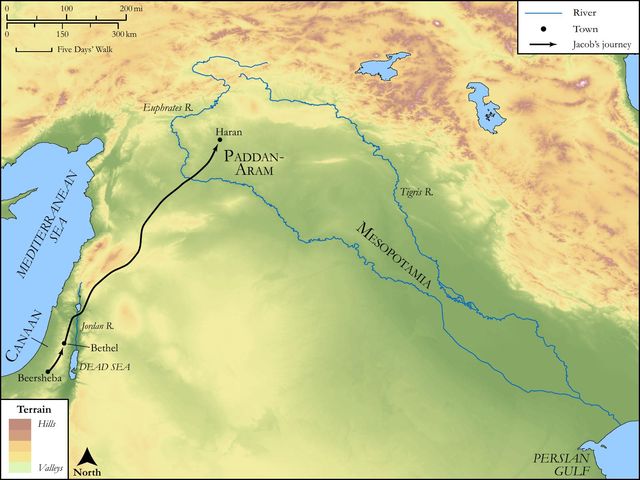
Jacob, having taken leave of his father, was hastened away with all speed, lest his brother should find an opportunity to do him a mischief, and away he went to Padan-aram, Gen 28:5. How unlike was his taking a wife thence to his father's! Isaac had servants and camels sent to fetch his; Jacob must go himself, go alone, and go afoot, to fetch his: he must go too in a fright from his father's house, not knowing when he might return. Note, If God, in his providence, disable us, we must be content, though we cannot keep up the state and grandeur of our ancestors. We should be more in care to maintain their piety than to maintain their dignity, and to be as good as they were than to be as great. Rebekah is here called Jacob's and Esau's mother. Jacob is named first, not only because he had always been his mother's darling, but because he was now make his father's heir, and Esau was, in this sense, set aside. Note, The time will come when piety will have precedency, whatever it has now.
Historical interpretation
Historical reception
1 surviving comment on this verse from the historical church.
See how this good man foretells everything to him and gives Jacob sufficient support for his comfort by forecasting to him his return and possession of the land and the fact that not only will he grow into a multitude but also that a league of nations will come from his descendants. On hearing this the young man carried out his father’s wishes and traveled to Meso-potamia to his mother’s brother, Laban.… Do you see, dearly beloved, how much perspicacity this loving mother showed in rescuing Jacob from danger by supplying a plausible excuse for his journey, neither highlighting Esau’s wickedness nor revealing the reason to the father but giving appropriate advice to her son so that he might be persuaded through fear to accept what was said by her and propose a convincing plan to his father? Hence the good man went along with what she said and sent Jacob on his way after plying him with his blessings.
Continue studying Genesis 28:4 across the web’s major study libraries — every link below opens this exact verse, chapter, or book on the destination site.
Read & Compare
 BibleGatewayThis verse in more than 200 translations and 70 languages.
 Bible.comThe YouVersion reader — hundreds of translations, reading plans, and highlights.
 ESV.orgCrossway's official English Standard Version reader.
 NET BibleThe NET translation with 60,000+ translators' notes on every rendering decision.
 STEP BibleTyndale House's free study tool — original text, vocabulary, and scholarly resources.
 BibliaLogos Bible Software's free web reader.
 USCCBThe New American Bible (Revised Edition) with the U.S. bishops' study notes.
Commentaries
 BibleHub CommentariesDozens of classic commentaries on this verse, gathered on one page.
 StudyLightMore than 100 commentary sets — the largest collection on the web.
 BibleRefPlain-English commentary on what this verse means, verse by verse.
 Enduring WordDavid Guzik's free commentary on this chapter, widely used by Bible teachers.
 Bible Study ToolsVerse commentary alongside Greek and Hebrew study aids.
Original Language & Research
- BibleHub InterlinearThe verse word by word — original language, transliteration, and English.
- BibleHub LexiconEvery word's original-language definition and Strong's entry.
 Blue Letter BibleDeep-study tools — Strong's numbers, concordance, and word studies.
 SefariaThe Hebrew text with Rashi and centuries of Jewish commentary.
Sermons, Hymns & Audio


TrulyRandomVerse is not affiliated with these sites and doesn’t control their content. They’re linked because they’re genuinely useful.
Summary
Genesis 28:4 records Isaac's profound blessing upon Jacob, a pivotal moment transmitting the full scope of the Abrahamic covenant. This blessing, bestowed as Jacob flees from Esau, meticulously reiterates the promise of a numerous seed, the inheritance of the promised land, and the divine origin of these assurances, underscoring God's unwavering faithfulness and the continuity of His redemptive plan through the chosen lineage, even in circumstances of uncertainty and displacement.
Context
ShowHideLiterary Context
Genesis 28:4 is an integral part of Isaac's final, formal blessing upon Jacob, occurring immediately after Jacob, at Rebekah's urging, prepares to flee to Haran to escape the murderous rage of his brother Esau. Having already deceptively secured the birthright and the primary patriarchal blessing in Genesis 27, Jacob now receives a distinct, deliberate blessing from Isaac that explicitly connects him to the covenant promises made to Abraham. This particular verse serves as a direct and intentional transfer of the Abrahamic covenant, solidifying Jacob's position as the chosen heir of God's promises, even as he departs from the land of promise. It sets the theological stage for Jacob's subsequent encounter with God at Bethel in Genesis 28:10-22, where God personally reaffirms these very promises to him.
Historical & Cultural Context
In the family of Abraham, patriarchal blessings were highly significant, carrying legal, social, and spiritual weight. They were considered irrevocable and determinative for the recipient's future and destiny. The act of bestowing a blessing was a formal declaration, often under divine inspiration, that conferred authority, prosperity, and the continuation of the family line and its heritage. The concept of "inheritance" (H3423, yârash) was crucial, referring not just to material possessions but to the full legacy, including the family's identity and divine favor. The "land" (H776, ʼerets) was not merely territory but a sacred space, central to God's covenant with Abraham. Being a "stranger" or sojourner (H4033, mâgûwr) was a common status for patriarchs like Abraham, Isaac, and Jacob, highlighting their transient existence in the promised land before its full possession, emphasizing reliance on God's future fulfillment.
Key Themes
ShowHideThis verse powerfully reinforces several key themes prevalent throughout Genesis and the Pentateuch. The theme of Covenant Continuity is paramount, demonstrating God's unwavering commitment to His promises across generations, from Abraham to Isaac and now to Jacob, despite human failings and deceptive actions. It highlights Divine Election and Sovereignty, as God's choice of Jacob as the covenant heir is reaffirmed through Isaac's inspired blessing, irrespective of Jacob's merit or immediate circumstances. The Promise of Land is central, serving as a tangible sign of God's faithfulness and the future inheritance of His people, a theme that resonates throughout the narrative of Israel's formation and eventual entry into Canaan. Furthermore, the emphasis on "seed" (H2233, zeraʻ) underscores the theme of Generational Blessing and Future Descendants, pointing not only to the vast multitude that would become the nation of Israel but also prophetically to the singular "Seed" through whom all nations would be blessed, a concept further developed in the New Testament (e.g., Galatians 3:16).
Exposition and Analysis
ShowHideKey Word Analysis
ShowHideFrom the root bârak (to kneel, to bless), this term signifies a divine benediction, an impartation of favor, prosperity, and well-being. Here, it is not merely a wish but a prophetic declaration and transfer of the comprehensive covenantal promises given to Abraham, encompassing spiritual favor, material prosperity, and the continuation of a divinely favored lineage.
This word literally means "seed" or "sperm," but figuratively it refers to offspring, descendants, or posterity. In the context of the Abrahamic covenant, it carries immense theological weight, referring to the numerous progeny that would form a great nation, and prophetically, to the singular "Seed" (Christ) through whom the ultimate blessings of the covenant would be realized.
This primitive root means "to occupy (by driving out previous tenants, and possessing in their place)," or "to seize, to rob, to inherit." It implies taking possession of something previously held by another, or receiving a legacy. In this verse, it speaks to the future, divinely guaranteed possession of the land of Canaan by Jacob and his descendants, despite their current status as sojourners.
This term denotes a "temporary abode" or "pilgrimage," and by extension, one who sojourns or is a temporary resident without permanent ownership. Jacob, like his father and grandfather, is a sojourner in the land promised to him, highlighting the tension between the present reality of non-possession and the future certainty of divine fulfillment.
Verse Breakdown
ShowHide"And give thee the blessing of Abraham,"
This opening clause establishes the core purpose of Isaac's utterance: to formally transfer the full scope of the covenant promises made to Abraham. It is a deliberate and authoritative act, signifying that Jacob, not Esau, is the chosen heir to the divine legacy. This "blessing" (H1293, Bᵉrâkâh) is comprehensive, encompassing all aspects of God's promises to Abraham—a great name, numerous descendants, and the land.
"to thee, and to thy seed with thee;"
This phrase emphasizes the generational nature of the covenant. The promises are not solely for Jacob as an individual but are explicitly extended to his future descendants (H2233, zeraʻ). This ensures the continuity of the lineage through whom God's redemptive purposes would unfold, leading to the formation of the nation of Israel and, ultimately, the Messiah.
"that thou mayest inherit the land wherein thou art a stranger,"
This clause specifies a key component of the Abrahamic covenant: the promise of the land of Canaan (H776, ʼerets). Despite Jacob's current status as a "stranger" (H4033, mâgûwr) or sojourner, without fixed possession, the blessing assures him and his descendants of future, permanent ownership and inheritance (H3423, yârash). This highlights the theme of God's ultimate fulfillment of His promises, even when immediate circumstances appear contradictory.
"which God gave unto Abraham."
This concluding phrase underscores the divine origin and unchangeable nature of the promise. It is not a human wish or a mere patriarchal custom, but a divinely ordained inheritance, rooted in God's sovereign gift (H5414, nâthan) to Abraham (H85, ʼAbrâhâm). This reinforces the reliability and certainty of the covenant, emphasizing that God Himself (H430, ʼĕlôhîym) is the ultimate guarantor of its fulfillment.
Literary Devices
ShowHideGenesis 28:4 employs several potent literary devices. The most prominent is Covenant Language, as Isaac's words directly echo and reaffirm the promises made to Abraham in earlier chapters, specifically the land and seed promises. This repetition reinforces the continuity and immutability of God's covenant. There is also clear Foreshadowing, particularly in the mention of "seed," which not only points to the multitude of Jacob's descendants but also prophetically anticipates the singular "Seed" (Christ) through whom the ultimate blessings would flow. The contrast between Jacob being a "stranger" and the promise that he "mayest inherit the land" creates a powerful Juxtaposition, highlighting the tension between present reality and future divine promise, a theme central to the pilgrim journey of faith. The "land" itself functions as a Symbolism of God's faithfulness and the tangible manifestation of His covenant promises, representing security, identity, and divine presence.
Theological and Thematic Connections
ShowHideGenesis 28:4 is a profound theological statement on God's unwavering commitment to His covenant promises, demonstrating His faithfulness across generations despite human flaws and circumstances. It underscores the divine initiative in election, as God sovereignly chooses His instruments for the unfolding of His redemptive plan, ensuring the continuity of the covenant line from Abraham to Isaac and now to Jacob. The promise of land and seed are not merely material or demographic; they are foundational to the establishment of God's people and the eventual arrival of the Messiah, through whom the blessing would extend to all nations. This verse also introduces the tension of the pilgrim life—being a sojourner in the present while holding fast to the future, divinely guaranteed inheritance, a theme that resonates deeply with the Christian experience of living in this world but belonging to another.
Reflection and Application
ShowHideGenesis 28:4 offers profound assurance of God's steadfast faithfulness to His promises, even when our personal circumstances are uncertain or challenging, much like Jacob's flight from Esau. It encourages believers to trust in God's timing and His sovereign plan, recognizing that His word will ultimately be fulfilled, regardless of present difficulties or our own imperfections. For us today, this verse reminds us that God's covenant promises, ultimately fulfilled in Jesus Christ, are reliable and extend to all who are in Christ, who are considered the spiritual "seed of Abraham" by faith. It calls us to live with patience, hope, and unwavering confidence in the God who keeps His word across generations, embracing our own journey as spiritual sojourners who await a promised inheritance that is far greater than any earthly land. This passage challenges us to see beyond our immediate struggles and fix our gaze on the eternal promises of God.
Questions for Reflection
ShowHideFAQ
ShowHideWhat is the "blessing of Abraham" mentioned here?
ShowHideThe "blessing of Abraham" refers to the comprehensive covenant promises God made to Abraham, first detailed in Genesis 12:1-3. These promises included: a great nation descending from him, a great name for himself, blessings upon those who blessed him and curses upon those who cursed him, and crucially, that "in you all the families of the earth shall be blessed." It also encompassed the promise of the land of Canaan as an everlasting possession for his descendants (Genesis 17:8). In Genesis 28:4, Isaac is formally transferring this entire package of divine promises and favor to Jacob, designating him as the next heir in the lineage through whom God's redemptive plan would continue.
Why is the land so important in this blessing, given that Jacob is fleeing it?
ShowHideThe land of Canaan (H776, ʼerets) is a tangible and central component of the Abrahamic covenant, repeatedly promised to Abraham and his descendants (Genesis 13:15). Even though Jacob is fleeing the land, Isaac's blessing reiterates the promise of future inheritance (H3423, yârash) to underscore God's unwavering faithfulness. It highlights that the current circumstances of being a "stranger" (H4033, mâgûwr) are temporary, and God's ultimate plan for His people to possess the land remains certain. The land represents not just territory, but the place where God's people would dwell, form a nation, and from whom the Messiah would come, making it integral to the unfolding of God's redemptive history.
Christ-Centered Fulfillment
ShowHideGenesis 28:4, with its emphasis on the "blessing of Abraham" extending to Jacob's "seed" and the promise of "inheriting the land," finds its ultimate and most profound fulfillment in Jesus Christ. The "seed" (H2233, zeraʻ) is not merely a multitude of physical descendants, but as Paul clarifies in Galatians 3:16, it refers preeminently to Christ himself: "Now to Abraham and his seed were the promises made. He saith not, And to seeds, as of many; but as of one, And to thy seed, which is Christ." Through Christ, the blessing of Abraham—which is the blessing of justification by faith—is extended to all nations, fulfilling the universal scope of God's original promise (Galatians 3:8). Furthermore, the promise of "inheriting the land" transcends its earthly, geographical dimension in Christ. Believers, who are "in Christ," become the spiritual "seed of Abraham" (Galatians 3:29) and are heirs not merely to a physical land, but to a spiritual, eternal inheritance—the new heavens and new earth, the heavenly Jerusalem (Hebrews 11:13-16 and Revelation 21:1-4). Thus, Jacob's blessing foreshadows the greater, spiritual blessings and the eternal inheritance secured for all believers through the finished work of Christ, the true heir of all God's promises.