


Genesis 28:5
Bible text: King James Version (1769 Blayney text) · Public domain
Bible text: King James Version with Strong's numbers · Public domain
Bible text: Berean Standard Bible · Public domain
Bible text: American Standard Version (1901) · Public domain
Bible text: World English Bible, Messianic edition · Public domain
Bible text: Geneva Bible (1599) · Public domain
Bible text: Young's Literal Translation · Public domain
- וַיִּשְׁלַחvai·yish·Lachand he sent offH7971Conj-w ¦ V-Qal-ConsecImperf-3msVerb Qal Consecutive Imperfect 3rd Singular Masculineוַandיִּשְׁלַחhe sent off
- יִצְחָקyitz·ChakIsaacH3327N-proper-mNoun Proper Masculine
- אֶת'et<obj.>H853DirObjMParticle Object Indicator
- יַעֲקֹבya·'a·KoJacobH3290N-proper-mNoun Proper Masculine
- וַיֵּלֶךְvai·Ye·lekhand he wentH1980Conj-w ¦ V-Qal-ConsecImperf-3msVerb Qal Consecutive Imperfect 3rd Singular Masculineוַandיֵּלֶךְhe went
- פַּדֶּנָהpa·De·nahPaddan towardsH6307N-proper ¦ SfxNoun Proper LocationפַּדֶּנָPaddanהtowards
- אֲרָם'a·RamAramH758N-properNoun Proper Location
- אֶל'eltoH413PrepPreposition
- לָבָןla·VanLabanH3837N-proper-mNoun Proper Masculine
- בֶּןben[the] son ofH1121N-mscNoun Singular Masculine Construct
- בְּתוּאֵלbe·tu·'ElBethuelH1328N-proper-mNoun Proper Masculine
- הָאֲרַמִּיha·'a·ra·Mithe ArameanH761Art ¦ N-msNoun Gentilic Singular Masculine AbsoluteהָtheאֲרַמִּיAramean
- אֲחִי'a·Chi[the] brother ofH251N-mscNoun Singular Masculine Construct
- רִבְקָהriv·KahRebekahH7259N-proper-fNoun Proper Feminine
- אֵם'em[the] mother ofH517N-fscNoun Singular Feminine Construct
- יַעֲקֹבya·'a·KoJacobH3290N-proper-mNoun Proper Masculine
- וְעֵשָׂוve·'e·Savand EsauH6215Conj-w ¦ N-proper-mNoun Proper MasculineוְandעֵשָׂוEsau
English is a literal word-by-word gloss of the Hebrew, not the KJV's wording. Why?
This is the original text the KJV's translators worked from — each Hebrew word with its own literal English meaning in this verse, prepared by scholars at Tyndale House, Cambridge. The KJV translates whole sentences, not word by word, so its wording differs: one Hebrew word can become several English words, and the KJV may choose “the LORD” where the gloss reads “Yahweh”. Both are faithful — they answer different questions. For the KJV's own rendering, switch to the KJV text.
Details
See on the biblical-era maps


Study this verse
Public-domain commentary
Matthew Henry
From his Commentary on the Whole Bible. Henry comments on passages, not single verses — this entry covers Genesis 28:1–5. His three-level outline is real structure in the source text, so it is rendered as structure.
Jacob had no sooner obtained the blessing than immediately he was forced to flee from his country; and, as it if were not enough that he was a stranger and sojourner there, he must go to be more so, and no better than an exile, in another country. Now Jacob fled into Syria, Hos 12:12. He was blessed with plenty of corn and wine, and yet he went away poor, was blessed with government, and yet went out to service, a hard service. This was, 1. Perhaps to correct him for his dealing fraudulently with his father. The blessing shall be confirmed to him, and yet he shall smart for the indirect course he took to obtain it. While there is such an alloy as there is of sin in our duties, we must expect an alloy of trouble in our comforts. However, 2. It was to teach us that those who inherit the blessing must expect persecution; those who have peace in Christ shall have tribulation in the world, Joh 16:33. Being told of his before, we must not think it strange, and, being assured of a recompence hereafter, we must not think it hard. We may observe, likewise, that God's providences often seem to contradict his promises, and to go cross to them; and yet, when the mystery of God shall be finished, we shall see that all was for the best, and that cross providences did but render the promises and the accomplishment of them the more illustrious. Now Jacob is here dismissed by his father,
I.With a solemn charge:
He blessed him, and charged him, Gen 28:1, Gen 28:2. Note, Those that have the blessing must keep the charge annexed to it, and not think to separate what God has joined. The charge is like that in Co2 6:14, Be not unequally yoked with unbelievers; and all that inherit the promises of the remission of sins, and the gift of the Holy Ghost, must keep this charge, which follows those promises, Save yourselves from this untoward generation, Act 2:38-40. Those that are entitled to peculiar favours must be a peculiar people. If Jacob be an heir of promise, he must not take a wife of the daughters of Canaan; those that profess religion should not marry those that are irreligious.
II.With a solemn blessing, Gen 28:3, Gen 28:4.
He had before blessed him unwittingly; now he does it designedly, for the greater encouragement of Jacob in that melancholy condition to which he was now removing. This blessing is more express and full than the former; it is an entail of the blessing of Abraham, that blessing which was poured on the head of Abraham like the anointing oil, thence to run down to his chosen seed, as the skirts of his garments. It is a gospel blessing, the blessing of church-privileges, that is the blessing of Abraham, which upon the Gentiles through faith, Gal 3:14. It is a blessing from God Almighty, by which name God appeared to the patriarchs, Exo 6:3. Those are blessed indeed whom God Almighty blesses; for he commands and effects the blessing. Two great promises Abraham was blessed with, and Isaac here entails them both upon Jacob.
1.The promise of heirs: God make thee fruitful, and multiply thee, Gen 28:3.
(1.)Through his loins should descend from Abraham that people who should be numerous as the stars of heaven, and the sand of the sea, and who should increase more than the rest of the nations, so as to be an assembly of people, as the margin reads it. And never was such a multitude of people so often gathered into one assembly as the tribes of Israel were in the wilderness, and afterwards.
(2.)Through his loins should descend from Abraham that person in whom all the families of the earth should be blessed, and to whom the gathering of the people should be. Jacob had in him a multitude of people indeed, for all things in heaven and earth are united in Christ (Eph 1:10), all centre in him, that corn of wheat, which falling to the ground, produced much fruit, Joh 12:24.
2.The promise of an inheritance for those heirs: That thou mayest inherit the land of thy sojournings, Gen 28:4. Canaan was hereby entailed upon the seed of Jacob, exclusive of the seed of Esau. Isaac was now sending Jacob away into a distant country, to settle there for some time; and, lest this should look like disinheriting him, he here confirms the settlement of it upon him, that he might be assured that the discontinuance of his possession should be no defeasance of his right. Observe, He is here told that he should inherit the land wherein he sojourned. Those that are sojourners now shall be heirs for ever: and, even now, those do most inherit the earth (though they do not inherit most of it) that are most like strangers in it. Those have the best enjoyment of present things that sit most loose to them. This promise looks as high as heaven, of which Canaan was a type. This was the better country, which Jacob, with the other patriarchs, had in his eye, when he confessed himself a stranger and pilgrim upon the earth, Heb 11:13.
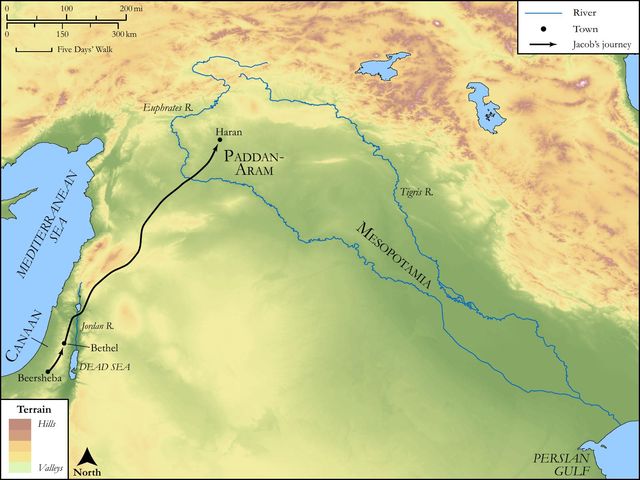
Jacob, having taken leave of his father, was hastened away with all speed, lest his brother should find an opportunity to do him a mischief, and away he went to Padan-aram, Gen 28:5. How unlike was his taking a wife thence to his father's! Isaac had servants and camels sent to fetch his; Jacob must go himself, go alone, and go afoot, to fetch his: he must go too in a fright from his father's house, not knowing when he might return. Note, If God, in his providence, disable us, we must be content, though we cannot keep up the state and grandeur of our ancestors. We should be more in care to maintain their piety than to maintain their dignity, and to be as good as they were than to be as great. Rebekah is here called Jacob's and Esau's mother. Jacob is named first, not only because he had always been his mother's darling, but because he was now make his father's heir, and Esau was, in this sense, set aside. Note, The time will come when piety will have precedency, whatever it has now.
Continue studying Genesis 28:5 across the web’s major study libraries — every link below opens this exact verse, chapter, or book on the destination site.
Read & Compare
 BibleGatewayThis verse in more than 200 translations and 70 languages.
 Bible.comThe YouVersion reader — hundreds of translations, reading plans, and highlights.
 ESV.orgCrossway's official English Standard Version reader.
 NET BibleThe NET translation with 60,000+ translators' notes on every rendering decision.
 STEP BibleTyndale House's free study tool — original text, vocabulary, and scholarly resources.
 BibliaLogos Bible Software's free web reader.
 USCCBThe New American Bible (Revised Edition) with the U.S. bishops' study notes.
Commentaries
 BibleHub CommentariesDozens of classic commentaries on this verse, gathered on one page.
 StudyLightMore than 100 commentary sets — the largest collection on the web.
 BibleRefPlain-English commentary on what this verse means, verse by verse.
 Enduring WordDavid Guzik's free commentary on this chapter, widely used by Bible teachers.
 Bible Study ToolsVerse commentary alongside Greek and Hebrew study aids.
Original Language & Research
- BibleHub InterlinearThe verse word by word — original language, transliteration, and English.
- BibleHub LexiconEvery word's original-language definition and Strong's entry.
 Blue Letter BibleDeep-study tools — Strong's numbers, concordance, and word studies.
 SefariaThe Hebrew text with Rashi and centuries of Jewish commentary.
Sermons, Hymns & Audio


TrulyRandomVerse is not affiliated with these sites and doesn’t control their content. They’re linked because they’re genuinely useful.
Summary
Genesis 28:5 details the pivotal moment of Jacob's departure from Canaan, initiated by his father Isaac, as he journeys to Padanaram. This journey, undertaken to find a wife from his mother Rebekah's family, marks a significant turning point in Jacob's life, shaping his personal destiny and profoundly influencing the future lineage of the covenant people of Israel.
Context
ShowHideLiterary Context
Genesis 28:5 is situated immediately after Isaac's final instructions and blessing upon Jacob in Genesis 28:1-4. This verse serves as the direct fulfillment of Isaac's command for Jacob to go to Padanaram to take a wife from among the daughters of Laban, Bethuel's son. The narrative flow highlights the urgency and purpose of Jacob's departure, driven by both parental instruction to secure a suitable marriage within their kin and Rebekah's earlier, more immediate concern for Jacob's safety from Esau's murderous intent, revealed in Genesis 27:41-45. Thus, this verse marks the commencement of Jacob's long sojourn away from the promised land, a period critical for his personal formation and the expansion of the patriarchal family.
Historical & Cultural Context
The practice of endogamy—marrying within one's kin group—was a crucial cultural norm in the time of the patriarchs, particularly for families like Abraham's, who sought to preserve their distinct identity, heritage, and religious purity. Isaac's insistence that Jacob not marry a Canaanite woman (Genesis 28:1) reflects this deep-seated concern, echoing Abraham's earlier directive for Isaac's own marriage in Genesis 24:3-4. Padanaram, meaning "the field of Aram," refers to the region of Mesopotamia where Haran was located, the ancestral homeland of Abraham's family before their migration to Canaan. Traveling to this distant land underscored the commitment to preserving the lineage and the covenant promises, despite the significant risks and hardships of such a journey in that era.
Key Themes
ShowHideThis verse contributes significantly to several overarching themes in Genesis. The theme of Divine Providence is evident, as God orchestrates events, even through human deception and familial conflict, to ensure the continuation of the covenant line. Jacob's journey, though prompted by his own actions and Esau's wrath, is ultimately guided by God's sovereign hand, leading him to the very place where he will meet his future wives and become the father of the twelve tribes. The theme of Covenant Preservation is also paramount, as Isaac's explicit instruction for Jacob to marry outside of Canaan reinforces the importance of maintaining the spiritual and cultural distinctiveness of Abraham's descendants. Furthermore, the theme of Exile and Transformation begins here, as Jacob's forced departure initiates a period of profound personal growth, divine encounters (like at Bethel in Genesis 28:10-22), and the shaping of his character, preparing him for his role as the patriarch of Israel.
Exposition and Analysis
ShowHideGenesis 28:5 succinctly describes the critical moment of Jacob's departure, a journey initiated by his father and driven by profound familial and covenantal imperatives.
Key Word Analysis
ShowHideThis verb (H7971) signifies a primitive root meaning "to send away, for, or out (in a great variety of applications)." In this context, it highlights Isaac's deliberate and authoritative action in dispatching Jacob. It implies not just a simple departure but an intentional commissioning, underscoring the weight of Isaac's patriarchal instruction and the purpose behind Jacob's journey—to secure a wife from his kin.
This primitive root (H3212) means "to walk (literally or figuratively); causatively, to carry." Here, it describes Jacob's immediate and direct obedience to Isaac's command. It emphasizes the physical act of setting out on a journey, marking the commencement of a long and transformative period of Jacob's life away from the land of Canaan.
Derived from a root meaning "to build," this noun (H1121) refers to a "son (as a builder of the family name), in the widest sense." Its repeated use in the verse ("son of Bethuel," "Jacob's and Esau's mother") underscores the genealogical focus and the critical importance of lineage within the patriarchal narratives. It highlights the family relationships that define Jacob's destination and the purpose of his journey: to continue the family line.
Verse Breakdown
ShowHide"And Isaac sent away Jacob:"
This opening clause establishes the primary agent and the immediate action. Isaac, as the patriarch, exercises his authority, dispatching Jacob. This "sending away" is both an act of protection (from Esau) and a directive for the continuation of the covenant line through a suitable marriage.
"and he went to Padanaram unto Laban,"
This clause describes Jacob's immediate response and destination. Jacob's obedience is swift, as he sets out for Padanaram, a specific region in Mesopotamia. His direct destination is Laban, his maternal uncle, indicating the familial purpose of his journey.
"son of Bethuel the Syrian,"
This phrase provides crucial genealogical detail, identifying Laban's father, Bethuel, and his ethnic origin as "the Syrian" (or Aramean). This reinforces the connection to Rebekah's family, emphasizing the non-Canaanite lineage from which Jacob is to take a wife, thereby maintaining the purity of the Abrahamic covenant line.
"the brother of Rebekah, Jacob's and Esau's mother."
This final clause meticulously clarifies the familial relationship, linking Laban directly to Rebekah, who is identified as the mother of both Jacob and Esau. This precise identification underscores the familial ties that are the basis for Jacob's journey and the preservation of the family's heritage.
Literary Devices
ShowHideThe verse employs Narrative Economy, conveying a significant turning point in a concise manner while packing in crucial details about characters, relationships, and geography. The use of Genealogical Detail is prominent, with the verse meticulously tracing familial connections ("son of Bethuel," "brother of Rebekah," "Jacob's and Esau's mother"), which serves to emphasize the importance of lineage and the preservation of the covenant family's distinct identity. The Geographical Specificity of "Padanaram" and the ethnic identifier "the Syrian" provide a concrete setting and cultural context, grounding the narrative in a historical reality and highlighting the distance and foreignness of Jacob's destination.
Theological and Thematic Connections
ShowHideGenesis 28:5 is a pivotal verse that encapsulates the intertwining of human decisions and divine purpose within the patriarchal narrative. While Jacob's departure is immediately prompted by his deception and Esau's wrath, it simultaneously serves God's overarching plan to preserve the covenant lineage and bring about His promises. Isaac's instruction for Jacob to marry outside of Canaanite women underscores the critical importance of maintaining the distinct spiritual and cultural heritage of Abraham's family, ensuring the purity of the line through which the Messiah would eventually come. This narrative powerfully illustrates God's sovereignty, demonstrating His ability to work through imperfect human agents and challenging circumstances to accomplish His redemptive will. Jacob's journey, born of necessity, becomes a crucible for his spiritual formation and a vital step in the unfolding of Israel's history.
Reflection and Application
ShowHideGenesis 28:5 offers profound insights into the nature of God's providence and the human journey. It reminds us that even when our lives are marked by missteps, difficult choices, or forced changes, God remains sovereign and continues to work His purposes through us and our circumstances. Jacob's departure, though a consequence of his own deceit, was also a divinely orchestrated step that led him to a period of profound spiritual growth and the establishment of the twelve tribes of Israel. This narrative encourages us to trust in God's overarching plan, even when our personal path is uncertain, challenging, or born out of less-than-ideal situations. It highlights the enduring significance of family, heritage, and the choices we make regarding them, as they can have long-lasting implications for future generations and the fulfillment of God's promises. We are called to recognize God's hand in our "sent away" moments, understanding that He can redeem and redirect our paths for His glory and our ultimate good.
Questions for Reflection
ShowHideFAQ
ShowHideWhy was Jacob sent to Padanaram specifically?
ShowHideJacob was sent to Padanaram for a dual purpose. Primarily, it was for his safety, to escape the murderous wrath of his brother Esau, as advised by Rebekah in Genesis 27:41-45. Secondarily, and equally important from Isaac's perspective, it was to find a wife from his mother's family, thereby avoiding marriage to Canaanite women and preserving the distinct spiritual and cultural lineage of Abraham's covenant, as instructed in Genesis 28:1-2.
Who was Bethuel the Syrian?
ShowHideBethuel was the father of Rebekah and Laban, making him Jacob's maternal grandfather. He is identified as "the Syrian" (or Aramean) because he resided in Aram (Syria), specifically the region of Padanaram. This identification emphasizes the non-Canaanite origin of Rebekah's family, from whom Isaac desired Jacob to take a wife, ensuring the continuation of the covenant line free from the influences of the idolatrous nations of Canaan.
Does Jacob's obedience to his parents here negate his earlier deception?
ShowHideWhile Jacob's prompt departure demonstrates obedience to his parents' instructions, it does not negate his earlier deception regarding the blessing. Instead, it illustrates God's profound ability to work through imperfect individuals and challenging circumstances. Jacob's journey is a direct consequence of his actions and Esau's reaction, but it is simultaneously a stage for God's redemptive plan to unfold. God uses this forced exile not only to protect Jacob but also to further His covenant purposes for Jacob and his descendants, highlighting His sovereignty over human sin and its consequences.
Christ-Centered Fulfillment
ShowHideGenesis 28:5, marking Jacob's journey into exile and separation from his homeland, serves as a powerful foreshadowing of the greater journey and ultimate "sending away" of Christ. Just as Jacob was sent forth from his family, albeit under fraught circumstances, Jesus Christ, the Son of God, willingly "sent himself away" from the infinite glory and communion of heaven to dwell among humanity, taking on the form of a servant (Philippians 2:6-8). His earthly sojourn, culminating in His suffering, death, and resurrection, was a journey of profound separation and sacrifice, undertaken not for personal gain or escape, but to secure a divine blessing for His people, far surpassing any earthly inheritance. Jacob's journey was providentially guided to establish the lineage through which the Messiah would come, but Christ's journey ensures the fulfillment of all God's promises, establishing a new covenant (Hebrews 8:6) and a spiritual lineage of believers (Galatians 3:29) far greater than any earthly one, bringing eternal redemption and true blessing to all who believe in Him.