


Genesis 33:17
Bible text: King James Version (1769 Blayney text) · Public domain
Bible text: Berean Standard Bible · Public domain
Bible text: American Standard Version (1901) · Public domain
Bible text: World English Bible, Messianic edition · Public domain
Bible text: Geneva Bible (1599) · Public domain
Bible text: Young's Literal Translation · Public domain
- וְיַעֲקֹבve·ya·'a·Koand JacobH3290Conj-w ¦ N-proper-mNoun Proper MasculineוְandיַעֲקֹבJacob
- נָסַעna·Sa'he set outH5265V-Qal-Perf-3msVerb Qal Perfect 3rd Singular Masculine
- סֻכֹּתָהsu·Ko·tahSuccoth towardsH5523N-proper ¦ SfxNoun Proper LocationסֻכֹּתָSuccothהtowards
- וַיִּבֶןvai·Yi·venand he builtH1129Conj-w ¦ V-Qal-ConsecImperf-3msVerb Qal Consecutive Imperfect 3rd Singular Masculineוַandיִּבֶןhe built
- לוֹlofor <the> himselfPrep-l ¦ 3msSuffix Personal 3rd Singular Masculineלfor <the>וֹhimself
- בָּיִתBa·yita houseH1004N-msNoun Singular Masculine Absolute
- וּלְמִקְנֵהוּu·le·mik·Ne·huand for his livestockH4735Conj-w ¦ Prep-l ¦ N-msc ¦ 3msNoun Singular Masculine Constructוּandלְforמִקְנֵlivestockהוּhis
- עָשָׂה'a·Sahhe madeH6213V-Qal-Perf-3msVerb Qal Perfect 3rd Singular Masculine
- סֻכֹּתsu·KotsheltersH5521N-fpNoun Plural Feminine Absolute
- עַל'althere-H5921PrepPreposition
- כֵּןken-foreH3651AdvAdverb
- קָרָאka·Ra'he calledH7121V-Qal-Perf-3msVerb Qal Perfect 3rd Singular Masculine
- שֵׁםshem[the] name ofH8034N-mscNoun Singular Masculine Construct
- הַמָּקוֹםha·ma·Komthe placeH4725Art ¦ N-msNoun Singular Masculine Absoluteהַtheמָּקוֹםplace
- סֻכּוֹתsu·KotSuccothH5523N-properNoun Proper Location
English is a literal word-by-word gloss of the Hebrew, not the KJV's wording. Why?
This is the original text the KJV's translators worked from — each Hebrew word with its own literal English meaning in this verse, prepared by scholars at Tyndale House, Cambridge. The KJV translates whole sentences, not word by word, so its wording differs: one Hebrew word can become several English words, and the KJV may choose “the LORD” where the gloss reads “Yahweh”. Both are faithful — they answer different questions. For the KJV's own rendering, switch to the KJV text.
Details
See on the biblical-era maps


Study this verse
Public-domain commentary
Matthew Henry
From his Commentary on the Whole Bible. Henry comments on passages, not single verses — this entry covers Genesis 33:16–20.
Here, 1. Jacob comes to Succoth. Having in a friendly manner parted with Esau, who had gone to his own country (Gen 33:16), he comes to a place where, it should seem, he rested for some time, set up booths for his cattle, and other conveniences for himself and family. The place was afterwards known by the name of Succoth, a city in the tribe of Gad, on the other side Jordan (it signifies booths), that when his posterity afterwards dwelt in houses of stone, they might remember that the Syrian ready to perish was their father, who was glad of booths (Deu 26:5); such was the rock whence they were hewn. 2. He comes to Shechem; we read it, to Shalem, a city of Shechem; the critics generally incline to read it appellatively: he came safely, or in peace, to the city of Shechem. After a perilous journey, in which he had met with many difficulties, he came safely, at last, into Canaan. Note, Diseases and dangers should teach us how to value health and safety, and should help to enlarge our hearts in thankfulness, when our going out and coming in have been signally preserved. Here, (1.) He buys a field, Gen 33:19. Though the land of Canaan was his by promise, yet, the time for taking possession not having yet come, he is content to pay for his own, to prevent disputes with the present occupants. Note, Dominion is not founded in grace. Those that have heaven on free-cost must not expect to have earth so. (2.) He builds an altar, Gen 33:20. [1.] In thankfulness to God, for the good hand of his providence over him. He did not content himself with verbal acknowledgments of God's favour to him, but made real ones: [2.] That he might keep up religion, and the worship of God, in his family. Note, Where we have a tent God must have an altar, where we have a house he must have a church in it. He dedicated this altar, where we have a house he must have a church in it. He dedicated this altar to the honour of El-elohe-Israel - God, the God of Israel, to the honour of God, in general, the only living and true God, the best of beings and first of causes; and to the honour of the God of Israel, as a God in covenant with him. Note, In our worship of God we must be guided and governed by the joint-discoveries both of natural and revealed religion. God had lately called him by the name of Israel, and now he calls God the God of Israel; though he is styled a prince with God, God shall still be a prince with him, his Lord and his God. Note, Our honours then become honours indeed to us when they are consecrated to God's honour; Israel's God is Israel's glory.
Historical interpretation
Historical reception
1 surviving comment on this verse from the historical church.
(Verse 17) And Jacob built a house there for himself, and he built shelters for his livestock; therefore he called the name of that place Tabernacles. Where we have tents, it is read in Hebrew as Sochoth. Furthermore, until today, there is a city beyond the Jordan with this name in the region of Scythopolis, about which we have written in the book of Joshua.
Continue studying Genesis 33:17 across the web’s major study libraries — every link below opens this exact verse, chapter, or book on the destination site.
Read & Compare
 BibleGatewayThis verse in more than 200 translations and 70 languages.
 Bible.comThe YouVersion reader — hundreds of translations, reading plans, and highlights.
 ESV.orgCrossway's official English Standard Version reader.
 NET BibleThe NET translation with 60,000+ translators' notes on every rendering decision.
 STEP BibleTyndale House's free study tool — original text, vocabulary, and scholarly resources.
 BibliaLogos Bible Software's free web reader.
 USCCBThe New American Bible (Revised Edition) with the U.S. bishops' study notes.
Commentaries
 BibleHub CommentariesDozens of classic commentaries on this verse, gathered on one page.
 StudyLightMore than 100 commentary sets — the largest collection on the web.
 BibleRefPlain-English commentary on what this verse means, verse by verse.
 Enduring WordDavid Guzik's free commentary on this chapter, widely used by Bible teachers.
 Bible Study ToolsVerse commentary alongside Greek and Hebrew study aids.
Original Language & Research
- BibleHub InterlinearThe verse word by word — original language, transliteration, and English.
- BibleHub LexiconEvery word's original-language definition and Strong's entry.
 Blue Letter BibleDeep-study tools — Strong's numbers, concordance, and word studies.
 SefariaThe Hebrew text with Rashi and centuries of Jewish commentary.
Sermons, Hymns & Audio


TrulyRandomVerse is not affiliated with these sites and doesn’t control their content. They’re linked because they’re genuinely useful.
Summary
Genesis 33:17 chronicles Jacob's strategic pause in his return journey to Canaan, immediately following his momentous reconciliation with Esau. At a location east of the Jordan River, Jacob established a temporary but substantial settlement, constructing a house for his family and distinct booths for his extensive livestock. This significant act of building and settling led to the naming of the place "Succoth," a Hebrew term meaning "booths" or "shelters," thereby embedding the reason for its designation into its very identity.
Context
ShowHideLiterary Context
Genesis 33:17 is strategically positioned within the narrative of Jacob's return to the Promised Land after two decades in Paddan-Aram. It immediately follows the intensely dramatic and spiritually transformative encounter at Peniel, where Jacob wrestled with a divine being and received the new name Israel. This profound experience is directly succeeded by his anxious yet ultimately peaceful reunion with his estranged brother Esau in Genesis 33:1-16. Having successfully navigated these two pivotal encounters—one with God and one with man—Jacob's journey continues, but rather than proceeding directly into the heart of Canaan as Esau suggested, he makes a deliberate detour to Succoth, signaling a period of consolidation and rest before the next phase of his life in the land.
Historical & Cultural Context
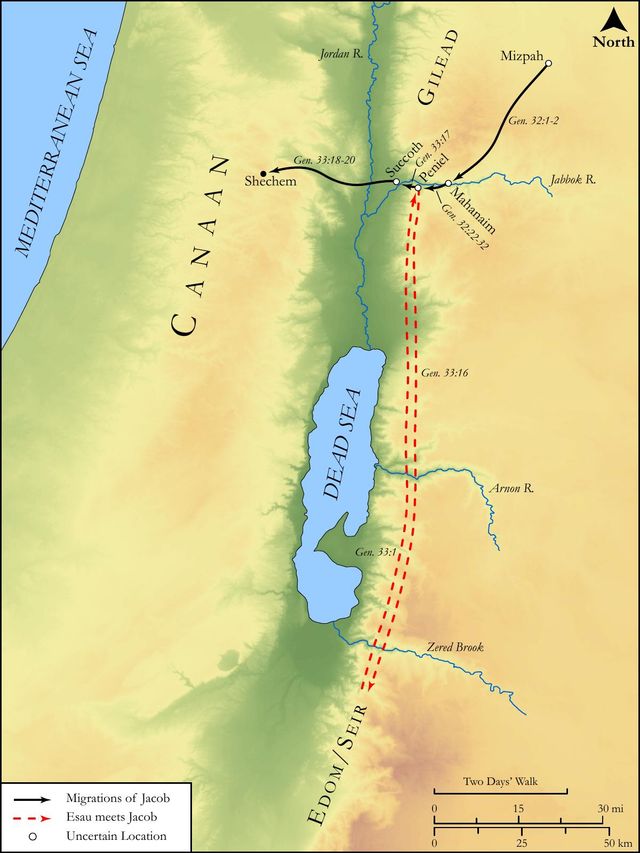
In the days of the patriarchs, nomadic and semi-nomadic peoples like Jacob's clan often moved with their flocks, utilizing temporary shelters. However, the construction of a "house" (Hebrew: bayith) in this context suggests a more substantial, albeit perhaps not permanent, dwelling than a typical tent, indicating an intention to reside for an extended period. This would have been common for patriarchs managing large households and extensive livestock, requiring stable bases for pasturing and security. The practice of naming places based on significant events, structures, or natural features was also a prevalent cultural norm, serving as a mnemonic device and a way to imbue the landscape with historical and spiritual meaning. Succoth itself was located east of the Jordan River, in the fertile Ghor valley, an area suitable for pasturing animals, providing a practical reason for Jacob's pause.
Key Themes
ShowHideThis verse contributes to several overarching themes in the book of Genesis. Foremost is the theme of Divine Faithfulness and Provision, as God continues to protect and prosper Jacob, enabling him to find a place of rest and build after his trials, fulfilling the promises made to him at Bethel and Paddan-Aram. It also highlights Jacob's Transformation and Maturation, as he moves from a cunning deceiver to a patriarch responsibly caring for his large household and livestock, demonstrating a newfound stability and wisdom. The act of building and settling, even temporarily, underscores the theme of Establishing Roots and Inheritance within the broader narrative of the patriarchal journey towards the Promised Land, even if Succoth itself is outside the traditional boundaries. Finally, the naming of the place "Succoth" reinforces the biblical theme of The Significance of Names and Memorials, where names serve as enduring reminders of God's actions and human experiences, a motif seen throughout Genesis.
Exposition and Analysis
ShowHideKey Word Analysis
ShowHideThis primitive root signifies "to pull up," especially tent-pins, thereby meaning "to start on a journey" or "to remove." In this context, it emphasizes Jacob's continued movement and the deliberate act of breaking camp to proceed to a new location.
Derived likely from the root "to build," this term refers to a dwelling, but encompasses a wide range of applications including family, household, palace, or temple. Here, it denotes a more substantial, perhaps semi-permanent, structure for Jacob's family, contrasting with the nomadic tent life he had previously led.
This feminine noun denotes a hut or lair, a temporary shelter often made of branches or foliage. Its use here specifically for "cattle" highlights the practical need for protection for his valuable livestock, and it is the direct etymological root for the name of the place, "Succoth."
Verse Breakdown
ShowHide"And Jacob journeyed to Succoth"
Following his reconciliation with Esau, Jacob did not immediately cross the Jordan River into central Canaan but instead traveled to a specific location east of the river. This journey signifies a deliberate choice of destination, indicating a planned pause rather than an impulsive stop.
"and built him an house"
This phrase indicates Jacob's construction of a dwelling for himself and his family. The term "house" (Hebrew: bayith) suggests a more permanent or substantial structure than a typical tent, implying an intention to settle for an extended period, perhaps for rest, recuperation, and the care of his large household and flocks.
"and made booths for his cattle"
In addition to his own dwelling, Jacob constructed temporary shelters (Hebrew: sukkot) specifically for his livestock. This act demonstrates his pastoral responsibility and foresight, providing protection for his valuable animals from the elements, which were essential to his wealth and livelihood.
"therefore the name of the place is called Succoth"
This final clause provides the etymological explanation for the place name. The Hebrew word "Succoth" (סֻכּוֹת) is the plural form of sukkah (סֻכָּה), meaning "booth" or "shelter." Thus, the name of the location serves as a direct memorial to Jacob's act of constructing these shelters, embedding his history into the geography of the land.
Literary Devices
ShowHideThe narrative in Genesis 33:17 employs several significant literary devices. The most prominent is Etiology, as the verse explicitly explains the origin of the place name "Succoth" by linking it directly to Jacob's action of "making booths for his cattle." This etiological naming serves to embed the historical event into the geographical landscape, providing a memorable and tangible connection between Jacob's journey and the land. Furthermore, there is a subtle use of Symbolism: the "house" represents Jacob's desire for stability and a settled life after years of wandering and conflict, while the "booths" (sukkot) for his cattle, though practical, also carry a symbolic weight, foreshadowing the temporary dwellings of the Israelites in the wilderness and the later Feast of Tabernacles, which commemorates God's provision during their transient journey. The verse also demonstrates Narrative Progression, marking a distinct phase in Jacob's journey—a period of rest and consolidation before his eventual re-entry into the heart of Canaan, highlighting a moment of relative peace and prosperity after the preceding anxieties.
Theological and Thematic Connections
ShowHideGenesis 33:17 underscores the theme of divine providence and the practical outworking of God's covenant promises in Jacob's life. After enduring significant trials—the wrestling match with God and the tense reunion with Esau—Jacob is granted a period of peace and stability, enabling him to build and settle. This pause at Succoth demonstrates God's continued care, providing not only safety but also the resources and opportunity for Jacob to establish a temporary home and protect his valuable livestock. It signifies a transition from a life of flight and uncertainty to one of relative security, reflecting God's faithfulness to bring Jacob back to the land and prosper him. The act of building, even if temporary, speaks to a newfound sense of belonging and responsibility, marking a significant step in Jacob's journey towards fully inheriting the land promised to Abraham and Isaac.
Reflection and Application
ShowHideGenesis 33:17 offers profound insights into the rhythm of life's journey, particularly after periods of intense challenge or significant transition. Jacob's decision to pause at Succoth, to build a house and make booths for his cattle, models the wisdom of intentional rest and responsible stewardship. In our own lives, after navigating difficult seasons, achieving significant milestones, or experiencing profound change, there is a spiritual and practical need to consolidate, to establish a temporary "base camp" where we can recover, assess, and prepare for the next leg of the journey. This isn't merely about physical rest, but about spiritual grounding—acknowledging God's provision that enables such stability, caring for those entrusted to our charge, and reflecting on the meaning embedded in our temporary stops. It reminds us that even provisional dwellings can be places of profound significance, where we experience God's faithfulness and prepare for His continued leading.
Questions for Reflection
ShowHideFAQ
ShowHideWhy did Jacob choose to stop at Succoth instead of immediately proceeding into Canaan?
ShowHideJacob's decision to pause at Succoth, located east of the Jordan River, was likely a strategic and practical choice. After the emotionally and physically taxing events of his wrestling match with God at Peniel and the potentially dangerous, yet ultimately peaceful, reunion with Esau in Genesis 33:1-16, Jacob and his large company, including many children and extensive livestock, would have been exhausted. Succoth offered fertile ground suitable for pasturing his flocks and a safe, accessible location to rest, recuperate, and consolidate his resources before venturing into the more populated and potentially challenging territories within the heart of Canaan, such as Shechem. This pause allowed for a period of stability and preparation.
What is the significance of the "booths" (Succoth) in this verse?
ShowHideThe "booths" (Hebrew: sukkot, plural of sukkah) were temporary shelters, likely constructed from branches, leaves, and other readily available materials, primarily intended to protect Jacob's numerous cattle from the elements. Their significance is twofold: pragmatically, they demonstrate Jacob's responsible care for his valuable livestock, which represented his wealth and livelihood. Theologically and etymologically, these temporary dwellings are the direct reason the place was named "Succoth," meaning "booths" or "shelters." This act of naming serves as a memorial. Furthermore, these "booths" carry a profound foreshadowing, as they connect to the later Israelite tradition of dwelling in temporary shelters during the Feast of Tabernacles, a festival commemorating God's provision and protection for Israel during their transient wilderness wanderings, reminding them of their identity as sojourners under God's care.
Christ-Centered Fulfillment
ShowHideJacob's journey to Succoth, marked by his establishment of a temporary dwelling and shelters, profoundly foreshadows the ultimate rest and secure dwelling found in Jesus Christ. Just as Jacob's "house" and "booths" provided a temporary haven and protection after his trials and uncertainties, Christ offers eternal security and a permanent dwelling place for all who are weary and burdened. He is the true "booth" or tabernacle, the one in whom God truly dwells among humanity, as John 1:14 declares, "The Word became flesh and made his dwelling among us." Our earthly journey, much like Jacob's, is often one of sojourning and transience, but in Christ, we find our ultimate rest and the promise of a heavenly Canaan—not a temporary settlement, but a city with eternal foundations, whose builder and maker is God (Hebrews 11:10). He is our refuge and strength (Psalm 46:1), providing shelter and provision for our souls, leading us to the ultimate, permanent dwelling place in His presence (Revelation 21:3).