


1 Samuel 9:1
- וַיְהִיvay·hiand he wasH1961Conj-w ¦ V-Qal-ConsecImperf-3msVerb Qal Consecutive Imperfect 3rd Singular Masculineוַandיְהִיhe was
- אִישׁ'isha manH376N-msNoun Singular Masculine Absolute
- מִבִּנְיָמִיןmi·bin·ya·Minfrom BenjaminH1144Prep-m ¦ N-proper-mNoun Proper MasculineמִfromבִּנְיָמִיןBenjamin
- וּשְׁמוֹu·she·moand his nameH8034Conj-w ¦ N-msc ¦ 3msNoun Singular Masculine Constructוּandשְׁמnameוֹhis
- קִישׁkish[was] KishH7027N-proper-mNoun Proper Masculine
- בֶּןben[the] son ofH1121N-mscNoun Singular Masculine Construct
- אֲבִיאֵל'a·vi·'ElAbielH22N-proper-mNoun Proper Masculine
- בֶּןben[the] son ofH1121N-mscNoun Singular Masculine Construct
- צְרוֹרtze·RorZerorH6872N-proper-mNoun Proper Masculine
- בֶּןben[the] son ofH1121N-mscNoun Singular Masculine Construct
- בְּכוֹרַתbe·kho·RatBecorathH1064N-proper-mNoun Proper Masculine
- בֶּןben[the] son ofH1121N-mscNoun Singular Masculine Construct
- אֲפִיחַ'a·Fi·achAphiahH647N-proper-mNoun Proper Masculine
- בֶּןbena son ofH1121N-mscNoun Singular Masculine Construct
- אִישׁ'isha manH376N-msNoun Singular Masculine Absolute
- יְמִינִיye·mi·Nia JaminiteH3227N-msNoun Gentilic Singular Masculine Absolute
- גִּבּוֹרgi·Bora mighty [man] ofH1368N-mscNoun Singular Masculine Construct
- חָיִלCha·yilwealthH2428N-msNoun Singular Masculine Absolute
English is a literal word-by-word gloss of the Hebrew, not the KJV's wording. Why?
This is the original text the KJV's translators worked from — each Hebrew word with its own literal English meaning in this verse, prepared by scholars at Tyndale House, Cambridge. The KJV translates whole sentences, not word by word, so its wording differs: one Hebrew word can become several English words, and the KJV may choose “the LORD” where the gloss reads “Yahweh”. Both are faithful — they answer different questions. For the KJV's own rendering, switch to the KJV text.
Details
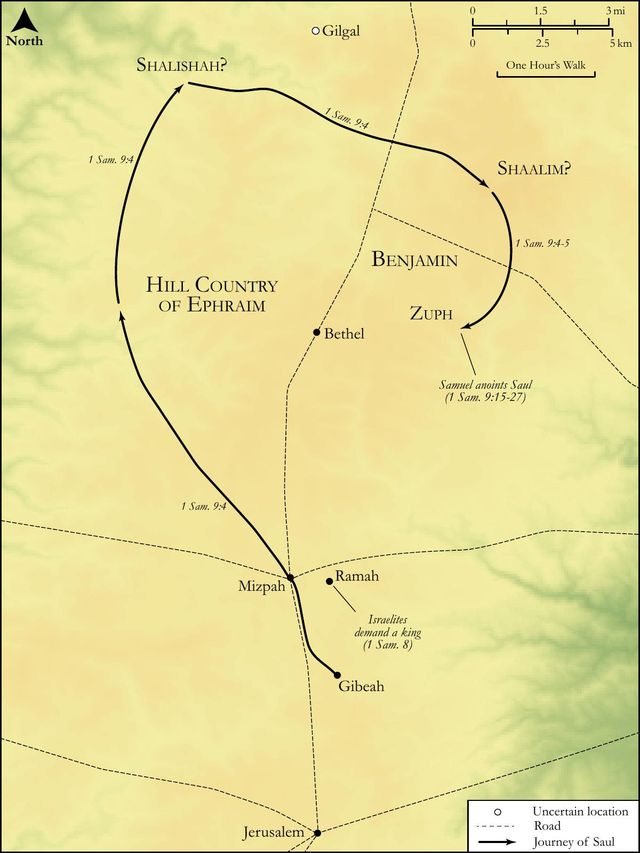
See on the biblical-era map
Study this verse
Public-domain commentary
Matthew Henry
From his Commentary on the Whole Bible. Henry comments on passages, not single verses — this entry covers 1 Samuel 9:1–2.
We are here told, 1. What a good family Saul was of, Sa1 9:1. He was of the tribe of Benjamin; so was the New Testament Saul, who also was called Paul, and he mentions it as his honour, for Benjamin was a favourite, Rom 11:1; Phi 3:5. That tribe had been reduced to a very small number by the fatal war with Gibeah, and much ado there was to provide wives for those 600 men that were the poor remains of it out of that diminished tribe, which is here called, with good reason, the smallest of the tribes of Israel, Sa1 9:21. Saul sprang as a root out of a dry ground. That tribe, though fewest in number, was first in dignity, God giving more abundant honour to that part which lacked, Co1 12:24. His father was Kish, a mighty man of power, or, as the margin reads it, in substance; in spirit bold, in body strong, in estate wealthy. The whole lot of the tribe of Benjamin coming to be distributed among 600 men, we may suppose their inheritances were much larger than theirs who were of other tribes, an advantage which somewhat helped to balance the disadvantage of the smallness of their number. 2. What a good figure Saul made, Sa1 9:2. No mention is here made of his wisdom or virtue, his learning or piety, or any of the accomplishments of his mind, but that he was a tall, proper, handsome man, that had a good face, a good shape, and a good presence, graceful and well proportioned: Among all the children of Israel there was not a goodlier person than he; and, as if nature had marked him for preeminence and superiority, he was taller by the head and shoulders than any of the people, the fitter to be a match for the giants of Gath, the champions of the Philistines. When God chose a king after his own heart he pitched upon one that was not at all remarkable for the height of his stature, nor any thing in his countenance but the innocence and sweetness that appeared there, Sa1 16:7, Sa1 16:12. But when he chose a king after the people's heart, who aimed at nothing so much as stateliness and grandeur, he pitched upon this huge tall man, who, if he had no other good qualities, yet would look great. It does not appear that he excelled in strength so much as he did in stature; Samson did, and him they slighted, bound, and betrayed into the hands of the Philistines; justly therefore are they now put off with one who, though of uncommon height, is weak as other men. They would have a king like the nations, and the nations commonly chose portly men for their kings.
Historical interpretation
Three Centuries of Reception
2 surviving comments on this verse. Each one is dated, so this reads as a timeline rather than a list.
Select a marker to jump to its quote. Markers stagger vertically where authors wrote within a few decades of each other.
The name Benjamin is a combination, then, of two words, son and right hand: ben means “son” and jamin means “right hand.”Let us remember once for all that the tribe of Benjamin was called Jemini. We read in the book of Kings [Samuel], where it speaks of Saul, the words “Now there was a man of Benjamin whose name was Saul, the son of Kish, the son of Abiel, son of Jethra, son of Jether, son of Gera, son of Jemini,” and immediately following, it says, a man of Jemini, that is, from the tribe of Jemini, or Benjamin. … Now why have I said all this? To show that the tribe of Jemini was the tribe of Benjamin.
And there was a man from Benjamin named Kish, son of Abiel, etc. In this Saul the king, who was chosen by the people instead of Samuel, who persecuted David, committed other crimes, rejected David, and dying received a successor to the kingdom: he signifies the wickedness of the Jews, who, despising and persecuting both the prophets and the Lord, preferred to reign by themselves; therefore they left the kingdom of God, from which they were expelled, to a nation producing its fruits. Now, in that he was anointed with holy oil, delivering Israel from the enemy, he figuratively announces the Lord Jesus Christ. And therefore, the present reading, which contains the history of the anointing of Saul, but no mark of reproof: designates the high mysteries of the Lord Savior's descent from heaven for us men, and for our salvation, his reception of baptism from John, and the other lofty mysteries of the temporal dispensation. And primarily, the sense that is concerning the Lord, helps, because Saul came from Benjamin, who is said to be chosen and good; whether because Benjamin is interpreted as 'son of the right hand,' or because it is the smallest tribe in Israel; for grace is always generated in Christ by the humble in spirit, to whom the kingdom of heaven belongs.
Continue studying 1 Samuel 9:1 across the web’s major study libraries — every link below opens this exact verse, chapter, or book on the destination site.
Read & Compare
 BibleGatewayThis verse in more than 200 translations and 70 languages.
 Bible.comThe YouVersion reader — hundreds of translations, reading plans, and highlights.
 ESV.orgCrossway's official English Standard Version reader.
 NET BibleThe NET translation with 60,000+ translators' notes on every rendering decision.
 STEP BibleTyndale House's free study tool — original text, vocabulary, and scholarly resources.
 BibliaLogos Bible Software's free web reader.
 USCCBThe New American Bible (Revised Edition) with the U.S. bishops' study notes.
Commentaries
 BibleHub CommentariesDozens of classic commentaries on this verse, gathered on one page.
 StudyLightMore than 100 commentary sets — the largest collection on the web.
 BibleRefPlain-English commentary on what this verse means, verse by verse.
 Enduring WordDavid Guzik's free commentary on this chapter, widely used by Bible teachers.
 Bible Study ToolsVerse commentary alongside Greek and Hebrew study aids.
Original Language & Research
- BibleHub InterlinearThe verse word by word — original language, transliteration, and English.
- BibleHub LexiconEvery word's original-language definition and Strong's entry.
 Blue Letter BibleDeep-study tools — Strong's numbers, concordance, and word studies.
 SefariaThe Hebrew text with Rashi and centuries of Jewish commentary.
Sermons, Hymns & Audio


TrulyRandomVerse is not affiliated with these sites and doesn’t control their content. They’re linked because they’re genuinely useful.
Summary
1 Samuel 9:1 serves as a pivotal introduction to the narrative of Saul's anointing as Israel's first king, meticulously detailing the lineage and social standing of his father, Kish. This verse establishes Kish as a prominent Benjamite, described as a "mighty man of power," thereby setting a foundational context for Saul's impressive human credentials. It subtly foreshadows the kind of outwardly strong and influential leader Israel sought, initiating the dramatic transition from the era of judges to a monarchy under human rather than purely divine selection.
Context
ShowHideLiterary Context
This verse acts as a crucial narrative pivot, immediately following the Israelites' demand for a king in 1 Samuel 8 and preceding the detailed account of Saul's providential encounter with Samuel. It shifts the narrative focus from the general state of Israel under the judges—a period characterized by spiritual decline and decentralized leadership, as extensively depicted in the book of Judges—to the specific individual chosen to inaugurate the monarchy. The lengthy genealogical listing for Kish is not merely an incidental detail but a deliberate literary device to establish the reputable and legitimate background of the future king, emphasizing his deep roots within the tribal structure. This introduction sets the stage for the subsequent verse, 1 Samuel 9:2, which further elaborates on Saul's impressive physical stature, building directly upon the distinguished introduction of his father.
Historical & Cultural Context
The period described in 1 Samuel is a transformative epoch in Israelite history, marking the transition from a tribal confederacy, often plagued by internal strife and external oppression, to a centralized monarchy. The people's demand for a king, articulated in 1 Samuel 8:5, stemmed from a desire to be "like all the nations," rejecting God's direct rule through judges and prophets. The tribe of Benjamin, though one of the smallest, possessed a complex and often turbulent history, including a near-annihilation detailed in Judges 20-21, yet they were renowned for their fierce warriors and skilled slingers (Judges 20:16). The description of Kish as a "mighty man of power" (Hebrew: gibbor chayil) would have signified not just physical prowess but also considerable wealth, influence, and high social standing within his clan and tribe, attributes highly valued for leadership in ancient Israelite society.
Key Themes
ShowHideThis verse primarily functions as the introduction of a key figure, Kish, and by extension, his son Saul, who will play a pivotal role in shaping Israel's future. It underscores the theme of tribal identity, explicitly naming Kish as a "Benjamite," which carries significant historical and symbolic weight given Benjamin's past reputation for martial prowess and its turbulent history. Furthermore, the characterization of Kish as "a mighty man of power" highlights the theme of social standing and human qualifications for leadership. This initial portrayal of Saul's impressive lineage and family background aligns perfectly with the human desire for a king who would be outwardly strong, influential, and from a respectable family, subtly setting up a dramatic contrast with God's later, divinely-inspired criteria for leadership, as powerfully articulated in 1 Samuel 16:7.
Exposition and Analysis
ShowHideKey Word Analysis
ShowHideH376 (from an unused root meaning to be extant); a man as an individual or a male person; often used as an adjunct to a more definite term (and in such cases frequently not expressed in translation); also, another, any (man), a certain, [phrase] champion, consent, each, every (one), fellow, (foot-, husband-) man, (good-, great, mighty) man, he, high (degree), him (that is), husband, man(-kind), [phrase] none, one, people, person, [phrase] steward, what (man) soever, whoso(-ever), worthy. In this context, it simply identifies Kish as a male individual, but in conjunction with "mighty man of power," it contributes to the description of his significant standing.
H1368 (shortened) intensive from the same as גֶּבֶר; powerful; by implication, warrior, tyrant; champion, chief, [idiom] excel, giant, man, mighty (man, one), strong (man), valiant man. This word describes a person of great strength, valor, or a warrior, often implying a heroic or powerful individual. When applied to Kish, it suggests not only physical strength but also a formidable presence and capability.
H2428 from חוּl; probably a force, whether of men, means or other resources; an army, wealth, virtue, valor, strength; able, activity, ([phrase]) army, band of men (soldiers), company, (great) forces, goods, host, might, power, riches, strength, strong, substance, train, ([phrase]) valiant(-ly), valour, virtuous(-ly), war, worthy(-ily). This term is highly versatile, encompassing strength, wealth, valor, and even military force. When combined with gibbôwr, it creates the phrase gibbor chayil, which denotes a person of considerable substance, influence, and resources, someone who is both valiant and prosperous.
Verse Breakdown
ShowHide"Now there was a man of Benjamin"
This opening clause immediately establishes the tribal affiliation of the central figure to be introduced. The tribe of Benjamin, though numerically small, had a distinct identity and history within Israel, setting a specific backdrop for Saul's origin.
"whose name [was] Kish"
This directly names the individual, Kish, whose primary significance in the biblical narrative is as the father of Israel's first king, Saul. The focus quickly shifts from the general tribal identity to a specific, identifiable person.
"the son of Abiel, the son of Zeror, the son of Bechorath, the son of Aphiah, a Benjamite"
This detailed genealogical listing emphasizes Kish's established lineage and deep roots within the tribe of Benjamin. Such an extensive recounting of ancestry would have underscored his legitimacy, respectability, and social standing in ancient Israelite society, confirming his honorable tribal identity and heritage.
"a mighty man of power"
This concluding descriptor provides a crucial characterization of Kish. As elaborated in the "Key Word Analysis," this compound phrase signifies not only physical strength but also valor, wealth, and significant social influence. It paints a picture of a prominent, respected, and affluent figure, thereby establishing the impressive human credentials and prestigious background of Saul's family.
Literary Devices
ShowHideThe verse primarily employs Introduction, Genealogy, and Foreshadowing. The direct Introduction of Kish serves to immediately establish the family from which Israel's first king will emerge, effectively shifting the narrative focus to the specific individuals involved in the establishment of the monarchy. The extensive Genealogy provides a detailed lineage, lending credibility, gravitas, and a sense of rootedness to Kish's (and by extension, Saul's) background within the tribal structure of Israel. This emphasis on his respectable origins and status as a "mighty man of power" subtly employs Foreshadowing, hinting at the kind of leader the people of Israel desired—one who was outwardly impressive and from a distinguished family—which ultimately sets up a key theological tension with God's later, contrasting criteria for kingship, a theme explored throughout the book of Samuel.
Theological and Thematic Connections
ShowHideThis seemingly straightforward genealogical introduction carries profound theological weight, subtly revealing God's sovereign hand in orchestrating the details of history, even in the seemingly mundane aspects of lineage and social standing. While Kish is presented as a "mighty man of power," suggesting humanly impressive qualifications, this subtly foreshadows the inherent tension between human preference and divine choice. Israel desired a king who was outwardly strong, physically imposing, and from a reputable background, and Saul, through his father Kish, initially fits this mold perfectly. However, the overarching narrative of Samuel will consistently demonstrate that God's ultimate criteria for leadership are not based on outward appearance or human strength but on the heart's posture and obedience, a profound truth powerfully articulated in 1 Samuel 16:7. This verse, therefore, lays the groundwork for understanding the human inclination to value external attributes and sets the stage for God's counter-cultural method of choosing and empowering His servants.
Reflection and Application
ShowHideThe introduction of Kish, a "mighty man of power" and the father of Israel's first king, offers a compelling reminder that God often works through seemingly ordinary or humanly impressive circumstances to advance His divine purposes. While human beings naturally tend to value outward strength, prestigious lineage, or high social status as qualifications for leadership, this verse, when viewed within the broader narrative of 1 Samuel, subtly challenges us to reconsider what truly matters in God's eyes. It prompts us to look beyond superficial appearances and to place our trust in God's sovereign hand, which can elevate the humble or utilize the outwardly impressive for His glory. Our own backgrounds, whether perceived as strong, weak, privileged, or disadvantaged, are all part of God's intricate tapestry. This verse encourages us to recognize God's providence in the seemingly small or mundane details of our lives and to seek His perspective on what constitutes true strength, leadership, and worth.
Questions for Reflection
ShowHideFAQ
ShowHideWhy is Kish's lineage so detailed in this verse?
ShowHideThe detailed lineage serves several crucial purposes within the narrative. Firstly, it firmly establishes Kish's, and by extension Saul's, legitimate tribal identity as a Benjamite, which was essential for social standing and recognition in ancient Israelite society. Secondly, it underscores the respectability and prominence of Saul's family, aligning perfectly with the people's desire for a king who was outwardly impressive and from a distinguished background, as explicitly expressed in 1 Samuel 8:5. Such genealogical depth would have lent significant credibility and authority to Saul's eventual anointing, presenting him as a highly suitable candidate from a human perspective.
What does "a mighty man of power" (KJV) truly mean in this context?
ShowHideThe Hebrew phrase is gibbor chayil (גִּבּוֹר חַיִל). While it certainly can imply physical strength and martial prowess, its meaning is much broader and richer, encompassing valor, wealth, and significant social influence. It describes a person of substantial means and standing within their community—someone who is respected, capable, and likely affluent. For Kish, it suggests he was a prominent and influential leader in his clan, providing an honorable and powerful background for his son, Saul. This description sets up Saul as a figure who would perfectly meet the human expectations of a king, who was desired to be strong and impressive, as further elaborated in 1 Samuel 9:2.
Why is the tribe of Benjamin specifically mentioned as Kish's tribe?
ShowHideThe mention of Benjamin is highly significant due to the tribe's unique history and characteristics. Although one of the smallest tribes, Benjamin had a formidable reputation for fierce warriors and exceptionally skilled slingers (e.g., Judges 20:16). The tribe also had a tumultuous and violent past, including a near-annihilation due to a devastating civil war recorded in Judges 19-21. Identifying Kish as a Benjamite immediately connects Saul to this specific tribal identity, potentially hinting at his own physical prowess and setting a complex backdrop for his reign, which would eventually be marked by conflict and a tragic end.
Christ-Centered Fulfillment
ShowHideThe introduction of Kish, a "mighty man of power" from the tribe of Benjamin, and the father of Israel's first king, subtly foreshadows the human desire for a king who is outwardly impressive and from a noble lineage. Saul's selection, rooted in this humanly desirable background, represents the people's longing for a king "like all the nations" (1 Samuel 8:5). However, this human-centered approach to kingship ultimately falls short, as Saul's reign is marked by disobedience and rejection. In stark contrast, the true King, Jesus Christ, fulfills the promise of an everlasting kingdom, not primarily through outward human might or a prestigious earthly lineage (though His lineage is impeccably traced back to David in Matthew 1:1 and Luke 3:23-38), but through divine power expressed in humility and sacrificial love. While Saul came from a "mighty man of power," Jesus, the Lamb of God who takes away the sin of the world, came in seeming weakness, born in a humble manger (Luke 2:7), yet He is the true King of kings and Lord of lords. His kingdom is not of this world (John 18:36), but it is eternal, founded on grace and truth, ultimately triumphing over sin and death, fulfilling the deepest longings of humanity for a perfect ruler who truly saves His people (Matthew 1:21).