


Judges 19:1
Bible text: King James Version (1769 Blayney text) · Public domain
Bible text: King James Version with Strong's numbers · Public domain
Bible text: Berean Standard Bible · Public domain
Bible text: American Standard Version (1901) · Public domain
Bible text: World English Bible, Messianic edition · Public domain
Bible text: Geneva Bible (1599) · Public domain
Bible text: Young's Literal Translation · Public domain
- וַיְהִיvay·Hiand it wasH1961Conj-w ¦ V-Qal-ConsecImperf-3msVerb Qal Consecutive Imperfect 3rd Singular Masculineוַandיְהִיit was
- בַּיָּמִיםbai·ya·Mimin the daysH3117Prep-b ¦ N-mpNoun Plural Masculine Absoluteבַּin theיָּמִיםdays
- הָהֵםha·Hem<the> thoseH1992Art ¦ Pro-3mpPronoun Personal 3rd Plural Masculineהָ<the>הֵםthose
- וּמֶלֶךְu·Me·lekhand [was] a kingH4428Conj-w ¦ N-msNoun Singular Masculine Absoluteוּandמֶלֶךְ[was] a king
- אֵין'einthere notH369N-mscNoun Singular Masculine Construct
- בְּיִשְׂרָאֵלbe·Yis·ra·'Elin IsraelH3478Prep-b ¦ N-properNoun Proper LocationבְּinיִשְׂרָאֵלIsrael
- וַיְהִיvay·Hiand he wasH1961Conj-w ¦ V-Qal-ConsecImperf-3msVerb Qal Consecutive Imperfect 3rd Singular Masculineוַandיְהִיhe was
- אִישׁ'isha manH376N-msNoun Singular Masculine Absolute
- לֵוִיle·Via LeviteH3881N-msNoun Gentilic Singular Masculine Absolute
- גָּרgarsojourningH1481V-Qal-Prtcpl-msVerb Qal Participle Singular Masculine Absolute
- בְּיַרְכְּתֵיbe·yar·ke·Teiin [the] remotest parts ofH3411Prep-b ¦ N-fdcNoun Dual Feminine Constructבְּinיַרְכְּתֵי[the] remotest parts of
- הַרhar[the] hill country ofH2022N-mscNoun Singular Masculine Construct
- אֶפְרַיִם'ef·Ra·yimEphraimH669N-proper-mNoun Proper Masculine
- וַיִּקַּחvai·yi·kachand he tookH3947Conj-w ¦ V-Qal-ConsecImperf-3msVerb Qal Consecutive Imperfect 3rd Singular Masculineוַandיִּקַּחhe took
- לוֹlofor <the> himselfPrep-l ¦ 3msSuffix Personal 3rd Singular Masculineלfor <the>וֹhimself
- אִשָּׁה'i·Shaha womanH802N-fsNoun Singular Feminine Absolute
- פִילֶגֶשׁfi·Le·gesha concubineH6370N-fsNoun Singular Feminine Absolute
- מִבֵּיתmi·Beitfrom Beth-H1035Prep-m ¦ N-properNoun Proper LocationמִfromבֵּיתBeth-
- לֶחֶםLe·chem-lehemH1035N-properNoun Proper Location
- יְהוּדָהye·hu·DahJudahH3063N-properNoun Proper Location
English is a literal word-by-word gloss of the Hebrew, not the KJV's wording. Why?
This is the original text the KJV's translators worked from — each Hebrew word with its own literal English meaning in this verse, prepared by scholars at Tyndale House, Cambridge. The KJV translates whole sentences, not word by word, so its wording differs: one Hebrew word can become several English words, and the KJV may choose “the LORD” where the gloss reads “Yahweh”. Both are faithful — they answer different questions. For the KJV's own rendering, switch to the KJV text.
Details
See on the biblical-era maps
Study this verse
Public-domain commentary
Matthew Henry
From his Commentary on the Whole Bible. Henry comments on passages, not single verses — this entry covers Judges 19:1–15. His four-level outline is real structure in the source text, so it is rendered as structure.
The domestic affairs of this Levite would not have been related thus largely but to make way for the following story of the injuries done him, in which the whole nation interested themselves. Bishop Hall's first remark upon this story is, That there is no complain of a public ordered state but there is a Levite at one end of it, either as an agent or as a patient. In Micah's idolatry a Levite was active; in the wickedness of Gibeah a Levite was passive; no tribe shall sooner feel the want of government than that of Levi; and, in all the book of Judges, no mention is made of any of that tribe, but of these two. This Levite was of Mount Ephraim, Jdg 19:1. He married a wife of Bethlehem-Judah. She is called his concubine, because she was not endowed, for perhaps he had nothing to endow her with, being himself a sojourner and not settled; but it does not appear that he had any other wife, and the margin calls her a wife, a concubine, Jdg 19:1. She came from the same city that Micah's Levite came from, as if Bethlehem-Judah owed a double ill turn to Mount Ephraim, for she was as bad for a Levite's wife as the other for a Levite.
I.This Levite's concubine played the whore and eloped from her husband, Jdg 19:2.
The Chaldee reads it only that she carried herself insolently to him, or despised him, and, he being displeased at it, she went away from him, and (which was not fair) was received and entertained at her father's house. Had her husband turned her out of doors unjustly, her father ought to have pitied her affliction; but, when she treacherously departed from her husband to embrace the bosom of a stranger, her father ought not to have countenanced her sin. Perhaps she would not have violated her duty to her husband if she had not known too well where she should be kindly received. Children's ruin is often owing very much to parents' indulgence.
II.The Levite went himself to court her return.
It was a sign there was no king, no judge, in Israel, else she would have been prosecuted and put to death as an adulteress; but, instead of that, she is addressed in the kindest manner by her injured husband, who takes a long journey on purpose to beseech her to be reconciled, Jdg 19:3. If he had put her away, it would have been a crime in him to return to her again, Jer 3:1. But, she having gone away, it was a virtue in him to forgive the offence, and, though the party wronged, to make the first motion to her to be friends again. It is part of the character of the wisdom from above that it is gentle and easy to be entreated. He spoke friendly to her, or comfortably (for so the Hebrew phrase of speaking to the heart commonly signifies), which intimates that she was in sorrow, penitent fore what she had done amiss, which probably he heard of when he came to fetch her back. Thus God promises concerning adulterous Israel (Hos 2:14), I will bring her into the wilderness, and speak comfortably to her.
III.Her father made him very welcome, and, by his extraordinary kindness to him, endeavoured to atone for the countenance he had given his daughter in withdrawing from him, and to confirm him in his disposition to be reconciled to her.
1.He entertains him kindly, rejoices to see him (Jer 3:3), treats him generously for three days, Jdg 19:4. And the Levite, to show that he was perfectly reconciled, accepted his kindness, and we do not find that he upbraided him or his daughter with what had been amiss, but was as easy and as pleasant as at his first wedding-feast. It becomes all, but especially Levites, to forgive as God does. Every thing among them gave a hopeful prospect of their living comfortably together for the future; but, could they have foreseen what befel them within one day or two, how would all their mirth have been embittered and turned into mourning! When the affairs of our families are in the best posture we ought to rejoice with trembling, because we know not what troubles one day may bring forth. We cannot foresee what evil is near us, but we ought to consider what may be, that we may not be secure, as if tomorrow must needs be as this day and much more abundant, Isa 56:12.
2.He is very earnest for his stay, as a further demonstration of his hearty welcome. The affection he had for him, and the pleasure he took in his company, proceeded,
(1.)From a civil regard to him as his son-in-law and an ingrafted branch of his own house. Note, Love and duty are due to those to whom we are related by marriage as well as to those who are bone of our bone: and those that show kindness as this Levite did may expect to receive kindness as he did. And,
(2.)From a pious respect to him as a Levite, a servant of God's house; if he was such a Levite as he should be (and nothing appears to the contrary) he is to be commended for courting his stay, finding his conversation profitable, and having opportunity to learn from him the good knowledge of the Lord, hoping also that the Lord will do him good because he has a Levite to be his son-in-law, and will bless him for his sake.
[1.]He forces him to stay the fourth day, and this was kind; not knowing when they might be together again, he engages him to stay as long as he possibly could. The Levite, though nobly treated, was very urgent to be gone. A good man's heart is where his business is; for as a bird that wanders from her nest so is the man that wanders form his place. It is a sign a man has either little to do at home, or little heart to do what he has to do, when he can take pleasure in being long abroad where he has nothing to do. It is especially good to see a Levite willing to go home to his few sheep in the wilderness. Yet this Levite was overcome by importunity and kind persuasion to stay longer than he intended, Jdg 19:5-7. We ought to avoid the extreme of an over-easy yielding, to the neglect of our duty on the one hand, and that of moroseness and wilfulness, to the neglect of our friends and their kindness on the other hand. Our Saviour, after his resurrection, was prevailed upon to stay with his friends longer than he at first intimated to be his purpose, Luk 24:28, Luk 24:29.
[2.]He forces him to stay till the afternoon of the fifth day, and this, as it proved, was unkind, Jdg 19:8, Jdg 19:9. He would by no means let him go before dinner, promises him he shall have dinner early, designing thereby, as he had done the day before, to detain him another night; but the Levite was intent on the house of the Lord at Shiloh (Jdg 19:18), and, being impatient to get thither, would stay no longer. Had they set out early, they might have reached some better lodging-place than that which they were now constrained to take up with, nay, they might have got to Shiloh. Note, Our friends' designed kindnesses often prove, in the event, real injuries; what is meant for our welfare becomes a trap. Who knows what is good for a man in this life? The Levite was unwise in setting out so late; he might have got home better if he had staid a night longer and taken the day before him.
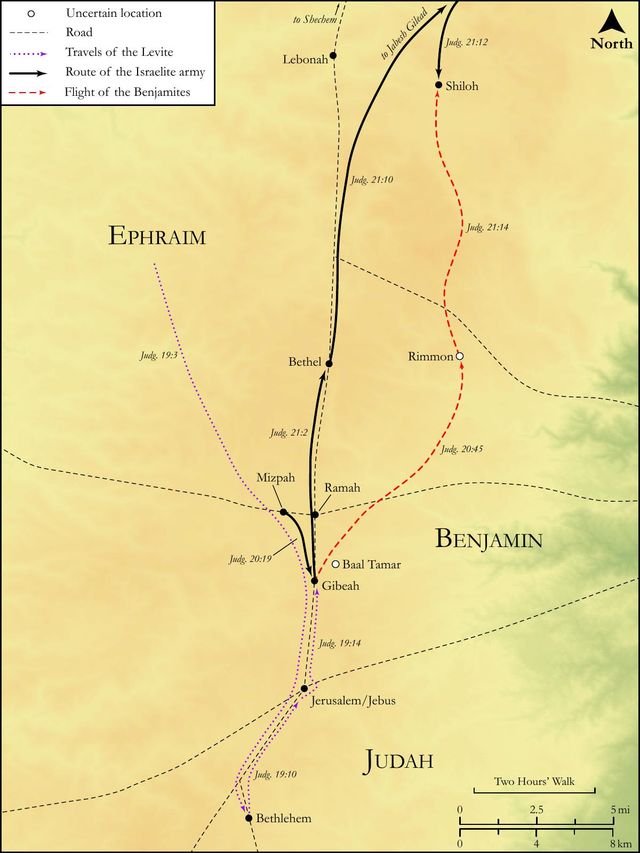
IV.In his return home he was forced to lodge at Gibeah, a city in the tribe of Benjamin, afterwards called Gibeah of Saul, which lay on his road towards Shiloh and Mount Ephraim. When it drew towards night, and the shadows of the evening were stretched out, they began to think (as it behoves us to do when we observe the day of our life hastening towards a period) where they must lodge. When night came they could not pursue their journey. He that walketh in darkness knoweth not whither he goes. They could not but desire rest, for which the night was intended, as the day for labour.
1.The servant proposed that they should lodge in Jebus, afterwards Jerusalem, but as yet in the possession of Jebusites. "Come," said the servant, "let us lodge in this city of the Jebusites," Jdg 19:11. And, if they had done so, it is probable they would have had much better usage than they met with in Gibeah of Benjamin. Debauched and profligate Israelites are worse and much more dangerous than Canaanites themselves. But the master, as became one of God's tribe, would by no means quarter, no, not one night, in a city of strangers (Jdg 19:12), not because he questioned his safety among them, but he was not willing, if he could possibly avoid it, to have so much intimacy and familiarity with them as a night's lodging came to, nor to be so much beholden to them. By shunning this place he would witness against the wickedness of those that contracted friendship and familiarity with these devoted nations. Let Israelites, Levites especially, associate with Israelites, and not with the sons of the stranger.
2.Having passed by Jebus, which was about five or six miles from Bethlehem (the place whence they came), and not having daylight to bring them to Ramah, they stopped at Gibeah (Jdg 19:13-15); there they sat down in the street, nobody offering them a lodging. In these countries, at that time, there were no inns, or public-houses, in which, as with us, travellers might have entertainment for their money, but they carried entertainment along with them, as this Levite did (Jdg 19:19), and depended upon the courtesy and hospitality of the inhabitants for a lodging. Let us take occasion hence, when we are in journeys, to thank God for this, among other conveniences of travelling, that there are inns to entertain strangers, and in which they may be welcome and well accommodated for their money. Surely there is no country in the world wherein one may stay at home with more satisfaction, or go abroad with more comfort, than in our own nation. This traveller, though a Levite (and to those of that tribe God had particularly commanded his people to be kind upon all occasions), met with very cold entertainment at Gibeah: No man took them into his house. If they had any reason to think he was a Levite perhaps that made those ill-disposed people the more shy of him. There are those who will have this laid to their charge at the great day, I was a stranger and you took me not in.
Historical interpretation
Historical reception
2 surviving comments on this verse. Each one is dated, so this reads as a timeline rather than a list.
How full of pitiful traits is this story! A man, it says, a Levite, had taken to himself a wife, who I suppose was called a concubine from the word concubitus. She some time afterwards, as is likely to happen, offended at certain things, returned to her father and was with him four months. Then her husband arose and went to the house of his father-in-law to reconcile himself with his wife, to win her back and take her home again. The woman ran to meet him and brought her husband into her father’s house.The maiden’s father rejoiced and went to meet him, and the man stayed with him three days, and they ate and rested. On the next day the Levite arose at daybreak but was detained by his father-in-law, that he might not so quickly lose the pleasure of his company. Again on the next and the third day the maiden’s father did not allow his son-in-law to start [his journey], until their joy and mutual regard was complete. But on the seventh day, when it was already drawing to a close, after a pleasant meal, having urged the approach of the coming night, so as to make him think he ought to sleep among friends rather than strangers, he was unable to keep him, and so let him go together with his daughter.
A Levite, more courageous than wealthy, lived in the region of Mount Ephrem, for his tribe was allotted a landed possession far removed in place of the right of inheritance. He took a wife from the tribe of Bethlehem of Judah. While they felt the first attraction of their love deeply and equally, he continued to burn with unbounded desire for his wife. Yet her ways were different. His passion for her intensified until he inwardly seethed with desire. Yet, because there was a difference in their ages, and because he felt—either because she seemed to love him less or due to the violence of his pain—that she didn’t consider him her equal, he used to criticize her. Frequently quarreling followed, and the offended wife gave back the keys of the house and went home.After the fourth month slipped by her husband, who was overwhelmed with love and had nothing else to hope for, went to her, trusting that the young girl’s heart would be softened on the advice of her parents. His father-in-law met him at the door and brought him into the house. He reconciled his daughter and, in order that he might send them away more joyous, kept them three days while he prepared a sort of nuptial banquet. Although the man wanted to depart, he kept him a fourth day, offering him excuses of civility, devising delays. In his desire to add a fifth day as well, he found new reasons for delaying them, while the husband, unwilling to thwart the father’s affection of its desire to keep his daughter, though he was at last promised an opportunity for setting forth, postponed it to midday so that they would start out well fortified with food. Even after dinner, the father wished to find some delay, saying that evening was now approaching. At last he acquiesced, though reluctantly, to the entreaties of his son-in-law.
Continue studying Judges 19:1 across the web’s major study libraries — every link below opens this exact verse, chapter, or book on the destination site.
Read & Compare
 BibleGatewayThis verse in more than 200 translations and 70 languages.
 Bible.comThe YouVersion reader — hundreds of translations, reading plans, and highlights.
 ESV.orgCrossway's official English Standard Version reader.
 NET BibleThe NET translation with 60,000+ translators' notes on every rendering decision.
 STEP BibleTyndale House's free study tool — original text, vocabulary, and scholarly resources.
 BibliaLogos Bible Software's free web reader.
 USCCBThe New American Bible (Revised Edition) with the U.S. bishops' study notes.
Commentaries
 BibleHub CommentariesDozens of classic commentaries on this verse, gathered on one page.
 StudyLightMore than 100 commentary sets — the largest collection on the web.
 BibleRefPlain-English commentary on what this verse means, verse by verse.
 Enduring WordDavid Guzik's free commentary on this chapter, widely used by Bible teachers.
 Bible Study ToolsVerse commentary alongside Greek and Hebrew study aids.
Original Language & Research
- BibleHub InterlinearThe verse word by word — original language, transliteration, and English.
- BibleHub LexiconEvery word's original-language definition and Strong's entry.
 Blue Letter BibleDeep-study tools — Strong's numbers, concordance, and word studies.
 SefariaThe Hebrew text with Rashi and centuries of Jewish commentary.
Sermons, Hymns & Audio


TrulyRandomVerse is not affiliated with these sites and doesn’t control their content. They’re linked because they’re genuinely useful.
Summary
Judges 19:1 opens one of the Bible's most disturbing narratives, immediately establishing a context of profound national and moral disarray in ancient Israel. It introduces a Levite, a member of the priestly tribe, residing in the hill country of Ephraim, who has taken a concubine from Bethlehemjudah. The verse's crucial opening phrase, "when there was no king in Israel," serves as a recurring theological refrain throughout the latter chapters of Judges, signaling a period of spiritual and societal anarchy where divine law was disregarded and individual moral relativism prevailed, thereby setting the stage for the horrific events that follow.
Context
ShowHideLiterary Context
Judges 19:1 marks the grim beginning of the final, and arguably most shocking, major narrative block in the book of Judges (chapters 19-21). This section functions as a powerful appendix, distinct from the cyclical accounts of judges and deliverances that characterize the main body of the book. It immediately follows the accounts of Micah's idolatry and the migration of the Danites (chapters 17-18), both of which also conclude with the ominous phrase, "in those days there was no king in Israel." This deliberate repetition creates a potent literary frame, emphasizing the pervasive lawlessness and moral vacuum that afflicted Israel. The story of the Levite and his concubine escalates dramatically from a personal tragedy to a devastating tribal war, serving as a climactic illustration of the depths of depravity Israel had reached, far surpassing the localized sins described earlier in the book. It sets the stage for the desperate measures taken by the other tribes to prevent the annihilation of Benjamin, culminating in acts of violence and moral compromise that underscore the desperate need for righteous leadership and divine order. The narrative serves as a stark contrast to the earlier, more hopeful stories of deliverance, revealing the full extent of the nation's spiritual decline.
Historical & Cultural Context
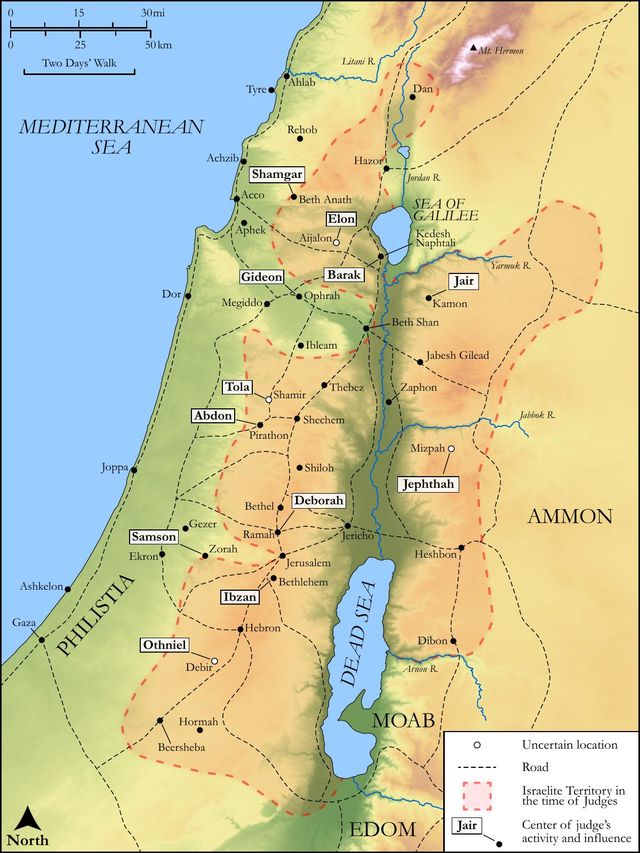
The period of the Judges, spanning roughly from the death of Joshua to the anointing of Saul as Israel's first king, was a transitional and often turbulent era in Israel's history. Lacking a centralized government or a permanent king, the twelve tribes operated largely independently, often failing to fully dispossess the Canaanites or adhere faithfully to the Mosaic covenant. The phrase "no king in Israel" reflects this political vacuum, but more profoundly, it points to a spiritual crisis: the people had largely rejected God's direct rule and the authority of His law. The mention of a "concubine" (Hebrew: pîlegeš) highlights a common, though subordinate, marital arrangement in the households of Israel, where such a woman often served as a secondary wife, typically for procreation or companionship, without the full legal status or inheritance rights of a primary wife. Her treatment in the subsequent narrative, however, dramatically exposes the societal degradation and disregard for human dignity prevalent in this lawless era. Furthermore, Bethlehemjudah, the concubine's hometown, was a small town in the tribal territory of Judah, significant later as the birthplace of King David and, prophetically, the Messiah. Its appearance here in such a dark narrative underscores that the moral decay had permeated even places destined for future glory.
Key Themes
ShowHideThis opening verse immediately introduces several critical themes that permeate the book of Judges and the broader Old Testament narrative. The most prominent is the theme of anarchy and moral relativism, powerfully encapsulated by the recurring refrain, "in those days there was no king in Israel" (also found in Judges 17:6, Judges 18:1, and Judges 21:25). This phrase is not merely a historical observation but a theological indictment, illustrating the devastating consequences when a nation rejects divine authority and "every man did that which was right in his own eyes" (Judges 21:25). The introduction of a Levite, a member of the priestly tribe consecrated for service to God and instruction in His law (Numbers 3:12), highlights the pervasive moral decay that had even corrupted those meant to uphold righteousness. His actions and the subsequent events reveal a profound breakdown of covenant fidelity and human decency, demonstrating how far Israel had fallen from its calling as a holy nation. This narrative ultimately serves as a stark foreshadowing of the need for a righteous king who would lead the people in obedience to God, a need that would eventually be met, imperfectly, in the monarchy, and perfectly in Christ.
Exposition and Analysis
ShowHideKey Word Analysis
ShowHideA descendant of Levi, one of Jacob's twelve sons. The tribe of Levi was set apart by God for priestly duties and service in the tabernacle/temple, responsible for teaching the Law and mediating between God and Israel (e.g., Deuteronomy 33:10). The presence of a Levite in this narrative, particularly one whose actions initiate such a horrific chain of events, underscores the profound spiritual degradation of Israel during this period. Even those dedicated to God's service were compromised or living in ways contrary to His standards, highlighting the depth of the national apostasy.
This word refers to a monarch or ruler. The repeated phrase "no king in Israel" (אֵין מֶלֶךְ בְּיִשְׂרָאֵל, ʾên meleḵ bĕyiśrāʾēl) is a central theological and literary motif in Judges 17-21. It signifies not merely the absence of a human monarch but, more profoundly, the absence of adherence to God's rule. God was intended to be Israel's ultimate King (1 Samuel 8:7), and the lack of a human king to enforce His laws led to a spiritual and moral vacuum where "every man did what was right in his own eyes" (Judges 21:25).
A secondary wife, often of lower social status than a primary wife, typically taken for companionship or to bear children, especially if the primary wife was barren. While a recognized arrangement in the households of Israel, the treatment of the concubine in the subsequent narrative of Judges 19 reveals a shocking disregard for human dignity and the sanctity of life, further illustrating the moral depravity of the age.
Verse Breakdown
ShowHide"¶ And it came to pass in those days, when [there was] no king in Israel"
This introductory clause immediately establishes the historical and theological context for the ensuing narrative. The phrase "no king in Israel" is a recurring refrain in Judges 17-21, serving as a profound theological explanation for the moral chaos that ensued. It signifies not just the absence of a human monarch but, more critically, the absence of divine order and adherence to God's covenant. This period was marked by lawlessness, moral relativism, and a profound spiritual vacuum, setting the stage for the horrific events that follow.
"that there was a certain Levite sojourning on the side of mount Ephraim"
This introduces the central character of the narrative. The Levite, a member of the tribe consecrated for sacred service and instruction in God's law, is depicted as "sojourning" (Hebrew, gûwr, living temporarily) in the hill country of Ephraim. His presence in this region, rather than in a Levitical city as prescribed by the Law, subtly hints at the disorder of the times and the breakdown of the established religious system. The fact that even a Levite is involved in such a morally compromised situation underscores the widespread apostasy that had permeated all levels of Israelite society, including those meant to uphold righteousness.
"who took to him a concubine out of Bethlehemjudah"
The Levite's domestic arrangement is introduced. He "took" (Hebrew, lâqach, implying acquisition or marriage) a concubine, a secondary wife, from Bethlehem in the tribal territory of Judah. This detail is significant for several reasons: it establishes the personal relationship that will be central to the unfolding tragedy, and it geographically connects the story to Bethlehem, a town that would later gain immense prophetic significance as the birthplace of King David and, ultimately, the Messiah. Its mention here in the context of such a dark narrative underscores how deeply the moral corruption had spread across the land, affecting even places destined for future glory.
Literary Devices
ShowHideThe opening verse of Judges 19 masterfully employs several literary devices to set the tone and context for the ensuing narrative. The most prominent is Repetition and Motif, specifically the phrase "when there was no king in Israel." This exact phrase appears four times in the final five chapters of Judges (Judges 17:6, Judges 18:1, Judges 19:1, Judges 21:25), functioning as a theological refrain that explains the moral and social chaos depicted. It is a powerful form of Foreshadowing, hinting at the horrific events to come by establishing a context of lawlessness and moral relativism. The phrase also serves as a Theological Commentary, implicitly arguing for the necessity of a righteous king who would uphold God's law and bring order to the nation. The introduction of a Levite in this context, a figure meant to embody holiness and uphold the Law, creates profound Irony, as his actions and the events he instigates profoundly contradict his sacred calling, thereby highlighting the depth of Israel's spiritual decline.
Theological and Thematic Connections
ShowHideJudges 19:1 serves as a stark theological commentary on the devastating consequences of rejecting divine authority. The repeated declaration "no king in Israel" is not merely a historical observation but a profound theological statement that frames the entire period of Judges. It underscores the spiritual anarchy that results when a people abandon God's covenant and His moral standards, leading to a society where "every man did what was right in his own eyes." This verse highlights the fundamental human need for righteous leadership, both human and divine, to prevent societal decay and ensure adherence to God's will. The narrative that unfolds from this verse is a grim testament to the depths of human depravity when divine restraint is removed, serving as a cautionary tale for all generations about the dangers of moral relativism and the indispensable role of God's law in maintaining order and justice.
Reflection and Application
ShowHideJudges 19:1, though brief, offers profound lessons for contemporary believers. The chilling phrase "no king in Israel" resonates far beyond ancient history, serving as a powerful metaphor for any society or individual that rejects ultimate divine authority. When God's Word is no longer the supreme standard, and personal desires or cultural trends dictate morality, the path to chaos and depravity is opened. This verse challenges us to examine where we place our ultimate allegiance and authority. Do we truly recognize God as our King, submitting our lives, our families, and our communities to His righteous rule? Or do we, like ancient Israel, allow "every man to do what is right in his own eyes," leading to spiritual and moral anarchy? The story that follows this verse is a grim reminder that individual moral failings, especially among those called to lead or serve God, can have devastating, far-reaching consequences for an entire community. It compels us to seek God's rule in our lives, to uphold His standards, and to pray for righteous leadership in all spheres of influence, understanding that true freedom is found not in lawlessness, but in joyful submission to the King of Kings.
Questions for Reflection
ShowHideFAQ
ShowHideWhat does "no king in Israel" truly mean in the context of Judges?
ShowHideThe phrase "no king in Israel" (אֵין מֶלֶךְ בְּיִשְׂרָאֵל) is a recurring theological and literary motif in the latter chapters of Judges (Judges 17:6, Judges 18:1, Judges 19:1, Judges 21:25). It signifies much more than just the absence of a human monarch. Theologically, it points to a profound spiritual vacuum and moral anarchy. God was intended to be Israel's ultimate King, and His Law (the Mosaic Covenant) was meant to govern their lives. The phrase indicates that the people had largely abandoned God's rule, leading to a state where "every man did what was right in his own eyes" (Judges 21:25). This resulted in widespread idolatry, violence, and moral depravity, illustrating the dire consequences of rejecting divine authority and the desperate need for a righteous, God-fearing leader.
Why is the mention of a Levite significant in this verse?
ShowHideThe mention of a Levite is highly significant because Levites were members of the tribe set apart by God for sacred service, responsible for maintaining the Tabernacle/Temple, teaching the Law, and mediating between God and the people (Numbers 3:12). They were meant to be exemplars of holiness and adherence to God's covenant. The fact that a Levite is involved in a situation that quickly spirals into extreme moral depravity (as the narrative unfolds) highlights the pervasive nature of Israel's spiritual decline. It demonstrates that even those consecrated for God's service were compromised or living in ways contrary to His standards, underscoring the depth of the national apostasy and the breakdown of religious and moral order. His actions, rather than upholding God's standards, tragically contribute to the chaos, making his presence a powerful indictment of the era's spiritual bankruptcy.
Christ-Centered Fulfillment
ShowHideJudges 19:1, with its bleak depiction of a nation without a king, crying out for righteous leadership, finds its ultimate and glorious fulfillment in Jesus Christ. The recurring refrain "no king in Israel" powerfully articulates the spiritual and moral chaos that ensues when humanity rejects God's rightful rule and each person does "what was right in his own eyes" (Judges 21:25). This desperate state of affairs in Judges foreshadows the universal human condition apart from Christ: a world adrift in sin, lacking true guidance and authority, marked by self-rule and its tragic consequences. Jesus, however, enters history not merely as a human king, but as the divine King of Kings and Lord of Lords (Revelation 19:16). He is the true and perfect Shepherd-King, unlike the flawed human leaders and compromised Levites of Judges, who perfectly embodies God's law and righteousness (Hebrews 4:15). His coming ushers in a new covenant where His Spirit writes God's law on the hearts of His people (Jeremiah 31:33), enabling them to live in obedience not out of obligation, but out of love and transformed desire. In Christ, we no longer do "what is right in our own eyes," but submit to the perfect will of the One who reigns eternally, bringing true order, peace, and salvation to those who believe (Colossians 1:13-14). He is the King for whom Israel longed, and the King humanity desperately needs.