


Joshua 24:33
Bible text: King James Version (1769 Blayney text) · Public domain
Bible text: Berean Standard Bible · Public domain
Bible text: American Standard Version (1901) · Public domain
Bible text: World English Bible, Messianic edition · Public domain
Bible text: Geneva Bible (1599) · Public domain
Bible text: Young's Literal Translation · Public domain
- וְאֶלְעָזָרve·'el·'a·Zarand EleazarH499Conj-w ¦ N-proper-mNoun Proper MasculineוְandאֶלְעָזָרEleazar
- בֶּןben[the] son ofH1121N-mscNoun Singular Masculine Construct
- אַהֲרֹן'a·ha·RonAaronH175N-proper-mNoun Proper Masculine
- מֵתMethe diedH4191V-Qal-Perf-3msVerb Qal Perfect 3rd Singular Masculine
- וַיִּקְבְּרוּvai·yik·be·Ruand people buriedH6912Conj-w ¦ V-Qal-ConsecImperf-3mpVerb Qal Consecutive Imperfect 3rd Plural Masculineוַandיִּקְבְּרוּpeople buried
- אֹתוֹ'o·To<obj.> himH853DirObjM ¦ 3msParticle Object Indicatorאֹת<obj.>וֹhim
- בְּגִבְעַתbe·giv·'Atat Gibeah ofH1390Prep-b ¦ N-properNoun Proper LocationבְּatגִבְעַתGibeah of
- פִּינְחָסpin·ChasPhinehasH6372N-proper-mNoun Proper Masculine
- בְּנוֹbe·Nohis sonH1121N-msc ¦ 3msNoun Singular Masculine Constructבְּנsonוֹhis
- אֲשֶׁר'a·SherwhichH834RelParticle Relative
- נִתַּןni·tanit had been givenH5414V-Niphal-Perf-3msVerb Niphal Perfect 3rd Singular Masculine
- לוֹloto <the> himPrep-l ¦ 3msSuffix Personal 3rd Singular Masculineלto <the>וֹhim
- בְּהַרbe·Harin [the] hill country ofH2022Prep-b ¦ N-mscNoun Singular Masculine Constructבְּinהַר[the] hill country of
- אֶפְרָיִם'ef·Ra·yimEphraimH669N-proper-mNoun Proper Masculine
English is a literal word-by-word gloss of the Hebrew, not the KJV's wording. Why?
This is the original text the KJV's translators worked from — each Hebrew word with its own literal English meaning in this verse, prepared by scholars at Tyndale House, Cambridge. The KJV translates whole sentences, not word by word, so its wording differs: one Hebrew word can become several English words, and the KJV may choose “the LORD” where the gloss reads “Yahweh”. Both are faithful — they answer different questions. For the KJV's own rendering, switch to the KJV text.
Details
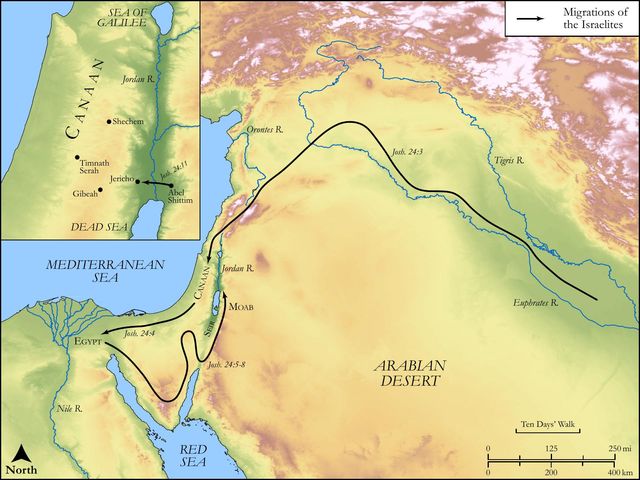
See on the biblical-era map
Study this verse
Public-domain commentary
Matthew Henry
From his Commentary on the Whole Bible. Henry comments on passages, not single verses — this entry covers Joshua 24:29–33.
This book, which began with triumphs, here ends with funerals, by which all the glory of man is stained. We have here 1. The burial of Joseph, Jos 24:32. He died about 200 years before in Egypt, but gave commandment concerning his bones, that they should not rest in their grave until Israel had rest in the land of promise; now therefore the children of Israel, who had brought this coffin full of bones with them out of Egypt, carried it along with them in all their marches through the wilderness (the two tribes of Ephraim and Manasseh, it is probable, taking particular care of it), and kept it in their camp till Canaan was perfectly reduced, now at last they deposited it in that piece of ground which his father gave him near Shechem, Gen 48:22. Probably it was upon this occasion that Joshua called for all Israel to meet him at Shechem (v. 1), to attend Joseph's coffin to the grave there, so that the sermon in this chapter served both for Joseph's funeral sermon and his own farewell sermon; and if it was, as is supposed, in the last year of his life, the occasion might very well remind him of his own death being at hand, for he was not just at the same age that his illustrious ancestor Joseph had arrived at when he died, 110 years old; compare Jos 24:29 with Gen 50:26. 2. The death and burial of Joshua, Jos 24:29, Jos 24:30. We are not told how long he lived after the coming of Israel into Canaan. Dr. Lightfoot thinks it was about seventeen years; but the Jewish chronologers generally say it was about twenty-seven or twenty-eight years. He is here called the servant of the Lord, the same title that was given to Moses (Jos 1:1) when mention was made of his death; for, though Joshua was in many respects inferior to Moses, yet in this he was equal to him, that, according as his work was, he approved himself a diligent and faithful servant of God. And he that traded with his two talents had the same approbation that he had who traded with his five. Well done, good and faithful servant. Joshua's burying-place is here said to be on the north side of the hill Gaash, or the quaking hill; the Jews say it was so called because it trembled at the burial of Joshua, to upbraid the people of Israel with their stupidity in that they did not lament the death of that great and good man as they ought to have done. Thus at the death of Christ, our Joshua, the earth quaked. The learned bishop Patrick observes that there is no mention of any days of mourning being observed for Joshua, as there were for Moses and Aaron, in which, he says, St. Hierom and others of the fathers think there is a mystery, namely, that under the law, when life and immortality were not brought to so clear a light as they are now, they had reason to mourn and weep for the death of their friends; but now that Jesus, our Joshua, has opened the kingdom of heaven, we may rather rejoice. 3. The death and burial of Eleazar the chief priest, who, it is probable, died about the same time that Joshua did, as Aaron in the same year with Moses, Jos 24:33. The Jews say that Eleazar, a little before he died, called the elders together, and gave them a charge as Joshua had done. He was buried in a hill that pertained to Phinehas his son, which came to him, not by descent, for then it would have pertained to his father first, nor had the priests any cities in Mount Ephraim, but either it fell to him by marriage, as the Jews conjecture, or it was freely bestowed upon him, to build a country seat on, by some pious Israelite that was well-affected to the priesthood, for it is here said to have been given him; and there he buried his dear father. 4. A general idea given us of the state of Israel at this time, Jos 24:31. While Joshua lived, religion was kept up among them under his care and influence; but soon after he and his contemporaries died it went to decay, so much oftentimes does one head hold up: how well is it for the gospel church that Christ, our Joshua, is still with it, by his Spirit, and will be always, even unto the end of the world!
Continue studying Joshua 24:33 across the web’s major study libraries — every link below opens this exact verse, chapter, or book on the destination site.
Read & Compare
 BibleGatewayThis verse in more than 200 translations and 70 languages.
 Bible.comThe YouVersion reader — hundreds of translations, reading plans, and highlights.
 ESV.orgCrossway's official English Standard Version reader.
 NET BibleThe NET translation with 60,000+ translators' notes on every rendering decision.
 STEP BibleTyndale House's free study tool — original text, vocabulary, and scholarly resources.
 BibliaLogos Bible Software's free web reader.
 USCCBThe New American Bible (Revised Edition) with the U.S. bishops' study notes.
Commentaries
 BibleHub CommentariesDozens of classic commentaries on this verse, gathered on one page.
 StudyLightMore than 100 commentary sets — the largest collection on the web.
 BibleRefPlain-English commentary on what this verse means, verse by verse.
 Enduring WordDavid Guzik's free commentary on this chapter, widely used by Bible teachers.
 Bible Study ToolsVerse commentary alongside Greek and Hebrew study aids.
Original Language & Research
- BibleHub InterlinearThe verse word by word — original language, transliteration, and English.
- BibleHub LexiconEvery word's original-language definition and Strong's entry.
 Blue Letter BibleDeep-study tools — Strong's numbers, concordance, and word studies.
 SefariaThe Hebrew text with Rashi and centuries of Jewish commentary.
Sermons, Hymns & Audio


TrulyRandomVerse is not affiliated with these sites and doesn’t control their content. They’re linked because they’re genuinely useful.
Summary
Joshua 24:33 serves as the poignant and definitive conclusion to the book of Joshua, meticulously detailing the peaceful passing and burial of Eleazar, the High Priest and son of Aaron. This terse yet profoundly significant verse, strategically placed after the accounts of Joshua's own death and the long-awaited burial of Joseph's bones, brings a foundational era of Israel's history—encompassing the Exodus, wilderness wandering, and the conquest and initial settlement of the Promised Land—to a complete and settled close. It powerfully underscores the meticulous fulfillment of God's covenant promises and signals a crucial transition in the spiritual and national leadership of the newly established nation.
Context
ShowHideLiterary Context
Joshua 24:33 functions as a vital epilogue, providing a comprehensive sense of closure to the entire narrative arc of the book of Joshua. It is the final element in a tripartite conclusion, immediately following the account of Joshua's death and burial (Joshua 24:29-30) and the deeply symbolic act of burying Joseph's bones (Joshua 24:32). This latter event fulfilled a sacred promise made centuries earlier to Joseph (Genesis 50:25) and reaffirmed by Moses (Exodus 13:19). The inclusion of Eleazar's death ensures that all the major figures from the Exodus generation who bore the mantle of leadership in bringing Israel into the land have now passed from the scene. This sequence powerfully emphasizes the definitive end of an epoch marked by direct divine guidance and sets the stage for the subsequent period of the Judges, characterized by decentralized leadership and a lamentable cycle of spiritual decline. This careful arrangement of final burials profoundly symbolizes the completion of God's initial phase of covenant fulfillment in the land of Canaan.
Historical & Cultural Context
Eleazar was an exceptionally significant figure in Israelite history, having faithfully succeeded his father Aaron as High Priest (Numbers 20:28) and serving diligently alongside Joshua during the conquest and subsequent division of the land (Joshua 14:1). His death marks the passing of the last major leader from the generation that directly experienced the miraculous Exodus from Egypt and the sustained divine provision in the wilderness. In Israel, the burial of prominent leaders was a profoundly significant event, often intricately tied to the land they inherited or conquered, thereby signifying their enduring legacy and the secure establishment of their lineage. The specific mention of "Mount Ephraim" is culturally and geographically significant, as it was a central and strategically important tribal territory. This detail indicates that Eleazar's family, the priestly line, possessed a specific land inheritance, further solidifying Israel's presence and God's faithfulness in distributing the land according to tribal allocations. The seamless continuity of the priesthood through Phinehas, Eleazar's son, was absolutely vital for maintaining the sacrificial system and ensuring Israel's ongoing covenant relationship with God.
Key Themes
ShowHideThis concluding verse powerfully contributes to several overarching themes woven throughout the book of Joshua and the broader Pentateuch. Firstly, it emphatically reinforces the Fulfillment of God's Promises, as the peaceful burial of these key leaders within the inherited land vividly underscores the completion of the Abrahamic covenant regarding the land (Genesis 12:7; 15:18). Secondly, it highlights the Continuity of Divine Institutions, particularly the Aaronic priesthood, through the explicit mention of Phinehas, who would succeed Eleazar. This continuity was absolutely crucial for Israel's ongoing spiritual life, worship, and the maintenance of their covenant relationship, as seen in Numbers 25:13. Thirdly, it marks the End of an Era and Transition in Leadership, signaling the close of the direct, divinely appointed leadership embodied by Moses, Joshua, and Eleazar. This transition prepares the reader for the more fragmented and less centralized leadership described in the Book of Judges, where the people would largely do "what was right in their own eyes" (Judges 21:25). Finally, it subtly yet profoundly points to the Sovereignty of God over life and death, and His unwavering faithfulness in carrying out His redemptive plans through successive generations, even as human leaders pass away.
Exposition and Analysis
ShowHideKey Word Analysis
ShowHideMeaning "God (is) helper" or "God has helped." Eleazar was the third son of Aaron (Exodus 6:23) and, upon Aaron's death at Mount Hor, succeeded him as High Priest (Numbers 20:28). He played a crucial and indispensable role alongside Joshua in the conquest and division of the land, overseeing the sacred aspects of the campaigns and the meticulous allocation of tribal inheritances (Joshua 14:1; 19:51). His death, recorded here, signifies the passing of the last major spiritual leader from the Exodus generation, bringing a definitive end to the direct, divinely appointed leadership that had guided Israel from Egypt to their settled inheritance in the Promised Land.
Meaning "mouth of a serpent" (though some suggest "mouth of bronze" or "oracle"). Phinehas was Eleazar's son and the designated successor to the high priesthood. He is most notably remembered for his zealous act in Numbers 25:7-13, where he intervened to stop a devastating plague by executing an Israelite man and a Midianite woman engaged in idolatrous sexual immorality. This act of righteous zeal earned him a "covenant of peace" and a perpetual priesthood for his line from God (Numbers 25:13). His mention here underscores the vital continuity of the Aaronic priesthood, ensuring that God's ordained system for atonement, worship, and mediation would persist for the nation of Israel.
This refers to the mountainous region within the tribal territory of Ephraim, a significant and central area in the land of Canaan. The Hebrew word har (H2022) denotes a "mountain or range of hills," while Ephrayim (H669) means "double fruit" and refers to the son of Joseph, his tribe, and its territory. This detail is profoundly significant because it indicates that Eleazar's family, though priestly and therefore without a tribal land inheritance in the same way as other tribes, still possessed a specific, settled place of burial within Israel's inherited land. This "hillock" (gibʻâh, H1389) or "hill" was given to Phinehas, signifying a family possession within the promised land, further cementing the fulfillment of God's promise of land and rest for His people. It also subtly reinforces the idea of the priesthood being firmly rooted and established within the land of Israel.
Verse Breakdown
ShowHide"And Eleazar the son of Aaron died;"
This clause succinctly records the death of Eleazar, the High Priest, marking the solemn end of his long and faithful service to the nation of Israel. As the spiritual head of the nation, his passing is a monumental event, paralleling the deaths of Moses (Deuteronomy 34:5) and Joshua (Joshua 24:29). It signifies the complete transition from the generation that led Israel out of Egyptian bondage and into the Promised Land. This statement emphasizes the mortality of even the most revered and divinely appointed leaders, yet implicitly points to the enduring nature of God's covenant and His divine purposes, which transcend the lifespan of any single individual.
"and they buried him in a hill [that pertained to] Phinehas his son,"
This clause meticulously details Eleazar's burial place, specifically on a hill belonging to his son, Phinehas. This highlights the orderly and divinely sanctioned succession within the priestly line, ensuring the continuity of Israel's spiritual leadership. While the priestly tribe of Levi did not receive a tribal land inheritance in the same way as the other tribes, they were allotted cities to dwell in (Joshua 21:19). This "hill" or "Gibeah" (H1389) likely refers to a private family estate or burial ground within the priestly allocations, emphasizing the establishment and rootedness of the priestly family within the settled land of Israel. It underscores the stability and permanence that God had brought to His people.
"which was given him in mount Ephraim."
This final phrase precisely specifies the geographical location of Phinehas's hill, placing it within the central and significant territory of Mount Ephraim. This detail confirms that the priestly family, through Phinehas, had a settled, established place within the land, further solidifying the complete fulfillment of God's promise to give Israel the land as an inheritance. The peaceful burial in an inherited family plot within the heart of Israel signifies the completion of the long, arduous journey from slavery and wandering to settled rest and possession in the Promised Land, a testament to God's unwavering faithfulness.
Literary Devices
ShowHideJoshua 24:33, though remarkably brief, employs several potent literary devices to convey its profound message. It functions as a powerful Epilogue, providing a definitive and satisfying conclusion not only to the narrative arc of the book of Joshua but, by extension, to the entire Pentateuchal history of the Exodus generation. The strategic placement of this verse, following the deaths of Joshua and the burial of Joseph's bones, creates a strong sense of Closure and finality, underscoring that a major, foundational epoch in Israel's history has definitively ended. The verse also utilizes potent Symbolism: the burial of Eleazar in a place belonging to his son, Phinehas, within the heart of the Promised Land, symbolizes the unwavering Continuity of God's Covenant and the meticulous Fulfillment of His Promises regarding both land and leadership. The orderly succession from Eleazar to Phinehas also serves as a subtle yet significant Foreshadowing of the challenges that will arise in the subsequent Book of Judges, where the absence of strong, centralized, and divinely appointed leadership (like Joshua's) will lead to spiritual and political disarray, contrasting sharply with the orderly and divinely sanctioned transition presented here.
Theological and Thematic Connections
ShowHideJoshua 24:33, as the concluding verse of the book, encapsulates profound theological truths that resonate throughout biblical history. It underscores God's unwavering faithfulness in meticulously fulfilling His covenant promises, particularly the promise of land and rest for His people. The passing of Eleazar, the High Priest, alongside Joshua, signifies the end of a foundational era but simultaneously highlights the enduring nature of God's divine institutions, specifically the Aaronic priesthood, which continues seamlessly through Phinehas. This verse reminds us that while human leaders are mortal and temporary, God's purposes, His covenant with His people, and His redemptive plan are eternal and transcend generations. It also points to the vital importance of an orderly transition of leadership and the legacy of faithfulness passed down through families, ensuring the continuity of God's work among His people. The secure burial within the promised land speaks volumes about God's provision and the establishment of His people.
Reflection and Application
ShowHideJoshua 24:33 offers a poignant and timeless reminder of life's transient nature and, more profoundly, the enduring faithfulness of God. Just as Eleazar, a great spiritual leader who served faithfully for decades, eventually passed away, so too do all human leaders and indeed, all people. This verse calls us to reflect deeply on our own mortality and the brevity of our time on earth, urging us to live lives of intentional purpose and unwavering faithfulness, diligently stewarding the gifts, talents, and callings God has graciously entrusted to us. It also powerfully highlights the importance of spiritual succession and legacy; Eleazar's vital work continued through Phinehas, demonstrating that our contributions to God's kingdom are part of a larger, ongoing narrative that extends far beyond our individual lives. We are therefore called to intentionally invest in the next generation, equipping and discipling them to faithfully carry forward the torch of faith and service. Ultimately, this verse directs our gaze to the unchanging nature of God's promises. If God was utterly faithful to bring Israel into the land and establish them there, even through the passing of key figures and the challenges of transition, how much more can we trust Him to fulfill His promises to us in Christ, providing ultimate rest, an eternal inheritance, and an everlasting High Priest who never dies?
Questions for Reflection
ShowHideFAQ
ShowHideWhy is Eleazar's death mentioned at the very end of the book of Joshua?
ShowHideEleazar's death is mentioned at the very end of the book of Joshua (along with Joshua's death in Joshua 24:29-30 and the burial of Joseph's bones in Joshua 24:32) to provide a comprehensive and definitive closure to the foundational era of Israel's history. This tripartite conclusion signifies the complete passing of the generation that experienced the Exodus and the conquest of Canaan, ensuring that all major figures from that era have been laid to rest within the promised land. As the High Priest, Eleazar was the spiritual head of the nation, and his death marks the end of the direct, divinely appointed leadership that had guided Israel from Egypt into the Promised Land. This strategic placement emphasizes that God's promises regarding the land have been fully and meticulously fulfilled, and it sets the stage for the subsequent period, which would be characterized by a different, less centralized form of leadership, as seen in the Book of Judges.
What is the significance of Eleazar being buried in a hill that "pertained to Phinehas his son"?
ShowHideThe detail that Eleazar was buried on a hill belonging to his son Phinehas is highly significant for several reasons. Firstly, it highlights the orderly and legitimate succession within the Aaronic priesthood, ensuring the vital continuity of Israel's central religious institution. Phinehas was Eleazar's designated successor as High Priest (Numbers 20:28), and his zeal had already secured a perpetual priesthood for his line (Numbers 25:13). Secondly, while the priestly tribe of Levi did not receive a tribal land inheritance in the same way as the other tribes, they were allotted cities to dwell in (Joshua 21). The mention of a "hill" or "Gibeah" belonging to Phinehas suggests a private family estate or burial ground within their allocated territory, likely in Mount Ephraim. This detail further underscores the complete fulfillment of God's promise to bring Israel into the land and establish them there, even providing a settled and permanent place for the priestly line. It symbolizes the rootedness, stability, and permanence that God had brought to His people in the Promised Land.
Christ-Centered Fulfillment
ShowHideJoshua 24:33, marking the end of an era and the peaceful passing of the High Priest Eleazar, finds its ultimate fulfillment and deeper theological meaning in the person and work of Jesus Christ. Eleazar, as the High Priest of Israel, served as the divinely appointed mediator between God and His people, offering sacrifices and interceding on their behalf. This Old Testament priesthood, though essential and divinely ordained, was inherently temporary and imperfect, as evidenced by the recurring death of each priest. The passing of Eleazar, like all his predecessors, points powerfully to the profound need for a High Priest who would not succumb to death, one whose ministry would be eternal, perfect, and eternally effective. Jesus Christ is that ultimate and eternal High Priest, appointed not "after the law of a carnal commandment, but after the power of an endless life" (Hebrews 7:16), "after the order of Melchizedek" (Hebrews 7:17). He "holds his priesthood permanently, because he continues forever" (Hebrews 7:24). Unlike Eleazar, who died and was buried, Jesus, through His glorious resurrection, conquered death definitively and now lives forever to make "intercession for us" (Hebrews 7:25) at the right hand of God. Furthermore, the overarching theme of rest and inheritance, so prominent throughout the book of Joshua, culminates in Christ. Just as Eleazar's burial in Mount Ephraim symbolized Israel's entry into their promised land of rest, Jesus is the one who provides true and eternal rest for the weary souls of His people (Matthew 11:28-30). He is the "author of eternal salvation" (Hebrews 5:9) who leads His people into the ultimate, heavenly inheritance, a "better country, that is, a heavenly one" (Hebrews 11:16), far surpassing the earthly Canaan. Thus, Eleazar's death, though marking the end of a significant earthly ministry, ultimately points forward to the everlasting, perfect, and all-sufficient ministry of Christ, our great High Priest and the giver of eternal rest and an imperishable inheritance.