


Genesis 48:22
Bible text: King James Version (1769 Blayney text) · Public domain
Bible text: Berean Standard Bible · Public domain
Bible text: American Standard Version (1901) · Public domain
Bible text: World English Bible, Messianic edition · Public domain
Bible text: Geneva Bible (1599) · Public domain
Bible text: Young's Literal Translation · Public domain
- וַאֲנִיva·'a·Niand IH589Conj-w ¦ Pro-1csPronoun Personal 1st Singular common genderוַandאֲנִיI
- נָתַתִּיna·Ta·tiI giveH5414V-Qal-Perf-1csVerb Qal Perfect 1st Singular common gender
- לְךָle·Khato youPrep-l ¦ 2msSuffix Personal 2nd Singular Masculineלְtoךָyou
- שְׁכֶםshe·Khema shoulderH7926N-msNoun Singular Masculine Absolute
- אַחַד'a·ChadoneH259Adj-fsAdjective Numerical Singular Feminine Absolute
- עַל'aloverH5921PrepPreposition
- אַחֶיךָ'a·Chei·khayour brothersH251N-mpc ¦ 2msNoun Plural Masculine Constructאַחֶיbrothersךָyour
- אֲשֶׁר'a·SherwhichH834RelParticle Relative
- לָקַחְתִּיla·Kach·tiI tookH3947V-Qal-Perf-1csVerb Qal Perfect 1st Singular common gender
- מִיַּדmi·Yadfrom [the] hand ofH3027Prep-m ¦ N-cscNoun Singular common gender Constructמִfromיַּד[the] hand of
- הָאֱמֹרִיha·'e·mo·Rithe Amorite[s]H567Art ¦ N-msNoun Gentilic Singular Masculine AbsoluteהָtheאֱמֹרִיAmorite[s]
- בְּחַרְבִּיbe·char·Biby my swordH2719Prep-b ¦ N-fsc ¦ 1csNoun Singular Feminine Constructבְּbyחַרְבִּswordיmy
- וּבְקַשְׁתִּיu·ve·kash·Tiand by my bowH7198Conj-w ¦ Prep-b ¦ N-fsc ¦ 1csNoun Singular Feminine Constructוּandבְbyקַשְׁתִּbowיmy
English is a literal word-by-word gloss of the Hebrew, not the KJV's wording. Why?
This is the original text the KJV's translators worked from — each Hebrew word with its own literal English meaning in this verse, prepared by scholars at Tyndale House, Cambridge. The KJV translates whole sentences, not word by word, so its wording differs: one Hebrew word can become several English words, and the KJV may choose “the LORD” where the gloss reads “Yahweh”. Both are faithful — they answer different questions. For the KJV's own rendering, switch to the KJV text.
Details
See on the biblical-era maps


Study this verse
Public-domain commentary
Matthew Henry
From his Commentary on the Whole Bible. Henry comments on passages, not single verses — this entry covers Genesis 48:8–22. His four-level outline is real structure in the source text, so it is rendered as structure.
Here is, I. The blessing with which Jacob blessed the two sons of Joseph, which is the more remarkable because the apostle makes such particular mention of it (Heb 11:21), while he says nothing of the blessing which Jacob pronounced on the rest of his sons, though that also was done in faith. Observe here,
1.Jacob was blind for age, Gen 48:10. It is one of the common infirmities of old age. Those that look out at the windows are darkened, Ecc 12:3. It is folly to walk in the sight of our eyes, and to suffer our hearts to go after them, while we know death will shortly close them, and we do not know but some accident between us and death may darken them. Jacob, like his father before him, when he was old, was dim-sighted. Note,
(1.)Those that have the honour of age must therewith be content to take the burden of it.
(2.)The eye of faith may be very clear even when the eye of the body is very much clouded.
2.Jacob was very fond of Joseph's sons: He kissed them and embraced them, Gen 48:10. It is common for old people to have a very particular affection for their grand-children, perhaps more than they had for their own children when they were little, which Solomon gives a reason for (Pro 17:6), Children's children are the crown of old men. With what satisfaction does Jacob say here (Gen 48:11), I had not thought to see thy face (having many years given him up for lost), and, lo, God has shown me also thy seed! See here,
(1.)How these two good men own God in their comforts. Joseph says (Gen 48:9), They are my sons whom God has given me, and, to magnify the favour, he adds, "In this place of my banishment, slavery, and imprisonment." Jacob says here, God has shown me thy seed. Our comforts are then doubly sweet to us when we see them coming from God's hand.
(2.)How often God, in his merciful providences, outdoes our expectations, and thus greatly magnifies his favours. He not only prevents our fears, but exceeds our hopes. We may apply this to the promise which is made to us and to our children. We could not have thought that we should have been taken into covenant with God ourselves, considering how guilty and corrupt we are; and yet, lo, he has shown us our seed also in covenant with him.
3.Before he entails his blessing, he recounts his experiences of God's goodness to him. He had spoken (Gen 48:3) of God's appearing to him. The particular visits of his grace, and the special communion we have sometimes had with him, ought never to be forgotten. But (Gen 48:15, Gen 48:16) he mentions the constant care which the divine Providence had taken of him all his days.
(1.)He had fed him all his life long unto this day, Gen 48:15. Note, As long as we have lived in this world we have had continual experience of God's goodness to us, in providing for the support of our natural life. Our bodies have called for daily food, and no little has gone to feed us, yet we have never wanted food convenient. He that has fed us all our life long surely will not fail us at last.
(2.)He had by his angel redeemed him from all evil, Gen 48:16. A great deal of hardship he had known in his time, but God had graciously kept him from the evil of his troubles. Now that he was dying he looked upon himself as redeemed from all evil, and bidding an everlasting farewell to sin and sorrow. Christ, the Angel of the covenant, is he that redeems us from all evil, Ti2 4:18. Note,
[1.]It becomes the servants of God, when they are old and dying, to witness for our God that they have found him gracious.
[2.]Our experiences of God's goodness to us are improvable, both for the encouragement of others to serve God, and for encouragement to us in blessing them and praying for them.
4.When he confers the blessing and name of Abraham and Isaac upon them he recommends the pattern and example of Abraham and Isaac to them, Gen 48:15. He calls God the God before whom his fathers Abraham and Isaac walked, that is, in whom they believed, whom they observed and obeyed, and with whom they kept up communion in instituted ordinances, according to the condition of the covenant. Walk before me, Gen 17:1. Note,
(1.)Those that would inherit the blessing of their godly ancestors, and have the benefit of God's covenant with them, must tread in the steps of their piety.
(2.)It should recommend religion and the service of God to us that God was the God of our fathers, and that they had satisfaction in walking before him.
5.In blessing them, he crossed hands. Joseph placed them so as that Jacob's right hand should be put on the head of Manasseh the elder, Gen 48:12, Gen 48:13. But Jacob would put it on the head of Ephraim the younger, Gen 48:14. This displeased Joseph, who was willing to support the reputation of his first-born, and would therefore have removed his father's hands, Gen 48:17, Gen 48:18. But Jacob gave him to understand that he know what he did, and that he did it not by mistake, nor in a humour, nor from a partial affection to one more than the other, but from a spirit of prophecy, and in compliance with the divine counsels. Manasseh should be great, but truly Ephraim should be greater. When the tribes were mustered in the wilderness, Ephraim was more numerous than Manasseh, and had the standard of that squadron (Num 1:32, Num 1:33, Num 1:35; Num 2:18, Num 2:20), and is named first, Psa 80:2. Joshua was of that tribe, so was Jeroboam. The tribe of Manasseh was divided, one half on one side Jordan, the other half on the other side, which made it the less powerful and considerable. In the foresight of this, Jacob crossed hands. Note.
(1.)God, in bestowing his blessings upon his people, gives more to some than to others, more gifts, graces, and comforts, and more of the good things of this life.
(2.)He often gives most to those that are least likely. He chooses the weak things of the world; raises the poor out of the dust. Grace observes not the order of nature, nor does God prefer those whom we think fittest to be preferred, but as it pleases him. It is observable how often God, by the distinguishing favours of his covenant, advanced the younger above the elder, Abel above Cain, Shem above Japheth, Abraham above Nahor and Haran, Isaac above Ishmael, Jacob above Esau; Judah and Joseph were preferred before Reuben, Moses before Aaron, David and Solomon before their elder brethren. See Sa1 16:7. He tied the Jews to observe the birthright (Deu 21:17), but he never tied himself to observe it. Some make this typical of the preference given to the Gentiles above the Jews; the Gentile converts were much more numerous than those of the Jews. See Gal 4:27. Thus free grace becomes more illustrious.
II.The particular tokens of his favour to Joseph.
1.He left with him the promise of their return out of Egypt, as a sacred trust: I die, but God shall be with you, and bring you again, Gen 48:21. Accordingly, Joseph, when he died, left it with his brethren, Gen 50:24. This assurance was given them, and carefully preserved among them, that they might neither love Egypt too much when it favoured them, nor fear it too much when it frowned upon them. These words of Jacob furnish us with comfort in reference to the death of our friends: They die; but God shall be with us, and his gracious presence is sufficient to make up the loss: they leave us, but he will never fail us. Further, He will bring us to the land of our fathers, the heavenly Canaan, whither our godly fathers have gone before us. If God be with us while we stay behind in this world, and will receive us shortly to be with those that have gone before to a better world, we ought not to sorrow as those that have no hope.
2.He bestowed one portion upon him above his brethren, Gen 48:22. The lands bequeathed are described to be those which he took out of the hand of the Amorite with his sword, and with his bow. He purchased them first (Jos 24:32), and, it seems, was afterwards disseized of them by the Amorites, but retook them by the sword, repelling force by force, and recovering his right by violence when he could not otherwise recover it. These lands he settled upon Joseph; mention is made of this grant, Joh 4:5. Pursuant to it, this parcel of ground was given to the tribe of Ephraim as their right, and the lot was never cast upon it; and in it Joseph's bones were buried, which perhaps Jacob had an eye to as much as to any thing in this settlement. Note, It may sometimes be both just and prudent to give some children portions above the rest; but a grave is that which we can most count upon as our own in this earth.
Historical interpretation
Historical reception
2 surviving comments on this verse. Each one is dated, so this reads as a timeline rather than a list.
Select a marker to jump to its quote. Markers stagger vertically where authors wrote within a few decades of each other.
After he blessed the sons and promoted the younger ahead of the elder by way of forecasting the future, he wanted to convince Joseph that it was not idly or to no purpose that he had done this but to foretell what was due to happen. So he predicted his own death and the fact that they would return from foreign parts to Canaan, the land of their ancestors, and raised sound hope in them so as to cheer them up with the expectation. The hope of good things to come, after all, always mitigates the troubles of the present life.
(Verse 22.) And I gave ((Or, do)) to you Sicima, the special one, over your brothers, which I received from the hands of the Amorites with my sword and arrow. Sicima, according to Greek and Latin custom, is declined. Otherwise, in Hebrew it is called Sichem, as John the Evangelist also testifies (IV, 5): although erroneously, it is read as Sichar, the error has prevailed: and now it is the city of Neapolis, the city of the Samaritans. Therefore, because Sichem () is translated into Hebrew as shoulder, he cleverly alluded to the name, saying: And I will give you one shoulder. For it is written specially, that is, in Hebrew. And what he says that he possessed it in a bow and sword: the bow here, and the sword, he calls righteousness, through which he deserved to be delivered from danger as a stranger and sojourner, by slaying Shechem and Hamor. For, as we read above, he feared lest the neighboring cities and castles should rise up against him for the destruction of the federal city (Gen. 34): and the Lord did not permit them to harm him. Certainly, you should understand it this way: I will give you Sichem, which I acquired with my own strength, that is, with money, which I earned with much labor and much sweat. And what he said, surpassing your brothers, shows that it was given to Joseph without any obligation. For indeed, Joseph is buried in the same place, and his tomb can still be seen there today.
Continue studying Genesis 48:22 across the web’s major study libraries — every link below opens this exact verse, chapter, or book on the destination site.
Read & Compare
 BibleGatewayThis verse in more than 200 translations and 70 languages.
 Bible.comThe YouVersion reader — hundreds of translations, reading plans, and highlights.
 ESV.orgCrossway's official English Standard Version reader.
 NET BibleThe NET translation with 60,000+ translators' notes on every rendering decision.
 STEP BibleTyndale House's free study tool — original text, vocabulary, and scholarly resources.
 BibliaLogos Bible Software's free web reader.
 USCCBThe New American Bible (Revised Edition) with the U.S. bishops' study notes.
Commentaries
 BibleHub CommentariesDozens of classic commentaries on this verse, gathered on one page.
 StudyLightMore than 100 commentary sets — the largest collection on the web.
 BibleRefPlain-English commentary on what this verse means, verse by verse.
 Enduring WordDavid Guzik's free commentary on this chapter, widely used by Bible teachers.
 Bible Study ToolsVerse commentary alongside Greek and Hebrew study aids.
Original Language & Research
- BibleHub InterlinearThe verse word by word — original language, transliteration, and English.
- BibleHub LexiconEvery word's original-language definition and Strong's entry.
 Blue Letter BibleDeep-study tools — Strong's numbers, concordance, and word studies.
 SefariaThe Hebrew text with Rashi and centuries of Jewish commentary.
Sermons, Hymns & Audio


TrulyRandomVerse is not affiliated with these sites and doesn’t control their content. They’re linked because they’re genuinely useful.
Summary
On his deathbed, Jacob prophetically bestows upon his beloved son Joseph a unique and preeminent inheritance, declaring, "Moreover I have given to thee one portion above thy brethren, which I took out of the hand of the Amorite with my sword and with my bow." This declaration signifies not only a special double portion, traditionally identified with the fertile region of Shechem, but also serves as a profound statement of Jacob's unwavering faith in God's past provision and future fulfillment of the covenant promises for his descendants to inherit the Promised Land.
Context
ShowHideLiterary Context
Genesis 48:22 serves as the culminating statement in Jacob's specific blessing of Joseph, immediately following his adoption of Joseph's two sons, Ephraim and Manasseh, as his own (Genesis 48:5-6). This act of adoption is crucial, as it effectively grants Joseph a double portion of the inheritance, a right typically reserved for the firstborn son. This preeminence is further underscored by Reuben's forfeiture of his birthright due to his transgression (Genesis 49:3-4; 1 Chronicles 5:1-2). Jacob's deathbed blessings, which begin here and continue into Genesis 49, are highly significant, functioning as prophetic pronouncements that shape the future tribal identities and destinies of Israel.
Historical & Cultural Context
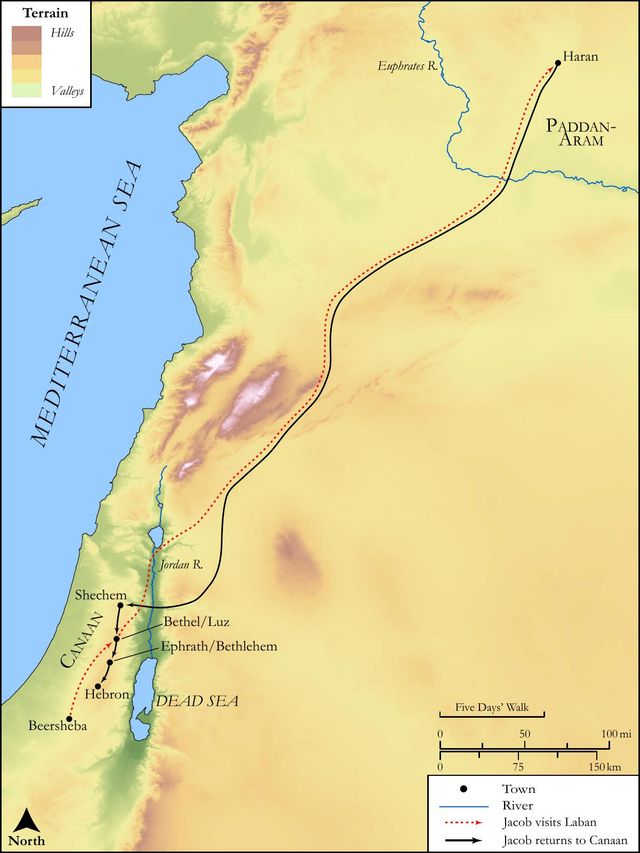
Among the patriarchs, inheritance was paramount, securing family lineage, economic stability, and social status. The concept of a "double portion" was a recognized privilege of the firstborn (Deuteronomy 21:17), signifying leadership and a greater share of the family's assets. Jacob's act of bestowing this upon Joseph, through his sons, elevates Joseph's line within the burgeoning nation of Israel. The "Amorite" refers to one of the prominent Canaanite tribes inhabiting the land God promised to Abraham's descendants. The specific "portion" is widely understood to be Shechem, a strategically vital and fertile area in central Canaan. Shechem held deep historical significance for the patriarchs, being the first place Abraham built an altar upon entering Canaan (Genesis 12:6-7), and where Jacob himself had purchased land and settled for a time (Genesis 33:18-20).
Key Themes
ShowHideThis verse resonates with several overarching themes found throughout Genesis and the Pentateuch. It powerfully illustrates Divine Faithfulness to the covenant promises made to Abraham, Isaac, and Jacob, particularly concerning the gift of the land of Canaan (Genesis 15:18-21). The theme of Covenant Inheritance is central, as Jacob's blessing anticipates Israel's future possession of the land through divine intervention and human agency. Furthermore, it highlights the theme of Sovereignty and Providence, demonstrating how God works through the lives and choices of individuals, even in seemingly ordinary or challenging circumstances, to bring about His grand redemptive plan. Jacob's prophetic declaration also underscores the theme of Patriarchal Blessing, where the words of the dying patriarch carry immense weight and prophetic authority for the future generations.
Exposition and Analysis
ShowHideKey Word Analysis
ShowHideThis word, meaning "the neck (between the shoulders) as the place of burdens; figuratively, the spur of a hill; back, consent, portion, shoulder," is a deliberate and profound wordplay. While it literally means "shoulder" or "ridge," it is also the proper name for the city of Shechem. This dual meaning strongly suggests that the specific "portion" Jacob is giving to Joseph, above his brothers, is indeed the strategic and fertile region of Shechem, a place of significant historical and future importance for Israel.
This primitive root means "to take (in the widest variety of applications); accept, bring, buy, carry away, drawn, fetch, get, infold, many, mingle, place, receive(-ing), reserve, seize, send for, take (away, -ing, up), use, win." In this context, Jacob's use of "took" is not merely a statement of past action but carries a strong sense of acquisition and possession, whether through direct conflict or, more likely, through divine enablement and future conquest. It emphasizes the active securing of the inheritance.
Derived from a root meaning "drought," this word refers to "a cutting instrument (from its destructive effect), as a knife, sword, or other sharp implement; axe, dagger, knife, mattock, sword, tool." Along with "bow," the sword represents instruments of warfare and conquest. Jacob's claim to have taken the land "with my sword and with my bow" is highly significant, as he was not primarily known as a warrior. This phrase points to either a specific, unrecorded defensive action, or more likely, a prophetic and symbolic declaration of future divine conquest through his descendants.
Verse Breakdown
ShowHide"Moreover I have given to thee one portion above thy brethren"
This clause establishes Joseph's unique and elevated status among his brothers. The "one portion" (Hebrew: shᵉkem) is a specific, additional inheritance beyond what his brothers would receive, effectively granting him the double portion of the firstborn. This preeminence is a recognition of Joseph's faithfulness, his role in preserving the family during the famine, and a fulfillment of God's providential plan for his lineage to become two great tribes (Ephraim and Manasseh).
"which I took out of the hand of the Amorite with my sword and with my bow"
This highly debated phrase is pivotal. Jacob, not known as a military conqueror, attributes the acquisition of this "portion" from the Amorites to his own "sword and bow." This is best understood not as a literal historical account of Jacob's personal military campaign, but as a prophetic declaration. Jacob, by faith, identifies with the future conquests of his descendants in the Promised Land. He sees their future victories, enabled by God, as an extension of his own faith and the divine power working through him. The "hand of the Amorite" signifies their control and possession of the land, from which it would be wrested.
Literary Devices
ShowHideThe verse employs several powerful Literary Devices. Foremost is Wordplay, specifically with the Hebrew word shᵉkem (H7926), which means both "shoulder/portion" and is the proper name for the city of Shechem. This clever linguistic connection strongly links the abstract idea of a "portion" to a concrete geographical location, emphasizing the specific nature of Jacob's gift. Symbolism is also prominent; the "sword and bow" are not merely literal weapons but symbols of struggle, conquest, and the means by which possession is secured. In Jacob's mouth, they become symbols of divine power and the future military victories of Israel, which he, through faith, claims as his own accomplishment. The phrase "out of the hand of the Amorite" uses Metonymy, where "hand" represents the power, control, or possession of the Amorites, from whom the land is to be taken. This prophetic declaration also contains an element of Hyperbole or Figurative Language, as Jacob's personal military exploits against the Amorites are not recorded, suggesting that his statement is a faith-filled assertion of God's future work through his descendants, viewed as already accomplished in the divine plan.
Theological and Thematic Connections
ShowHideJacob's final blessing to Joseph in Genesis 48:22 serves as a profound testament to God's unwavering faithfulness to His covenant promises, particularly concerning the land of Canaan. It underscores the theme of divine sovereignty, where God orchestrates events and empowers His people to fulfill His redemptive purposes, even through human struggle and future conquest. Jacob's prophetic declaration, made from his deathbed, bridges the gap between the present reality of the patriarchs residing in Egypt and the future reality of Israel's possession of the Promised Land, demonstrating a faith that looks beyond immediate circumstances to the ultimate fulfillment of God's word.
Reflection and Application
ShowHideGenesis 48:22 offers a powerful lesson in faith and perseverance for believers today. Jacob, at the end of his life, speaks with a prophetic certainty that transcends his current physical weakness and the immediate reality of his family's sojourn in Egypt. His declaration of having "taken" the land, though not literally accomplished by him in direct military conquest, reflects an profound trust in God's covenant promises and the future inheritance of his descendants. This challenges us to cultivate a similar long-term, faith-filled perspective, trusting in God's ultimate plan and promises for our lives and for the world, even when present circumstances seem to contradict them. Just as Joseph received a special portion, believers in Christ inherit spiritual blessings and a future hope that far surpasses any earthly possession (Ephesians 1:3). The "sword and bow" can symbolize the spiritual battles and challenges we face in our walk of faith (Ephesians 6:12), reminding us that God often works through our struggles and efforts to secure our spiritual inheritance and accomplish His purposes, even when we feel our strength is insufficient.
Questions for Reflection
ShowHideFAQ
ShowHideDid Jacob literally take land from the Amorites with his sword and bow?
ShowHideWhile Jacob was not primarily known as a warrior, and there is no specific biblical account of him conquering Amorite land with military force, his statement in Genesis 48:22 is best understood as a prophetic declaration rooted in faith. He attributes the future conquest of Canaan by his descendants, which God would enable, to his own faith and the divine power working through him. It reflects a deep trust in God's promise to give the land to his offspring, viewing it as already accomplished through God's sovereign power and through the agency of his descendants. Some scholars suggest it could refer to a defensive action, such as the protection of the land he purchased near Shechem after the incident with Dinah (Genesis 34), but the dominant view is its prophetic nature.
Why was Joseph given "one portion above thy brethren"?
ShowHideJoseph received a double portion because Jacob adopted Joseph's two sons, Ephraim and Manasseh, as his own (Genesis 48:5-6). This act effectively granted Joseph the inheritance rights of a firstborn son, elevating him above his brothers. This elevated status was also due to Reuben, the actual firstborn, forfeiting his birthright through his transgression (Genesis 49:3-4; 1 Chronicles 5:1-2). This special portion specifically refers to the land around Shechem, a significant and fertile location in Israel's history, which would later become part of the tribal inheritance of Joseph's descendants.
Christ-Centered Fulfillment
ShowHideThe special portion given to Joseph, secured through Jacob's faith and the symbolic "sword and bow," profoundly foreshadows the greater spiritual inheritance secured for believers through Jesus Christ. Just as Joseph received a preeminent place and a specific portion of the Promised Land, believers in Christ receive an indestructible, undefiled, and unfading inheritance in the heavenly realms. Christ, the true warrior and ultimate heir, conquered sin and death not with a physical sword and bow, but through His sacrificial death on the cross and His glorious resurrection (Colossians 2:15). By His decisive victory, He secured for His people an eternal inheritance and access to the true "Promised Land" of God's presence. Through Him, we are granted a portion far exceeding any earthly blessing, making us co-heirs with Christ in God's eternal kingdom, a reality that surpasses all human striving or earthly conquest. Indeed, in Christ, we have been "given a portion" that is truly above all others, an inheritance in the saints in light.