


Joshua 22:13
Bible text: King James Version (1769 Blayney text) · Public domain
Bible text: King James Version with Strong's numbers · Public domain
Bible text: Berean Standard Bible · Public domain
Bible text: American Standard Version (1901) · Public domain
Bible text: World English Bible, Messianic edition · Public domain
Bible text: Geneva Bible (1599) · Public domain
Bible text: Young's Literal Translation · Public domain
- וַיִּשְׁלְחוּvai·yish·le·Chuand they sentH7971Conj-w ¦ V-Qal-ConsecImperf-3mpVerb Qal Consecutive Imperfect 3rd Plural Masculineוַandיִּשְׁלְחוּthey sent
- בְנֵיve·nei[the] people ofH1121N-mpcNoun Plural Masculine Construct
- יִשְׂרָאֵלYis·ra·'ElIsraelH3478N-properNoun Proper Location
- אֶל'eltoH413PrepPreposition
- בְּנֵיbe·nei[the] descendants ofH1121N-mpcNoun Plural Masculine Construct
- רְאוּבֵןre·'u·VenReubenH7205N-proper-mNoun Proper Masculine
- וְאֶלve·'eland toH413Conj-w ¦ PrepPrepositionוְandאֶלto
- בְּנֵיbe·nei[the] descendants ofH1121N-mpcNoun Plural Masculine Construct
- גָדgadGadH1410N-proper-mNoun Proper Masculine
- וְאֶלve·'eland toH413Conj-w ¦ PrepPrepositionוְandאֶלto
- חֲצִיcha·Tzi[the] half ofH2677N-mscNoun Singular Masculine Construct
- שֵׁבֶטshe·vet[the] tribe ofH7626N-mscNoun Singular Masculine Construct
- מְנַשֶּׁהme·na·ShehManassehH4519N-proper-mNoun Proper Masculine
- אֶל'eltoH413PrepPreposition
- אֶרֶץ'E·retz[the] land ofH776N-fscNoun Singular Feminine Construct
- הַגִּלְעָדha·gil·'Ad<the> GileadH1568Art ¦ N-properNoun Proper Locationהַ<the>גִּלְעָדGilead
- אֶת'et<obj.>H853DirObjMParticle Object Indicator
- פִּינְחָסpin·ChasPhinehasH6372N-proper-mNoun Proper Masculine
- בֶּןben[the] son ofH1121N-mscNoun Singular Masculine Construct
- אֶלְעָזָר'el·'a·ZarEleazarH499N-proper-mNoun Proper Masculine
- הַכֹּהֵןha·ko·Henthe priestH3548Art ¦ N-msNoun Singular Masculine Absoluteהַtheכֹּהֵןpriest
English is a literal word-by-word gloss of the Hebrew, not the KJV's wording. Why?
This is the original text the KJV's translators worked from — each Hebrew word with its own literal English meaning in this verse, prepared by scholars at Tyndale House, Cambridge. The KJV translates whole sentences, not word by word, so its wording differs: one Hebrew word can become several English words, and the KJV may choose “the LORD” where the gloss reads “Yahweh”. Both are faithful — they answer different questions. For the KJV's own rendering, switch to the KJV text.
Details
See on the biblical-era map
Study this verse
Continue studying Joshua 22:13 across the web’s major study libraries — every link below opens this exact verse, chapter, or book on the destination site.
Read & Compare
 BibleGatewayThis verse in more than 200 translations and 70 languages.
 Bible.comThe YouVersion reader — hundreds of translations, reading plans, and highlights.
 ESV.orgCrossway's official English Standard Version reader.
 NET BibleThe NET translation with 60,000+ translators' notes on every rendering decision.
 STEP BibleTyndale House's free study tool — original text, vocabulary, and scholarly resources.
 BibliaLogos Bible Software's free web reader.
 USCCBThe New American Bible (Revised Edition) with the U.S. bishops' study notes.
Commentaries
 BibleHub CommentariesDozens of classic commentaries on this verse, gathered on one page.
 StudyLightMore than 100 commentary sets — the largest collection on the web.
 BibleRefPlain-English commentary on what this verse means, verse by verse.
 Enduring WordDavid Guzik's free commentary on this chapter, widely used by Bible teachers.
 Bible Study ToolsVerse commentary alongside Greek and Hebrew study aids.
Original Language & Research
- BibleHub InterlinearThe verse word by word — original language, transliteration, and English.
- BibleHub LexiconEvery word's original-language definition and Strong's entry.
 Blue Letter BibleDeep-study tools — Strong's numbers, concordance, and word studies.
 SefariaThe Hebrew text with Rashi and centuries of Jewish commentary.
Sermons, Hymns & Audio


TrulyRandomVerse is not affiliated with these sites and doesn’t control their content. They’re linked because they’re genuinely useful.
Summary
Joshua 22:13 marks a pivotal moment in Israel's post-conquest history, detailing the immediate and decisive action taken by the tribes settled west of the Jordan in response to the alarming news that their Transjordanian brethren—Reuben, Gad, and the half-tribe of Manasseh—had constructed a large, conspicuous altar in the land of Gilead. This verse initiates a high-stakes inquiry, underscoring the profound concern among the western tribes regarding a perceived threat to their covenant unity and the purity of their worship, leading them to dispatch a high-level delegation, notably including Phinehas the son of Eleazar the priest, to investigate the matter and avert a potential national crisis.
Context
ShowHideLiterary Context
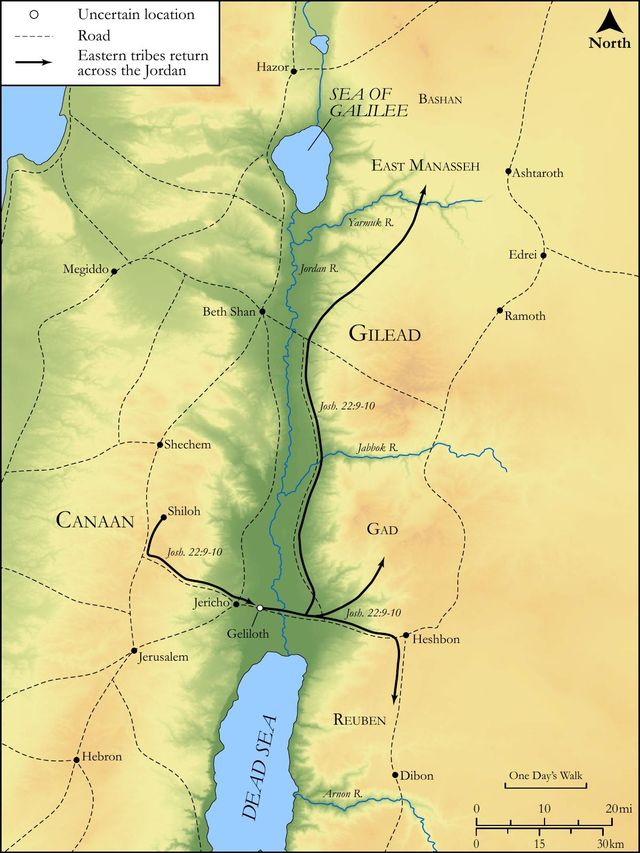
This verse is strategically placed at a critical juncture following the successful conquest and division of Canaan. Joshua had honorably dismissed the Transjordanian tribes, commending them for their faithfulness in assisting their brethren in the conquest (see Joshua 22:1-9). However, upon their return journey, these tribes built a large, prominent altar by the Jordan River (see Joshua 22:10). This act immediately provoked a strong, fearful reaction from the other tribes, who interpreted it as an egregious act of apostasy or schism from the central sanctuary at Shiloh, potentially inviting divine wrath upon all Israel (see Joshua 22:11-12). Joshua 22:13 thus marks the formal commencement of the western tribes' inquiry, preceding the detailed explanation and eventual resolution of the conflict, which ultimately averts civil war (see Joshua 22:21-34).
Historical & Cultural Context
The period immediately following the conquest of Canaan was characterized by Israel's challenging transition from a nomadic confederation to a settled nation. Maintaining national and religious unity under the Mosaic Covenant was paramount. The Mosaic Law explicitly commanded a single, central place of worship for all Israel (as stipulated in Deuteronomy 12:5-7) to prevent idolatry, syncretism, and the fragmentation of their distinct identity as God's chosen people. The construction of any unauthorized altar was therefore perceived as a grave offense, threatening the very foundation of their covenant relationship with Yahweh. The vivid memory of past collective punishments for corporate sin, such as the devastating plague at Peor (see Numbers 25:1-9), would have significantly heightened the western tribes' anxiety, prompting their swift and serious response. The "land of Gilead" refers to the Transjordanian territory allotted to Reuben, Gad, and half-Manasseh, distinguishing them geographically from the main body of Israel in Canaan.
Key Themes
ShowHideThis verse powerfully underscores several critical themes central to Israel's identity and covenant relationship with God. Firstly, the fragility of national unity is palpable, as a simple misunderstanding nearly escalates into civil war, highlighting the constant need for careful communication, trust, and shared commitment within the covenant community. Secondly, it demonstrates the western tribes' profound zeal for pure worship and covenant faithfulness, reflecting their deep commitment to monotheism and adherence to God's prescribed forms of worship. Their fear of a rival altar speaks to their understanding of the exclusivity of Yahweh's worship and the dangers of spiritual compromise. Thirdly, the dispatch of a high-level delegation rather than immediate military action emphasizes the importance of communication and inquiry in resolving disputes, preventing irreversible damage based on assumptions and promoting peaceful resolution. Finally, the inclusion of Phinehas highlights the authoritative role of the priesthood in matters of national religious purity and the gravity with which such perceived transgressions were viewed, signaling a spiritual crisis requiring immediate priestly intervention.
Exposition and Analysis
ShowHideKey Word Analysis
ShowHideThe inclusion of Phinehas, the son of Eleazar and grandson of Aaron, is highly significant. His name, meaning "mouth of a serpent," while not directly indicating his character, is associated with a figure renowned for his decisive and zealous action in Numbers 25:6-13. There, his zeal for the Lord's honor averted a plague by executing an Israelite man and a Midianite woman engaged in idolatrous immorality. His presence in this delegation signals the extreme seriousness with which the western tribes viewed the altar incident, conveying both the spiritual authority of the priesthood and the potential for divine judgment if the perceived apostasy was real.
This geographical term specifically designates the region east of the Jordan River, which was the inheritance of the tribes of Reuben, Gad, and the half-tribe of Manasseh. Its mention here serves as a clear demarcation, emphasizing the physical separation of these tribes from the main body of Israel in Canaan, a separation that could easily lead to cultural and religious divergence if not carefully managed. The altar's construction in this distinct territory further fueled the western tribes' suspicions about its purpose, given the command for a central sanctuary.
The verb "sent" implies a formal, official dispatch of representatives, not merely a casual visit. This indicates a deliberate and organized response from "the children of Israel" (representing the main body of the tribes). The act of sending a delegation, rather than immediately mobilizing for war, demonstrates a measured approach, prioritizing investigation and dialogue over rash judgment, even in the face of grave concerns about covenant fidelity.
Verse Breakdown
ShowHide"And the children of Israel sent"
This phrase emphasizes the unified and collective response of the nine and a half tribes settled west of the Jordan. It signifies a national, rather than localized, concern, reflecting their understanding of corporate responsibility under the covenant. Their immediate action underscores the gravity of the perceived threat to their shared faith and identity, demonstrating a proactive stance against potential apostasy.
"unto the children of Reuben, and to the children of Gad, and to the half tribe of Manasseh"
This specifies the recipients of the delegation, clearly identifying the Transjordanian tribes as the ones whose actions had caused such alarm. The explicit naming of each group highlights the perceived division within the unified nation of Israel and the directness of the inquiry.
"into the land of Gilead"
This detail pinpoints the geographical location of the Transjordanian tribes, specifically the site where the controversial altar had been built. It underscores the physical distance and, by implication, the potential for spiritual drift that concerned the western tribes, reinforcing their fears about the Transjordanian tribes establishing a separate religious identity.
"Phinehas the son of Eleazar the priest"
This climactic part of the verse names the chief delegate, highlighting his pivotal role. As the son of the high priest Eleazar and grandson of Aaron, Phinehas carried immense spiritual authority and represented the highest religious leadership of Israel. His inclusion in the delegation signaled the profound religious implications of the situation and the seriousness with which the western tribes approached the investigation, indicating their readiness to address a potential covenant violation with the utmost gravity.
Literary Devices
ShowHideThe passage employs several effective literary devices that heighten the narrative's tension and significance. Foreshadowing is evident in the immediate and severe reaction of the western tribes, hinting at the profound theological and national stakes involved and setting the stage for a dramatic confrontation that could escalate into civil war. The inclusion of Phinehas is a powerful instance of Characterization through Association, as his past zealous actions (e.g., Numbers 25) immediately convey the gravity and spiritual seriousness of the delegation's mission and the potential for divine judgment. There is also a strong element of Dramatic Irony, as the reader, by the end of the chapter, understands the true, innocent purpose of the altar (as a witness, not for sacrifice), while the western tribes initially misinterpret it as an act of apostasy. This tension drives the narrative forward, building suspense. Finally, the collective phrase "the children of Israel" acts as a Synecdoche, where a part (the western tribes) represents the whole (the unified nation of Israel), emphasizing the corporate identity and shared destiny of God's people under the covenant.
Theological and Thematic Connections
ShowHideJoshua 22:13 provides a potent illustration of the challenges inherent in maintaining unity and purity within a covenant community. The western tribes' immediate and forceful response to the perceived apostasy of their brethren underscores their deep theological conviction regarding the singularity of Yahweh's worship and the importance of the central sanctuary. This incident highlights the ever-present tension between geographical dispersion and theological cohesion, demonstrating how easily misunderstanding and suspicion can erode communal bonds, even among those committed to the same God. The theological lesson is clear: zeal for God's truth, while commendable, must be tempered with wisdom, humility, and a commitment to charitable communication, ensuring that actions are based on understanding rather than assumption, thereby preserving the precious unity of the body.
Reflection and Application
ShowHideThe narrative of Joshua 22:13 offers profound and enduring lessons for contemporary communities, whether families, churches, or organizations. It serves as a powerful reminder of the destructive potential of unverified assumptions and the vital role of open, empathetic communication in maintaining harmony and trust. Before jumping to conclusions, allowing suspicion to fester, or reacting with condemnation, we are called to seek clarification, to listen attentively, and to genuinely understand the perspective of others. The zeal for truth and righteousness, while noble and necessary, must always be guided by wisdom, humility, and a spirit of reconciliation, prioritizing the preservation of unity and relationship over immediate judgment. This passage encourages us to approach perceived offenses with a posture of inquiry, mirroring the delegation's mission, rather than condemnation, fostering environments where misunderstandings can be resolved and trust can be rebuilt, ultimately strengthening the bonds that unite us in faith and purpose.
Questions for Reflection
ShowHideFAQ
ShowHideWhy was Phinehas chosen to lead this delegation?
ShowHidePhinehas was chosen to lead this crucial delegation for several compelling reasons, reflecting both his personal history and his official standing. First, as the son of Eleazar and grandson of Aaron, he held a position of immense spiritual authority and prestige within Israel's priesthood. His presence immediately signaled the gravity and profound religious significance of the western tribes' concerns. Second, Phinehas had a well-established reputation for zealous and decisive devotion to Yahweh's honor, most notably demonstrated in Numbers 25:6-13, where his swift action against idolatry and immorality averted a devastating plague. This history made him the ideal representative to investigate a perceived act of apostasy, assuring the western tribes that the matter would be handled with utmost seriousness, adherence to God's law, and a commitment to preserving covenant purity. His inclusion also lent a quasi-judicial and spiritual authority to the delegation, indicating that they were prepared to address a serious covenant violation with the full weight of the Mosaic Law.
What was the "land of Gilead," and why was its location significant?
ShowHideThe "land of Gilead" refers to the mountainous region situated east of the Jordan River, which was allocated as an inheritance to the tribes of Reuben, Gad, and the half-tribe of Manasseh (see Numbers 32:33). Its geographical location east of the Jordan was highly significant because the Jordan River served as a natural, and often symbolic, boundary separating the Transjordanian tribes from the main body of Israel in Canaan. For the western tribes, the construction of a large altar on the "other side" of this boundary, away from the divinely appointed central sanctuary at Shiloh (see Joshua 18:1), raised profound fears of religious schism and the establishment of a rival worship center. This physical and symbolic separation fueled their concern that the Transjordanian tribes might be drifting away from the unified worship of Yahweh, potentially leading to idolatry, syncretism, or the formation of a separate religious identity, thereby undermining the national and spiritual unity of Israel.
Why was the construction of an altar by the Transjordanian tribes such a serious offense to the other tribes?
ShowHideThe construction of the altar was perceived as a grave offense because it appeared to directly violate the Mosaic Law's strict command for a single, central place of worship for all Israel (see Deuteronomy 12:5-7). This command was absolutely crucial for preventing idolatry, maintaining the purity and exclusivity of Yahweh's worship, and preserving the national and spiritual unity of Israel. Any unauthorized altar was seen as a direct challenge to God's exclusive claim on their worship and a potential invitation for divine wrath upon the entire nation, reminiscent of previous collective punishments for corporate sin (e.g., the plague at Peor in Numbers 25). The western tribes feared that their brethren were establishing a rival cult, which would effectively divide Israel spiritually and politically, undermine the very foundation of their covenant with God, and lead to widespread apostasy. Their reaction stemmed from a deep-seated commitment to covenant fidelity and a profound fear of God's judgment on a disobedient people.
Christ-Centered Fulfillment
ShowHideThe intense concern for unity and pure worship demonstrated in Joshua 22:13 finds its ultimate fulfillment and resolution in the person and work of Jesus Christ. The perceived schism and the fear of a divided worship in Joshua point to humanity's inherent tendency to stray from God and create its own means of approach. However, Christ Himself is the true and ultimate "altar" and the central, singular place of worship, not made with human hands, through whom all access to God is granted (see Hebrews 13:10). His perfect, once-for-all sacrifice on the cross fulfills and supersedes all Old Testament sacrificial systems and the need for physical altars (see Hebrews 9:11-14). Furthermore, Jesus is the great High Priest, superior to Phinehas and all Levitical priests, who mediates a new and better covenant, making direct access to God possible for all believers (see Hebrews 8:6). In Christ, the division between Jew and Gentile is broken down, and all believers are united into one spiritual body, the Church, where the Holy Spirit dwells, making every believer a temple of God (see Ephesians 2:14-22 and 1 Corinthians 6:19). The unity that the Israelites struggled to maintain through law and vigilance is now a spiritual reality in Christ, who is our peace and the foundation of our common faith, calling us to preserve the unity of the Spirit in the bond of peace (see Ephesians 4:1-6).