


Joshua 22:14
Bible text: King James Version (1769 Blayney text) · Public domain
Bible text: King James Version with Strong's numbers · Public domain
Bible text: Berean Standard Bible · Public domain
Bible text: American Standard Version (1901) · Public domain
Bible text: World English Bible, Messianic edition · Public domain
Bible text: Geneva Bible (1599) · Public domain
Bible text: Young's Literal Translation · Public domain
- וַעֲשָׂרָהva·'a·sa·Rahand tenH6235Conj-w ¦ N-fsNoun Singular Feminine Absoluteוַandעֲשָׂרָהten
- נְשִׂאִיםne·si·'ImleadersH5387N-mpNoun Plural Masculine Absolute
- עִמּוֹi·Mo[were] with himH5973Prep ¦ 3msPreposition Definiteעִמּ[were] withוֹhim
- נָשִׂיאna·Si'a leaderH5387N-msNoun Singular Masculine Absolute
- אֶחָד'e·ChadoneH259Adj-fsAdjective Numerical Singular Feminine Absolute
- נָשִׂיאna·Si'a leaderH5387N-msNoun Singular Masculine Absolute
- אֶחָד'e·ChadoneH259Adj-fsAdjective Numerical Singular Feminine Absolute
- לְבֵיתle·Veitto [the] house ofH1004Prep-l ¦ N-mscNoun Singular Masculine Constructלְtoבֵית[the] house of
- אָב'Ava fatherH1N-msNoun Singular Masculine Absolute
- לְכֹלle·Kholto allH3605Prep-l ¦ N-mscNoun Singular Masculine Constructלְtoכֹלall
- מַטּוֹתma·Tot[the] tribes ofH4294N-fpcNoun Plural Feminine Construct
- יִשְׂרָאֵלYis·ra·'ElIsraelH3478N-properNoun Proper Location
- וְאִישׁve·'Ishand eachH376Conj-w ¦ N-msNoun Singular Masculine Absoluteוְandאִישׁeach
- רֹאשׁrosh[was] a leader ofH7218N-mscNoun Singular Masculine Construct
- בֵּיתbeit[the] house ofH1004N-mscNoun Singular Masculine Construct
- אֲבוֹתָם'a·vo·Tamtheir fathersH1N-fpc ¦ 3mpNoun Plural Feminine Constructאֲבוֹתָfathersםtheir
- הֵמָּהHe·mahtheyH1992Pro-3mpPronoun Personal 3rd Plural Masculine
- לְאַלְפֵיle·'al·Fei[belong] to [the] families ofH505Prep-l ¦ N-cpcNoun Plural common gender Constructלְ[belong] toאַלְפֵי[the] families of
- יִשְׂרָאֵלYis·ra·'ElIsraelH3478N-properNoun Proper Location
English is a literal word-by-word gloss of the Hebrew, not the KJV's wording. Why?
This is the original text the KJV's translators worked from — each Hebrew word with its own literal English meaning in this verse, prepared by scholars at Tyndale House, Cambridge. The KJV translates whole sentences, not word by word, so its wording differs: one Hebrew word can become several English words, and the KJV may choose “the LORD” where the gloss reads “Yahweh”. Both are faithful — they answer different questions. For the KJV's own rendering, switch to the KJV text.
Details
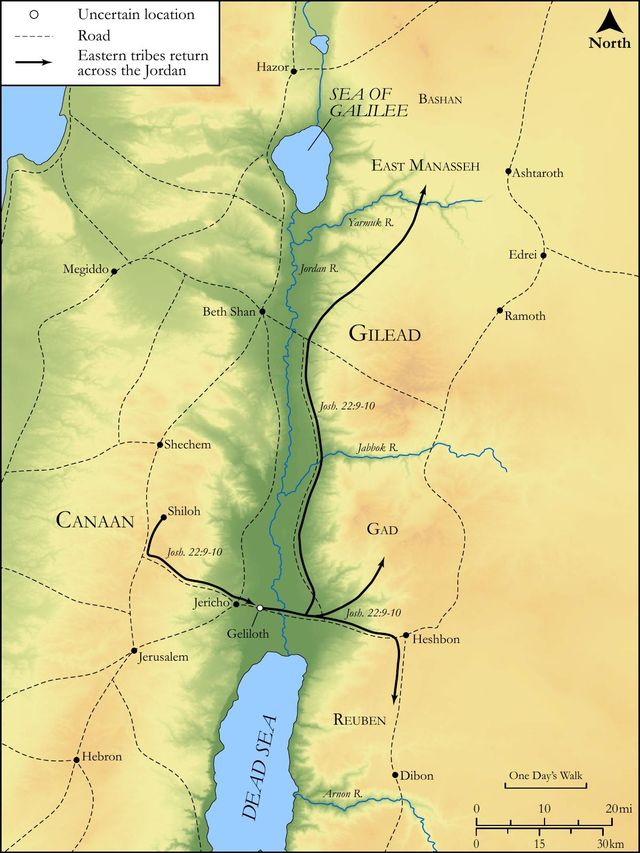
See on the biblical-era map
Study this verse
Continue studying Joshua 22:14 across the web’s major study libraries — every link below opens this exact verse, chapter, or book on the destination site.
Read & Compare
 BibleGatewayThis verse in more than 200 translations and 70 languages.
 Bible.comThe YouVersion reader — hundreds of translations, reading plans, and highlights.
 ESV.orgCrossway's official English Standard Version reader.
 NET BibleThe NET translation with 60,000+ translators' notes on every rendering decision.
 STEP BibleTyndale House's free study tool — original text, vocabulary, and scholarly resources.
 BibliaLogos Bible Software's free web reader.
 USCCBThe New American Bible (Revised Edition) with the U.S. bishops' study notes.
Commentaries
 BibleHub CommentariesDozens of classic commentaries on this verse, gathered on one page.
 StudyLightMore than 100 commentary sets — the largest collection on the web.
 BibleRefPlain-English commentary on what this verse means, verse by verse.
 Enduring WordDavid Guzik's free commentary on this chapter, widely used by Bible teachers.
 Bible Study ToolsVerse commentary alongside Greek and Hebrew study aids.
Original Language & Research
- BibleHub InterlinearThe verse word by word — original language, transliteration, and English.
- BibleHub LexiconEvery word's original-language definition and Strong's entry.
 Blue Letter BibleDeep-study tools — Strong's numbers, concordance, and word studies.
 SefariaThe Hebrew text with Rashi and centuries of Jewish commentary.
Sermons, Hymns & Audio


TrulyRandomVerse is not affiliated with these sites and doesn’t control their content. They’re linked because they’re genuinely useful.
Summary
Joshua 22:14 meticulously describes the esteemed composition of the delegation dispatched by the western Israelite tribes to investigate the controversial altar built by the Transjordanian tribes. This verse specifies that accompanying Phinehas, the high priest's son, were ten princes—one from each of the remaining ten tribes of Israel. Each of these delegates was not merely a tribal representative but a prominent "head of the house of their fathers" and a leader "among the thousands of Israel," thereby underscoring the delegation's immense authority, comprehensive representativeness, and the profound gravity of their peacemaking mission to avert a potential civil war within the nascent nation.
Context
ShowHideLiterary Context
Joshua 22:14 is situated within a critical narrative immediately following the successful conquest and division of the land of Canaan. Joshua, having completed his charge, sends the Transjordanian tribes (Reuben, Gad, and the half-tribe of Manasseh) back to their inheritance east of the Jordan River, commending them for their unwavering faithfulness in assisting their brethren (Joshua 22:1-6). However, en route, these tribes construct a large, conspicuous altar by the Jordan River (Joshua 22:10). This act is gravely misinterpreted by the western tribes as a direct breach of the Mosaic Covenant, specifically a departure from the command for a single, central sanctuary for legitimate worship (Deuteronomy 12:5-7). Their immediate, zealous reaction is to prepare for war (Joshua 22:12), fearing divine wrath upon the entire nation for this perceived apostasy. Wisely, before resorting to conflict, they decide to send a high-level delegation to investigate. Verse 13 introduces Phinehas, the son of Eleazar the priest, as the spiritual head of this mission, and verse 14 elaborates on the political and tribal representatives accompanying him, emphasizing the delegation's comprehensive authority and national representation.
Historical & Cultural Context
The historical setting is the immediate post-conquest period, a pivotal time of transition from military campaigns to the settlement of the land and the establishment of Israel's national identity under the Mosaic Covenant. Central to this covenant was the imperative for a unified worship system, exclusively centered at the tabernacle (and later the Temple). Any deviation, particularly the construction of an unauthorized altar, was viewed as an act of profound apostasy that could invite corporate judgment upon Israel, reminiscent of severe past transgressions like the sin at Baal-Peor (Numbers 25:1-9). The tribal structure of Israel was paramount, with each tribe maintaining distinct leadership through "princes" and "heads of houses" who held significant authority. The Jordan River served not only as a geographical boundary but also a symbolic one, separating the Transjordanian tribes from the main body of Israel. The decision to dispatch such a high-ranking and representative delegation reflects the deeply ingrained cultural value of corporate responsibility, the gravity with which potential covenant violations were regarded, and the pragmatic need for inter-tribal communication and dispute resolution to preserve national unity.
Key Themes
ShowHideThis verse profoundly contributes to several overarching themes within the book of Joshua and the broader Pentateuchal narrative. It powerfully underscores the theme of Covenant Fidelity, highlighting the profound concern for maintaining the purity of Israel's worship and unwavering obedience to God's commands, especially regarding the central sanctuary. The careful selection of the delegation emphasizes Representative Leadership, illustrating the critical importance of wise governance in times of crisis, where leaders are chosen for their authority, integrity, and ability to genuinely speak for their people. Furthermore, the narrative powerfully conveys the theme of Unity and Peacemaking, demonstrating a deep commitment to preserving the fragile national cohesion forged through the conquest. Rather than resorting to immediate warfare, the tribes prioritize Due Diligence and Communication, seeking understanding and reconciliation before resorting to violence. This reflects a mature and covenantal approach to inter-communal conflict resolution that values truth and peace over hasty judgment, a principle echoed in wisdom literature such as Proverbs 18:13.
Exposition and Analysis
ShowHideKey Word Analysis
ShowHideThis term refers to an "exalted one," signifying a king, chief, governor, or ruler. In the context of Israel's tribal organization, a nasi' was a highly respected figure who held significant civil and often military authority, representing the entire tribe in national assemblies and decisions. Their inclusion in this delegation underscored that the message conveyed and any resolution reached would carry immense weight and legitimacy, binding upon their respective tribes.
This word denotes a "house" in its broadest sense, encompassing not just a physical dwelling but also a "family" or "household." When combined with "fathers" (H1, ʼâb), as in "house of their fathers," it refers to the foundational extended family unit or clan, which was a fundamental social and administrative division within ancient Israelite society. Being a "prince of each chief house" implies these delegates were patriarchs and leaders of significant family groups, possessing deep roots and influence within their communities.
This term literally means "head" but is used figuratively in many applications, including "rank," "chief," "principal," or "ruler." In the phrase "an head of the house of their fathers," it emphatically confirms the delegates' status as paramount leaders and patriarchs within their respective family units and broader tribal divisions. Their position as "heads" signified their authority, wisdom, and the trust placed in them by their people.
Verse Breakdown
ShowHide"And with him ten princes"
This phrase immediately establishes the composition of the delegation, connecting it directly to Phinehas, the priest, who was introduced in the preceding verse as the spiritual leader. The "ten princes" represent the ten western tribes of Israel (excluding Levi, whose representative was Phinehas, and the two and a half Transjordanian tribes who were the subject of the inquiry). This precise numerical representation underscores the comprehensive and national nature of the delegation, ensuring that every concerned tribe had a voice and a vested interest in the outcome.
"of each chief house a prince throughout all the tribes of Israel"
This clause further specifies the exceptionally high caliber and broad representation of the delegation. It emphasizes that each of the ten western tribes contributed a top-tier leader, a "prince" who was also the head of a significant "chief house" or clan. This detail highlights that the delegates were not merely nominal representatives but were individuals of substantial standing, inherent authority, and profound influence within their respective tribal and clan structures, capable of truly speaking for and binding their people.
"and each one [was] an head of the house of their fathers among the thousands of Israel"
This final phrase reiterates and powerfully amplifies the authority and patriarchal leadership of each delegate. Being an "head of the house of their fathers" confirms their status as respected patriarchs and leaders of extended family units, signifying their deep-seated influence and hereditary authority. The addition "among the thousands of Israel" indicates their leadership extended to larger administrative or military divisions within their tribes, demonstrating that their influence permeated a broad segment of the population, thereby ensuring that their findings and any subsequent agreement would be accepted as legitimate and binding by the entire nation.
Literary Devices
ShowHideJoshua 22:14 employs several potent literary devices to underscore the gravity and representative nature of the delegation. The pervasive use of Repetition and Emphasis is evident in the multiple, layered phrases describing the delegates' status: "ten princes," "of each chief house a prince," and "an head of the house of their fathers among the thousands of Israel." This cumulative description powerfully conveys the high rank, broad representation, and undisputed authority of the individuals chosen for this critical mission. The phrase "chief house" alongside "thousands of Israel" functions as a form of Merism, encompassing the full spectrum of Israelite societal organization, from the foundational family unit to larger tribal divisions. This signifies that the delegation truly represented the entire nation from its most basic social structures to its broader administrative units. Furthermore, the meticulous detail given to the delegation's composition serves as a subtle form of Foreshadowing, hinting at the eventual successful resolution of the conflict. The very authority and representativeness of these men would ensure that their investigation would be thorough, their findings credible, and their proposed solution accepted, thus averting a potentially devastating civil war.
Theological and Thematic Connections
ShowHideJoshua 22:14, by detailing the composition of a delegation sent to prevent civil strife, powerfully illustrates God's desire for unity and peace among His people, even when faced with misunderstanding and potential conflict. The wisdom displayed in sending respected, representative leaders to investigate before acting rashly reflects a divine principle of due process, open communication, and the pursuit of truth in resolving disputes. This approach mirrors the covenantal ideal of Israel as a unified people under one God, where internal harmony is a testament to their corporate faithfulness. It underscores that true leadership, especially in spiritual communities, involves not just authority but also the humility to listen, the courage to confront, and the wisdom to mediate, always prioritizing reconciliation and the preservation of the community's integrity.
Reflection and Application
ShowHideThe meticulous selection of the delegation in Joshua 22:14 offers profound and enduring lessons for contemporary leadership and community dynamics. In an age often characterized by hasty judgments, social media outrage, and fractured relationships, this passage calls us to pause and consider the wisdom of seeking understanding before condemnation. It highlights the critical importance of sending "the right people"—individuals who are respected, representative, and genuinely committed to truth and reconciliation—to mediate disputes or investigate sensitive matters. Whether in church leadership, family conflicts, or professional environments, prioritizing open, direct, and authoritative communication led by credible individuals can prevent misunderstandings from escalating into irreparable divisions. This narrative challenges us to cultivate environments where due diligence, empathetic listening, and a genuine desire for unity are valued above tribalism or self-righteous indignation, reminding us that the preservation of communal harmony is a sacred trust and a reflection of God's heart for His people.
Questions for Reflection
ShowHideFAQ
ShowHideWhy was such a large and high-ranking delegation sent to confront the Transjordanian tribes?
ShowHideThe western tribes sent such a large and high-ranking delegation for several critical reasons, reflecting the gravity of the situation and their commitment to national unity. First, the act of building an unauthorized altar was perceived as a grave violation of the Mosaic Covenant, specifically the command for a single, central place of worship (Deuteronomy 12:5-7). Such an act could bring corporate judgment upon the entire nation, as seen in past instances of apostasy. Second, by sending "ten princes, of each chief house a prince throughout all the tribes of Israel," the delegation ensured maximum representativeness and authority. This meant that their findings and any subsequent agreement would be accepted as legitimate and binding by all the western tribes, preventing further internal dissent and ensuring national cohesion. Finally, the high-level nature of the delegation underscored the gravity of the situation while also signaling a genuine desire for peace and understanding before resorting to the drastic measure of civil war. It was an act of due diligence aimed at preserving the fragile unity of the newly settled nation, demonstrating a mature approach to conflict resolution.
Christ-Centered Fulfillment
ShowHideJoshua 22:14, with its emphasis on a representative delegation sent to mediate and reconcile a fractured people, finds its ultimate and most profound fulfillment in the person and redemptive work of Jesus Christ. Just as the princes were dispatched to bridge a divide and restore covenant fidelity among God's people, Christ is the supreme Mediator, the one true "Head of the house" (Hebrews 3:6) who perfectly reconciles humanity to God. The Israelite delegation sought to prevent civil war and restore unity among God's chosen nation; Christ, through His sacrificial death on the cross, broke down the dividing wall of hostility between God and humanity, and between Jew and Gentile, creating one new humanity in Himself (Ephesians 2:14-16). He is the ultimate representative, not merely a prince from a tribe, but the Son of God, who perfectly fulfilled the Law and bore the corporate sin of His people, making peace through the blood of His cross (Colossians 1:20). Through Him, God Himself was reconciling the world to Himself, not counting their trespasses against them (2 Corinthians 5:18-19), demonstrating that the divine desire for unity and reconciliation, so powerfully evident in Joshua 22:14, is fully realized in the person of the Lamb of God, who takes away the sin of the world!.