


Joshua 22:15
Bible text: King James Version (1769 Blayney text) · Public domain
Bible text: King James Version with Strong's numbers · Public domain
Bible text: Berean Standard Bible · Public domain
Bible text: American Standard Version (1901) · Public domain
Bible text: World English Bible, Messianic edition · Public domain
Bible text: Geneva Bible (1599) · Public domain
Bible text: Young's Literal Translation · Public domain
- וַיָּבֹאוּvai·ya·Vo·'uand they wentH935Conj-w ¦ V-Qal-ConsecImperf-3mpVerb Qal Consecutive Imperfect 3rd Plural Masculineוַandיָּבֹאוּthey went
- אֶל'eltoH413PrepPreposition
- בְּנֵיbe·nei[the] descendants ofH1121N-mpcNoun Plural Masculine Construct
- רְאוּבֵןre·'u·VenReubenH7205N-proper-mNoun Proper Masculine
- וְאֶלve·'eland toH413Conj-w ¦ PrepPrepositionוְandאֶלto
- בְּנֵיbe·nei[the] descendants ofH1121N-mpcNoun Plural Masculine Construct
- גָדgadGadH1410N-proper-mNoun Proper Masculine
- וְאֶלve·'eland toH413Conj-w ¦ PrepPrepositionוְandאֶלto
- חֲצִיcha·Tzi[the] half ofH2677N-mscNoun Singular Masculine Construct
- שֵׁבֶטshe·vet[the] tribe ofH7626N-mscNoun Singular Masculine Construct
- מְנַשֶּׁהme·na·ShehManassehH4519N-proper-mNoun Proper Masculine
- אֶל'eltoH413PrepPreposition
- אֶרֶץ'E·retz[the] land ofH776N-fscNoun Singular Feminine Construct
- הַגִּלְעָדha·gil·'Ad<the> GileadH1568Art ¦ N-properNoun Proper Locationהַ<the>גִּלְעָדGilead
- וַיְדַבְּרוּvay·da·be·Ruand they spokeH1696Conj-w ¦ V-Piel-ConsecImperf-3mpVerb Piel Consecutive Imperfect 3rd Plural Masculineוַandיְדַבְּרוּthey spoke
- אִתָּם'i·Tamwith themH854Prep ¦ 3mpPreposition Definiteאִתָּwithםthem
- לֵאמֹרle·Mor<to> sayingH559Prep-l ¦ V-Qal-InfVerb Qal Infinitive Constructלֵ<to>אמֹרsaying
English is a literal word-by-word gloss of the Hebrew, not the KJV's wording. Why?
This is the original text the KJV's translators worked from — each Hebrew word with its own literal English meaning in this verse, prepared by scholars at Tyndale House, Cambridge. The KJV translates whole sentences, not word by word, so its wording differs: one Hebrew word can become several English words, and the KJV may choose “the LORD” where the gloss reads “Yahweh”. Both are faithful — they answer different questions. For the KJV's own rendering, switch to the KJV text.
Details
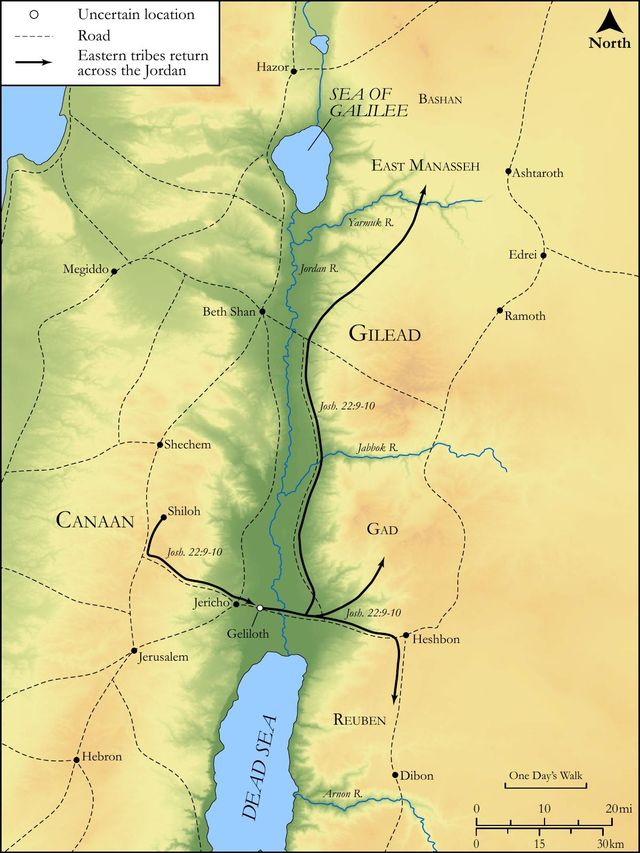
See on the biblical-era map
Study this verse
Continue studying Joshua 22:15 across the web’s major study libraries — every link below opens this exact verse, chapter, or book on the destination site.
Read & Compare
 BibleGatewayThis verse in more than 200 translations and 70 languages.
 Bible.comThe YouVersion reader — hundreds of translations, reading plans, and highlights.
 ESV.orgCrossway's official English Standard Version reader.
 NET BibleThe NET translation with 60,000+ translators' notes on every rendering decision.
 STEP BibleTyndale House's free study tool — original text, vocabulary, and scholarly resources.
 BibliaLogos Bible Software's free web reader.
 USCCBThe New American Bible (Revised Edition) with the U.S. bishops' study notes.
Commentaries
 BibleHub CommentariesDozens of classic commentaries on this verse, gathered on one page.
 StudyLightMore than 100 commentary sets — the largest collection on the web.
 BibleRefPlain-English commentary on what this verse means, verse by verse.
 Enduring WordDavid Guzik's free commentary on this chapter, widely used by Bible teachers.
 Bible Study ToolsVerse commentary alongside Greek and Hebrew study aids.
Original Language & Research
- BibleHub InterlinearThe verse word by word — original language, transliteration, and English.
- BibleHub LexiconEvery word's original-language definition and Strong's entry.
 Blue Letter BibleDeep-study tools — Strong's numbers, concordance, and word studies.
 SefariaThe Hebrew text with Rashi and centuries of Jewish commentary.
Sermons, Hymns & Audio


TrulyRandomVerse is not affiliated with these sites and doesn’t control their content. They’re linked because they’re genuinely useful.
Summary
Joshua 22:15 records the pivotal moment when a high-level delegation, representing the western Israelite tribes, arrived in the territory of Gilead to confront their brethren from the tribes of Reuben, Gad, and the half-tribe of Manasseh. This encounter was precipitated by the eastern tribes' construction of a large, conspicuous altar by the Jordan River, an act gravely misinterpreted by the western tribes as a potential rebellion against Yahweh and His prescribed central sanctuary. The verse thus sets the stage for a critical dialogue aimed at averting a devastating civil war and preserving the spiritual and national unity of Israel.
Context
ShowHideLiterary Context
This verse is situated at a critical juncture in the book of Joshua, immediately following the eastern tribes' honorable discharge by Joshua after they had faithfully assisted in the conquest of Canaan, as detailed in Joshua 22:1-6. As these tribes journeyed back to their inheritance east of the Jordan, they built a prominent altar near the river (Joshua 22:10). This act, though innocent in its intent (as later revealed), was perceived by the western tribes as a direct violation of the Mosaic Law's injunction for a single, central place of worship (Deuteronomy 12:5-7). Their alarm escalated to the point of contemplating military action, but in a display of wisdom and adherence to due process, they first dispatched a formidable delegation led by Phinehas, the son of Eleazar the high priest, accompanied by ten tribal chiefs (Joshua 22:13-14). Verse 15 precisely marks the arrival of this delegation in Gilead, poised to deliver their grave accusation and demand an explanation, thereby initiating the climactic dialogue of the chapter.
Historical & Cultural Context
The historical backdrop is the immediate post-conquest period, as Israel transitioned from a nomadic, warring confederacy to a settled nation in their promised land. The Deuteronomic law, particularly its emphasis on monotheism and a singular cultic center, was foundational to Israel's identity and covenant relationship with Yahweh. Any perceived deviation from this central sanctuary mandate was not merely a ceremonial infraction but an act of apostasy, threatening the very fabric of their national and spiritual existence. The memory of past corporate judgments, such as the devastating consequences of Achan's sin (Joshua 7:1-5) or the plague following the incident at Peor (Numbers 25:1-9), would have instilled a profound fear that the eastern tribes' actions could provoke divine wrath upon the entire nation. The dispatch of such a high-ranking delegation, including the high priest's son, underscores the extreme gravity of the perceived offense and the cultural imperative for diplomatic resolution and theological clarity before resorting to internecine conflict among covenant brethren.
Key Themes
ShowHideJoshua 22:15 significantly contributes to several overarching themes within the book of Joshua and the broader Old Testament narrative. Firstly, it powerfully illustrates the unity and solidarity of Israel as a single covenant people. The western tribes' intense concern stemmed from a deep-seated conviction that the spiritual integrity and national cohesion of all twelve tribes were inextricably linked. An offense by one part could indeed affect the whole, emphasizing the communal responsibility inherent in their covenant with Yahweh. Secondly, the passage underscores the critical importance of covenant faithfulness to Yahweh and strict adherence to His prescribed worship. The perceived violation of the central sanctuary law was viewed as a direct breach of their covenant with God, potentially leading to severe divine judgment. Lastly, the narrative, initiated by this verse, powerfully demonstrates the value of communication and conflict resolution within the community of faith. The decision to send a delegation for dialogue, rather than immediately resorting to war, highlights a profound commitment to understanding, reconciliation, and the preservation of national unity, thereby preventing a potentially devastating civil conflict rooted in misunderstanding.
Exposition and Analysis
ShowHideKey Word Analysis
ShowHideThe verb bôwʼ (H935) signifies a purposeful and deliberate arrival, often with a specific objective or mission. In this context, it emphasizes the official and weighty nature of the delegation's journey. They did not happen upon the eastern tribes; rather, they "came" with a clear agenda, burdened by grave concerns and prepared for a serious confrontation, thereby highlighting the solemnity and urgency of their diplomatic task.
The noun bên (H1121), meaning "son" or "child," is used here collectively to refer to the "children of Reuben," "children of Gad," and "children of Manasseh." This term emphasizes their familial and tribal identity, underscoring that the impending confrontation is not with foreign enemies but with fellow Israelites, members of the same covenant family. It highlights the internal, brotherly nature of the conflict, making the potential for civil war all the more tragic.
The verb dâbar (H1696) often denotes formal, authoritative, or significant speech, distinct from casual conversation. The phrase "and they spake with them, saying" (וַיְדַבְּרוּ אִתָּם לֵאמֹר) indicates that the ensuing dialogue would be a weighty address, a formal presentation of accusations and demands for explanation, rather than an informal chat. This sets a serious and official tone for the impending confrontation, signaling the commencement of a critical discourse.
Verse Breakdown
ShowHide"And they came unto the children of Reuben, and to the children of Gad, and to the half tribe of Manasseh"
This clause precisely identifies the two parties involved in the impending confrontation. "They" refers to the high-level delegation from the western tribes (specifically, Phinehas and the ten princes), representing the collective concern and authority of the majority of Israel. The recipients of this solemn visit are the eastern tribes, whose actions (the building of the altar) have provoked this national crisis, thereby setting the stage for a direct, face-to-face encounter between brethren.
"unto the land of Gilead"
This specifies the geographical location of the meeting. Gilead was the territory east of the Jordan River, which had been allotted to the tribes of Reuben, Gad, and the half-tribe of Manasseh. Its mention highlights the physical and, at times, symbolic separation of these tribes from the main body of Israel in Canaan, a geographical distinction that inadvertently contributed to the misunderstanding regarding the altar's purpose and fueled the western tribes' anxieties about their brethren's loyalty.
"and they spake with them, saying,"
This concluding phrase marks the critical initiation of the crucial dialogue. It signals that the delegation has successfully reached their destination and is now ready to formally present their case, articulate their concerns, and seek an explanation. The subsequent "saying" (לֵאמֹר) implies that what follows will be direct speech, a formal address that will lay out the accusations and seek clarification, underscoring the gravity and formality of this diplomatic mission and the impending theological debate.
Literary Devices
ShowHideThe verse employs Foreshadowing by explicitly stating "and they spake with them, saying," which immediately builds anticipation for the critical dialogue and resolution that will unfold in the subsequent verses of Joshua 22. This phrase acts as a powerful narrative cue, signaling that the core conflict of the chapter—the profound misunderstanding over the altar's purpose—is about to be addressed directly and formally. There is also a strong element of Dramatic Irony at play, as the reader is already aware (from earlier verses, specifically Joshua 22:27-28) of the eastern tribes' true, innocent, and even pious intentions for building the altar. In contrast, the western tribes approach them with severe accusations, firmly believing their actions to be rebellious and apostate. This creates significant tension between the audience's privileged knowledge and the characters' limited, fearful understanding. Furthermore, the geographical detail of "the land of Gilead" and the act of "coming unto" them underscores the Symbolism of the Jordan River as a potential divider, not just physically but also spiritually, emphasizing the urgent need for communication to bridge this perceived chasm of faith and prevent national disunity.
Theological and Thematic Connections
ShowHideJoshua 22:15, though concise, is pregnant with profound theological significance, primarily emphasizing the paramount importance of unity and covenant fidelity within God's people. The western tribes' swift and severe reaction stemmed from a deep-seated fear of corporate judgment, a recurring motif in Israel's history where the sin of a few could bring divine wrath upon the entire nation. Their concern was not merely political or territorial but profoundly theological: any perceived deviation from the central sanctuary law was an affront to Yahweh's holiness and a direct threat to the nation's unique, exclusive relationship with Him. This episode underscores that true unity among believers is rooted in a shared, unwavering commitment to God's revealed will and a willingness to address perceived breaches through dialogue and humble inquiry rather than immediate condemnation or conflict. It highlights that maintaining spiritual purity and communal harmony often requires proactive engagement, courageous confrontation (in love), and a readiness to seek understanding before judgment.
Reflection and Application
ShowHideThe arrival of the delegation in Joshua 22:15 serves as a powerful and timeless reminder of the enduring human tendency to misinterpret actions and motives, and the critical importance of open, honest communication in resolving conflict. Before the western tribes resorted to war based on their assumptions and fears, they wisely chose the path of inquiry and dialogue. This narrative teaches us a vital lesson: in our personal relationships, within families, in our churches, and across communities, we must resist the impulse to jump to conclusions or allow suspicion and unverified assumptions to fester. Instead, we are called to humbly seek understanding, to ask clarifying questions with a spirit of grace, and to listen actively and empathetically to explanations, even when initial actions appear to contradict our expectations or values. This passage encourages a posture of grace, patience, and a steadfast commitment to reconciliation and the preservation of unity over hasty judgment or punitive action. It challenges us to consider how many conflicts could be averted or de-escalated if we first sought to "speak with them, saying," rather than allowing unverified assumptions and fear to dictate our responses.
Questions for Reflection
ShowHideFAQ
ShowHideWhy were the western tribes so quick to assume the worst about the altar?
ShowHideThe western tribes' immediate assumption that the altar was for illicit worship stemmed from several deeply ingrained factors. Firstly, the Deuteronomic law strictly commanded a single, central place of worship for all Israel (Deuteronomy 12:5), making any unauthorized altar a grave offense against Yahweh and a direct threat to the purity of their national worship. Secondly, Israel had a vivid and painful history of corporate sin leading to severe divine judgment, such as the devastating plague following the incident at Peor (Numbers 25:1-9) or the defeat at Ai due to Achan's sin (Joshua 7:1-5). This history instilled a profound fear that the eastern tribes' perceived apostasy could bring corporate wrath upon the entire nation. Their zeal was rooted in a genuine, albeit initially misguided, desire to protect the purity of Israel's worship and their covenant relationship with God, believing that swift action was necessary to avert divine judgment.
Christ-Centered Fulfillment
ShowHideThe dramatic tension in Joshua 22:15, born from misunderstanding and the looming threat of division among God's people, finds its ultimate resolution and profound fulfillment in Christ. The perceived barrier of the Jordan River, symbolizing a potential spiritual and geographical divide between the tribes, foreshadows the far greater chasm of sin that separated humanity from a holy God, and the divisions that exist within humanity itself. Christ, through His atoning work on the cross, becomes the ultimate bridge, tearing down the "dividing wall of hostility" (Ephesians 2:14) and creating one new humanity, reconciling both Jew and Gentile to God in one body. His body, broken on the cross, is the true and perfect altar, making all other altars obsolete and uniting believers from every tribe, tongue, and nation into one spiritual house and holy priesthood (1 Peter 2:5). The reconciliation achieved in Joshua 22, through diligent dialogue and understanding, points to the profound and eternal reconciliation achieved by Christ, who, as our great High Priest, mediates perfectly between God and humanity. He is the one who "spake with them, saying," not with accusation or misunderstanding, but with divine grace and truth (John 1:17), bringing clarity, peace, and an unbreakable spiritual unity where there was once profound misunderstanding and the threat of eternal division.