


2 Chronicles 26:18
- וַיַּעַמְדוּvai·ya·'am·Duand they took their standH5975Conj-w ¦ V-Qal-ConsecImperf-3mpVerb Qal Consecutive Imperfect 3rd Plural Masculineוַandיַּעַמְדוּthey took their stand
- עַל'alonH5921PrepPreposition
- עֻזִּיָּהוּ'u·zi·Ya·huUzziahH5818N-proper-mNoun Proper Masculine
- הַמֶּלֶךְha·Me·lekhthe kingH4428Art ¦ N-msNoun Singular Masculine Absoluteהַtheמֶּלֶךְking
- וַיֹּאמְרוּvai·Yo·me·ruand they saidH559Conj-w ¦ V-Qal-ConsecImperf-3mpVerb Qal Consecutive Imperfect 3rd Plural Masculineוַandיֹּאמְרוּthey said
- לוֹloto himPrep-l ¦ 3msSuffix Personal 3rd Singular Masculineלtoוֹhim
- לֹאlo'notH3808NegParticle Negative
- לְךָle·Kha[belongs] to youPrep-l ¦ 2msSuffix Personal 2nd Singular Masculineלְ[belongs] toךָyou
- עֻזִּיָּהוּ'u·zi·Ya·huO UzziahH5818N-proper-mNoun Proper Masculine
- לְהַקְטִירle·hak·Tirto make smokeH6999Prep-l ¦ V-Hiphil-InfVerb Hiphil Infinitive Constructלְtoהַקְטִירmake smoke
- לַיהוָהla·Yah·wehto YahwehH3068Prep-l ¦ N-properNoun Proper TitleלַtoיהוָהYahweh
- כִּיkiforH3588PrtParticle Conditional
- לַכֹּהֲנִיםla·ko·ha·Nimto the priestsH3548Prep-l ¦ N-mpNoun Plural Masculine Absoluteלַto theכֹּהֲנִיםpriests
- בְּנֵיbe·nei[the] descendants ofH1121N-mpcNoun Plural Masculine Construct
- אַהֲרֹן'a·ha·RonAaronH175N-proper-mNoun Proper Masculine
- הַמְקֻדָּשִׁיםham·ku·da·Shimwho are consecratedH6942Art ¦ V-Pual-PassPrtcpl-mpVerb Pual Participle Passive Plural Masculine Absoluteהַwhoמְקֻדָּשִׁיםare consecrated
- לְהַקְטִירle·hak·Tirto make smokeH6999Prep-l ¦ V-Hiphil-InfVerb Hiphil Infinitive Constructלְtoהַקְטִירmake smoke
- צֵאtze'go outH3318V-Qal-Imp-2msVerb Qal Imperative 2nd Singular Masculine
- מִןminfromH4480PrepPreposition
- הַמִּקְדָּשׁha·mik·Dashthe sanctuaryH4720Art ¦ N-msNoun Singular Masculine Absoluteהַtheמִּקְדָּשׁsanctuary
- כִּיkiforH3588PrtParticle Conditional
- מָעַלְתָּma·'Al·tayou have acted unfaithfullyH4603V-Qal-Perf-2msVerb Qal Perfect 2nd Singular Masculine
- וְלֹאve·lo'and notH3808Conj-w ¦ NegParticle Negativeוְandלֹאnot
- לְךָle·Khaof youPrep-l ¦ 2msSuffix Personal 2nd Singular Masculineלְofךָyou
- לְכָבוֹדle·kha·Vodfor honorH3519Prep-l ¦ N-msNoun Singular Masculine Absoluteלְforכָבוֹדhonor
- מֵיְהוָהme·Yah·wehfrom YahwehH3068Prep-m ¦ N-properNoun Proper TitleמֵfromיְהוָהYahweh
- אֱלֹהִים'E·lo·HimGodH430N-mpNoun Plural Masculine Absolute
English is a literal word-by-word gloss of the Hebrew, not the KJV's wording. Why?
This is the original text the KJV's translators worked from — each Hebrew word with its own literal English meaning in this verse, prepared by scholars at Tyndale House, Cambridge. The KJV translates whole sentences, not word by word, so its wording differs: one Hebrew word can become several English words, and the KJV may choose “the LORD” where the gloss reads “Yahweh”. Both are faithful — they answer different questions. For the KJV's own rendering, switch to the KJV text.
Details
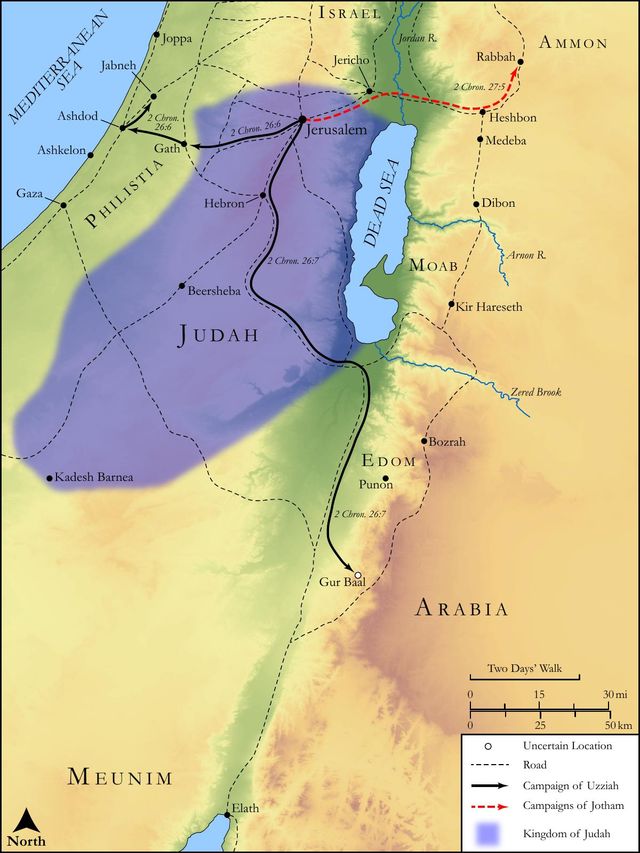
See on the biblical-era map
Study this verse
Public-domain commentary
Matthew Henry
From his Commentary on the Whole Bible. Henry comments on passages, not single verses — this entry covers 2 Chronicles 26:16–23. His three-level outline is real structure in the source text, so it is rendered as structure.
Here is the only blot we find on the name of king Uzziah, and it is such a one as lies not on any other of the kings. Whoredom, murder, oppression, persecution, and especially idolatry, gave characters to the bad kings and some of them blemishes to the good ones, David himself not excepted, witness the matter of Uriah. But we find not Uzziah charged with any of these; and yet he transgressed against the Lord his God, and fell under the marks of his displeasure in consequence, not, as other kings, in vexatious wars or rebellions, but an incurable disease.
I.His sin was invading the priest's office.
The good way is one; by-paths are many. The transgression of his predecessors was forsaking the temple of the Lord, flying off from it (Ch2 24:18), and burning incense upon idolatrous altars, Ch2 25:14. His was intruding into the temple of the Lord further than was allowed him, and attempting him to burn incense upon the altar of God, for which, it is likely, he pretended an extraordinary zeal and affection. See how hard it is to avoid one extreme and not run into another.
1.That which was at the bottom of his sin was pride of heart, a lust that ruins more than any other whatsoever (Ch2 26:16): When he was strong (and he was marvellously helped by the good providence of God till he was so, Ch2 26:15), when he had grown very great and considerable in wealth, interest, and power, instead of lifting up the name of God in gratitude to him who had done so much for him, his heart was lifted up to his destruction. Thus the prosperity of fools, by puffing them up with pride, destroys them. Now that he had done so much business, and won so much honour, he began to think no business, no honour, too great or too good for him, no, not that of the priesthood Men's pretending to forbidden knowledge, and exercising themselves in things too high for them, are owing to the pride of their heart, and the fleshly mind they are vainly puffed up with.
2.His sin was going into the temple of the Lord to burn incense, probably on some solemn feast day, or when he himself had some special occasion for supplicating the divine favour. What could move him to this piece of presumption, or put it into his head, I cannot conjecture. None of all his predecessors, not the best, not the worst, attempted it. The law, he knew, was express against him, and there was no usage or precedent for him. He could not pretend any necessity, as there was for David's eating the show-bread.
(1.)Perhaps he fancied the priests did not do their office so dexterously, decently, and devoutly, as they ought, and he could do it better. Or,
(2.)He observed that the idolatrous kings did themselves burn incense at the altars of their gods; his father did so, and Jeroboam (Kg1 13:1), an ambition of which honour was perhaps one thing that tempted them from the house of God, where it was not permitted them; and he, being resolved to cleave to God's altar, would try to break through this restraint and come as near it as the idolatrous kings did to their altars. But it is called a transgression against the Lord his God. He was not content with the honours God had put upon him, but would usurp those that were forbidden him, like our first parents.
3.He was opposed in this attempt by the chief priest and other priests that attended and assisted him, Ch2 26:17, Ch2 26:18. They were ready to burn incense for the king, according to the duty of their place; but, when he offered to do it himself, they plainly let him know that he meddled with that which did not belong to him, and that it was at his peril. They did not resist him by laying violent hands on him, though they were valiant men, but by reasoning with him and showing him,
(1.)That it was not lawful for him to burn incense: "It appertaineth not to thee, O Uzziah! but to the priests, whose birthright it is, as sons of Aaron, and who are consecrated to the service." Aaron and his sons were appointed by the law to burn incense, Exo 30:7. See Deu 33:10; Ch1 23:13. David had blessed the people and Solomon and Jehoshaphat had prayed with them and preached to them. Uzziah might have done this, and it would have been to his praise; but as for burning incense, that service was to be performed by the priests only. The kingly and priestly offices were separated by the law of Moses, not to be united again but in the person of the Messiah. If Uzziah did intend to honour God, and gain acceptance with him, in what he did, he was quite out in his aim; for, being a service purely of divine institution, he could not expect it should be accepted unless it were done in the way and by the hands that God had appointed.
(2.)That it was not safe. It shall not be for thy honour from the Lord God. More is implied: "It will be thy disgrace, and it is at thy peril." The law runs expressly against all strangers that came nigh (Num 3:10, Num 18:7), that is, all that were not priests. Korah and his accomplices, though Levites, paid dearly for offering to burn incense, which was the work of the priests only, Num 16:35. The incense of our prayers must be by faith put into the hands of our Lord Jesus, the great high priest of our profession, else we cannot expect it should be accepted by God, Rev 8:3.
4.He fell into a passion with the priests that reproved him, and would push forward to do what he intended notwithstanding (Ch2 26:19): Uzziah was wroth, and would not part with the censer out of his hand. He took it ill to be checked, and would not bear interference. Nitimur in vetitum - We are prone to do what is forbidden.
II.His punishment was an incurable leprosy, which rose up in his forehead while he was contending with the priests.
If he had submitted to the priests' admonition, acknowledged his error, and gone back, all would have been well; but when he was wroth with the priests, and fell foul upon them, then God was wroth with him and smote him with a plague of leprosy. Josephus says that he threatened the priests with death if they opposed him, and that then the earth shook, the roof of the temple opened, and through the cleft a beam of the sun darted directly upon the king's face, wherein immediately the leprosy appeared. And some conjecture that that was the earthquake in the days of Uzziah which we read of Amo 1:1 and Zac 14:5. Now this sudden stroke,
1.Ended the controversy between him and the priests; for, when the leprosy appeared, they were emboldened to thrust him out of the temple; nay, he himself hasted to go out, because the Lord had smitten him with a disease which was in a particular manner a token of his displeasure, and which he knew secluded him from common converse with men, much more from the altar of God. He would not be convinced by what the priests said, but God took an effectual course to convince him. If presumptuous men will not be made to see their error by the judgments of God's mouth, they shall be made to see it by the judgments of his hand. It evinced some religious fear of God in the heart of this king, even in the midst of his transgression, that, as soon as he found God was angry with him, he not only let fall his attempt, but retired with the utmost precipitation. Though he strove with the priests, he would not strive with his Maker.
2.It remained a lasting punishment of his transgression; for he continued a leper to the day of his death, shut up in confinement, and shut out from society, and forced to leave it to his son to manage all his business, Ch2 26:21. Thus God gave an instance of his resisting the proud and of his jealousy for the purity and honour of his own institutions; thus he gave fair warning even to great and good men to know and keep their distance, and not to intrude into those things which they have not seen; and thus he gave Uzziah a loud and constant call to repentance, and a long space to repent, which we have reason to hope he improved. He had been a man of much business in the world; but being taken off from that, and confined to a separate house, he had leisure to think of another world and prepare for it. By this judgment upon the king God intended to possess the people with a great veneration for the temple, the priesthood, and other sacred things, which they had been apt to think meanly of. While the king was a leper, he was as good as dead, dead while he lived, and buried alive; and so the law was, in effect, answered, that the stranger who cometh nigh shall be put to death. The disgrace survived him; for, when he was dead, they would not bury him in the sepulchres of the kings because he was a leper, which stained all his other glory.
3.It was a punishment that answered the sin as face does face in a glass.
(1.)Pride was at the bottom of his transgression, and thus God humbled him and put dishonour upon him.
(2.)He invaded the office of the priests in contempt of them, and God struck him with a disease which in a particular manner made him subject to the inspection and sentence of the priests; for to them pertained the judgment of the leprosy, Deu 24:8.
(3.)He thrust himself into the temple of God, whither the priests only had admission, and for that was thrust out of the very courts of the temple, into which the meanest of his subjects that was ceremonially clean had free access.
(4.)He confronted the priests that faced him and opposed his presumption, and for that the leprosy rose in his forehead, which, in Miriam's case, is compared to her father's spitting in her face, Num 12:14.
(5.)He invaded the dignity of the priesthood, which he had no right to, and for that he was deprived even of his royal dignity, which he had a right to. Those that covet forbidden honours forfeit allowed ones. Adam, by catching at the tree of knowledge of which he might not eat, debarred himself from the tree of life, of which he might have eaten. Let all that read it say, The Lord is righteous.
Historical interpretation
Two Centuries of Reception
7 surviving comments on this verse. Each one is dated, so this reads as a timeline rather than a list.
Select a marker to jump to its quote. Markers stagger vertically where authors wrote within a few decades of each other.
When King Uzziah carried a censer and violently took on himself to sacrifice, against the law of God, and refused to submit or give place, despite the opposition of Azariah the priest, he was confounded by God’s indignation and defiled with the markings of leprosy on his forehead, branded by the Lord’s anger on that part of the body on which those who win the Lord’s favor are sealed.
Uzziah is described as at first having been righteous, and then it is related that he was lifted up in mind and dared to offer sacrifice to God himself, and his face became leprous in consequence. But Josephus carefully studied the additional comments of the expounders as well, and a Hebrew of the Hebrews as he was, hear his description of the events of those times. He tells: “Though the priests urged Uzziah to go out of the temple and not to break the law of God, he angrily threatened them with death unless they held their peace. And meanwhile an earthquake shook the earth, and a bright light shone through a breach in the temple and struck the king’s face, so that at once it became leprous. And before the city at the place called Eroga, the western half of the Mount was split asunder and rolling four stadia stopped at the eastern mountain, so as to block up the royal approach and gardens.” This I take from the work of Josephus on Jewish antiquities. And I found in the beginning of the prophet Amos the statement that he began to prophecy “in the days of Uzziah, king of Judah, two years before the earthquake.” What earthquake he does not clearly say. But I think the same prophet further on suggests this earthquake when he says, “I saw the Lord standing on the altar. And he said, Strike the altar, and the doors shall be shaken, and strike the heads of all, and the remnant I will slay with the sword.”Here I understand a prediction of the earthquake, and of the destruction of the ancient solemnities of the Jewish race and of the worship practiced by them in Jerusalem, the ruin that should overtake them after the coming of our Savior, when, since they rejected the Christ of God, the true High Priest, leprosy infected their souls, as in the days of Uzziah, when the Lord himself standing on the altar gave leave to him that struck, saying, “Strike the altar.”
Remember Uzziah, how he entered the sanctuary; by seeking to seize the priesthood he lost his kingdom. Adam, by wishing to enrich himself, incurred a double loss. Recognize in the sanctuary the Tree, in the censer the fruit and in the leprosy the nakedness. From these two treasures there proceeded harm in both cases.
In the midst of paradise God had planted the Tree of Knowledge to separate off, above and below, sanctuary from Holy of Holies. Adam made bold to touch and was smitten like Uzziah: the king became leprous, Adam was tripped. Being struck like Uzziah, he hastened to leave: both kings fled and hid, in shame of their bodies.
As, therefore, it was not lawful for one of another tribe that was not a Levite to offer anything or to approach the altar without the priest, so also do you do nothing without the bishop; for if anyone does anything without the bishop, he does it to no purpose. For it will not be esteemed as of any avail to him.… For as Uzziah the king, who was not a priest and yet would exercise the functions of the priests, was smitten with leprosy for his transgression; so every lay person shall not be unpunished who despises God, and is so mad as to affront his priests and unjustly to snatch that honor to himself: not imitating Christ, “who glorified not himself to be made an high priest” but waited till he heard from his Father, “The Lord swore and will not repent, You are a priest forever, after the order of Melchizedek.” If, therefore, Christ did not glorify himself without the Father, how dare anyone thrust himself into the priesthood who has not received that dignity from his superior and do such things that it is lawful only for the priests to do?
Neither do we permit the laity to perform any of the offices belonging to the priesthood, as, for instance, neither the sacrifice, nor baptism, nor the laying on of hands nor the blessing, whether the smaller or the greater, for “no one takes this honor to himself, but he that is called of God.” For such sacred offices are conferred by the laying on of the hands of the bishop. But a person to whom such an office is not committed but seizes on it for himself, he shall undergo the punishment of Uzziah.
Of Uzziah, the ancestor of this king of whom we have been speaking, himself also praised in all things by the witness of the Scripture, after great commendation for his virtue, after countless triumphs that he achieved by the merit of his devotion and faith, learn how he was cast down by the pride of vainglory. “And,” we are told, “the name of Uzziah went forth, for the Lord helped him and had strengthened him. But when he was made strong, his heart was lifted up to his destruction, and he neglected the Lord his God.” … You see how dangerous the successes of prosperity generally are, so that those who could not be injured by adversity are ruined, unless they are careful, by prosperity; and those who in the conflict of battle have escaped the danger of death fall before their own trophies and triumphs.
Continue studying 2 Chronicles 26:18 across the web’s major study libraries — every link below opens this exact verse, chapter, or book on the destination site.
Read & Compare
 BibleGatewayThis verse in more than 200 translations and 70 languages.
 Bible.comThe YouVersion reader — hundreds of translations, reading plans, and highlights.
 ESV.orgCrossway's official English Standard Version reader.
 NET BibleThe NET translation with 60,000+ translators' notes on every rendering decision.
 STEP BibleTyndale House's free study tool — original text, vocabulary, and scholarly resources.
 BibliaLogos Bible Software's free web reader.
 USCCBThe New American Bible (Revised Edition) with the U.S. bishops' study notes.
Commentaries
 BibleHub CommentariesDozens of classic commentaries on this verse, gathered on one page.
 StudyLightMore than 100 commentary sets — the largest collection on the web.
 BibleRefPlain-English commentary on what this verse means, verse by verse.
 Enduring WordDavid Guzik's free commentary on this chapter, widely used by Bible teachers.
 Bible Study ToolsVerse commentary alongside Greek and Hebrew study aids.
Original Language & Research
- BibleHub InterlinearThe verse word by word — original language, transliteration, and English.
- BibleHub LexiconEvery word's original-language definition and Strong's entry.
 Blue Letter BibleDeep-study tools — Strong's numbers, concordance, and word studies.
 SefariaThe Hebrew text with Rashi and centuries of Jewish commentary.
Sermons, Hymns & Audio


TrulyRandomVerse is not affiliated with these sites and doesn’t control their content. They’re linked because they’re genuinely useful.
Summary
2 Chronicles 26:18 vividly recounts the dramatic confrontation between King Uzziah and the Levitical priests, led by Azariah, as Uzziah presumptuously attempts to burn incense in the Temple. This pivotal moment underscores Uzziah's pride-fueled transgression of divinely established boundaries, as the priests courageously declare that this sacred act is reserved exclusively for the consecrated sons of Aaron. Their bold declaration highlights the severity of Uzziah's sacrilege, foreshadowing his loss of honor from the LORD God, a judgment that immediately follows with his affliction of leprosy.
Context
ShowHideLiterary Context
This verse marks a tragic and abrupt turning point in the otherwise illustrious reign of King Uzziah. The preceding narrative (2 Chronicles 26:1-15) extensively chronicles his remarkable success, military victories, ambitious building projects, and agricultural advancements, all explicitly attributed to his diligent seeking of God. Indeed, the Chronicler states he was "marvelously helped till he was strong" 2 Chronicles 26:15. However, 2 Chronicles 26:16 introduces the fatal flaw: "But when he was strong, his heart was lifted up to his destruction." The narrative immediately transitions from Uzziah's prosperity to his prideful act of entering the Temple to burn incense, setting the stage for the priestly confrontation in this verse and the swift divine judgment that follows in 2 Chronicles 26:19-21. This precise narrative arrangement clearly highlights the direct causal link between Uzziah's transgression and his subsequent downfall.
Historical & Cultural Context
King Uzziah, also known as Azariah, reigned over Judah for an impressive 52 years (c. 792-740 BC), a period characterized by significant prosperity and stability for the kingdom. In ancient Israel, the roles of king and priest were strictly separate and divinely ordained, reflecting God's established order for His people. Kings, traditionally from the tribe of Judah, were responsible for civil governance, justice, and leading the nation in war. Priests, exclusively from the lineage of Aaron within the tribe of Levi, were consecrated for sacred duties within the Tabernacle and later the Temple. These duties included offering sacrifices, maintaining the sacred space, and specifically burning incense on the golden altar, as detailed in Exodus 30:7-8 and Numbers 3:10. Burning incense was a highly symbolic act, representing the prayers of the people ascending to God and requiring ritual purity and specific divine authorization. Uzziah's attempt was not merely a breach of protocol but a direct usurpation of a sacred, divinely restricted office, constituting a profound act of sacrilege against God's established order.
Key Themes
ShowHideThe narrative of Uzziah's transgression powerfully illustrates several enduring themes crucial to understanding God's relationship with His people. Firstly, it underscores the theme of Divine Boundaries and Authority, emphasizing God's strict separation of religious and civil authority. Even a powerful king like Uzziah had no right to infringe upon the divinely appointed functions of the priesthood. This divine order was crucial for maintaining the sanctity of worship and the integrity of mediation between God and His people, as seen throughout the Mosaic Law (e.g., Numbers 18). Secondly, the account serves as a stark warning about The Danger of Pride. Uzziah's immense success led to an inflated sense of self-importance, causing him to transgress God's clear commands. His downfall vividly demonstrates that "pride goes before destruction, and a haughty spirit before a fall". Thirdly, the priests' actions exemplify Courageous Confrontation and faithfulness. Led by Azariah, they prioritized obedience to God's law over deference to royal authority, even risking their lives to uphold divine truth, echoing the prophetic courage seen in figures like Nathan confronting David (2 Samuel 12). Finally, the narrative highlights the severe Consequences of Disobedience. Uzziah's "trespass" was a serious violation against God's holiness, leading directly to divine judgment in the form of leprosy, which stripped him of his honor and ability to rule effectively, as described in 2 Chronicles 26:19.
Exposition and Analysis
ShowHideKey Word Analysis
ShowHideThis verb signifies to "stand," "stand up," or "take a stand." In this context, it conveys a sense of firm opposition and courageous confrontation. The priests did not merely object; they actively positioned themselves against the king, demonstrating remarkable resolve and a fearless commitment to God's law, even in the face of royal power. This act of "standing" implies a resolute defense of God's established order.
This powerful term denotes acting unfaithfully, committing sacrilege, or violating a trust, particularly in relation to holy things or covenant obligations. It's not merely a mistake or a minor infraction but a profound offense against God's holiness and His established order. It implies a breach of loyalty and a desecration of the sacred, carrying a strong connotation of spiritual infidelity.
Properly meaning "weight," this word is used figuratively in a good sense to denote splendor, glory, or copiousness. In this context, the priests' declaration that Uzziah's act would not be "for thine honour" signifies that his presumptuous action would not bring him esteem or respect from God, but rather the opposite – disgrace and a stripping away of his royal dignity, which indeed came to pass through his affliction.
Verse Breakdown
ShowHide"And they withstood Uzziah the king"
This opening clause immediately establishes the dramatic tension and the courageous stance of the priests. "They" refers to Azariah the priest and the eighty other courageous priests mentioned in the preceding verse (2 Chronicles 26:17). Their act of "withstanding" a powerful monarch underscores their unwavering commitment to God's law above human authority, even at great personal risk.
"and said unto him, [It appertaineth] not unto thee, Uzziah, to burn incense unto the LORD, but to the priests the sons of Aaron, that are consecrated to burn incense"
This is the core of the priests' declaration, a direct and unequivocal statement of divine prohibition. They explicitly state that the act of burning incense is not within Uzziah's purview ("not unto thee"). They then clarify the exclusive right of the Aaronic priesthood, who were specifically "consecrated" (set apart and ordained by God) for this sacred duty, thereby highlighting the sanctity and exclusivity of the priestly office and the divine mandate behind their authority.
"go out of the sanctuary; for thou hast trespassed"
The priests issue a direct, immediate, and uncompromising command for Uzziah to leave the holy place. The imperative "go out" reflects the urgency and seriousness of his offense. The justification "for thou hast trespassed" provides the theological basis for their demand, identifying his action not as a minor error, but as a grave violation against God's holy requirements, a sacrilege against the divine order.
"neither [shall it be] for thine honour from the LORD God"
This final clause is a prophetic declaration of divine judgment and its consequence. The priests pronounce that Uzziah's act will not bring him honor or glory from the very God he sought to serve presumptuously, but rather dishonor. This ominous statement foreshadows the immediate consequence of leprosy, which would indeed strip him of his royal dignity, force him into isolation, and prevent him from fulfilling his kingly duties effectively.
Literary Devices
ShowHideThe narrative of 2 Chronicles 26:18 employs several potent literary devices to convey its profound message. There is a strong sense of Dramatic Irony, as Uzziah's immense strength and prosperity, which should have fostered deeper humility and gratitude, instead became the very catalyst for his pride and ultimate downfall. The stark contrast between his initial seeking of God and his later presumption creates a tragic arc for his reign. Foreshadowing is powerfully evident in the priests' declaration that Uzziah's act would not bring him "honour from the LORD God"; this ominous pronouncement immediately precedes the divine judgment of leprosy in the following verses (2 Chronicles 26:19-21), which indeed stripped him of his royal honor and forced him into isolation. The narrative also utilizes Contrast to highlight the tension between human presumption and divine order, and between royal power and priestly authority. Uzziah, the most powerful man in the kingdom, is confronted and ultimately humbled by a group of priests acting on God's behalf, emphasizing that God's authority transcends all earthly power and that His sacred boundaries must be respected.
Theological and Thematic Connections
ShowHideThe account of Uzziah's trespass profoundly underscores the sanctity of God's appointed order and the severe consequences of human pride encroaching upon divine prerogatives. God, as the sovereign Creator and King, establishes clear boundaries for worship, leadership, and access to His holy presence. Uzziah's sin was not merely a procedural error but an act of sacrilege, a direct challenge to God's holiness and the divinely ordained system of mediation. This narrative serves as a timeless reminder that true honor comes from humble obedience to God's revealed will, not from self-exaltation or the usurpation of roles not granted by divine authority. It highlights that God demands worship on His terms, not ours, and that faithfulness involves respecting the distinct roles and callings He has established within His covenant community.
Reflection and Application
ShowHideThe tragic story of Uzziah's fall from grace due to pride and presumption offers profound lessons for believers today. It calls us to a deep humility before God, regardless of our achievements, status, or perceived spiritual strength. Success, whether in ministry, career, or personal life, can be a dangerous catalyst for pride, tempting us to believe we are above God's rules or that our gifts entitle us to roles not divinely appointed. We are reminded to respect the spiritual authorities and structures God has established within His church, recognizing that God works through order, not chaos or self-appointed authority. Furthermore, this narrative challenges us to honestly assess our own hearts: are we seeking to serve God on His terms, or are we secretly trying to dictate the terms of our service? Are we content with the roles God has given us, or do we covet positions or responsibilities that are not ours to claim? The consequences of Uzziah's sin serve as a sobering warning that spiritual presumption leads to dishonor and separation from God's full blessing, reminding us that obedience is always preferable to self-exaltation.
Questions for Reflection
ShowHideFAQ
ShowHideWhy was Uzziah's act of burning incense considered such a severe sin, warranting divine judgment?
ShowHideUzziah's act was not merely a minor ceremonial infraction but a profound act of sacrilege and usurpation of divine authority. God had explicitly and repeatedly designated the burning of incense as an exclusive duty of the consecrated priests from the lineage of Aaron (e.g., Exodus 30:7-8, Numbers 3:10, Numbers 18:7). This distinction was foundational to Israel's worship system, emphasizing God's holiness and the necessity of approaching Him through His appointed means and personnel. Uzziah, as king, held civil authority, but not priestly authority. His attempt to burn incense was an act of presumption, an attempt to seize a sacred prerogative that was not his. It was a direct challenge to God's established order and holiness, akin to the "strange fire" offered by Nadab and Abihu in Leviticus 10:1-2, which also resulted in immediate divine judgment. His sin was rooted in pride, believing his success and position entitled him to transgress God's clear commands, thereby dishonoring God and profaning the sanctuary.
Christ-Centered Fulfillment
ShowHideThe tragic story of Uzziah, a powerful king who presumed to act as a priest and was struck with leprosy and dishonor, profoundly foreshadows the perfect and singular fulfillment found in Jesus Christ. Uzziah's failure highlights the inherent limitations and distinct roles within the Old Covenant system: kings ruled, and priests mediated. Yet, no earthly king could bridge the gap between humanity and a holy God. In stark contrast, Jesus Christ perfectly embodies and fulfills both roles, not through presumption, but by divine appointment and inherent right. He is the true King, reigning eternally on David's throne (Luke 1:32-33), and simultaneously our Great High Priest, who, unlike the Aaronic priests, offered a perfect, once-for-all sacrifice, not for His own sins, but for the sins of the world (Hebrews 7:23-28). While Uzziah's unauthorized incense brought judgment, Christ's perfect offering of Himself is a fragrant aroma to God (Ephesians 5:2). He alone has the right to enter the true, heavenly sanctuary, not with the blood of animals, but with His own blood, securing eternal redemption (Hebrews 9:11-14). Uzziah's dishonor serves as a powerful backdrop to the unparalleled honor and glory of Christ, who, as our King-Priest, perfectly mediates between God and humanity, granting us bold access to the Father through His flawless obedience and atoning sacrifice (Hebrews 4:14-16).