


2 Chronicles 26:19
Bible text: King James Version (1769 Blayney text) · Public domain
Bible text: King James Version with Strong's numbers · Public domain
Bible text: Berean Standard Bible · Public domain
Bible text: American Standard Version (1901) · Public domain
Bible text: World English Bible, Messianic edition · Public domain
Bible text: Geneva Bible (1599) · Public domain
Bible text: Young's Literal Translation · Public domain
- וַיִּזְעַףvai·yiz·'Afand he was enragedH2196Conj-w ¦ V-Qal-ConsecImperf-3msVerb Qal Consecutive Imperfect 3rd Singular Masculineוַandיִּזְעַףhe was enraged
- עֻזִּיָּהוּ'u·zi·Ya·huUzziahH5818N-proper-mNoun Proper Masculine
- וּבְיָדוֹu·ve·ya·Doand [was] in his handH3027Conj-w ¦ Prep-b ¦ N-csc ¦ 3msNoun Singular common gender Constructוּandבְ[was] inיָדhandוֹhis
- מִקְטֶרֶתmik·Te·reta censerH4730N-fsNoun Singular Feminine Absolute
- לְהַקְטִירle·hak·Tirto make smokeH6999Prep-l ¦ V-Hiphil-InfVerb Hiphil Infinitive Constructלְtoהַקְטִירmake smoke
- וּבְזַעְפּוֹu·ve·za'·Poand when he enragingH2196Conj-w ¦ Prep-b ¦ V-Qal-Inf ¦ 3msVerb Qal Infinitive Constructוּandבְwhenזַעְפּenragingוֹhe
- עִם'imwithH5973PrepPreposition
- הַכֹּהֲנִיםha·ko·ha·Nimthe priestsH3548Art ¦ N-mpNoun Plural Masculine Absoluteהַtheכֹּהֲנִיםpriests
- וְהַצָּרַעַתVe·ha·tza·ra·'atand <the> skin diseaseH6883Conj-w ¦ Art ¦ N-fsNoun Singular Feminine Absoluteוְandהַ<the>צָּרַעַתskin disease
- זָרְחָהza·re·Chahit aroseH2224V-Qal-Perf-3fsVerb Qal Perfect 3rd Singular Feminine
- בְמִצְחוֹve·mitz·Choon his foreheadH4696Prep-b ¦ N-msc ¦ 3msNoun Singular Masculine Constructבְonמִצְחforeheadוֹhis
- לִפְנֵיlif·Nei<to> beforeH6440Prep-l ¦ N-mpcNoun Plural Masculine Constructלִ<to>פְנֵיbefore
- הַכֹּהֲנִיםha·ko·ha·Nimthe priestsH3548Art ¦ N-mpNoun Plural Masculine Absoluteהַtheכֹּהֲנִיםpriests
- בְּבֵיתbe·Veitin [the] house ofH1004Prep-b ¦ N-mscNoun Singular Masculine Constructבְּinבֵית[the] house of
- יְהוָהYah·wehYahwehH3068N-properNoun Proper Title
- מֵעַלme·'Alfrom onH5921Prep-m ¦ PrepPrepositionמֵfromעַלon
- לְמִזְבַּחle·miz·Bachto [the] altar ofH4196Prep-l ¦ N-mscNoun Singular Masculine Constructלְtoמִזְבַּח[the] altar of
- הַקְּטֹרֶתha·ke·To·ret<the> incenseH7004Art ¦ N-fsNoun Singular Feminine Absoluteהַ<the>קְּטֹרֶתincense
English is a literal word-by-word gloss of the Hebrew, not the KJV's wording. Why?
This is the original text the KJV's translators worked from — each Hebrew word with its own literal English meaning in this verse, prepared by scholars at Tyndale House, Cambridge. The KJV translates whole sentences, not word by word, so its wording differs: one Hebrew word can become several English words, and the KJV may choose “the LORD” where the gloss reads “Yahweh”. Both are faithful — they answer different questions. For the KJV's own rendering, switch to the KJV text.
Details
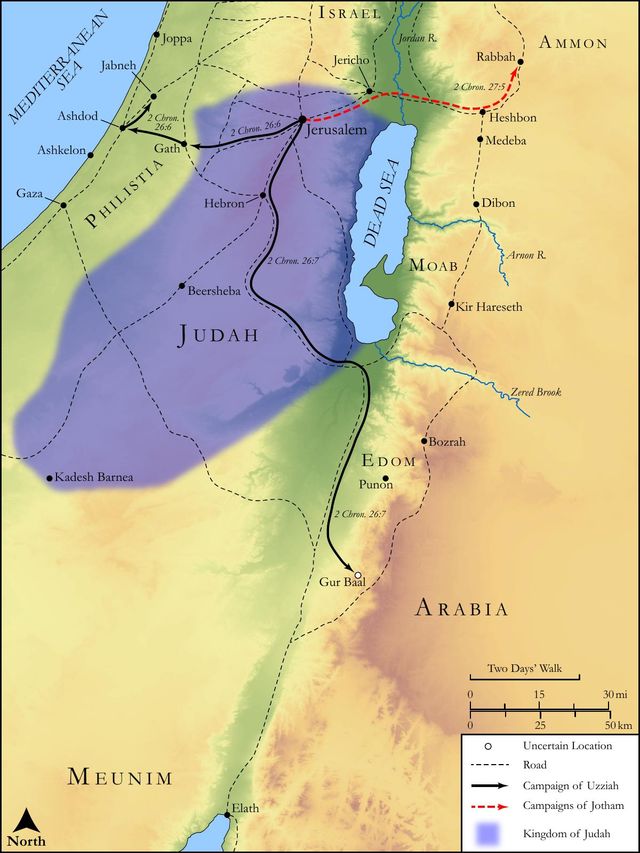
See on the biblical-era map
Study this verse
Public-domain commentary
Matthew Henry
From his Commentary on the Whole Bible. Henry comments on passages, not single verses — this entry covers 2 Chronicles 26:16–23. His three-level outline is real structure in the source text, so it is rendered as structure.
Here is the only blot we find on the name of king Uzziah, and it is such a one as lies not on any other of the kings. Whoredom, murder, oppression, persecution, and especially idolatry, gave characters to the bad kings and some of them blemishes to the good ones, David himself not excepted, witness the matter of Uriah. But we find not Uzziah charged with any of these; and yet he transgressed against the Lord his God, and fell under the marks of his displeasure in consequence, not, as other kings, in vexatious wars or rebellions, but an incurable disease.
I.His sin was invading the priest's office.
The good way is one; by-paths are many. The transgression of his predecessors was forsaking the temple of the Lord, flying off from it (Ch2 24:18), and burning incense upon idolatrous altars, Ch2 25:14. His was intruding into the temple of the Lord further than was allowed him, and attempting him to burn incense upon the altar of God, for which, it is likely, he pretended an extraordinary zeal and affection. See how hard it is to avoid one extreme and not run into another.
1.That which was at the bottom of his sin was pride of heart, a lust that ruins more than any other whatsoever (Ch2 26:16): When he was strong (and he was marvellously helped by the good providence of God till he was so, Ch2 26:15), when he had grown very great and considerable in wealth, interest, and power, instead of lifting up the name of God in gratitude to him who had done so much for him, his heart was lifted up to his destruction. Thus the prosperity of fools, by puffing them up with pride, destroys them. Now that he had done so much business, and won so much honour, he began to think no business, no honour, too great or too good for him, no, not that of the priesthood Men's pretending to forbidden knowledge, and exercising themselves in things too high for them, are owing to the pride of their heart, and the fleshly mind they are vainly puffed up with.
2.His sin was going into the temple of the Lord to burn incense, probably on some solemn feast day, or when he himself had some special occasion for supplicating the divine favour. What could move him to this piece of presumption, or put it into his head, I cannot conjecture. None of all his predecessors, not the best, not the worst, attempted it. The law, he knew, was express against him, and there was no usage or precedent for him. He could not pretend any necessity, as there was for David's eating the show-bread.
(1.)Perhaps he fancied the priests did not do their office so dexterously, decently, and devoutly, as they ought, and he could do it better. Or,
(2.)He observed that the idolatrous kings did themselves burn incense at the altars of their gods; his father did so, and Jeroboam (Kg1 13:1), an ambition of which honour was perhaps one thing that tempted them from the house of God, where it was not permitted them; and he, being resolved to cleave to God's altar, would try to break through this restraint and come as near it as the idolatrous kings did to their altars. But it is called a transgression against the Lord his God. He was not content with the honours God had put upon him, but would usurp those that were forbidden him, like our first parents.
3.He was opposed in this attempt by the chief priest and other priests that attended and assisted him, Ch2 26:17, Ch2 26:18. They were ready to burn incense for the king, according to the duty of their place; but, when he offered to do it himself, they plainly let him know that he meddled with that which did not belong to him, and that it was at his peril. They did not resist him by laying violent hands on him, though they were valiant men, but by reasoning with him and showing him,
(1.)That it was not lawful for him to burn incense: "It appertaineth not to thee, O Uzziah! but to the priests, whose birthright it is, as sons of Aaron, and who are consecrated to the service." Aaron and his sons were appointed by the law to burn incense, Exo 30:7. See Deu 33:10; Ch1 23:13. David had blessed the people and Solomon and Jehoshaphat had prayed with them and preached to them. Uzziah might have done this, and it would have been to his praise; but as for burning incense, that service was to be performed by the priests only. The kingly and priestly offices were separated by the law of Moses, not to be united again but in the person of the Messiah. If Uzziah did intend to honour God, and gain acceptance with him, in what he did, he was quite out in his aim; for, being a service purely of divine institution, he could not expect it should be accepted unless it were done in the way and by the hands that God had appointed.
(2.)That it was not safe. It shall not be for thy honour from the Lord God. More is implied: "It will be thy disgrace, and it is at thy peril." The law runs expressly against all strangers that came nigh (Num 3:10, Num 18:7), that is, all that were not priests. Korah and his accomplices, though Levites, paid dearly for offering to burn incense, which was the work of the priests only, Num 16:35. The incense of our prayers must be by faith put into the hands of our Lord Jesus, the great high priest of our profession, else we cannot expect it should be accepted by God, Rev 8:3.
4.He fell into a passion with the priests that reproved him, and would push forward to do what he intended notwithstanding (Ch2 26:19): Uzziah was wroth, and would not part with the censer out of his hand. He took it ill to be checked, and would not bear interference. Nitimur in vetitum - We are prone to do what is forbidden.
II.His punishment was an incurable leprosy, which rose up in his forehead while he was contending with the priests.
If he had submitted to the priests' admonition, acknowledged his error, and gone back, all would have been well; but when he was wroth with the priests, and fell foul upon them, then God was wroth with him and smote him with a plague of leprosy. Josephus says that he threatened the priests with death if they opposed him, and that then the earth shook, the roof of the temple opened, and through the cleft a beam of the sun darted directly upon the king's face, wherein immediately the leprosy appeared. And some conjecture that that was the earthquake in the days of Uzziah which we read of Amo 1:1 and Zac 14:5. Now this sudden stroke,
1.Ended the controversy between him and the priests; for, when the leprosy appeared, they were emboldened to thrust him out of the temple; nay, he himself hasted to go out, because the Lord had smitten him with a disease which was in a particular manner a token of his displeasure, and which he knew secluded him from common converse with men, much more from the altar of God. He would not be convinced by what the priests said, but God took an effectual course to convince him. If presumptuous men will not be made to see their error by the judgments of God's mouth, they shall be made to see it by the judgments of his hand. It evinced some religious fear of God in the heart of this king, even in the midst of his transgression, that, as soon as he found God was angry with him, he not only let fall his attempt, but retired with the utmost precipitation. Though he strove with the priests, he would not strive with his Maker.
2.It remained a lasting punishment of his transgression; for he continued a leper to the day of his death, shut up in confinement, and shut out from society, and forced to leave it to his son to manage all his business, Ch2 26:21. Thus God gave an instance of his resisting the proud and of his jealousy for the purity and honour of his own institutions; thus he gave fair warning even to great and good men to know and keep their distance, and not to intrude into those things which they have not seen; and thus he gave Uzziah a loud and constant call to repentance, and a long space to repent, which we have reason to hope he improved. He had been a man of much business in the world; but being taken off from that, and confined to a separate house, he had leisure to think of another world and prepare for it. By this judgment upon the king God intended to possess the people with a great veneration for the temple, the priesthood, and other sacred things, which they had been apt to think meanly of. While the king was a leper, he was as good as dead, dead while he lived, and buried alive; and so the law was, in effect, answered, that the stranger who cometh nigh shall be put to death. The disgrace survived him; for, when he was dead, they would not bury him in the sepulchres of the kings because he was a leper, which stained all his other glory.
3.It was a punishment that answered the sin as face does face in a glass.
(1.)Pride was at the bottom of his transgression, and thus God humbled him and put dishonour upon him.
(2.)He invaded the office of the priests in contempt of them, and God struck him with a disease which in a particular manner made him subject to the inspection and sentence of the priests; for to them pertained the judgment of the leprosy, Deu 24:8.
(3.)He thrust himself into the temple of God, whither the priests only had admission, and for that was thrust out of the very courts of the temple, into which the meanest of his subjects that was ceremonially clean had free access.
(4.)He confronted the priests that faced him and opposed his presumption, and for that the leprosy rose in his forehead, which, in Miriam's case, is compared to her father's spitting in her face, Num 12:14.
(5.)He invaded the dignity of the priesthood, which he had no right to, and for that he was deprived even of his royal dignity, which he had a right to. Those that covet forbidden honours forfeit allowed ones. Adam, by catching at the tree of knowledge of which he might not eat, debarred himself from the tree of life, of which he might have eaten. Let all that read it say, The Lord is righteous.
Historical interpretation
Two Centuries of Reception
7 surviving comments on this verse. Each one is dated, so this reads as a timeline rather than a list.
Select a marker to jump to its quote. Markers stagger vertically where authors wrote within a few decades of each other.
When King Uzziah carried a censer and violently took on himself to sacrifice, against the law of God, and refused to submit or give place, despite the opposition of Azariah the priest, he was confounded by God’s indignation and defiled with the markings of leprosy on his forehead, branded by the Lord’s anger on that part of the body on which those who win the Lord’s favor are sealed.
Uzziah is described as at first having been righteous, and then it is related that he was lifted up in mind and dared to offer sacrifice to God himself, and his face became leprous in consequence. But Josephus carefully studied the additional comments of the expounders as well, and a Hebrew of the Hebrews as he was, hear his description of the events of those times. He tells: “Though the priests urged Uzziah to go out of the temple and not to break the law of God, he angrily threatened them with death unless they held their peace. And meanwhile an earthquake shook the earth, and a bright light shone through a breach in the temple and struck the king’s face, so that at once it became leprous. And before the city at the place called Eroga, the western half of the Mount was split asunder and rolling four stadia stopped at the eastern mountain, so as to block up the royal approach and gardens.” This I take from the work of Josephus on Jewish antiquities. And I found in the beginning of the prophet Amos the statement that he began to prophecy “in the days of Uzziah, king of Judah, two years before the earthquake.” What earthquake he does not clearly say. But I think the same prophet further on suggests this earthquake when he says, “I saw the Lord standing on the altar. And he said, Strike the altar, and the doors shall be shaken, and strike the heads of all, and the remnant I will slay with the sword.”Here I understand a prediction of the earthquake, and of the destruction of the ancient solemnities of the Jewish race and of the worship practiced by them in Jerusalem, the ruin that should overtake them after the coming of our Savior, when, since they rejected the Christ of God, the true High Priest, leprosy infected their souls, as in the days of Uzziah, when the Lord himself standing on the altar gave leave to him that struck, saying, “Strike the altar.”
Remember Uzziah, how he entered the sanctuary; by seeking to seize the priesthood he lost his kingdom. Adam, by wishing to enrich himself, incurred a double loss. Recognize in the sanctuary the Tree, in the censer the fruit and in the leprosy the nakedness. From these two treasures there proceeded harm in both cases.
In the midst of paradise God had planted the Tree of Knowledge to separate off, above and below, sanctuary from Holy of Holies. Adam made bold to touch and was smitten like Uzziah: the king became leprous, Adam was tripped. Being struck like Uzziah, he hastened to leave: both kings fled and hid, in shame of their bodies.
As, therefore, it was not lawful for one of another tribe that was not a Levite to offer anything or to approach the altar without the priest, so also do you do nothing without the bishop; for if anyone does anything without the bishop, he does it to no purpose. For it will not be esteemed as of any avail to him.… For as Uzziah the king, who was not a priest and yet would exercise the functions of the priests, was smitten with leprosy for his transgression; so every lay person shall not be unpunished who despises God, and is so mad as to affront his priests and unjustly to snatch that honor to himself: not imitating Christ, “who glorified not himself to be made an high priest” but waited till he heard from his Father, “The Lord swore and will not repent, You are a priest forever, after the order of Melchizedek.” If, therefore, Christ did not glorify himself without the Father, how dare anyone thrust himself into the priesthood who has not received that dignity from his superior and do such things that it is lawful only for the priests to do?
Neither do we permit the laity to perform any of the offices belonging to the priesthood, as, for instance, neither the sacrifice, nor baptism, nor the laying on of hands nor the blessing, whether the smaller or the greater, for “no one takes this honor to himself, but he that is called of God.” For such sacred offices are conferred by the laying on of the hands of the bishop. But a person to whom such an office is not committed but seizes on it for himself, he shall undergo the punishment of Uzziah.
Of Uzziah, the ancestor of this king of whom we have been speaking, himself also praised in all things by the witness of the Scripture, after great commendation for his virtue, after countless triumphs that he achieved by the merit of his devotion and faith, learn how he was cast down by the pride of vainglory. “And,” we are told, “the name of Uzziah went forth, for the Lord helped him and had strengthened him. But when he was made strong, his heart was lifted up to his destruction, and he neglected the Lord his God.” … You see how dangerous the successes of prosperity generally are, so that those who could not be injured by adversity are ruined, unless they are careful, by prosperity; and those who in the conflict of battle have escaped the danger of death fall before their own trophies and triumphs.
Continue studying 2 Chronicles 26:19 across the web’s major study libraries — every link below opens this exact verse, chapter, or book on the destination site.
Read & Compare
 BibleGatewayThis verse in more than 200 translations and 70 languages.
 Bible.comThe YouVersion reader — hundreds of translations, reading plans, and highlights.
 ESV.orgCrossway's official English Standard Version reader.
 NET BibleThe NET translation with 60,000+ translators' notes on every rendering decision.
 STEP BibleTyndale House's free study tool — original text, vocabulary, and scholarly resources.
 BibliaLogos Bible Software's free web reader.
 USCCBThe New American Bible (Revised Edition) with the U.S. bishops' study notes.
Commentaries
 BibleHub CommentariesDozens of classic commentaries on this verse, gathered on one page.
 StudyLightMore than 100 commentary sets — the largest collection on the web.
 BibleRefPlain-English commentary on what this verse means, verse by verse.
 Enduring WordDavid Guzik's free commentary on this chapter, widely used by Bible teachers.
 Bible Study ToolsVerse commentary alongside Greek and Hebrew study aids.
Original Language & Research
- BibleHub InterlinearThe verse word by word — original language, transliteration, and English.
- BibleHub LexiconEvery word's original-language definition and Strong's entry.
 Blue Letter BibleDeep-study tools — Strong's numbers, concordance, and word studies.
 SefariaThe Hebrew text with Rashi and centuries of Jewish commentary.
Sermons, Hymns & Audio


TrulyRandomVerse is not affiliated with these sites and doesn’t control their content. They’re linked because they’re genuinely useful.
Summary
2 Chronicles 26:19 records the tragic climax of King Uzziah's reign, where his presumptuous act of burning incense in the Temple, a duty reserved for priests, resulted in immediate divine judgment. Despite being confronted by the priests, Uzziah's defiant anger led to leprosy erupting on his forehead, marking him as unclean and demonstrating God's swift and unyielding response to the violation of His sacred boundaries and ordained authority. This verse serves as a powerful testament to the dangers of pride and the inviolable holiness of God's sanctuary and commands.
Context
ShowHideLiterary Context
This verse is the dramatic culmination of Uzziah's story, following a detailed account of his initial righteousness and remarkable success. 2 Chronicles 26:1-5 describes his early reign marked by seeking God and consequent prosperity, including military victories, building projects, and agricultural advancements (2 Chronicles 26:6-15). However, 2 Chronicles 26:16 explicitly states that "when he was strong, his heart was lifted up to his destruction." This pride led him to transgress against the Lord by entering the Temple to burn incense, an act forbidden to kings. The immediate confrontation by Azariah and eighty courageous priests (2 Chronicles 26:17-18) sets the stage for the divine intervention described in verse 19, which then leads to Uzziah's lifelong isolation and the transfer of regency to his son Jotham (2 Chronicles 26:20-21). The narrative serves as a stark warning within the Chronicler's broader theological framework, emphasizing the importance of obedience to God's law and respect for His established order for the well-being of the monarchy and the nation.
Historical & Cultural Context
King Uzziah (also known as Azariah in 2 Kings 15) reigned for 52 years (c. 792-740 BC), one of the longest and most prosperous reigns in Judah's history. During this period, Judah experienced significant economic growth, military strength, and architectural innovation. Culturally, the burning of incense on the golden altar within the Holy Place of the Temple was a highly sacred ritual, symbolizing the prayers of the people ascending to God and performed exclusively by the Levitical priests, specifically the descendants of Aaron (Exodus 30:7-8; Numbers 16:40). A king, though God's anointed, was from the tribe of Judah, not Levi, and had no authority to perform priestly functions. Uzziah's act was a direct violation of this divinely ordained separation of roles, a usurpation of priestly authority that challenged the very structure of Israelite worship and governance established by God. Leprosy (Hebrew: tsara'at) in ancient Israel was not merely a physical ailment but often carried strong connotations of ceremonial uncleanness and divine judgment, as seen in cases like Miriam (Numbers 12:10) or Gehazi (2 Kings 5:27). Its appearance on the forehead made it immediately visible, serving as a public mark of God's displeasure and rendering the individual ritually impure and requiring isolation.
Key Themes
ShowHideThe narrative of Uzziah's downfall powerfully illustrates several key themes. Firstly, it highlights The Danger of Pride, demonstrating how even great success and divine blessing can lead to a "lifted up" heart, causing one to overstep God's boundaries (Proverbs 16:18). Secondly, it underscores the absolute necessity of Respect for Divine Authority and Boundaries. God established clear distinctions between civil and religious authority, and Uzziah's attempt to conflate them was a direct affront to God's sovereign order. This theme resonates with earlier accounts of those who presumed upon priestly roles, such as Korah and his company (Numbers 16). Thirdly, the immediate onset of leprosy emphasizes God's Swift and Certain Judgment against presumptuous sin, particularly when it defiles His sanctuary or disobeys explicit commands. This visible, undeniable judgment serves as a stark reminder of God's holiness and His intolerance for unholy acts within His sacred space. Finally, the account reinforces The Sanctity of the Temple and Priesthood, emphasizing that the Lord's house and the roles of those who minister within it are consecrated and must be approached with reverence and according to divine prescription.
Exposition and Analysis
ShowHideKey Word Analysis
ShowHideFrom a primitive root meaning "to boil up," this word signifies intense anger, fury, or indignation, often implying a peevish or fretful disposition. In this context, Uzziah's "wrath" was not merely annoyance but a deep-seated rage that "boiled up" within him, directed at the priests who dared to challenge his authority. It reveals a hardened heart, unwilling to repent or submit to divine instruction, even when confronted by those upholding God's law. His anger was a manifestation of his pride, an emotional outburst against the perceived affront to his kingly prerogative.
This refers to a pan or vessel used for burning incense. The presence of the censer in Uzziah's hand is crucial, as it physically represents his usurpation of the priestly office. It was the instrument of his transgression, a sacred implement that he, as a non-Levite, was forbidden to touch for this purpose. His grasping of it symbolized his grasping for a role not divinely appointed to him.
This term encompasses various severe skin diseases in the biblical context, often associated with ritual impurity and, significantly, with divine judgment for specific sins like pride, rebellion, or slander (e.g., Miriam's leprosy in Numbers 12). Its sudden appearance on Uzziah's forehead, a highly visible location, was an undeniable, public, and immediate sign of God's judgment, marking him as unclean and unfit for both kingship and worship. It was a physical manifestation of his spiritual defilement.
Verse Breakdown
ShowHide"Then Uzziah was wroth, and [had] a censer in his hand to burn incense"
This clause captures the king's defiant state of mind and action. His "wrath" indicates his furious rejection of the priests' rightful intervention, showcasing his stubborn pride. The "censer in his hand" signifies his active participation in the forbidden act, demonstrating his willful transgression against God's explicit command regarding priestly duties. This was not an accidental or ignorant sin, but a presumptuous act of rebellion.
"and while he was wroth with the priests"
This repetition emphasizes the persistence of Uzziah's anger even as divine judgment was imminent. It highlights his unrepentant heart; instead of yielding to the priests' warning, which was a warning from God Himself, he remained consumed by rage. This stubborn resistance to correction underscored the depth of his spiritual rebellion and made the ensuing judgment all the more fitting.
"the leprosy even rose up in his forehead before the priests in the house of the LORD, from beside the incense altar"
This final, powerful clause describes the immediate and precise nature of God's judgment. The leprosy "rose up" instantly, a supernatural manifestation. Its location "in his forehead" made it unmistakably public and visible to all present, particularly "the priests" who had just confronted him. The setting "in the house of the LORD, from beside the incense altar" is highly significant; the judgment occurred at the very spot of his transgression, in the most sacred space, underscoring the gravity of his sin against God's holiness and His sanctuary.
Literary Devices
ShowHideThe narrative in 2 Chronicles 26:19 employs several potent literary devices to convey its theological message. Irony is prominent, as Uzziah, a king who achieved great strength and prosperity through God's blessing, ultimately found his strength leading to his destruction and a humiliating, debilitating disease. His pursuit of glory through forbidden means resulted in public shame and isolation. Symbolism is powerfully used with the leprosy itself; it is not merely a disease but a visible, physical manifestation of Uzziah's spiritual uncleanness and God's righteous judgment for his presumptuous sin. The defilement on his body mirrors the defilement of his heart and his attempted defilement of the sacred space. The immediate onset of the disease also creates Dramatic Impact, emphasizing the swiftness and certainty of divine retribution for rebellion against God's established order. The narrative also uses Foreshadowing, as Uzziah's initial success, followed by the explicit mention of his pride in 2 Chronicles 26:16, prepares the reader for the inevitable downfall that follows.
Theological and Thematic Connections
ShowHideThe account of Uzziah's leprosy serves as a profound theological statement on the absolute holiness of God, the inviolability of His divine commands, and the severe consequences of presumptuous sin. God established a clear distinction between the roles of king and priest, a separation designed to maintain order and prevent the concentration of all power in one human office, thereby safeguarding the purity of worship. Uzziah's act was not merely a procedural error but a direct challenge to God's sovereign authority and the sacred covenant order. His pride led him to believe he could transcend the boundaries God had set, a dangerous spiritual arrogance that God met with immediate and visible judgment. This narrative underscores that God's mercy does not negate His justice, and His holiness demands reverence and obedience, especially in matters pertaining to worship and His sanctuary.
Reflection and Application
ShowHideThe tragic story of King Uzziah offers timeless and sobering lessons for believers today. It serves as a powerful reminder that prosperity and success, if not handled with humility and gratitude, can become fertile ground for spiritual pride. We must constantly guard our hearts against the temptation to believe that our achievements or positions grant us special privileges to disregard God's clear commands or overstep established boundaries, whether in the church or in our personal lives. God's order, His word, and His appointed authorities are to be respected, not because of human merit, but because they are part of His divine design. Uzziah's immediate judgment underscores the seriousness of sin, particularly presumptuous sin that challenges God's holiness. It calls us to cultivate a spirit of humility, submission to God's will, and a deep reverence for His character and His word. We are reminded that while God is merciful, He is also just, and He will not tolerate unholy acts, especially when they stem from a proud and rebellious heart. Our walk with God must be marked by obedience, recognizing that true freedom and blessing come from living within the parameters He has graciously set.
Questions for Reflection
ShowHideFAQ
ShowHideWhy was Uzziah's act so serious, given his long and prosperous reign?
ShowHideUzziah's act was profoundly serious because it was a direct and presumptuous violation of God's established order for worship and the priesthood. God had explicitly reserved the duty of burning incense on the golden altar for the Aaronic priests alone (Exodus 30:7-8; Numbers 3:10). As king, Uzziah was from the tribe of Judah, not Levi, and therefore had no divine authorization to perform priestly functions. His transgression was an act of pride and rebellion against God's sovereign authority, not merely a ceremonial oversight. It challenged the very distinction God had ordained between the secular and the sacred, and between the roles of king and priest, which was crucial for maintaining the sanctity of the Temple and the purity of Israel's worship.
Why did God choose leprosy as the form of judgment for Uzziah?
ShowHideGod chose leprosy as the form of judgment for Uzziah for several symbolic and practical reasons. Biblically, leprosy (tsara'at) was often associated with divine judgment for acts of rebellion, pride, or slander (e.g., Miriam's leprosy in Numbers 12:10 for speaking against Moses). It was a highly visible, debilitating disease that rendered the afflicted ceremonially unclean, requiring isolation from the community and the Temple (Leviticus 13:45-46). By striking Uzziah with leprosy on his forehead, God made his sin and its consequence undeniably public and visible to everyone, especially the priests who had confronted him. This judgment immediately disqualified him from his kingly duties and from entering the Temple, physically enforcing the very boundary he had attempted to cross. The visible decay of his body mirrored the spiritual decay of his heart due to pride and rebellion, serving as a lasting mark of his transgression and a powerful warning to others.
Christ-Centered Fulfillment
ShowHideThe tragic account of King Uzziah's presumptuous sin and divine judgment in 2 Chronicles 26:19 powerfully foreshadows and highlights the unique qualifications and perfect fulfillment found in Jesus Christ. Uzziah, a king, arrogantly attempted to usurp the priestly role, resulting in defilement and judgment. In stark contrast, Jesus is the only true King-Priest, perfectly uniting both offices without any usurpation or defilement. He is the rightful King of kings, descended from Judah, yet also the High Priest "after the order of Melchizedek" (Hebrews 7:17), appointed by God Himself, not by human lineage or ambition (Hebrews 5:5-6). Unlike Uzziah, who sought to offer incense for his own glory, Christ offered Himself as the ultimate, spotless sacrifice, not with physical incense, but with His own blood, once for all, to take away the sin of the world (Hebrews 9:11-14). Uzziah's pride led to his downfall and isolation, but Christ's profound humility, emptying Himself and taking the form of a servant, led to His exaltation and the redemption of humanity (Philippians 2:5-8). Thus, Uzziah's failure underscores the necessity and glory of Christ, who perfectly embodies the roles Uzziah presumptuously sought, offering a true and lasting atonement that no human king or priest could ever achieve.