


2 Kings 5:25
Bible text: King James Version (1769 Blayney text) · Public domain
Bible text: Berean Standard Bible · Public domain
Bible text: American Standard Version (1901) · Public domain
Bible text: World English Bible, Messianic edition · Public domain
Bible text: Geneva Bible (1599) · Public domain
Bible text: Young's Literal Translation · Public domain
- וְהוּאve·hu'and heH1931Conj-w ¦ Pro-3msPronoun Personal 3rd Singular Masculineוְandהוּאhe
- בָאva'he wentH935V-Qal-Perf-3msVerb Qal Perfect 3rd Singular Masculine
- וַיַּעֲמֹדvai·ya·'a·Modand he stoodH5975Conj-w ¦ V-Qal-ConsecImperf-3msVerb Qal Consecutive Imperfect 3rd Singular Masculineוַandיַּעֲמֹדhe stood
- אֶל'eltoH413PrepPreposition
- אֲדֹנָיו'a·do·Navhis master<s>H113N-mpc ¦ 3msNoun Plural Masculine Constructאֲדֹנָיmaster<s>וhis
- וַיֹּאמֶרvai·Yo·merand he saidH559Conj-w ¦ V-Qal-ConsecImperf-3msVerb Qal Consecutive Imperfect 3rd Singular Masculineוַandיֹּאמֶרhe said
- אֵלָיו'e·Lavto himH413Prep ¦ 3msPrepositionאֵלָיtoוhim
- אֱלִישָׁע'e·li·Sha'ElishaH477N-proper-mNoun Proper Masculine
- מֵאַיִןme·'anfrom whence?H370Prep-m ¦ InterrogParticle Interrogativeמֵfromאַיִןwhence?
- גֵּחֲזִיge·cha·ZiO GehaziH1522N-proper-mNoun Proper Masculine
- וַיֹּאמֶרvai·Yo·merand he saidH559Conj-w ¦ V-Qal-ConsecImperf-3msVerb Qal Consecutive Imperfect 3rd Singular Masculineוַandיֹּאמֶרhe said
- לֹאlo'notH3808NegParticle Negative
- הָלַךְha·Lakhhe has goneH1980V-Qal-Perf-3msVerb Qal Perfect 3rd Singular Masculine
- עַבְדְּךָ'av·de·Khayour servantH5650N-msc ¦ 2msNoun Singular Masculine Constructעַבְדְּservantךָyour
- אָנֶה'A·nehwhere?H575InterrogParticle Interrogative
- וָאָנָהva·'A·nahand where?H575Conj-w ¦ InterrogParticle Interrogativeוָandאָנָהwhere?
English is a literal word-by-word gloss of the Hebrew, not the KJV's wording. Why?
This is the original text the KJV's translators worked from — each Hebrew word with its own literal English meaning in this verse, prepared by scholars at Tyndale House, Cambridge. The KJV translates whole sentences, not word by word, so its wording differs: one Hebrew word can become several English words, and the KJV may choose “the LORD” where the gloss reads “Yahweh”. Both are faithful — they answer different questions. For the KJV's own rendering, switch to the KJV text.
Details
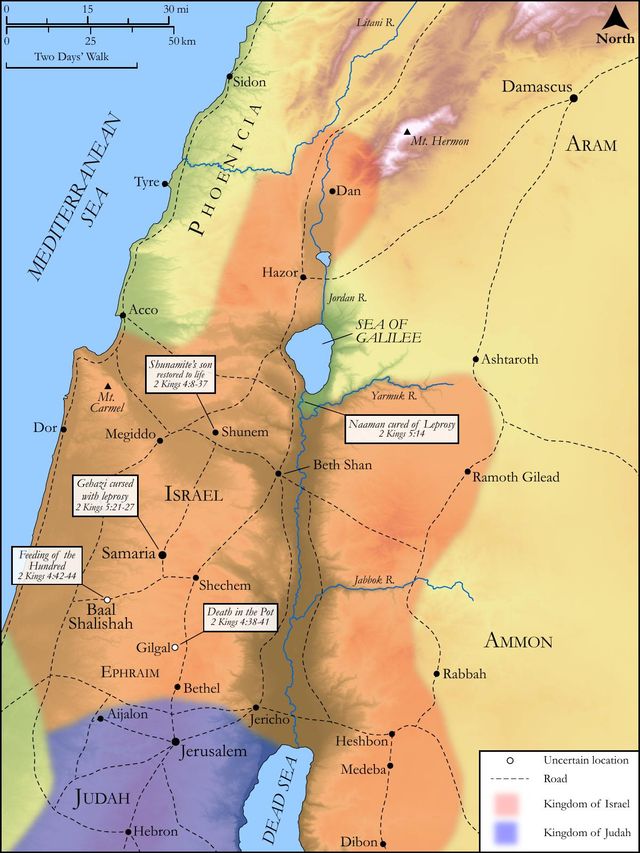
See on the biblical-era map
Study this verse
Public-domain commentary
Matthew Henry
From his Commentary on the Whole Bible. Henry comments on passages, not single verses — this entry covers 2 Kings 5:20–27. His three-level outline is real structure in the source text, so it is rendered as structure.
Naaman, a Syrian, a courtier, a soldier, had many servants, and we read how wise and good they were, Kg2 5:13. Elisha, a holy prophet, a man of God, has but one servant, and he proves a base, lying, naughty fellow. Those that heard of Elisha at a distance honoured him, and got good by what they heard; but he that stood continually before him, to hear his wisdom, had no good impressions made upon him either by his doctrine or miracles. One would have expected that Elisha's servant should be a saint (even Ahab's servant, Obadiah, was), but even Christ himself had a Judas among his followers. The means of grace cannot give grace. The best men, the best ministers have often had those about them that have been their grief and shame. The nearer the church the further from God. Many come from the east and west to sit down with Abraham when the children of the kingdom shall be cast out. Here is,
I.Gehazi's sin. It was a complicated sin.
1.The love of money, that root of all evil, was at the bottom of it. His master contemned Naaman's treasures, but he coveted them, Kg2 5:20. His heart (says bishop Hall) was packed up in Naaman's chests, and he must run after him to fetch it. Multitudes, by coveting worldly wealth, have erred from the faith and pierced themselves with many sorrows.
2.He blamed his master for refusing Naaman's present, condemned him as foolish in not taking gold when he might have it, envied and grudged his kindness and generosity to this stranger, though it was for the good of his soul. In short, he thought himself wiser than his master.
3.When Naaman, like a person of accomplished manners, alighted from his chariot to meet him (Kg2 5:21), he told him a deliberate lie, that his master sent him to him, and so he received that courtesy to himself that Naaman intended to his master.
4.He abused his master, and basely misrepresented him to Naaman as one that had soon repented of his generosity, that was fickle, and did not know his own mind, that would say and unsay, swear and unswear, that would not do an honourable thing but he must presently undo it again. his story of the two sons of the prophets was as silly as it was false; if he would have begged a token for two young scholars, surely less than a talent of silver might serve them.
5.There was danger of his alienating Naaman from that holy religion which he had espoused, and lessening his good opinion of it. he would be ready to say, as Paul's enemies suggested concerning him (Co2 12:16, Co2 12:17), that, though Elisha himself did not burden him, yet being crafty he caught him with guile, sending those that made a gain of him. We hope that he understood afterwards that Elisha's hand was not in it, and that Gehazi was forced to restore what he had unjustly got, else it might have driven him to his idols again.
6.His seeking to conceal what he had unjustly got added much to his sin.
(1.)He hid it, as Achan did his gain, by sacrilege, in the tower, a secret place, a strong place, till he should have an opportunity of laying it out, Kg2 5:24. Now he thought himself sure of it, and applauded his own management of a fraud by which he had imposed, not only upon the prudence of Naaman, but upon Elisha's spirit of discerning, as Ananias and Sapphira upon the apostles.
(2.)He denied it: He went in, and stood before his master, ready to receive his orders. None looked more observant of his master, though really none more injurious to him; he thought, as Ephraim, I have become rich, but they shall find no iniquity in me, Hos 12:8. His master asked him where he had been, "Nowhere, sir" (said he), "out of the house." Note, One lie commonly begets another: the way of that sin is down-hill; therefore dare to be true.
II.The punishment of this sin. Elisha immediately called him to an account for it; and observe,
1.How he was convicted. he thought to impose upon the prophet, but was soon given to understand that the Spirit of prophecy could not be deceived, and that it was in vain to lie to the Holy Ghost. Elisha could tell him,
(1.)What he had done, though he had denied it. "Thou sayest thou wentest nowhere, but went not my heart with thee?" Kg2 5:26. Had Gehazi yet to learn that prophets had spiritual eyes? or could he think to hide any thing from a seer, from him with whom the secret of the Lord was? Note, It is folly to presume upon sin in hopes of secresy. When thou goest aside into any by-path does not thy own conscience go with thee? Does not the eye of God go with thee? He that covers his sin shall not prosper, particularly a lying tongue is but for a moment, Pro 12:19. Truth will transpire, and often comes to light strangely, to the confusion of those that make lies their refuge.
(2.)What he designed, though he kept that in his own breast. He could tell him the very thoughts and intents of his heart, that he was projecting, now that he had got these two talents, to purchase ground and cattle, to leave Elisha's service, and to set up for himself. Note, All the foolish hopes and contrivances of carnal worldlings are open before God. And he tells him also the evil of it: "Is it a time to receive money? Is this an opportunity of enriching thyself? Couldst thou find no better way of getting money than by belying thy master and laying a stumbling-block before a young convert?" Note, Those that are for getting wealth at any time, and by any ways and means whatsoever, right or wrong, lay themselves open to a great deal of temptation. Those that will be rich (per fas, per nefas; rem, rem, quocunque modo rem - by fair means, by foul means; careless of principle, intent only on money) drown themselves in destruction and perdition, Ti1 6:9. War, and fire, and plague, and shipwreck, are not, as many make them, things to get money by. It is not a time to increase our wealth when we cannot do it but in such ways as are dishonourable to God and religion or injurious to our brethren or the public.
2.How he was punished for it: The leprosy of Naaman shall cleave to thee, Kg2 5:27. If he will have his money, he shall take his disease with it, Transit cum onere - It passes with this incumbrance. He was contriving to entail lands upon his posterity; but, instead of them, he entails a loathsome disease on the heirs of his body, from generation to generation. The sentence was immediately executed on himself; no sooner said than done: He went out from his presence a leper as white as snow. Thus he is stigmatized and made infamous, and carries the mark of his shame wherever he goes: thus he loads himself and family with a curse, which shall not only for the present proclaim his villany, but for ever perpetuate the remembrance of it. Note, The getting of treasures by a lying tongue is a vanity tossed to and fro of those that seek death, Pro 21:6. Those who get wealth by fraud and injustice cannot expect either the comfort or the continuance of it. What was Gehazi profited, though he gained his two talents, when thereby he lost his health, his honour, his peace, his service, and, if repentance prevented not, his soul for ever? See Job 20:12, etc.
Historical interpretation
Historical reception
1 surviving comment on this verse from the historical church.
After Gehazi had come back from his meeting with Naaman, he entered Elisha’s house, and [the prophet] asked him, according to custom, why he had moved away from him. “Where do you come from?” he said to Gehazi. He said this on purpose, so that the justice of the judgment passed on his sin might be evident. If Gehazi repented and swore, he would have been forgiven; but if he denied that he had secretly received money, the leprosy of Naaman would cover him conspicuously.
Continue studying 2 Kings 5:25 across the web’s major study libraries — every link below opens this exact verse, chapter, or book on the destination site.
Read & Compare
 BibleGatewayThis verse in more than 200 translations and 70 languages.
 Bible.comThe YouVersion reader — hundreds of translations, reading plans, and highlights.
 ESV.orgCrossway's official English Standard Version reader.
 NET BibleThe NET translation with 60,000+ translators' notes on every rendering decision.
 STEP BibleTyndale House's free study tool — original text, vocabulary, and scholarly resources.
 BibliaLogos Bible Software's free web reader.
 USCCBThe New American Bible (Revised Edition) with the U.S. bishops' study notes.
Commentaries
 BibleHub CommentariesDozens of classic commentaries on this verse, gathered on one page.
 StudyLightMore than 100 commentary sets — the largest collection on the web.
 BibleRefPlain-English commentary on what this verse means, verse by verse.
 Enduring WordDavid Guzik's free commentary on this chapter, widely used by Bible teachers.
 Bible Study ToolsVerse commentary alongside Greek and Hebrew study aids.
Original Language & Research
- BibleHub InterlinearThe verse word by word — original language, transliteration, and English.
- BibleHub LexiconEvery word's original-language definition and Strong's entry.
 Blue Letter BibleDeep-study tools — Strong's numbers, concordance, and word studies.
 SefariaThe Hebrew text with Rashi and centuries of Jewish commentary.
Sermons, Hymns & Audio


TrulyRandomVerse is not affiliated with these sites and doesn’t control their content. They’re linked because they’re genuinely useful.
Summary
This verse captures the tense and pivotal moment following Gehazi's deceitful pursuit of Naaman, where he returns to stand before his master, Elisha. It records Elisha's divinely-inspired, penetrating question, "Whence [comest thou], Gehazi?", which immediately exposes Gehazi's secret actions. In response, Gehazi offers a bold, yet ultimately futile, denial, claiming he "went no whither." This confrontation dramatically sets the stage for the swift revelation of his covetous sin and the severe, divinely ordained consequences that follow, marking a critical turning point in the narrative of Naaman's healing and Elisha's ministry.
Context
ShowHideLiterary Context
2 Kings 5:25 serves as the dramatic climax to the narrative arc initiated by Naaman's miraculous healing. The preceding verses detail Naaman, the Syrian commander, being cured of leprosy through Elisha's instruction to wash seven times in the Jordan River, a testament to God's sovereign power, not human might or ritual (2 Kings 5:10-14). Overwhelmed with gratitude, Naaman offered Elisha lavish gifts, which the prophet steadfastly refused, emphasizing that God's grace is not a commodity to be purchased (2 Kings 5:15-16). However, Gehazi, Elisha's servant, driven by covetousness, secretly pursued Naaman, fabricating a story that Elisha had changed his mind and required silver and garments (2 Kings 5:20-24). Verse 25 captures Gehazi's return to Elisha's presence, attempting to appear innocent, but immediately met with a question that reveals Elisha's supernatural awareness of his actions, thereby setting the stage for the divine judgment that swiftly ensues.
Historical & Cultural Context
The historical backdrop is the Northern Kingdom of Israel during the 9th century BC, a period marked by the powerful ministries of prophets like Elisha, who served as God's direct spokespersons, often wielding significant spiritual and moral authority. The relationship between a prophet and his servant, such as Elisha and Gehazi, was one of profound trust and loyalty; the servant's integrity directly reflected upon the master's reputation and the divine message he conveyed. In Israel and among the nations, the exchange of gifts was a common practice, signifying gratitude, tribute, or the sealing of covenants, as when Abraham gave sheep and oxen to Abimelech and both of them made a covenant. Naaman's offering was a genuine expression of thanksgiving, but Elisha's refusal was a crucial theological statement, distinguishing the God of Israel from pagan deities whose favor was often perceived as purchasable. Gehazi's actions, therefore, were not merely a personal act of greed but a profound betrayal of his master's integrity and a misrepresentation of God's character, especially to Naaman, a newly converted Gentile. Leprosy, in this cultural context, was not only a severe physical ailment but also carried profound social and ritual impurity, leading to ostracization. Its miraculous cure was a powerful demonstration of God's unique power, and Gehazi's subsequent affliction with it would have been universally understood as a deeply symbolic and just divine judgment.
Key Themes
ShowHideThis verse powerfully contributes to several overarching themes within the book of 2 Kings and the broader biblical narrative. Firstly, it underscores the theme of Divine Omniscience and Accountability. Elisha's divinely-inspired question to Gehazi highlights that no deed, however secretly committed, is hidden from God's all-seeing eye. This echoes the biblical truth that God knows all things, even the thoughts and intentions of the heart, and that all are accountable to Him (Psalm 139:7-12). Secondly, the passage starkly contrasts Integrity versus Greed. Elisha's principled refusal of Naaman's gifts exemplifies unwavering integrity and faith in God's provision, while Gehazi's covetousness leads him down a path of deception and moral compromise. This serves as a potent warning against the corrupting influence of material desires, a theme consistently found in wisdom literature, such as Proverbs 15:27). Finally, it emphasizes the Consequences of Deception and Sin. Gehazi's bold lie, "Thy servant went no whither," is immediately exposed, leading to swift and severe judgment. This reinforces the principle that sin has consequences and that attempts to cover up wrongdoing are futile before God, as clearly stated in Numbers 32:23).
Exposition and Analysis
ShowHideKey Word Analysis
ShowHideThis word (H370) is used in the sense of a query, specifically "where?" or "from where?". In Elisha's question, "Whence [comest thou], Gehazi?", it is not a question born of ignorance but of divine insight. It serves as a rhetorical probe, inviting Gehazi to confess his hidden actions. The prophet's use of this word, combined with the context of his supernatural knowledge, underscores the theme of divine omniscience; God knows Gehazi's movements, even though they were performed in secret.
This proper noun (H1522) identifies Elisha's servant. Its apparent derivation from "valley of a visionary" (גַּיְא and חָזָה) is ironically poignant in this context. Gehazi, the servant of a great visionary prophet, himself lacks true spiritual vision, being blinded by greed. His name, therefore, stands in stark contrast to his actions, highlighting his failure to embody the spiritual discernment and integrity expected of one so close to God's prophet.
This word (H575), derived from a form of "where?", is used here in a negative construction to mean "nowhere" or "not here and there." Gehazi's categorical denial, "Thy servant went no whither," is an outright lie. It is a desperate attempt to conceal his secret journey and illicit gain. The use of this absolute negation highlights the depth of his deception and his hardened heart, as he directly contradicts the truth known by his divinely-empowered master.
Verse Breakdown
ShowHide"But he went in, and stood before his master."
This opening clause marks Gehazi's physical return to Elisha's presence after his clandestine pursuit of Naaman. The conjunction "But" (וַיָּבֹא֙ vayyavo) signals a shift in the narrative, bringing Gehazi back into the immediate sphere of accountability. His act of "standing before his master" (לִפְנֵ֥י אֲדֹנָֽיו lifnei adonaw) is a conventional posture of a servant awaiting instructions or reporting, outwardly conveying submission and normalcy. However, this outward demeanor stands in stark contrast to the inward deceit and the illicit actions he has just committed, creating immediate dramatic tension for the reader who is aware of his transgression.
"And Elisha said unto him, Whence [comest thou], Gehazi?"
Elisha's question is the pivotal moment of confrontation. It is not a query born of ignorance but of profound divine revelation. The direct address, "Gehazi," personalizes the challenge, cutting through any pretense. Elisha's tone, though unstated, carries the weight of prophetic authority and supernatural knowledge. This question immediately shatters Gehazi's facade of innocence, forcing him into a corner and demanding an explanation for actions he believed were hidden. It serves as a final opportunity for Gehazi to confess his sin before its full exposure.
"And he said, Thy servant went no whither."
Gehazi's response is an unequivocal and unreserved lie. Instead of confessing, he doubles down on his deception, asserting that he did not leave Elisha's immediate vicinity. The phrase "Thy servant" (עַבְדְּךָ֖ 'avdekha) is deeply ironic, as his actions have been anything but loyal or serving of his master's integrity. This blatant falsehood, spoken directly to a prophet of God, reveals the depth of his moral corruption, his underestimation of Elisha's spiritual discernment, and his desperate attempt to evade responsibility, demonstrating a profound lack of fear of God or respect for His appointed messenger.
Literary Devices
ShowHideThe passage in 2 Kings 5:25 is rich with several significant literary devices that heighten its dramatic and theological impact. Foremost is Irony, particularly Dramatic Irony. The audience is fully aware of Gehazi's secret journey and his deceitful acquisition of gifts from Naaman, while Gehazi attempts to present himself as innocent before Elisha. His declaration, "Thy servant went no whither," is profoundly ironic, as he has indeed gone "hither and thither" for ill-gotten gain. This creates a palpable Suspense as the reader anticipates Elisha's response, knowing the prophet's divine insight. Elisha's question, "Whence [comest thou], Gehazi?", functions as a form of Rhetorical Question, not seeking information but rather prompting confession and exposing the lie. The entire scene is a powerful Contrast between Elisha's integrity and spiritual discernment and Gehazi's greed and deceit. Finally, the verse employs Foreshadowing, as Gehazi's bold lie immediately sets the stage for the swift and severe divine judgment that follows in the subsequent verses, where his sin is fully exposed and punished.
Theological and Thematic Connections
ShowHideThis pivotal verse underscores profound theological truths about God's character and the nature of sin. It powerfully affirms God's omniscience; no action, however secret, escapes His notice, and He uses His prophets to bring hidden deeds to light. Gehazi's attempt to deceive Elisha is, by extension, an attempt to deceive God, revealing a fundamental misunderstanding of divine presence and knowledge. The narrative also highlights the corrupting power of covetousness, demonstrating how unchecked desire for material gain can lead to a cascade of sins, including deception, betrayal, and ultimately, severe judgment. It serves as a stark warning against allowing worldly desires to compromise spiritual integrity and the call to selfless service. The contrast between Elisha's unwavering commitment to God's honor and Gehazi's self-serving ambition is a timeless lesson on the importance of integrity and accountability in the life of a believer, especially those in positions of spiritual leadership.
Reflection and Application
ShowHideThe narrative of Gehazi's deception in 2 Kings 5:25 offers timeless lessons for contemporary believers. It serves as a potent reminder that our actions, whether in public or in secret, are always known to God. Gehazi's failed attempt to conceal his greed and dishonesty underscores the futility of trying to hide sin from an omniscient God or His discerning Spirit. This should prompt us to cultivate a life of radical honesty and transparency, not out of fear of exposure, but out of reverence for God and a desire to live in alignment with His truth. Furthermore, Gehazi's story is a sobering warning against the insidious nature of covetousness. The desire for material gain, left unchecked, can erode integrity, lead to outright deception, and ultimately result in devastating consequences, both spiritual and temporal. We are called to examine our hearts for any hidden desires that might compromise our witness or lead us away from selfless service. Instead, we are challenged to embrace contentment and trust in God's provision, reflecting the integrity of Elisha rather than the deceit of Gehazi. This passage encourages a deep introspection into our motives and actions, knowing that true freedom and blessing comes from living authentically before God and others.
Questions for Reflection
ShowHideFAQ
ShowHideWhy did Elisha refuse Naaman's gifts in the first place, and why was Gehazi's acceptance so wrong?
ShowHideElisha refused Naaman's gifts to demonstrate that God's healing power and grace are freely given and cannot be bought or sold. This was crucial for Naaman, a Gentile, to understand that the God of Israel operates differently from pagan deities, whose favor often required costly sacrifices or payments. Elisha's refusal upheld the purity and freeness of God's salvation. Gehazi's acceptance was profoundly wrong because he undermined this crucial theological lesson. By secretly taking gifts, he not only contradicted his master's principled stand but also misrepresented the character of God to a new convert, implying that divine service could be exploited for personal gain. His actions were driven by greed and brought dishonor to God's name and Elisha's ministry, as highlighted by the severe judgment that followed in 2 Kings 5:27.
Did Elisha know Gehazi was lying immediately, or did God reveal it to him?
ShowHideElisha knew Gehazi was lying immediately, and this knowledge was clearly a divine revelation, not a result of natural observation. His question, "Whence [comest thou], Gehazi?", implies a prior knowledge of Gehazi's movements and intentions. The subsequent verses confirm this, as Elisha reveals not only that he knew Gehazi went to Naaman but also the specific details of what Gehazi acquired, even stating, "Went not my heart with thee, when the man turned again from his chariot to meet thee?" (2 Kings 5:26). This supernatural discernment underscores Elisha's role as a true prophet of God, through whom God's omniscience was made manifest, ensuring that Gehazi's sin would not remain hidden.
What are the lasting consequences of Gehazi's sin beyond his personal punishment?
ShowHideGehazi's sin had significant lasting consequences beyond his personal affliction with leprosy. Firstly, it brought shame and dishonor to the prophetic office and to the name of the God of Israel, especially in the eyes of Naaman, a newly converted Gentile. This could have potentially undermined Naaman's burgeoning faith and his perception of the true God. Secondly, the curse of leprosy was pronounced not only upon Gehazi but also upon his "seed forever" (2 Kings 5:27), indicating a generational consequence for his profound moral failure and greed. This serves as a stark warning about the far-reaching impact of sin, particularly for those in spiritual leadership, where personal failings can have wider implications for the community and for future generations. It emphasizes the seriousness with which God views integrity and purity in ministry.
Christ-Centered Fulfillment
ShowHideThe narrative of Gehazi's deception, culminating in 2 Kings 5:25,