


Joshua 22:16
Bible text: King James Version (1769 Blayney text) · Public domain
Bible text: King James Version with Strong's numbers · Public domain
Bible text: Berean Standard Bible · Public domain
Bible text: American Standard Version (1901) · Public domain
Bible text: World English Bible, Messianic edition · Public domain
Bible text: Geneva Bible (1599) · Public domain
Bible text: Young's Literal Translation · Public domain
- כֹּהkohthusH3541AdvAdverb
- אָמְרוּ'a·me·Ruthey sayH559V-Qal-Perf-3cpVerb Qal Perfect 3rd Plural common gender
- כֹּלkolallH3605N-mscNoun Singular Masculine Construct
- עֲדַת'a·Dat[the] congregation ofH5712N-fscNoun Singular Feminine Construct
- יְהוָהYah·wehYahwehH3068N-properNoun Proper Title
- מָהmahwhat?H4100InterrogPronoun Interrogative
- הַמַּעַלha·Ma·'al[is] the unfaithfulnessH4604Art ¦ N-msNoun Singular Masculine Absoluteהַ[is] theמַּעַלunfaithfulness
- הַזֶּהha·Zeh<the> thisH2088Art ¦ PrtParticle Demonstrativeהַ<the>זֶּהthis
- אֲשֶׁר'a·SherwhichH834RelParticle Relative
- מְעַלְתֶּםme·'al·Temyou have acted unfaithfullyH4603V-Qal-Perf-2mpVerb Qal Perfect 2nd Plural Masculine
- בֵּאלֹהֵיbe·lo·Heiagainst [the] God ofH430Prep-b ¦ N-mpcNoun Plural Masculine Constructבֵּagainstאלֹהֵי[the] God of
- יִשְׂרָאֵלYis·ra·'ElIsraelH3478N-properNoun Proper Location
- לָשׁוּבla·Shuvby turning backH7725Prep-l ¦ V-Qal-InfVerb Qal Infinitive Constructלָbyשׁוּבturning back
- הַיּוֹםhai·Yomthis dayH3117Art ¦ N-msNoun Singular Masculine Absoluteהַthisיּוֹםday
- מֵאַחֲרֵיme·'a·cha·Reifrom afterH310Prep-m ¦ Adj-mpcAdjective Numerical Plural Masculine Constructמֵfromאַחֲרֵיafter
- יְהוָהYah·wehYahwehH3068N-properNoun Proper Title
- בִּבְנוֹתְכֶםbiv·not·Khemwhen built youH1129Prep-b ¦ V-Qal-Inf ¦ 2mpVerb Qal Infinitive Constructבִּwhenבְנוֹתְbuiltכֶםyou
- לָכֶםla·Khemfor <the> yourselvesPrep-l ¦ 2mpSuffix Personal 2nd Plural Masculineלָfor <the>כֶםyourselves
- מִזְבֵּחַmiz·Be·achan altarH4196N-msNoun Singular Masculine Absolute
- לִמְרָדְכֶםlim·ra·de·Khemby rebelling yourH4775Prep-l ¦ V-Qal-Inf ¦ 2mpVerb Qal Infinitive Constructלִbyמְרָדְrebellingכֶםyour
- הַיּוֹםhai·Yomthis dayH3117Art ¦ N-msNoun Singular Masculine Absoluteהַthisיּוֹםday
- בַּיהוָהba·Yah·wehagainst YahwehH3068Prep-b ¦ N-properNoun Proper TitleבַּagainstיהוָהYahweh
English is a literal word-by-word gloss of the Hebrew, not the KJV's wording. Why?
This is the original text the KJV's translators worked from — each Hebrew word with its own literal English meaning in this verse, prepared by scholars at Tyndale House, Cambridge. The KJV translates whole sentences, not word by word, so its wording differs: one Hebrew word can become several English words, and the KJV may choose “the LORD” where the gloss reads “Yahweh”. Both are faithful — they answer different questions. For the KJV's own rendering, switch to the KJV text.
Details
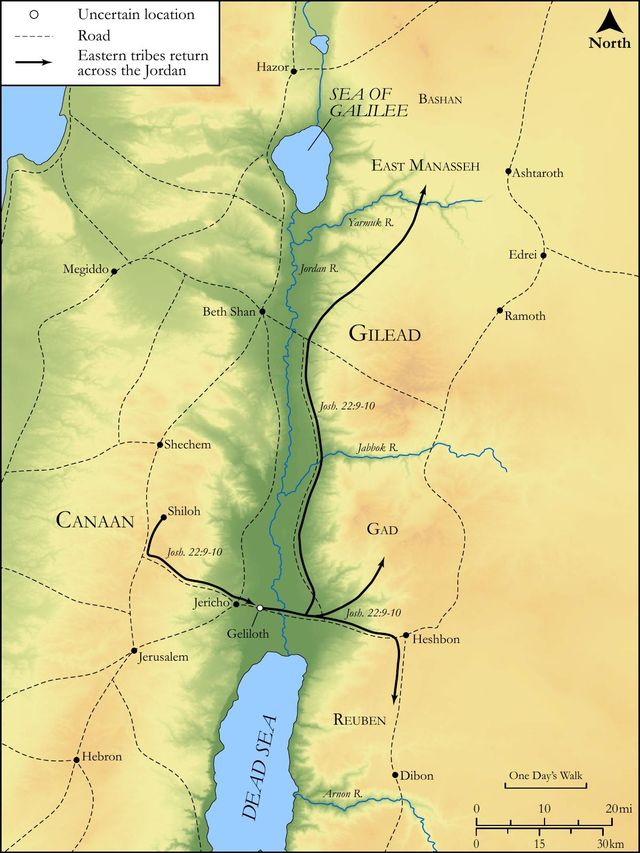
See on the biblical-era map
Study this verse
Continue studying Joshua 22:16 across the web’s major study libraries — every link below opens this exact verse, chapter, or book on the destination site.
Read & Compare
 BibleGatewayThis verse in more than 200 translations and 70 languages.
 Bible.comThe YouVersion reader — hundreds of translations, reading plans, and highlights.
 ESV.orgCrossway's official English Standard Version reader.
 NET BibleThe NET translation with 60,000+ translators' notes on every rendering decision.
 STEP BibleTyndale House's free study tool — original text, vocabulary, and scholarly resources.
 BibliaLogos Bible Software's free web reader.
 USCCBThe New American Bible (Revised Edition) with the U.S. bishops' study notes.
Commentaries
 BibleHub CommentariesDozens of classic commentaries on this verse, gathered on one page.
 StudyLightMore than 100 commentary sets — the largest collection on the web.
 BibleRefPlain-English commentary on what this verse means, verse by verse.
 Enduring WordDavid Guzik's free commentary on this chapter, widely used by Bible teachers.
 Bible Study ToolsVerse commentary alongside Greek and Hebrew study aids.
Original Language & Research
- BibleHub InterlinearThe verse word by word — original language, transliteration, and English.
- BibleHub LexiconEvery word's original-language definition and Strong's entry.
 Blue Letter BibleDeep-study tools — Strong's numbers, concordance, and word studies.
 SefariaThe Hebrew text with Rashi and centuries of Jewish commentary.
Sermons, Hymns & Audio


TrulyRandomVerse is not affiliated with these sites and doesn’t control their content. They’re linked because they’re genuinely useful.
Summary
Joshua 22:16 captures the intense accusation leveled by the western tribes of Israel against their eastern counterparts, Reuben, Gad, and the half-tribe of Manasseh. Upon their return to their inheritance east of the Jordan, these eastern tribes constructed a prominent altar, an act immediately perceived by the western tribes as a grave "trespass" and "rebellion" against the LORD. This verse articulates the profound concern of the "whole congregation of the LORD" that such an action would jeopardize the spiritual purity, covenant relationship, and very unity of the entire nation, potentially inviting severe divine judgment.
Context
ShowHideLiterary Context
Joshua 22:16 is situated within a critical narrative that marks the formal conclusion of Israel's conquest of Canaan and the subsequent division of the land. The eastern tribes, having faithfully fulfilled their commitment to assist their brethren in securing the promised land west of the Jordan, are now being honorably dismissed by Joshua to return to their own inheritance. Before crossing the Jordan River, however, they construct a large, conspicuous altar (as detailed in Joshua 22:10). This act, immediately reported to the western tribes, triggers an intense and severe reaction. The accusation articulated in this verse, delivered by a delegation led by Phinehas, the son of Eleazar the priest, sets the stage for a dramatic confrontation. The perceived transgression threatens the unity of the twelve tribes and their covenant relationship with God, leading to a near civil war that is only averted by the eastern tribes' subsequent explanation of their true, non-sacrificial intentions, as revealed later in the chapter (e.g., Joshua 22:28).
Historical & Cultural Context
The historical backdrop for this verse is the nascent period of Israelite settlement in Canaan, immediately following the conquest, and within the framework of the Mosaic Covenant established at Mount Sinai. A cornerstone of this covenant, particularly as reiterated in Deuteronomy, was the command for a single, centralized place of worship and sacrifice for the entire nation, initially the Tabernacle (at this time located in Shiloh), as explicitly prescribed in Deuteronomy 12:5-6. Building an altar outside this designated sanctuary was strictly forbidden, as it was seen as a direct violation of God's command, a potential gateway to idolatry, syncretistic practices, or unauthorized worship, all of which were anathema to Yahwistic monotheism. The western tribes' intense reaction, therefore, stems from a deep-seated fear of corporate judgment, a fear vividly reinforced by recent history, such as Achan's sin (Joshua 7), where one individual's disobedience brought severe consequences upon the entire nation. Their concern reflects a tribal and national identity inextricably linked to strict covenant fidelity.
Key Themes
ShowHideJoshua 22:16 powerfully underscores several key themes prevalent throughout the book of Joshua and the broader Deuteronomic history. Firstly, it highlights The Seriousness of Apostasy and Covenant Fidelity, revealing Israel's profound fear of "turning away from the LORD," which was considered the ultimate betrayal of their covenant with God and the gravest of sins. The building of an unauthorized altar was immediately interpreted as such a turning away. Secondly, it emphasizes Corporate Responsibility and Unity, demonstrating that the "whole congregation" felt a collective duty for the spiritual well-being of all tribes. The perceived sin of the eastern tribes was viewed as a direct threat to the entire nation's relationship with God and a potential trigger for divine wrath, thus necessitating a unified response to preserve the integrity of the covenant community. Thirdly, the narrative, ignited by this accusation, perfectly illustrates the dangers of Misunderstanding, Presumption, and Hasty Judgment, as the western tribes immediately assumed the worst intentions without seeking clarification. This presumption leads to significant inter-tribal tension and nearly results in civil war, underscoring the importance of communication within the community of faith. Finally, it showcases Zeal for God's Exclusivity and Purity of Worship, reflecting the Israelites' fervent commitment to worshiping the LORD alone and preventing any perceived deviation into idolatry or unauthorized religious practice, a constant struggle throughout Israel's history, as seen in subsequent narratives like 1 Kings 12:25-33.
Exposition and Analysis
ShowHideKey Word Analysis
ShowHideThis term (מַעַל, H4604) signifies an act of unfaithfulness, treachery, or a breach of trust, often specifically involving a violation against God or holy things. It implies a deliberate act of turning away from covenant obligations, a profound disloyalty that defiles the community and can incur divine wrath. In this context, it is a serious charge, suggesting a profound spiritual offense against the very nature of God's covenant and His exclusive right to worship.
The word (מִזְבֵּחַ, H4196) denotes a place of sacrifice, derived from a root meaning "to slaughter." In Israelite worship, altars were central to offering sacrifices to the LORD. The concern here is not the object itself, but its unauthorized construction outside the prescribed central sanctuary, which was perceived as a direct challenge to God's command for unified and exclusive worship.
This term (מָרַד, H4775) means to revolt, to be rebellious, or to renounce allegiance. In the context of Joshua 22:16, it strongly conveys the idea of defiance against established authority, specifically the divine authority of the LORD and His laws concerning proper worship. To "rebel" against the LORD is to challenge His sovereignty and reject His commands, an act of high treason in the covenant relationship, potentially leading to severe consequences.
Verse Breakdown
ShowHide"Thus saith the whole congregation of the LORD"
This opening phrase immediately establishes the gravity and authority of the accusation. It is not merely an individual or a few tribal leaders complaining, but a collective declaration from the entire unified body of Israel, indicating a shared, profound concern for covenant fidelity and national purity. This underscores the corporate nature of their faith and responsibility before God.
"What trespass [is] this that ye have committed against the God of Israel"
This is a powerful rhetorical question, functioning as a direct and forceful accusation rather than a genuine inquiry. The use of "trespass" (ma'al) immediately labels the eastern tribes' action as a profound act of unfaithfulness and sacrilege, a direct offense against the very God who delivered Israel from Egypt and established the covenant with them. It implies a betrayal of the most sacred relationship.
"to turn away this day from following the LORD"
This clause specifies the core nature of the perceived trespass: an immediate and deliberate act of apostasy. "Turning away" (shûwb) implies a conscious decision to abandon their loyalty and obedience to Yahweh, thereby breaking the foundational command of the covenant to follow Him alone and worship Him exclusively. The phrase "this day" emphasizes the perceived immediacy and decisiveness of their perceived defection.
"in that ye have builded you an altar, that ye might rebel this day against the LORD?"
This final clause identifies the specific action that triggered the accusation – the construction of an altar – and interprets its intent as an act of rebellion. The phrase "builded you an altar" (bânâh... mizbêach) is presented as the concrete evidence of their perceived defiance. The repetition of "this day" underscores the perceived audacity and present nature of their rebellion, linking the physical act of building the altar directly to a spiritual act of rebellion against God's exclusive authority and prescribed worship.
Literary Devices
ShowHideJoshua 22:16 masterfully employs several literary devices to convey the intense tension and gravity of the moment. The verse is framed as a Rhetorical Question, "What trespass [is] this... that ye might rebel...?", which is not posed to elicit information but to express a vehement accusation and condemnation. This rhetorical device emphasizes the outrage, certainty, and profound alarm of the western tribes in their judgment. There is also a strong element of Dramatic Irony, as the audience (and the eastern tribes themselves) knows the true, innocent, and even unifying purpose of the altar, while the western tribes remain tragically misinformed, creating suspense and highlighting the dangers of presumption. The repetition of phrases like "this day" and "against the LORD" serves as Emphasis, underscoring the perceived immediacy and direct affront to God's sovereignty and covenant. Furthermore, the strong language used by the western tribes, particularly the terms "trespass" and "rebel," might be seen as Hyperbole or exaggeration, reflecting their heightened fear and zealous commitment to God's law, which, though rooted in genuine concern for God's honor, leads them to jump to the worst possible conclusion.
Theological and Thematic Connections
ShowHideJoshua 22:16 powerfully illustrates the profound importance of covenant fidelity and the dangers of perceived apostasy within the Israelite community. The western tribes' reaction, though ultimately based on a misunderstanding, underscores the theological principle that God demands exclusive worship and that any deviation from His prescribed ways is considered a grave offense. This incident highlights the corporate nature of Israel's covenant with God: the sin of a few could bring judgment upon the many, fostering a deep sense of collective responsibility for maintaining national purity and preventing divine wrath. It also serves as a cautionary tale about the perils of hasty judgment and the vital need for clear, charitable communication within the community of faith, demonstrating how assumptions can lead to severe conflict and threaten the very unity God desires for His people. The zeal for God's honor, while commendable, must be tempered with wisdom, discernment, and a willingness to understand before condemning.
Reflection and Application
ShowHideThe intense confrontation depicted in Joshua 22:16 offers timeless lessons for believers today, particularly regarding community dynamics and conflict resolution. It serves as a potent reminder of the critical importance of seeking understanding and clarification before making accusations or passing judgment within the community of faith. Miscommunication, often fueled by assumptions, fear, and a lack of charity, can lead to serious conflict, division, and even animosity, even among those who share the same core beliefs and devotion to God. While a fervent commitment to upholding biblical truth and maintaining pure worship is commendable and necessary, this zeal must be exercised with discernment, humility, and a willingness to listen to and understand others' perspectives and intentions. The narrative underscores the interconnectedness of believers within the body of Christ, reminding us that the actions of one part can affect the whole, emphasizing the need for unity, accountability, and a spirit of grace, patience, and love in addressing perceived wrongs or differences. Our primary posture should be one of seeking to preserve the unity of the Spirit in the bond of peace, even as we contend for truth.
Questions for Reflection
ShowHideFAQ
ShowHideWhy were the western tribes so quick to assume the worst intentions from their brethren?
ShowHideThe western tribes' swift and severe reaction stemmed from a combination of deeply ingrained theological principles and recent historical experiences under the Mosaic Covenant. Firstly, they had a vivid and traumatic memory of Achan's sin (Joshua 7), where one man's transgression brought devastating corporate judgment—defeat in battle and the death of thirty-six Israelites—upon the entire nation. This instilled a profound fear of divine wrath for communal sin. Secondly, the Mosaic Law strictly prohibited building altars for sacrifice outside the designated central sanctuary, which at this time was the Tabernacle at Shiloh (see Deuteronomy 12:5-6). Any deviation from this command was seen as a direct act of apostasy, idolatry, or rebellion against the LORD, threatening the purity of their worship and their unique covenant relationship with God. Their intense zeal for God's exclusivity and their national identity as His chosen people led them to jump to the worst possible conclusion, prioritizing immediate confrontation over initial inquiry, driven by a desire to avert God's judgment.
What was the actual purpose of the altar built by the eastern tribes, if not for illicit sacrifice?
ShowHideAs revealed later in the narrative, specifically in the eastern tribes' defense found in Joshua 22:27-28, the altar was built not for illicit sacrifice, but as a "witness" (Hebrew: 'ed) between themselves and the western tribes. Their concern was that in future generations, their descendants, living across the Jordan River, might be perceived as separate from the main body of Israel and thus denied access to the central sanctuary and the LORD's worship. The altar was intended as a permanent, visible reminder and testimony that they, too, were part of the LORD's people, shared in His covenant, and had a right to worship at the central sanctuary. It was a monument to unity and a safeguard against future division, not an act of rebellion or a rival place of worship.
Does this story teach us anything about church unity or conflict resolution today?
ShowHideAbsolutely. The narrative of Joshua 22:16 and the ensuing resolution offers profound and enduring lessons for church unity and conflict resolution in any community of believers. It highlights the critical importance of clear, humble communication and the dangers of hasty judgment based on assumptions or incomplete information. The western tribes' initial reaction demonstrates how zeal, even for a righteous cause like upholding God's law, can lead to misunderstanding, suspicion, and division if not tempered with a spirit of inquiry, patience, and charity. The story underscores the need for believers to listen to one another, seek clarification, and prioritize understanding over immediate condemnation when disagreements or perceived offenses arise. It teaches that unity is preserved not by ignoring potential issues, but by addressing them directly, yet with patience, humility, and a commitment to seeking the truth and preserving the bonds of fellowship (Ephesians 4:2-3). It is a powerful reminder that love "believes all things, hopes all things" (as seen in 1 Corinthians 13:7) and seeks to understand before it judges.
Christ-Centered Fulfillment
ShowHideThe intense fear of "trespass" and "rebellion" against the LORD, so palpable in Joshua 22:16, finds its ultimate resolution and fulfillment in the person and work of Jesus Christ. The very problem of humanity's turning away from God, our inherent rebellion and unfaithfulness (as described in Romans 3:23), is addressed not by human altars or fearful accusations, but by the perfect, once-for-all sacrifice of the Lamb of God, who takes away the sin of the world). Jesus, as our Great High Priest, offered Himself on the cross, becoming the ultimate altar and the perfect atonement for our sins, thereby removing the corporate guilt and the threat of divine judgment that Israel so dreaded (as prophesied in Isaiah 53:5-6). He is the true "witness" (as seen in Revelation 1:5) who testifies to God's grace and brings all believers, regardless of their earthly divisions or perceived spiritual distances, into one unified body. Through His blood, Christ has broken down the dividing wall of hostility and created one new humanity, reconciling both Jew and Gentile to God in one body through the cross, thereby putting an end to the spiritual separation that the eastern tribes feared (as beautifully articulated in Ephesians 2:14-16). The zeal for God's purity, once expressed through strict adherence to the Law and fear of external altars, is now fulfilled in the spiritual purity and righteousness found only through faith in Christ, who makes us holy and blameless before God (Colossians 1:21-22). In Christ, we have eternal access to God, not through physical altars, but through His finished work, which perfectly addresses the rebellion of our hearts.