


Exodus 6:25
- וְאֶלְעָזָרve·'el·'a·Zarand EleazarH499Conj-w ¦ N-proper-mNoun Proper MasculineוְandאֶלְעָזָרEleazar
- בֶּןben[the] son ofH1121N-mscNoun Singular Masculine Construct
- אַהֲרֹן'a·ha·RonAaronH175N-proper-mNoun Proper Masculine
- לָקַחla·kachhe tookH3947V-Qal-Perf-3msVerb Qal Perfect 3rd Singular Masculine
- לוֹlofor <the> himselfPrep-l ¦ 3msSuffix Personal 3rd Singular Masculineלfor <the>וֹhimself
- מִבְּנוֹתmi·be·Notone of [the] daughters ofH1323Prep-m ¦ N-fpcNoun Plural Feminine Constructמִone ofבְּנוֹת[the] daughters of
- פּוּטִיאֵלpu·ti·'ElPutielH6317N-proper-mNoun Proper Masculine
- לוֹlofor <the> himselfPrep-l ¦ 3msSuffix Personal 3rd Singular Masculineלfor <the>וֹhimself
- לְאִשָּׁהle·'i·Shahto a wifeH802Prep-l ¦ N-fsNoun Singular Feminine Absoluteלְtoאִשָּׁהa wife
- וַתֵּלֶדva·Te·ledand she boreH3205Conj-w ¦ V-Qal-ConsecImperf-3fsVerb Qal Consecutive Imperfect 3rd Singular Feminineוַandתֵּלֶדshe bore
- לוֹloto <the> himPrep-l ¦ 3msSuffix Personal 3rd Singular Masculineלto <the>וֹhim
- אֶת'et<obj.>H853DirObjMParticle Object Indicator
- פִּינְחָסpin·ChasPhinehasH6372N-proper-mNoun Proper Masculine
- אֵלֶּה'E·lehtheseH428PrtParticle Demonstrative
- רָאשֵׁיra·Shei[were] [the] heads ofH7218N-mpcNoun Plural Masculine Construct
- אֲבוֹת'a·Vot[the] ancestors ofH1N-fpcNoun Plural Feminine Construct
- הַלְוִיִּםhal·vi·Yimthe LevitesH3881Art ¦ N-mpNoun Gentilic Plural Masculine AbsoluteהַtheלְוִיִּםLevites
- לְמִשְׁפְּחֹתָםle·mish·pe·cho·Tamto their clansH4940Prep-l ¦ N-fpc ¦ 3mpNoun Plural Feminine Constructלְtoמִשְׁפְּחֹתָclansםtheir
English is a literal word-by-word gloss of the Hebrew, not the KJV's wording. Why?
This is the original text the KJV's translators worked from — each Hebrew word with its own literal English meaning in this verse, prepared by scholars at Tyndale House, Cambridge. The KJV translates whole sentences, not word by word, so its wording differs: one Hebrew word can become several English words, and the KJV may choose “the LORD” where the gloss reads “Yahweh”. Both are faithful — they answer different questions. For the KJV's own rendering, switch to the KJV text.
Details
See on the biblical-era map
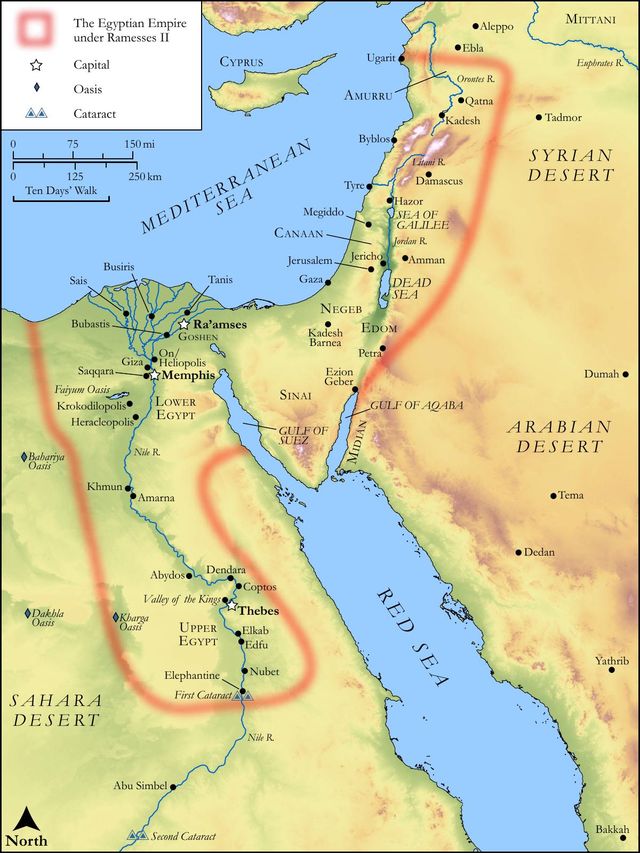
Study this verse
Public-domain commentary
Matthew Henry
From his Commentary on the Whole Bible. Henry comments on passages, not single verses — this entry covers Exodus 6:14–30. His two-level outline is real structure in the source text, so it is rendered as structure.
I.We have here a genealogy, not an endless one, such as the apostle condemns (Ti1 1:4), for it ends in those two great patriots Moses and Aaron, and comes in here to show that they were Israelites, bone of their bone and flesh of their flesh whom they were sent to deliver, raised up unto them of their brethren, as Christ also should be, who was to be the prophet and priest, the Redeemer and lawgiver, of the people of Israel, and whose genealogy also, like this, was to be carefully preserved. The heads of the houses of three of the tribes are here named, agreeing with the accounts we had, Gen. 46. Dr. Lightfoot thinks that Reuben, Simeon, and Levi, are thus dignified here by themselves for this reason, because they were left under marks of infamy by their dying father, Reuben for his incest and Simeon and Levi for their murder of the Shechemites; and therefore Moses would put this particular honour upon them, to magnify God's mercy in their repentance and remission, as a pattern to those that should afterwards believe: the two former seem rather to be mentioned only for the sake of a third, which was Levi, from whom Moses and Aaron descended, and all the priests of the Jewish church. Thus was the tribe of Levi distinguished betimes. Observe here, 1. That Kohath, from whom Moses and Aaron, and all the priests, derived their pedigree, was a younger son of Levi, Exo 6:16. Note, The grants of God's favours do not go by seniority of age and priority of birth, but the divine sovereignty often prefers the younger before the elder, so crossing hands. 2. That the ages of Levi, Kohath, and Amram, the father, grandfather, and great grandfather, of Moses, are here recorded; they all lived to a great age, Levi to 137, Kohath to 133, and Amram to 137. Moses himself came much short of them, and fixed seventy or eighty for the ordinary stretch of human life (Psa 90:10); for now that God's Israel was multiplied and had become a great nation, and divine revelation was by the hand of Moses committed to writing and no longer trusted to tradition, the two great reasons for the long lives of the patriarchs had ceased, and therefore henceforward fewer years must serve men. 3. That Aaron married Elisheba (the same name with that of the wife of Zecharias, Elizabeth, as Miriam is the same with Mary), daughter of Amminadab, one of the chief of the fathers of the tribe of Judah; for the tribes of Levi and Judah often intermarried, Exo 6:23. 4. It must not be omitted that Moses has recorded the marriage of his father Amram with Jochebed his own aunt (Exo 6:20); and it appears by Num 26:59 that it must be taken strictly for his father's own sister, at least by the half blood. This marriage was afterwards forbidden as incestuous (Lev 18:12), which might be looked upon as a blot upon his family, though before that law; yet Moses does not conceal it, for he sought not his own praise, but wrote with a sincere regard to truth, whether it smiled or frowned upon him. 5. He concludes it with a particular mark of honour on the persons he is writing of, though he himself was one of them, Exo 6:26, Exo 6:27. These are that Moses and Aaron whom God pitched upon to be his plenipotentiaries in this treaty. These were those to whom God spoke (Exo 6:26), and who spoke to Pharaoh on Israel's behalf, Exo 6:27. Note, Communion with God and serviceableness to his church are things that, above any other, put true honour upon men. Those are great indeed with whom God converses and whom he employs on his service. Such were that Moses and Aaron; and something of this honour have all his saints, who are made to our God kings and priests.
II.In the close of the chapter Moses returns to his narrative, from which he had broken off somewhat abruptly (Exo 6:13), and repeats,
1.The charge God had given him to deliver his message to Pharaoh (Exo 6:29): Speak all that I say unto thee, as a faithful ambassador. Note, Those that go on God's errand must not shun to declare the whole counsel of God.
2.His objection against it, Exo 6:30. Note, Those that have at any time spoken unadvisedly with their lips ought often to reflect upon it with regret, as Moses seems to do here.
Continue studying Exodus 6:25 across the web’s major study libraries — every link below opens this exact verse, chapter, or book on the destination site.
Read & Compare
 BibleGatewayThis verse in more than 200 translations and 70 languages.
 Bible.comThe YouVersion reader — hundreds of translations, reading plans, and highlights.
 ESV.orgCrossway's official English Standard Version reader.
 NET BibleThe NET translation with 60,000+ translators' notes on every rendering decision.
 STEP BibleTyndale House's free study tool — original text, vocabulary, and scholarly resources.
 BibliaLogos Bible Software's free web reader.
 USCCBThe New American Bible (Revised Edition) with the U.S. bishops' study notes.
Commentaries
 BibleHub CommentariesDozens of classic commentaries on this verse, gathered on one page.
 StudyLightMore than 100 commentary sets — the largest collection on the web.
 BibleRefPlain-English commentary on what this verse means, verse by verse.
 Enduring WordDavid Guzik's free commentary on this chapter, widely used by Bible teachers.
 Bible Study ToolsVerse commentary alongside Greek and Hebrew study aids.
Original Language & Research
- BibleHub InterlinearThe verse word by word — original language, transliteration, and English.
- BibleHub LexiconEvery word's original-language definition and Strong's entry.
 Blue Letter BibleDeep-study tools — Strong's numbers, concordance, and word studies.
 SefariaThe Hebrew text with Rashi and centuries of Jewish commentary.
Sermons, Hymns & Audio


TrulyRandomVerse is not affiliated with these sites and doesn’t control their content. They’re linked because they’re genuinely useful.
Summary
Exodus 6:25 serves as a crucial genealogical entry, meticulously documenting the marriage of Eleazar, son of Aaron, to a daughter of Putiel, and the subsequent birth of their son, Phinehas. This verse is not merely a record of lineage but a foundational statement, establishing Eleazar and Phinehas as "heads of the fathers of the Levites," thereby authenticating the divine order, succession, and authority within the Aaronic priesthood and the broader Levitical structure. It underscores the importance of an unbroken, divinely sanctioned line for sacred service.
Context
ShowHideLiterary Context
Exodus 6:25 is strategically positioned within a broader genealogical account in Exodus 6, which meticulously traces the lineages of Reuben, Simeon, and Levi. This detailed record is not incidental; it serves a profound purpose in authenticating the divine appointment of Moses and Aaron as leaders of Israel. By tracing their ancestry back to Levi, the text establishes their tribal legitimacy. Crucially, this verse, by focusing on Eleazar and Phinehas, specifically establishes the sacred lineage of the high priesthood through Aaron's direct descendants, a line that would later be extensively elaborated upon in laws concerning priestly service and succession, such as those found in Exodus 28 and Numbers 3. This specific entry ensures the continuity and legitimacy of the priestly branch of the Levites, vital for the future worship system.
Historical & Cultural Context
In ancient Israelite society, genealogies held immense significance, serving as legal documents, proof of tribal affiliation, and validation of claims to land, inheritance, or, most importantly, sacred office. The priesthood, specifically the Aaronic line, was divinely ordained to mediate between God and Israel, offering sacrifices and administering the covenant. Therefore, the purity and verifiable nature of the priestly lineage were paramount to maintain the sanctity and authority of their role. Marriage within or between specific families was often strategically important for maintaining status and continuity. The mention of Putiel, whose name has been debated as possibly having Egyptian roots, subtly highlights the complex cultural landscape of the Israelites emerging from Egypt and the potential for diverse backgrounds to be integrated into the community, even within the sacred priestly line, under divine providence.
Key Themes
ShowHideThis verse contributes to several overarching themes within Exodus and the Pentateuch. Primarily, it reinforces the theme of Divine Election and Appointment, showing God's meticulous selection of specific individuals and families for sacred service, particularly the Aaronic priesthood. It also highlights the Continuity of Covenantal Promises and Sacred Office, ensuring an unbroken line of those authorized to minister before God, crucial for the stability of Israel's religious life. The inclusion of Phinehas, who would later demonstrate profound zeal for God's honor in Numbers 25, subtly foreshadows the importance of Faithfulness and Zeal within the priestly line, a quality that would secure a perpetual covenant of peace for his descendants (Numbers 25:13). Finally, the detailed genealogical record underscores God's Meticulous Order and Providence in orchestrating the details of His people's structure and leadership.
Exposition and Analysis
ShowHideKey Word Analysis
ShowHideThis word signifies not merely a physical head but carries the weighty meaning of chief, principal, or leader. In this context, it designates Eleazar and Phinehas as the foundational and leading figures of their respective family branches within the Levites, indicating their authority and prominence in the tribal and priestly structure.
Beyond its literal meaning of a male parent, 'fathers' here extends to progenitors, ancestors, or even the founders of a lineage or clan. When combined with "heads," it emphasizes their role as patriarchal figures from whom significant Levitical families would descend, establishing their foundational status.
This term refers to a circle of relatives, a clan, or a subdivision of a tribe. Its use here highlights the organized, structured nature of the Levitical tribe, indicating that Eleazar and Phinehas were not just individuals but the recognized leaders of distinct, significant family units within the larger Levitical framework, each with specific duties in the tabernacle service.
Verse Breakdown
ShowHide"And Eleazar Aaron's son took him [one] of the daughters of Putiel to wife"
This clause establishes the marriage of Eleazar, Aaron's second son, who was destined to succeed Aaron as High Priest (Numbers 20:28). The identity of his wife is given only through her father, Putiel. While Putiel's background is not detailed, the name itself (H6317, Pûwṭîyʼêl) is of uncertain derivation, with some scholars suggesting an Egyptian origin, possibly meaning "afflicted of God" or "God is my bow." This detail, though brief, signifies the specific familial connection that would produce a crucial figure in Israelite history, highlighting God's sovereign hand in orchestrating even the seemingly minor details of His plan.
"and she bare him Phinehas"
This simple statement records the birth of Phinehas (H6372, Pîynᵉchâç), who would later become a prominent and zealous figure in Israel's history, renowned for his decisive action to halt a plague and his fervent defense of God's honor (Numbers 25:7-13). His inclusion here is significant, marking the continuation of the priestly line through a son who would prove himself worthy of the covenant of perpetual priesthood.
"these [are] the heads of the fathers of the Levites according to their families"
This concluding phrase underscores the authoritative and foundational status of Eleazar and Phinehas within the broader Levitical tribe. The term "heads of the fathers" (H7218 rôʼsh and H1 ʼâb) signifies their role not merely as individuals but as progenitors and leading figures of significant family branches (H4940 mishpâchâh), responsible for the sacred service and maintenance of the tabernacle. This meticulous genealogical record serves to validate the divine appointment and succession of the priestly office, ensuring order and legitimacy in the worship of God.
Literary Devices
ShowHideThe primary literary device at play in Exodus 6:25 is Genealogy. This verse functions as a Structural Marker within the broader genealogical list of Exodus 6, specifically highlighting the lineage of Aaron and his sons. By meticulously recording the succession, the text establishes legitimacy and continuity for the Aaronic priesthood, which is central to Israel's covenant relationship with God. The mention of Phinehas, even at this early stage, also serves as a subtle form of Foreshadowing, hinting at his future prominence and the significant role he will play in Israel's history, particularly his zealous act that secures a perpetual priesthood for his descendants. The precise naming of individuals and their familial connections underscores the Precision and Deliberation of God's plan for His people.
Theological and Thematic Connections
ShowHideExodus 6:25, while a concise genealogical entry, carries profound theological weight, underscoring God's meticulous design for the sacred order of His people. The careful recording of Eleazar's marriage and the birth of Phinehas highlights the divine emphasis on lineage for the Aaronic priesthood, ensuring that those who ministered before God were divinely appointed and properly consecrated. This continuity was essential for maintaining the purity of worship and the integrity of the covenant. It demonstrates that God's plan unfolds through specific individuals and families, chosen and prepared for their roles, emphasizing the importance of heritage and succession in His redemptive purposes.
Reflection and Application
ShowHideWhile Exodus 6:25 might seem like a mere historical footnote, it offers profound insights for contemporary believers. This verse reminds us that God's grand design for salvation and worship unfolds through specific individuals and families, meticulously chosen and prepared for their roles across generations. Just as Eleazar and Phinehas were integral to the continuity of the Aaronic priesthood, believers today are called to faithfulness within their own spheres of influence, contributing to the ongoing work of God's kingdom. Our lives are part of a larger, divinely orchestrated narrative, where each generation builds upon the foundation laid by the last, ensuring the continuation of God's purposes. This passage encourages us to value our spiritual heritage, recognizing that our individual stories are woven into the magnificent tapestry of God's redemptive history. It challenges us to live with intentionality, understanding that our faithfulness today impacts the spiritual legacy we leave for future generations, just as the lineage of Eleazar and Phinehas secured the priestly future for Israel.
Questions for Reflection
ShowHideFAQ
ShowHideWhy are genealogies so important in the Bible, especially for the priesthood?
ShowHideGenealogies in the Bible serve several crucial purposes. They establish historical accuracy, demonstrate God's faithfulness in fulfilling promises across generations, and, particularly for the priesthood, they authenticate the legitimacy and divine appointment of individuals to sacred office. For the Aaronic priesthood, a precise lineage was essential to ensure that only those divinely designated could serve, maintaining the purity and order of worship. This meticulous record, as seen in Exodus 6, provided undeniable proof of an individual's right to serve in such a holy capacity, ensuring the proper functioning of the sacrificial system and the covenant relationship.
Who was Putiel, and why is his daughter mentioned in the priestly lineage?
ShowHidePutiel is mentioned only here in Exodus 6:25 as the father-in-law of Eleazar and grandfather of Phinehas. His exact identity and background are not elaborated upon in Scripture, and the etymology of his name (H6317, Pûwṭîyʼêl) is debated, possibly having non-Israelite or Egyptian roots. The mention of his daughter, though brief, highlights God's sovereignty in orchestrating even the seemingly minor details of His plan, including the specific familial connections within the priestly line. It also subtly suggests the potential for individuals from diverse backgrounds to be integrated into God's chosen people, even at the highest levels of sacred service, demonstrating that God's purposes transcend narrow human distinctions.
Christ-Centered Fulfillment
ShowHideThe meticulous genealogical record of the Aaronic priesthood, exemplified by Eleazar and Phinehas in Exodus 6:25, powerfully foreshadows the ultimate and eternal High Priesthood of Jesus Christ. While the Levitical priests served through a succession of generations, their ministry was temporary, limited by death, and imperfect, requiring repeated sacrifices for sin. This constant need for succession and atonement pointed to the necessity of a perfect sacrifice and a permanent mediator. Christ, however, is the High Priest "after the order of Melchizedek" (Hebrews 7:17), whose priesthood is not dependent on human descent or succession but on the power of an indestructible life (Hebrews 7:16). He offered a single, perfect sacrifice for sins "once for all" (Hebrews 10:10), eternally cleansing sin and providing direct access to God for all who believe. Thus, the Levitical lineage, with its emphasis on continuity and legitimacy, ultimately finds its complete and perfect fulfillment in Christ, who establishes a new and better covenant (Hebrews 8:6) through His eternal priestly ministry.