


Genesis 29:34
- וַתַּהַרva·Ta·harand she conceivedH2029Conj-w ¦ V-Qal-ConsecImperf-3fsVerb Qal Consecutive Imperfect 3rd Singular Feminineוַandתַּהַרshe conceived
- עוֹד'OdagainH5750Adj-msAdjective Numerical Singular Masculine Absolute
- וַתֵּלֶדva·Te·ledand she boreH3205Conj-w ¦ V-Qal-ConsecImperf-3fsVerb Qal Consecutive Imperfect 3rd Singular Feminineוַandתֵּלֶדshe bore
- בֵּןbena sonH1121N-msNoun Singular Masculine Absolute
- וַתֹּאמֶרva·To·merand she saidH559Conj-w ¦ V-Qal-ConsecImperf-3fsVerb Qal Consecutive Imperfect 3rd Singular Feminineוַandתֹּאמֶרshe said
- עַתָּה'a·TahnowH6258AdvAdverb
- הַפַּעַםha·Pa·'amthis timeH6471Art ¦ N-fsNoun Singular Feminine Absoluteהַthisפַּעַםtime
- יִלָּוֶהyi·la·Vehhe will join himselfH3867V-Niphal-Imperf-3msVerb Niphal Imperfect 3rd Singular Masculine
- אִישִׁי'i·Shimy husbandH376N-msc ¦ 1csNoun Singular Masculine Constructאִישִׁhusbandיmy
- אֵלַי'e·Laito meH413Prep ¦ 1csPreposition Definiteאֵלַtoיme
- כִּיkiforH3588PrtParticle Conditional
- יָלַדְתִּיya·Lad·tiI have borneH3205V-Qal-Perf-1csVerb Qal Perfect 1st Singular common gender
- לוֹloto <the> himPrep-l ¦ 3msSuffix Personal 3rd Singular Masculineלto <the>וֹhim
- שְׁלֹשָׁהshe·lo·ShahthreeH7969Adj-csAdjective Numerical Singular common gender Absolute
- בָנִיםva·NimsonsH1121N-mpNoun Plural Masculine Absolute
- עַל'althere-H5921PrepPreposition
- כֵּןken-foreH3651AdvAdverb
- קָרָאka·ra'he calledH7121V-Qal-Perf-3msVerb Qal Perfect 3rd Singular Masculine
- שְׁמוֹshe·Mohis nameH8034N-msc ¦ 3msNoun Singular Masculine Constructשְׁמnameוֹhis
- לֵוִיle·ViLeviH3878N-proper-mNoun Proper Masculine
English is a literal word-by-word gloss of the Hebrew, not the KJV's wording. Why?
This is the original text the KJV's translators worked from — each Hebrew word with its own literal English meaning in this verse, prepared by scholars at Tyndale House, Cambridge. The KJV translates whole sentences, not word by word, so its wording differs: one Hebrew word can become several English words, and the KJV may choose “the LORD” where the gloss reads “Yahweh”. Both are faithful — they answer different questions. For the KJV's own rendering, switch to the KJV text.
Details
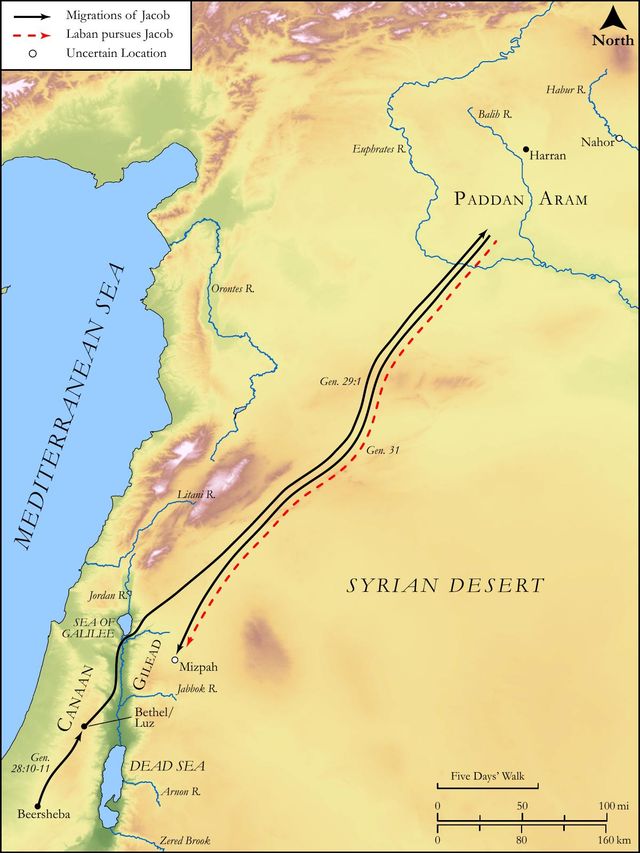
See on the biblical-era map


Study this verse
Public-domain commentary
Matthew Henry
From his Commentary on the Whole Bible. Henry comments on passages, not single verses — this entry covers Genesis 29:31–35.
We have here the birth of four of Jacob's sons, all by Leah. Observe, 1. That Leah, who was less beloved, was blessed with children, when Rachel was denied that blessing, Gen 29:31. See how Providence, in dispensing its gifts, observes a proportion, to keep the balance even, setting crosses and comforts one over-against another, that none may be either too much elevated or too much depressed. Rachel wants children, but she is blessed with her husband's love; Leah wants that, but she is fruitful. Thus it was between Elkana's two wives (Sa1 1:5); for the Lord is wise and righteous. When the Lord saw that Leah was hated, that is, loved less than Rachel, in which sense it is required that we hate father and mother, in comparison with Christ (Luk 14:26), then the Lord granted her a child, which was a rebuke to Jacob, for making so great a difference between those that he was equally related to, - a check to Rachel, who perhaps insulted over her sister upon that account, - and a comfort to Leah, that she might not be overwhelmed with the contempt put upon her: thus God giveth abundant honour to that which lacked, Co1 12:24. 2. The names she gave her children were expressive of her respectful regards both to God and to her husband. (1.) She appears very ambitious of her husband's love: she reckoned the want of it her affliction (Gen 29:32); not upbraiding him with it as his fault, nor reproaching him for it, and so making herself uneasy to him, but laying it to heart as her grief, which yet she had reason to bear with the more patience because she herself was consenting to the fraud by which she became his wife; and we may well bear that trouble with patience which we bring upon ourselves by our own sin and folly. She promised herself that the children she bore him would gain her the interest she desired in his affections. She called her first-born Reuben (see a son), with this pleasant thought, Now will my husband love me; and her third son Levi (joined), with this expectation, Now will my husband by joined unto me, Gen 29:34. Mutual affection is both the duty and comfort of that relation; and yoke-fellows should study to recommend themselves to each other, Co1 7:33, Co1 7:34. (2.) She thankfully acknowledges the kind providence of God in it: The Lord hath looked upon my affliction, Gen 29:32. "The Lord hath heard, that is, taken notice of it, that I was hated (for our afflictions, as they are before God's eyes, so they have a cry in his ears), he has therefore given me this son." Note, Whatever we have that contributes either to our support and comfort under our afflictions or to our deliverance from them, God must be owned in it, especially his pity and tender mercy. Her fourth she called Judah (praise), saying, Now will I praise the Lord, Gen 29:35. And this was he of whom, as concerning the flesh, Christ came. Note, [1.] Whatever is the matter of our rejoicing ought to be the matter of our thanksgiving. Fresh favours should quicken us to praise God for former favours. Now will I praise the Lord more and better than I have done. [2.] All our praises must centre in Christ, both as the matter of them and as the Mediator of them. He descended from him whose name was praise, for he is our praise. Is Christ formed in my heart? Now will I praise the Lord.
Historical interpretation
Historical reception
1 surviving comment on this verse from the historical church.
(Verse 34) And she conceived again, and bore a son, and said: Now my husband will be with me, because I have borne him three sons: therefore she called his name Levi. When we read, 'My husband will be with me,' Aquila interpreted it as, 'My husband will be attached to me,' which is the Hebrew word (), Illave. And among the Hebrew doctors, it is translated differently, so that they say, 'My husband will follow me,' that is, I have no doubt about the love of my husband for me: he will be my companion in this life, and his affection will lead me to death, and he will follow me: for I have borne him three sons.
Continue studying Genesis 29:34 across the web’s major study libraries — every link below opens this exact verse, chapter, or book on the destination site.
Read & Compare
 BibleGatewayThis verse in more than 200 translations and 70 languages.
 Bible.comThe YouVersion reader — hundreds of translations, reading plans, and highlights.
 ESV.orgCrossway's official English Standard Version reader.
 NET BibleThe NET translation with 60,000+ translators' notes on every rendering decision.
 STEP BibleTyndale House's free study tool — original text, vocabulary, and scholarly resources.
 BibliaLogos Bible Software's free web reader.
 USCCBThe New American Bible (Revised Edition) with the U.S. bishops' study notes.
Commentaries
 BibleHub CommentariesDozens of classic commentaries on this verse, gathered on one page.
 StudyLightMore than 100 commentary sets — the largest collection on the web.
 BibleRefPlain-English commentary on what this verse means, verse by verse.
 Enduring WordDavid Guzik's free commentary on this chapter, widely used by Bible teachers.
 Bible Study ToolsVerse commentary alongside Greek and Hebrew study aids.
Original Language & Research
- BibleHub InterlinearThe verse word by word — original language, transliteration, and English.
- BibleHub LexiconEvery word's original-language definition and Strong's entry.
 Blue Letter BibleDeep-study tools — Strong's numbers, concordance, and word studies.
 SefariaThe Hebrew text with Rashi and centuries of Jewish commentary.
Sermons, Hymns & Audio


TrulyRandomVerse is not affiliated with these sites and doesn’t control their content. They’re linked because they’re genuinely useful.
Summary
Genesis 29:34 chronicles the birth of Levi, Leah's third son by Jacob, whose name profoundly expresses her earnest desire for Jacob to be emotionally "joined" to her. This poignant moment illuminates the intricate and often painful family dynamics, Leah's deep yearning for affection and acceptance, and the overarching divine sovereignty at work in establishing the foundational tribes of Israel amidst human struggle and unfulfilled desires.
Context
ShowHideLiterary Context
This verse is deeply embedded within the complex and emotionally charged narrative of Jacob's family, specifically the rivalry between his two wives, Leah and Rachel. Jacob's profound love for Rachel, and his deception by Laban into marrying Leah first, sets the stage for Leah's ongoing struggle for affection. The preceding verses detail Leah's first two sons, Reuben and Simeon, whose names similarly reflect her emotional state and her perception of God's intervention in her suffering. The birth of Levi continues this pattern, with Leah's naming choice revealing her persistent longing for Jacob's love and acceptance, a theme that will continue to unfold in the subsequent births of her children.
Historical & Cultural Context
In ancient Near Eastern patriarchal societies, a woman's status and security were often tied to her ability to bear children, especially sons, for her husband. Polygamy, though not ideal, was practiced, often leading to intense rivalry among wives, particularly concerning the husband's affection and the birth order of heirs. Naming conventions were highly significant; names were not mere labels but often encapsulated the circumstances of birth, parental hopes, or even prophetic insights. Leah's repeated naming of her sons to reflect her emotional state and her relationship with Jacob and God is a prime example of this cultural practice, highlighting the profound personal and theological weight attached to names.
Key Themes
ShowHideGenesis 29:34 contributes significantly to several overarching themes within the book of Genesis and the broader biblical narrative. It underscores the theme of divine sovereignty working through human brokenness, as God's plan to build a nation unfolds despite Jacob's dysfunctional family life and Leah's personal sorrow. The verse also highlights the significance of naming as a reflection of personal experience and theological understanding, a pattern seen throughout the patriarchal narratives, from Adam's naming of Eve to Abraham's naming of Isaac. Furthermore, it emphasizes the human longing for love and belonging, a universal desire that Leah's story poignantly illustrates, foreshadowing humanity's ultimate need for union with God.
Exposition and Analysis
ShowHideGenesis 29:34 marks a pivotal moment in Leah's personal journey and the unfolding of Israel's tribal history. With the birth of her third son, Levi, Leah articulates a profound desire for emotional intimacy and acceptance from Jacob.
Key Word Analysis
ShowHideFrom the primitive root H3867, meaning "to twine," "to unite," or "to remain." In this context, Leah uses it to express her fervent hope that Jacob would become emotionally attached or united to her, moving beyond mere physical cohabitation to a deeper, relational bond. This word encapsulates her yearning for affection and belonging within her marriage.
Derived directly from the root lâvâh, meaning "attached." The name itself is an etymological explanation of Leah's hope. It signifies her expectation that, having borne Jacob three sons, she would finally secure his affection and he would be "attached" to her in a meaningful way.
Referring to a man as an individual or a male person, often used as an adjunct to a more definite term. Here, it emphasizes Jacob's role as her spouse, highlighting the specific relational bond Leah desires to strengthen. Her hope is not for a generic man to be joined to her, but for her husband, Jacob, to reciprocate her affection.
Verse Breakdown
ShowHide"And she conceived again, and bare a son;"
This clause succinctly describes the continuation of God's blessing upon Leah, as He had opened her womb while Rachel remained barren. It signifies the ongoing fulfillment of God's promise to multiply Jacob's offspring, even amidst the family's internal strife.
"and said, Now this time will my husband be joined unto me,"
This is the heart of Leah's emotional expression. The phrase "Now this time" (Hebrew, paʻam) emphasizes her renewed, perhaps desperate, hope. Her declaration reveals her deep longing for Jacob to move beyond his favoritism for Rachel and to genuinely connect with her, to be "joined" to her in affection and commitment, now that she had given him three sons.
"because I have born him three sons:"
This provides Leah's rationale for her hope. In her cultural context, bearing sons was a significant contribution to the family's legacy and a source of honor. She believes that her consistent fruitfulness, particularly in providing three male heirs, should finally earn her husband's love and loyalty. This highlights her continued reliance on external circumstances to gain Jacob's affection.
"therefore was his name called Levi."
This final clause directly links the name of the son to Leah's expressed hope. The name "Levi" (meaning "joined" or "attached") serves as a perpetual reminder of Leah's earnest prayer and desire for a deeper bond with Jacob, encapsulating the emotional landscape of her life at this moment.
Literary Devices
ShowHideThe narrative employs several literary devices to convey its profound meaning. Etymological Naming is central, as the name "Levi" is directly explained by Leah's hope that Jacob would be "joined" to her. This device highlights the personal significance of the name and Leah's emotional state. There is also a clear Repetition and Pattern in Leah's naming of her first three sons (Reuben, Simeon, Levi), each name reflecting her evolving prayers and desires concerning Jacob's affection and God's intervention. Furthermore, the verse contains a subtle Foreshadowing; while Leah's hope is for a personal "joining" with Jacob, the tribe of Levi would later be uniquely "joined" to the service of God, fulfilling a much grander, communal, and sacred purpose that transcends Leah's immediate desire. This also introduces an element of Irony, where Leah's deeply personal and somewhat desperate longing for human affection is, in God's sovereign plan, repurposed to establish a tribe dedicated to divine service.
Theological and Thematic Connections
ShowHideLeah's naming of Levi underscores the profound theological truth that God's sovereign plan unfolds even amidst human imperfection, personal sorrow, and relational brokenness. Her unfulfilled longing for Jacob's affection, while deeply human, is ultimately redeemed and repurposed by God for a greater, divine purpose. The very name "Levi," born out of a desire for human attachment, foreshadows a sacred "joining" to God through the dedicated service of the Levites, who would mediate between God and His people, demonstrating how divine purpose can transcend and transform human desire.
Reflection and Application
ShowHideLeah's story in Genesis 29:34 offers a poignant reflection on the universal human quest for love, acceptance, and belonging. Her persistent efforts to earn Jacob's affection through bearing children highlight a common human tendency to seek validation and fulfillment in external circumstances, relationships, or achievements. This narrative serves as a powerful reminder that while human relationships are vital and God-given, they can never fully satisfy the deepest longings of the heart. True and lasting fulfillment, the ultimate "joining" or attachment, is found in our relationship with God, who alone can perfectly love, accept, and satisfy us. Our personal desires, even those born of pain and longing, can be redeemed and repurposed by God for His glory and the good of His kingdom, just as Levi's personal name foreshadowed a communal, sacred calling. We are invited to bring our unfulfilled longings to God, trusting that He can transform them into pathways for His divine purpose.
Questions for Reflection
ShowHideFAQ
ShowHideWhy did Leah name her son Levi?
ShowHideLeah named her son Levi because she hoped that by bearing Jacob a third son, her husband would finally be "joined" or "attached" to her emotionally and relationally, rather than solely favoring Rachel, who was Jacob's preferred wife, as seen in Genesis 29:30.
What does the Hebrew name Levi mean?
ShowHideThe Hebrew name Levi (לֵוִי) is derived from the verb lavah (לָוָה), meaning "to join," "to attach," or "to accompany." It directly reflects Leah's desire for Jacob to be emotionally united with her.
How did the tribe of Levi become distinct in Israel?
ShowHideWhile Levi's name initially reflected Leah's personal hope for a human bond, his descendants, the Levites, were later uniquely consecrated by God for sacred service in the Tabernacle and Temple. They were "joined" to the service of God and His worship, fulfilling a deeper, communal, and spiritual meaning of their patriarch's name as the priestly tribe of Israel, as detailed in Numbers 3:5-13.
Christ-Centered Fulfillment
ShowHideLeah's profound longing to be "joined" to her husband, Jacob, finds its ultimate fulfillment and perfect resolution in Christ. Her personal yearning for acceptance and belonging mirrors humanity's deepest spiritual need to be reconciled and "joined" to God. The Levites, descendants of Levi, served as mediators between God and His people, pointing forward to Jesus Christ, who is the true and perfect High Priest according to the order of Melchizedek, as described in Hebrews 7:11-28. He is the ultimate Mediator of a new and better covenant, established not by the blood of animals but by His own precious blood, as proclaimed in Hebrews 9:15. In Christ, believers are not merely "joined" by human affection or ritual, but are spiritually united to God through faith, becoming part of His body, His very flesh and bones, as beautifully articulated in Ephesians 5:30-32. This union with Christ offers a perfect, eternal belonging that fully satisfies the soul's deepest longing for love, acceptance, and an unbreakable bond with the Creator.