


Genesis 25:21
Bible text: King James Version (1769 Blayney text) · Public domain
Bible text: Berean Standard Bible · Public domain
Bible text: American Standard Version (1901) · Public domain
Bible text: World English Bible, Messianic edition · Public domain
Bible text: Geneva Bible (1599) · Public domain
Bible text: Young's Literal Translation · Public domain
- וַיֶּעְתַּרvai·ye'·Tarand he prayedH6279Conj-w ¦ V-Qal-ConsecImperf-3msVerb Qal Consecutive Imperfect 3rd Singular Masculineוַandיֶּעְתַּרhe prayed
- יִצְחָקyitz·ChakIsaacH3327N-proper-mNoun Proper Masculine
- לַיהוָהla·Yah·wehto YahwehH3068Prep-l ¦ N-properNoun Proper TitleלַtoיהוָהYahweh
- לְנֹכַחle·No·khachto beforeH5227Prep-l ¦ Adj-mscAdjective Numerical Singular Masculine Constructלְtoנֹכַחbefore
- אִשְׁתּוֹ'ish·Tohis wifeH802N-fsc ¦ 3msNoun Singular Feminine Constructאִשְׁתּwifeוֹhis
- כִּיkiforH3588PrtParticle Conditional
- עֲקָרָה'a·ka·Rah[was] barrenH6135Adj-fsAdjective Singular Feminine Absolute
- הִואhi'sheH1931Pro-3fsPronoun Personal 3rd Singular Feminine
- וַיֵּעָתֶרvai·ye·'A·terand he was entreatedH6279Conj-w ¦ V-Niphal-ConsecImperf-3msVerb Niphal Consecutive Imperfect 3rd Singular Masculineוַandיֵּעָתֶרhe was entreated
- לוֹloby <the> himPrep-l ¦ 3msSuffix Personal 3rd Singular Masculineלby <the>וֹhim
- יְהוָהYah·wehYahwehH3068N-properNoun Proper Title
- וַתַּהַרva·Ta·harand she conceivedH2029Conj-w ¦ V-Qal-ConsecImperf-3fsVerb Qal Consecutive Imperfect 3rd Singular Feminineוַandתַּהַרshe conceived
- רִבְקָהriv·KahRebekahH7259N-proper-fNoun Proper Feminine
- אִשְׁתּוֹ'ish·Tohis wifeH802N-fsc ¦ 3msNoun Singular Feminine Constructאִשְׁתּwifeוֹhis
English is a literal word-by-word gloss of the Hebrew, not the KJV's wording. Why?
This is the original text the KJV's translators worked from — each Hebrew word with its own literal English meaning in this verse, prepared by scholars at Tyndale House, Cambridge. The KJV translates whole sentences, not word by word, so its wording differs: one Hebrew word can become several English words, and the KJV may choose “the LORD” where the gloss reads “Yahweh”. Both are faithful — they answer different questions. For the KJV's own rendering, switch to the KJV text.
Details
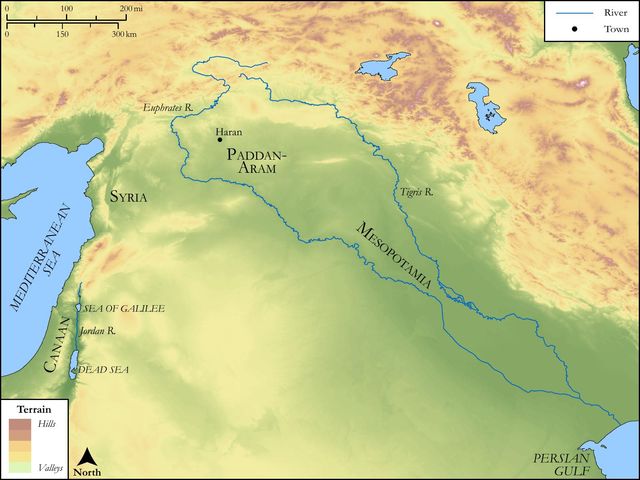
See on the biblical-era maps


Study this verse
Public-domain commentary
Matthew Henry
From his Commentary on the Whole Bible. Henry comments on passages, not single verses — this entry covers Genesis 25:19–28. His four-level outline is real structure in the source text, so it is rendered as structure.
We have here an account of the birth of Jacob and Esau, the twin sons of Isaac and Rebekah: their entrance into the world was (which is not usual) one of the most considerable parts of their story; nor is much related concerning Isaac but what had reference to his father while he lived and to his sons afterwards. For Isaac seems not to have been a man of action, nor much tried, but to have spent his days in quietness and silence. Now concerning Jacob and Esau we are here told,
I.That they were prayed for.
Their parents, after they had been long childless, obtained them by prayer, Gen 25:20, Gen 25:21. Isaac was forty years old when he was married; though he was an only son, and the person from whom the promised seed was to come, yet he made no haste to marry. He was sixty years old when his sons were born (Gen 25:26), so that, after he was married, he had no child for twenty years. Note, Though the accomplishment of God's promise is always sure, yet it is often slow, and seems to be crossed and contradicted by Providence, that the faith of believers may be tried, their patience exercised, and mercies long waited for may be the more welcome when they come. While this mercy was delayed, Isaac did not approach to a handmaid's bed, as Abraham had done, and Jacob afterwards; for he loved Rebekah, Gen 24:67. But,
1.He prayed: he entreated the Lord for his wife. Though God had promised to multiply his family, he prayed for its increase; for God's promises must not supersede, but encourage, our prayers, and be improved as the ground of our faith. Though he had prayed for this mercy very often, and had continued his supplication many years, and it was not granted, yet he did not leave off praying for it; for men ought always to pray, and not to faint (Luk 18:1), to pray without ceasing, and knock till the door be opened, He prayed for his wife; some read it with his wife. Note, Husbands and wives should pray together, which is intimated in the apostle's caution, that their prayers be not hindered, Pe1 3:7. The Jews have a tradition that Isaac, at length, took his wife with him to mount Moriah, where God had promised that he would multiply Abraham's seed (ch. 22:17), and there, in his prayer with her and for her, pleaded the promise made in that very place.
2.God heard his prayer, and was entreated of him. Note, Children are the gift of God. Those that continue instant in prayer, as Isaac did, shall find, at last, that they did not seek in vain, Isa 45:19.
II.That they were prophesied of before they were born, and great mysteries were wrapped up in the prophecies which went before of them, Gen 25:22, Gen 25:23. Long had Isaac prayed for a son; and now his wife is with child of two, to recompense him for his long waiting. Thus God often outdoes our prayers, and gives more than we are able to ask or think. Now Rebekah being with child of these two sons, observe here,
1.How she was perplexed in her mind concerning her present case: The children struggled together within her. The commotion she felt was altogether extraordinary and made her very uneasy. Whether she was apprehensive that the birth would be her death, or whether she was weary of the intestine tumult, or whether she suspected it to be an ill omen, it seems she was ready to wish that either she had not been with child or that she might die immediately, and not bring forth such a struggling brood: If it be so, or, since it is so, Why am I thus? Before, the want of children was her trouble, now, the struggle of the children is no loss so. Note,
(1.)The comforts we are most desirous of are sometimes found to bring along with them more occasion of trouble and uneasiness that we thought of; vanity being written upon all things under the sun, God thus teaches us to read it.
(2.)We are too apt to be discontented with our comforts, because of the uneasiness that attends them. We know not when we are pleased; we know neither how to want nor how to abound. This struggle between the kingdom of God and the kingdom of Satan,
[1.]In the world. The seed of the woman and the seed of the serpent have been contending ever since the enmity was put between them (Gen 3:15), and this has occasioned a constant uneasiness among men. Christ himself came to send fire on earth, and this division, Luk 12:49, Luk 12:51. But let not this be offence to us. A holy war is better than the peace of the devil's palace.
[2.]In the hearts of believers. No sooner is Christ formed in the soul than immediately there begins a conflict between the flesh and spirit, Gal 5:17. The stream is not turned without a mighty struggle, which yet ought not to discourage us. It is better to have a conflict with sin than tamely to submit to it.
2.What course she took for her relief: She went to enquire of the Lord. Some think Melchizedek was now consulted as an oracle, or perhaps some Urim or Teraphim were now used to enquire of God by, as afterwards in the breast-plate of judgment. Note, The word and prayer, by both which we now enquire of the Lord, give great relief to those that are upon any account perplexed. It is a great relief to the mind to spread our case before the Lord, and ask counsel at his mouth. Go into the sanctuary, Psa 73:17.
3.The information given her, upon her enquiry, which expounded the mystery: Two nations are in thy womb, Gen 25:23. She was now pregnant, not only with two children, but two nations, which should not only in their manners and dispositions greatly differ from each other, but in their interests clash and contend with each other; and the issue of the contest should be that the elder should serve the younger, which was fulfilled in the subjection of the Edomites, for many ages, to the house of David, till they revolted, Ch2 21:8. Observe here, (1.) God is a free agent in dispensing his grace; it is his prerogative to make a difference between those who have not as yet themselves done either good or evil. This the apostle infers hence, Rom 9:12 (2.) In the struggle between grace and corruption in the soul, grace, the younger, shall certainly get the upper hand at last.
III.That when they were born there was a great difference between them, which served to confirm what had been foretold (Gen 25:23), was presage of the accomplishment of it, and served greatly to illustrate the type.
1.There was a great difference in their bodies, Gen 25:25. Esau, when he was born, was rough and hairy, as if he had been already a grown man, whence he had his name Esau, made, reared already. This was an indication of a very strong constitution, and gave cause to expect that he would be a very robust, daring, active man. But Jacob was smooth and tender as other children. Note,
(1.)The difference of men's capacities, and consequently of their condition in the world, arises very much from the difference of their natural constitution; some are plainly designed by nature for activity and honour, others as manifestly marked for obscurity. This instance of the divine sovereignty in the kingdom of providence may perhaps help to reconcile us to the doctrine of the divine sovereignty in the kingdom of grace.
(2.)It is God's usual way to choose the weak things of the world, and to pass by the mighty, Co1 1:26, Co1 1:27.
2.There was a manifest contest in their births. Esau, the stronger, came forth first; but Jacob's hand took hold of his heel, Gen 25:26. This signified,
(1.)Jacob's pursuit of the birthright and blessing; from the first, he reached forth to catch hold of it, and, if possible, to prevent his brother.
(2.)His prevailing for it at last, that, in precess of time, he should undermine his brother, and gain his point. This passage is referred to (Hos 12:8), and hence he had his name, Jacob, a supplanter.
3.They were very unlike in the temper of their minds, and the way of living they chose, Gen 25:27. They soon appeared to be of very different dispositions.
(1.)Esau was a man for this world. He was a man addicted to his sports, for he was a hunter; and a man who knew how to live by his wits, for he was a cunning hunter. Recreation was his business; he studied the art of it, and spent all his time in it. He never loved a book, nor cared for being within doors; but he was a man of the field, like Nimrod and Ishmael, all for the game, and never well but when he was upon the stretch in pursuit of it: in short, he set up for a gentleman and a soldier.
(2.)Jacob was a man for the other world. He was not cut out for a statesman, nor did he affect to look great, but he was a plain man, dwelling in tents, an honest man that always meant well, and dealt fairly, that preferred the true delights of solitude and retirement to all the pretended pleasure of busy noisy sports: he dwelt in tents,
[1.]As a shepherd. he was attached to that safe and silent employment of keeping sheep, to which also he bred up his children, Gen 46:34. Or,
[2.]As a student. He frequented the tents of Melchizedek, or Heber, as some understand it, to be taught by them divine things. And this was that son of Isaac on whom the covenant was entailed.
4.Their interest in the affections of their parents was likewise different. They had but these two children, and, it seems, one was the father's darling and the other the mother's, Gen 25:28.
(1.)Isaac, though he was not a stirring man himself (for when he went into the fields he went to meditate and pray, not to hunt), yet loved to have his son active. Esau knew how to please him, and showed a great respect for him, by treating him often with venison, which gained him the affections of the good old man, and won upon him more than one would have thought.
(2.)Rebekah was mindful of the oracle of God, which had given the preference to Jacob, and therefore she preferred him in her love. And, if it be lawful for parents to make a difference between their children upon any account, doubtless Rebekah was in the right, that loved him whom God loved.
Historical interpretation
Five Centuries of Reception
7 surviving comments on this verse. Each one is dated, so this reads as a timeline rather than a list.
Select a marker to jump to its quote. Markers stagger vertically where authors wrote within a few decades of each other.
First of all consider why it is that many holy women in the Scriptures are related to have been barren, as Sarah herself, and now Rebekah. But also Rachel, Israel’s beloved, was barren. Hanna also, the mother of Samuel, is recorded to have been barren. But also in the Gospels Elizabeth is related to have been barren. Yet in all these instances this term is used because after sterility they all gave birth to a holy person.
Isaac too demonstrated the power of prayer when he prayed over Rebekah, and she gave birth.
And Rebecca conceived, and by her patience she untied the knot of sterility. But let us consider what the prophetic and apostolic soul gives birth to and how it gives birth. She went, it says, to inquire of the Lord (Gen. XXV, 22), because the infants in her womb were rejoicing. And she received this answer: Two nations are in your womb (Ibid., 23); for she presumes nothing of her own accord, but in all things she seeks the highest God as the ruler of her plans. In fullness of peace and piety, she joins together two peoples by her faith and preaching, and she encloses them as in her own womb. She is rightly called sister more than wife, because she adopts the name of a gentle and peaceful soul of shared piety rather than a special bond; and because she considers herself more bound to all than to one.
One question is worth raising initially: If she and her husband were conspicuous for their good life and both concerned for chaste living, why was she barren? We cannot find fault with their life or say barrenness was the result of sin. To grasp the full extent of this remarkable circumstance, remember that it was not only herself who was barren but also the good man’s mother, Sarah; and not only his mother but also his daughter-in-law—I mean Jacob’s wife Rachel.What is the meaning of this gallery of sterile people? All were good people, all virtuous, all given testimony by God; of them he said, “I am the God of Abraham, the God of Isaac and the God of Jacob.” And blessed Paul says, “Hence God is not ashamed to be called their God.” There is great commendation of them in the New Testament; great praise of them in the Old. In each case they were distinguished and remarkable men, yet all had barren wives. They spent a long period in a childless condition. So whenever you see a man and wife of virtuous life experiencing childlessness, whenever you see pious people devoted to religion yet childless, don’t think it is the result of sin. After all, many reasons for God’s designs are beyond our understanding, and we ought to thank God for everything and brand as wicked only those living in sin, not those without children. It frequently happens, in fact, that God works things for our good without our realizing the reason for what happens. Hence in every case we should marvel at his wisdom and praise his ineffable love.
These things are told for our benefit so that we may give evidence of much goodwill and not pry into God’s plans. Yet we need to explain the reason why these women were barren. What, then, is the reason? So that when you see the Virgin giving birth to our common Lord you may not be incredulous. Exercise your mind, it is saying, on the womb of these sterile women, so that when you see an infertile and sealed womb opened for childbearing by God’s grace, you may not be surprised to hear that a maiden gave birth. Or rather, feel surprise and amazement but don’t refuse faith in the marvel. So when the Jew says, “How did the Virgin give birth?” say to him, “How did the sterile old woman give birth?” In that case, you see, there were two impediments, her advanced age and the imperfect condition of nature, whereas with the Virgin there was one impediment, her not having experienced marriage. Consequently the barren woman prepares the way for the virgin.
(Verse 21.) And Rebecca his wife conceived, and the sons within her were moved. Concerning this movement, the Seventy Interpreters rendered it as ἐσκίρτων, which means they were playing or kicking; which Aquila translated as they were breaking in the womb. But Symmachus rendered it as διέπλεον, which means they were carried on the surface like a ship.
Thus Isaac, the son of the promise, who as a figure of our Redeemer became obedient to his father even unto death, was born of parents who were old. He had a mother who had long been barren. Thus Jacob, the patriarch Joseph, Samson, [who was] the bravest of the chieftains, and Samuel, [who was] the most distinguished of the prophets, [all] had as their progenitors [mothers who were] for a long time barren in body but always fruitful in virtues. In this way their dignity would be known from the miraculous nativity of those who were born, and it might be proven that they would be famous in their lives, since at the very outset of their lives they transcended the norms of the human condition.
Continue studying Genesis 25:21 across the web’s major study libraries — every link below opens this exact verse, chapter, or book on the destination site.
Read & Compare
 BibleGatewayThis verse in more than 200 translations and 70 languages.
 Bible.comThe YouVersion reader — hundreds of translations, reading plans, and highlights.
 ESV.orgCrossway's official English Standard Version reader.
 NET BibleThe NET translation with 60,000+ translators' notes on every rendering decision.
 STEP BibleTyndale House's free study tool — original text, vocabulary, and scholarly resources.
 BibliaLogos Bible Software's free web reader.
 USCCBThe New American Bible (Revised Edition) with the U.S. bishops' study notes.
Commentaries
 BibleHub CommentariesDozens of classic commentaries on this verse, gathered on one page.
 StudyLightMore than 100 commentary sets — the largest collection on the web.
 BibleRefPlain-English commentary on what this verse means, verse by verse.
 Enduring WordDavid Guzik's free commentary on this chapter, widely used by Bible teachers.
 Bible Study ToolsVerse commentary alongside Greek and Hebrew study aids.
Original Language & Research
- BibleHub InterlinearThe verse word by word — original language, transliteration, and English.
- BibleHub LexiconEvery word's original-language definition and Strong's entry.
 Blue Letter BibleDeep-study tools — Strong's numbers, concordance, and word studies.
 SefariaThe Hebrew text with Rashi and centuries of Jewish commentary.
Sermons, Hymns & Audio


TrulyRandomVerse is not affiliated with these sites and doesn’t control their content. They’re linked because they’re genuinely useful.
Summary
Genesis 25:21 records a pivotal moment in the life of Isaac and Rebekah, detailing Isaac's earnest prayer to the LORD concerning his wife's barrenness and God's gracious and direct response, which led to Rebekah's miraculous conception. This event not only highlights the power of persistent intercessory prayer but also underscores God's unwavering faithfulness to His covenant promises, ensuring the continuation of the divinely chosen lineage through which His redemptive plan for humanity would unfold.
Context
ShowHideLiterary Context
This verse is situated within the patriarchal narratives of Genesis, specifically following Isaac's marriage to Rebekah at the age of forty, as recorded in Genesis 25:20. The twenty-year period of Rebekah's barrenness (Isaac was sixty when Jacob and Esau were born, per Genesis 25:26) creates a significant narrative tension, echoing the earlier challenge of Sarah's barrenness in Genesis 11:30. This delay emphasizes the human inability to produce the promised heir and sets the stage for divine intervention, making the subsequent conception a clear act of God's power and faithfulness, rather than a natural occurrence. It immediately precedes the miraculous birth of Jacob and Esau, whose destinies are prophetically declared even before their birth in Genesis 25:23.
Historical & Cultural Context
In the patriarchal narratives, barrenness was considered a significant misfortune and often a source of shame for women, as children, especially sons, were crucial for lineage, inheritance, and social standing. The continuation of the family line was paramount, and a barren wife posed a direct threat to this. For Abraham's descendants, the issue was even more acute, as God's covenant with Abraham hinged on the promise of numerous offspring who would become a great nation and possess the land (e.g., Genesis 12:2 and Genesis 15:5). Therefore, Rebekah's barrenness was not merely a personal trial but a theological crisis, challenging the very fulfillment of God's divine promises to the patriarchs. Isaac's action of "entreating the LORD" reflects a deep-seated cultural and spiritual understanding of seeking divine intervention in matters of great importance, especially those pertaining to family and covenant.
Key Themes
ShowHideGenesis 25:21 powerfully contributes to several overarching themes within the book of Genesis and the broader biblical narrative. Firstly, it reiterates the theme of divine sovereignty and intervention, demonstrating that God actively works within human history to accomplish His purposes, often transcending natural limitations, as seen in the repeated motif of miraculous births to barren women (e.g., Sarah in Genesis 21:1-2, Rachel in Genesis 30:22-24, Hannah in 1 Samuel 1:19-20). Secondly, it highlights the efficacy of prayer, portraying Isaac's earnest supplication as a direct catalyst for God's action. Thirdly, it underscores God's covenant faithfulness, proving that He will uphold His promises to Abraham and his descendants, even when human circumstances seem to contradict them. This verse is a crucial link in the chain of the promised seed, ensuring the continuation of the lineage through which the Messiah would ultimately come.
Exposition and Analysis
ShowHideKey Word Analysis
ShowHideThis verb, used twice in the verse, signifies a deep, earnest, and fervent prayer or supplication. It implies a persistent and heartfelt pleading, often involving a sense of burning or offering, as if burning incense in worship. When applied to God, as in "the LORD was intreated," it means He was favorably disposed to the prayer, heard it, and responded. It is not merely a request but a profound act of seeking God's face and intervention.
This is the Tetragrammaton, the personal covenant name of God, often translated as "Yahweh" or "Jehovah." It speaks to God's self-existence, eternality, and His covenant relationship with His people. Isaac's entreaty was not to a generic deity but to the specific God who had made promises to his father Abraham and with whom he was in covenant relationship. The use of this name emphasizes God's personal faithfulness and His active involvement in the lives of His chosen ones.
This term describes a state of sterility, implying that the generative organs are as if "extirpated" or rendered unproductive. It highlights a natural impossibility, setting the stage for a supernatural intervention. The inclusion of this detail emphasizes that Rebekah's conception was not a natural occurrence but a direct, miraculous act of God in response to prayer, overcoming a physical limitation.
Verse Breakdown
ShowHide"And Isaac intreated the LORD for his wife, because she was barren:"
This clause establishes the problem and Isaac's response. Rebekah's barrenness, a significant challenge to the covenant promise of numerous descendants, prompts Isaac to turn to the LORD in earnest prayer. His action demonstrates faith and reliance on God's power to overcome natural limitations, rather than resorting to human schemes (unlike Abraham and Sarah with Hagar in Genesis 16:1-4). The preposition "for" (Hebrew, nôkach'), meaning "in behalf of" or "in front of," underscores Isaac's direct and specific intercession on Rebekah's behalf.
"and the LORD was intreated of him,"
This crucial phrase signifies God's favorable reception and positive response to Isaac's prayer. The passive voice ("was intreated") emphasizes God's sovereign initiative in answering, yet it directly links His action to Isaac's fervent plea. It confirms that God heard, acknowledged, and decided to act in accordance with His will and covenant promises. This is a powerful affirmation of the efficacy of prayer.
"and Rebekah his wife conceived."
This final clause states the miraculous outcome. The conception of Rebekah, after twenty years of barrenness, is presented as a direct result of the LORD's intervention in response to Isaac's prayer. This event ensures the continuation of the promised lineage, fulfilling God's word and setting the stage for the birth of Jacob and Esau, who would play pivotal roles in Israel's history.
Literary Devices
ShowHideThe narrative employs several literary devices to convey its profound theological message. The recurring Barrenness Motif (also seen with Sarah, Rachel, and Hannah) serves to highlight God's Divine Sovereignty and His power to bring life from apparent impossibility, ensuring that the birth of covenant heirs is always understood as a miraculous gift, not a natural occurrence. The direct cause-and-effect relationship between Isaac's prayer and Rebekah's conception demonstrates Divine Responsiveness, emphasizing the efficacy of earnest intercession. The concise, declarative style of the verse, particularly the phrase "and Rebekah his wife conceived," functions as a Climax, providing a clear resolution to the twenty-year tension and affirming God's faithfulness to His covenant promises.
Theological and Thematic Connections
ShowHideGenesis 25:21 is a profound theological statement on God's active involvement in human history and His unwavering commitment to His covenant promises. It reveals that God's sovereign plan for redemption often unfolds through human weakness and in response to the faithful prayers of His people. The miraculous conception of Rebekah underscores that the continuation of the Abrahamic lineage, critical for the coming of the Messiah, was not dependent on human fertility or ingenuity but solely on God's supernatural power and faithfulness. This event serves as a powerful reminder that God hears and responds to the earnest cries of His children, working in ways that transcend natural limitations to accomplish His divine purposes. It teaches us about the nature of God as a covenant-keeping God who actively intervenes in the lives of His people.
Reflection and Application
ShowHideGenesis 25:21 offers enduring lessons for believers today, particularly concerning the nature and power of prayer. Isaac's persistent and fervent "entreaty" in the face of a twenty-year barrenness models a profound reliance on God, even when circumstances seem impossible. This challenges us to cultivate a prayer life marked by earnestness and perseverance, bringing our deepest concerns and seemingly insurmountable obstacles before the LORD with unwavering faith. The immediate and clear response, "the LORD was intreated of him, and Rebekah his wife conceived," serves as a powerful affirmation that God hears and answers the prayers of His people according to His perfect will and timing. This passage encourages us to trust in God's sovereignty, knowing that He is actively involved in our lives and possesses the power to work beyond natural limitations to achieve His purposes, particularly those aligned with His redemptive plan. It reminds us that just as God was faithful to His covenant with Abraham by enabling Rebekah to conceive, He remains faithful to His promises to us, providing immense comfort and assurance in times of uncertainty and reinforcing the truth that His timing is always perfect.
Questions for Reflection
ShowHideFAQ
ShowHideWhy was Rebekah barren for twenty years before conceiving?
ShowHideRebekah's twenty-year barrenness, much like Sarah's, highlights several crucial theological truths. Firstly, it underscores the miraculous nature of the subsequent conception, emphasizing that the birth of Isaac's heirs was solely a result of divine intervention, not natural ability. This reinforces God's sovereignty and His direct involvement in fulfilling His covenant promises, demonstrating that the lineage would continue by His power alone. Secondly, it serves as a test of faith and an impetus for prayer, as seen in Isaac's earnest entreaty. The delay cultivated dependence on God. Finally, barrenness is a recurring theme in the Old Testament, often preceding the birth of significant figures in God's redemptive plan (e.g., Genesis 11:30, Genesis 29:31, 1 Samuel 1:2), demonstrating that God often chooses to work through human weakness and apparent impossibility to display His power and ensure His glory.
What does it mean that "the LORD was intreated of him"?
ShowHideThe phrase "the LORD was intreated of him" signifies that God was favorably disposed to Isaac's earnest prayer and responded directly to it. The Hebrew verb ʿāthar (עָתַר), translated "intreated," conveys the idea of a fervent, persistent, and heartfelt supplication, akin to burning incense or making a solemn plea. When it is said that God "was intreated," it means He heard Isaac's specific, passionate plea and acted in response to it. This demonstrates God's attentiveness to the prayers of His people and His willingness to intervene in human circumstances according to His divine will and covenant promises. It is a powerful affirmation of the efficacy of prayer when offered in faith and alignment with God's purposes, showing that God delights in responding to the cries of His children.
Christ-Centered Fulfillment
ShowHideGenesis 25:21, with its account of a miraculous conception ensuring the continuation of the promised lineage, profoundly points forward to the ultimate fulfillment in Jesus Christ. God's sovereign intervention to overcome Rebekah's barrenness underscores His unwavering commitment to preserving the specific line through which the Messiah would eventually come, demonstrating His meticulous orchestration of redemptive history. Every miraculous birth in the Old Testament, including this one, serves as a prefigurement of the unique and ultimate miraculous birth of Jesus, who was conceived by the Holy Spirit (as foretold in Luke 1:34-35), without human father. Jesus is the true "seed" of Abraham, through whom all the promises made to Abraham find their ultimate realization (Galatians 3:16). Through Christ, not only is the physical lineage fulfilled, but the spiritual offspring promised to Abraham, extending salvation and blessing to all nations, is also realized (Romans 4:16-17). Thus, this ancient narrative of divine intervention for the sake of a barren womb ultimately anticipates the greater miracle of God becoming flesh to redeem humanity, ensuring the spiritual "conception" of all who believe in Him.