


Judges 18:31
Bible text: King James Version (1769 Blayney text) · Public domain
Bible text: Berean Standard Bible · Public domain
Bible text: American Standard Version (1901) · Public domain
Bible text: World English Bible, Messianic edition · Public domain
Bible text: Geneva Bible (1599) · Public domain
Bible text: Young's Literal Translation · Public domain
- וַיָּשִׂימוּvai·ya·Si·muand they set upH7760Conj-w ¦ V-Qal-ConsecImperf-3mpVerb Qal Consecutive Imperfect 3rd Plural Masculineוַandיָּשִׂימוּthey set up
- לָהֶםla·Hemfor <the> themselvesPrep-l ¦ 3mpSuffix Personal 3rd Plural Masculineלָfor <the>הֶםthemselves
- אֶת'et<obj.>H853DirObjMParticle Object Indicator
- פֶּסֶלPe·sel[the] carved image ofH6459N-mscNoun Singular Masculine Construct
- מִיכָהmi·KhahMicahH4318N-proper-mNoun Proper Masculine
- אֲשֶׁר'a·SherwhichH834RelParticle Relative
- עָשָׂה'a·Sahhe had madeH6213V-Qal-Perf-3msVerb Qal Perfect 3rd Singular Masculine
- כָּלkolallH3605N-mscNoun Singular Masculine Construct
- יְמֵיye·Mei[the] days ofH3117N-mpcNoun Plural Masculine Construct
- הֱיוֹתhe·Yot[the] being ofH1961V-Qal-InfVerb Qal Infinitive Construct
- בֵּיתbeit[the] house ofH1004N-mscNoun Singular Masculine Construct
- הָאֱלֹהִיםha·'E·lo·Him<the> GodH430Art ¦ N-mpNoun Plural Masculine Absoluteהָ<the>אֱלֹהִיםGod
- בְּשִׁלֹהbe·shi·Lohat ShilohH7887Prep-b ¦ N-properNoun Proper LocationבְּatשִׁלֹהShiloh
English is a literal word-by-word gloss of the Hebrew, not the KJV's wording. Why?
This is the original text the KJV's translators worked from — each Hebrew word with its own literal English meaning in this verse, prepared by scholars at Tyndale House, Cambridge. The KJV translates whole sentences, not word by word, so its wording differs: one Hebrew word can become several English words, and the KJV may choose “the LORD” where the gloss reads “Yahweh”. Both are faithful — they answer different questions. For the KJV's own rendering, switch to the KJV text.
Details
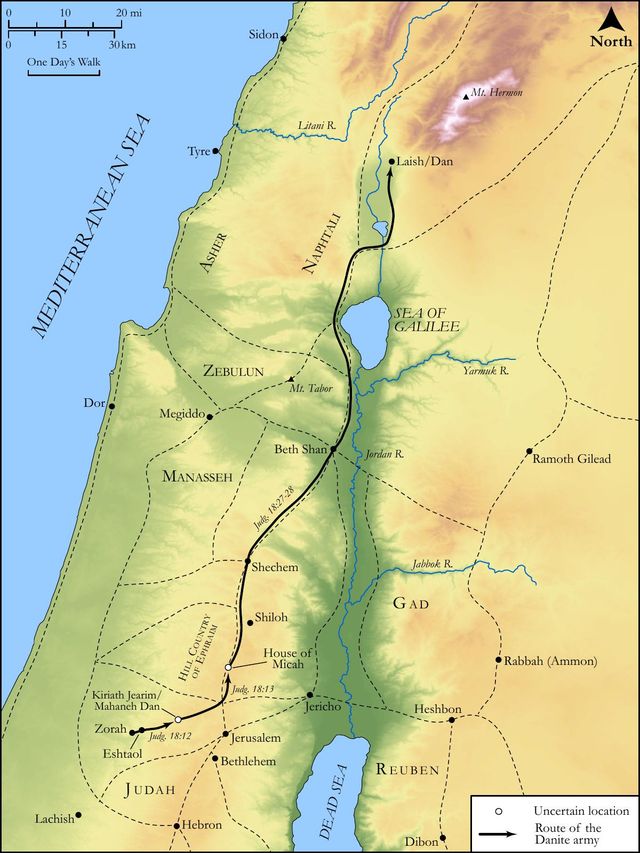
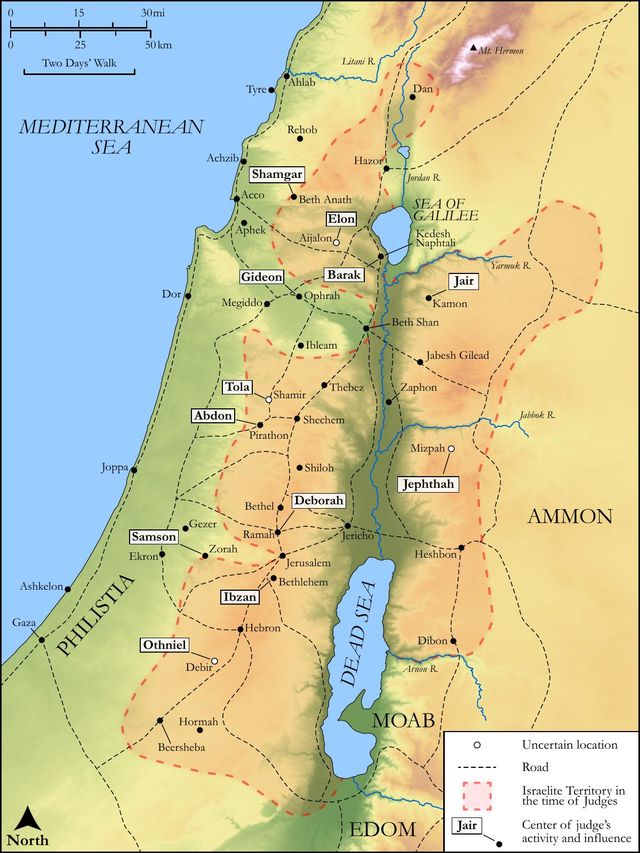
See on the biblical-era maps
Study this verse
Public-domain commentary
Matthew Henry
From his Commentary on the Whole Bible. Henry comments on passages, not single verses — this entry covers Judges 18:27–31. His two-level outline is real structure in the source text, so it is rendered as structure.
Here is, I. Laish conquered by the Danites. They proceeded on their march, and, because they met with no disaster, perhaps concluded they had not done amiss in robbing Micah. Many justify themselves in their impiety by their prosperity. Observe, 1. What posture they found the people of Laish in, both those of the city and those of the country about. They were quiet and secure, not jealous of the five spies that had been among them to search out the land, nor had they any intelligence of the approach of this enemy, which made them a very easy prey to this little handful of men that came upon them, Jdg 18:27. Note, Many are brought to destruction by their security. Satan gets advantage against us when we are careless and off our watch. Happy therefore is the man that feareth always. 2. What a complete victory they obtained over them: They put all the people to the sword, and burnt down so much of the city as they thought fit to rebuild (Jdg 18:27, Jdg 18:28), and, for aught that appears, herein they met with no resistance; for the measure of the iniquity of the Canaanites was full, that of the Danites was but beginning to fill. 3. How the conquerors settled themselves in their room, Jdg 18:28, Jdg 18:29. They built the city, or much of it, anew (the old buildings having gone to decay), and called the name of it Dan, to be a witness for them that, though separated so far off from their brethren, they were nevertheless Danites by birth, which might hereafter, by reason of their distance, be called in question. We should feel concerned not to lose the privilege of our relation to God's Israel, and therefore should take all occasions to own it and preserve the remembrance of it to ours after us.
II.Idolatry immediately set up there.
God had graciously performed his promise, in putting them in possession of that which fell to their lot, obliging them thereby to be faithful to him who had been so to them. They inherited the labour of the people, that they might observe his statues, Psa 105:44, Psa 105:45. But the first thing they do after they are settled is to break his statues. As soon as they began to settle themselves they set up the graven image (Jdg 18:30), perversely attributing their success to that idol which, if God had not been infinitely patient, would have been their ruin. Thus a prosperous idolater goes on to offend, imputing this his power unto his god, Hab 1:11. Their Levite, who officiated as priest, is at length named here - Jonathan, the son of Gershom, the son of Manasseh. The word Manasseh, in the original, has the letter n, set over the head, which, some of the Jewish rabbin say, is an intimation that it should be left out, and then Manasseh will be Moses, and this Levite, they say, was grandson to the famous Moses, who indeed had a son named Gershom; but, say they, the historian, in honour of Moses, by a half interposition of that letter, turned the name into Manasseh. The vulgar Latin reads it Moses. And if indeed Moses had a grandson that was rakish, and was picked up as a fit tool to be made use of in the setting up of idolatry, it is not the only instance (would to God it were!) of the unhappy degenerating of the posterity of great and good men. Children's children are not always the crown of old men. But the learned bishop Patrick takes this to be an idle conceit of the rabbin, and supposes this Jonathan to be of some other family of the Levites. How long these corruptions continued we are told in the close.
1.That the posterity of this Jonathan continued to act as priests to this family of Dan that was seated at Laish, and in the country about, till the captivity, Jdg 18:30. After Micah's image was removed this family retained the character of priests, and had respect paid them as such by that city, and it is very probable that Jeroboam had an eye to them when he set up one of his calves there (which they could welcome at Can, and put some reputation upon, when the priests of the Lord would have nothing to do with them), and that this family officiated as some of his priests.
2.That these images continued till Samuel's time, for so long the ark of God was at Shiloh; and it is probable that in him time effectual care was taken to suppress and abolish this idolatry. See how dangerous it is to admit an infection, for spiritual distempers are not so soon cured as caught.
Continue studying Judges 18:31 across the web’s major study libraries — every link below opens this exact verse, chapter, or book on the destination site.
Read & Compare
 BibleGatewayThis verse in more than 200 translations and 70 languages.
 Bible.comThe YouVersion reader — hundreds of translations, reading plans, and highlights.
 ESV.orgCrossway's official English Standard Version reader.
 NET BibleThe NET translation with 60,000+ translators' notes on every rendering decision.
 STEP BibleTyndale House's free study tool — original text, vocabulary, and scholarly resources.
 BibliaLogos Bible Software's free web reader.
 USCCBThe New American Bible (Revised Edition) with the U.S. bishops' study notes.
Commentaries
 BibleHub CommentariesDozens of classic commentaries on this verse, gathered on one page.
 StudyLightMore than 100 commentary sets — the largest collection on the web.
 BibleRefPlain-English commentary on what this verse means, verse by verse.
 Enduring WordDavid Guzik's free commentary on this chapter, widely used by Bible teachers.
 Bible Study ToolsVerse commentary alongside Greek and Hebrew study aids.
Original Language & Research
- BibleHub InterlinearThe verse word by word — original language, transliteration, and English.
- BibleHub LexiconEvery word's original-language definition and Strong's entry.
 Blue Letter BibleDeep-study tools — Strong's numbers, concordance, and word studies.
 SefariaThe Hebrew text with Rashi and centuries of Jewish commentary.
Sermons, Hymns & Audio


TrulyRandomVerse is not affiliated with these sites and doesn’t control their content. They’re linked because they’re genuinely useful.
Summary
Judges 18:31 serves as a somber concluding statement to the Danite migration narrative, encapsulating the profound spiritual decay characteristic of the Judges period. It recounts how the tribe of Dan established an unauthorized and idolatrous worship center in their newly acquired northern territory, featuring Micah's graven image. This act of blatant apostasy is starkly contrasted with the concurrent presence of the legitimate "house of God," the Tabernacle, located in Shiloh, underscoring Israel's widespread departure from covenant faithfulness and the pervasive nature of syncretistic worship during this era.
Context
ShowHideLiterary Context
Judges 18:31 concludes the dramatic two-chapter narrative (Judges 17-18) detailing the rise of Micah's private shrine and its subsequent appropriation by the migrating tribe of Dan. Chapter 17 introduces Micah, an Ephraimite, who creates a graven image and hires a Levite as his personal priest, establishing a syncretistic cult. Chapter 18 then recounts the Danites' search for new territory after failing to secure their inheritance in the south. Their spies encounter Micah's shrine, and the tribe later forcibly takes his idols and persuades his priest to join them. They proceed to conquer the peaceful, unsuspecting city of Laish in the far north, renaming it Dan, and establish this illicit worship center there. Judges 18:31 acts as a final, damning summary, providing a chronological anchor by explicitly mentioning the Tabernacle's presence in Shiloh, thereby highlighting the deliberate nature of the Danites' apostasy in relation to the authorized place of worship. This narrative, along with the subsequent accounts in Judges 19-21, paints a grim picture of Israel's moral and spiritual decline, culminating in the recurring refrain that "in those days there was no king in Israel."
Historical & Cultural Context
The period of the Judges (roughly 14th-11th centuries BC) was characterized by a decentralized tribal confederacy in Israel, lacking a central human king and often a strong, unified spiritual authority. This era was marked by cycles of apostasy, oppression by foreign powers, and deliverance by divinely raised judges. The phrase "in those days there was no king in Israel; every man did that which was right in his own eyes" (Judges 17:6 and Judges 21:25) perfectly encapsulates the spiritual and social anarchy. Shiloh, located in Ephraim, was the primary cultic center for Israel during much of this period, housing the Tabernacle and the Ark of the Covenant (Joshua 18:1). It was the divinely appointed place for national worship, sacrifices, and seeking God's will, serving as the de facto spiritual capital. The Danites, originally allotted coastal territory, failed to dispossess the Philistines (Judges 1:34) and consequently sought new land, leading them to conquer Laish in the far north. Their establishment of an idolatrous shrine was a direct violation of the Mosaic Law, particularly the commandments against idolatry and for a centralized place of worship (Deuteronomy 12:5-14).
Key Themes
ShowHideThis verse powerfully underscores several critical themes within the Book of Judges and the broader Old Testament narrative. Foremost is the pervasive theme of Idolatry and Apostasy, as the Danites, a tribe of Israel, deliberately establish a man-made image for worship, directly defying God's explicit commands against graven images (Exodus 20:4-5). This act is a stark manifestation of Spiritual Decline and Anarchy, illustrating how Israel's failure to adhere to the covenant led to widespread moral and religious corruption, where individual tribes and even families acted independently of God's revealed will. The explicit mention of Shiloh highlights the Contrast with True Worship, emphasizing the difference between God's ordained sanctuary and the Danites' self-devised religion. This contrast further accentuates the Failure of Covenant Faithfulness among God's people, demonstrating their propensity to turn away from Yahweh despite His presence and provisions. The narrative implicitly warns of the Consequences of Disobedience, as such widespread idolatry would inevitably lead to divine judgment and national instability, contributing to the eventual downfall of the northern kingdom.
Exposition and Analysis
ShowHideKey Word Analysis
ShowHideDerived from a root meaning "to cut" or "to carve," this term refers to a sculpted or carved image, typically made of wood or stone, often overlaid with metal. In the biblical context, peçel explicitly denotes an idol, something fashioned by human hands to represent or embody a deity. The second commandment of the Decalogue strictly forbids the making and worship of such images (Exodus 20:4). The use of this term here emphasizes the direct and egregious violation of God's law by the Danites, highlighting the man-made and therefore illegitimate nature of their object of worship.
This phrase specifically refers to the Tabernacle, the portable sanctuary constructed according to divine specifications that served as the central place of worship for Israel before the building of Solomon's Temple. The word bayith means "house" or "temple," and 'ĕlôhîym refers to "God" (specifically the supreme God). Its presence in Shiloh signified God's dwelling among His people and the legitimate, divinely ordained locus of worship, sacrifice, and seeking God's will. The phrase highlights the stark contrast between the Danites' illicit, man-made cult and the true, God-sanctioned worship.
A significant Israelite city in the territory of Ephraim, Shiloh was the location where the Tabernacle and the Ark of the Covenant were stationed for much of the Judges period, serving as the spiritual capital of the tribal confederacy (Joshua 18:1). Its mention in Judges 18:31 is a crucial chronological and theological marker. It indicates that the Danites' idolatry persisted concurrently with the functioning of the legitimate national sanctuary, underscoring the severity and deliberate nature of their apostasy. Their choice to establish a rival cult was not out of ignorance or necessity, but a conscious rejection of God's revealed will and the established order of worship.
Verse Breakdown
ShowHide"And they set them up Micah's graven image"
This clause describes the active, intentional, and public establishment of an unauthorized worship center by the tribe of Dan. "They" refers to the Danites, who, having conquered Laish and renamed it Dan, immediately prioritized the installation of this idol and its associated cult, which they had forcibly taken from Micah. This act signifies their commitment to a syncretistic, man-made religion rather than the exclusive worship of Yahweh, demonstrating a profound spiritual disorientation.
"which he made"
This parenthetical phrase serves as a crucial theological commentary. It emphasizes the human origin of the idol, highlighting that it was not a divine revelation or command, but a creation of Micah, a mere man. This detail underscores the inherent futility, powerlessness, and blasphemy of worshipping an object fashioned by human hands, especially in contrast to the living God who created all things. It exposes the absurdity of their misplaced devotion.
"all the time that the house of God was in Shiloh"
This critical chronological and theological marker provides the broader context for the Danites' actions and intensifies the indictment against them. It indicates that their idolatrous worship in Dan was not an isolated incident or done in ignorance, but persisted throughout the entire period when the legitimate central sanctuary, the Tabernacle, was established and actively functioning in Shiloh. This juxtaposition reveals their deliberate choice to reject God's revealed will and His manifest presence for a self-devised form of worship, demonstrating the depth of Israel's spiritual decline during this era.
Literary Devices
ShowHideJudges 18:31 employs several potent literary devices to convey its message of spiritual decay and the tragic state of Israel. The most prominent is Irony, as a tribe of Israel, supposedly God's chosen people, establishes an idol and an illegitimate priesthood while the very "house of God" and its divinely ordained priesthood are functioning just a few days' journey away in Shiloh. This highlights the absurdity and perversity of their actions. There is also a strong element of Contrast woven throughout the verse and the preceding narrative: the peaceful, unsuspecting Laish contrasted with the aggressive, conquering Danites; the legitimate worship at Shiloh contrasted with the illicit cult at Dan; and the true God contrasted with a man-made idol. The verse also serves as a form of Foreshadowing, hinting at the persistent idolatry that would plague the northern kingdom of Israel, particularly in Dan, where Jeroboam I would later establish one of his golden calves (1 Kings 12:28-30). Finally, the entire narrative of Judges 17-18, culminating in this verse, is a powerful Exemplum or cautionary tale, illustrating the depths of moral and spiritual depravity that resulted from Israel's failure to adhere to the covenant and the recurring theme that "every man did what was right in his own eyes."
Theological and Thematic Connections
ShowHideJudges 18:31 stands as a stark theological commentary on Israel's recurring failure to uphold the covenant, particularly the foundational commands against idolatry and for exclusive worship of Yahweh. It vividly illustrates the dangers of syncretism and the human propensity to create a religion that suits personal preferences rather than adhering to God's revealed truth. The verse underscores the profound spiritual malaise of the Judges period, where the absence of strong, righteous leadership and the widespread practice of "doing what was right in one's own eyes" led to a fragmented and apostate nation. The deliberate establishment of a rival worship center, despite the concurrent presence of the legitimate Tabernacle in Shiloh, highlights a conscious rejection of God's authority and a profound misunderstanding of His holiness and exclusivity. This narrative serves as a timeless warning against spiritual compromise and the insidious nature of false worship, demonstrating how even proximity to truth does not guarantee faithfulness.
Reflection and Application
ShowHideJudges 18:31 offers a profound and sobering reflection for believers today. It serves as a powerful reminder that outward religious observance or even proximity to spiritual truth (like the Tabernacle in Shiloh) does not guarantee genuine faithfulness or prevent the insidious creep of idolatry. The Danites' actions challenge us to examine our own hearts and lives for any "graven images"—anything that subtly or overtly displaces God from His rightful, supreme position. This could manifest as an inordinate pursuit of wealth, status, comfort, personal relationships, or even self-righteousness and intellectual pride. True worship is not merely about avoiding physical idols but about the exclusive devotion of our hearts to God alone, as revealed in His Word. This verse calls for constant vigilance against spiritual compromise, syncretism (blending biblical truth with worldly values), and the temptation to create a personalized religion that caters to our desires rather than conforming to God's holy character and commands. It compels us to ask if we are truly seeking God's will or simply "doing what is right in our own eyes," even within the context of our faith.
Questions for Reflection
ShowHideFAQ
ShowHideWhy is the mention of "Shiloh" so important in this verse?
ShowHideThe mention of Shiloh is critically important because it was the divinely appointed location of the Tabernacle, the central sanctuary where God met with His people and where legitimate sacrifices and worship were offered according to the Mosaic Law. Its inclusion in Judges 18:31 highlights the profound irony and deliberate apostasy of the Danites. They chose to establish a rival, man-made worship center in Dan, despite the presence of God's true "house" nearby. This underscores their rebellion against God's revealed will and the covenant, emphasizing that their idolatry was not out of ignorance but a conscious rejection of the established order for worship (Deuteronomy 12:5-14). It signifies a deep spiritual decline where God's explicit commands were openly disregarded.
What happened to Micah's graven image and the Danite cult?
ShowHideThe text in Judges does not explicitly state the immediate fate of Micah's graven image or the Danite cult after the period of the Judges. However, it is understood that this idolatrous worship continued in the city of Dan for a significant period. The city of Dan, in the far north, became a notorious center for idolatry. Later, when the kingdom divided into Israel (North) and Judah (South), Jeroboam I, the first king of the Northern Kingdom, established golden calves in Bethel and Dan as alternative worship sites to Jerusalem. His motivation was to prevent his northern subjects from returning to the legitimate worship in the south, fearing their allegiance would shift back to the Davidic dynasty (1 Kings 12:28-30). It is highly probable that Jeroboam's choice of Dan was influenced by the pre-existing idolatrous shrine established by the Danites, indicating its long-standing presence and influence as a center of illicit worship in the northern kingdom.
Christ-Centered Fulfillment
ShowHideJudges 18:31, with its stark depiction of Israel's spiritual decline and persistent idolatry, powerfully highlights humanity's desperate need for a true and faithful High Priest, a perfect King, and a new covenant. The "house of God" in Shiloh, though divinely ordained, could not ultimately prevent Israel's apostasy, demonstrating the limitations of the Old Covenant system in transforming hearts and ensuring lasting faithfulness. This narrative points forward to Jesus Christ, who is not merely a place of worship but the very presence of God among us, the true Tabernacle in whom God fully dwells. Unlike the man-made idols or the temporary sanctuary, Christ offers perfect access to God, fulfilling the law's demands and providing the only way to true worship "in spirit and truth" (John 4:23-24). He is the ultimate Lamb of God, whose single sacrifice forever atones for sin, rendering all other forms of worship and self-devised religion obsolete. In Christ, we find the end of idolatry, as He alone is worthy of all worship and allegiance (Philippians 2:9-11). The failure of the Judges era underscores the necessity of God's perfect rule, which is fully realized in the kingship of Christ, who perfectly obeys God's will and truly does what is right in God's eyes, not His own (Hebrews 4:15). He is the one who delivers us from the cycle of sin and provides the Spirit to empower genuine, heart-felt worship that honors God alone.